

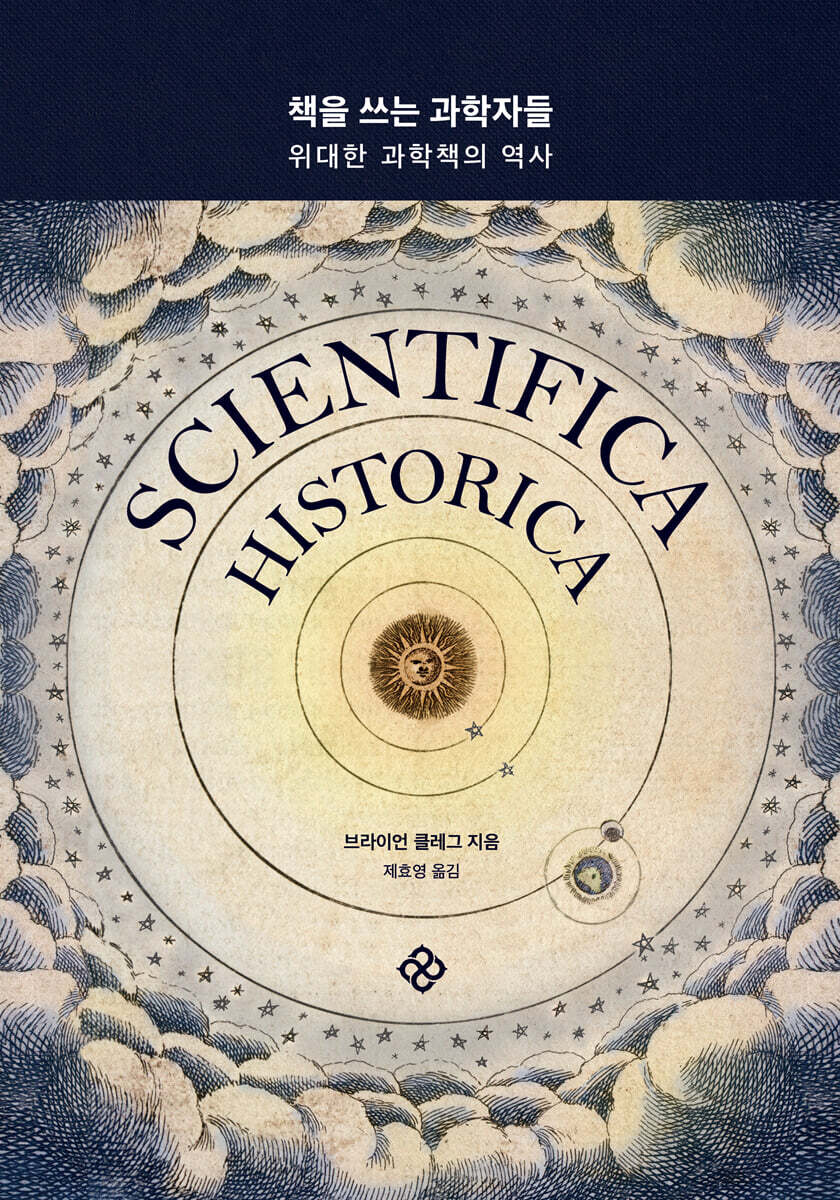
Scientists who write books
 |
Description
Book Introduction
- A word from MD
- The Latin word 'scientifca', the etymology of science, means to create knowledge.
Science has accumulated knowledge about the world.
This book introduces 150 science books that have transformed civilization from ancient times to the present.
A feast of scientific masterpieces continues, from Aristotle to Newton, Darwin, Einstein, and Hawking.
- Min-gyu Son, PD of Natural Sciences
Written by Brian Clegg, who has built a reputation by writing over 40 popular science books, this book highlights the scientific books that have had a significant impact on humanity over 2,500 years, from ancient times to the present, and the scientists who wrote them.
It examines the characteristics, historical background, position in the history of science, and limitations of these books, and aids understanding with over 280 high-resolution illustrations of the book covers, illustrations, author images, and historical materials.
This book covers the history of science books, but it goes beyond a simple chronological listing. Its concise and well-structured development and flowing narrative, demonstrating the author's accumulated expertise over many years, help readers comprehensively understand the history of science.
It examines the characteristics, historical background, position in the history of science, and limitations of these books, and aids understanding with over 280 high-resolution illustrations of the book covers, illustrations, author images, and historical materials.
This book covers the history of science books, but it goes beyond a simple chronological listing. Its concise and well-structured development and flowing narrative, demonstrating the author's accumulated expertise over many years, help readers comprehensively understand the history of science.
- You can preview some of the book's contents.
Preview
index
preface
1.
Records of the Ancient World: Laying the Foundation
2.
The Renaissance of Publishing: The Book Revolution
3.
A Classic of the Modern Age: Stability in the 19th Century
4.
A Science Book Beyond the Classics: The Upside-Down World
5.
Next Generation: The Shift in Knowledge
main
150 Great Science Books
Acknowledgements
Translator's Note
Source of the illustration
Search
1.
Records of the Ancient World: Laying the Foundation
2.
The Renaissance of Publishing: The Book Revolution
3.
A Classic of the Modern Age: Stability in the 19th Century
4.
A Science Book Beyond the Classics: The Upside-Down World
5.
Next Generation: The Shift in Knowledge
main
150 Great Science Books
Acknowledgements
Translator's Note
Source of the illustration
Search
Detailed image

Into the book
One surprising fact about the Romans is that they contributed very little to the advancement of science, but they did contribute enormously to the development of scientific books (and not just scientific books, but books in general) by first developing the codex in the first century.
The codex was a typical book as we know it today, made by binding several sheets together so that you could easily turn the pages one by one and find the part you wanted.
For science to be recorded in writing and widely disseminated through books, multiple copies had to be made, and it was much easier to make copies of codexes than of scrolls.
After the advent of the codex, the production of copies of books, mainly for religious institutions, developed into an industry.
Scientific theories also spread far beyond the places where they first appeared through books.
The art of making copies of books blossomed after its first buds with the invention of the printing press.
Writing, which had been an expensive means of communication available only to a select few, began to be used as a means of bringing science closer to the general public with the advent of printing technology.
--- p.14
Although Gilbert's book contains errors in its section on gravity, it is important as the first book to explore magnetism in scientific detail.
In "On the Magnet," Gilbert describes various experiments he conducted to explain the fact that the Earth's magnetic field affects different places on the Earth. For these experiments, he also created a spherical magnet called a "Terrella."
Gilbert's attempt provided solid support for Bacon's claim that nature could be explored through artifacts, a necessary step for the full acceptance of scientific experimentation.
Gilbert's book is considered the first truly scientific book by today's standards.
--- p.132~133
Newton intended to write the final volume of the three-volume Principia so that it could be easily read by the general public, but due to opposition from members of the Royal Society, Volume 3, like the first two volumes, ended up being a book difficult for non-scientists to understand.
Of all the topics covered in the Principia, from the concept of mass to the law of gravitation he established (though not presented in equation form as it is used today), the most outstanding is his explanation of the gravitational force we experience on the surface of the Earth as a unity with the force that causes the Earth to orbit the Sun and the Moon to orbit the Earth.
--- p.160
In 1859, perhaps the most famous science book ever published was finally published.
Charles Darwin's book, 'The Origin of Species', introduced the concept of evolution through natural selection to the public.
(…) Now that everything is known, it seems so obvious that evolution is driven by natural selection.
Anyone with a basic understanding of science and how genetic information is passed from one generation to the next can predict that offspring that are better suited to their environment will have a greater survival advantage than those that are not.
It is also quite predictable that individuals with more advantageous genetic changes will reproduce and produce offspring, and that the advantageous characteristics that develop as they adapt to the environment will be passed on to the next generation.
However, in Darwin's time, this genetic knowledge did not exist, so the leap of thought was much more difficult.
--- p.206~207
One thing is clear: Silent Spring opened a new chapter in science literature.
Both the fact that the message contained in the science book sparked heated debate and the fact that the book was written by a scientist on a topic outside his own field of expertise were novel features of the science book.
Carson also demonstrated the importance of the way science books tell a story—the ability to unfold a narrative in a way that keeps the reader engaged.
Since the publication of Silent Spring, such abilities have become a must-have for any good science book.
The codex was a typical book as we know it today, made by binding several sheets together so that you could easily turn the pages one by one and find the part you wanted.
For science to be recorded in writing and widely disseminated through books, multiple copies had to be made, and it was much easier to make copies of codexes than of scrolls.
After the advent of the codex, the production of copies of books, mainly for religious institutions, developed into an industry.
Scientific theories also spread far beyond the places where they first appeared through books.
The art of making copies of books blossomed after its first buds with the invention of the printing press.
Writing, which had been an expensive means of communication available only to a select few, began to be used as a means of bringing science closer to the general public with the advent of printing technology.
--- p.14
Although Gilbert's book contains errors in its section on gravity, it is important as the first book to explore magnetism in scientific detail.
In "On the Magnet," Gilbert describes various experiments he conducted to explain the fact that the Earth's magnetic field affects different places on the Earth. For these experiments, he also created a spherical magnet called a "Terrella."
Gilbert's attempt provided solid support for Bacon's claim that nature could be explored through artifacts, a necessary step for the full acceptance of scientific experimentation.
Gilbert's book is considered the first truly scientific book by today's standards.
--- p.132~133
Newton intended to write the final volume of the three-volume Principia so that it could be easily read by the general public, but due to opposition from members of the Royal Society, Volume 3, like the first two volumes, ended up being a book difficult for non-scientists to understand.
Of all the topics covered in the Principia, from the concept of mass to the law of gravitation he established (though not presented in equation form as it is used today), the most outstanding is his explanation of the gravitational force we experience on the surface of the Earth as a unity with the force that causes the Earth to orbit the Sun and the Moon to orbit the Earth.
--- p.160
In 1859, perhaps the most famous science book ever published was finally published.
Charles Darwin's book, 'The Origin of Species', introduced the concept of evolution through natural selection to the public.
(…) Now that everything is known, it seems so obvious that evolution is driven by natural selection.
Anyone with a basic understanding of science and how genetic information is passed from one generation to the next can predict that offspring that are better suited to their environment will have a greater survival advantage than those that are not.
It is also quite predictable that individuals with more advantageous genetic changes will reproduce and produce offspring, and that the advantageous characteristics that develop as they adapt to the environment will be passed on to the next generation.
However, in Darwin's time, this genetic knowledge did not exist, so the leap of thought was much more difficult.
--- p.206~207
One thing is clear: Silent Spring opened a new chapter in science literature.
Both the fact that the message contained in the science book sparked heated debate and the fact that the book was written by a scientist on a topic outside his own field of expertise were novel features of the science book.
Carson also demonstrated the importance of the way science books tell a story—the ability to unfold a narrative in a way that keeps the reader engaged.
Since the publication of Silent Spring, such abilities have become a must-have for any good science book.
--- p.267
Publisher's Review
“If I have seen further, it is because I stood on the shoulders of giants.” ― Isaac Newton
Great giants who explored the world by lending each other their shoulders.
The 2,500-year chronology of their intellectual history, compiled through scientific books.
Archimedes, an ancient Greek mathematician and engineer, attempted to estimate the size of the universe in his book, The Sandman (3rd century BC). Since then, explorations of the universe have continued, with Copernicus proposing a cosmic structure with the sun, not the Earth, at the center in his book, On the Revolutions of the Heavenly Spheres (1543). Furthermore, Kepler established an accurate model of the universe in his book, Astronomy Newe (1609), by revealing that each planet revolves around the sun in an elliptical orbit.
The advancement of science can be said to be a long chronology, built upon layers of discoveries made through new attempts and further challenges and explorations based on these discoveries, supporting each other.
And at the center of this history of science is the 'book', a repository of ideas and discoveries.
Through books, we encounter texts written hundreds or thousands of years ago, thousands of kilometers away.
Without books, human knowledge would not have been systematically continued.
Books that enable communication across time and space are the core of what makes science exist.
In this book, author Brian Clegg fully utilizes his extensive experience and writing skills as a writer of over 40 popular science books. He follows the 2,500-year history of science books from ancient times to the present day, looking back at the characteristics, historical background, position in the history of science, and limitations of science books that had a great influence on humanity in each period.
This book is a must-read for anyone interested in science, as it goes beyond simply listing the chronology of science and provides a comprehensive understanding of the history of science through the medium of books.
It also includes over 280 high-resolution illustrations of science book covers, illustrations, author images, and historical materials to aid understanding.
It is a systematic archive whose flow can be felt even by just looking at the illustrations.
From the first scientific books to the latest modern scientific books
The groundbreaking science books that changed the world and the scientists who wrote them.
Science books can even save people's lives.
The book "The Causes, Understanding, and Prevention of Childbed Fever" (1861), written by the 19th-century Hungarian physician Ignaz Semmelweis, saved the lives of countless women giving birth.
At the time, maternal mortality rates in Europe were so high that nearly four out of ten women died during childbirth.
In this book, Semmelweis systematically explains that the reason is that doctors examine mothers without washing their hands, and he presents solid evidence that if doctors wash their hands with disinfectant, the chances of a safe delivery are much higher.
Although it was decades after his publication, maternal mortality rates dropped dramatically when his recommendations were implemented.
Semmelweis suffered from mental illness and died after receiving much criticism at the time of its publication, but his book lived on and significantly reduced maternal infection rates.
Such innovative science books directly save lives, completely change our perspective on the world, and bring about a shift in perception.
This book includes famous books that cannot be left out in the history of science, such as 『The Hippocratic Collection』, Euclid's 『Elements』, Copernicus' 『On the Revolutions of the Heavenly Spheres』, Isaac Newton's 『Principia』, Charles Darwin's 『On the Origin of Species』, James Clerk Maxwell's 『Electromagnetism』, and Richard Dawkins' 『The Selfish Gene』, as well as scientific books that have made impressive contributions in each period and accompanied the journey of mankind.
The author believes that while people today proclaim the death of books, science books have long served as a bright beacon illuminating human progress and will continue to do so in the future.
As this book traces the chronology of intellect from ancient times to the present, the author's dedication to the scientists who have driven scientific advancement and the books they have written is truly remarkable.
Translator Je Hyo-young, who translated “Scientists Who Write Books” into Korean, emphasizes the role of readers of science books, saying, “Scientific knowledge is not the exclusive property of a select few who pursue science as their profession. It is only when it flows out into the world and reaches the eyes of more people, like fresh air, that it is completed and continues to develop.”
The books contained in this book have also been in touch with readers for a long time.
Another important feature of this book is that it examines in detail what kind of science books readers wanted in each period and how scientists responded to those needs.
This book contains the great journey of scientists who write books and people who read books.
Great giants who explored the world by lending each other their shoulders.
The 2,500-year chronology of their intellectual history, compiled through scientific books.
Archimedes, an ancient Greek mathematician and engineer, attempted to estimate the size of the universe in his book, The Sandman (3rd century BC). Since then, explorations of the universe have continued, with Copernicus proposing a cosmic structure with the sun, not the Earth, at the center in his book, On the Revolutions of the Heavenly Spheres (1543). Furthermore, Kepler established an accurate model of the universe in his book, Astronomy Newe (1609), by revealing that each planet revolves around the sun in an elliptical orbit.
The advancement of science can be said to be a long chronology, built upon layers of discoveries made through new attempts and further challenges and explorations based on these discoveries, supporting each other.
And at the center of this history of science is the 'book', a repository of ideas and discoveries.
Through books, we encounter texts written hundreds or thousands of years ago, thousands of kilometers away.
Without books, human knowledge would not have been systematically continued.
Books that enable communication across time and space are the core of what makes science exist.
In this book, author Brian Clegg fully utilizes his extensive experience and writing skills as a writer of over 40 popular science books. He follows the 2,500-year history of science books from ancient times to the present day, looking back at the characteristics, historical background, position in the history of science, and limitations of science books that had a great influence on humanity in each period.
This book is a must-read for anyone interested in science, as it goes beyond simply listing the chronology of science and provides a comprehensive understanding of the history of science through the medium of books.
It also includes over 280 high-resolution illustrations of science book covers, illustrations, author images, and historical materials to aid understanding.
It is a systematic archive whose flow can be felt even by just looking at the illustrations.
From the first scientific books to the latest modern scientific books
The groundbreaking science books that changed the world and the scientists who wrote them.
Science books can even save people's lives.
The book "The Causes, Understanding, and Prevention of Childbed Fever" (1861), written by the 19th-century Hungarian physician Ignaz Semmelweis, saved the lives of countless women giving birth.
At the time, maternal mortality rates in Europe were so high that nearly four out of ten women died during childbirth.
In this book, Semmelweis systematically explains that the reason is that doctors examine mothers without washing their hands, and he presents solid evidence that if doctors wash their hands with disinfectant, the chances of a safe delivery are much higher.
Although it was decades after his publication, maternal mortality rates dropped dramatically when his recommendations were implemented.
Semmelweis suffered from mental illness and died after receiving much criticism at the time of its publication, but his book lived on and significantly reduced maternal infection rates.
Such innovative science books directly save lives, completely change our perspective on the world, and bring about a shift in perception.
This book includes famous books that cannot be left out in the history of science, such as 『The Hippocratic Collection』, Euclid's 『Elements』, Copernicus' 『On the Revolutions of the Heavenly Spheres』, Isaac Newton's 『Principia』, Charles Darwin's 『On the Origin of Species』, James Clerk Maxwell's 『Electromagnetism』, and Richard Dawkins' 『The Selfish Gene』, as well as scientific books that have made impressive contributions in each period and accompanied the journey of mankind.
The author believes that while people today proclaim the death of books, science books have long served as a bright beacon illuminating human progress and will continue to do so in the future.
As this book traces the chronology of intellect from ancient times to the present, the author's dedication to the scientists who have driven scientific advancement and the books they have written is truly remarkable.
Translator Je Hyo-young, who translated “Scientists Who Write Books” into Korean, emphasizes the role of readers of science books, saying, “Scientific knowledge is not the exclusive property of a select few who pursue science as their profession. It is only when it flows out into the world and reaches the eyes of more people, like fresh air, that it is completed and continues to develop.”
The books contained in this book have also been in touch with readers for a long time.
Another important feature of this book is that it examines in detail what kind of science books readers wanted in each period and how scientists responded to those needs.
This book contains the great journey of scientists who write books and people who read books.
GOODS SPECIFICS
- Date of issue: January 10, 2025
- Format: Hardcover book binding method guide
- Page count, weight, size: 352 pages | 714g | 152*220*30mm
- ISBN13: 9788932475332
- ISBN10: 8932475334
You may also like
카테고리
korean


korean

![GQ KOREA Mark (Monthly): December [2025]](http://librairie.coreenne.fr/cdn/shop/files/8ef265dbbfbf186523ed75ba7319009d.jpg?v=1765340328&width=3840)


