

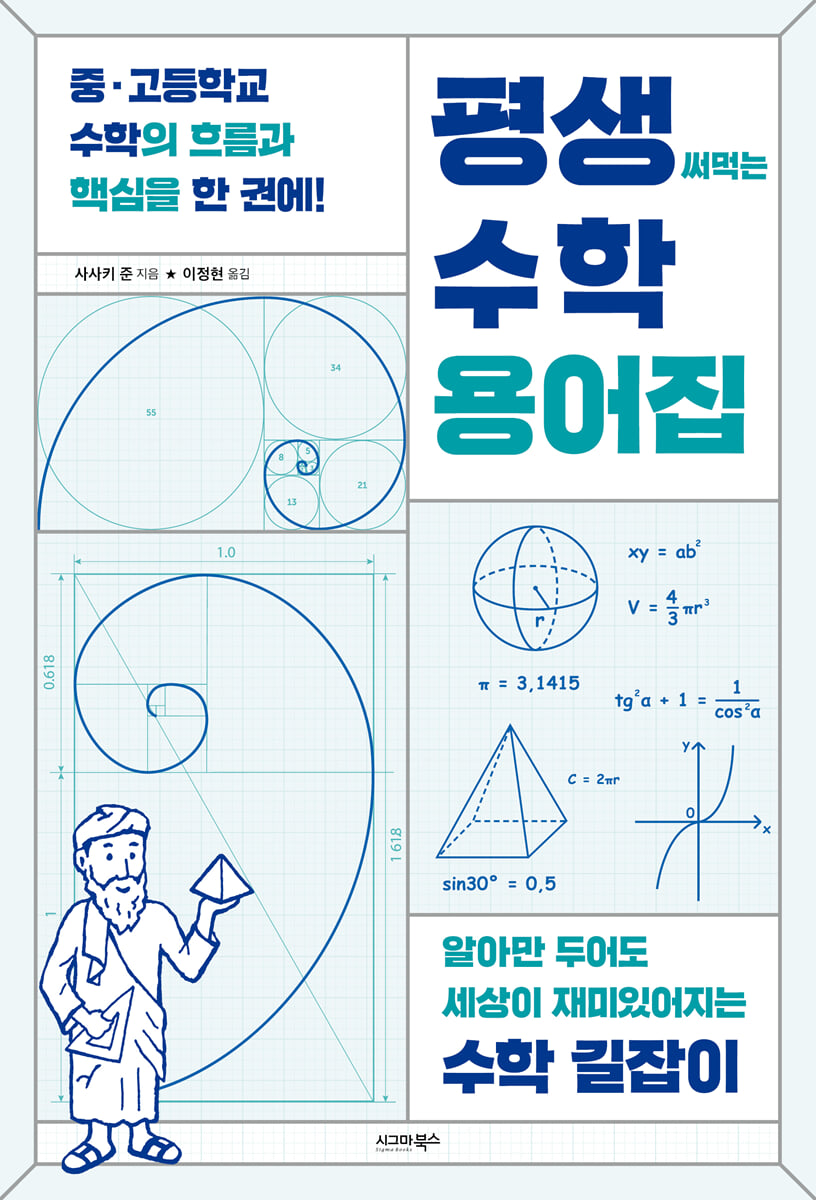
A glossary of math terms you'll use for life
 |
Description
Book Introduction
The flow and core of middle and high school mathematics in one book!
A math guide that makes the world more interesting just by knowing it.
As data science and AI advance, the number of people wanting to learn mathematics is increasing, but it's practically impossible to study the vast scope of mathematics from scratch.
This book provides a brief overview of important mathematical terms and includes various illustrations to aid understanding, allowing those who are curious to learn in a short amount of time.
You don't have to read from the first page. You can open it and read from the part that interests you, like a dictionary.
Let's understand and apply fundamental mathematical concepts in practice through this book!
A math guide that makes the world more interesting just by knowing it.
As data science and AI advance, the number of people wanting to learn mathematics is increasing, but it's practically impossible to study the vast scope of mathematics from scratch.
This book provides a brief overview of important mathematical terms and includes various illustrations to aid understanding, allowing those who are curious to learn in a short amount of time.
You don't have to read from the first page. You can open it and read from the part that interests you, like a dictionary.
Let's understand and apply fundamental mathematical concepts in practice through this book!
- You can preview some of the book's contents.
Preview
index
To begin with
Chapter 1.
Math terms that appear on university entrance exams
01 Divisors, common divisors, greatest common divisor
02 Prime numbers
03 Sieve of Eratosthenes
04 Coprime, irreducible fraction
05 Perfect Numbers
06 Partial Fraction Decomposition
07 Pi
Column: Pi Problem on the University of Tokyo Entrance Exam
08 Sexagesimal, Degrees and Radians
09 Rotating body with difficult name
Chapter 2.
Mathematical terms related to roots
01 Definition of square root
02 Rationalization of the denominator
03 Golden ratio and diamond ratio
04 Pythagorean theorem
05 Pythagorean Triplets
06 Taxi number and Ramanujan
Chapter 3.
Mathematical terms related to numbers and formulas
01 Definition, theorem, formula, proposition
02 Associative law, commutative law, distributive law
03 Absolute value
04 Gaussian symbol
05 Set
06 Power, exponent, degree, power, ascending, descending
07 Necessary conditions, sufficient conditions, necessary and sufficient conditions
08 Converse, Converse, and Contradictory of Proposition
Chapter 4.
Mathematical terms related to equations
01 Equations and Identities
02 Inequalities and absolute inequalities
03 Arithmetic mean-geometric mean inequality
04 Factorization
05 Password
06 Root formula, discriminant, conjugate
Chapter 5.
Mathematical terms related to functions
01 Coordinate plane (Cartesian plane)
02 Function
03 One-on-one correspondence
04 Linear Function
05 Linear domain and linear programming
06 Quadratic function
07 Square Completion, Square Expression, Perfect Square Expression
08 Convex upwards, convex downwards
Column: Shouldn't we use concavity in mathematics?
09 Formula for the distance between a point and a straight line
10 Power and Exponential Functions
11 log(log, ln)
12 Trigonometric ratios (sinθ, cosθ, tanθ)
13 Definition of trigonometric functions (sinx, cosx, tanx)
14 Addition Theorem
15 Composition of trigonometric functions
Chapter 6.
Mathematical terms related to complex numbers
01 Imaginary numbers, pure imaginary numbers, and complex numbers
02 Complex plane (Gaussian plane)
03 Product of Complex Numbers and De Moivre's Theorem
04 Assembly method
05 Napier's number, Euler's formula, Euler's equation
Column: What role do invisible complex numbers play?
Chapter 7.
Mathematical terms related to sequences
01 Arithmetic sequence
02 Geometric sequence
03 Σ symbol and Π symbol
04 Ignition
05 Fibonacci sequence
06 General term of the difference sequence
07 Deductive and Inductive Methods
Chapter 8.
Mathematical terms related to probability
01 Terms related to probability
02 Law of Large Numbers
03 Permutations (P) and Factorials (!)
04 Permutations and combinations containing the same (C)
05 Repeated permutations (Π) and repeated combinations (H)
06 Complete permutations and Montmorency numbers
07 Conditional probability
08 Bayes' Theorem
Chapter 9.
Mathematical terms related to statistics
01 Descriptive and Inferential Statistics
02 scale
03 Bar graphs and line graphs
04 Representative value
05 Mean, Median, Mode
06 Variance and standard deviation
07 Standardization and Deviation Values, Standard Score
08 Academic Achievement Score
09 Random Variables and Probability Distributions
10 Expected value (mean)
11 Bernoulli Trials and the Binomial Distribution
12 Poisson distribution
13 Normal distribution
14 Scatterplot and Correlation Coefficient
15-point estimation and interval estimation
16 Hypothesis Testing
Chapter 10.
Mathematical terms related to calculus
01 Limit of a function
02 Average rate of change, instantaneous rate of change, differential coefficient, derivative
03 Differentiation
04 Extreme value
05 Convex upward, convex downward and inflection point
06 Tangent, normal
07 Integration
08 Relationship between Differentiation and Integration
09 Distinction method
10 Fundamental Theorem of Calculus
11 Primitive functions and indefinite integrals
Chapter 11.
Mathematical terms related to vectors
01 Vectors and Scalars
02 Position vector and vector components
03 Primary Independence and Primary Dependence
04 Dot product of vectors
Chapter 12.
Mathematical terms related to shapes
01 Misalignment of triangles
02 Internal and external division points and the circle of Apollonius
03 Theorem of the central angle, Thales' theorem, and tangent theorem
04 Menelaus's theorem and Cheba's theorem
05 Law of Sines, Law of Cosines
06 Ptolemy's Theorem
07 Radius of the inscribed circle
08 Heron's Formula and Brahmagupta's Formula
Search
Chapter 1.
Math terms that appear on university entrance exams
01 Divisors, common divisors, greatest common divisor
02 Prime numbers
03 Sieve of Eratosthenes
04 Coprime, irreducible fraction
05 Perfect Numbers
06 Partial Fraction Decomposition
07 Pi
Column: Pi Problem on the University of Tokyo Entrance Exam
08 Sexagesimal, Degrees and Radians
09 Rotating body with difficult name
Chapter 2.
Mathematical terms related to roots
01 Definition of square root
02 Rationalization of the denominator
03 Golden ratio and diamond ratio
04 Pythagorean theorem
05 Pythagorean Triplets
06 Taxi number and Ramanujan
Chapter 3.
Mathematical terms related to numbers and formulas
01 Definition, theorem, formula, proposition
02 Associative law, commutative law, distributive law
03 Absolute value
04 Gaussian symbol
05 Set
06 Power, exponent, degree, power, ascending, descending
07 Necessary conditions, sufficient conditions, necessary and sufficient conditions
08 Converse, Converse, and Contradictory of Proposition
Chapter 4.
Mathematical terms related to equations
01 Equations and Identities
02 Inequalities and absolute inequalities
03 Arithmetic mean-geometric mean inequality
04 Factorization
05 Password
06 Root formula, discriminant, conjugate
Chapter 5.
Mathematical terms related to functions
01 Coordinate plane (Cartesian plane)
02 Function
03 One-on-one correspondence
04 Linear Function
05 Linear domain and linear programming
06 Quadratic function
07 Square Completion, Square Expression, Perfect Square Expression
08 Convex upwards, convex downwards
Column: Shouldn't we use concavity in mathematics?
09 Formula for the distance between a point and a straight line
10 Power and Exponential Functions
11 log(log, ln)
12 Trigonometric ratios (sinθ, cosθ, tanθ)
13 Definition of trigonometric functions (sinx, cosx, tanx)
14 Addition Theorem
15 Composition of trigonometric functions
Chapter 6.
Mathematical terms related to complex numbers
01 Imaginary numbers, pure imaginary numbers, and complex numbers
02 Complex plane (Gaussian plane)
03 Product of Complex Numbers and De Moivre's Theorem
04 Assembly method
05 Napier's number, Euler's formula, Euler's equation
Column: What role do invisible complex numbers play?
Chapter 7.
Mathematical terms related to sequences
01 Arithmetic sequence
02 Geometric sequence
03 Σ symbol and Π symbol
04 Ignition
05 Fibonacci sequence
06 General term of the difference sequence
07 Deductive and Inductive Methods
Chapter 8.
Mathematical terms related to probability
01 Terms related to probability
02 Law of Large Numbers
03 Permutations (P) and Factorials (!)
04 Permutations and combinations containing the same (C)
05 Repeated permutations (Π) and repeated combinations (H)
06 Complete permutations and Montmorency numbers
07 Conditional probability
08 Bayes' Theorem
Chapter 9.
Mathematical terms related to statistics
01 Descriptive and Inferential Statistics
02 scale
03 Bar graphs and line graphs
04 Representative value
05 Mean, Median, Mode
06 Variance and standard deviation
07 Standardization and Deviation Values, Standard Score
08 Academic Achievement Score
09 Random Variables and Probability Distributions
10 Expected value (mean)
11 Bernoulli Trials and the Binomial Distribution
12 Poisson distribution
13 Normal distribution
14 Scatterplot and Correlation Coefficient
15-point estimation and interval estimation
16 Hypothesis Testing
Chapter 10.
Mathematical terms related to calculus
01 Limit of a function
02 Average rate of change, instantaneous rate of change, differential coefficient, derivative
03 Differentiation
04 Extreme value
05 Convex upward, convex downward and inflection point
06 Tangent, normal
07 Integration
08 Relationship between Differentiation and Integration
09 Distinction method
10 Fundamental Theorem of Calculus
11 Primitive functions and indefinite integrals
Chapter 11.
Mathematical terms related to vectors
01 Vectors and Scalars
02 Position vector and vector components
03 Primary Independence and Primary Dependence
04 Dot product of vectors
Chapter 12.
Mathematical terms related to shapes
01 Misalignment of triangles
02 Internal and external division points and the circle of Apollonius
03 Theorem of the central angle, Thales' theorem, and tangent theorem
04 Menelaus's theorem and Cheba's theorem
05 Law of Sines, Law of Cosines
06 Ptolemy's Theorem
07 Radius of the inscribed circle
08 Heron's Formula and Brahmagupta's Formula
Search
Detailed image

Into the book
It is known that the name perfect number was given by Pythagoras, who said that 'the origin of all things is number'.
The perfect numbers discovered in ancient Greece are 6, 28, 496, and 8128.
All of the perfect numbers given as examples so far are even numbers.
It is not yet known whether there are odd perfect numbers.
It is also not clear whether the number of perfect numbers is infinite or finite.
Although the definition of a perfect number is simple, there are still many unresolved problems related to perfect numbers.
--- 「Chapter 1 '05.
From "Perfect Number"
After middle school math, the need to find specific numbers decreases because letters are used more frequently, but it is very important to calculate the final equation to find specific numbers.
That is why we rationalize the denominator to find a specific number.
Conversely, if you don't need to know the specific number, you don't need to rationalize the denominator.
When teaching students, they sometimes ask, “Why don’t you rationalize the denominator this time?” Remember that when solving problems that don’t require identifying specific numbers, you don’t need to rationalize the denominator.
--- 「Chapter 2 '02.
From "The Rationalization of the Denominator"
Something that is accepted as true regardless of the reason is called an axiom.
It can be understood that a theory is accepted as true even without the assumptions that form the theory's premise or without proof.
For example, 'No matter how large the natural number n is, there exists a natural number next to it, n+1', is also an axiom.
--- 「Chapter 3 '01.
From "Definition, Theorem, Formula, Proposition"
The meaning of the formula for the roots of a quadratic equation is that it guarantees that 'a quadratic equation must have a solution and that its value can be specifically found', including imaginary numbers that will be discussed later.
In general, in mathematics, you cannot tell whether a problem is solvable or not.
However, since there is a formula for the roots of a quadratic equation, we can see that it can definitely be solved.
When you study mathematics in college, you are introduced to the concepts of 'existence' and 'uniqueness'.
In other words, what is important is whether the solution exists (existence) and whether there is only one solution obtained regardless of the method used (uniqueness).
The ‘root formula of a quadratic equation’ contains both the important concepts of ‘existence’ and ‘uniqueness’.
--- 「Chapter 4 '06.
From "Root formula, discriminant, and conjugate"
It was thanks to a 'bug' that Descartes was able to come up with the concept of a coordinate plane.
One day, Descartes woke up and saw a bug on the ceiling. He wondered how he could properly convey the bug's location to his friend.
And I thought the other person would understand if I said that there was a bug at the 4th position to the right of the corner and 3rd position above.
--- 「Chapter 5 '01.
From "Coordinate Plane (Cartesian Plane)"
Deductive reasoning is a method of deriving a conclusion by using premises or general laws and specific facts.
A representative example is the syllogism.
For example, let's say the premise or general law is 'Humans (B) will die someday (C).'
If the concrete fact is 'Socrates (A) is human (B),' then the conclusion is 'Socrates (A) will die someday (C).'
--- 「Chapter 7 '07.
From "Deductive and Inductive Methods"
When you make a bundle by 'picking out' several objects without considering the order, each of them is called a combination.
Because the order is not taken into account, for example, the cases of picking 'A and B' and picking 'B and A' are considered the same.
In other words, 'People who like sushi are A and B' and 'People who like sushi are B and A' have the same meaning.
--- 「Chapter 8 '04.
Among the permutations and combinations (C) that include the same thing,
The importance of data is increasing day by day these days, and statistics is what helps us use data appropriately.
For example, it is difficult to understand the characteristics of numerical data, such as test scores, simply by looking at them.
So, with the given data, we can get the highest score, average score, and deviation value as needed, and make meaningful numbers to determine whether the test is passed or failed.
In other words, statistics can be seen as the process of turning simple data into valuable and meaningful information.
--- 「Chapter 9 '01.
From "Descriptive Statistics and Inferential Statistics"
The basis of differentiation is division, and the basis of division is subtraction.
That is why differentiation is useful when finding the ‘difference’.
In high school mathematics, differentiation is used to find increases and decreases and to draw graphs. This is possible because differentiation allows us to find differences.
--- 「Chapter 10 '02.
Among the average rate of change, instantaneous rate of change, differential coefficient, and derivative
In the past, trigonometric problems using inscribed quadrilaterals were frequently asked in Japanese university entrance exams.
Inscribed quadrilaterals can be used as a basic problem as well as an applied problem using auxiliary lines, so they would be an appropriate material for a test that measures a wide range of learning abilities.
However, learning the technique of utilizing auxiliary lines is not easy.
Moreover, it will feel even more difficult in situations where it is difficult to demonstrate one's usual abilities due to the tension, such as during an exam.
In such cases, we tend to resort to special tricks or techniques, and there is one theorem that is useful for applying to problems involving inscribed quadrilaterals.
This is Ptolemy's theorem.
The perfect numbers discovered in ancient Greece are 6, 28, 496, and 8128.
All of the perfect numbers given as examples so far are even numbers.
It is not yet known whether there are odd perfect numbers.
It is also not clear whether the number of perfect numbers is infinite or finite.
Although the definition of a perfect number is simple, there are still many unresolved problems related to perfect numbers.
--- 「Chapter 1 '05.
From "Perfect Number"
After middle school math, the need to find specific numbers decreases because letters are used more frequently, but it is very important to calculate the final equation to find specific numbers.
That is why we rationalize the denominator to find a specific number.
Conversely, if you don't need to know the specific number, you don't need to rationalize the denominator.
When teaching students, they sometimes ask, “Why don’t you rationalize the denominator this time?” Remember that when solving problems that don’t require identifying specific numbers, you don’t need to rationalize the denominator.
--- 「Chapter 2 '02.
From "The Rationalization of the Denominator"
Something that is accepted as true regardless of the reason is called an axiom.
It can be understood that a theory is accepted as true even without the assumptions that form the theory's premise or without proof.
For example, 'No matter how large the natural number n is, there exists a natural number next to it, n+1', is also an axiom.
--- 「Chapter 3 '01.
From "Definition, Theorem, Formula, Proposition"
The meaning of the formula for the roots of a quadratic equation is that it guarantees that 'a quadratic equation must have a solution and that its value can be specifically found', including imaginary numbers that will be discussed later.
In general, in mathematics, you cannot tell whether a problem is solvable or not.
However, since there is a formula for the roots of a quadratic equation, we can see that it can definitely be solved.
When you study mathematics in college, you are introduced to the concepts of 'existence' and 'uniqueness'.
In other words, what is important is whether the solution exists (existence) and whether there is only one solution obtained regardless of the method used (uniqueness).
The ‘root formula of a quadratic equation’ contains both the important concepts of ‘existence’ and ‘uniqueness’.
--- 「Chapter 4 '06.
From "Root formula, discriminant, and conjugate"
It was thanks to a 'bug' that Descartes was able to come up with the concept of a coordinate plane.
One day, Descartes woke up and saw a bug on the ceiling. He wondered how he could properly convey the bug's location to his friend.
And I thought the other person would understand if I said that there was a bug at the 4th position to the right of the corner and 3rd position above.
--- 「Chapter 5 '01.
From "Coordinate Plane (Cartesian Plane)"
Deductive reasoning is a method of deriving a conclusion by using premises or general laws and specific facts.
A representative example is the syllogism.
For example, let's say the premise or general law is 'Humans (B) will die someday (C).'
If the concrete fact is 'Socrates (A) is human (B),' then the conclusion is 'Socrates (A) will die someday (C).'
--- 「Chapter 7 '07.
From "Deductive and Inductive Methods"
When you make a bundle by 'picking out' several objects without considering the order, each of them is called a combination.
Because the order is not taken into account, for example, the cases of picking 'A and B' and picking 'B and A' are considered the same.
In other words, 'People who like sushi are A and B' and 'People who like sushi are B and A' have the same meaning.
--- 「Chapter 8 '04.
Among the permutations and combinations (C) that include the same thing,
The importance of data is increasing day by day these days, and statistics is what helps us use data appropriately.
For example, it is difficult to understand the characteristics of numerical data, such as test scores, simply by looking at them.
So, with the given data, we can get the highest score, average score, and deviation value as needed, and make meaningful numbers to determine whether the test is passed or failed.
In other words, statistics can be seen as the process of turning simple data into valuable and meaningful information.
--- 「Chapter 9 '01.
From "Descriptive Statistics and Inferential Statistics"
The basis of differentiation is division, and the basis of division is subtraction.
That is why differentiation is useful when finding the ‘difference’.
In high school mathematics, differentiation is used to find increases and decreases and to draw graphs. This is possible because differentiation allows us to find differences.
--- 「Chapter 10 '02.
Among the average rate of change, instantaneous rate of change, differential coefficient, and derivative
In the past, trigonometric problems using inscribed quadrilaterals were frequently asked in Japanese university entrance exams.
Inscribed quadrilaterals can be used as a basic problem as well as an applied problem using auxiliary lines, so they would be an appropriate material for a test that measures a wide range of learning abilities.
However, learning the technique of utilizing auxiliary lines is not easy.
Moreover, it will feel even more difficult in situations where it is difficult to demonstrate one's usual abilities due to the tension, such as during an exam.
In such cases, we tend to resort to special tricks or techniques, and there is one theorem that is useful for applying to problems involving inscribed quadrilaterals.
This is Ptolemy's theorem.
--- 「Chapter 12 '06.
From "Ptolemy's Theorem"
From "Ptolemy's Theorem"
Publisher's Review
Even if you don't want to admit it, even if you try hard to ignore it
We need math
The new word 'math giver' has now become a common word, so there are quite a few people who find math difficult and give up.
You probably remember the sight of many of your friends lying face down on their desks and escaping into dreamland during math class during your school days.
According to statistics, the percentage of high school seniors in Korea who did not meet basic math skills in 2023 was 16.6%.
One out of six high school sophomores is a failure.
But even if we don't want to admit it, even if we try hard to ignore it, mathematics is very closely connected to our daily lives.
At the heart of ever-evolving technologies, such as data science and AI, which have recently been in the spotlight, lies the fundamental discipline of mathematics.
Is that all?
Whether it's the smartphone and A4 paper on my desk right now, when I order from a waiter at a restaurant, or when I try to divide 11 apples among three people, we are utilizing the laws of mathematics.
You just don't notice it.
Many people think that math is just a means to get into a good university and get a good job.
However, mathematics is necessary to logically understand the laws and principles that operate in our daily lives, and mathematics is also necessary to keep up with the ever-changing times.
This is why we should not completely abandon mathematics, even if it is insufficient and loose.
Mathematics is a window to a wider world.
Build your math foundation with 103 themes!
A minimal dictionary of mathematical terms that even a beginner can understand.
"A Lifelong Math Glossary" is a must-read for anyone who wants to become familiar with mathematics but is unsure of where to start or how to approach it.
The scope of middle and high school mathematics is so vast that it would take a considerable amount of time to study it from scratch.
This book is a 'minimal dictionary of mathematical terms' that provides a rough explanation of important mathematical terms and includes various illustrations to aid understanding, so that people who want to study mathematics can learn about things they are curious about in a short amount of time without facing such difficulties.
This book contains a total of 103 themes spread across 12 chapters.
From pi to roots, squares, equations and inequalities, functions, probability, calculus, vectors and shapes, the core of important terms in mathematics are explained 'roughly', and it is organized so that middle and high school mathematics courses can be quickly and efficiently digested centered on terms.
This book is a dictionary, so you don't have to read it from the first page.
By referring to the table of contents and index, you can gradually build your basic mathematical skills by starting with the section that you think is most necessary for you.
And if you have a rough understanding, I recommend that you try to apply it in practice.
Perhaps the most important thing to relearn when studying math is not perfectionism, which requires trying to cram all the concepts into your head from the beginning, but rather flexibility, which allows you to be 'okay even if it's not enough or if it's lax.'
Let's keep the "Lifelong Math Glossary" by our side and steadily become familiar with math, even if we are not very good at it.
As you master the mathematical terms one by one and draw your own rough mathematical map, there will come a shining moment when mathematics becomes a decisive help in your life!
We need math
The new word 'math giver' has now become a common word, so there are quite a few people who find math difficult and give up.
You probably remember the sight of many of your friends lying face down on their desks and escaping into dreamland during math class during your school days.
According to statistics, the percentage of high school seniors in Korea who did not meet basic math skills in 2023 was 16.6%.
One out of six high school sophomores is a failure.
But even if we don't want to admit it, even if we try hard to ignore it, mathematics is very closely connected to our daily lives.
At the heart of ever-evolving technologies, such as data science and AI, which have recently been in the spotlight, lies the fundamental discipline of mathematics.
Is that all?
Whether it's the smartphone and A4 paper on my desk right now, when I order from a waiter at a restaurant, or when I try to divide 11 apples among three people, we are utilizing the laws of mathematics.
You just don't notice it.
Many people think that math is just a means to get into a good university and get a good job.
However, mathematics is necessary to logically understand the laws and principles that operate in our daily lives, and mathematics is also necessary to keep up with the ever-changing times.
This is why we should not completely abandon mathematics, even if it is insufficient and loose.
Mathematics is a window to a wider world.
Build your math foundation with 103 themes!
A minimal dictionary of mathematical terms that even a beginner can understand.
"A Lifelong Math Glossary" is a must-read for anyone who wants to become familiar with mathematics but is unsure of where to start or how to approach it.
The scope of middle and high school mathematics is so vast that it would take a considerable amount of time to study it from scratch.
This book is a 'minimal dictionary of mathematical terms' that provides a rough explanation of important mathematical terms and includes various illustrations to aid understanding, so that people who want to study mathematics can learn about things they are curious about in a short amount of time without facing such difficulties.
This book contains a total of 103 themes spread across 12 chapters.
From pi to roots, squares, equations and inequalities, functions, probability, calculus, vectors and shapes, the core of important terms in mathematics are explained 'roughly', and it is organized so that middle and high school mathematics courses can be quickly and efficiently digested centered on terms.
This book is a dictionary, so you don't have to read it from the first page.
By referring to the table of contents and index, you can gradually build your basic mathematical skills by starting with the section that you think is most necessary for you.
And if you have a rough understanding, I recommend that you try to apply it in practice.
Perhaps the most important thing to relearn when studying math is not perfectionism, which requires trying to cram all the concepts into your head from the beginning, but rather flexibility, which allows you to be 'okay even if it's not enough or if it's lax.'
Let's keep the "Lifelong Math Glossary" by our side and steadily become familiar with math, even if we are not very good at it.
As you master the mathematical terms one by one and draw your own rough mathematical map, there will come a shining moment when mathematics becomes a decisive help in your life!
GOODS SPECIFICS
- Date of issue: September 4, 2024
- Page count, weight, size: 414 pages | 153*225*24mm
- ISBN13: 9791168622760
- ISBN10: 116862276X
You may also like
카테고리
korean


korean

![GQ KOREA Mark (Monthly): December [2025]](http://librairie.coreenne.fr/cdn/shop/files/8ef265dbbfbf186523ed75ba7319009d.jpg?v=1765340328&width=3840)


