

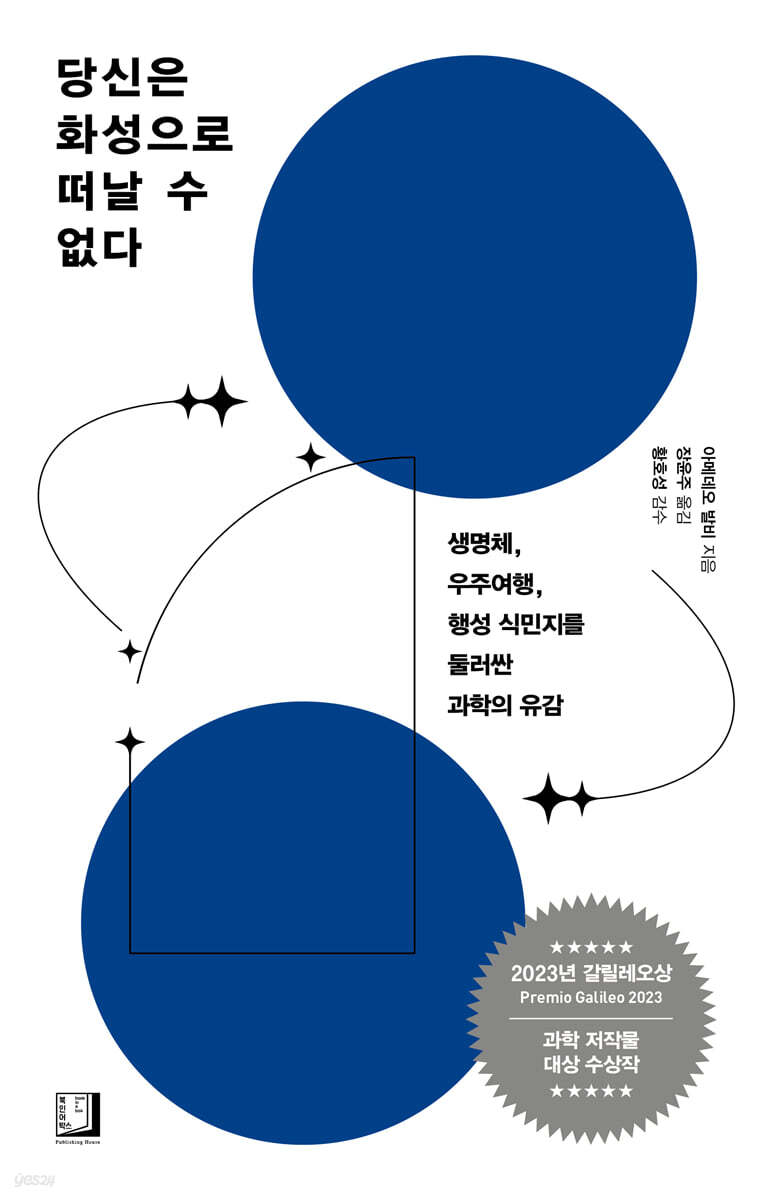
You can't leave for Mars
 |
Description
Book Introduction
“Even the progress of civilization cannot overcome the limits of physics!”
An Astrophysicist's "Real Universe" Story for Pseudo-Space Merchants
★ Winner of the 2023 Galileo Prize (Premio Galileo 2023) Scientific Writing Award
“You will be able to take a fresh look at the limits and possibilities of escaping Earth.
That limitation isn't particularly inconvenient.
It's not because our scientific capabilities are lacking, but because even this is part of the natural order.
If you're curious about Elon Musk's next move, this book has the answer." - Recommended by Professor Hwang Ho-seong (Department of Physics and Astronomy, Seoul National University)
It's like seeing the return of the 'Age of Apollo'.
Manned lunar exploration, which seemed to have disappeared after Apollo 8 in 1971, is making a spectacular comeback thanks to plans by emerging powers such as Europe and China.
But now, unlike in the past, exploration is planned with the purpose of living on the moon, rather than as a one-time event where we 'stop by and come back'.
Ambitious private space companies like SpaceX are promising to build cities beyond the moon and on Mars within this century, and every media outlet—from dramas and movies to documentaries and news—is presenting this blueprint as if it will soon become reality.
So, will we really see all these sights in our lifetime? Or will they be realized in the next generation?
"You Can't Go to Mars" is a book that explores humanity's dream of "migrating to space" and the realistic limitations that dream faces from a scientific perspective.
Renowned Italian astrophysicist Amedeo Balbi points out that the current space exploration craze is as much about romantic dreams about the human future as it is about scientific progress, and he explores the difficulties we face when these dreams collide with real-world technological, biological, and ethical issues.
It explores the fundamental realities surrounding the movement of 'space exploration': whether establishing human colonies on other planets is possible, what technological challenges will be encountered, whether humans can adapt to new environments beyond Earth, and, above all, whether it is worth it.
Moreover, the journey into space goes beyond mere technological achievements; it also explores the conditions that humanity must meet to establish itself as a cosmic being.
The author emphasizes a more responsible approach to the future of space exploration, pointing out that “space exploration is a process of pursuing a bold dream for humanity’s future, but to realize this dream, we must apply the lessons learned from Earth and find ways to adapt to the strict order of space.”
This book will help you understand the various forms of space exploration taking place today, and furthermore, gain a new perspective on the 'blue Earth' on which we stand.
An Astrophysicist's "Real Universe" Story for Pseudo-Space Merchants
★ Winner of the 2023 Galileo Prize (Premio Galileo 2023) Scientific Writing Award
“You will be able to take a fresh look at the limits and possibilities of escaping Earth.
That limitation isn't particularly inconvenient.
It's not because our scientific capabilities are lacking, but because even this is part of the natural order.
If you're curious about Elon Musk's next move, this book has the answer." - Recommended by Professor Hwang Ho-seong (Department of Physics and Astronomy, Seoul National University)
It's like seeing the return of the 'Age of Apollo'.
Manned lunar exploration, which seemed to have disappeared after Apollo 8 in 1971, is making a spectacular comeback thanks to plans by emerging powers such as Europe and China.
But now, unlike in the past, exploration is planned with the purpose of living on the moon, rather than as a one-time event where we 'stop by and come back'.
Ambitious private space companies like SpaceX are promising to build cities beyond the moon and on Mars within this century, and every media outlet—from dramas and movies to documentaries and news—is presenting this blueprint as if it will soon become reality.
So, will we really see all these sights in our lifetime? Or will they be realized in the next generation?
"You Can't Go to Mars" is a book that explores humanity's dream of "migrating to space" and the realistic limitations that dream faces from a scientific perspective.
Renowned Italian astrophysicist Amedeo Balbi points out that the current space exploration craze is as much about romantic dreams about the human future as it is about scientific progress, and he explores the difficulties we face when these dreams collide with real-world technological, biological, and ethical issues.
It explores the fundamental realities surrounding the movement of 'space exploration': whether establishing human colonies on other planets is possible, what technological challenges will be encountered, whether humans can adapt to new environments beyond Earth, and, above all, whether it is worth it.
Moreover, the journey into space goes beyond mere technological achievements; it also explores the conditions that humanity must meet to establish itself as a cosmic being.
The author emphasizes a more responsible approach to the future of space exploration, pointing out that “space exploration is a process of pursuing a bold dream for humanity’s future, but to realize this dream, we must apply the lessons learned from Earth and find ways to adapt to the strict order of space.”
This book will help you understand the various forms of space exploration taking place today, and furthermore, gain a new perspective on the 'blue Earth' on which we stand.
- You can preview some of the book's contents.
Preview
index
Recommendation by Hwang Ho-seong (Professor, Department of Physics and Astronomy, Seoul National University)
Prologue: "What a Wonderful World"
Chapter 1: The End of the World: Asteroids, Comets, and Volcanoes
Death from the Sky | The Odds of an Asteroid Collision with Earth | Observe and Predict | Prepare for 'Impacts' | Volcanic Eruptions and Supernovae | What the Great Acceleration Means | "You Must Leave Earth to Survive"
Chapter 2: Where I Want to Go: Mars, the Moon, and Space Colonies
How to escape from Earth | A brief history of space exploration | A beautiful place, its polar opposite | Where should we (not) go? | A vast wilderness near and far | Heading back to the moon | A Mars project 'on paper' | A common way to travel to Mars | Mars is beautiful, but | Earth's South Pole also becomes a paradise there | Surviving in a sealed glass | A merchant selling space | A 'one-way' ticket to Mars | Can terraforming make Mars green? | Martian life forms that cannot be overlooked | Why we cannot leave for Mars | Space islands, space habitats | If there were an elevator to the sky | Beyond Earth
Chapter 3: Worlds Beyond the Solar System: Habitable Planets and Interstellar Travel
What 'habitable planets' say | Another Earth, Earth 2.0 | Leaving the cradle | Beyond Jupiter, the 'gravity catapult' | Realistic technology for interstellar travel | Could we reach Proxima in 20 years? | Generation spaceships, space arks | What happens when you travel at the speed of light
Epilogue technology cannot circumvent the "limits of physics."
Huzhou
Prologue: "What a Wonderful World"
Chapter 1: The End of the World: Asteroids, Comets, and Volcanoes
Death from the Sky | The Odds of an Asteroid Collision with Earth | Observe and Predict | Prepare for 'Impacts' | Volcanic Eruptions and Supernovae | What the Great Acceleration Means | "You Must Leave Earth to Survive"
Chapter 2: Where I Want to Go: Mars, the Moon, and Space Colonies
How to escape from Earth | A brief history of space exploration | A beautiful place, its polar opposite | Where should we (not) go? | A vast wilderness near and far | Heading back to the moon | A Mars project 'on paper' | A common way to travel to Mars | Mars is beautiful, but | Earth's South Pole also becomes a paradise there | Surviving in a sealed glass | A merchant selling space | A 'one-way' ticket to Mars | Can terraforming make Mars green? | Martian life forms that cannot be overlooked | Why we cannot leave for Mars | Space islands, space habitats | If there were an elevator to the sky | Beyond Earth
Chapter 3: Worlds Beyond the Solar System: Habitable Planets and Interstellar Travel
What 'habitable planets' say | Another Earth, Earth 2.0 | Leaving the cradle | Beyond Jupiter, the 'gravity catapult' | Realistic technology for interstellar travel | Could we reach Proxima in 20 years? | Generation spaceships, space arks | What happens when you travel at the speed of light
Epilogue technology cannot circumvent the "limits of physics."
Huzhou
Detailed image
.jpg)
Into the book
Yes, that's right.
The Earth is truly amazing.
So it feels like it was made just for us.
For thousands of years we have believed that.
But later science showed us that the truth was on the other side.
To be precise, we, the species, were created for the Earth.
Our species, like all other species that have appeared on Earth, was slowly formed through natural selection and was created to adapt to its given environment.
--- From "Prologue: "What a Wonderful World""
In about a billion years, the amount of energy the Earth receives from the Sun will have increased by 10 percent compared to today, and the average temperature of the Earth's surface will have reached about 50 degrees Celsius.
This will have disastrous consequences.
The oceans will evaporate, and the water vapor in the atmosphere will form an increasingly thick layer, which will in turn increase temperatures, causing more evaporation, and so on.
After a few million years, all the water on Earth's surface will evaporate into the atmosphere and eventually disperse into space.
At that point, Earth will become a barren wasteland, and the possibility of complex life forms surviving will be virtually eliminated.
The biosphere that has surrounded the Earth for billions of years will no longer exist.
--- From "The End of the World Script"
That's why the idea of leaving Earth altogether as a plan B for the future of humanity is capturing people's hearts.
Although the number is not particularly large, there are quite a few people who are passionate about this idea, both past and present.
The most famous of these is the widely known and beloved physicist Stephen Hawking (1942-2018).
Like Reese, he was convinced that humanity had little chance of surviving beyond the centuries, and at every opportunity he argued that our species' only hope for long-term survival lay in space travel and the colonization of other planets.
--- From “You Must Leave Earth to Survive”
right.
Most people don't realize that our entire existence is protected by a thin protective shield from the hostile environment of the universe.
We live in the atmosphere, the sea we call air.
All that we call 'the world' is nothing more than a layer of gas a few tens of kilometers thick where we live from the time we are born until we die.
On the surface of the Earth, moving 100 kilometers away doesn't really change anything.
It's just a matter of seeing a nice view or going on a picnic by the sea.
But once you climb 100 kilometers up, everything is over without proper protective gear.
That is, you will face death.
--- From "A Beautiful Place, Its Opposite Space"
Mercury's proximity to the Sun makes it extremely hostile to life, and it's also extremely difficult to explore with robotic probes.
From an energy standpoint, surprisingly, it takes more energy to reach Mercury than to leave the solar system.
Mercury moves so fast that any spacecraft approaching it would have to travel at a similar speed and overcome the Sun's enormous gravity to enter orbit.
For this reason, Mercury is the planet least visited by humans among the inner planets of the solar system, and no probe has ever landed on its surface.
--- From "Where should I (not) go?"
Because the moon has almost no atmosphere, its surface temperature varies greatly.
When exposed to sunlight, it reaches temperatures of up to 130 degrees Celsius, and when not exposed, it drops to -170 degrees Celsius.
A lunar day, or the moon's rotation cycle, takes about 29 Earth days, and humans have to endure not only extreme temperature changes but also long, lightless nights, which is a great hardship.
Although this characteristic can be inefficient when using sunlight as an energy source, it can be very useful in some areas of the lunar polar regions that are never in shade.
Also, because the Moon always has the same side facing Earth (the far side, also called the "Dark Side of the Moon," is not visible from Earth but receives the same amount of sunlight), only permanent settlements built on the visible near side can communicate directly with us (communication with the far side requires a separate lunar orbit relay satellite).
--- From "The Great Wilderness, Near and Far"
The Mars Project was realistic, at least on paper, and its grandeur was enough to capture the public's imagination.
His ideas received significant attention at the time through popular magazines, television programs, and even a documentary series produced by Walt Disney.
After the success of the Apollo missions, von Braun used his fame to promote the Mars program, which was aimed at implementation in the 1980s.
Later, the initial plan was revised and a proposal was made to the U.S. government to have two spacecraft each carrying six crew members.
The proposal was seriously considered by President Nixon, but was ultimately abandoned, despite von Braun's influence, in favor of the Space Shuttle program (a reusable space shuttle program that ended in 2011 after 30 years, including two major disasters that killed 14 astronauts).
--- From "The Mars Project on Paper"
One of the most efficient orbital maneuvers was developed in 1925 by German scientist Walter Hohmann (1880–1945).
He came up with the concept after reading Kurd Lasswitz's (1848-1910) science fiction novel Auf zwei Planeten (On Two Planets), published in 1897, which coincidentally dealt with Mars and the then-popular idea of intelligent life.
In any case, the so-called 'Hohmann transfer orbit' deals with how a spacecraft can maneuver from one orbit to another with minimal fuel consumption.
In principle, this maneuver requires two rocket ignitions.
The first ignition occurs when leaving the starting orbit, and the second ignition occurs when entering the destination orbit.
While on a path to change orbit, the spacecraft moves by inertia and does not consume fuel in the process.
--- From "Common Travel Methods to Mars"
One thing to remember is that the flight dynamics of a Mars rover require much more sophisticated technology than a lunar rover.
For example, as distance from Earth increases, real-time communication gradually becomes less efficient and two-way electromagnetic signal delay increases.
When Earth and Mars are closest, light takes about 4 minutes to travel between them, but when they are farthest away, it takes about 24 minutes.
Therefore, in the event of an emergency, astronauts are virtually unable to receive assistance from Earth's technical staff.
Additionally, since the spacecraft accelerates at high speed after ignition to leave low Earth orbit, it is difficult to perform corrective maneuvers if a problem occurs.
In this situation, it is very difficult to turn back.
If something similar to the Apollo 13 accident were to happen on a spacecraft bound for Mars, it would be a far more tragic situation.
--- From "A Common Journey to Mars"
The spectacular Martian landscapes captured by robotic rovers over the past few decades may at first glance appear not so different from exotic places on Earth.
So, for those who dream of adventure, it might be tempting to board the first spaceship with a backpack and sunglasses on.
But the real situation is very different.
After a dangerous and arduous journey, humans who arrive on Mars will face a harsh environment incomparable to any desolate and barren place on Earth.
In effect, you will have to minimize outdoor activities and spend most of your time in artificial spaces isolated from the outside environment, such as underground.
--- From "Mars is Beautiful, But"
Biosphere 2 is designed like a giant terrarium.
It was the most artificial Martian (or extraterrestrial) ecosystem ever created among the experiments conducted up to that point.
But unfortunately, problems arose almost immediately after the start.
They planned to eat mainly vegetables, supplementing the lack of animal protein with small amounts of milk, meat, and eggs from livestock.
However, not only was growing vegetables and raising livestock much more difficult than expected, but the vegetables that were available for consumption were limited to sugar beets and potatoes, making it difficult to obtain sufficient calories and nutrients.
After a few months, oxygen levels inside the structure also began to drop to worrying levels.
As the carbon dioxide gradually accumulated, all eight participants developed symptoms of altitude sickness, including drowsiness, sluggish movements and slurred speech.
As many of the animals that had entered together died, species with strong survival instincts such as cockroaches and ants began to fill the entire Biosphere 2.
In addition, frequent conflicts arose over operations and management, and interpersonal problems arose among participants.
--- From "Survival in a Sealed Glass"
You might wonder why Musk's plans are so grand.
Why would they devise such a complex plan to relocate such a large group of people, rather than a simple mission involving just a few people? The reason is simple.
Because his plan is an economic strategy, not a scientific or engineering plan.
In fact, he has no concrete plans for how to solve the problems of space travel and the enormous difficulties of survival on Mars.
For Musk, ensuring the financial sustainability of his business is his only concern.
Musk predicts that as the price of tickets to Mars becomes cheaper, more people will want to board the spacecraft.
Therefore, it is advantageous to focus technological capabilities on lowering ticket prices.
That's why SpaceX is more interested in spaceships than survival on a Martian colony.
--- From "One-Way Ticket to Mars"
In theory, the process of making Mars habitable again might seem simple.
That is, by supplying greenhouse gases into the atmosphere, we can change the situation by increasing the pressure and temperature at the surface and melting the soil and polar ice.
This scenario suggests that a denser atmosphere and abundant water (even if it is difficult to breathe) will be created, and that by introducing photosynthetic organisms, including plants, which will emit oxygen, an environment conducive to human habitation will be created.
It seems so simple when explained like this, it makes you wonder why we don't already have a second blue planet in our solar system.
--- From "Terraforming, Can Mars Become Blue?"
It is difficult to predict an uncertain future.
What was impossible in a few years may become possible in hundreds of years.
But no matter what point you imagine, you must remember one simple fact:
Mars cannot be a replacement for Earth today.
It may not seem like it, but the Martian environment is just as hostile as the Moon.
Moreover, compared to the Moon, there are few advantages to settling on Mars.
The moon is a bit easier to get to.
To be blunt, people (including scientists and experts) cannot offer a single valid reason why we should leave Earth and go live on Mars.
--- From "Why We Can't Go to Mars"
Any hypothetical plan to migrate some of humanity off Earth would face enormous complexity.
To establish a settlement on the Moon or Mars, the only two theoretically viable options, we must be able to not only maintain an independent, isolated settlement on the surface of these worlds, but also safely transport large quantities of supplies and personnel.
If so, wouldn't it be better to completely abandon plans to settle on other celestial bodies and instead create an artificial environment suitable for humans in space? If there's no alternative to living in a sealed glass tube, it makes sense to build it somewhere more convenient for us to access.
This means that it might be better to build a massive space habitat (space colony) close to Earth rather than building a domed, sealed biosphere on Mars.
--- From "Space Island, Space Residence"
Building another human settlement beyond Earth is not only a challenging task in itself, with its hostile environment, risks, and technical challenges, but also the enormous cost of construction that must be addressed.
Whether it's a massive space colony like Jeff Bezos envisions, or Elon Musk's Martian city, transporting the necessary materials beyond Earth and assembling them in orbit, on the moon, or on the surface of Mars remains a difficult concept to imagine.
This is especially true considering that with today's technology, it costs tens of thousands of dollars to move a single kilogram of material out of Earth's atmosphere.
--- From "If There Was an Elevator to Heaven"
Even if we could relocate to other parts of the solar system, the natural disasters that threaten our survival in the short to medium term (within centuries or millennia) would not disappear.
For example, collisions with asteroids or comets would remain an unresolved problem on Mars or the Moon, and could have the same impact on habitable spaces in orbit.
The best way to deal with these threats, as we have seen, is through surveillance and prevention, so that when the worst happens, we can develop solutions to minimize the damage.
All of this requires new technologies and knowledge related to space observation and exploration.
The dangers arising from human actions will not disappear or diminish with the creation of extraterrestrial colonies.
Rather, it may be the opposite.
--- From "Beyond the Earth"
In recent years, there have been several media reports about the discovery of potentially habitable planets around other stars.
The news came with the startling estimate that there could be hundreds of millions of habitable planets in our galaxy alone.
When you hear news like this, you might think that planets like Earth are incredibly common in the universe.
But to properly evaluate this and put it into context, we need to understand what astronomers often mean by the term "potentially habitable."
--- From "What the 'habitable planet' says"
The reason we seek out new exoplanets is not to live there, but to study them and learn things we don't yet know: how life began, how life is distributed across the universe, how to make Earth more habitable, and what makes a planet inhospitable.
Therefore, it is fundamentally absurd to view every newly discovered habitable planet as a twin of Earth.
Nature on a grand scale may have found a variety of solutions to foster life, and we will learn more by exploring how our Earth differs from other planets.
--- From "Another Earth, Earth 2.0"
However, we must remember that we live in a universe where order exists beyond our control.
Walt Disney's famous quote, "If you can dream it, you can do it" doesn't apply to everything.
For example, the inability to exceed the speed of light is not a temporary technological limitation, but a fact of the order of reality.
As with the law of conservation of energy, we cannot travel from one point in space to another faster than the signal of light.
These limitations have nothing to do with the stage of development of our civilization.
It is part of the very fabric of nature, and all we can do is find ingenious solutions to get the most out of it within its given limits.
The Earth is truly amazing.
So it feels like it was made just for us.
For thousands of years we have believed that.
But later science showed us that the truth was on the other side.
To be precise, we, the species, were created for the Earth.
Our species, like all other species that have appeared on Earth, was slowly formed through natural selection and was created to adapt to its given environment.
--- From "Prologue: "What a Wonderful World""
In about a billion years, the amount of energy the Earth receives from the Sun will have increased by 10 percent compared to today, and the average temperature of the Earth's surface will have reached about 50 degrees Celsius.
This will have disastrous consequences.
The oceans will evaporate, and the water vapor in the atmosphere will form an increasingly thick layer, which will in turn increase temperatures, causing more evaporation, and so on.
After a few million years, all the water on Earth's surface will evaporate into the atmosphere and eventually disperse into space.
At that point, Earth will become a barren wasteland, and the possibility of complex life forms surviving will be virtually eliminated.
The biosphere that has surrounded the Earth for billions of years will no longer exist.
--- From "The End of the World Script"
That's why the idea of leaving Earth altogether as a plan B for the future of humanity is capturing people's hearts.
Although the number is not particularly large, there are quite a few people who are passionate about this idea, both past and present.
The most famous of these is the widely known and beloved physicist Stephen Hawking (1942-2018).
Like Reese, he was convinced that humanity had little chance of surviving beyond the centuries, and at every opportunity he argued that our species' only hope for long-term survival lay in space travel and the colonization of other planets.
--- From “You Must Leave Earth to Survive”
right.
Most people don't realize that our entire existence is protected by a thin protective shield from the hostile environment of the universe.
We live in the atmosphere, the sea we call air.
All that we call 'the world' is nothing more than a layer of gas a few tens of kilometers thick where we live from the time we are born until we die.
On the surface of the Earth, moving 100 kilometers away doesn't really change anything.
It's just a matter of seeing a nice view or going on a picnic by the sea.
But once you climb 100 kilometers up, everything is over without proper protective gear.
That is, you will face death.
--- From "A Beautiful Place, Its Opposite Space"
Mercury's proximity to the Sun makes it extremely hostile to life, and it's also extremely difficult to explore with robotic probes.
From an energy standpoint, surprisingly, it takes more energy to reach Mercury than to leave the solar system.
Mercury moves so fast that any spacecraft approaching it would have to travel at a similar speed and overcome the Sun's enormous gravity to enter orbit.
For this reason, Mercury is the planet least visited by humans among the inner planets of the solar system, and no probe has ever landed on its surface.
--- From "Where should I (not) go?"
Because the moon has almost no atmosphere, its surface temperature varies greatly.
When exposed to sunlight, it reaches temperatures of up to 130 degrees Celsius, and when not exposed, it drops to -170 degrees Celsius.
A lunar day, or the moon's rotation cycle, takes about 29 Earth days, and humans have to endure not only extreme temperature changes but also long, lightless nights, which is a great hardship.
Although this characteristic can be inefficient when using sunlight as an energy source, it can be very useful in some areas of the lunar polar regions that are never in shade.
Also, because the Moon always has the same side facing Earth (the far side, also called the "Dark Side of the Moon," is not visible from Earth but receives the same amount of sunlight), only permanent settlements built on the visible near side can communicate directly with us (communication with the far side requires a separate lunar orbit relay satellite).
--- From "The Great Wilderness, Near and Far"
The Mars Project was realistic, at least on paper, and its grandeur was enough to capture the public's imagination.
His ideas received significant attention at the time through popular magazines, television programs, and even a documentary series produced by Walt Disney.
After the success of the Apollo missions, von Braun used his fame to promote the Mars program, which was aimed at implementation in the 1980s.
Later, the initial plan was revised and a proposal was made to the U.S. government to have two spacecraft each carrying six crew members.
The proposal was seriously considered by President Nixon, but was ultimately abandoned, despite von Braun's influence, in favor of the Space Shuttle program (a reusable space shuttle program that ended in 2011 after 30 years, including two major disasters that killed 14 astronauts).
--- From "The Mars Project on Paper"
One of the most efficient orbital maneuvers was developed in 1925 by German scientist Walter Hohmann (1880–1945).
He came up with the concept after reading Kurd Lasswitz's (1848-1910) science fiction novel Auf zwei Planeten (On Two Planets), published in 1897, which coincidentally dealt with Mars and the then-popular idea of intelligent life.
In any case, the so-called 'Hohmann transfer orbit' deals with how a spacecraft can maneuver from one orbit to another with minimal fuel consumption.
In principle, this maneuver requires two rocket ignitions.
The first ignition occurs when leaving the starting orbit, and the second ignition occurs when entering the destination orbit.
While on a path to change orbit, the spacecraft moves by inertia and does not consume fuel in the process.
--- From "Common Travel Methods to Mars"
One thing to remember is that the flight dynamics of a Mars rover require much more sophisticated technology than a lunar rover.
For example, as distance from Earth increases, real-time communication gradually becomes less efficient and two-way electromagnetic signal delay increases.
When Earth and Mars are closest, light takes about 4 minutes to travel between them, but when they are farthest away, it takes about 24 minutes.
Therefore, in the event of an emergency, astronauts are virtually unable to receive assistance from Earth's technical staff.
Additionally, since the spacecraft accelerates at high speed after ignition to leave low Earth orbit, it is difficult to perform corrective maneuvers if a problem occurs.
In this situation, it is very difficult to turn back.
If something similar to the Apollo 13 accident were to happen on a spacecraft bound for Mars, it would be a far more tragic situation.
--- From "A Common Journey to Mars"
The spectacular Martian landscapes captured by robotic rovers over the past few decades may at first glance appear not so different from exotic places on Earth.
So, for those who dream of adventure, it might be tempting to board the first spaceship with a backpack and sunglasses on.
But the real situation is very different.
After a dangerous and arduous journey, humans who arrive on Mars will face a harsh environment incomparable to any desolate and barren place on Earth.
In effect, you will have to minimize outdoor activities and spend most of your time in artificial spaces isolated from the outside environment, such as underground.
--- From "Mars is Beautiful, But"
Biosphere 2 is designed like a giant terrarium.
It was the most artificial Martian (or extraterrestrial) ecosystem ever created among the experiments conducted up to that point.
But unfortunately, problems arose almost immediately after the start.
They planned to eat mainly vegetables, supplementing the lack of animal protein with small amounts of milk, meat, and eggs from livestock.
However, not only was growing vegetables and raising livestock much more difficult than expected, but the vegetables that were available for consumption were limited to sugar beets and potatoes, making it difficult to obtain sufficient calories and nutrients.
After a few months, oxygen levels inside the structure also began to drop to worrying levels.
As the carbon dioxide gradually accumulated, all eight participants developed symptoms of altitude sickness, including drowsiness, sluggish movements and slurred speech.
As many of the animals that had entered together died, species with strong survival instincts such as cockroaches and ants began to fill the entire Biosphere 2.
In addition, frequent conflicts arose over operations and management, and interpersonal problems arose among participants.
--- From "Survival in a Sealed Glass"
You might wonder why Musk's plans are so grand.
Why would they devise such a complex plan to relocate such a large group of people, rather than a simple mission involving just a few people? The reason is simple.
Because his plan is an economic strategy, not a scientific or engineering plan.
In fact, he has no concrete plans for how to solve the problems of space travel and the enormous difficulties of survival on Mars.
For Musk, ensuring the financial sustainability of his business is his only concern.
Musk predicts that as the price of tickets to Mars becomes cheaper, more people will want to board the spacecraft.
Therefore, it is advantageous to focus technological capabilities on lowering ticket prices.
That's why SpaceX is more interested in spaceships than survival on a Martian colony.
--- From "One-Way Ticket to Mars"
In theory, the process of making Mars habitable again might seem simple.
That is, by supplying greenhouse gases into the atmosphere, we can change the situation by increasing the pressure and temperature at the surface and melting the soil and polar ice.
This scenario suggests that a denser atmosphere and abundant water (even if it is difficult to breathe) will be created, and that by introducing photosynthetic organisms, including plants, which will emit oxygen, an environment conducive to human habitation will be created.
It seems so simple when explained like this, it makes you wonder why we don't already have a second blue planet in our solar system.
--- From "Terraforming, Can Mars Become Blue?"
It is difficult to predict an uncertain future.
What was impossible in a few years may become possible in hundreds of years.
But no matter what point you imagine, you must remember one simple fact:
Mars cannot be a replacement for Earth today.
It may not seem like it, but the Martian environment is just as hostile as the Moon.
Moreover, compared to the Moon, there are few advantages to settling on Mars.
The moon is a bit easier to get to.
To be blunt, people (including scientists and experts) cannot offer a single valid reason why we should leave Earth and go live on Mars.
--- From "Why We Can't Go to Mars"
Any hypothetical plan to migrate some of humanity off Earth would face enormous complexity.
To establish a settlement on the Moon or Mars, the only two theoretically viable options, we must be able to not only maintain an independent, isolated settlement on the surface of these worlds, but also safely transport large quantities of supplies and personnel.
If so, wouldn't it be better to completely abandon plans to settle on other celestial bodies and instead create an artificial environment suitable for humans in space? If there's no alternative to living in a sealed glass tube, it makes sense to build it somewhere more convenient for us to access.
This means that it might be better to build a massive space habitat (space colony) close to Earth rather than building a domed, sealed biosphere on Mars.
--- From "Space Island, Space Residence"
Building another human settlement beyond Earth is not only a challenging task in itself, with its hostile environment, risks, and technical challenges, but also the enormous cost of construction that must be addressed.
Whether it's a massive space colony like Jeff Bezos envisions, or Elon Musk's Martian city, transporting the necessary materials beyond Earth and assembling them in orbit, on the moon, or on the surface of Mars remains a difficult concept to imagine.
This is especially true considering that with today's technology, it costs tens of thousands of dollars to move a single kilogram of material out of Earth's atmosphere.
--- From "If There Was an Elevator to Heaven"
Even if we could relocate to other parts of the solar system, the natural disasters that threaten our survival in the short to medium term (within centuries or millennia) would not disappear.
For example, collisions with asteroids or comets would remain an unresolved problem on Mars or the Moon, and could have the same impact on habitable spaces in orbit.
The best way to deal with these threats, as we have seen, is through surveillance and prevention, so that when the worst happens, we can develop solutions to minimize the damage.
All of this requires new technologies and knowledge related to space observation and exploration.
The dangers arising from human actions will not disappear or diminish with the creation of extraterrestrial colonies.
Rather, it may be the opposite.
--- From "Beyond the Earth"
In recent years, there have been several media reports about the discovery of potentially habitable planets around other stars.
The news came with the startling estimate that there could be hundreds of millions of habitable planets in our galaxy alone.
When you hear news like this, you might think that planets like Earth are incredibly common in the universe.
But to properly evaluate this and put it into context, we need to understand what astronomers often mean by the term "potentially habitable."
--- From "What the 'habitable planet' says"
The reason we seek out new exoplanets is not to live there, but to study them and learn things we don't yet know: how life began, how life is distributed across the universe, how to make Earth more habitable, and what makes a planet inhospitable.
Therefore, it is fundamentally absurd to view every newly discovered habitable planet as a twin of Earth.
Nature on a grand scale may have found a variety of solutions to foster life, and we will learn more by exploring how our Earth differs from other planets.
--- From "Another Earth, Earth 2.0"
However, we must remember that we live in a universe where order exists beyond our control.
Walt Disney's famous quote, "If you can dream it, you can do it" doesn't apply to everything.
For example, the inability to exceed the speed of light is not a temporary technological limitation, but a fact of the order of reality.
As with the law of conservation of energy, we cannot travel from one point in space to another faster than the signal of light.
These limitations have nothing to do with the stage of development of our civilization.
It is part of the very fabric of nature, and all we can do is find ingenious solutions to get the most out of it within its given limits.
--- From "Epilogue: Technology Cannot Bypass the 'Limits of Physics'"
Publisher's Review
“Could we become a ‘multi-planetary species’?”
Scientific, technological, and ethical barriers surrounding space development
“Starship will take humanity to Mars and ultimately lead humanity to becoming a multi-planetary species.” Elon Musk makes no secret of his firm determination to build a city of one million people on Mars whenever he gets the chance.
If one way to do that were to build a reusable spacecraft and lower the price of a ticket to under $200,000, I'm sure there would be a line of people waiting to go to Mars.
Then, he attaches great significance to each test flight and elicits enthusiastic support from the people.
But that's it.
Despite numerous test launches, Starship has never left orbit.
SpaceX has pledged to send a crewed spacecraft to Mars by 2030, but it's doubtful that a crewed spacecraft capable of carrying at least 100 people will be fully built by then.
The problem doesn't stop there.
Even if the "perfect" Starship is completed, safely sending humans to Mars, 100 times farther away than the Moon, will be even more difficult, and even if they do get there, keeping them alive will be even more difficult.
But why does Elon Musk dream such a grand, seemingly impossible dream? Will we actually reach Mars within our lifetime, as he claims? And even, is it even possible to build a city on Mars?
Amedeo Balbi, a prominent Italian astrophysicist and professor of physics at the University of Rome Tor Vergata, criticizes some space entrepreneurs for exploiting people's romantic dreams about space exploration and focusing solely on financial gain.
In "You Can't Go to Mars," the author examines the challenges faced by planetary colonization by space entrepreneurs like Elon Musk and Jeff Bezos due to various insurmountable physical conditions, and illuminates the scientific, technological, and ethical hurdles their plans face from an astrophysicist's perspective.
He points out that “we must ask fundamental questions about whether human survival on extraterrestrial planets is realistically possible with current technology,” and argues that there are barriers that cannot be overcome even with scientific advancement.
For example, it points out that we cannot reach the speed of light in terms of energy, that there is no groundbreaking means of freeing heavy masses from the bonds of gravity, and, crucially, that it is virtually impossible to take the Earth's biosphere, which has accumulated over billions of years, and move it.
Should we then abandon all of humanity's dreams of venturing beyond Earth? Even setting aside the lofty dreams of businessmen, should we dismiss as mere empty boasts the statement made by Stephen Hawking, considered one of history's greatest scientists, that "our only hope for the long-term survival of our species lies not in remaining on Earth, but in expanding into space"?
“Which is easier: terraforming Mars or solving global warming?”
Why You Can't Leave Earth and Live on Mars
What are the biggest challenges facing space exploration and Mars colonization? Professor Amedeo Balbi points out two technical challenges that are difficult to overcome.
First of all, spacecraft cannot fly in a straight line with rockets running continuously when traveling long distances, such as from Earth to Mars, because it consumes a huge amount of heat just to leave the Earth's atmosphere.
This would greatly reduce travel time, but it would be virtually impossible to carry a sufficient amount of propellant.
Therefore, the spacecraft must use the gravity between the planets to achieve orbital flight, which takes a whopping nine months just to get to Mars.
There is absolutely no technology to ensure the safety of crew and passengers during that period (the Moon and Mars are fundamentally different).
Not only would the weight of food and supplies increase unrealistically, but beyond that, there is currently no technology to block harmful electromagnetic waves, including radiation from the sun.
There are ways to increase the thickness of the spacecraft walls, but this would inevitably lead to an increase in the spacecraft's mass, which would be incredibly inefficient.
Moreover, living in a confined space with zero gravity for nine months is an adventure worth risking your life for.
The second problem arises when we assume that we have arrived safely on Mars after overcoming numerous difficulties.
Will Martians be able to secure enough oxygen, water, and food to breathe? Travel between Earth and Mars is only possible during the "launch window," a limited timeframe. Once on Mars, they will face at least one or two years in a harsh environment.
Unlike the International Space Station, which receives a constant supply of oxygen and supplies from Earth, a virtually isolated Martian settlement would need to source massive amounts of food, water, and air locally, but there is virtually no solution.
Although various concepts such as electrolysis and hydroponics are being proposed, the possibility of their realization is very low.
Some say that technological advancements will overcome all these problems.
The author also does not deny the fact that things will get better little by little.
He says that it may not be impossible to go back and forth 'for a short time' like the Apollo missions someday.
However, it is clear that long-term stay, let alone colonization of Mars, is impossible.
Unless we can transport parts of Earth's environment that are essential to human survival, humans will not be able to survive in the Martian environment, which is extremely cold and receives 100 times more radiation than Earth.
The concept of terraforming, which aims to make Mars' climate like Earth's, is also criticized point by point as being physically impossible.
And then he dismisses it like this:
“If we had the technology to terraform Mars, wouldn’t it be much easier to solve global warming first?”
“Why must we leave Earth? Why on earth?”
The scientific regrets surrounding life, space travel, and planetary colonization
The discourse of planetary colonization ultimately starts from the premise that human habitation on Earth will become impossible.
In a billion years, when the Sun has swelled, the average temperature on the Earth's surface will reach 50 degrees Celsius and we will be gone from the planet.
The scenarios that caused past mass extinctions, such as collisions with asteroids or comets or massive volcanic eruptions, could easily occur.
But today, we face the threat of hastening our demise due to problems of our own making: resource depletion, poverty, and global warming.
Therefore, the alternative idea of planetary colonization advocates is to leave Earth and establish a human settlement on a new planet, such as the Moon or Mars.
Professor Amedeo Balbi questions their thinking.
“Why on earth should we leave Earth and live on Mars, a place that is even more difficult to live on than Antarctica?”
He analyzes, through various examples, how highly sophisticated technology is required for survival on various planets, including not only Mars but also the Moon, Mercury, Venus, and even exoplanets outside the solar system that have even a slight possibility of human habitation.
And then we come to a paradoxical conclusion.
“If we can reach that level of technology, we will have no difficulty in solving global problems such as global warming, resource depletion, and food shortages.” In fact, if the technologies needed for space colonies, as advocated by space explorers, are used on Earth, it is likely that not only the one million inhabitants of Mars, but also billions of people (and even life on Earth) will become happier.
If the means of space travel created by limitless imagination, such as terraforming to restore the atmosphere of a planet, space colonies to create artificial habitats in space, space elevators to overcome the limitations of gravity, and nuclear fusion spaceships to enable interstellar travel, are realized, the problem of global warming will become a trivial matter.
This does not mean, however, that the author is skeptical of space development and space exploration as a whole.
Despite the complex problems on Earth, he points out that continued interest and investment in the world beyond space is necessary.
Isn't this only natural when you consider the technologies and lessons learned in the process of observing and developing space?
However, he cautions that today's space exploration is proceeding in an unsustainable way driven by economic and political interests, much like the post-Apollo discontinuity.
He believes that presenting the impossible as possible will be detrimental to space exploration in the long run.
This book not only presents various scientific ideas surrounding space exploration, but also confronts the practical challenges and tasks required for its practical implementation, providing readers with both interest and insight into understanding the complex relationship between space and Earth.
As the 2023 Italian Galileo Award Selection Committee stated in selecting this book for the prestigious scientific work, “Amedeo Balbi’s insightful analysis raises fundamental questions about how space exploration should be viewed beyond the development of new technologies or economic gain, but rather about how humanity should fulfill its role as a cosmic being.” Balancing an optimistic outlook on space exploration with a cautious sense of reality, this book will enhance scientific understanding while offering a fresh perspective on the future of space.
“This book is a significant contribution to science by integrating astrophysical expertise and scientific communication skills with profound philosophical questions about the future of humanity and life beyond Earth.
“It is commendable that it explores not only the scientific aspects of colonizing other planets, but also the profound implications of such exploration for better understanding Earth.”
- Among the reasons for selection as the winner of the 2023 Galileo Prize (Premio Galileo 2023) for scientific works
“Along with scientific insights, it raises fundamental questions about how humans should fulfill their role as cosmic beings.
Amedeo Balbi offers readers a deeper understanding of the complexities of Earth and space exploration, and a unique reflection on the future.
“It is a very interesting book.”
- 『La Repubblica』
“The author, a renowned astrophysicist, reminds us that while the universe seen through science fiction may seem fascinating, it is no more precious than what we see every day.
In this book, he explores intriguingly whether other planets similar to Earth could exist and whether these planets could truly be the escape hatches that will save humanity.”
- 『Corriere della Sera』
“In this book, the author explores the real possibility of space colonization, while pointing out that it is more urgent to find solutions to the environmental problems we face.
He says that with current technology, it is impossible to reach the nearest planets like Proxima b, and concludes that it is not realistic for us to leave Earth and migrate to a new planet.”
- 『La Stampa』
Scientific, technological, and ethical barriers surrounding space development
“Starship will take humanity to Mars and ultimately lead humanity to becoming a multi-planetary species.” Elon Musk makes no secret of his firm determination to build a city of one million people on Mars whenever he gets the chance.
If one way to do that were to build a reusable spacecraft and lower the price of a ticket to under $200,000, I'm sure there would be a line of people waiting to go to Mars.
Then, he attaches great significance to each test flight and elicits enthusiastic support from the people.
But that's it.
Despite numerous test launches, Starship has never left orbit.
SpaceX has pledged to send a crewed spacecraft to Mars by 2030, but it's doubtful that a crewed spacecraft capable of carrying at least 100 people will be fully built by then.
The problem doesn't stop there.
Even if the "perfect" Starship is completed, safely sending humans to Mars, 100 times farther away than the Moon, will be even more difficult, and even if they do get there, keeping them alive will be even more difficult.
But why does Elon Musk dream such a grand, seemingly impossible dream? Will we actually reach Mars within our lifetime, as he claims? And even, is it even possible to build a city on Mars?
Amedeo Balbi, a prominent Italian astrophysicist and professor of physics at the University of Rome Tor Vergata, criticizes some space entrepreneurs for exploiting people's romantic dreams about space exploration and focusing solely on financial gain.
In "You Can't Go to Mars," the author examines the challenges faced by planetary colonization by space entrepreneurs like Elon Musk and Jeff Bezos due to various insurmountable physical conditions, and illuminates the scientific, technological, and ethical hurdles their plans face from an astrophysicist's perspective.
He points out that “we must ask fundamental questions about whether human survival on extraterrestrial planets is realistically possible with current technology,” and argues that there are barriers that cannot be overcome even with scientific advancement.
For example, it points out that we cannot reach the speed of light in terms of energy, that there is no groundbreaking means of freeing heavy masses from the bonds of gravity, and, crucially, that it is virtually impossible to take the Earth's biosphere, which has accumulated over billions of years, and move it.
Should we then abandon all of humanity's dreams of venturing beyond Earth? Even setting aside the lofty dreams of businessmen, should we dismiss as mere empty boasts the statement made by Stephen Hawking, considered one of history's greatest scientists, that "our only hope for the long-term survival of our species lies not in remaining on Earth, but in expanding into space"?
“Which is easier: terraforming Mars or solving global warming?”
Why You Can't Leave Earth and Live on Mars
What are the biggest challenges facing space exploration and Mars colonization? Professor Amedeo Balbi points out two technical challenges that are difficult to overcome.
First of all, spacecraft cannot fly in a straight line with rockets running continuously when traveling long distances, such as from Earth to Mars, because it consumes a huge amount of heat just to leave the Earth's atmosphere.
This would greatly reduce travel time, but it would be virtually impossible to carry a sufficient amount of propellant.
Therefore, the spacecraft must use the gravity between the planets to achieve orbital flight, which takes a whopping nine months just to get to Mars.
There is absolutely no technology to ensure the safety of crew and passengers during that period (the Moon and Mars are fundamentally different).
Not only would the weight of food and supplies increase unrealistically, but beyond that, there is currently no technology to block harmful electromagnetic waves, including radiation from the sun.
There are ways to increase the thickness of the spacecraft walls, but this would inevitably lead to an increase in the spacecraft's mass, which would be incredibly inefficient.
Moreover, living in a confined space with zero gravity for nine months is an adventure worth risking your life for.
The second problem arises when we assume that we have arrived safely on Mars after overcoming numerous difficulties.
Will Martians be able to secure enough oxygen, water, and food to breathe? Travel between Earth and Mars is only possible during the "launch window," a limited timeframe. Once on Mars, they will face at least one or two years in a harsh environment.
Unlike the International Space Station, which receives a constant supply of oxygen and supplies from Earth, a virtually isolated Martian settlement would need to source massive amounts of food, water, and air locally, but there is virtually no solution.
Although various concepts such as electrolysis and hydroponics are being proposed, the possibility of their realization is very low.
Some say that technological advancements will overcome all these problems.
The author also does not deny the fact that things will get better little by little.
He says that it may not be impossible to go back and forth 'for a short time' like the Apollo missions someday.
However, it is clear that long-term stay, let alone colonization of Mars, is impossible.
Unless we can transport parts of Earth's environment that are essential to human survival, humans will not be able to survive in the Martian environment, which is extremely cold and receives 100 times more radiation than Earth.
The concept of terraforming, which aims to make Mars' climate like Earth's, is also criticized point by point as being physically impossible.
And then he dismisses it like this:
“If we had the technology to terraform Mars, wouldn’t it be much easier to solve global warming first?”
“Why must we leave Earth? Why on earth?”
The scientific regrets surrounding life, space travel, and planetary colonization
The discourse of planetary colonization ultimately starts from the premise that human habitation on Earth will become impossible.
In a billion years, when the Sun has swelled, the average temperature on the Earth's surface will reach 50 degrees Celsius and we will be gone from the planet.
The scenarios that caused past mass extinctions, such as collisions with asteroids or comets or massive volcanic eruptions, could easily occur.
But today, we face the threat of hastening our demise due to problems of our own making: resource depletion, poverty, and global warming.
Therefore, the alternative idea of planetary colonization advocates is to leave Earth and establish a human settlement on a new planet, such as the Moon or Mars.
Professor Amedeo Balbi questions their thinking.
“Why on earth should we leave Earth and live on Mars, a place that is even more difficult to live on than Antarctica?”
He analyzes, through various examples, how highly sophisticated technology is required for survival on various planets, including not only Mars but also the Moon, Mercury, Venus, and even exoplanets outside the solar system that have even a slight possibility of human habitation.
And then we come to a paradoxical conclusion.
“If we can reach that level of technology, we will have no difficulty in solving global problems such as global warming, resource depletion, and food shortages.” In fact, if the technologies needed for space colonies, as advocated by space explorers, are used on Earth, it is likely that not only the one million inhabitants of Mars, but also billions of people (and even life on Earth) will become happier.
If the means of space travel created by limitless imagination, such as terraforming to restore the atmosphere of a planet, space colonies to create artificial habitats in space, space elevators to overcome the limitations of gravity, and nuclear fusion spaceships to enable interstellar travel, are realized, the problem of global warming will become a trivial matter.
This does not mean, however, that the author is skeptical of space development and space exploration as a whole.
Despite the complex problems on Earth, he points out that continued interest and investment in the world beyond space is necessary.
Isn't this only natural when you consider the technologies and lessons learned in the process of observing and developing space?
However, he cautions that today's space exploration is proceeding in an unsustainable way driven by economic and political interests, much like the post-Apollo discontinuity.
He believes that presenting the impossible as possible will be detrimental to space exploration in the long run.
This book not only presents various scientific ideas surrounding space exploration, but also confronts the practical challenges and tasks required for its practical implementation, providing readers with both interest and insight into understanding the complex relationship between space and Earth.
As the 2023 Italian Galileo Award Selection Committee stated in selecting this book for the prestigious scientific work, “Amedeo Balbi’s insightful analysis raises fundamental questions about how space exploration should be viewed beyond the development of new technologies or economic gain, but rather about how humanity should fulfill its role as a cosmic being.” Balancing an optimistic outlook on space exploration with a cautious sense of reality, this book will enhance scientific understanding while offering a fresh perspective on the future of space.
“This book is a significant contribution to science by integrating astrophysical expertise and scientific communication skills with profound philosophical questions about the future of humanity and life beyond Earth.
“It is commendable that it explores not only the scientific aspects of colonizing other planets, but also the profound implications of such exploration for better understanding Earth.”
- Among the reasons for selection as the winner of the 2023 Galileo Prize (Premio Galileo 2023) for scientific works
“Along with scientific insights, it raises fundamental questions about how humans should fulfill their role as cosmic beings.
Amedeo Balbi offers readers a deeper understanding of the complexities of Earth and space exploration, and a unique reflection on the future.
“It is a very interesting book.”
- 『La Repubblica』
“The author, a renowned astrophysicist, reminds us that while the universe seen through science fiction may seem fascinating, it is no more precious than what we see every day.
In this book, he explores intriguingly whether other planets similar to Earth could exist and whether these planets could truly be the escape hatches that will save humanity.”
- 『Corriere della Sera』
“In this book, the author explores the real possibility of space colonization, while pointing out that it is more urgent to find solutions to the environmental problems we face.
He says that with current technology, it is impossible to reach the nearest planets like Proxima b, and concludes that it is not realistic for us to leave Earth and migrate to a new planet.”
- 『La Stampa』
GOODS SPECIFICS
- Date of issue: August 9, 2024
- Page count, weight, size: 260 pages | 404g | 135*210*17mm
- ISBN13: 9791198563248
- ISBN10: 1198563249
You may also like
카테고리
korean


korean

![GQ KOREA Mark (Monthly): December [2025]](http://librairie.coreenne.fr/cdn/shop/files/8ef265dbbfbf186523ed75ba7319009d.jpg?v=1765340328&width=3840)


