

London's art addict falls in love with the Renaissance
 |
Description
Book Introduction
Walk along the streets of Florence, following the breath of the Renaissance people.
Approaching the essence of Michelangelo and da Vinci's art in Milan,
We see the seeds of modern painting sown by Giorgione in Venice.
The author, who lives in London and has regularly toured European art galleries, believes that "the place where a work of art is hung is also a part of the art," and revives the spirit of the times beyond the painting, the artist's anguish, and even the atmosphere of the place where the work was placed.
This book is not simply a commentary on art history or a pilgrimage to art museums.
This is a 'field report' that meticulously examines all aspects of Renaissance art, including the essence of art, human anxiety, competition and desire, the economics of art patronage, and even the standards of value that distinguish authenticity from counterfeiting.
This book primarily deals with Italian Renaissance art, but it also captures the atmosphere of the era and the stories of its people.
First, the author examines the socio-cultural atmosphere of Florence, where the Italian Renaissance began, and shows how the culture of "comparison and competition," which was the driving force behind the development of art, and the tradition of art patronage centered around Cosimo de' Medici, formed the city's cultural foundation.
Next, we will highlight the goals pursued by Renaissance art and the artists who changed the paradigm of art within its flow, such as Masaccio, who first introduced perspective to painting, Leonardo da Vinci, who created a reality more lifelike than reality, and Giorgione, who captured the inner self and psychology of an individual in his portraits.
Finally, we look at works and artists that have been rediscovered and re-evaluated from our perspectives today.
The protagonists are Michelangelo's Rondanini Pietà, which was left unfinished and not properly evaluated for a long time, and Artemisia, a female painter ahead of her time.
The book concludes with examples of works that have been restored from forgeries to authenticity, raising questions about the criteria for determining the authenticity of works of art and their value.
This book allows readers to appreciate the artworks in their original locations, and the author, who has explored his own unique art history, lovingly shares exciting new discoveries in art history and stories of art he has experienced with his five senses.
Readers interested in art will gain new insights into appreciating and understanding the work.
“Although this book covers works and events from 500 to 600 years ago, my goal is not simply to convey art historical knowledge and information.
“I would be most delighted if, when readers of this book encounter the works, they can reflect on the circumstances of the time and the artist’s mind in their own lives, and thus feel close to them as if they were alive right next to us, easily jumping over centuries.” (Author’s Note)
Approaching the essence of Michelangelo and da Vinci's art in Milan,
We see the seeds of modern painting sown by Giorgione in Venice.
The author, who lives in London and has regularly toured European art galleries, believes that "the place where a work of art is hung is also a part of the art," and revives the spirit of the times beyond the painting, the artist's anguish, and even the atmosphere of the place where the work was placed.
This book is not simply a commentary on art history or a pilgrimage to art museums.
This is a 'field report' that meticulously examines all aspects of Renaissance art, including the essence of art, human anxiety, competition and desire, the economics of art patronage, and even the standards of value that distinguish authenticity from counterfeiting.
This book primarily deals with Italian Renaissance art, but it also captures the atmosphere of the era and the stories of its people.
First, the author examines the socio-cultural atmosphere of Florence, where the Italian Renaissance began, and shows how the culture of "comparison and competition," which was the driving force behind the development of art, and the tradition of art patronage centered around Cosimo de' Medici, formed the city's cultural foundation.
Next, we will highlight the goals pursued by Renaissance art and the artists who changed the paradigm of art within its flow, such as Masaccio, who first introduced perspective to painting, Leonardo da Vinci, who created a reality more lifelike than reality, and Giorgione, who captured the inner self and psychology of an individual in his portraits.
Finally, we look at works and artists that have been rediscovered and re-evaluated from our perspectives today.
The protagonists are Michelangelo's Rondanini Pietà, which was left unfinished and not properly evaluated for a long time, and Artemisia, a female painter ahead of her time.
The book concludes with examples of works that have been restored from forgeries to authenticity, raising questions about the criteria for determining the authenticity of works of art and their value.
This book allows readers to appreciate the artworks in their original locations, and the author, who has explored his own unique art history, lovingly shares exciting new discoveries in art history and stories of art he has experienced with his five senses.
Readers interested in art will gain new insights into appreciating and understanding the work.
“Although this book covers works and events from 500 to 600 years ago, my goal is not simply to convey art historical knowledge and information.
“I would be most delighted if, when readers of this book encounter the works, they can reflect on the circumstances of the time and the artist’s mind in their own lives, and thus feel close to them as if they were alive right next to us, easily jumping over centuries.” (Author’s Note)
- You can preview some of the book's contents.
Preview
index
Prologue: My Art History Begins with a Pilgrimage to Art Museums
Chapter 1: The Force That Made the Renaissance Bloom: The Aesthetics of Comparison and Competition, by Paragone
Chapter 2: Renaissance ESG Management: Cosimo de' Medici and the Convent of San Marco
Chapter 3: Madonnas on the Street Corners of Florence: Why They Obsessed with Statues of the Virgin Mary
Chapter 4: The Birthplace of a New Artistic Revolution: The Legacy of the Genius Painter Masaccio, the Brancacci Chapel
Chapter 5: Leonardo's Virtual Reality: The Last Supper, More Real Than Reality
Chapter 6: A Storyteller Who Introduced the Humanities into Painting: Botticelli and the Collaboration of Neoplatonism
Chapter 7 Cartoons Become Art: Raphael's "The School of Athens"
Chapter 8: The Revolution in Portraiture: Giorgione, the Unstoppable Man
Chapter 9: The Unfinished Mystery: Michelangelo's Rondanini Pietà
Chapter 10: The Power of Women: Artemisia, the Woman with the Spirit of Caesar
Chapter 11 Fake or Hit: The Fate of the Swapped Work
Americas
References
Chapter 1: The Force That Made the Renaissance Bloom: The Aesthetics of Comparison and Competition, by Paragone
Chapter 2: Renaissance ESG Management: Cosimo de' Medici and the Convent of San Marco
Chapter 3: Madonnas on the Street Corners of Florence: Why They Obsessed with Statues of the Virgin Mary
Chapter 4: The Birthplace of a New Artistic Revolution: The Legacy of the Genius Painter Masaccio, the Brancacci Chapel
Chapter 5: Leonardo's Virtual Reality: The Last Supper, More Real Than Reality
Chapter 6: A Storyteller Who Introduced the Humanities into Painting: Botticelli and the Collaboration of Neoplatonism
Chapter 7 Cartoons Become Art: Raphael's "The School of Athens"
Chapter 8: The Revolution in Portraiture: Giorgione, the Unstoppable Man
Chapter 9: The Unfinished Mystery: Michelangelo's Rondanini Pietà
Chapter 10: The Power of Women: Artemisia, the Woman with the Spirit of Caesar
Chapter 11 Fake or Hit: The Fate of the Swapped Work
Americas
References
Detailed image
Into the book
The wonder I felt when I first saw Jan van Eyck's altarpiece in the Cathedral of St. Bavo in Ghent, the moment I half-believed it couldn't be authentic when I saw Rubens's altarpiece casually hanging in the Cathedral of Our Lady in Antwerp, the thrill of encountering the original "The Burghers of Calais" in Calais, and the dogged steps I took again and again in search of the actual Delft landscape that Vermeer had painted—all these experiences left an indelible mark on me.
The two years I spent in Brussels were chaotic and solitary, but they were also precious times, as they marked the beginning of my own exploration of art history.
--- p.6
My own exploration of art history went beyond simply viewing the artwork; it involved experiencing the entire space where the artwork was placed with all five senses.
At that moment, the artist was no longer a figure from the distant past, but a living, breathing human being who was both joyful and suffering right where I was standing.
The power of 'in situ' lies here.
--- p.9
Although this book covers works and events from 500 to 600 years ago, my goal is not simply to convey art historical knowledge and information.
I would be most delighted if, when readers of this book encounter the works, they can reflect on the circumstances of the time and the artist's mind in light of our own lives, and thus feel close to them as if they were alive and well, easily transcending centuries.
--- p.11
The same was true of Florence's external environment as well as its internal environment.
Florence had a relatively free environment where many powerful families and prominent individuals could compete with each other.
In this atmosphere, it was perhaps natural that fierce competition would occur, and it was also natural that ingenious creativity and endless effort would follow to win the competition.
--- p.17
In the inevitably heated competition of paragone, Renaissance artists had to hone their skills to excel, and to be different, they needed a provocative and revolutionary shift in thinking.
Through the Renaissance art pieces and artists we will examine in this book, we will be able to see how the visual orientation and goals of art at the time developed and evolved.
--- p.47~48
Looking at Cosimo's conduct and his generous investments in society, religion, academia, and the arts, one gets the impression that he had an early grasp of the ESG management concept, a key keyword in corporate management today.
If we translate the modern concept of respected corporate management through environmental, social, and governance principles into the Renaissance era in which Cosimo lived, doesn't it perfectly align with his efforts to gain public trust and respect through various sponsorships? Furthermore, considering Cosimo's frequent prayer and meditation at the San Marco Monastery, we see that he embodied ESG concepts not only in his business but also in his private life, demonstrating his exemplary citizenship.
Because Cosimo was like that, after his death, the Florentine government bestowed upon him the title of 'Pater Patriae', meaning 'Father of the Nation'.
--- p.76
Even during the prosperous times of the Middle Ages and the Renaissance, the citizens of Florence were constantly in fear due to frequent epidemics, the constant threat of war, the high mortality rate of mothers and infants, and the daily violence in the streets. They needed special protection and grace.
So, they hung up statues of the Virgin Mary in churches, in every corner of their homes, and even on the streets, and prayed that they might be protected and saved in the embrace of the Virgin Mary, who was like a mother to them.
In a society where the economy and culture prospered day by day but violence and barbarism still coexisted, street statues of the Virgin Mary served as protective symbols placed throughout the city.
--- p.80~81
There is no better place to appreciate Masaccio's true value than the Brancacci Chapel.
This is where we can fully see the starting point of the revolutionary change he achieved in painting, and also imagine the even greater revolution he might have achieved had he lived longer.
--- p.136
After stepping into the Repettorio, the Last Supper, viewed from a distance, comes across as a perfect virtual reality world.
Although Ghirlandaio's "The Last Supper" is much more natural and realistic than previous works, it is still evident that it is a painting because the outlines of the people and objects are clear.
On the other hand, Leonardo, who was deeply interested in optics, recognized that the human eye does not clearly see the outlines of objects, and used the sfumato technique to greatly enhance realism.
Perhaps that is why, when I look at this painting, I feel like I am not looking at a painting, but rather that the interior of the restaurant has expanded into the space where Jesus and the apostles are sitting.
Beyond the windows behind Jesus, the Tuscan fields unfold, and a bright light comes in through the windows, creating an optical illusion that illuminates the restaurant.
--- p.161
The practice at the time, where clients who commissioned a work of art would design the content of the work and specify even the details, would have significantly restricted artists from expressing their vision through original works.
In this environment, great artists had to highly develop their own style during the creative process.
Even if the same scene was drawn, it had to be recognizable at a glance as to whose work it was, and furthermore, it had to be a novel style that no one else could even imitate.
Standing before Botticelli's work, one realizes that he has established his own style more successfully than anyone else.
It was a new, fresh, and conversational language that only he could use.
--- p.188
The cartoon I encountered here was simply a monochrome drawing drawn with black charcoal, but the impact of the work was immense.
A different thrill ran down my spine than when I saw the completed coloring of this cartoon in the Vatican.
Leaving Raphael's Cartoon Room and reaching the end of the gallery tour, we finally encounter Leonardo's Portrait of a Musician.
But even at that moment, I cannot help but confess that I was unable to properly appreciate Leonardo's paintings because I was unable to escape the emotion I felt while looking at Raphael's cartoons.
--- p.209
Giorgione died in his early thirties, lasting only fifteen years, and is therefore less well known than Titian, but he can be considered a revolutionary in Venetian art rather than simply a genius painter.
The revolution he brought about was not a noisy and emotional revolution, but a poetic, pastoral, and at the same time deeply personal and intimate revolution.
If we say that Giorgione was the one who laid the foundation for the universal images that come to mind when we think of 'Western painting' today, can't we guess how important a figure he was in the history of Western painting?
--- p.237
Although Giorgione's period of activity was short, his popularity seems to have been considerable even at a young age.
Upon hearing the news of his sudden death, Isabella d'Este, the Marchioness of Mantua, who was an avid art collector, rushed to acquire his works.
But the answer I received from my acquaintance in Venice was, “No matter what price you pay, you cannot buy his work.”
Her heart must have sank with regret when she heard those words.
Furthermore, considering that Giorgione was the only Venetian painter that Giorgio Vasari, who was obsessed with Florentine-centrism, covered in the first edition of his Lives of the Artists in 1550, we can infer that his reputation in the art world at the time was so great that even Vasari could not ignore him.
--- p.264~265
As I was thinking about the work, I looked closely at Christ's right shoulder to resolve my curiosity about the broken arm.
But… the arm on Christ’s right shoulder is not intact.
Go! So whose broken arm is this? I thought seeing the artwork in person would satisfy my curiosity, but instead, I ended up lost in the dark.
To add to that, we discovered some truly amazing shapes.
As I was carefully examining the statue several times, taking photos and zooming in on the photos to find the answer to the broken, healthy arm, a strange shape suddenly caught my eye.
I caught a glimpse of what appeared to be a third figure being carried on the Virgin Mary's back behind Christ! How startling I was for a moment...
Did I see a goblin? No, it wasn't a goblin.
When I came to my senses and looked again, I could see another face carved on the side of the Virgin Mary's head, looking straight ahead.
--- p.279
Artemisia's greatness lies not only in the fact that she entered a genre of painting exclusively for men.
As a storyteller with natural talent, she excelled at unfolding narratives through paintings, possessing an overwhelming pictorial expressiveness and a remarkable ability to handle color richly.
But Artemisia's greatest strength as a female painter was her amazing ability to capture perspectives and subtle emotional lines that only women can see and feel, and that men cannot.
The women in her paintings do not remain mere objects of observation; they reveal their will, make eye contact, resist silently, and communicate with the viewer with their hearts.
The two years I spent in Brussels were chaotic and solitary, but they were also precious times, as they marked the beginning of my own exploration of art history.
--- p.6
My own exploration of art history went beyond simply viewing the artwork; it involved experiencing the entire space where the artwork was placed with all five senses.
At that moment, the artist was no longer a figure from the distant past, but a living, breathing human being who was both joyful and suffering right where I was standing.
The power of 'in situ' lies here.
--- p.9
Although this book covers works and events from 500 to 600 years ago, my goal is not simply to convey art historical knowledge and information.
I would be most delighted if, when readers of this book encounter the works, they can reflect on the circumstances of the time and the artist's mind in light of our own lives, and thus feel close to them as if they were alive and well, easily transcending centuries.
--- p.11
The same was true of Florence's external environment as well as its internal environment.
Florence had a relatively free environment where many powerful families and prominent individuals could compete with each other.
In this atmosphere, it was perhaps natural that fierce competition would occur, and it was also natural that ingenious creativity and endless effort would follow to win the competition.
--- p.17
In the inevitably heated competition of paragone, Renaissance artists had to hone their skills to excel, and to be different, they needed a provocative and revolutionary shift in thinking.
Through the Renaissance art pieces and artists we will examine in this book, we will be able to see how the visual orientation and goals of art at the time developed and evolved.
--- p.47~48
Looking at Cosimo's conduct and his generous investments in society, religion, academia, and the arts, one gets the impression that he had an early grasp of the ESG management concept, a key keyword in corporate management today.
If we translate the modern concept of respected corporate management through environmental, social, and governance principles into the Renaissance era in which Cosimo lived, doesn't it perfectly align with his efforts to gain public trust and respect through various sponsorships? Furthermore, considering Cosimo's frequent prayer and meditation at the San Marco Monastery, we see that he embodied ESG concepts not only in his business but also in his private life, demonstrating his exemplary citizenship.
Because Cosimo was like that, after his death, the Florentine government bestowed upon him the title of 'Pater Patriae', meaning 'Father of the Nation'.
--- p.76
Even during the prosperous times of the Middle Ages and the Renaissance, the citizens of Florence were constantly in fear due to frequent epidemics, the constant threat of war, the high mortality rate of mothers and infants, and the daily violence in the streets. They needed special protection and grace.
So, they hung up statues of the Virgin Mary in churches, in every corner of their homes, and even on the streets, and prayed that they might be protected and saved in the embrace of the Virgin Mary, who was like a mother to them.
In a society where the economy and culture prospered day by day but violence and barbarism still coexisted, street statues of the Virgin Mary served as protective symbols placed throughout the city.
--- p.80~81
There is no better place to appreciate Masaccio's true value than the Brancacci Chapel.
This is where we can fully see the starting point of the revolutionary change he achieved in painting, and also imagine the even greater revolution he might have achieved had he lived longer.
--- p.136
After stepping into the Repettorio, the Last Supper, viewed from a distance, comes across as a perfect virtual reality world.
Although Ghirlandaio's "The Last Supper" is much more natural and realistic than previous works, it is still evident that it is a painting because the outlines of the people and objects are clear.
On the other hand, Leonardo, who was deeply interested in optics, recognized that the human eye does not clearly see the outlines of objects, and used the sfumato technique to greatly enhance realism.
Perhaps that is why, when I look at this painting, I feel like I am not looking at a painting, but rather that the interior of the restaurant has expanded into the space where Jesus and the apostles are sitting.
Beyond the windows behind Jesus, the Tuscan fields unfold, and a bright light comes in through the windows, creating an optical illusion that illuminates the restaurant.
--- p.161
The practice at the time, where clients who commissioned a work of art would design the content of the work and specify even the details, would have significantly restricted artists from expressing their vision through original works.
In this environment, great artists had to highly develop their own style during the creative process.
Even if the same scene was drawn, it had to be recognizable at a glance as to whose work it was, and furthermore, it had to be a novel style that no one else could even imitate.
Standing before Botticelli's work, one realizes that he has established his own style more successfully than anyone else.
It was a new, fresh, and conversational language that only he could use.
--- p.188
The cartoon I encountered here was simply a monochrome drawing drawn with black charcoal, but the impact of the work was immense.
A different thrill ran down my spine than when I saw the completed coloring of this cartoon in the Vatican.
Leaving Raphael's Cartoon Room and reaching the end of the gallery tour, we finally encounter Leonardo's Portrait of a Musician.
But even at that moment, I cannot help but confess that I was unable to properly appreciate Leonardo's paintings because I was unable to escape the emotion I felt while looking at Raphael's cartoons.
--- p.209
Giorgione died in his early thirties, lasting only fifteen years, and is therefore less well known than Titian, but he can be considered a revolutionary in Venetian art rather than simply a genius painter.
The revolution he brought about was not a noisy and emotional revolution, but a poetic, pastoral, and at the same time deeply personal and intimate revolution.
If we say that Giorgione was the one who laid the foundation for the universal images that come to mind when we think of 'Western painting' today, can't we guess how important a figure he was in the history of Western painting?
--- p.237
Although Giorgione's period of activity was short, his popularity seems to have been considerable even at a young age.
Upon hearing the news of his sudden death, Isabella d'Este, the Marchioness of Mantua, who was an avid art collector, rushed to acquire his works.
But the answer I received from my acquaintance in Venice was, “No matter what price you pay, you cannot buy his work.”
Her heart must have sank with regret when she heard those words.
Furthermore, considering that Giorgione was the only Venetian painter that Giorgio Vasari, who was obsessed with Florentine-centrism, covered in the first edition of his Lives of the Artists in 1550, we can infer that his reputation in the art world at the time was so great that even Vasari could not ignore him.
--- p.264~265
As I was thinking about the work, I looked closely at Christ's right shoulder to resolve my curiosity about the broken arm.
But… the arm on Christ’s right shoulder is not intact.
Go! So whose broken arm is this? I thought seeing the artwork in person would satisfy my curiosity, but instead, I ended up lost in the dark.
To add to that, we discovered some truly amazing shapes.
As I was carefully examining the statue several times, taking photos and zooming in on the photos to find the answer to the broken, healthy arm, a strange shape suddenly caught my eye.
I caught a glimpse of what appeared to be a third figure being carried on the Virgin Mary's back behind Christ! How startling I was for a moment...
Did I see a goblin? No, it wasn't a goblin.
When I came to my senses and looked again, I could see another face carved on the side of the Virgin Mary's head, looking straight ahead.
--- p.279
Artemisia's greatness lies not only in the fact that she entered a genre of painting exclusively for men.
As a storyteller with natural talent, she excelled at unfolding narratives through paintings, possessing an overwhelming pictorial expressiveness and a remarkable ability to handle color richly.
But Artemisia's greatest strength as a female painter was her amazing ability to capture perspectives and subtle emotional lines that only women can see and feel, and that men cannot.
The women in her paintings do not remain mere objects of observation; they reveal their will, make eye contact, resist silently, and communicate with the viewer with their hearts.
--- p.310
Publisher's Review
Seeing the work right where it is placed!
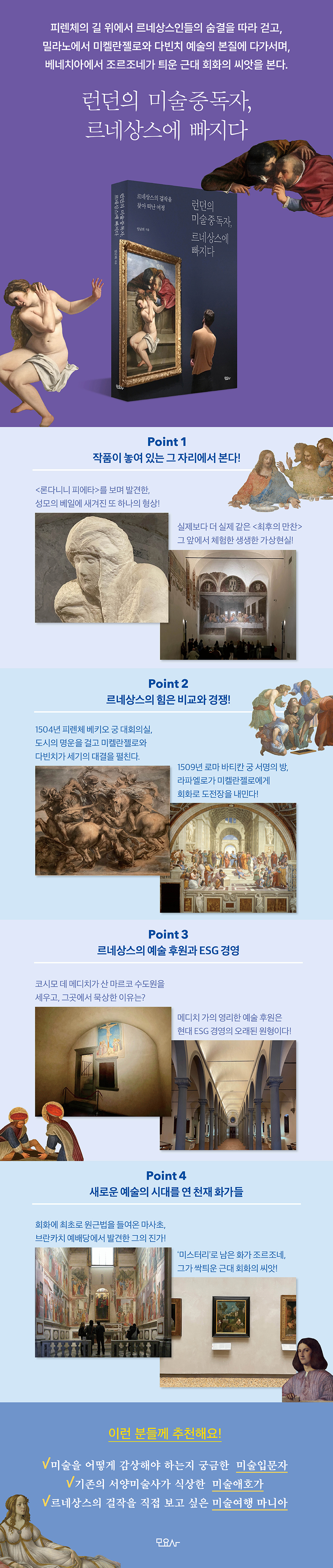
The most significant feature of this book is that it focuses on the experience of appreciating the work directly ‘in situ.’
In particular, Renaissance art is mostly inseparable from space, such as altarpieces, murals, and architectural decorations, so encountering the works in their original locations provides special insight and emotion.
The author imagines the rivalry between the two painters as they faced each other in the Ornisanti Chapel in Florence, with works by Ghirlandaio and Botticelli on opposite walls.
The thrilling excitement felt on the spot makes you feel like a Renaissance man.
In front of Michelangelo's last unfinished work, the Rondanini Pietà, one wonders about the powerful arms detached from the main body and another figure carved into the Virgin's veil.
The journey to uncover the secret is the highlight of this book.
As you read this book, you will realize that 'seeing a painting' ultimately means 'standing in front of a painting', and 'understanding a painting' means reaching your own 'sensory insight'.
The power of the Renaissance is comparison and competition!
The Great Hall of the Palazzo Vecchio, Florence, 1504.
Leonardo da Vinci and Michelangelo, two genius artists whose fate depended on the city, engage in a battle of the century in front of a wall facing each other.
Leonardo tried to prove his skill and belief in art with The Battle of Anghiari, and Michelangelo tried to prove his skill and belief in art with The Battle of Cascina.
Although neither work was completed, their confrontation raises fundamental questions about what art should aim for.
The author reminds us that in this fierce competition, called "paragone," artists honed their skills to excel and undertook revolutionary shifts in thinking to stand out from others.
The Economics of Arts Patronage: Cosimo de' Medici's ESG Management
The Medici family's support was behind the Renaissance's flourishing in Florence.
And the person who stood at the starting point was Cosimo de' Medici.
He built key institutions in Florence, including the convent and library of San Marco and the dome of the Duomo, while also actively supporting the humanities and the arts.
His patronage ultimately won him the fervent support of the Florentine people, laying the foundation for the Medici family to rule Florence for the next three hundred years.
Through the Monastery of San Marco, which he founded, the author insightfully demonstrates that patronage of the arts is the oldest management philosophy for sustainable growth.
Masaccio and Giorgione, two geniuses who ushered in a new era of art
Masaccio of Florence and Giorgione of Venice, two genius painters who died young, changed the landscape of Renaissance art in different ways.
The author personally visits the Brancacci Chapel, known as the "Sistine Chapel of the Early Renaissance," and closely examines each fresco painted by Masaccio, detailing the innovations in painting he brought about.
Although many great masters, including Filippo Lippi and Michelangelo, studied his work here, few books cover the Brancacci Chapel in such detail.
In that sense, this passage is a valuable record that vividly shows how the foundations of painting were newly established during the early Renaissance.
Although the word 'mysterious' always precedes Giorgione's name, he was in fact a revolutionary who changed the direction of Venetian painting.
Through the portraits he left behind, the author traces how his paintings, which capture the inner self and even momentary emotions of individuals, sprouted as seeds of modern painting.
Artemisia, the power of women
At the border of the Renaissance and Baroque, Artemisia Gentileschi, as a female artist, directly broke the prejudices and oppression of her time.
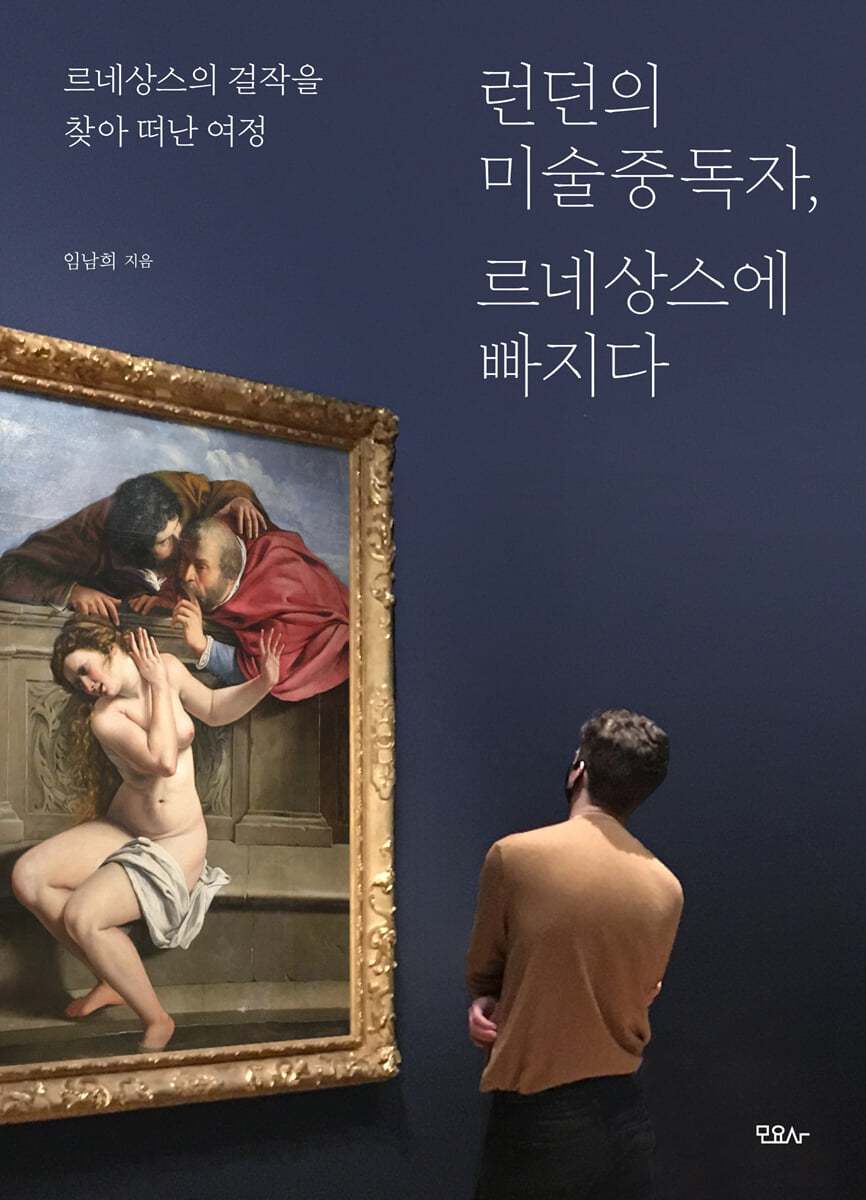
The author delicately captures how she rewrites the narrative of women, focusing on “Susanna and the Elders.”
In the process, it reminds us that the reason her paintings captivate the hearts of many in her time and in the 21st century is not simply because she was an outstanding female painter, but because she was a rare artist who embodied in her paintings the “power of women”—the “perspective and authority that only women can display.”
How is the value of art determined?
In 2017, Leonardo da Vinci's "Salvator Mundi" sold for $453 million at Christie's in New York, setting a record for the highest price ever paid for a painting.
But the world's most expensive painting soon finds itself at the center of controversy over its authenticity.
Taking this incident as a starting point, the author traces the fate of works of art that are either restored to authenticity or, conversely, relegated to the status of forgery.
From Leonardo da Vinci's "Madonna of the Rocks" and Raphael's "Portrait of Julius II" held at the National Gallery in London to Jan Vermeer's "Girl with a Flute," which shocked the world in 2022 when it was declared a forgery, the author asks how the value of a work of art is determined through a series of interesting cases.
Through this book, the author movingly conveys the fact that when a painting speaks to us, Renaissance art is no longer art of the past, but art that begins again in our lives today.
The most significant feature of this book is that it focuses on the experience of appreciating the work directly ‘in situ.’
In particular, Renaissance art is mostly inseparable from space, such as altarpieces, murals, and architectural decorations, so encountering the works in their original locations provides special insight and emotion.
The author imagines the rivalry between the two painters as they faced each other in the Ornisanti Chapel in Florence, with works by Ghirlandaio and Botticelli on opposite walls.
The thrilling excitement felt on the spot makes you feel like a Renaissance man.
In front of Michelangelo's last unfinished work, the Rondanini Pietà, one wonders about the powerful arms detached from the main body and another figure carved into the Virgin's veil.
The journey to uncover the secret is the highlight of this book.
As you read this book, you will realize that 'seeing a painting' ultimately means 'standing in front of a painting', and 'understanding a painting' means reaching your own 'sensory insight'.
The power of the Renaissance is comparison and competition!
The Great Hall of the Palazzo Vecchio, Florence, 1504.
Leonardo da Vinci and Michelangelo, two genius artists whose fate depended on the city, engage in a battle of the century in front of a wall facing each other.
Leonardo tried to prove his skill and belief in art with The Battle of Anghiari, and Michelangelo tried to prove his skill and belief in art with The Battle of Cascina.
Although neither work was completed, their confrontation raises fundamental questions about what art should aim for.
The author reminds us that in this fierce competition, called "paragone," artists honed their skills to excel and undertook revolutionary shifts in thinking to stand out from others.
The Economics of Arts Patronage: Cosimo de' Medici's ESG Management
The Medici family's support was behind the Renaissance's flourishing in Florence.
And the person who stood at the starting point was Cosimo de' Medici.
He built key institutions in Florence, including the convent and library of San Marco and the dome of the Duomo, while also actively supporting the humanities and the arts.
His patronage ultimately won him the fervent support of the Florentine people, laying the foundation for the Medici family to rule Florence for the next three hundred years.
Through the Monastery of San Marco, which he founded, the author insightfully demonstrates that patronage of the arts is the oldest management philosophy for sustainable growth.
Masaccio and Giorgione, two geniuses who ushered in a new era of art
Masaccio of Florence and Giorgione of Venice, two genius painters who died young, changed the landscape of Renaissance art in different ways.
The author personally visits the Brancacci Chapel, known as the "Sistine Chapel of the Early Renaissance," and closely examines each fresco painted by Masaccio, detailing the innovations in painting he brought about.
Although many great masters, including Filippo Lippi and Michelangelo, studied his work here, few books cover the Brancacci Chapel in such detail.
In that sense, this passage is a valuable record that vividly shows how the foundations of painting were newly established during the early Renaissance.
Although the word 'mysterious' always precedes Giorgione's name, he was in fact a revolutionary who changed the direction of Venetian painting.
Through the portraits he left behind, the author traces how his paintings, which capture the inner self and even momentary emotions of individuals, sprouted as seeds of modern painting.
Artemisia, the power of women
At the border of the Renaissance and Baroque, Artemisia Gentileschi, as a female artist, directly broke the prejudices and oppression of her time.
The author delicately captures how she rewrites the narrative of women, focusing on “Susanna and the Elders.”
In the process, it reminds us that the reason her paintings captivate the hearts of many in her time and in the 21st century is not simply because she was an outstanding female painter, but because she was a rare artist who embodied in her paintings the “power of women”—the “perspective and authority that only women can display.”
How is the value of art determined?
In 2017, Leonardo da Vinci's "Salvator Mundi" sold for $453 million at Christie's in New York, setting a record for the highest price ever paid for a painting.
But the world's most expensive painting soon finds itself at the center of controversy over its authenticity.
Taking this incident as a starting point, the author traces the fate of works of art that are either restored to authenticity or, conversely, relegated to the status of forgery.
From Leonardo da Vinci's "Madonna of the Rocks" and Raphael's "Portrait of Julius II" held at the National Gallery in London to Jan Vermeer's "Girl with a Flute," which shocked the world in 2022 when it was declared a forgery, the author asks how the value of a work of art is determined through a series of interesting cases.
Through this book, the author movingly conveys the fact that when a painting speaks to us, Renaissance art is no longer art of the past, but art that begins again in our lives today.
GOODS SPECIFICS
- Date of issue: November 25, 2025
- Page count, weight, size: 384 pages | 620g | 148*205*20mm
- ISBN13: 9791199508910
- ISBN10: 1199508918
You may also like
카테고리
korean


korean

![GQ KOREA Mark (Monthly): December [2025]](http://librairie.coreenne.fr/cdn/shop/files/8ef265dbbfbf186523ed75ba7319009d.jpg?v=1765340328&width=3840)


