

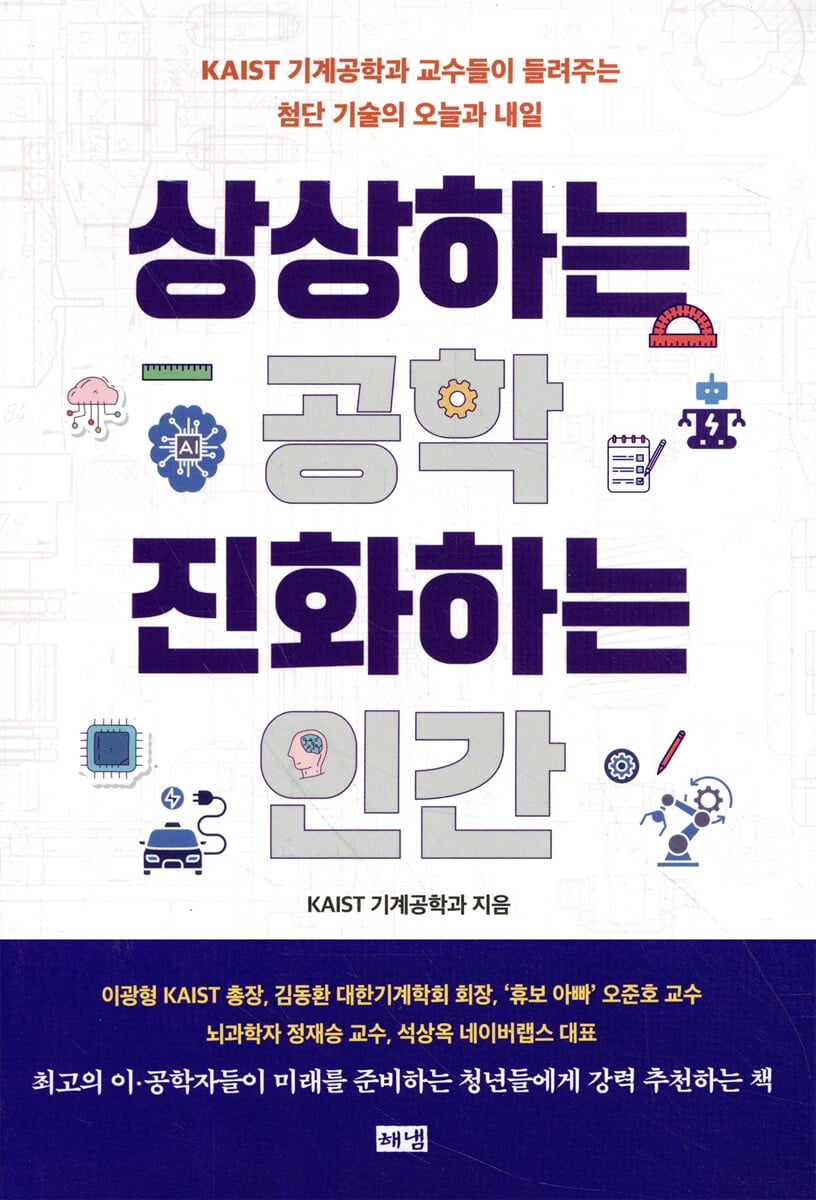
Imaginative Engineering Evolving Humans
 |
Description
Book Introduction
So that new ideas do not end in imagination but become technologies that change the future.
Engineering that solves today's problems and designs tomorrow's possibilities!
Cutting-edge technological solutions and imagination from KAIST's world-class mechanical engineers!
When will we actually wear a robot like Iron Man? Will there be energy innovations that effectively address the climate crisis? What are the technical principles that allow robotic arms to move in response to human will? What if we could replicate my own organs in a coin-sized laboratory? In today's "age of technological revolution," engineering plays a crucial role in our daily lives and the advancement of society.
In this way, we live in an era where understanding of technology and engineering thinking have become essential liberal arts.
However, it is difficult for a non-specialist to grasp the ever-advancing technological changes, and if you add questions about future prospects to the mix, providing answers becomes even more challenging.
To inform readers about today's cutting-edge technologies and explore the future together, the book "Imagining Engineering, Evolving Humans" has been published, bringing together the knowledge of 27 professors from the KAIST Department of Mechanical Engineering. KAIST's Department of Mechanical Engineering is recognized as a global leader in engineering, pioneering new technologies such as the development of Korea's first humanoid robot.
Engineers who have achieved world-class results in their respective fields of research participated as contributors, and this book is packed with in-depth knowledge, covering not only the principles and application cases of cutting-edge technology, but also its future development potential.
Above all, this book explains specialized terms and concepts step by step at a level that is accessible to non-specialists, making it a book that can be read by both future generations preparing for a new tomorrow based on their knowledge of technology, as well as the general public who wants to understand the aspects and trends of cutting-edge technology.
Engineering that solves today's problems and designs tomorrow's possibilities!
Cutting-edge technological solutions and imagination from KAIST's world-class mechanical engineers!
When will we actually wear a robot like Iron Man? Will there be energy innovations that effectively address the climate crisis? What are the technical principles that allow robotic arms to move in response to human will? What if we could replicate my own organs in a coin-sized laboratory? In today's "age of technological revolution," engineering plays a crucial role in our daily lives and the advancement of society.
In this way, we live in an era where understanding of technology and engineering thinking have become essential liberal arts.
However, it is difficult for a non-specialist to grasp the ever-advancing technological changes, and if you add questions about future prospects to the mix, providing answers becomes even more challenging.
To inform readers about today's cutting-edge technologies and explore the future together, the book "Imagining Engineering, Evolving Humans" has been published, bringing together the knowledge of 27 professors from the KAIST Department of Mechanical Engineering. KAIST's Department of Mechanical Engineering is recognized as a global leader in engineering, pioneering new technologies such as the development of Korea's first humanoid robot.
Engineers who have achieved world-class results in their respective fields of research participated as contributors, and this book is packed with in-depth knowledge, covering not only the principles and application cases of cutting-edge technology, but also its future development potential.
Above all, this book explains specialized terms and concepts step by step at a level that is accessible to non-specialists, making it a book that can be read by both future generations preparing for a new tomorrow based on their knowledge of technology, as well as the general public who wants to understand the aspects and trends of cutting-edge technology.
- You can preview some of the book's contents.
Preview
index
Preface: Mechanical Engineering, Moving the World│Kim Jeong
Part 1: Engineering that Changes the World
Chapter 1: Robotics and Mobility: Writing a New History
· What is a Robot?│Hwangbo Je-min
· Walking robots running in the present and future│Park Hae-won
· People 'wear' robots│Gong Kyung-chul
· What Makes Us Move?│Kim Jin-hwan
· How do bats and self-driving cars perceive space? │ Park Yong-hwa
· Putting Eyes on Machines│Yoon Kook-jin
Chapter 2: Energy Innovation for Tomorrow's Survival
· We need to start right now│Jang Dae-jun
Hydrogen Energy Technology: The Key to Carbon Neutrality│Lee Kang-taek
· A World That's Getting Hotter: The War on Heat│Nam Young-seok
Chapter 3: Advanced Production Technologies Shaping the Future
· Thinking Machines: Revolutionizing Industry│Yoo Seung-hwa
· 'The Rice of Modern Civilization,' the Core of Semiconductor Technology│Kim Young-jin
· An era of personalized manufacturing, from cars to hearts│Kim San-ha
· An Engineer's Eye on Coffee, Wine, Whiskey, and Beverages│Hyungsoo Kim
· What do pyramids and space solar power structures have in common? │Kim Seong-su
Part 2: Engineering that Evolves Humans
Chapter 4: Machines that are invisible but always by our side
· Cutting-edge sensors for a safer and more convenient world│Park In-gyu
· Controlling noise and vibration for a quiet and comfortable future│Jeon Won-ju
· The Dynamics of Small for Big│Sim Ki-dong
· A mechanical engineer dreaming of a startup│Yoon Yong-jin
Chapter 5: Engineering Leading a New Medical Paradigm
· There's a medical school in the Department of Mechanical Engineering│Kim Hyun-jin
· Let there be light!│Yoo Hong-gi
· Can I grow my own organs outside my body?│Jeon Seong-yoon
Chapter 6: Humans Evolving with Machines
· Robots that resemble living things│Kyung-wook Gyeong
· Is the Six Million Dollar Man Possible in Real Life? │ Park Hyung-soon
· Mechanical mechanics breathe inside me│Koo Seung-beom
· Newton's Descendants: Connecting Brains and Machines│Lee Pil-seung
Conclusion: A Guide to the Future│Bae Chung-sik
Part 1: Engineering that Changes the World
Chapter 1: Robotics and Mobility: Writing a New History
· What is a Robot?│Hwangbo Je-min
· Walking robots running in the present and future│Park Hae-won
· People 'wear' robots│Gong Kyung-chul
· What Makes Us Move?│Kim Jin-hwan
· How do bats and self-driving cars perceive space? │ Park Yong-hwa
· Putting Eyes on Machines│Yoon Kook-jin
Chapter 2: Energy Innovation for Tomorrow's Survival
· We need to start right now│Jang Dae-jun
Hydrogen Energy Technology: The Key to Carbon Neutrality│Lee Kang-taek
· A World That's Getting Hotter: The War on Heat│Nam Young-seok
Chapter 3: Advanced Production Technologies Shaping the Future
· Thinking Machines: Revolutionizing Industry│Yoo Seung-hwa
· 'The Rice of Modern Civilization,' the Core of Semiconductor Technology│Kim Young-jin
· An era of personalized manufacturing, from cars to hearts│Kim San-ha
· An Engineer's Eye on Coffee, Wine, Whiskey, and Beverages│Hyungsoo Kim
· What do pyramids and space solar power structures have in common? │Kim Seong-su
Part 2: Engineering that Evolves Humans
Chapter 4: Machines that are invisible but always by our side
· Cutting-edge sensors for a safer and more convenient world│Park In-gyu
· Controlling noise and vibration for a quiet and comfortable future│Jeon Won-ju
· The Dynamics of Small for Big│Sim Ki-dong
· A mechanical engineer dreaming of a startup│Yoon Yong-jin
Chapter 5: Engineering Leading a New Medical Paradigm
· There's a medical school in the Department of Mechanical Engineering│Kim Hyun-jin
· Let there be light!│Yoo Hong-gi
· Can I grow my own organs outside my body?│Jeon Seong-yoon
Chapter 6: Humans Evolving with Machines
· Robots that resemble living things│Kyung-wook Gyeong
· Is the Six Million Dollar Man Possible in Real Life? │ Park Hyung-soon
· Mechanical mechanics breathe inside me│Koo Seung-beom
· Newton's Descendants: Connecting Brains and Machines│Lee Pil-seung
Conclusion: A Guide to the Future│Bae Chung-sik
Detailed image

Into the book
Mechanical Engineering, Moving the World
The essence of mechanical engineering is to create new value through the design, manufacture, and application of the most important tools, machines, or devices of each era.
As a result, it has expanded beyond traditional design, structure, materials, and flow to nanoscale semiconductor processes and virtual space, and is expanding its scope to include healthcare and even psychology.
At this point, you can see that the British Institution of Mechanical Engineers' slogan, "Nothing moves without mechanical engineers," is no exaggeration.
The current era is often called the 'era of technological hegemony'.
In other words, a country with a strong industry and manufacturing sector armed with technology will have the upper hand in competition.
This is why our country's public, especially future generations, need to learn about the principles and technologies of engineering, even if it is somewhat difficult.
There is no conclusion at the end of this book.
I hope you will add new chapters to this book in the future.
---From the "Preface"
Engineers don't wait for the future.
Create your future with your own hands!
Various questions surrounding new technologies and clear answers from KAIST mechanical engineers!
On March 11, 2011, a magnitude 7 earthquake struck the Tohoku region of Japan.
The earthquake triggered a massive tsunami that reached 15 meters in height and soon struck the Fukushima nuclear power plant.
As the situation deteriorated to the point where it was too dangerous for people to enter, the Japanese government and Tokyo Electric Power Company decided to deploy robots.
At the time, Japan's robotics technology was known to be the best in the world, but it would have been difficult for any robot to respond to a disaster of this magnitude.
The Fukushima nuclear power plant disaster clearly demonstrated how helpless the robotics technology of the time was in disaster situations.
And the U.S. Defense Advanced Research Projects Agency, which had been keeping an eye on this, held a disaster relief robot competition in 2015, four years after the accident, with the aim of developing robot technology.
---From "Chapter 1: Robot Technology and Mobility Writing a New History - Walking Robots Running in the Present and Future"
Should you use plastic bags or paper bags to reduce greenhouse gases? From a raw material standpoint, paper bags are preferable.
But if you look into the actual manufacturing process, paper bags consume five times more energy and emit that much more carbon.
There are a growing number of products that appear eco-friendly but are essentially anti-environmental.
As you can see from the examples above, ‘apparent eco-friendliness’ and ‘absolute eco-friendliness’ are different.
Recently, many companies have attempted green marketing that emphasizes environmental friendliness, but there are cases where they deceive consumers and investors with 'green washing' that only looks good on the packaging.
To prevent such deception and fraud, wise consumer judgment and continuous monitoring are absolutely necessary.
---From "Chapter 2: Energy Innovation for Tomorrow's Survival - We Must Start Now"
We live in a smart world, and we carry small smartphones in our hands that boast faster and more powerful performance than the computers that sent humans to the moon.
This tremendous change is due to the continuous advancement of integrated circuit technology.
Modern semiconductors are made by repeatedly patterning various metals and semiconductor oxides into fine line widths on silicon wafers, layer by layer, thereby building up complex microstructures in multiple layers.
---From "Chapter 3: Advanced Production Technology Shaping the Future - 'The Rice of Modern Civilization,' the Core of Semiconductor Technology"
Acoustic metamaterials are artificial structures that have acoustic properties that are completely different from those of conventional materials.
Scientists have discovered that they can design materials that don't actually make the density negative, but make it feel like it is negative from the perspective of sound waves.
The result is near-perfect sound wave blocking with a very thin thickness and light weight.
Just as exciting as acoustic metamaterials, acoustic black hole technology is also being developed.
Acoustic black holes are a new technology that can focus waves into a specific point and dissipate them as heat, much like a black hole draws in light and all matter.
---From "Chapter 4 Machines that are invisible but always by our side - Controlling noise and vibration for a quiet and comfortable future"
Scientists want to better understand how our organs work and how diseases affect them.
However, experiments using cells in test tubes or living animals have many differences from the actual human environment, which limits our understanding of human diseases and organs.
At this time, microfluidic systems have become excellent tools that can complement the limitations of existing experiments.
Various organ systems, such as the heart, lungs, brain, eyes, muscles, and blood vessels, implemented within a microfluidic system are called microorganism systems or organ chips.
In the case of the pulmonary system, the phenomenon of alveoli expanding when a person inhales was implemented within the microbiological system.
---From "Chapter 5 Engineering Leading a New Medical Paradigm - Can I Create My Own Organs Outside My Body?"
In 2006, Professor Todd Kuiken of Northwestern University in the United States successfully performed a highly difficult surgery called targeted muscle reinnervation.
The patient was a man named Sullivan who had lost both arms in an electrical accident.
Through this surgery, Professor Kuiken replanted the peripheral nerve bundle that remained at the end of the patient's shoulder into the chest muscles, and through sensors connected to the nerve bundle, he was able to read even the intention of complex upper limb movements.
Let's take a closer look at the surgical procedure. The peripheral nervous system bundles connected to Mr. Sullivan's amputated arm were severed at the shoulder, but the bundles that were connected to the muscles that moved his shoulder, elbow, wrist, and fingers were still alive, having lost their purpose.
The essence of mechanical engineering is to create new value through the design, manufacture, and application of the most important tools, machines, or devices of each era.
As a result, it has expanded beyond traditional design, structure, materials, and flow to nanoscale semiconductor processes and virtual space, and is expanding its scope to include healthcare and even psychology.
At this point, you can see that the British Institution of Mechanical Engineers' slogan, "Nothing moves without mechanical engineers," is no exaggeration.
The current era is often called the 'era of technological hegemony'.
In other words, a country with a strong industry and manufacturing sector armed with technology will have the upper hand in competition.
This is why our country's public, especially future generations, need to learn about the principles and technologies of engineering, even if it is somewhat difficult.
There is no conclusion at the end of this book.
I hope you will add new chapters to this book in the future.
---From the "Preface"
Engineers don't wait for the future.
Create your future with your own hands!
Various questions surrounding new technologies and clear answers from KAIST mechanical engineers!
On March 11, 2011, a magnitude 7 earthquake struck the Tohoku region of Japan.
The earthquake triggered a massive tsunami that reached 15 meters in height and soon struck the Fukushima nuclear power plant.
As the situation deteriorated to the point where it was too dangerous for people to enter, the Japanese government and Tokyo Electric Power Company decided to deploy robots.
At the time, Japan's robotics technology was known to be the best in the world, but it would have been difficult for any robot to respond to a disaster of this magnitude.
The Fukushima nuclear power plant disaster clearly demonstrated how helpless the robotics technology of the time was in disaster situations.
And the U.S. Defense Advanced Research Projects Agency, which had been keeping an eye on this, held a disaster relief robot competition in 2015, four years after the accident, with the aim of developing robot technology.
---From "Chapter 1: Robot Technology and Mobility Writing a New History - Walking Robots Running in the Present and Future"
Should you use plastic bags or paper bags to reduce greenhouse gases? From a raw material standpoint, paper bags are preferable.
But if you look into the actual manufacturing process, paper bags consume five times more energy and emit that much more carbon.
There are a growing number of products that appear eco-friendly but are essentially anti-environmental.
As you can see from the examples above, ‘apparent eco-friendliness’ and ‘absolute eco-friendliness’ are different.
Recently, many companies have attempted green marketing that emphasizes environmental friendliness, but there are cases where they deceive consumers and investors with 'green washing' that only looks good on the packaging.
To prevent such deception and fraud, wise consumer judgment and continuous monitoring are absolutely necessary.
---From "Chapter 2: Energy Innovation for Tomorrow's Survival - We Must Start Now"
We live in a smart world, and we carry small smartphones in our hands that boast faster and more powerful performance than the computers that sent humans to the moon.
This tremendous change is due to the continuous advancement of integrated circuit technology.
Modern semiconductors are made by repeatedly patterning various metals and semiconductor oxides into fine line widths on silicon wafers, layer by layer, thereby building up complex microstructures in multiple layers.
---From "Chapter 3: Advanced Production Technology Shaping the Future - 'The Rice of Modern Civilization,' the Core of Semiconductor Technology"
Acoustic metamaterials are artificial structures that have acoustic properties that are completely different from those of conventional materials.
Scientists have discovered that they can design materials that don't actually make the density negative, but make it feel like it is negative from the perspective of sound waves.
The result is near-perfect sound wave blocking with a very thin thickness and light weight.
Just as exciting as acoustic metamaterials, acoustic black hole technology is also being developed.
Acoustic black holes are a new technology that can focus waves into a specific point and dissipate them as heat, much like a black hole draws in light and all matter.
---From "Chapter 4 Machines that are invisible but always by our side - Controlling noise and vibration for a quiet and comfortable future"
Scientists want to better understand how our organs work and how diseases affect them.
However, experiments using cells in test tubes or living animals have many differences from the actual human environment, which limits our understanding of human diseases and organs.
At this time, microfluidic systems have become excellent tools that can complement the limitations of existing experiments.
Various organ systems, such as the heart, lungs, brain, eyes, muscles, and blood vessels, implemented within a microfluidic system are called microorganism systems or organ chips.
In the case of the pulmonary system, the phenomenon of alveoli expanding when a person inhales was implemented within the microbiological system.
---From "Chapter 5 Engineering Leading a New Medical Paradigm - Can I Create My Own Organs Outside My Body?"
In 2006, Professor Todd Kuiken of Northwestern University in the United States successfully performed a highly difficult surgery called targeted muscle reinnervation.
The patient was a man named Sullivan who had lost both arms in an electrical accident.
Through this surgery, Professor Kuiken replanted the peripheral nerve bundle that remained at the end of the patient's shoulder into the chest muscles, and through sensors connected to the nerve bundle, he was able to read even the intention of complex upper limb movements.
Let's take a closer look at the surgical procedure. The peripheral nervous system bundles connected to Mr. Sullivan's amputated arm were severed at the shoulder, but the bundles that were connected to the muscles that moved his shoulder, elbow, wrist, and fingers were still alive, having lost their purpose.
---From "Chapter 6: Humans Evolving with Machines - Is the Six Million Dollar Man Possible in Reality?"
Publisher's Review
“Nothing can move without mechanical engineers.”
Engineering is a discipline that utilizes the principles of natural science to meet the needs of the times to create new technologies and values, and has solved many problems faced by humanity.
Among the various engineering fields, mechanical engineering in particular began in earnest with the invention of the steam engine, which triggered the Industrial Revolution in the 18th century, and advanced civilization with various tools and machines.
Because mechanical engineering has the longest history among all types of engineering, it is often misunderstood as being distant from the mainstream of today's Fourth Industrial Revolution.
However, mechanical engineering is a discipline at the center of convergence and innovation, and its traditional fields of mechanics and design are expanding their roles through combination with data-driven artificial intelligence.
In addition to rapidly evolving robotics technology, there are virtually no fields in which mechanical engineering is not involved, including future mobility, thermal management, energy, materials, advanced semiconductors, medicine, and psychology.
Professor Kim Jeong, head of the Department of Mechanical Engineering at KAIST, borrows the slogan of the British Society of Mechanical Engineers and says:
“Nothing moves without mechanical engineers.” Therefore, understanding mechanical engineering plays a very important role in understanding the history of technological civilization and the foundation of engineering.
This book consists of two parts and six chapters.
Part 1, "Engineering That Changes the World," explores how technology has transformed the world and how it will continue to evolve in the future.
We explore the potential of robots and mobility technologies that have already become a part of our daily lives (Chapter 1, "Robots and Mobility: Writing a New History") and examine the importance of eco-friendly energy and its utilization technologies for achieving carbon neutrality (Chapter 2, "Energy Innovation for Tomorrow's Survival").
Cases where cutting-edge technologies such as 3D printers and artificial intelligence are dramatically changing the manufacturing environment (Chapter 3, "Advanced Production Technologies Shaping the Future") are also worth paying attention to in order to gauge the current state of new technologies.
Part 2, “Engineering that Evolves Humanity,” explores engineering techniques that expand the possibilities of human life.
In particular, research on the development of biomedical engineering and, furthermore, on cases where humans and machines are combined stimulates our imagination.
We will learn about various cutting-edge sensors and machines that help human life, such as acoustic black holes, that we are not aware of but that are always around us (Chapter 4, 'Machines that are invisible but always around us'), and explore the potential for advancements in biomedical engineering that help us detect diseases more easily and accurately, such as optical technology and organ chips (Chapter 5, 'Engineering that leads a new medical paradigm').
We also explore the possibility that humans can evolve not simply by using machines, but through fusion with them (Chapter 6, 'Humans Evolving with Machines').
Towards Technology for Humans: Why We Should Learn Engineering
Of course, technology does not only enrich human life.
The side effects and harm caused by technology are also significant.
The rapid development of fossil fuel-based technology and mass production systems have resulted in the climate crisis.
There is also a fierce debate over whether the development of artificial intelligence will only benefit human life.
Therefore, the authors emphasize the ethical awareness that technology researchers must have, and they also do not forget to ask the question of who future technological development should benefit.
Professor Bae Chung-sik, former Dean of KAIST College of Engineering, says:
“It is true that the problems that arise with technological advancement cannot be solved with technology alone, but the possibility of solving them increases with the development of better technology.” This is why we must learn engineering to create a sustainable world together.
Empathizing with this spirit, Korea's top scientists and engineers, including KAIST President Lee Kwang-hyung, neuroscientist Professor Jeong Jae-seung, and Naver Labs CEO Seok Sang-ok, recommended this book to young people who will lead the future. "Imagining Engineering, Evolving Humans" is an engineering textbook that delves into the various cutting-edge technologies driven by mechanical engineering today, and will serve as a guide that presents the direction and flow of the technological revolution that has deeply penetrated our lives today.
Engineering is a discipline that utilizes the principles of natural science to meet the needs of the times to create new technologies and values, and has solved many problems faced by humanity.
Among the various engineering fields, mechanical engineering in particular began in earnest with the invention of the steam engine, which triggered the Industrial Revolution in the 18th century, and advanced civilization with various tools and machines.
Because mechanical engineering has the longest history among all types of engineering, it is often misunderstood as being distant from the mainstream of today's Fourth Industrial Revolution.
However, mechanical engineering is a discipline at the center of convergence and innovation, and its traditional fields of mechanics and design are expanding their roles through combination with data-driven artificial intelligence.
In addition to rapidly evolving robotics technology, there are virtually no fields in which mechanical engineering is not involved, including future mobility, thermal management, energy, materials, advanced semiconductors, medicine, and psychology.
Professor Kim Jeong, head of the Department of Mechanical Engineering at KAIST, borrows the slogan of the British Society of Mechanical Engineers and says:
“Nothing moves without mechanical engineers.” Therefore, understanding mechanical engineering plays a very important role in understanding the history of technological civilization and the foundation of engineering.
This book consists of two parts and six chapters.
Part 1, "Engineering That Changes the World," explores how technology has transformed the world and how it will continue to evolve in the future.
We explore the potential of robots and mobility technologies that have already become a part of our daily lives (Chapter 1, "Robots and Mobility: Writing a New History") and examine the importance of eco-friendly energy and its utilization technologies for achieving carbon neutrality (Chapter 2, "Energy Innovation for Tomorrow's Survival").
Cases where cutting-edge technologies such as 3D printers and artificial intelligence are dramatically changing the manufacturing environment (Chapter 3, "Advanced Production Technologies Shaping the Future") are also worth paying attention to in order to gauge the current state of new technologies.
Part 2, “Engineering that Evolves Humanity,” explores engineering techniques that expand the possibilities of human life.
In particular, research on the development of biomedical engineering and, furthermore, on cases where humans and machines are combined stimulates our imagination.
We will learn about various cutting-edge sensors and machines that help human life, such as acoustic black holes, that we are not aware of but that are always around us (Chapter 4, 'Machines that are invisible but always around us'), and explore the potential for advancements in biomedical engineering that help us detect diseases more easily and accurately, such as optical technology and organ chips (Chapter 5, 'Engineering that leads a new medical paradigm').
We also explore the possibility that humans can evolve not simply by using machines, but through fusion with them (Chapter 6, 'Humans Evolving with Machines').
Towards Technology for Humans: Why We Should Learn Engineering
Of course, technology does not only enrich human life.
The side effects and harm caused by technology are also significant.
The rapid development of fossil fuel-based technology and mass production systems have resulted in the climate crisis.
There is also a fierce debate over whether the development of artificial intelligence will only benefit human life.
Therefore, the authors emphasize the ethical awareness that technology researchers must have, and they also do not forget to ask the question of who future technological development should benefit.
Professor Bae Chung-sik, former Dean of KAIST College of Engineering, says:
“It is true that the problems that arise with technological advancement cannot be solved with technology alone, but the possibility of solving them increases with the development of better technology.” This is why we must learn engineering to create a sustainable world together.
Empathizing with this spirit, Korea's top scientists and engineers, including KAIST President Lee Kwang-hyung, neuroscientist Professor Jeong Jae-seung, and Naver Labs CEO Seok Sang-ok, recommended this book to young people who will lead the future. "Imagining Engineering, Evolving Humans" is an engineering textbook that delves into the various cutting-edge technologies driven by mechanical engineering today, and will serve as a guide that presents the direction and flow of the technological revolution that has deeply penetrated our lives today.
GOODS SPECIFICS
- Date of issue: May 20, 2024
- Page count, weight, size: 316 pages | 548g | 153*224*20mm
- ISBN13: 9791167140814
- ISBN10: 1167140818
You may also like
카테고리
korean


korean

![GQ KOREA Mark (Monthly): December [2025]](http://librairie.coreenne.fr/cdn/shop/files/8ef265dbbfbf186523ed75ba7319009d.jpg?v=1765340328&width=3840)


