

Materials and techniques of Korean painting
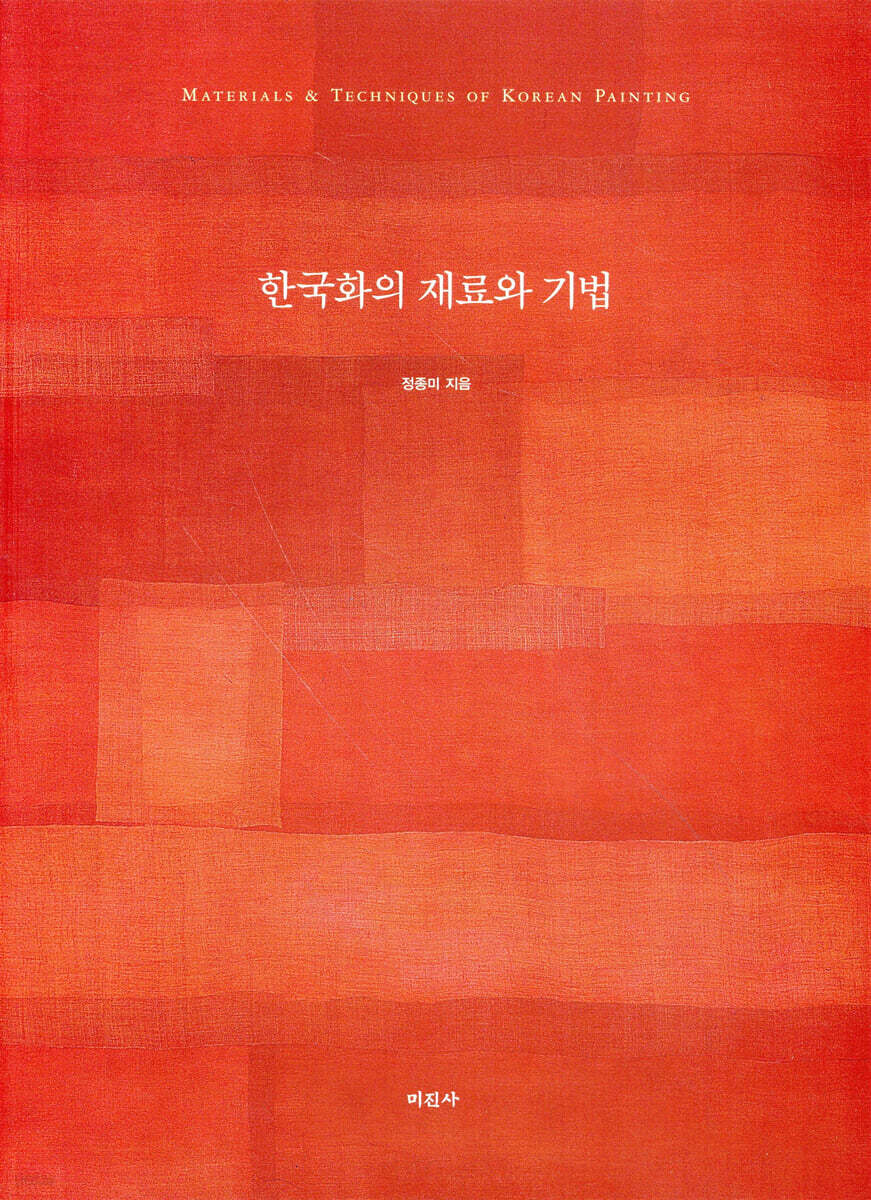 |
Description
Book Introduction
This is a book by painter Jeong Jong-mi, who has broadened the horizons of Korean art by creating a modern form of the formative language of murals, Buddhist paintings, and folk paintings in our art and by using unique coloring techniques using traditional materials.
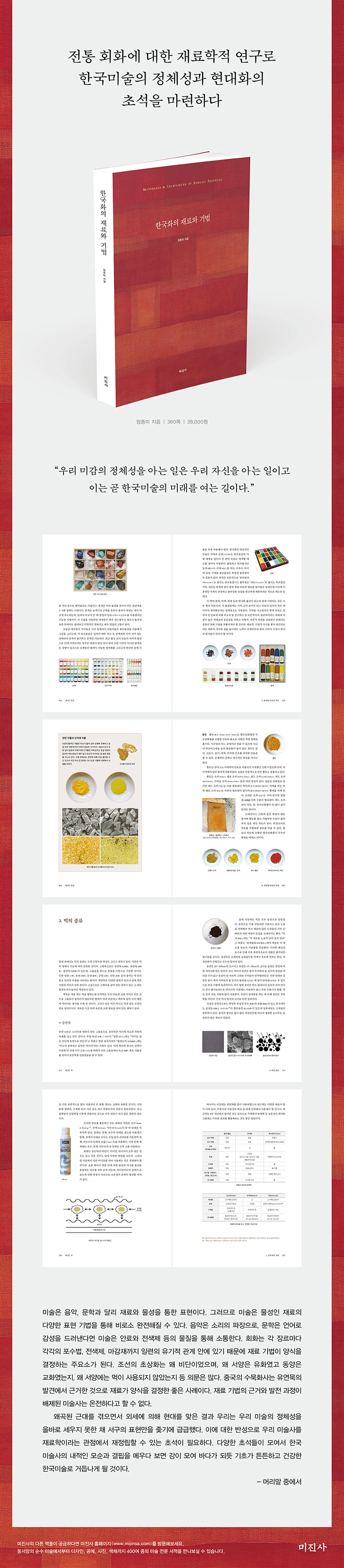
『Materials and Techniques of Korean Painting』 introduces the microscopic analysis of pigments and the characteristics, functions, and usage methods of each type of paint according to the colorant, based on materials science research on traditional painting.
The author says that knowing the identity of our aesthetic sensibility is “knowing ourselves,” and that this is “the path to opening the future of Korean art.”
He also says that the controversies and conflicts between Eastern and Western painting, or between color and ink, can only “advance to the integrated dimension of painting” when they are overcome through “material studies.”
The author's profound insight into Korean art invites us into a world of colorful paintings.
This book is recommended to general readers and researchers interested in Korean painting or those who wish to establish basic concepts in materials science, as well as those who wish to experience the traditional aesthetics and emotions of Korean art in a three-dimensional way.
『Materials and Techniques of Korean Painting』 introduces the microscopic analysis of pigments and the characteristics, functions, and usage methods of each type of paint according to the colorant, based on materials science research on traditional painting.
The author says that knowing the identity of our aesthetic sensibility is “knowing ourselves,” and that this is “the path to opening the future of Korean art.”
He also says that the controversies and conflicts between Eastern and Western painting, or between color and ink, can only “advance to the integrated dimension of painting” when they are overcome through “material studies.”
The author's profound insight into Korean art invites us into a world of colorful paintings.
This book is recommended to general readers and researchers interested in Korean painting or those who wish to establish basic concepts in materials science, as well as those who wish to experience the traditional aesthetics and emotions of Korean art in a three-dimensional way.
index
Recommendation
preface
Chapter 1.
pigment
1.
Overview of Korean painting pigments
2.
Types and properties of pigments
1) Natural pigments
Natural stone mortar | Natural water mortar
2) Artificial and synthetic pigments
Shinseokchae | Synthetic stone chae | Synthetic powder chae | Dry pigment | Bongchae/Anchae/Pyeonchae | Tube paint
3.
Pigment particles and color development
1) Color development principle of pigment particles
2) Types and particle sizes of Korean painting pigments
3) Types of Korean painting paints and particle sizes
4.
Characteristics of pigments by color
1) White
Powder | Chalk | Kaolin | Clay | Marble Powder | Mica | Pumice | Talc | Titanium White |
Lead powder/lead white/white powder | Barium white/Blancfix | Gypsum | Silica
2) Yellow
Stone yellow | Yellow clay | Yellow powder | Yellow dandelion/long dandelion | Cadmium yellow | Yellow dandelion | Yellow dandelion | Gardenia | Gwaehwa | Curcuma longa |
Indian Yellow
3) Red
Injection | Coral powder | Evening pearl | Silver pearl/Cinnabar/Vermilion | Red powder | Lotus | Cadmium red | Thousand-grained chrysanthemum |
Safflower | Sapwood | Red/Cochineal | Cochineal/Rack
4) Green
Green | Green Clay | Green Powder | Copper | Cobalt Green | Phthalocyanine Green
5) Blue
Stone blue | Navy blue | Indigo | Blue powder | Ultramarine blue | Phthalocyanine blue | Cobalt blue |
Manganese Blue | Prussian Blue | Cerulean Blue | Verdigris Blue
6) Brown
Dazai | Raw Sienna | Raw Umber | Indian Red | Light Red | Sepia | Persimmon Juice or Tangerine Extract |
Acorn shell extract | Walnut inner shell extract | Other brown pigments
7) Purple
Ultramarine Violet | Cobalt Violet | Mars Violet | Manganese Violet | Mauve
8) Black
Black Stone/Graphite | Spinel Black | Iron Oxide Black/Mars Black | White Carnation | Pomegranate Black | Pine Black |
Flexible black | Gallic ash | Black lacquer/lacquer | Lamp black | Charcoal | Bone black/ivory black | Carbon black | Other synthetic black pigments
9) Metallic pigments
Gold and silver leaf | Gold and silver teeth | Gold-plated
5.
How to use pigments
1) How to use each type of pigment
2) How to open the pigment
3) Paint production and coloring techniques
White pigment | Yellow pigment | Red pigment | Green pigment | Blue pigment | Brown pigment | Purple pigment |
black pigment
Chapter 2.
Indian ink
1.
The concept of food
2.
Origin of food
1) Korean food
2) Chinese food
3) Japanese food
3.
Types of food
1) Song Yeon-muk
2) Flexible ink
3) Seven-color ink
4) Color ink and blue ink
Anseokmuk | Cheongmuk | Chaemuk
5) Liquid ink
4.
Manufacturing of ink
1) The process of making food
Selection of high-quality soot | Selection of high-quality tea | Selection of medicinal herbs | Mixing tea | Steaming | Pounding | Weighing |
Training | Drying in the shade | Feeding in the light
2) The reality of food manufacturing
How to Make Yeonmuk | How to Make Pine Ink
5.
Silent and silent
1) Silent
2) Silence
Flame and ink | Particle size and ink color | Ink and ink color
6.
Ink wash painting and soft ink
1) Eastern and Western color concepts
2) Ink wash painting and black and white painting
3) The role of Yu Yeon-muk in the history of Oriental painting
7.
Selection and use of food
1) Choice of food
2) Use of food
8.
ink stone
1) Origin of the inkstone
Korean inkstone | Chinese inkstone
2) Choosing an inkstone
9.
brush
1) Origin of the brush
2) Structure and name of the brush
3) Type of brush
4) Making a brush
The process of making a calligraphy brush | The process of making a calligraphy brush
5) Choosing a brush
6) How to use the brush
Chapter 3.
school
1.
The concept of a color changer
2.
The color of Korean painting, Kyo
1) Components and properties of doctrine
2) Type of doctrine
3.
Professor Manufacturing
1) Facilitating the teaching
2) Dissolution of doctrine
3) Professor's storage
4.
Bridge catcher
1) The concept of catcher
2) Making a stirrer
3) Catcher
Authentic Stir-fried Rice Cakes | Easy Hot Rice Cakes | Mixed Rice Cakes for Various Bases | Various Mixing Methods for Different Colorants
Material information
References
index
preface
Chapter 1.
pigment
1.
Overview of Korean painting pigments
2.
Types and properties of pigments
1) Natural pigments
Natural stone mortar | Natural water mortar
2) Artificial and synthetic pigments
Shinseokchae | Synthetic stone chae | Synthetic powder chae | Dry pigment | Bongchae/Anchae/Pyeonchae | Tube paint
3.
Pigment particles and color development
1) Color development principle of pigment particles
2) Types and particle sizes of Korean painting pigments
3) Types of Korean painting paints and particle sizes
4.
Characteristics of pigments by color
1) White
Powder | Chalk | Kaolin | Clay | Marble Powder | Mica | Pumice | Talc | Titanium White |
Lead powder/lead white/white powder | Barium white/Blancfix | Gypsum | Silica
2) Yellow
Stone yellow | Yellow clay | Yellow powder | Yellow dandelion/long dandelion | Cadmium yellow | Yellow dandelion | Yellow dandelion | Gardenia | Gwaehwa | Curcuma longa |
Indian Yellow
3) Red
Injection | Coral powder | Evening pearl | Silver pearl/Cinnabar/Vermilion | Red powder | Lotus | Cadmium red | Thousand-grained chrysanthemum |
Safflower | Sapwood | Red/Cochineal | Cochineal/Rack
4) Green
Green | Green Clay | Green Powder | Copper | Cobalt Green | Phthalocyanine Green
5) Blue
Stone blue | Navy blue | Indigo | Blue powder | Ultramarine blue | Phthalocyanine blue | Cobalt blue |
Manganese Blue | Prussian Blue | Cerulean Blue | Verdigris Blue
6) Brown
Dazai | Raw Sienna | Raw Umber | Indian Red | Light Red | Sepia | Persimmon Juice or Tangerine Extract |
Acorn shell extract | Walnut inner shell extract | Other brown pigments
7) Purple
Ultramarine Violet | Cobalt Violet | Mars Violet | Manganese Violet | Mauve
8) Black
Black Stone/Graphite | Spinel Black | Iron Oxide Black/Mars Black | White Carnation | Pomegranate Black | Pine Black |
Flexible black | Gallic ash | Black lacquer/lacquer | Lamp black | Charcoal | Bone black/ivory black | Carbon black | Other synthetic black pigments
9) Metallic pigments
Gold and silver leaf | Gold and silver teeth | Gold-plated
5.
How to use pigments
1) How to use each type of pigment
2) How to open the pigment
3) Paint production and coloring techniques
White pigment | Yellow pigment | Red pigment | Green pigment | Blue pigment | Brown pigment | Purple pigment |
black pigment
Chapter 2.
Indian ink
1.
The concept of food
2.
Origin of food
1) Korean food
2) Chinese food
3) Japanese food
3.
Types of food
1) Song Yeon-muk
2) Flexible ink
3) Seven-color ink
4) Color ink and blue ink
Anseokmuk | Cheongmuk | Chaemuk
5) Liquid ink
4.
Manufacturing of ink
1) The process of making food
Selection of high-quality soot | Selection of high-quality tea | Selection of medicinal herbs | Mixing tea | Steaming | Pounding | Weighing |
Training | Drying in the shade | Feeding in the light
2) The reality of food manufacturing
How to Make Yeonmuk | How to Make Pine Ink
5.
Silent and silent
1) Silent
2) Silence
Flame and ink | Particle size and ink color | Ink and ink color
6.
Ink wash painting and soft ink
1) Eastern and Western color concepts
2) Ink wash painting and black and white painting
3) The role of Yu Yeon-muk in the history of Oriental painting
7.
Selection and use of food
1) Choice of food
2) Use of food
8.
ink stone
1) Origin of the inkstone
Korean inkstone | Chinese inkstone
2) Choosing an inkstone
9.
brush
1) Origin of the brush
2) Structure and name of the brush
3) Type of brush
4) Making a brush
The process of making a calligraphy brush | The process of making a calligraphy brush
5) Choosing a brush
6) How to use the brush
Chapter 3.
school
1.
The concept of a color changer
2.
The color of Korean painting, Kyo
1) Components and properties of doctrine
2) Type of doctrine
3.
Professor Manufacturing
1) Facilitating the teaching
2) Dissolution of doctrine
3) Professor's storage
4.
Bridge catcher
1) The concept of catcher
2) Making a stirrer
3) Catcher
Authentic Stir-fried Rice Cakes | Easy Hot Rice Cakes | Mixed Rice Cakes for Various Bases | Various Mixing Methods for Different Colorants
Material information
References
index
Detailed image
Into the book
Unlike music and literature, art is an expression through materials and physical properties.
Therefore, art can only be complete through the various expressive techniques of material properties.
If music expresses emotions through sound waves and literature through language, art communicates through materials such as pigments and colorants.
Since each genre of painting has its own unique capturing method, color, and finishing materials within a series of organic relationships, material techniques become the main elements that determine the style.
There are many questions, such as why Joseon portraits were made of silk, why the West used oil paintings while the East used gyo-hwa, and why the West did not use ink.
Chinese ink painting is a good example of how materials determine style, based on the discovery of ink.
The history of art cannot be considered complete if the basis and development of material techniques are excluded.
---"preface
Regardless of whether it is Eastern or Western painting, traditional paintings have a creative element in which the artist creates his own colors by directly adjusting the concentration and amount of pigments, colorants, and water.
Because the process of creating pigments was very cumbersome, a training process of handling the materials and refining the techniques was absolutely necessary.
However, after the Industrial Revolution, most people started using newly created tube paints, which brought convenience, but also limitations in terms of expressiveness, preservation, and aesthetics.
---Chapter 1 Pigment
In the philosophy of the Five Elements, blue corresponds to the east in terms of direction, wood in terms of the Five Elements, and spring in terms of season.
The word youth also originates here.
Natural pigments that produce blue include inorganic pigments such as stone blue and ultramarine, and organic pigments such as indigo.
In addition to natural mineral pigments such as stone blue and ultramarine blue, there are also smalt, Maya blue, and Egyptian blue, but these are ancient pigments and are rarely used today.
It is a natural plant pigment extracted from the remaining parts and has been widely used since ancient times.
There are also Seokcheong and Guncheong in Shinseokchae, but there may be confusion in the names, so they will be called Shinseokcheong (新石靑) and Shinguncheong (新群靑).
---From Chapter 1 Pigment
If you can freely change the base and color of the painting as needed and choose freely, there is no need to maintain the boundary between Eastern and Western painting.
As long as you have a precise understanding and mastery of the materials, integration and expansion into a pictorial dimension will not be difficult.
The plate on the side was painted with a color technique using blue and yellow powder on the paper, and then colored again with red powder.
And the red color inside was colored only with water, excluding the glue.
That is, it is a technique of reduction.
Traditional teaching is a very functional painting that creates various spaces just by the presence or absence of teaching.
I believe that it is not respectful to ourselves to only consider imported products as good and ignore or discard our own strengths.
We must make good use of the strengths of these traditions to create our own unique horizon of creative painting.
---From Chapter 1 Pigment
Ink is a very important material in traditional painting, possessing the properties of both pigment and dye, and is closely related to calligraphy as well as dyeing.
Since ink is a special material that exists only in the East and not in the West, understanding it will allow you to naturally accept the differences in worldviews and aesthetics between the East and the West.
In addition to its simple physical function as a material, ink itself possessed a high level of spiritual meaning, creating an extremely metaphysical painting style called 'sumuk (水墨)'.
However, as these tendencies become excessively absolutized and biased, the most basic physical properties of food tend to be overlooked.
Trying to understand everything about ink with only a high level of spirituality, without understanding the ultrafine nature of carbon, the basic unit of ink, or the glue that coagulates and disperses carbon, will not be the condition for a balanced and true ink painting.
This obsession with losing balance has led many modern artists to use low-quality materials such as acrylic paints or liquid ink, such as 'synthetic resin + carbon black', and yet they call it 'ink painting' and claim the supremacy of ink. This has even led to the contradiction of these artists.
Ink painting, along with color painting, is a form of glue painting.
It is natural that neither ink nor color has its own identity, except for the color of the painting.
Just as oil becomes an emulsion when used as a vehicle, acrylic resin becomes an acrylic when used as a vehicle.
This is another form of conversation that is completely different from teaching.
If you use synthetic resin paints such as acrylic, you will never achieve ink painting; it will only be a 'black and white painting' or 'monochromatic painting'.
'Ink and ink supremacy', which does not take into account the physical properties of the material called food, can be considered a very dangerous idea.
Only when the concept of ink painting begins with this most fundamental understanding and affirmation can ink painting be reborn as a healthy art form of our time, rather than a shadow of tradition.
---From Chapter 2, Food
The three countries of Korea, China, and Japan have shared a food culture while also developing their own unique characteristics.
Goryeo's paper and ink were so excellent that even Su Shi (1037-1101), a writer and calligrapher of the Northern Song Dynasty, praised them, and their reputation was so high in China that it is no exaggeration to say that our current ink culture is shameful compared to our glorious past.
Even in this superficial age, it is absolutely necessary to properly understand food and establish a new food culture.
Food culture, which holds the core of well-being and healing, has long played a significant role as a tool of expression and communication within us. Even in our modern society, where communication is lacking, it remains an essential emotion, and therefore must be revived to elevate our lives.
---From Chapter 2, Food
This aspect of Mibul as a materials expert was largely unknown to us.
In this regard, we must realize that there is a major blind spot in our perspective on art, and we must also urge reflection on our art education.
Now, we should not only pay attention to the philosophical artistry of the late literati painter, but also pay tribute to his experimental research on the knowledge and use of such materials.
Here, we come to realize that truly true art is created when the subject and object are deeply immersed in an impartial encounter.
As an artist who majored in Oriental painting, you should learn the attitude of innovating while respecting the past through this attitude of not paying attention.
---From Chapter 2, Food
The brush is a very meaningful tool that has made it possible to pass down traditions through records in human history.
It is a recording tool of a slightly different dimension from modern writing instruments, so through long-term practice and acquisition, it became a part of the body of writers and painters and was loved as the most suitable tool for conveying the language of their hearts.
In particular, Oriental brushes, unlike Western brushes, are unique tools that possess high density of expressiveness and excellent flexibility, allowing for a variety of expressions on multiple levels.
The fact that a single brush can express ten thousand different things is a difference from Western brushes, but the most powerful difference is that the brush is not a simple tool, but is embodied/incarnated as a part of the artist's body, revealing his thoughts and energy.
This is easily understandable when we consider that calligraphy and paintings of the Four Gentlemen are arts that attempt to expand expression through the ‘vibration of energy.’
---From Chapter 2, Food
Paint is a combination of pigment and colorant, and all paintings use the same pigments, with the only difference being that the pigments are high-quality and low-quality.
Therefore, the genre of a painting is determined by the color scheme.
Before examining the basic color medium of Korean painting, we will learn about the materials commonly used in painting, such as binder, medium, and varnish. Representative genres of painting include murals, glue paintings, oil paintings, tempera, watercolors, crayon paintings, and acrylic paintings.
There are wet and dry murals, and wet murals are the only painting style that does not use any colorants.
In the case of dry murals, local coloring agents such as oil, glue, and egg yolk were used.
The colorant for ink paintings and color paintings is glue, for oil paintings it is drying oil, for tempera it is egg yolk, for watercolors it is gum arabic, for crayons, pastels it is wax, and for acrylics it is acrylic resin.
Among these, the most commonly used painting genres throughout history are probably oil painting and calligraphy.
Along with this, other genres such as tempera and watercolor have also been verified as paintings.
Acrylic painting is the only genre of painting that has not yet been verified as having been created after the Industrial Revolution.
---From Chapter 3, Teachings
The base of a painting must be surface treated before painting.
If the absorbency of the base material such as paper or cloth (silk/cotton) is too strong, it is difficult to apply the pigment properly.
So, it is necessary to create an intermediate layer called a ground by applying glue or filling in small holes.
This is to settle the color layer that follows.
The process of creating these intermediate layers is called sizing or binding.
In other words, a catcher can be said to be a method of converting a base that cannot be painted into a base on which a picture can be painted.
That is, without a catcher, no background can become the basis for a conversation.
As such, the catcher plays an important role in conversation.
In the case of architecture, it is very important to solidify the foundation, such as by digging the ground and covering it with gravel, in order to build a sturdy and stable building.
Painting is like architecture; the better the foundation, the more solid the painting becomes and the better it can be preserved.
In order to create a painting with a solid foundation, you must be able to properly start with the capturing process that solidifies the foundation.
---From Chapter 3, Teachings
Any screen can be used as a base for a painting if it is processed as a catcher, so you can draw on it. However, no matter what base you draw on, the genre of the painting must be determined by the color theme.
For example, if you draw on jeans, if you draw on the pants and then paint with pigment and oil, it will be an oil painting, and if you draw on jeans and glue, it will be a colored painting.
Now, it is right to classify conversations by their names based on the colorants (materials).
In other words, if oil is used, it should be called oil painting, not Western painting, and if it uses teachings, it should be called teachings.
Color painting and ink painting are just specific names for Gyohwa, and it seems more reasonable to call them Gyohwa, which is the general term.
By increasing our understanding of materials science, we can overcome the conceptual distinction between Eastern and Western painting and move toward an integrated dimension of painting.
However, Korean painting, which is a style that continues the tradition of traditional painting, should be considered as a separate field in order to secure and foster its own identity and independence.
To achieve this, research and education on traditional Eastern and Western painting techniques must be conducted in parallel.
Therefore, art can only be complete through the various expressive techniques of material properties.
If music expresses emotions through sound waves and literature through language, art communicates through materials such as pigments and colorants.
Since each genre of painting has its own unique capturing method, color, and finishing materials within a series of organic relationships, material techniques become the main elements that determine the style.
There are many questions, such as why Joseon portraits were made of silk, why the West used oil paintings while the East used gyo-hwa, and why the West did not use ink.
Chinese ink painting is a good example of how materials determine style, based on the discovery of ink.
The history of art cannot be considered complete if the basis and development of material techniques are excluded.
---"preface
Regardless of whether it is Eastern or Western painting, traditional paintings have a creative element in which the artist creates his own colors by directly adjusting the concentration and amount of pigments, colorants, and water.
Because the process of creating pigments was very cumbersome, a training process of handling the materials and refining the techniques was absolutely necessary.
However, after the Industrial Revolution, most people started using newly created tube paints, which brought convenience, but also limitations in terms of expressiveness, preservation, and aesthetics.
---Chapter 1 Pigment
In the philosophy of the Five Elements, blue corresponds to the east in terms of direction, wood in terms of the Five Elements, and spring in terms of season.
The word youth also originates here.
Natural pigments that produce blue include inorganic pigments such as stone blue and ultramarine, and organic pigments such as indigo.
In addition to natural mineral pigments such as stone blue and ultramarine blue, there are also smalt, Maya blue, and Egyptian blue, but these are ancient pigments and are rarely used today.
It is a natural plant pigment extracted from the remaining parts and has been widely used since ancient times.
There are also Seokcheong and Guncheong in Shinseokchae, but there may be confusion in the names, so they will be called Shinseokcheong (新石靑) and Shinguncheong (新群靑).
---From Chapter 1 Pigment
If you can freely change the base and color of the painting as needed and choose freely, there is no need to maintain the boundary between Eastern and Western painting.
As long as you have a precise understanding and mastery of the materials, integration and expansion into a pictorial dimension will not be difficult.
The plate on the side was painted with a color technique using blue and yellow powder on the paper, and then colored again with red powder.
And the red color inside was colored only with water, excluding the glue.
That is, it is a technique of reduction.
Traditional teaching is a very functional painting that creates various spaces just by the presence or absence of teaching.
I believe that it is not respectful to ourselves to only consider imported products as good and ignore or discard our own strengths.
We must make good use of the strengths of these traditions to create our own unique horizon of creative painting.
---From Chapter 1 Pigment
Ink is a very important material in traditional painting, possessing the properties of both pigment and dye, and is closely related to calligraphy as well as dyeing.
Since ink is a special material that exists only in the East and not in the West, understanding it will allow you to naturally accept the differences in worldviews and aesthetics between the East and the West.
In addition to its simple physical function as a material, ink itself possessed a high level of spiritual meaning, creating an extremely metaphysical painting style called 'sumuk (水墨)'.
However, as these tendencies become excessively absolutized and biased, the most basic physical properties of food tend to be overlooked.
Trying to understand everything about ink with only a high level of spirituality, without understanding the ultrafine nature of carbon, the basic unit of ink, or the glue that coagulates and disperses carbon, will not be the condition for a balanced and true ink painting.
This obsession with losing balance has led many modern artists to use low-quality materials such as acrylic paints or liquid ink, such as 'synthetic resin + carbon black', and yet they call it 'ink painting' and claim the supremacy of ink. This has even led to the contradiction of these artists.
Ink painting, along with color painting, is a form of glue painting.
It is natural that neither ink nor color has its own identity, except for the color of the painting.
Just as oil becomes an emulsion when used as a vehicle, acrylic resin becomes an acrylic when used as a vehicle.
This is another form of conversation that is completely different from teaching.
If you use synthetic resin paints such as acrylic, you will never achieve ink painting; it will only be a 'black and white painting' or 'monochromatic painting'.
'Ink and ink supremacy', which does not take into account the physical properties of the material called food, can be considered a very dangerous idea.
Only when the concept of ink painting begins with this most fundamental understanding and affirmation can ink painting be reborn as a healthy art form of our time, rather than a shadow of tradition.
---From Chapter 2, Food
The three countries of Korea, China, and Japan have shared a food culture while also developing their own unique characteristics.
Goryeo's paper and ink were so excellent that even Su Shi (1037-1101), a writer and calligrapher of the Northern Song Dynasty, praised them, and their reputation was so high in China that it is no exaggeration to say that our current ink culture is shameful compared to our glorious past.
Even in this superficial age, it is absolutely necessary to properly understand food and establish a new food culture.
Food culture, which holds the core of well-being and healing, has long played a significant role as a tool of expression and communication within us. Even in our modern society, where communication is lacking, it remains an essential emotion, and therefore must be revived to elevate our lives.
---From Chapter 2, Food
This aspect of Mibul as a materials expert was largely unknown to us.
In this regard, we must realize that there is a major blind spot in our perspective on art, and we must also urge reflection on our art education.
Now, we should not only pay attention to the philosophical artistry of the late literati painter, but also pay tribute to his experimental research on the knowledge and use of such materials.
Here, we come to realize that truly true art is created when the subject and object are deeply immersed in an impartial encounter.
As an artist who majored in Oriental painting, you should learn the attitude of innovating while respecting the past through this attitude of not paying attention.
---From Chapter 2, Food
The brush is a very meaningful tool that has made it possible to pass down traditions through records in human history.
It is a recording tool of a slightly different dimension from modern writing instruments, so through long-term practice and acquisition, it became a part of the body of writers and painters and was loved as the most suitable tool for conveying the language of their hearts.
In particular, Oriental brushes, unlike Western brushes, are unique tools that possess high density of expressiveness and excellent flexibility, allowing for a variety of expressions on multiple levels.
The fact that a single brush can express ten thousand different things is a difference from Western brushes, but the most powerful difference is that the brush is not a simple tool, but is embodied/incarnated as a part of the artist's body, revealing his thoughts and energy.
This is easily understandable when we consider that calligraphy and paintings of the Four Gentlemen are arts that attempt to expand expression through the ‘vibration of energy.’
---From Chapter 2, Food
Paint is a combination of pigment and colorant, and all paintings use the same pigments, with the only difference being that the pigments are high-quality and low-quality.
Therefore, the genre of a painting is determined by the color scheme.
Before examining the basic color medium of Korean painting, we will learn about the materials commonly used in painting, such as binder, medium, and varnish. Representative genres of painting include murals, glue paintings, oil paintings, tempera, watercolors, crayon paintings, and acrylic paintings.
There are wet and dry murals, and wet murals are the only painting style that does not use any colorants.
In the case of dry murals, local coloring agents such as oil, glue, and egg yolk were used.
The colorant for ink paintings and color paintings is glue, for oil paintings it is drying oil, for tempera it is egg yolk, for watercolors it is gum arabic, for crayons, pastels it is wax, and for acrylics it is acrylic resin.
Among these, the most commonly used painting genres throughout history are probably oil painting and calligraphy.
Along with this, other genres such as tempera and watercolor have also been verified as paintings.
Acrylic painting is the only genre of painting that has not yet been verified as having been created after the Industrial Revolution.
---From Chapter 3, Teachings
The base of a painting must be surface treated before painting.
If the absorbency of the base material such as paper or cloth (silk/cotton) is too strong, it is difficult to apply the pigment properly.
So, it is necessary to create an intermediate layer called a ground by applying glue or filling in small holes.
This is to settle the color layer that follows.
The process of creating these intermediate layers is called sizing or binding.
In other words, a catcher can be said to be a method of converting a base that cannot be painted into a base on which a picture can be painted.
That is, without a catcher, no background can become the basis for a conversation.
As such, the catcher plays an important role in conversation.
In the case of architecture, it is very important to solidify the foundation, such as by digging the ground and covering it with gravel, in order to build a sturdy and stable building.
Painting is like architecture; the better the foundation, the more solid the painting becomes and the better it can be preserved.
In order to create a painting with a solid foundation, you must be able to properly start with the capturing process that solidifies the foundation.
---From Chapter 3, Teachings
Any screen can be used as a base for a painting if it is processed as a catcher, so you can draw on it. However, no matter what base you draw on, the genre of the painting must be determined by the color theme.
For example, if you draw on jeans, if you draw on the pants and then paint with pigment and oil, it will be an oil painting, and if you draw on jeans and glue, it will be a colored painting.
Now, it is right to classify conversations by their names based on the colorants (materials).
In other words, if oil is used, it should be called oil painting, not Western painting, and if it uses teachings, it should be called teachings.
Color painting and ink painting are just specific names for Gyohwa, and it seems more reasonable to call them Gyohwa, which is the general term.
By increasing our understanding of materials science, we can overcome the conceptual distinction between Eastern and Western painting and move toward an integrated dimension of painting.
However, Korean painting, which is a style that continues the tradition of traditional painting, should be considered as a separate field in order to secure and foster its own identity and independence.
To achieve this, research and education on traditional Eastern and Western painting techniques must be conducted in parallel.
---From Chapter 3, Teachings
Publisher's Review
Korean painter Jeong Jong-mi conveys
A Materialistic Study of Traditional Painting and Color
『Materials and Techniques of Korean Painting』 is a material technique book that contains microscopic analysis of pigments and the characteristics, functions, and usage methods of each type of paint according to colorant, based on material studies of traditional painting.
This is a book by painter Jeong Jong-mi, who has broadened the horizons of Korean art by creating a modern form of the formative language of murals, Buddhist paintings, and folk paintings in our art and by using unique coloring techniques using traditional materials.
This book consists of three main chapters.
Chapter 1, “Pigments,” explores the types and properties of Korean painting pigments and examines the coloring principles of pigment particles.
It introduces the characteristics of each pigment, from white, yellow, red, green, blue, brown, purple, black, and metallic pigments, and organizes the basic concepts of pigments.
In particular, the section on ‘paint production and coloring techniques’ among the methods of using pigments is noteworthy.
Through examples of the dual-color technique using primary colors, it is specifically shown that an infinite variety of multi-layered colors can be expressed using only the five cardinal colors.
Chapter 2, “Eat,” examines the origin, concept, and types of eat.
In particular, the process of ink production is examined in detail through the illustrations of Han Sang-muk and Yu Pil-mu, and the manufacturing methods of yeonyun ink and songyeon ink are introduced, respectively, providing a variety of ways to use ink.
In addition, it provides detailed information on the characteristics of ink and ink brush, the concept of ink painting and soft ink, and information on inkstones and brushes.
Chapter 3, “Kyo,” establishes the concept of kyo as a Korean painting medium, including its components, properties, and types, and introduces methods of capturing and preserving it.
The author says that knowing the identity of our aesthetic sensibility is “knowing ourselves,” and that this is “the path to opening the future of Korean art.”
He also says that the controversies and conflicts between Eastern and Western painting, or between color and ink, can only “advance to the integrated dimension of painting” when they are overcome through “material studies.”
The author's profound insight into Korean art invites us into a world of colorful paintings.
This book is recommended to general readers and researchers interested in Korean painting or those who wish to establish basic concepts in materials science, as well as those who wish to experience the traditional aesthetics and emotions of Korean art in a three-dimensional way.
A Materialistic Study of Traditional Painting and Color
『Materials and Techniques of Korean Painting』 is a material technique book that contains microscopic analysis of pigments and the characteristics, functions, and usage methods of each type of paint according to colorant, based on material studies of traditional painting.
This is a book by painter Jeong Jong-mi, who has broadened the horizons of Korean art by creating a modern form of the formative language of murals, Buddhist paintings, and folk paintings in our art and by using unique coloring techniques using traditional materials.
This book consists of three main chapters.
Chapter 1, “Pigments,” explores the types and properties of Korean painting pigments and examines the coloring principles of pigment particles.
It introduces the characteristics of each pigment, from white, yellow, red, green, blue, brown, purple, black, and metallic pigments, and organizes the basic concepts of pigments.
In particular, the section on ‘paint production and coloring techniques’ among the methods of using pigments is noteworthy.
Through examples of the dual-color technique using primary colors, it is specifically shown that an infinite variety of multi-layered colors can be expressed using only the five cardinal colors.
Chapter 2, “Eat,” examines the origin, concept, and types of eat.
In particular, the process of ink production is examined in detail through the illustrations of Han Sang-muk and Yu Pil-mu, and the manufacturing methods of yeonyun ink and songyeon ink are introduced, respectively, providing a variety of ways to use ink.
In addition, it provides detailed information on the characteristics of ink and ink brush, the concept of ink painting and soft ink, and information on inkstones and brushes.
Chapter 3, “Kyo,” establishes the concept of kyo as a Korean painting medium, including its components, properties, and types, and introduces methods of capturing and preserving it.
The author says that knowing the identity of our aesthetic sensibility is “knowing ourselves,” and that this is “the path to opening the future of Korean art.”
He also says that the controversies and conflicts between Eastern and Western painting, or between color and ink, can only “advance to the integrated dimension of painting” when they are overcome through “material studies.”
The author's profound insight into Korean art invites us into a world of colorful paintings.
This book is recommended to general readers and researchers interested in Korean painting or those who wish to establish basic concepts in materials science, as well as those who wish to experience the traditional aesthetics and emotions of Korean art in a three-dimensional way.
GOODS SPECIFICS
- Date of issue: March 22, 2023
- Page count, weight, size: 360 pages | 928g | 188*257*21mm
- ISBN13: 9788940806722
- ISBN10: 8940806727
You may also like
카테고리
korean


korean

![GQ KOREA Mark (Monthly): December [2025]](http://librairie.coreenne.fr/cdn/shop/files/8ef265dbbfbf186523ed75ba7319009d.jpg?v=1765340328&width=3840)


