

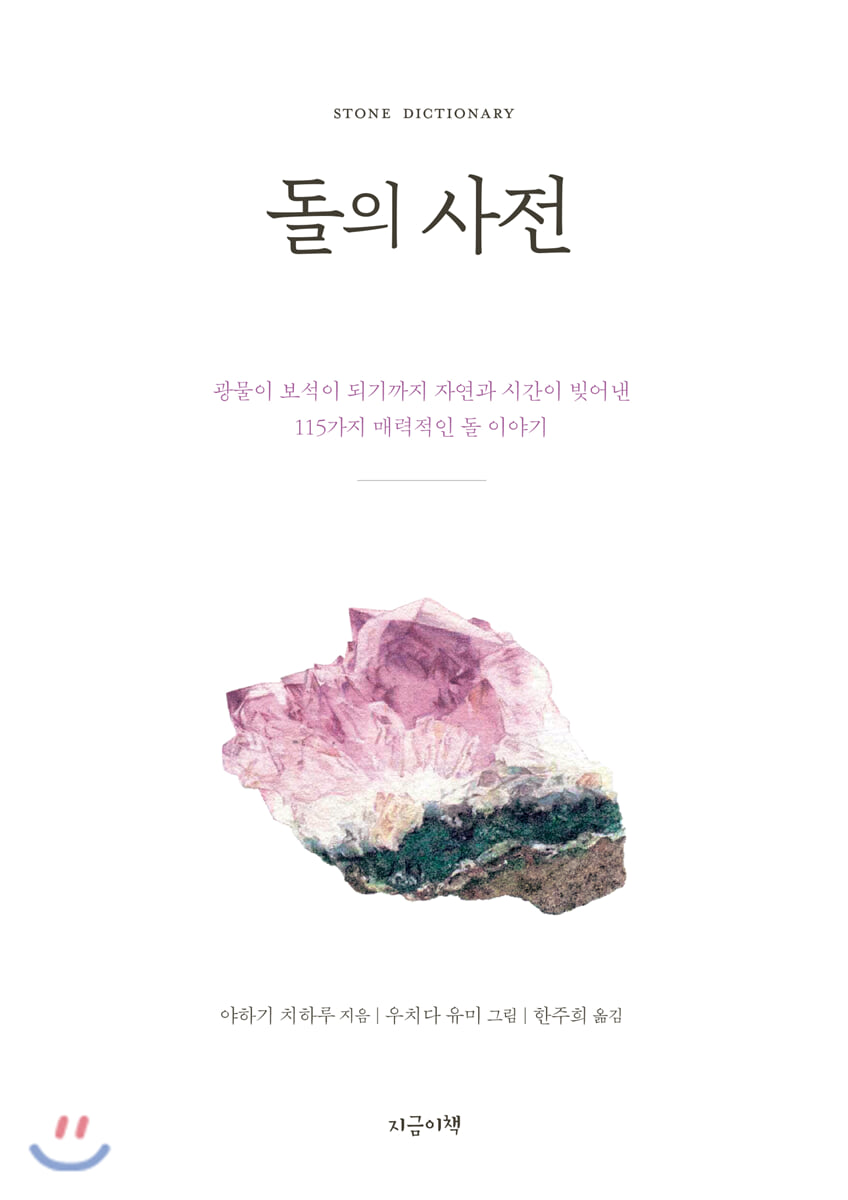
Dictionary of Stones
 |
Description
Book Introduction
Beautiful colors and patterns created by the passage of time on Earth,
The origin, legends, and culture surrounding it
A small but immense world of stones, filled with the mysteries of nature and the history of mankind.
Stones, which have been with mankind for a long time, can be easily encountered in many places in our daily lives.
Even in the majestic natural landscapes created by rocks, or in the streets and buildings of barren cities, perhaps every space we walk on is made of stone.
In fact, countless stones began before humans, along with the birth of the Earth.
Stones contain countless mysteries of the universe that we cannot know.
『Dictionary of Stones』 guides us into the world of small stones, where the great secrets of nature and the mysteries of the universe are embedded.
It concisely introduces the process of stone creation and circulation, including how minerals are created and discovered, what they are made of, and how they are used and shaped around us.
From zircon, the oldest mineral formed 4.4 billion years ago, to moldavite formed by meteorite impacts, lapis lazuli, the guardian stone of the ancient Egyptians, and diamonds born from the Earth's mantle, the colorful stories behind 115 stones pique our interest.
The myths and legends surrounding the names of the stones here add to the fun of reading.
In particular, while there are stone names that are simple and intuitive, such as sunstone or moonstone, there are many cases where it is difficult to infer a connection, such as rielga or kunzite. The book focuses on the most important scientific names, but also looks at the meanings contained in widely used gemstone names and nicknames.
It is explained in a way that anyone interested in minerals, gemstones, and gems can easily understand, without being overly academic.
Additionally, to make it easier to understand the characteristics of stones, we have included an introduction to minerals in order of hardness from soft to hard based on the Mohs hardness scale.
Here, stone drawings that are more vivid than photographs invite readers into the fascinating world of stones that cannot be found in any other mineral or gem-related book.
The origin, legends, and culture surrounding it
A small but immense world of stones, filled with the mysteries of nature and the history of mankind.
Stones, which have been with mankind for a long time, can be easily encountered in many places in our daily lives.
Even in the majestic natural landscapes created by rocks, or in the streets and buildings of barren cities, perhaps every space we walk on is made of stone.
In fact, countless stones began before humans, along with the birth of the Earth.
Stones contain countless mysteries of the universe that we cannot know.
『Dictionary of Stones』 guides us into the world of small stones, where the great secrets of nature and the mysteries of the universe are embedded.
It concisely introduces the process of stone creation and circulation, including how minerals are created and discovered, what they are made of, and how they are used and shaped around us.
From zircon, the oldest mineral formed 4.4 billion years ago, to moldavite formed by meteorite impacts, lapis lazuli, the guardian stone of the ancient Egyptians, and diamonds born from the Earth's mantle, the colorful stories behind 115 stones pique our interest.
The myths and legends surrounding the names of the stones here add to the fun of reading.
In particular, while there are stone names that are simple and intuitive, such as sunstone or moonstone, there are many cases where it is difficult to infer a connection, such as rielga or kunzite. The book focuses on the most important scientific names, but also looks at the meanings contained in widely used gemstone names and nicknames.
It is explained in a way that anyone interested in minerals, gemstones, and gems can easily understand, without being overly academic.
Additionally, to make it easier to understand the characteristics of stones, we have included an introduction to minerals in order of hardness from soft to hard based on the Mohs hardness scale.
Here, stone drawings that are more vivid than photographs invite readers into the fascinating world of stones that cannot be found in any other mineral or gem-related book.
- You can preview some of the book's contents.
Preview
index
Entering
STONE 001-115
COLUMN Mineral Knowledge
Ⅰ.
gloss
Ⅱ.
Jo Hun
Ⅲ.
decision
Ⅳ.
association
V.
Name of mineral
Ⅵ.
Legend of the Jewel
In conclusion
Mineral terminology
Index | Mineral Name
Index | Mineral Images
References
STONE 001-115
COLUMN Mineral Knowledge
Ⅰ.
gloss
Ⅱ.
Jo Hun
Ⅲ.
decision
Ⅳ.
association
V.
Name of mineral
Ⅵ.
Legend of the Jewel
In conclusion
Mineral terminology
Index | Mineral Name
Index | Mineral Images
References
Detailed image

Into the book
019 Calcite A shell born in the primeval sea
A stone derived from living organisms, such as shells and pearls, whose main component is calcium carbonate, such as aragonite.
It is a stone widely distributed in nature, and there are over 300 types of crystals, and they come in a variety of colors and shapes.
Calcite is the main mineral that makes up limestone and marble, which are raw materials for cement.
When you hold a colorless, transparent calcite crystal up to a letter or picture, it shows a 'double refraction phenomenon' where it appears to overlap twice. Because of its property of doubly refracting light, it is used to make optical instruments such as polarizers.
The highly transparent calcite used in double refraction experiments comes primarily from volcanic caves in Iceland.
It was also used in the tomb of Tutankhamun and fragments of alabaster jars from ancient Egypt.
--- p.48
028 Chalkpyrite, the stone that holds the mysterious Milky Way
It is a compound word of Khalkos, the Greek word for copper, and Pyrite, iron pyrite.
Although it does not contain a lot of copper, it is mined in areas where copper is abundant, so it is the most important ore as a raw material for copper, with about 80% of the world's copper being made from chalcopyrite.
As the name suggests, brassite is a stone that is originally rusty yellow in color, but over time it oxidizes and turns into a cloudy rainbow color.
Its appearance is very similar to that of pyrite, making it difficult to distinguish between them, but chalcopyrite has a darker yellow color than pyrite.
It is found in hydrothermal veins of high to medium temperature, and has a long history of mining in the Rio Tinto River basin in Spain, dating back to ancient Roman times.
--- p.67
056 Turkuaz A stone that was like a talisman most loved by the ancients
Although it is mainly produced in Iran, it was originally spread from Persia to Europe via Turkey, hence the name 'Turquoise', which means 'Turkey' in French.
It was used as a protective stone to protect the body, and many turquoise sculptures and jewelry ornaments have been excavated from ancient ruins such as those in Egypt, Mesopotamia, and the Aztec civilization.
If it contains iron, it is blue, and if it contains copper, it is green.
It is a porous stone with a soft texture, so it is distributed in the form of a reinforced stone with wax or resin, or a mold-processed stone with colored turquoise powder.
The oldest mineral mined for gemstones, the Iranian stone known as 'Persian' is known to be of the highest quality.
--- p.133
059 Green natural glass formed by the impact of a Moldavite meteorite
It was discovered along the Moldau River in the Czech Republic and was given the name Moldavite.
It is a natural glass that was formed 15 million years ago when a meteorite impact near Rees, Bavaria, Germany, caused molten rock to solidify instantly in the air.
Rarely, moldavite is found in a thin, dendrite-like state, scattered in the air.
Moldavite is a type of rock called tektite, but unlike tektites found on many continents, only the stones found in meteorite impact craters are called moldavite.
They range in size from 1 mm to several mm and are moss green or yellowish green in color.
--- p.139
097 Noble purple used in the garments of Amethyst priests
It is a purple stone that was created when trace amounts of iron ions were mixed in and the balance of the crystal structure was broken due to the influence of natural radiation.
The darker the transparent purple, the more valuable it is.
In Greek mythology, it is known as a stone created by Dionysus, the god of wine, and its name is derived from the Greek word 'amethystos', meaning 'not drunk'.
In the old days, amethyst powder was also used as a hangover cure.
Since ancient times, purple has been considered a noble color, and in ancient Egypt, amethyst was used in jewelry and seals.
Also, because it is a stone with strong religious meaning, it was used in the bishop's ring worn by Catholic priests and in the garments of Jewish high priests.
--- p.223
106 Zircon, the oldest mineral, formed 4.4 billion years ago
Found in the Jack Hills of Western Australia, it is the oldest mineral on Earth, estimated to have formed 4.4 billion years ago.
Considering that the solar system is about 4.6 billion years old, it is also a mineral that holds many secrets about the Earth's early environment and the origin of life.
Because it is weather-resistant and heavy, it is often found in sand along the coast.
Colorless zircon, a colorful gemstone with a high refractive index and diffuse light, is used as a diamond imitation.
The artificial stone called zirconia is easy to confuse with zircon because of its similar name, but it is a stone with different properties from zircon.
Because it is a hard mineral found in many types of rocks, it is commonly used in measuring radiometric dating.
A stone derived from living organisms, such as shells and pearls, whose main component is calcium carbonate, such as aragonite.
It is a stone widely distributed in nature, and there are over 300 types of crystals, and they come in a variety of colors and shapes.
Calcite is the main mineral that makes up limestone and marble, which are raw materials for cement.
When you hold a colorless, transparent calcite crystal up to a letter or picture, it shows a 'double refraction phenomenon' where it appears to overlap twice. Because of its property of doubly refracting light, it is used to make optical instruments such as polarizers.
The highly transparent calcite used in double refraction experiments comes primarily from volcanic caves in Iceland.
It was also used in the tomb of Tutankhamun and fragments of alabaster jars from ancient Egypt.
--- p.48
028 Chalkpyrite, the stone that holds the mysterious Milky Way
It is a compound word of Khalkos, the Greek word for copper, and Pyrite, iron pyrite.
Although it does not contain a lot of copper, it is mined in areas where copper is abundant, so it is the most important ore as a raw material for copper, with about 80% of the world's copper being made from chalcopyrite.
As the name suggests, brassite is a stone that is originally rusty yellow in color, but over time it oxidizes and turns into a cloudy rainbow color.
Its appearance is very similar to that of pyrite, making it difficult to distinguish between them, but chalcopyrite has a darker yellow color than pyrite.
It is found in hydrothermal veins of high to medium temperature, and has a long history of mining in the Rio Tinto River basin in Spain, dating back to ancient Roman times.
--- p.67
056 Turkuaz A stone that was like a talisman most loved by the ancients
Although it is mainly produced in Iran, it was originally spread from Persia to Europe via Turkey, hence the name 'Turquoise', which means 'Turkey' in French.
It was used as a protective stone to protect the body, and many turquoise sculptures and jewelry ornaments have been excavated from ancient ruins such as those in Egypt, Mesopotamia, and the Aztec civilization.
If it contains iron, it is blue, and if it contains copper, it is green.
It is a porous stone with a soft texture, so it is distributed in the form of a reinforced stone with wax or resin, or a mold-processed stone with colored turquoise powder.
The oldest mineral mined for gemstones, the Iranian stone known as 'Persian' is known to be of the highest quality.
--- p.133
059 Green natural glass formed by the impact of a Moldavite meteorite
It was discovered along the Moldau River in the Czech Republic and was given the name Moldavite.
It is a natural glass that was formed 15 million years ago when a meteorite impact near Rees, Bavaria, Germany, caused molten rock to solidify instantly in the air.
Rarely, moldavite is found in a thin, dendrite-like state, scattered in the air.
Moldavite is a type of rock called tektite, but unlike tektites found on many continents, only the stones found in meteorite impact craters are called moldavite.
They range in size from 1 mm to several mm and are moss green or yellowish green in color.
--- p.139
097 Noble purple used in the garments of Amethyst priests
It is a purple stone that was created when trace amounts of iron ions were mixed in and the balance of the crystal structure was broken due to the influence of natural radiation.
The darker the transparent purple, the more valuable it is.
In Greek mythology, it is known as a stone created by Dionysus, the god of wine, and its name is derived from the Greek word 'amethystos', meaning 'not drunk'.
In the old days, amethyst powder was also used as a hangover cure.
Since ancient times, purple has been considered a noble color, and in ancient Egypt, amethyst was used in jewelry and seals.
Also, because it is a stone with strong religious meaning, it was used in the bishop's ring worn by Catholic priests and in the garments of Jewish high priests.
--- p.223
106 Zircon, the oldest mineral, formed 4.4 billion years ago
Found in the Jack Hills of Western Australia, it is the oldest mineral on Earth, estimated to have formed 4.4 billion years ago.
Considering that the solar system is about 4.6 billion years old, it is also a mineral that holds many secrets about the Earth's early environment and the origin of life.
Because it is weather-resistant and heavy, it is often found in sand along the coast.
Colorless zircon, a colorful gemstone with a high refractive index and diffuse light, is used as a diamond imitation.
The artificial stone called zirconia is easy to confuse with zircon because of its similar name, but it is a stone with different properties from zircon.
Because it is a hard mineral found in many types of rocks, it is commonly used in measuring radiometric dating.
--- p.241
Publisher's Review
A symbol of faith and a symbol of wealth and absolute power
A major currency and a tool of temptation to show off beauty, a gemstone mineral
Over a hundred precious treasures, including lapis lazuli and carnelian, were unearthed from Tutankhamun's tomb, and turquoise and obsidian were discovered throughout Mesopotamia, the cradle of civilization. In ancient India, it was believed that wearing a ruby would bring wealth and health.
In particular, diamonds, emeralds, rubies, and sapphires have been treated as precious stones, enough to be considered as one of the world's four great gemstones.
The word diamond, a natural mineral composed entirely of pure carbon, comes from the Greek word 'adamas', meaning 'unbreakable'.
It symbolizes 'strong mentality and victory'.
Emerald was a symbol of prosperity and life in ancient Egypt, and was also a gem greatly loved by Cleopatra.
Meanwhile, in ancient India, it was believed that wearing a ruby would bring 'wealth and health'.
And sapphire, the 'color symbolizing heaven', is said to have been a powerful protective stone, especially favored by the Pope of Rome and alchemists.
In this way, the ancients gave each gem its own meaning and symbolism.
Stones, which are symbols of wealth and power for some and symbols of faith for others, have always been with human history as symbols of faith, wealth, and absolute power, as a type of currency, and as a tool of temptation to show off beauty.
Ruby, the symbol of victory, and sapphire, the jewel of kings,
Were these two actually the same stone?
Ruby and sapphire each have their own unique color, so it is easy to think they are different minerals, but they are both corundum, a hardness of 9, and are gemstones made of crystallized aluminum oxide.
So why are the colors of these two gems different?
Ruby and sapphire are gemstones derived from the mineral corundum.
Corundum is made of aluminum oxide, and when crystallized purely as aluminum oxide, it becomes colorless and transparent.
If trace elements are added, it crystallizes into various colors. For example, if chromium is added, it becomes a red ruby, and if titanium or iron is added, it becomes a blue sapphire.
A very small amount of one element can make a big difference in the crystallinity, color, and use of a mineral, such as a ruby or a sapphire.
In this way, nature hides details that are so profound that we cannot even imagine them!
If we understand stones, our knowledge of the world will be enriched!
“Even from common stones on the roadside, you can make very meaningful discoveries.
In particular, the legends contained in stones containing the history of religion and people are very interesting.
“If this book can help, even in a small way, broaden the horizons of knowledge and enrich someone’s life, there is nothing more satisfying as an author.”
There is a stone named after the great German writer Johann Wolfgang von Goethe.
Also known as Goethite.
In addition to his life as a writer, Goethe was also fascinated by natural science and collected minerals. It is said that he collected over 6,500 types of minerals during his lifetime.
Goethe placed such importance on observing nature that if he were to establish a university, he would say, “Let no one who cannot observe enter my university.”
Just as Goethe observed nature with endless curiosity, Chiharu Yahagi, the representative of the Japanese Migratory Bird Factory and an author, has traveled the world collecting precious minerals created by humanity and nature over a long period of time.
Perhaps that is why his stone stories are as beautiful, warm, and delicate as nature itself.
Wouldn't our hearts become deeper and richer as we imagine that not only gorgeous jewels but also common roadside stones hold layers of mysteries of Earth's time and the universe?
A major currency and a tool of temptation to show off beauty, a gemstone mineral
Over a hundred precious treasures, including lapis lazuli and carnelian, were unearthed from Tutankhamun's tomb, and turquoise and obsidian were discovered throughout Mesopotamia, the cradle of civilization. In ancient India, it was believed that wearing a ruby would bring wealth and health.
In particular, diamonds, emeralds, rubies, and sapphires have been treated as precious stones, enough to be considered as one of the world's four great gemstones.
The word diamond, a natural mineral composed entirely of pure carbon, comes from the Greek word 'adamas', meaning 'unbreakable'.
It symbolizes 'strong mentality and victory'.
Emerald was a symbol of prosperity and life in ancient Egypt, and was also a gem greatly loved by Cleopatra.
Meanwhile, in ancient India, it was believed that wearing a ruby would bring 'wealth and health'.
And sapphire, the 'color symbolizing heaven', is said to have been a powerful protective stone, especially favored by the Pope of Rome and alchemists.
In this way, the ancients gave each gem its own meaning and symbolism.
Stones, which are symbols of wealth and power for some and symbols of faith for others, have always been with human history as symbols of faith, wealth, and absolute power, as a type of currency, and as a tool of temptation to show off beauty.
Ruby, the symbol of victory, and sapphire, the jewel of kings,
Were these two actually the same stone?
Ruby and sapphire each have their own unique color, so it is easy to think they are different minerals, but they are both corundum, a hardness of 9, and are gemstones made of crystallized aluminum oxide.
So why are the colors of these two gems different?
Ruby and sapphire are gemstones derived from the mineral corundum.
Corundum is made of aluminum oxide, and when crystallized purely as aluminum oxide, it becomes colorless and transparent.
If trace elements are added, it crystallizes into various colors. For example, if chromium is added, it becomes a red ruby, and if titanium or iron is added, it becomes a blue sapphire.
A very small amount of one element can make a big difference in the crystallinity, color, and use of a mineral, such as a ruby or a sapphire.
In this way, nature hides details that are so profound that we cannot even imagine them!
If we understand stones, our knowledge of the world will be enriched!
“Even from common stones on the roadside, you can make very meaningful discoveries.
In particular, the legends contained in stones containing the history of religion and people are very interesting.
“If this book can help, even in a small way, broaden the horizons of knowledge and enrich someone’s life, there is nothing more satisfying as an author.”
There is a stone named after the great German writer Johann Wolfgang von Goethe.
Also known as Goethite.
In addition to his life as a writer, Goethe was also fascinated by natural science and collected minerals. It is said that he collected over 6,500 types of minerals during his lifetime.
Goethe placed such importance on observing nature that if he were to establish a university, he would say, “Let no one who cannot observe enter my university.”
Just as Goethe observed nature with endless curiosity, Chiharu Yahagi, the representative of the Japanese Migratory Bird Factory and an author, has traveled the world collecting precious minerals created by humanity and nature over a long period of time.
Perhaps that is why his stone stories are as beautiful, warm, and delicate as nature itself.
Wouldn't our hearts become deeper and richer as we imagine that not only gorgeous jewels but also common roadside stones hold layers of mysteries of Earth's time and the universe?
GOODS SPECIFICS
- Publication date: December 15, 2020
- Format: Hardcover book binding method guide
- Page count, weight, size: 288 pages | 484g | 127*180*20mm
- ISBN13: 9791188554430
- ISBN10: 1188554433
You may also like
카테고리
korean


korean

![GQ KOREA Mark (Monthly): December [2025]](http://librairie.coreenne.fr/cdn/shop/files/8ef265dbbfbf186523ed75ba7319009d.jpg?v=1765340328&width=3840)


