

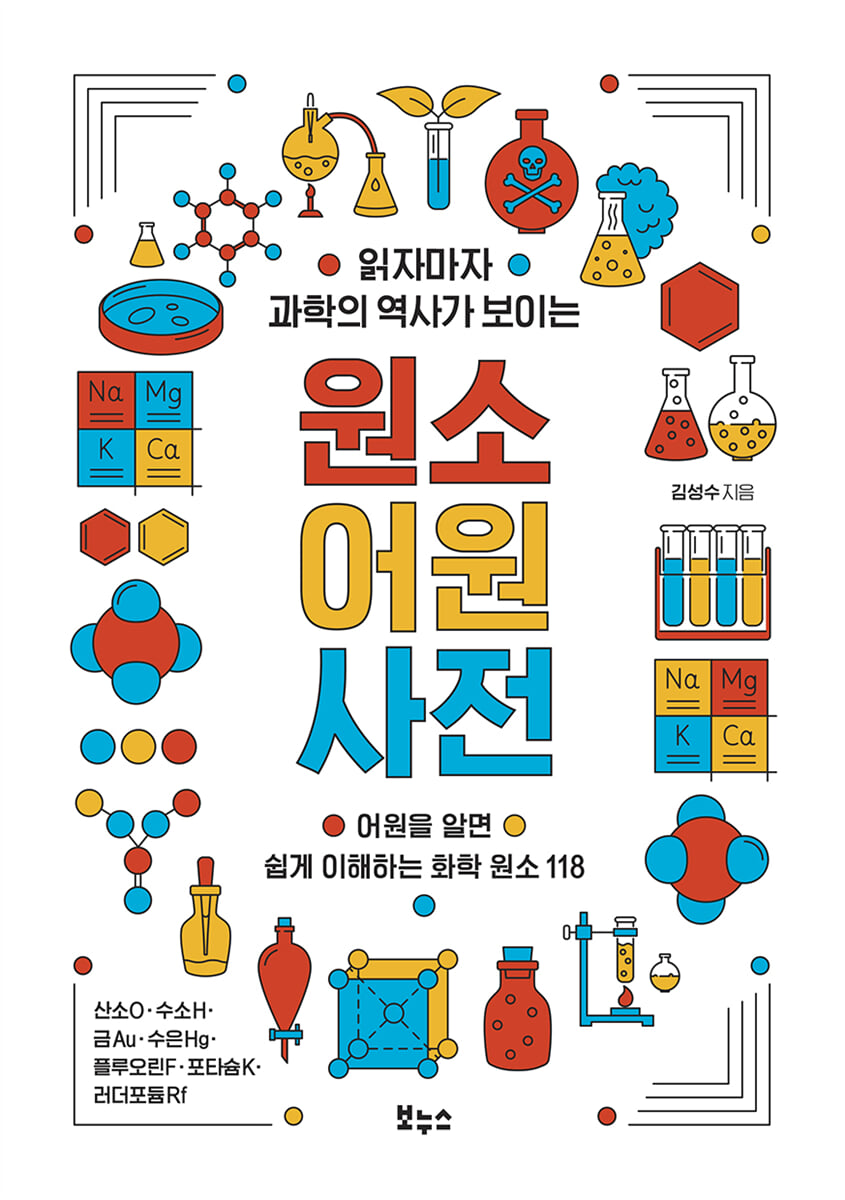
An etymological dictionary of elements that reveals the history of science as soon as you read it.
 |
Description
Book Introduction
People have constantly tried to uncover the identity of the elements that are the source of all things in the world.
When scientists finally discovered a new element after years or even decades of experimentation and research, the first thing they did was to give it a name that best represented it.
The name hydrogen must have been filled with the vision and affection of the scientist who first discovered hydrogen, and bromine must have had a reason for being named that way as well.
If we trace back the origin of the word "element," we can glimpse not only the scientific characteristics and properties of the element, but also the history of science surrounding the element, the values of the time, and the great ideas of the scientists of the time.
When scientists finally discovered a new element after years or even decades of experimentation and research, the first thing they did was to give it a name that best represented it.
The name hydrogen must have been filled with the vision and affection of the scientist who first discovered hydrogen, and bromine must have had a reason for being named that way as well.
If we trace back the origin of the word "element," we can glimpse not only the scientific characteristics and properties of the element, but also the history of science surrounding the element, the values of the time, and the great ideas of the scientists of the time.
- You can preview some of the book's contents.
Preview
index
preface
Chapter 1: Who Named the Elements?
What is a chemical element?
How would you translate the element names?
How to name elements
-Metal elements used since ancient times
-After the mid-17th century
-After the 20th century
Element names in our country
-An element widely used as a simple substance since ancient times
-Elements with names phonetized by Japanese scholars
-Revision of the Korean Chemical Society's nomenclature
Wait! Chemistry Common Sense) Yoan Udagawa
Chapter 2: The Seven Metals That Shaped Human History
CopperCu
Lead Pb
Comment Sn
Gold Au
Silver Ag
iron Fe
mercury Hg
Wait! Chemistry Tips) Claire Patterson
Chapter 3 Elements without the prefix '소'
InP
Hwang S
Zinc Zn
Platinum Pt
Chapter 4 Elements with 'So' attached
Oxygen O
Hydrogen H
Nitrogen N
Carbon C
Boron B
Silicon (Si)
Arsenic As
Wait! Chemistry Common Sense) Antoine Lavoisier
Chapter 5 Elements that Make Salt
Chlorine Cl
Fluorine F
Iodine I
Bromine Br
Wait! Chemistry Common Sense) Joseph Gay-Lussac
Chapter 6: The Noble Gaseous Elements
ArgonAr
KryptonKr
Neon
Xenon Xe
RadonRn
Helium
Wait! Chemistry Common Sense) William Ramsay
Chapter 7 Lye and Lye: The Element with Two Names
Potassium K
Sodium Na
Potassium K
Sodium Na
Wait! Chemistry Common Sense) Humphry Davy
Chapter 8: The Transfermium War
transuranium elements
Mendelevium Md
Nobelium No
Lawrencium Lr
RutherfordiumRf
DubniumDb
SibogyumSg
Wait! Chemistry Common Sense) Yuri Oganesyan
List of element names by language
Materials worth reading together
Chapter 1: Who Named the Elements?
What is a chemical element?
How would you translate the element names?
How to name elements
-Metal elements used since ancient times
-After the mid-17th century
-After the 20th century
Element names in our country
-An element widely used as a simple substance since ancient times
-Elements with names phonetized by Japanese scholars
-Revision of the Korean Chemical Society's nomenclature
Wait! Chemistry Common Sense) Yoan Udagawa
Chapter 2: The Seven Metals That Shaped Human History
CopperCu
Lead Pb
Comment Sn
Gold Au
Silver Ag
iron Fe
mercury Hg
Wait! Chemistry Tips) Claire Patterson
Chapter 3 Elements without the prefix '소'
InP
Hwang S
Zinc Zn
Platinum Pt
Chapter 4 Elements with 'So' attached
Oxygen O
Hydrogen H
Nitrogen N
Carbon C
Boron B
Silicon (Si)
Arsenic As
Wait! Chemistry Common Sense) Antoine Lavoisier
Chapter 5 Elements that Make Salt
Chlorine Cl
Fluorine F
Iodine I
Bromine Br
Wait! Chemistry Common Sense) Joseph Gay-Lussac
Chapter 6: The Noble Gaseous Elements
ArgonAr
KryptonKr
Neon
Xenon Xe
RadonRn
Helium
Wait! Chemistry Common Sense) William Ramsay
Chapter 7 Lye and Lye: The Element with Two Names
Potassium K
Sodium Na
Potassium K
Sodium Na
Wait! Chemistry Common Sense) Humphry Davy
Chapter 8: The Transfermium War
transuranium elements
Mendelevium Md
Nobelium No
Lawrencium Lr
RutherfordiumRf
DubniumDb
SibogyumSg
Wait! Chemistry Common Sense) Yuri Oganesyan
List of element names by language
Materials worth reading together
Detailed image
.jpg)
Into the book
Following the principles established by the IUPAC, newly discovered elements are named after one of the following: mythology, celestial terms, minerals, place names, properties of the elements, or names of scientists. However, elements in groups 1 to 16 are named with the suffix -ium, elements in group 17 with the suffix -ine, and elements in group 18 with the suffix -on.
Of course, this principle is not entirely new.
Although this rule had been implicitly followed before, elements with atomic numbers higher than uranium in particular came to have names that faithfully followed this rule.
--- p.28
However, apart from being easy to obtain, in the old days when there was a lack of understanding of chemistry, it seems that lead and tin were all similar substances because they had low melting points and melted quickly when heated.
Looking at the fact that another name for tin is 'sangnap', we can say that our ancestors have long considered lead and tin to be similar metals.
It is said that the ancient Romans also thought that the two metals were different only in color, so they called lead plumbum nigrum (black lead) and tin plumbum album (white lead).
--- p.47
Judging from the fact that the Annals of the Joseon Dynasty record this metal as mercury, we can see that the name mercury has been used for a long time not only in China and Japan, but also in Korea.
In other words, all East Asian people gave mercury this name because it was a 'silver-white metal that flows like water.'
I think this kind of thinking was similar in the West as well.
When the ancient Greeks called mercury, they combined the word hydor, meaning 'water', with the word argyros, meaning 'silver', and called it hydrargyros.
Meanwhile, in Latin, mercury was called argentum vivum, meaning 'living silver', because it flowed as if it were alive.
Due to this influence, mercury is also called Quecksilber, meaning living silver in modern German, and this was introduced into English as quicksilver.
--- p.65
In the past, people extracted a salt called verdigris from copper (Cu) to obtain a green pigment, and this was not an easy process.
In addition, there was a problem with the verdigris oxidizing over time and gradually turning dark brown.
The pigment called 'Shele Green', which was spotlighted as a substitute for this, was easy to synthesize and was used for not only indoor wallpaper but also clothing due to its vivid and stable green color.
However, people who were blinded by the green beauty created by Shelley Green began to suffer from unknown symptoms and die.
Later, it was discovered that the cause of all the problems was arsenic contained in Scheele green, and this once-enchanting green pigment was never used again.
--- p.118
The reason this huge photograph was called a 'bromide' is because it was developed on paper using silver bromide (AgBr) as a light-sensitive agent.
Silver bromide is called silver bromide in English, so the Japanese, who like to shorten it, initially called it [puromaido], but then settled on [bromaido], and this was introduced into Korean popular culture.
It's a little surprising that the name of a compound is so widely used in popular culture, isn't it?
--- p.138
Ramsay and Rayleigh noticed its unwillingness to react with other elements, so they created a new name, argon, by adding -on, which was attached to non-metallic substances, to the classical Greek word argos, meaning 'lazy'.
The inside of the bag is filled with nitrogen gas to prevent the candy from breaking and spoiling.
This is because nitrogen gas does not react with other substances very often.
However, when an inert atmosphere stronger than nitrogen needs to be created, argon is used.
So, almost every chemistry lab has a gas cylinder containing argon.
Although it is a machine with a lazy name, on the contrary, it can be said that it is a machine that works hard without any time to be lazy in an actual laboratory.
--- p.146
In 1961, researchers at LBNL in the United States synthesized element 98+5=103 by colliding californium Cf with boron B ions, which has atomic number 98.
They named the new element lawrencium after Ernest Lawrence, who had played a major role in developing a particle accelerator called a cyclotron and founding LBNL at the University of California.
However, the Soviet Union's JINR objected, saying that IUPAC had too hastily acknowledged the American discovery.
They claimed to have created element 95+8=103 in 1965, naming it rutherfordium after Ernest Rutherford, a New Zealand-born nuclear physicist with the same name as Lawrence.
No one could deny the fame of Rutherford, who was also a Nobel Prize winner, but JINR's proposal was an act that scratched LBNL's pride.
Of course, this principle is not entirely new.
Although this rule had been implicitly followed before, elements with atomic numbers higher than uranium in particular came to have names that faithfully followed this rule.
--- p.28
However, apart from being easy to obtain, in the old days when there was a lack of understanding of chemistry, it seems that lead and tin were all similar substances because they had low melting points and melted quickly when heated.
Looking at the fact that another name for tin is 'sangnap', we can say that our ancestors have long considered lead and tin to be similar metals.
It is said that the ancient Romans also thought that the two metals were different only in color, so they called lead plumbum nigrum (black lead) and tin plumbum album (white lead).
--- p.47
Judging from the fact that the Annals of the Joseon Dynasty record this metal as mercury, we can see that the name mercury has been used for a long time not only in China and Japan, but also in Korea.
In other words, all East Asian people gave mercury this name because it was a 'silver-white metal that flows like water.'
I think this kind of thinking was similar in the West as well.
When the ancient Greeks called mercury, they combined the word hydor, meaning 'water', with the word argyros, meaning 'silver', and called it hydrargyros.
Meanwhile, in Latin, mercury was called argentum vivum, meaning 'living silver', because it flowed as if it were alive.
Due to this influence, mercury is also called Quecksilber, meaning living silver in modern German, and this was introduced into English as quicksilver.
--- p.65
In the past, people extracted a salt called verdigris from copper (Cu) to obtain a green pigment, and this was not an easy process.
In addition, there was a problem with the verdigris oxidizing over time and gradually turning dark brown.
The pigment called 'Shele Green', which was spotlighted as a substitute for this, was easy to synthesize and was used for not only indoor wallpaper but also clothing due to its vivid and stable green color.
However, people who were blinded by the green beauty created by Shelley Green began to suffer from unknown symptoms and die.
Later, it was discovered that the cause of all the problems was arsenic contained in Scheele green, and this once-enchanting green pigment was never used again.
--- p.118
The reason this huge photograph was called a 'bromide' is because it was developed on paper using silver bromide (AgBr) as a light-sensitive agent.
Silver bromide is called silver bromide in English, so the Japanese, who like to shorten it, initially called it [puromaido], but then settled on [bromaido], and this was introduced into Korean popular culture.
It's a little surprising that the name of a compound is so widely used in popular culture, isn't it?
--- p.138
Ramsay and Rayleigh noticed its unwillingness to react with other elements, so they created a new name, argon, by adding -on, which was attached to non-metallic substances, to the classical Greek word argos, meaning 'lazy'.
The inside of the bag is filled with nitrogen gas to prevent the candy from breaking and spoiling.
This is because nitrogen gas does not react with other substances very often.
However, when an inert atmosphere stronger than nitrogen needs to be created, argon is used.
So, almost every chemistry lab has a gas cylinder containing argon.
Although it is a machine with a lazy name, on the contrary, it can be said that it is a machine that works hard without any time to be lazy in an actual laboratory.
--- p.146
In 1961, researchers at LBNL in the United States synthesized element 98+5=103 by colliding californium Cf with boron B ions, which has atomic number 98.
They named the new element lawrencium after Ernest Lawrence, who had played a major role in developing a particle accelerator called a cyclotron and founding LBNL at the University of California.
However, the Soviet Union's JINR objected, saying that IUPAC had too hastily acknowledged the American discovery.
They claimed to have created element 95+8=103 in 1965, naming it rutherfordium after Ernest Rutherford, a New Zealand-born nuclear physicist with the same name as Lawrence.
No one could deny the fame of Rutherford, who was also a Nobel Prize winner, but JINR's proposal was an act that scratched LBNL's pride.
--- p.198
Publisher's Review
Knowing the elements opens up a world full of science!
The fascinating history of science hidden in the names and etymologies of elements
The discovery of chemical elements has always marked a pivotal moment in history.
From copper and tin, which ushered in the Bronze Age, which marked the beginning of human history on Earth, to oxygen, which shattered the phlogiston theory, an old-fashioned relic symbolizing irrationality, to uranium, which became the starting point of the greatest and most dangerous discipline called 'nuclear chemistry', elements are like crystals that symbolize the scientific achievements and advancements that humans have made.
But even while studying such an important element, there is one question that people rarely ask.
'Who on earth named the elements, and how?'
There is an idiom called “a person’s reputation is his own nature.”
It means that 'a name immediately reveals the nature of that being.'
As the saying goes, when we first meet someone we don't know, the first thing we ask is their name.
Because I believe that only by knowing the name can you know who this person is.
In this way, the names of chemical elements contain the principles and history of science, as well as the blood and sweat shed by scientists.
Let's focus on the etymology of element names, which we haven't paid attention to in chemistry classes so far.
The moment you understand the roots of why elements are given their names, you will realize the essence of the elements that form the foundation of science and the world and the universe.
From the elements that formed the universe to those created by humans.
A story of chemical elements that embraces the world's science, history, and culture.
What was the first element discovered and used by humans? For example, copper and iron were widely used in places where Bronze and Iron Age civilizations developed, regardless of whether they were in the East or the West.
However, it is not clear exactly who first discovered these elements or what their names are.
Instead, these historic elements were given names that reflected the history, values, and culture of the people at the time.
In this way, we can glimpse the history of the world through the names of elements that vary in each region and language.
For example, the element 'copper', which is a pure Korean word, is deeply related to ancient Korean.
In the old days, Koreans called fire 'gut' or 'gul'.
Words derived from here are words related to fire, such as gudeul, geulli-da, geul-da, chimney, and bowl.
Because copper, unlike other metals, has a red color, it was given the name 'guri', which is derived from 'gul', meaning red metal.
Meanwhile, in English, copper is called copper [cooper], and this name is closely related to the region.
During the Bronze Age, the most famous place for bronze production in Europe was the island of Cyprus.
Therefore, the most plausible theory is that the Latin word cyprium, referring to the island of Cyprus, changed to cuprum, which then became the current copper.
The names of not only elements known since ancient times but also those of the transuranium elements discovered in modern times, such as mendelevium, nobelium, rutherfordium, and seaborgium, reflect the 20th century's modern history of scientific and technological advancement and the resulting conflicts.
The results of the fierce battle between the two nuclear development camps, represented by the Soviet Union and the United States, are reflected in the names of the elements.
Elements with such profound and bizarre stories that they only finally have names after more than 40 years of discovery still exist throughout society.
The principles of chemistry and the properties of substances contained in the elements
If you want to understand the essence of science, read the names of the elements!
Long ago, the ancient Greek philosopher Thales said that all things were made of water, and Aristotle argued that the world was made of four elements: water, fire, earth, and air.
Then, in the 18th century, French chemist Antoine Lavoisier, known as the 'father of modern chemistry', first proposed 33 elements with a concept similar to the chemical elements we know today.
Since then, countless scientists have continued to conduct research, and as a result, phenomena and components of the world that were previously known only through experience have been gradually revealed.
The English name for mercury, mercury, contains the ideas of alchemists who connected Western medieval culture, astronomical phenomena, and the order of the solar system, and the name for silicon, silicon, clearly shows how science and technology have changed from flint, which humans first used to make fire, to Silicon Valley, the high-tech industrial complex in the United States.
The Chinese character name, silicon (硅素), also shows that the inanimate metallic element silicon is closely related to the marine organism diatom.
To understand the order of the world, we must know the science that creates its laws, and to understand the essence of science, we must know the elements that form the basis of all matter.
The moment you read the story behind the discovery of the elements that make up the universe and their etymology, your eyes will be wide open to science.
The fascinating history of science hidden in the names and etymologies of elements
The discovery of chemical elements has always marked a pivotal moment in history.
From copper and tin, which ushered in the Bronze Age, which marked the beginning of human history on Earth, to oxygen, which shattered the phlogiston theory, an old-fashioned relic symbolizing irrationality, to uranium, which became the starting point of the greatest and most dangerous discipline called 'nuclear chemistry', elements are like crystals that symbolize the scientific achievements and advancements that humans have made.
But even while studying such an important element, there is one question that people rarely ask.
'Who on earth named the elements, and how?'
There is an idiom called “a person’s reputation is his own nature.”
It means that 'a name immediately reveals the nature of that being.'
As the saying goes, when we first meet someone we don't know, the first thing we ask is their name.
Because I believe that only by knowing the name can you know who this person is.
In this way, the names of chemical elements contain the principles and history of science, as well as the blood and sweat shed by scientists.
Let's focus on the etymology of element names, which we haven't paid attention to in chemistry classes so far.
The moment you understand the roots of why elements are given their names, you will realize the essence of the elements that form the foundation of science and the world and the universe.
From the elements that formed the universe to those created by humans.
A story of chemical elements that embraces the world's science, history, and culture.
What was the first element discovered and used by humans? For example, copper and iron were widely used in places where Bronze and Iron Age civilizations developed, regardless of whether they were in the East or the West.
However, it is not clear exactly who first discovered these elements or what their names are.
Instead, these historic elements were given names that reflected the history, values, and culture of the people at the time.
In this way, we can glimpse the history of the world through the names of elements that vary in each region and language.
For example, the element 'copper', which is a pure Korean word, is deeply related to ancient Korean.
In the old days, Koreans called fire 'gut' or 'gul'.
Words derived from here are words related to fire, such as gudeul, geulli-da, geul-da, chimney, and bowl.
Because copper, unlike other metals, has a red color, it was given the name 'guri', which is derived from 'gul', meaning red metal.
Meanwhile, in English, copper is called copper [cooper], and this name is closely related to the region.
During the Bronze Age, the most famous place for bronze production in Europe was the island of Cyprus.
Therefore, the most plausible theory is that the Latin word cyprium, referring to the island of Cyprus, changed to cuprum, which then became the current copper.
The names of not only elements known since ancient times but also those of the transuranium elements discovered in modern times, such as mendelevium, nobelium, rutherfordium, and seaborgium, reflect the 20th century's modern history of scientific and technological advancement and the resulting conflicts.
The results of the fierce battle between the two nuclear development camps, represented by the Soviet Union and the United States, are reflected in the names of the elements.
Elements with such profound and bizarre stories that they only finally have names after more than 40 years of discovery still exist throughout society.
The principles of chemistry and the properties of substances contained in the elements
If you want to understand the essence of science, read the names of the elements!
Long ago, the ancient Greek philosopher Thales said that all things were made of water, and Aristotle argued that the world was made of four elements: water, fire, earth, and air.
Then, in the 18th century, French chemist Antoine Lavoisier, known as the 'father of modern chemistry', first proposed 33 elements with a concept similar to the chemical elements we know today.
Since then, countless scientists have continued to conduct research, and as a result, phenomena and components of the world that were previously known only through experience have been gradually revealed.
The English name for mercury, mercury, contains the ideas of alchemists who connected Western medieval culture, astronomical phenomena, and the order of the solar system, and the name for silicon, silicon, clearly shows how science and technology have changed from flint, which humans first used to make fire, to Silicon Valley, the high-tech industrial complex in the United States.
The Chinese character name, silicon (硅素), also shows that the inanimate metallic element silicon is closely related to the marine organism diatom.
To understand the order of the world, we must know the science that creates its laws, and to understand the essence of science, we must know the elements that form the basis of all matter.
The moment you read the story behind the discovery of the elements that make up the universe and their etymology, your eyes will be wide open to science.
GOODS SPECIFICS
- Date of issue: September 20, 2023
- Page count, weight, size: 224 pages | 446g | 148*210*15mm
- ISBN13: 9788964946534
You may also like
카테고리
korean


korean

![GQ KOREA Mark (Monthly): December [2025]](http://librairie.coreenne.fr/cdn/shop/files/8ef265dbbfbf186523ed75ba7319009d.jpg?v=1765340328&width=3840)


