

Western music history
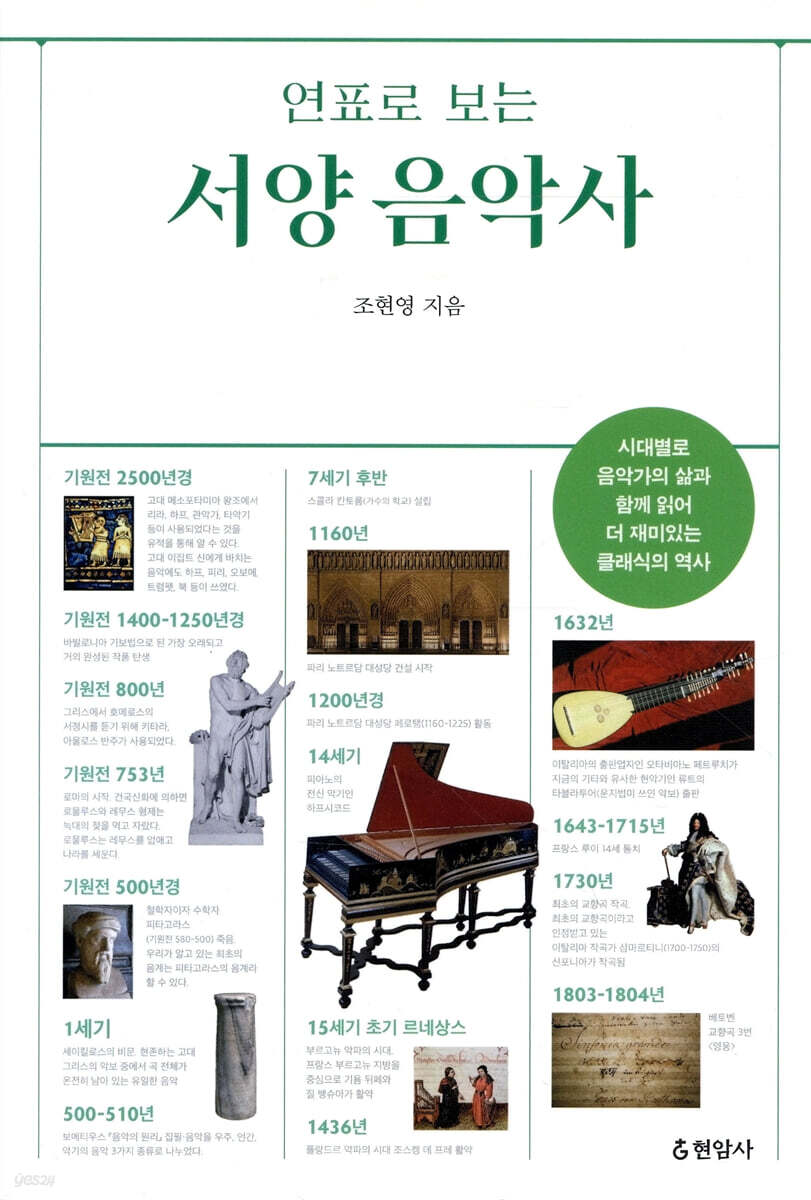 |
Description
Book Introduction
Read along with the lives of musicians by era
A more interesting history of classics
The second installment of Hyeonamsa's "Chronology Series," "Western Music History," has been published!
Where did the word "music" originate? When did the names of notes, keys like C major and D major, and symbols representing music first emerge? When did these first come to be recorded and performed in sheet music form, and how has the history of those who create and perform music evolved to the present day?
Following 'Western Art History', the second book in the Hyeonamsa Chronology series, 'Western Music History in Chronology', organizes the complex and long history of classical music in chronological order, from ancient music to Baroque, Classical, Romantic, and modern times.
Familiar names and pieces from Bach, Vivaldi, Mozart, Beethoven, Erik Satie, and Leonard Bernstein are presented in connection with the flow of history that formed the background of the time, allowing for a deeper understanding of the language of the times called music.
Unlike previous Western music history books that were so thick that it was difficult to read, this book is not burdensome and is easy to read at any time, as it unfolds the story of the musicians and their lives by era.
There is a strong perception that music, unlike painting, is an invisible art form that can only be understood by those who can read sheet music.
This book, with its rich photographic material and the story of the musician's life, helps to alleviate some of the difficulties of the invisible art of music.
From the origins of music to modern classical music, you can discover the traces of music hidden in vivid photos of historical figures and beautiful works of art, and learn that classical music has been stirring people's hearts for a very long time.
A more interesting history of classics
The second installment of Hyeonamsa's "Chronology Series," "Western Music History," has been published!
Where did the word "music" originate? When did the names of notes, keys like C major and D major, and symbols representing music first emerge? When did these first come to be recorded and performed in sheet music form, and how has the history of those who create and perform music evolved to the present day?
Following 'Western Art History', the second book in the Hyeonamsa Chronology series, 'Western Music History in Chronology', organizes the complex and long history of classical music in chronological order, from ancient music to Baroque, Classical, Romantic, and modern times.
Familiar names and pieces from Bach, Vivaldi, Mozart, Beethoven, Erik Satie, and Leonard Bernstein are presented in connection with the flow of history that formed the background of the time, allowing for a deeper understanding of the language of the times called music.
Unlike previous Western music history books that were so thick that it was difficult to read, this book is not burdensome and is easy to read at any time, as it unfolds the story of the musicians and their lives by era.
There is a strong perception that music, unlike painting, is an invisible art form that can only be understood by those who can read sheet music.
This book, with its rich photographic material and the story of the musician's life, helps to alleviate some of the difficulties of the invisible art of music.
From the origins of music to modern classical music, you can discover the traces of music hidden in vivid photos of historical figures and beautiful works of art, and learn that classical music has been stirring people's hearts for a very long time.
- You can preview some of the book's contents.
Preview
index
Opening remarks: Classical music, music that will be with us forever.
1.
The Beginning of Music: From Antiquity to the Renaissance
2.
Baroque music
3.
classical music
4.
Romantic music
5.
contemporary music
Find a person's name
References
1.
The Beginning of Music: From Antiquity to the Renaissance
2.
Baroque music
3.
classical music
4.
Romantic music
5.
contemporary music
Find a person's name
References
Detailed image

Into the book
The voice that is born with the body itself when a human is born is vocal music, the beginning of music.
If we were to guess by looking at the cave paintings, the first instruments that would have been used would have been percussion instruments and drums that made sounds by striking stones or animal bones.
Since musical instruments are made by using objects to produce sound, there would have been percussion instruments made of animal bones, stones, shells, etc., wind instruments made by making holes in animal bones and letting air pass through them, and string instruments made by rubbing horse tail hairs.
---From "The Beginning of Music"
The ancient Greeks considered poetry a fundamental subject and made it compulsory for children to learn singing and playing musical instruments until they were 14 years old.
The Greeks believed that music influenced human emotions and feelings of love, and therefore argued that listening to good music would make one a better person.
This is the ethos theory.
---From "The Beginning of Music"
The first image of Baroque is far from what we think of today as elegant and noble.
To those accustomed to the orderly art of the Renaissance, the Baroque seemed strange, extremely barbaric, and decadent.
The word "Baroque," which first appeared in a 1733 review of Jean-Philippe Rameau's opera "Hippolyte et Aricie," referred to a vulgar music characterized by inconsistent and dissonant melodies, frequent changes in meter and key, and a very fast tempo.
The philosopher Jean-Jacques Rousseau criticized Baroque music, saying that it was full of chaotic harmonies, modulations, and dissonances, and that the songs were jarring and abnormal, difficult to sing in precise pitch, and monotonous in movement.
It was not until the late 19th century that this period began to be referred to as the Baroque period.
---From "Baroque Music"
The Classical period can be said to be the greatest golden age in the history of music.
He further developed the musical techniques inherited from the previous Baroque era, and filled in any shortcomings or imperfections to perfection.
In the classical period, attempts were made to create very old-fashioned and strict, yet at the same time free and diverse forms.
As the power of the absolute monarchy, which seemed destined to last forever, weakened, the French Revolution broke out in 1789.
The deaths of Louis XVI and Marie Antoinette on the guillotine and the Citizens' Revolution are historically and culturally significant events.
---From "Classical Music"
Artists of the time considered music to be the greatest art form of the time, as they believed it could express all aspects of the romantic sensibility that humans sought.
The musicians have captured here stories of nostalgia, desire, aspiration for the infinite, longing, fantasy, and dreams.
In particular, in the early 19th century, opera composers emerged in large numbers, leading to the rapid development of operas with dramatic narratives.
The publishing market for musical scores and the development of musical instruments were also active. As musical instruments developed, the ways of using them also diversified, and composers began to incorporate high-level performance techniques into their scores.
---From "Romantic Music"
Contemporary music is a music that takes pluralism (recognizing diversity) and dissonance, atonality, irregularity, and destruction for granted.
Although we live in modern times, it takes time and effort to truly understand modern music.
To feel music with your whole body, you must understand the world we live in and the imaginary world created by the individual composer.
Contemporary music can be an art form that brings empathy and emotion to some, but to others, it can be an endlessly difficult noise to listen to.
But in some way, the new world is moving forward.
Music emerged in a time when universal standards were no longer feasible.
If we were to guess by looking at the cave paintings, the first instruments that would have been used would have been percussion instruments and drums that made sounds by striking stones or animal bones.
Since musical instruments are made by using objects to produce sound, there would have been percussion instruments made of animal bones, stones, shells, etc., wind instruments made by making holes in animal bones and letting air pass through them, and string instruments made by rubbing horse tail hairs.
---From "The Beginning of Music"
The ancient Greeks considered poetry a fundamental subject and made it compulsory for children to learn singing and playing musical instruments until they were 14 years old.
The Greeks believed that music influenced human emotions and feelings of love, and therefore argued that listening to good music would make one a better person.
This is the ethos theory.
---From "The Beginning of Music"
The first image of Baroque is far from what we think of today as elegant and noble.
To those accustomed to the orderly art of the Renaissance, the Baroque seemed strange, extremely barbaric, and decadent.
The word "Baroque," which first appeared in a 1733 review of Jean-Philippe Rameau's opera "Hippolyte et Aricie," referred to a vulgar music characterized by inconsistent and dissonant melodies, frequent changes in meter and key, and a very fast tempo.
The philosopher Jean-Jacques Rousseau criticized Baroque music, saying that it was full of chaotic harmonies, modulations, and dissonances, and that the songs were jarring and abnormal, difficult to sing in precise pitch, and monotonous in movement.
It was not until the late 19th century that this period began to be referred to as the Baroque period.
---From "Baroque Music"
The Classical period can be said to be the greatest golden age in the history of music.
He further developed the musical techniques inherited from the previous Baroque era, and filled in any shortcomings or imperfections to perfection.
In the classical period, attempts were made to create very old-fashioned and strict, yet at the same time free and diverse forms.
As the power of the absolute monarchy, which seemed destined to last forever, weakened, the French Revolution broke out in 1789.
The deaths of Louis XVI and Marie Antoinette on the guillotine and the Citizens' Revolution are historically and culturally significant events.
---From "Classical Music"
Artists of the time considered music to be the greatest art form of the time, as they believed it could express all aspects of the romantic sensibility that humans sought.
The musicians have captured here stories of nostalgia, desire, aspiration for the infinite, longing, fantasy, and dreams.
In particular, in the early 19th century, opera composers emerged in large numbers, leading to the rapid development of operas with dramatic narratives.
The publishing market for musical scores and the development of musical instruments were also active. As musical instruments developed, the ways of using them also diversified, and composers began to incorporate high-level performance techniques into their scores.
---From "Romantic Music"
Contemporary music is a music that takes pluralism (recognizing diversity) and dissonance, atonality, irregularity, and destruction for granted.
Although we live in modern times, it takes time and effort to truly understand modern music.
To feel music with your whole body, you must understand the world we live in and the imaginary world created by the individual composer.
Contemporary music can be an art form that brings empathy and emotion to some, but to others, it can be an endlessly difficult noise to listen to.
But in some way, the new world is moving forward.
Music emerged in a time when universal standards were no longer feasible.
---From "Modern Music"
Publisher's Review
Why do we need to know the flow of history to listen to classical music?
Observing the evolution of classical music over time is not only fascinating, but also allows us to appreciate the music more deeply and richly.
For example, the word baroque, which appeared in the 16th century, means 'a distorted and warped pearl', and was used in a derogatory way by people at the time to mean something strange, uncivilized, or decadent.
It began to develop as a means of expressing the Counter-Reformation in a strictly Catholic country, and so it took on a more ornate and exaggerated form.
Baroque music, once criticized as "vulgar music," remains with us today as rich and diverse music that transcended the rigidity of the era.
Also, after the French Revolution of 1789, the music of the time underwent a great change as people expressed their will for freedom, equality, and their rights that had been suppressed for so long.
Understanding how the Civil War and the Enlightenment transformed music, and how the classical music of that period was imbued with a yearning for freedom, will allow you to appreciate classical music more deeply.
This is the most important reason why you need to know the history of classical music.
All music has evolved slowly to the present day, influenced by composers of previous eras, reflecting the times, or through the changes of individual composers.
That is why listening to music today is an exercise in understanding the era in which the composer lived and hearing the composer's language.
The reason we need to understand classics in relation to each era is to continue this conversation.
From the origins of music to modern classical music
A history of classics that have shaken our hearts
Even for those who love classical music, Western music history is a boring and difficult subject.
The author also said that when he was a student, he wanted to avoid thick books on the history of Western music, but the more he listened to music, the more he realized that appreciating music without a comprehensive knowledge of Western music history was like understanding the world by only touching an elephant's leg.
This book, born from that experience, presents a list of 100 must-listen composers in Western music history, presented in a light-hearted manner.
It's not too much content, but it's not superficial either. I've organized the composers you absolutely must meet by era and trend.
I hope that through this book, you will discover new aspects of familiar music and have exciting encounters with new musicians.
*Hyeonamsa's 'Chronology Series' continues!
Observing the evolution of classical music over time is not only fascinating, but also allows us to appreciate the music more deeply and richly.
For example, the word baroque, which appeared in the 16th century, means 'a distorted and warped pearl', and was used in a derogatory way by people at the time to mean something strange, uncivilized, or decadent.
It began to develop as a means of expressing the Counter-Reformation in a strictly Catholic country, and so it took on a more ornate and exaggerated form.
Baroque music, once criticized as "vulgar music," remains with us today as rich and diverse music that transcended the rigidity of the era.
Also, after the French Revolution of 1789, the music of the time underwent a great change as people expressed their will for freedom, equality, and their rights that had been suppressed for so long.
Understanding how the Civil War and the Enlightenment transformed music, and how the classical music of that period was imbued with a yearning for freedom, will allow you to appreciate classical music more deeply.
This is the most important reason why you need to know the history of classical music.
All music has evolved slowly to the present day, influenced by composers of previous eras, reflecting the times, or through the changes of individual composers.
That is why listening to music today is an exercise in understanding the era in which the composer lived and hearing the composer's language.
The reason we need to understand classics in relation to each era is to continue this conversation.
From the origins of music to modern classical music
A history of classics that have shaken our hearts
Even for those who love classical music, Western music history is a boring and difficult subject.
The author also said that when he was a student, he wanted to avoid thick books on the history of Western music, but the more he listened to music, the more he realized that appreciating music without a comprehensive knowledge of Western music history was like understanding the world by only touching an elephant's leg.
This book, born from that experience, presents a list of 100 must-listen composers in Western music history, presented in a light-hearted manner.
It's not too much content, but it's not superficial either. I've organized the composers you absolutely must meet by era and trend.
I hope that through this book, you will discover new aspects of familiar music and have exciting encounters with new musicians.
*Hyeonamsa's 'Chronology Series' continues!
GOODS SPECIFICS
- Date of issue: March 3, 2023
- Page count, weight, size: 272 pages | 500g | 152*224*15mm
- ISBN13: 9788932322841
- ISBN10: 8932322848
You may also like
카테고리
korean


korean

![GQ KOREA Mark (Monthly): December [2025]](http://librairie.coreenne.fr/cdn/shop/files/8ef265dbbfbf186523ed75ba7319009d.jpg?v=1765340328&width=3840)


