

A Walk with Apes
 |
Description
Book Introduction
To understand and respect chimpanzees, gorillas, and orangutans
The Story of Three Female Scientists Who Changed Science and the World
50 Recommended Books Selected for the Seoul Metropolitan Office of Education's In-Depth Reading and Discussion Program
Today, as the number of lives suffering from the climate crisis increases,
A book that makes you think about how humans should relate to animals.
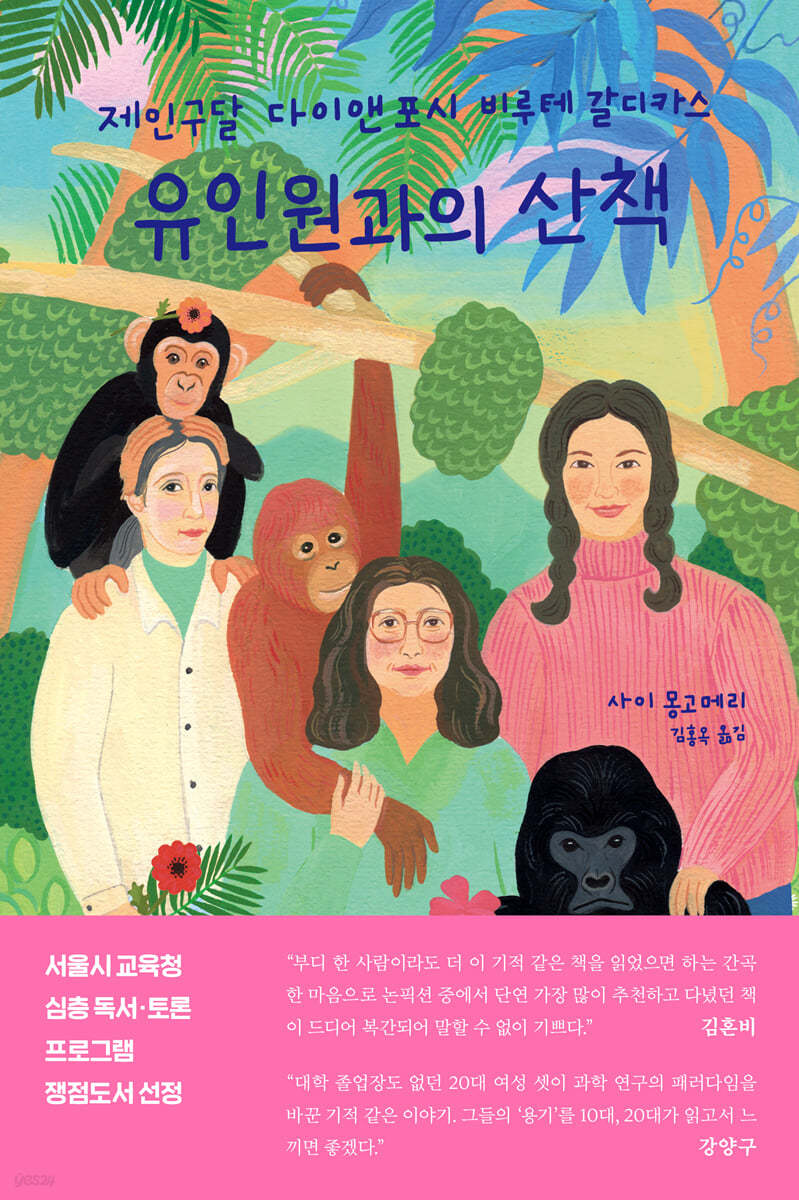
This book provides a three-dimensional introduction to the lives and research of three women who changed the paradigm of animal research: Jane Goodall, Dian Fossey, and Birute Galdikas, as well as the chimpanzees, gorillas, and orangutans they developed relationships with, and the rainforests of Africa and Borneo where these animals live.
In 2010, around the time the revised edition of the original book came out, Jane Goodall's Gombe Institute celebrated its 50th anniversary, and in 2017, Dian Fossey's Karisoke Centre celebrated its 50th anniversary.
Birute Galdikas' Orangutan Foundation continues to treat and care for orphaned and captive orangutans, releasing them back into the wild. (The volunteer program, which was suspended due to COVID-19, also announced on social media that it will resume in 2024.)
Human and animal refugees pouring out from all over the world due to disasters such as wildfires and floods caused by the climate crisis, as well as wars and civil wars (which are in some ways not entirely unrelated to the climate crisis); livestock that are increasingly produced and consumed like industrial products in factory farms; wild animals that are not only endangered due to the loss of their habitats but also suffer from infectious diseases due to increased contact with humans; animals suffering in poor environments in medical laboratories and clothing factories; animals living in indoor and outdoor animal experience centers and zoos; and on the other hand, the number of companion animals that are increasing and animals that are now living in sanctuaries.
In today's world, where humans and animals are more intricately intertwined than ever before, this book challenges us to transcend all preconceptions and presumptions and fundamentally reflect, explore, and act on how humans should relate to animals and nature.
The Story of Three Female Scientists Who Changed Science and the World
50 Recommended Books Selected for the Seoul Metropolitan Office of Education's In-Depth Reading and Discussion Program
Today, as the number of lives suffering from the climate crisis increases,
A book that makes you think about how humans should relate to animals.
This book provides a three-dimensional introduction to the lives and research of three women who changed the paradigm of animal research: Jane Goodall, Dian Fossey, and Birute Galdikas, as well as the chimpanzees, gorillas, and orangutans they developed relationships with, and the rainforests of Africa and Borneo where these animals live.
In 2010, around the time the revised edition of the original book came out, Jane Goodall's Gombe Institute celebrated its 50th anniversary, and in 2017, Dian Fossey's Karisoke Centre celebrated its 50th anniversary.
Birute Galdikas' Orangutan Foundation continues to treat and care for orphaned and captive orangutans, releasing them back into the wild. (The volunteer program, which was suspended due to COVID-19, also announced on social media that it will resume in 2024.)
Human and animal refugees pouring out from all over the world due to disasters such as wildfires and floods caused by the climate crisis, as well as wars and civil wars (which are in some ways not entirely unrelated to the climate crisis); livestock that are increasingly produced and consumed like industrial products in factory farms; wild animals that are not only endangered due to the loss of their habitats but also suffer from infectious diseases due to increased contact with humans; animals suffering in poor environments in medical laboratories and clothing factories; animals living in indoor and outdoor animal experience centers and zoos; and on the other hand, the number of companion animals that are increasing and animals that are now living in sanctuaries.
In today's world, where humans and animals are more intricately intertwined than ever before, this book challenges us to transcend all preconceptions and presumptions and fundamentally reflect, explore, and act on how humans should relate to animals and nature.
- You can preview some of the book's contents.
Preview
index
● Recommendation for the revised edition: Elizabeth Marshall Thomas
● Preface
Part 1: Parents
1 Birute Galdikas and Sufina
2 Jane Goodall and Flo
3 Dian Fossey and Digit
Part 2 Scientists
4 Louis Leakey and the Ape Women
5 Jane Goodall, Beyond Authoritative Science
6 Dian Fossey, The Sacrifice of Niramakaveli
7 Birute Galdikas, Endless Challenge
Part 3: Female Warriors
Exercise 8: Jane Goodall's Dilemma
9 Magic: The Madness of Dian Fossey
10 Diplomacy: The Transformation of Birute Galdikas
● Review: Shamans
● Acknowledgements
Translator's Note
● References
● Preface
Part 1: Parents
1 Birute Galdikas and Sufina
2 Jane Goodall and Flo
3 Dian Fossey and Digit
Part 2 Scientists
4 Louis Leakey and the Ape Women
5 Jane Goodall, Beyond Authoritative Science
6 Dian Fossey, The Sacrifice of Niramakaveli
7 Birute Galdikas, Endless Challenge
Part 3: Female Warriors
Exercise 8: Jane Goodall's Dilemma
9 Magic: The Madness of Dian Fossey
10 Diplomacy: The Transformation of Birute Galdikas
● Review: Shamans
● Acknowledgements
Translator's Note
● References
Detailed image

Into the book
They were all passionate about their apes.
I saw all three women together at a symposium in New York before Diane was murdered.
At the time, I was somewhat puzzled by the way each of them tried to outdo the other by showing 'in what way their ape was most like a human.'
They put a lot of effort into making their animals more appealing to the audience.
Birute said orangutans are most similar to humans in that they have white sclera.
Diane argued that mountain gorillas are the most human-like because of their strong family bonds.
Jane was at pains to remind us that chimpanzees are the apes most closely related to humans, as their genetic material is 99 percent identical to ours.
Looking at them, I thought of children who would cry, “My dad beats your dad,” or grandmothers who would fiercely insist that their grandchild was better than theirs.
Neither of them intended to disparage the other's work, but they never wavered in their belief that the animals they loved were the best.
They all loved their animals.
The love was deep and passionate, like the love for a child, spouse, or lover.
But it was a love unlike any other.
The bonds these women formed with the apes they studied were complex, nuanced, and defy simple understanding.
--- p.34
Birute doesn't particularly resent Lord for abandoning her.
While Birute devoted seven years to observing wild orangutans, Lord devoted himself to clearing roads through the sweltering, leech-infested swamps and negotiating with Indonesian officials.
For the first few months after arriving there, the couple used the camp as a rehabilitative center for captured orphaned orangutans confiscated by the Indonesian government.
From then on, Birute and Rod had up to five young orangutans in their bed at a time, who bit them, clung to them, and screamed.
The orangutans tore apart the cotton from their bed mattresses and tore down the thatched roofs of their huts in search of food.
At the table, he would shovel rice into his mouth, and when no one was looking, he would secretly put pills in his tea.
I sniffed shampoo, swallowed toothpaste, and even sucked up fountain pen ink.
As he left Birute, Lord said in a dejected tone, "You love the orangutan more than I do."
--- p.36
Birute doesn't pretend to know what's in the orangutan's head.
But we know very well that they have memories.
In 1987, Birute saw Purn and Fran again in the canopy of the jungle.
The mother and daughter, who met for the first time in about ten years, recognized each other, hugged each other, and spent four days together.
--- p.55
Older Flo has a sense of history.
She had experienced decades of pain, birth and death, triumph and sorrow that Jane could never have imagined.
This old chimpanzee bears the scars of battle all over his body.
The tattered ears testified to past events, illnesses, and countless battles won and lost.
Jane spoke of Flo with admiration, calling her "a tough survivor to the end."
What does Flo remember from her youth?
Jane always wondered about that.
--- p.61
Jane saw in these chimpanzees the origins of the traits that define us as human: human imagination, human play, and the ability to connect with others through contact.
In the lives of the Gombe chimpanzees, Jane saw the human heritage and the distant past of our lineage.
And in Flo's deep eyes, he could vaguely see his future.
--- p.66
Dian Fossey suffered from asthma since childhood and was already a heavy smoker in her teens.
The lung X-ray I took when I graduated from college looked like "a New York street map superimposed on a Los Angeles street map."
Now, after eight years living high in the oxygen-starved crater of the Virunga volcano in central Africa, her lungs are practically useless from the cold, humid night air.
--- p.86
That day, Digit and Diane had a long and deep conversation.
At that time, Digit had already known Diane for seven years.
She has been there for Digit as he has grown from a boy to a young black-backed man, and now to a silver-backed sentinel.
Digit had been with Diane longer than his own mother, who may have died before he was five, or may have left the group altogether.
Likewise, Diane had been with her longer than her old silverback father, who died of natural causes about a year after she first discovered him.
When Digit was nine years old, three females of the same age from Group 4 left him.
It is a common occurrence for young females to be kidnapped by silverbacks from rival groups.
Digit took Diane as his playmate instead.
He sometimes broke away from the group to walk closer to Diane.
Digit touched Diane's things, sniffed her gloves and jeans, and even tugged gently at her long brown hair.
--- p.92
Adult gorillas fight to the death to defend their families.
This is why poachers must kill the entire adult family when trying to steal a baby gorilla for the zoo.
--- p.95
At first, Diane watched the animal from a distance, hiding and holding her breath.
Then, over several months, he slowly began to make his presence known.
First, they imitated the sound they make when they are satisfied.
He let out a clear sound from deep within his throat, saying, 'Naum naum naum.'
I also munched on crunchy wild celery stalks.
He also scratched his body for a long time, hunched over like a gorilla and looking away.
Finally, Diane got close enough to smell their body odor, see the furrows in the roof of their mouths when they yawned, and even without binoculars, see the cuticles of their black, human-like fingernails.
--- p.95
One time, Diane discovered Group 4 on the other side of a narrow, steep valley.
But she was too weak to cross over there.
Then Uncle Bert, seeing her, led the whole herd across the valley towards her.
Digit stood at the very end of the line.
Diane wrote:
"Soon he came to me and gently stroked my hair.
"I wanted to give them everything I had, if only I could," Diane said, occasionally crying with joy.
She is the chosen one.
The wild gorilla stubbornly approached her.
--- p.99
Ian didn't see Diane cry that day.
He recalled that she had an almost superhuman level of emotional control.
No matter how much she cried, recited any spells or prayed, the pain of losing her digits could not be alleviated.
One day, several years later, Diane filled a page of her diary with just one word, writing over and over again.
"Digit digit digit digit digit digit......."
--- p.115
But Jane decided to sleep in the open that night and not do any experiments or manipulations.
Her research was approached solely with trust as her weapon.
Jane just hoped the chimpanzees would accept her silence into their lives.
--- p.157
During the first 18 months, Jane did not quantify her research through surveying.
She wrote in words, not numbers.
I didn't start with any theory.
Instead, he willingly accepted the drama unfolding before him and wrote down what he saw and felt.
She focused on each individual rather than some general archetype.
Jane's chimpanzees were each named, not numbered.
At a time when ethology was becoming increasingly theoretical, impersonal, experimentally controlled, and statistical, she insisted on an intuitive, personal, receptive, and narrative approach.
--- p.169
Jane's Cambridge supervisor, Robert Hinde, expressed bewilderment at her methodology.
Hinde forced her to measure and quantify and to do quantitative analysis.
He suggested something like, "When you return to Gombe, measure the distance between the chimpanzees' feeding grounds and the forest canopy where they play."
Hinde persistently argued that only numbers, not narratives, could tell us scientific truth, and that only statistics, not intuition, could reveal empirical reality.
Hinde, a respected British ethologist, was at the forefront of those in the field struggling to transform from naturalist to scientist.
The naturalist, who was considered a leading self-taught researcher in the 19th and early 20th centuries, only wrote in scribbled notes.
Meanwhile, in the 1960s, a new generation of bright young male scientists in white coats emerged and were seen as the world's saviors.
--- p.170
Harlow's experiments were conducted with the primate's mind and emotions under control to a level of sophistication that was undreamed of.
The experimental devices he devised are as plentiful as a Christmas shopping list.
The 'Well of Despair' is a solitary confinement cell designed to induce extreme depression in baby monkeys for research purposes.
He even created a surrogate mother, the "Iron Lady," who concealed nails that would appear at the experimenter's press of a button.
This creation, like his other 'evil mothers', demonstrated that even when a mother is inherently cruel and vicious, her young desperately need her comfort.
He also developed a 'rape platform', a device that immobilized female monkeys while artificially impregnating them.
Harlow even went so far as to artificially produce far more offspring than healthy wild animals could produce, in order to provide research animals for other laboratories.
--- p.185
"Some scientists frown upon this practice, saying that nature is destined to die out in such a way," Jane wrote in The Chimpanzees of Gombe, the scholarly culmination of her first 26 years of research.
"But I think some degree of positive intervention is actually desirable, because humans have already interfered with many animals in many places to a significant degree, often in very negative ways."
--- p.190
The emptiness of being left alone tormented her for weeks.
Diane had no desire to listen to the shortwave radio that Lewis had insisted she take, to read the popular science books she had brought, or even to use the typewriter.
"Anything that could communicate with the outside world only made me feel more lonely," she wrote.
Only when Diane confronted her longing and loneliness in the pitch-black abyss of the African night could she finally purify herself.
After emptying herself through harsh solitude and becoming a clear and spacious vessel, she was finally able to fill that space with the lives of the animals she studied.
--- p.218
Diane and her gorillas never received the same amount of attention as Jane and her chimpanzees.
Diane uncovered important facts about gorilla life.
Females can migrate from their original group to another, either voluntarily or through raids by rival silverbacks; raiding silverbacks often kill their offspring to arouse the females during mating; and gorillas will even eat their own feces to recycle nutrients.
However, these facts are overshadowed by chimpanzee behaviors that make them appear much more human-like, such as meat-eating, tool use, cannibalism, and warfare.
--- p.240
But it took more than two and a half years after Birute and Lewis's first meeting to secure funding for orangutan research.
When her departure was delayed so long that Louise suggested to her one day that she study bonobos in Zaire instead of orangutans.
But just as Diane insisted on studying mountain gorillas to the end, Birute also did not give up on his insistence on studying orangutans.
--- p.268
The orangutans revealed themselves very slowly.
It was not until eight years later that Birute was able to see an orangutan using a tool.
A male scratched his buttocks with a piece of wood for 25 seconds.
I saw all three women together at a symposium in New York before Diane was murdered.
At the time, I was somewhat puzzled by the way each of them tried to outdo the other by showing 'in what way their ape was most like a human.'
They put a lot of effort into making their animals more appealing to the audience.
Birute said orangutans are most similar to humans in that they have white sclera.
Diane argued that mountain gorillas are the most human-like because of their strong family bonds.
Jane was at pains to remind us that chimpanzees are the apes most closely related to humans, as their genetic material is 99 percent identical to ours.
Looking at them, I thought of children who would cry, “My dad beats your dad,” or grandmothers who would fiercely insist that their grandchild was better than theirs.
Neither of them intended to disparage the other's work, but they never wavered in their belief that the animals they loved were the best.
They all loved their animals.
The love was deep and passionate, like the love for a child, spouse, or lover.
But it was a love unlike any other.
The bonds these women formed with the apes they studied were complex, nuanced, and defy simple understanding.
--- p.34
Birute doesn't particularly resent Lord for abandoning her.
While Birute devoted seven years to observing wild orangutans, Lord devoted himself to clearing roads through the sweltering, leech-infested swamps and negotiating with Indonesian officials.
For the first few months after arriving there, the couple used the camp as a rehabilitative center for captured orphaned orangutans confiscated by the Indonesian government.
From then on, Birute and Rod had up to five young orangutans in their bed at a time, who bit them, clung to them, and screamed.
The orangutans tore apart the cotton from their bed mattresses and tore down the thatched roofs of their huts in search of food.
At the table, he would shovel rice into his mouth, and when no one was looking, he would secretly put pills in his tea.
I sniffed shampoo, swallowed toothpaste, and even sucked up fountain pen ink.
As he left Birute, Lord said in a dejected tone, "You love the orangutan more than I do."
--- p.36
Birute doesn't pretend to know what's in the orangutan's head.
But we know very well that they have memories.
In 1987, Birute saw Purn and Fran again in the canopy of the jungle.
The mother and daughter, who met for the first time in about ten years, recognized each other, hugged each other, and spent four days together.
--- p.55
Older Flo has a sense of history.
She had experienced decades of pain, birth and death, triumph and sorrow that Jane could never have imagined.
This old chimpanzee bears the scars of battle all over his body.
The tattered ears testified to past events, illnesses, and countless battles won and lost.
Jane spoke of Flo with admiration, calling her "a tough survivor to the end."
What does Flo remember from her youth?
Jane always wondered about that.
--- p.61
Jane saw in these chimpanzees the origins of the traits that define us as human: human imagination, human play, and the ability to connect with others through contact.
In the lives of the Gombe chimpanzees, Jane saw the human heritage and the distant past of our lineage.
And in Flo's deep eyes, he could vaguely see his future.
--- p.66
Dian Fossey suffered from asthma since childhood and was already a heavy smoker in her teens.
The lung X-ray I took when I graduated from college looked like "a New York street map superimposed on a Los Angeles street map."
Now, after eight years living high in the oxygen-starved crater of the Virunga volcano in central Africa, her lungs are practically useless from the cold, humid night air.
--- p.86
That day, Digit and Diane had a long and deep conversation.
At that time, Digit had already known Diane for seven years.
She has been there for Digit as he has grown from a boy to a young black-backed man, and now to a silver-backed sentinel.
Digit had been with Diane longer than his own mother, who may have died before he was five, or may have left the group altogether.
Likewise, Diane had been with her longer than her old silverback father, who died of natural causes about a year after she first discovered him.
When Digit was nine years old, three females of the same age from Group 4 left him.
It is a common occurrence for young females to be kidnapped by silverbacks from rival groups.
Digit took Diane as his playmate instead.
He sometimes broke away from the group to walk closer to Diane.
Digit touched Diane's things, sniffed her gloves and jeans, and even tugged gently at her long brown hair.
--- p.92
Adult gorillas fight to the death to defend their families.
This is why poachers must kill the entire adult family when trying to steal a baby gorilla for the zoo.
--- p.95
At first, Diane watched the animal from a distance, hiding and holding her breath.
Then, over several months, he slowly began to make his presence known.
First, they imitated the sound they make when they are satisfied.
He let out a clear sound from deep within his throat, saying, 'Naum naum naum.'
I also munched on crunchy wild celery stalks.
He also scratched his body for a long time, hunched over like a gorilla and looking away.
Finally, Diane got close enough to smell their body odor, see the furrows in the roof of their mouths when they yawned, and even without binoculars, see the cuticles of their black, human-like fingernails.
--- p.95
One time, Diane discovered Group 4 on the other side of a narrow, steep valley.
But she was too weak to cross over there.
Then Uncle Bert, seeing her, led the whole herd across the valley towards her.
Digit stood at the very end of the line.
Diane wrote:
"Soon he came to me and gently stroked my hair.
"I wanted to give them everything I had, if only I could," Diane said, occasionally crying with joy.
She is the chosen one.
The wild gorilla stubbornly approached her.
--- p.99
Ian didn't see Diane cry that day.
He recalled that she had an almost superhuman level of emotional control.
No matter how much she cried, recited any spells or prayed, the pain of losing her digits could not be alleviated.
One day, several years later, Diane filled a page of her diary with just one word, writing over and over again.
"Digit digit digit digit digit digit......."
--- p.115
But Jane decided to sleep in the open that night and not do any experiments or manipulations.
Her research was approached solely with trust as her weapon.
Jane just hoped the chimpanzees would accept her silence into their lives.
--- p.157
During the first 18 months, Jane did not quantify her research through surveying.
She wrote in words, not numbers.
I didn't start with any theory.
Instead, he willingly accepted the drama unfolding before him and wrote down what he saw and felt.
She focused on each individual rather than some general archetype.
Jane's chimpanzees were each named, not numbered.
At a time when ethology was becoming increasingly theoretical, impersonal, experimentally controlled, and statistical, she insisted on an intuitive, personal, receptive, and narrative approach.
--- p.169
Jane's Cambridge supervisor, Robert Hinde, expressed bewilderment at her methodology.
Hinde forced her to measure and quantify and to do quantitative analysis.
He suggested something like, "When you return to Gombe, measure the distance between the chimpanzees' feeding grounds and the forest canopy where they play."
Hinde persistently argued that only numbers, not narratives, could tell us scientific truth, and that only statistics, not intuition, could reveal empirical reality.
Hinde, a respected British ethologist, was at the forefront of those in the field struggling to transform from naturalist to scientist.
The naturalist, who was considered a leading self-taught researcher in the 19th and early 20th centuries, only wrote in scribbled notes.
Meanwhile, in the 1960s, a new generation of bright young male scientists in white coats emerged and were seen as the world's saviors.
--- p.170
Harlow's experiments were conducted with the primate's mind and emotions under control to a level of sophistication that was undreamed of.
The experimental devices he devised are as plentiful as a Christmas shopping list.
The 'Well of Despair' is a solitary confinement cell designed to induce extreme depression in baby monkeys for research purposes.
He even created a surrogate mother, the "Iron Lady," who concealed nails that would appear at the experimenter's press of a button.
This creation, like his other 'evil mothers', demonstrated that even when a mother is inherently cruel and vicious, her young desperately need her comfort.
He also developed a 'rape platform', a device that immobilized female monkeys while artificially impregnating them.
Harlow even went so far as to artificially produce far more offspring than healthy wild animals could produce, in order to provide research animals for other laboratories.
--- p.185
"Some scientists frown upon this practice, saying that nature is destined to die out in such a way," Jane wrote in The Chimpanzees of Gombe, the scholarly culmination of her first 26 years of research.
"But I think some degree of positive intervention is actually desirable, because humans have already interfered with many animals in many places to a significant degree, often in very negative ways."
--- p.190
The emptiness of being left alone tormented her for weeks.
Diane had no desire to listen to the shortwave radio that Lewis had insisted she take, to read the popular science books she had brought, or even to use the typewriter.
"Anything that could communicate with the outside world only made me feel more lonely," she wrote.
Only when Diane confronted her longing and loneliness in the pitch-black abyss of the African night could she finally purify herself.
After emptying herself through harsh solitude and becoming a clear and spacious vessel, she was finally able to fill that space with the lives of the animals she studied.
--- p.218
Diane and her gorillas never received the same amount of attention as Jane and her chimpanzees.
Diane uncovered important facts about gorilla life.
Females can migrate from their original group to another, either voluntarily or through raids by rival silverbacks; raiding silverbacks often kill their offspring to arouse the females during mating; and gorillas will even eat their own feces to recycle nutrients.
However, these facts are overshadowed by chimpanzee behaviors that make them appear much more human-like, such as meat-eating, tool use, cannibalism, and warfare.
--- p.240
But it took more than two and a half years after Birute and Lewis's first meeting to secure funding for orangutan research.
When her departure was delayed so long that Louise suggested to her one day that she study bonobos in Zaire instead of orangutans.
But just as Diane insisted on studying mountain gorillas to the end, Birute also did not give up on his insistence on studying orangutans.
--- p.268
The orangutans revealed themselves very slowly.
It was not until eight years later that Birute was able to see an orangutan using a tool.
A male scratched his buttocks with a piece of wood for 25 seconds.
--- p.277
Publisher's Review
Three female primatologists: scientists, nurturers, activists, and shamans
Jane Goodall (1934~), Dian Fossey (1932~1985), and Birute Galdikas (1946~), three female primatologists, did not have extensive scientific training at higher education institutions, but they took studying these animals more seriously than anyone else as their calling.
Above all, it was a complete rebellion against the animal research methods of the time, which involved kidnapping animals into laboratories, injecting them with all sorts of germs or chemicals, or subjecting them to painful stimuli to observe their behavioral patterns, thereby accumulating fragmentary knowledge.
By creating their own research methods and policies (mainly waiting humbly and endlessly, observing quietly for a long time without disturbing them, acknowledging the individual characteristics and circumstances of the individual and trying to feel and think from the individual's perspective, and recording them in the form of stories rather than numbers), they made outstanding scientific discoveries that no one else had ever achieved.
So, it is quite appropriate to call them scientists, but as the author of this book, Sy Montgomery, calls them, before being scientists, they were also nurturers and protectors of animals, activists who fought for the survival and happiness of animals, and even shamans who communicated with animals on a high level and effectively conveyed and educated them to humans.
In short, these are women who have integrated their lives, research, and activities at the highest level.
Jane Goodall, Dian Fossey, and Birute Galdikas are all students of paleoanthropologist Louis Leakey.
Louis Leakey, who unearthed the fossils of human ancestors named Zinjanthropus and Homo habilis in Africa, entrusts three women with studying the apes (the most similar to humans) in order to infer the behavioral patterns and customs of ancient humans. This begins their journey as scientists, nurturers/protectors, activists, warriors, educators, and shamans.
When Louis Leakey announced that his lead investigators were Jane Goodall, a 26-year-old secretary; Dian Fossey, a former physical therapist; and Galdikas, a 23-year-old graduate student, people thought he was crazy (or suffering from male menopause).
There were also loud voices of concern about their safety.
But he has never wavered in his support of them since he decided to entrust them with great responsibility and authority through his own special tests.
These women conducted long-term research in the jungles of Africa and Borneo with more courage, wisdom, tenacity, and patience than any male researcher.
Three women who remained centered amidst public attention and controversy.
We delve into their lives and research in detail.
Sai Montgomery's dazzling achievements, recorded objectively and movingly.
Their research methods have generated as much controversy as public interest.
They all gave names to the animals they observed and formed special relationships with them.
Another feature they shared was that they recorded the animals' behavior in a narrative format rather than in a quantitative manner.
Jane Goodall intervened to save chimpanzees from polio with vaccines and treatments, and even drew criticism from Louis Leakey for feeding them bananas.
Dian Fossey was criticized for her use of violence against poachers and indigenous people.
Birute has long been criticized for his lack of published papers and other works.
(Especially in the case of Jane Goodall) she was consistently criticized for being a young white woman who garnered public attention.
But they did not give up on following their own path despite external criticism.
And it has created the current achievements.
In the sense that Cy Montgomery, despite the difficult circumstances, did not give up and went to the field, interviewed people, read all kinds of research papers and books to study these three primate researchers (the hardships she endured are well captured in Elizabeth Thomas's foreword to the revised edition of this book), she is a writer with the same blood and soul as Jane Goodall, Dian Fossey, and Biruté Galdikas.
Cy Montgomery neither romanticizes their lives nor parrots the world's criticisms.
While deeply empathizing with the subjects of my research, I wrote this book by objectively and persistently exploring them and their surroundings.
Beautiful sentences and deep insights into humanity are a bonus.
This book was selected as a notable book by many organizations, including the New York Times' "Notable Book of the Year," and is still considered one of the most beloved books by numerous readers.
It's full of fascinating stories.
Cy Montgomery tells the story of the immense complexity of the science pursued by these three women, the tricky task of observing strange creatures, and the many subtle techniques involved in doing so.
Most importantly, she deftly avoids the cliché that there must be something wrong with women who spend a lot of time with apes, demonstrating how dogmatic the notion that humans are the only beings worth knowing is.
It is a captivating book, full of insight, emotion, and topicality.
- [New York Times Book Review]
This book is incredibly lovely, touching, and at times, heartbreaking.
I highly recommend reading it.
- [Library Journal]
It's an interesting book.
Montgomery demonstrates exceptional skill in presenting organ research on large primates in a way that is accessible to the general public.
It's an excellent story that will captivate both researchers and readers who are not familiar with the field.
- [Booklist]
It is a captivating and artistically crafted book.
Montgomery introduces these innovators with warm empathy.
- [Smithsonian]
A book like a tribute that completely captures the heart.
Few readers will be unmoved by Montgomery's story.
Her prose is breathtakingly beautiful.
- [San Francisco Examiner]
Most of us would never look back when we leave the Borneo jungle behind, but for Birute Galdikas, it was his daily home.
This vivid and provocative trilogy depicts her career and that of two other "apewomen" (Jane Goodall and Dian Fossey) in fascinating detail.
Montgomery focuses on the kinship these women shared with the apes, a feeling uncommon even among humans.
- [Buffalo News]
An insightful and thrilling book about the legend of a unique scientific sisterhood.
- [Chicago Tribune]
In her biographies of the trio, Montgomery skillfully blends facts about the lives of the three women with her research on the apes they observed.
Montgomery's similar approach adds depth to the already sensationalist reporting on these scientists.
- [Midwest Book Review]
"Walking with Apes" is a book that shows how love—the force that leads us beyond ourselves and our own interests to connect with the "other"—can truly transform life and the world.
Author Montgomery covers the lives and work of three women with admirable class and kindness.
In doing so, in many ways, the three women scientists granted them the same dignity and respect that they had accorded to the animals they had observed so deeply and loved so dearly.
It's a book worth reading as an example of professional storytelling, fueled by exceptional and passionate writing.
- [Cape Cod Times]
A great novel always contains fascinating characters, a captivating story, and exciting locations.
If nonfiction meets these same conditions, it is likely to be either heaven or an 'abyss of darkness.'
"Walking with Apes" presents us with both of these aspects simultaneously.
The depiction of Africa helps create a world that encompasses not only stories of love and tragedy, but also everything you might expect to find in a novel.
- [Fort Lauderdale Sun Sentinel]
In her biographies of these remarkable female primatologists, the author aptly describes them as "shamans" who entered the animal kingdom armed with compassion, humility, and awe.
Now we can respond to the author's challenge by supporting conservation efforts for these great apes.
This is a great book that should be widely shared.
- [Brusat's Book News]
Excellent, entertaining and informative.
"Walking with Apes" is invaluable for several reasons.
First, we compare and contrast the work of three primatologists.
And I introduce readers to the work of Birute Galdikas, who wrestled with Indonesian orangutans (which have not received as much attention as Goodall's chimpanzees or Fossey's gorillas).
It also leads us to think about how women define scientific research.
- [Gloucester Times]
Jane Goodall (1934~), Dian Fossey (1932~1985), and Birute Galdikas (1946~), three female primatologists, did not have extensive scientific training at higher education institutions, but they took studying these animals more seriously than anyone else as their calling.
Above all, it was a complete rebellion against the animal research methods of the time, which involved kidnapping animals into laboratories, injecting them with all sorts of germs or chemicals, or subjecting them to painful stimuli to observe their behavioral patterns, thereby accumulating fragmentary knowledge.
By creating their own research methods and policies (mainly waiting humbly and endlessly, observing quietly for a long time without disturbing them, acknowledging the individual characteristics and circumstances of the individual and trying to feel and think from the individual's perspective, and recording them in the form of stories rather than numbers), they made outstanding scientific discoveries that no one else had ever achieved.
So, it is quite appropriate to call them scientists, but as the author of this book, Sy Montgomery, calls them, before being scientists, they were also nurturers and protectors of animals, activists who fought for the survival and happiness of animals, and even shamans who communicated with animals on a high level and effectively conveyed and educated them to humans.
In short, these are women who have integrated their lives, research, and activities at the highest level.
Jane Goodall, Dian Fossey, and Birute Galdikas are all students of paleoanthropologist Louis Leakey.
Louis Leakey, who unearthed the fossils of human ancestors named Zinjanthropus and Homo habilis in Africa, entrusts three women with studying the apes (the most similar to humans) in order to infer the behavioral patterns and customs of ancient humans. This begins their journey as scientists, nurturers/protectors, activists, warriors, educators, and shamans.
When Louis Leakey announced that his lead investigators were Jane Goodall, a 26-year-old secretary; Dian Fossey, a former physical therapist; and Galdikas, a 23-year-old graduate student, people thought he was crazy (or suffering from male menopause).
There were also loud voices of concern about their safety.
But he has never wavered in his support of them since he decided to entrust them with great responsibility and authority through his own special tests.
These women conducted long-term research in the jungles of Africa and Borneo with more courage, wisdom, tenacity, and patience than any male researcher.
Three women who remained centered amidst public attention and controversy.
We delve into their lives and research in detail.
Sai Montgomery's dazzling achievements, recorded objectively and movingly.
Their research methods have generated as much controversy as public interest.
They all gave names to the animals they observed and formed special relationships with them.
Another feature they shared was that they recorded the animals' behavior in a narrative format rather than in a quantitative manner.
Jane Goodall intervened to save chimpanzees from polio with vaccines and treatments, and even drew criticism from Louis Leakey for feeding them bananas.
Dian Fossey was criticized for her use of violence against poachers and indigenous people.
Birute has long been criticized for his lack of published papers and other works.
(Especially in the case of Jane Goodall) she was consistently criticized for being a young white woman who garnered public attention.
But they did not give up on following their own path despite external criticism.
And it has created the current achievements.
In the sense that Cy Montgomery, despite the difficult circumstances, did not give up and went to the field, interviewed people, read all kinds of research papers and books to study these three primate researchers (the hardships she endured are well captured in Elizabeth Thomas's foreword to the revised edition of this book), she is a writer with the same blood and soul as Jane Goodall, Dian Fossey, and Biruté Galdikas.
Cy Montgomery neither romanticizes their lives nor parrots the world's criticisms.
While deeply empathizing with the subjects of my research, I wrote this book by objectively and persistently exploring them and their surroundings.
Beautiful sentences and deep insights into humanity are a bonus.
This book was selected as a notable book by many organizations, including the New York Times' "Notable Book of the Year," and is still considered one of the most beloved books by numerous readers.
It's full of fascinating stories.
Cy Montgomery tells the story of the immense complexity of the science pursued by these three women, the tricky task of observing strange creatures, and the many subtle techniques involved in doing so.
Most importantly, she deftly avoids the cliché that there must be something wrong with women who spend a lot of time with apes, demonstrating how dogmatic the notion that humans are the only beings worth knowing is.
It is a captivating book, full of insight, emotion, and topicality.
- [New York Times Book Review]
This book is incredibly lovely, touching, and at times, heartbreaking.
I highly recommend reading it.
- [Library Journal]
It's an interesting book.
Montgomery demonstrates exceptional skill in presenting organ research on large primates in a way that is accessible to the general public.
It's an excellent story that will captivate both researchers and readers who are not familiar with the field.
- [Booklist]
It is a captivating and artistically crafted book.
Montgomery introduces these innovators with warm empathy.
- [Smithsonian]
A book like a tribute that completely captures the heart.
Few readers will be unmoved by Montgomery's story.
Her prose is breathtakingly beautiful.
- [San Francisco Examiner]
Most of us would never look back when we leave the Borneo jungle behind, but for Birute Galdikas, it was his daily home.
This vivid and provocative trilogy depicts her career and that of two other "apewomen" (Jane Goodall and Dian Fossey) in fascinating detail.
Montgomery focuses on the kinship these women shared with the apes, a feeling uncommon even among humans.
- [Buffalo News]
An insightful and thrilling book about the legend of a unique scientific sisterhood.
- [Chicago Tribune]
In her biographies of the trio, Montgomery skillfully blends facts about the lives of the three women with her research on the apes they observed.
Montgomery's similar approach adds depth to the already sensationalist reporting on these scientists.
- [Midwest Book Review]
"Walking with Apes" is a book that shows how love—the force that leads us beyond ourselves and our own interests to connect with the "other"—can truly transform life and the world.
Author Montgomery covers the lives and work of three women with admirable class and kindness.
In doing so, in many ways, the three women scientists granted them the same dignity and respect that they had accorded to the animals they had observed so deeply and loved so dearly.
It's a book worth reading as an example of professional storytelling, fueled by exceptional and passionate writing.
- [Cape Cod Times]
A great novel always contains fascinating characters, a captivating story, and exciting locations.
If nonfiction meets these same conditions, it is likely to be either heaven or an 'abyss of darkness.'
"Walking with Apes" presents us with both of these aspects simultaneously.
The depiction of Africa helps create a world that encompasses not only stories of love and tragedy, but also everything you might expect to find in a novel.
- [Fort Lauderdale Sun Sentinel]
In her biographies of these remarkable female primatologists, the author aptly describes them as "shamans" who entered the animal kingdom armed with compassion, humility, and awe.
Now we can respond to the author's challenge by supporting conservation efforts for these great apes.
This is a great book that should be widely shared.
- [Brusat's Book News]
Excellent, entertaining and informative.
"Walking with Apes" is invaluable for several reasons.
First, we compare and contrast the work of three primatologists.
And I introduce readers to the work of Birute Galdikas, who wrestled with Indonesian orangutans (which have not received as much attention as Goodall's chimpanzees or Fossey's gorillas).
It also leads us to think about how women define scientific research.
- [Gloucester Times]
GOODS SPECIFICS
- Date of issue: March 22, 2023
- Page count, weight, size: 456 pages | 512g | 140*210*23mm
- ISBN13: 9791198009050
- ISBN10: 1198009055
You may also like
카테고리
korean


korean

![GQ KOREA Mark (Monthly): December [2025]](http://librairie.coreenne.fr/cdn/shop/files/8ef265dbbfbf186523ed75ba7319009d.jpg?v=1765340328&width=3840)


