

There's chemistry in everything
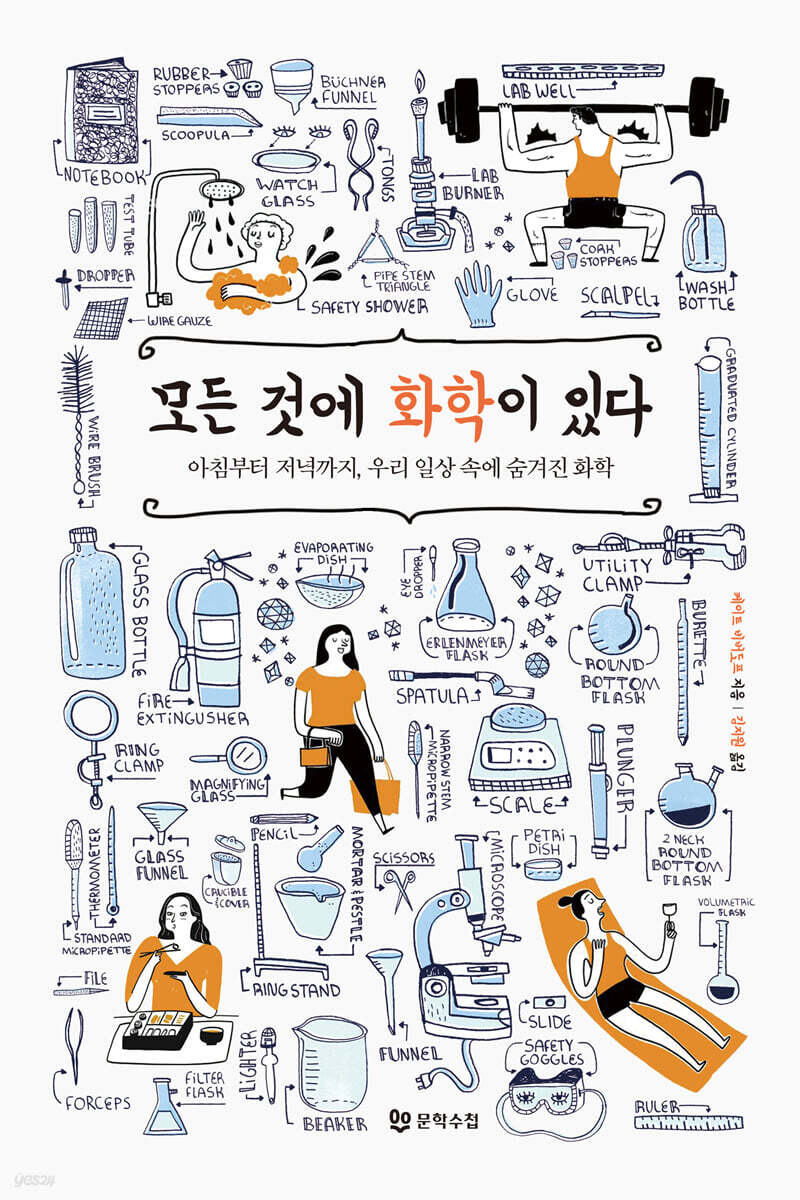 |
Description
Book Introduction
Chemistry hidden all around us
The book that will teach you everything you missed in high school chemistry class.
From the shampoo in our bathrooms to the sunlight coming from outside the Earth, the popular science book "Chemistry is in Everything - Chemistry Hidden in Our Daily Lives" (original title: It's Elemental) that talks about the chemistry that makes up everything around us has been published by Munhak Su-cheop.
Kate Biberdorf, a professor of chemistry at the University of Texas and a self-proclaimed "chemistry nerd," talks about the chemistry that's constantly at work from the moment you wake up until you go to bed, and even while you sleep.
Part 1: What You Missed in High School Chemistry Classes provides an easy-to-understand explanation of the fundamentals of chemistry, including atoms, molecules, the periodic table, and chemical equations.
With accessible explanations filled with humor and wit, readers will be well-prepared to embark on a journey to discover the chemistry embedded in our everyday lives in Part 2: Chemistry Here, There, and Everywhere.
In this book, the author explains the basic principles of chemistry that we did not understand in high school and shows how chemistry comes to life in real life.
This delightful guide, brimming with sharp wit and empathetic passion, will rekindle the passion of those who have always loved chemistry and transform the way we see and feel the world.
The book that will teach you everything you missed in high school chemistry class.
From the shampoo in our bathrooms to the sunlight coming from outside the Earth, the popular science book "Chemistry is in Everything - Chemistry Hidden in Our Daily Lives" (original title: It's Elemental) that talks about the chemistry that makes up everything around us has been published by Munhak Su-cheop.
Kate Biberdorf, a professor of chemistry at the University of Texas and a self-proclaimed "chemistry nerd," talks about the chemistry that's constantly at work from the moment you wake up until you go to bed, and even while you sleep.
Part 1: What You Missed in High School Chemistry Classes provides an easy-to-understand explanation of the fundamentals of chemistry, including atoms, molecules, the periodic table, and chemical equations.
With accessible explanations filled with humor and wit, readers will be well-prepared to embark on a journey to discover the chemistry embedded in our everyday lives in Part 2: Chemistry Here, There, and Everywhere.
In this book, the author explains the basic principles of chemistry that we did not understand in high school and shows how chemistry comes to life in real life.
This delightful guide, brimming with sharp wit and empathetic passion, will rekindle the passion of those who have always loved chemistry and transform the way we see and feel the world.
- You can preview some of the book's contents.
Preview
index
Entering
Part 1.
What You Missed in High School Chemistry Class
1.
Small things are matter: atoms
2.
All About Shape: Atoms in 3D
3.
Speak with your body: solids, liquids, gases
4.
Bonds are meant to be broken: chemical reactions
Part 2.
Chemistry here, there, everywhere
5.
Why It's Good to Wake Up in the Morning: Breakfast
6.
Burning Muscle: Exercise
7.
Al-eum-da-um: Getting ready to go out
8.
Sunshine for me: at the beach
9.
Today's Recipe: In the Kitchen
10.
Whistling to Work: Cleaning the House
11.
Happy Hour is a happy time: at the bar
12.
Relaxing while watching the sunset: in the bedroom
periodic table
Acknowledgements
Glossary of Terms
Abridged Reference Book
Part 1.
What You Missed in High School Chemistry Class
1.
Small things are matter: atoms
2.
All About Shape: Atoms in 3D
3.
Speak with your body: solids, liquids, gases
4.
Bonds are meant to be broken: chemical reactions
Part 2.
Chemistry here, there, everywhere
5.
Why It's Good to Wake Up in the Morning: Breakfast
6.
Burning Muscle: Exercise
7.
Al-eum-da-um: Getting ready to go out
8.
Sunshine for me: at the beach
9.
Today's Recipe: In the Kitchen
10.
Whistling to Work: Cleaning the House
11.
Happy Hour is a happy time: at the bar
12.
Relaxing while watching the sunset: in the bedroom
periodic table
Acknowledgements
Glossary of Terms
Abridged Reference Book
Into the book
"Katie, I have no idea what any of this is talking about! Ace... what's a naptil?"
Mom laughed so hard she couldn't speak anymore.
I was very curious.
I told my mom what my research was about.
But why don't you understand? I opened the paper again and read the first line.
We present the synthesis and catalytic properties of six new 1,2-acenaphthenyl N-heterocyclic carbene-based palladium(II) catalysts.
Acenaphthenyl carbenes can also be prepared using mesityl or 1,2-diisopropyl N-aryl substituents.
---From "Entering"
If atoms are too close together, the possibility of bonding may decrease.
It's like when a stranger sits too close to you in a coffee shop, you step away.
When a stranger invades our personal space, we often increase our distance to feel more comfortable again.
Sometimes they just get up and leave, and that's what happens between atoms.
When an electron from one atom comes too close to an electron from another atom, the electrons repel each other and move further apart.
---「2.
From "All About Shape: Atoms in 3D"
If you want to imagine resistance heating, imagine a football player trying to run from one end to the other.
Unfortunately for this player, the football field is filled with hundreds of opposing players, and he has to work incredibly hard to break through all of their defenses.
When the poor player gets to the other side of the pitch, he will be burning out from all the hard work.
The exact same thing happens to electronics when you cook with induction.
As electrons work with tremendous effort to pass between the iron atoms in the frying pan, they release energy in the form of heat.
---「5.
From "Why It's Good to Wake Up in the Morning: Breakfast"
Speaking of which, bleach doesn't actually remove foreign molecules from the surface.
Instead, it breaks some bonds within the molecule (which kills the bacteria).
But the components, or atoms, are still stuck in the cracks of your countertop or bathroom floor.
So if you're trying to hide something from the police, don't use bleach.
---「10.
From "Whistling to Work: Cleaning the House"
The best way to beat a hangover is to be a responsible adult.
You probably already know that you need to hydrate your body properly before going out for a drink.
But you should have dinner with your first glass of wine and eat food that takes a while to digest.
Ethanol must pass through food before being absorbed into the bloodstream.
So, the complex carbohydrates we talked about in the previous chapter (like potatoes and corn) act as a physical barrier in this situation, slowing down the absorption of ethanol.
So, be sure to eat some food!
Mom laughed so hard she couldn't speak anymore.
I was very curious.
I told my mom what my research was about.
But why don't you understand? I opened the paper again and read the first line.
We present the synthesis and catalytic properties of six new 1,2-acenaphthenyl N-heterocyclic carbene-based palladium(II) catalysts.
Acenaphthenyl carbenes can also be prepared using mesityl or 1,2-diisopropyl N-aryl substituents.
---From "Entering"
If atoms are too close together, the possibility of bonding may decrease.
It's like when a stranger sits too close to you in a coffee shop, you step away.
When a stranger invades our personal space, we often increase our distance to feel more comfortable again.
Sometimes they just get up and leave, and that's what happens between atoms.
When an electron from one atom comes too close to an electron from another atom, the electrons repel each other and move further apart.
---「2.
From "All About Shape: Atoms in 3D"
If you want to imagine resistance heating, imagine a football player trying to run from one end to the other.
Unfortunately for this player, the football field is filled with hundreds of opposing players, and he has to work incredibly hard to break through all of their defenses.
When the poor player gets to the other side of the pitch, he will be burning out from all the hard work.
The exact same thing happens to electronics when you cook with induction.
As electrons work with tremendous effort to pass between the iron atoms in the frying pan, they release energy in the form of heat.
---「5.
From "Why It's Good to Wake Up in the Morning: Breakfast"
Speaking of which, bleach doesn't actually remove foreign molecules from the surface.
Instead, it breaks some bonds within the molecule (which kills the bacteria).
But the components, or atoms, are still stuck in the cracks of your countertop or bathroom floor.
So if you're trying to hide something from the police, don't use bleach.
---「10.
From "Whistling to Work: Cleaning the House"
The best way to beat a hangover is to be a responsible adult.
You probably already know that you need to hydrate your body properly before going out for a drink.
But you should have dinner with your first glass of wine and eat food that takes a while to digest.
Ethanol must pass through food before being absorbed into the bloodstream.
So, the complex carbohydrates we talked about in the previous chapter (like potatoes and corn) act as a physical barrier in this situation, slowing down the absorption of ethanol.
So, be sure to eat some food!
---「11.
Happy Hour is a Happy Time: From the Bar
Happy Hour is a Happy Time: From the Bar
Publisher's Review
You don't need a PhD to understand chemistry.
Everything You Need to Know About Everyday Chemistry from a Fire-Breathing Chemistry Professor
Why do some people struggle to come to their senses until they've had their morning coffee? Why is the sky blue during the day but red at sunset? And why does my friend always tap dance when he's drunk? Have you ever wondered these things? The answer lies in chemistry! From the moment you wake up until you go to bed, and even while you sleep, chemistry is still at work.
And you don't need a PhD in science to understand these facts.
But scientists often talk about science in a way that is incomprehensible to anyone who doesn't have a PhD.
The author, who often puts on a fire-breathing chemistry show during his lectures, feels sorry for this situation and wants to let people know “why chemistry is cool, why it’s so exciting, why you should love it,” by explaining the principles of chemistry in a way that even non-scientists can understand.
Beginning with the definitions of elements and atoms, understanding the composition of atoms (electrons, protons, and neutrons), how to read the periodic table, and the basic concept of ions, the book then moves on to an easy-to-understand and often humorous explanation of how atoms bond together.
In chemistry, a bond is essentially an agreement between two atoms.
Atoms will travel together everywhere until an atom that attracts them more strongly appears.
For example, I'm holding hands with a wonderful person I just met, and I plan to keep doing so… … .
Until Ryan Reynolds showed up there.
When this happens, I will let go of that person's hand and move towards a better union.
This very thing happens between atoms. ('2.
All About Shape: Atoms in 3 Dimensions'
The author describes a single bond between atoms by holding hands with Ryan Reynolds, or a double bond by holding two hands.
After understanding the basic concepts of the three main phases in chemistry - solid, liquid, and gas - the book explains chemical reactions, in which molecules transform into new forms, using the example of the cake-making process as an example.
The explanation of the 'mole', a chemical unit that expresses "mass in the macroscopic world in terms of the number of molecules in the microscopic world," is also clear and intuitive enough to be immediately understood.
If you were given a 10-won coin on the day you were born and you spent 1 million won every second until you were 100, you would still have 99.99% of your money on your 100th birthday.
Even if you spend 1 million won every second for 100 years, you can only spend 0.01% of the money you have.
Can you believe it? 1 mole is a huge number. ('4.
Bonds are bound to break: in 'Chemical Reactions')
Also, there are tips throughout the text such as 'How to talk like a chemist', 'A mole is not a gram', 'To bleach [flour] or not', 'Fresh barley vs. frozen barley', which are helpful for understanding the chemical principles explained in each chapter.
You may also refer to the 'Periodic Table' in the highlighted pages at the back of the book.
There is no need to give up on chemistry, nor should you give up on it.
Why? Because everything around us is chemistry!
One of the strengths of this book, "There's Chemistry in Everything," is that you can apply the chemistry knowledge you build in Part 1 to real-life applications in Part 2.
As a discipline that helps us explain and understand all the phenomena around us, chemistry can be found not only in scientists' laboratories but also in the food we eat, the shampoos and detergents we use on a daily basis, and even the clothes we wear.
For example, coffee, which wakes up countless people in the early morning, contains the famous caffeine with the molecular formula C8H10N4O2.
Because of its structure, the caffeine molecule can bind to specific receptors in the brain, which typically prefer to bind to adenosine molecules, which are naturally present in our bodies.
When adenosine binds to this receptor, you feel drowsy or lethargic.
But when caffeine enters the body, the receptors form a bond with caffeine instead of adenosine.
In other words, caffeine doesn't actually give our bodies energy, but rather blocks other molecules from making us sleepy.
Of course, caffeine's binding to the receptor is short-lived, so it doesn't permanently block adenosine's job of making us sleepy.
It also explains the chemical reactions that occur in our bodies when we exercise after drinking our morning coffee and the chemical principles behind our workout clothes.
In this chapter, we will understand how the food we digest is converted into adenosine triphosphate (ATP), a source of energy, and how excess energy stored in the body is converted into fat.
Now, here's the million dollar question.
How can we actually lose weight? What happens after it's burned? If you've been paying attention, you've probably noticed that every time we burn ATP, we release carbon dioxide.
This means that all the fat, protein, and carbohydrates you burn during exercise are released from your body through your breath.
Can you believe it? You're exhaling fat.
That's how you lose weight.
You don't lose weight when you go to the bathroom or sweat, you literally lose molecules through the breath you exhale during (and after) exercise. ('6.
Burning Muscle: From Exercise'
It also covers the chemistry at play when you finish exercising and get ready to go to work/school/go out.
When water pours onto our bodies during a shower, water molecules form hydrogen bonds with neighboring water molecules on our skin.
When the adhesive force of water is very strong, the water molecules are more attracted to each other than to things like the salt on the skin, and form water droplets on the skin.
Shampoos and shower products also contain various types of molecules. In the case of shampoos containing silicone molecules, silicone has high thermal stability and protects hair from environmental damage, but the silicone molecules can also form bonds with each other, creating so-called 'sticky hair'.
We also talk about the chemistry at work when you cook in the kitchen, the chemistry that forms the plastic products that fill the beach with sunlight or sand, the chemistry in detergents that remove stains, and the chemistry in alcohol that lifts your spirits or makes you talk nonsense.
In this way, chemistry is knowledge that can be applied not only academically but also in real life.
Knowledge of chemistry can change the way you look at everyday activities like showering, putting on makeup, and cooking.
Of course, you will gain knowledge that will help protect the environment, such as learning about the role of ozone (O3) or the effect of octyl methoxycinnamate (a molecule found in some sunscreens) on coral reefs.
After reading this book, you might find yourself drinking a beer and muttering, "Oh, this is a top-fermented beer."
Everything You Need to Know About Everyday Chemistry from a Fire-Breathing Chemistry Professor
Why do some people struggle to come to their senses until they've had their morning coffee? Why is the sky blue during the day but red at sunset? And why does my friend always tap dance when he's drunk? Have you ever wondered these things? The answer lies in chemistry! From the moment you wake up until you go to bed, and even while you sleep, chemistry is still at work.
And you don't need a PhD in science to understand these facts.
But scientists often talk about science in a way that is incomprehensible to anyone who doesn't have a PhD.
The author, who often puts on a fire-breathing chemistry show during his lectures, feels sorry for this situation and wants to let people know “why chemistry is cool, why it’s so exciting, why you should love it,” by explaining the principles of chemistry in a way that even non-scientists can understand.
Beginning with the definitions of elements and atoms, understanding the composition of atoms (electrons, protons, and neutrons), how to read the periodic table, and the basic concept of ions, the book then moves on to an easy-to-understand and often humorous explanation of how atoms bond together.
In chemistry, a bond is essentially an agreement between two atoms.
Atoms will travel together everywhere until an atom that attracts them more strongly appears.
For example, I'm holding hands with a wonderful person I just met, and I plan to keep doing so… … .
Until Ryan Reynolds showed up there.
When this happens, I will let go of that person's hand and move towards a better union.
This very thing happens between atoms. ('2.
All About Shape: Atoms in 3 Dimensions'
The author describes a single bond between atoms by holding hands with Ryan Reynolds, or a double bond by holding two hands.
After understanding the basic concepts of the three main phases in chemistry - solid, liquid, and gas - the book explains chemical reactions, in which molecules transform into new forms, using the example of the cake-making process as an example.
The explanation of the 'mole', a chemical unit that expresses "mass in the macroscopic world in terms of the number of molecules in the microscopic world," is also clear and intuitive enough to be immediately understood.
If you were given a 10-won coin on the day you were born and you spent 1 million won every second until you were 100, you would still have 99.99% of your money on your 100th birthday.
Even if you spend 1 million won every second for 100 years, you can only spend 0.01% of the money you have.
Can you believe it? 1 mole is a huge number. ('4.
Bonds are bound to break: in 'Chemical Reactions')
Also, there are tips throughout the text such as 'How to talk like a chemist', 'A mole is not a gram', 'To bleach [flour] or not', 'Fresh barley vs. frozen barley', which are helpful for understanding the chemical principles explained in each chapter.
You may also refer to the 'Periodic Table' in the highlighted pages at the back of the book.
There is no need to give up on chemistry, nor should you give up on it.
Why? Because everything around us is chemistry!
One of the strengths of this book, "There's Chemistry in Everything," is that you can apply the chemistry knowledge you build in Part 1 to real-life applications in Part 2.
As a discipline that helps us explain and understand all the phenomena around us, chemistry can be found not only in scientists' laboratories but also in the food we eat, the shampoos and detergents we use on a daily basis, and even the clothes we wear.
For example, coffee, which wakes up countless people in the early morning, contains the famous caffeine with the molecular formula C8H10N4O2.
Because of its structure, the caffeine molecule can bind to specific receptors in the brain, which typically prefer to bind to adenosine molecules, which are naturally present in our bodies.
When adenosine binds to this receptor, you feel drowsy or lethargic.
But when caffeine enters the body, the receptors form a bond with caffeine instead of adenosine.
In other words, caffeine doesn't actually give our bodies energy, but rather blocks other molecules from making us sleepy.
Of course, caffeine's binding to the receptor is short-lived, so it doesn't permanently block adenosine's job of making us sleepy.
It also explains the chemical reactions that occur in our bodies when we exercise after drinking our morning coffee and the chemical principles behind our workout clothes.
In this chapter, we will understand how the food we digest is converted into adenosine triphosphate (ATP), a source of energy, and how excess energy stored in the body is converted into fat.
Now, here's the million dollar question.
How can we actually lose weight? What happens after it's burned? If you've been paying attention, you've probably noticed that every time we burn ATP, we release carbon dioxide.
This means that all the fat, protein, and carbohydrates you burn during exercise are released from your body through your breath.
Can you believe it? You're exhaling fat.
That's how you lose weight.
You don't lose weight when you go to the bathroom or sweat, you literally lose molecules through the breath you exhale during (and after) exercise. ('6.
Burning Muscle: From Exercise'
It also covers the chemistry at play when you finish exercising and get ready to go to work/school/go out.
When water pours onto our bodies during a shower, water molecules form hydrogen bonds with neighboring water molecules on our skin.
When the adhesive force of water is very strong, the water molecules are more attracted to each other than to things like the salt on the skin, and form water droplets on the skin.
Shampoos and shower products also contain various types of molecules. In the case of shampoos containing silicone molecules, silicone has high thermal stability and protects hair from environmental damage, but the silicone molecules can also form bonds with each other, creating so-called 'sticky hair'.
We also talk about the chemistry at work when you cook in the kitchen, the chemistry that forms the plastic products that fill the beach with sunlight or sand, the chemistry in detergents that remove stains, and the chemistry in alcohol that lifts your spirits or makes you talk nonsense.
In this way, chemistry is knowledge that can be applied not only academically but also in real life.
Knowledge of chemistry can change the way you look at everyday activities like showering, putting on makeup, and cooking.
Of course, you will gain knowledge that will help protect the environment, such as learning about the role of ozone (O3) or the effect of octyl methoxycinnamate (a molecule found in some sunscreens) on coral reefs.
After reading this book, you might find yourself drinking a beer and muttering, "Oh, this is a top-fermented beer."
GOODS SPECIFICS
- Date of issue: February 24, 2023
- Page count, weight, size: 296 pages | 458g | 150*225*20mm
- ISBN13: 9791192776361
- ISBN10: 1192776364
You may also like
카테고리
korean


korean

![GQ KOREA Mark (Monthly): December [2025]](http://librairie.coreenne.fr/cdn/shop/files/8ef265dbbfbf186523ed75ba7319009d.jpg?v=1765340328&width=3840)


