

Richard Dawkins' lecture on evolution
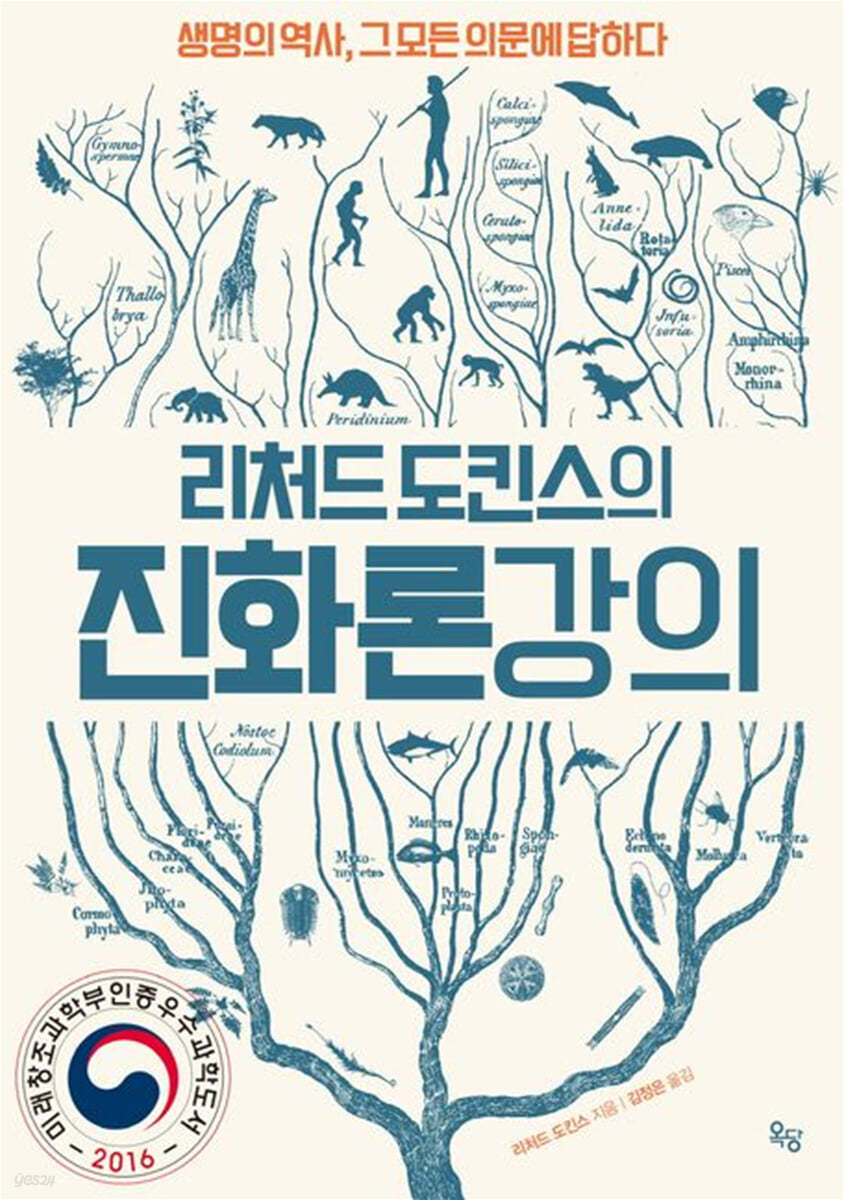 |
Description
Book Introduction
The Essence of Dawkins's Theory of Evolution, Which Drives Controversy
This book is a revised and revised version of Richard Dawkins's Christmas Lectures, a popular science program at the Royal Institution in the UK.
As a book that started out as a lecture introducing science in a way that both children and adults can relate to and understand, it writes even difficult scientific knowledge in a relatively easy-to-understand way.
It is fortunate to have such an accessible yet sophisticated lecture on evolution in book form.
Dawkins not only conveys knowledge about the theory of evolution, but also surprises us with the history of the existence of life and its birth, and makes us think about the process together.
Dawkins tells us how the world we live in is full of wonders and how much joy it brings us to look closely at its beauty.
This book is a revised and revised version of Richard Dawkins's Christmas Lectures, a popular science program at the Royal Institution in the UK.
As a book that started out as a lecture introducing science in a way that both children and adults can relate to and understand, it writes even difficult scientific knowledge in a relatively easy-to-understand way.
It is fortunate to have such an accessible yet sophisticated lecture on evolution in book form.
Dawkins not only conveys knowledge about the theory of evolution, but also surprises us with the history of the existence of life and its birth, and makes us think about the process together.
Dawkins tells us how the world we live in is full of wonders and how much joy it brings us to look closely at its beauty.
- You can preview some of the book's contents.
Preview
index
Author's Note
Lesson 1: Where did the illusion that life was designed come from?
Hawaiian Mountainsides and Mount Rushmore | Beetles' Ant-Imitating Behavior | Design and Efficiency |
Insect-Catching Plants and Similar-Design Traps | The Nest-Building of Wasps and Horned Shearers | Why Do We Think Life Is Designed? |
Accumulated Discovery | Evolutionary Experiments with Computer Biomorphs | Artificial Selection and Natural Selection
Lecture 2: How Natural Selection Works: A Look at Spiderwebs
Spiders' Secret Strategy for Insect Hunting | Garden Spiders' Webbing | Male Spiders' Deadly Mating |
Round Nets and Ladder Nets | Unique Hunting Techniques Using Spider Webs | Natural Selection Experiments with Movewatches and Netspinners |
Sexual Reproduction in Computer Spiders | Artificial Life and Computer Fish
The 3-Strength Evolution: Climbing the Impossible Mountain
Scientists Ignorant of Darwinism | Impossible Perfection | Mutations and Natural Selection | Mutation-Causing Genes |
The Foundation of Evolution: Genetics and DNA | The Elephant Trunk's Story of Evolution | The Great Mutation |
The Boeing 747 and the Extended DC8 Mutation | Misunderstandings About Punctuated Equilibrium
How did the four wings evolve?
Why Humans Can't Fly | The Evolution of Insect Wings | The Gliding Theory of Vertebrates | The Takeoff Theory and Bird Flight |
The Flight Skills of the Swift and the Eagle | Animals Returning to the Sea | How Does Evolutionary Improvement Happen?
How did the 5th eye evolve?
The Complexity of the Eye That Baffled Darwin | Photocytes and Photon Economics | The Emergence of the Concave Eye |
Evolution of the Pinhole Eye | How Lenses Work | Evolution of the Lens | Evolution of the Eye's Substructures |
Curved mirrors and scallop eyes | Coplanar compound eyes | Superimposed compound eyes | Walter Gehring's genetic manipulation experiments
Lesson 6: Mutations or Natural Selection: Which is More Important?
A Museum of All Possible AnimalsㅣThree Characteristics of a Snail ShellㅣRauf's Cubeㅣ
The Blind Shell Cutter | Museum of Imagination vs.
Museum of Reality | Natural Selection and Design
Symmetry Enriches Evolution
Kaleidoscopes and Mutations | Why Do Animals Have Symmetry? | Radial Symmetry in Jellyfish |
The Beautiful Symmetry of Radiolaria | Segmentation | 'Grammar' Mutations and Asromorph Embryology |
Homeogeneic mutations and lobsters
8. What is the purpose of all living things?
Bees and Flowers Tame Each Other in the Ultraviolet Garden | The Diverse Partnerships of Plants and Animals |
Why do viruses exist? ㅣ DNA's command: Clone me!
9. Robot mediators that obey the commands of genes.
3D Printers and Robots | The Accidental Appearance of the First Replicator | How the Original Replicator Became a Metazoan |
How DNA Molecules Create Elephants | Gigatech, Nanotech
10-Strategy Game of Fig Trees and Bees
The Life Cycle of the Fig Wasp | The Strangulation of the Parasitic Fig Tree | The Mystery of Altruism |
The Parasites on the Fig Tree | The Struggle Theory vs.
Stable Equilibrium Theory | The Strategic Game of Dioecious Figs and Bees |
The Weapon of the Monoecious Fig Tree | The Mysterious Coevolution of Fig Trees and Bees
Lesson 1: Where did the illusion that life was designed come from?
Hawaiian Mountainsides and Mount Rushmore | Beetles' Ant-Imitating Behavior | Design and Efficiency |
Insect-Catching Plants and Similar-Design Traps | The Nest-Building of Wasps and Horned Shearers | Why Do We Think Life Is Designed? |
Accumulated Discovery | Evolutionary Experiments with Computer Biomorphs | Artificial Selection and Natural Selection
Lecture 2: How Natural Selection Works: A Look at Spiderwebs
Spiders' Secret Strategy for Insect Hunting | Garden Spiders' Webbing | Male Spiders' Deadly Mating |
Round Nets and Ladder Nets | Unique Hunting Techniques Using Spider Webs | Natural Selection Experiments with Movewatches and Netspinners |
Sexual Reproduction in Computer Spiders | Artificial Life and Computer Fish
The 3-Strength Evolution: Climbing the Impossible Mountain
Scientists Ignorant of Darwinism | Impossible Perfection | Mutations and Natural Selection | Mutation-Causing Genes |
The Foundation of Evolution: Genetics and DNA | The Elephant Trunk's Story of Evolution | The Great Mutation |
The Boeing 747 and the Extended DC8 Mutation | Misunderstandings About Punctuated Equilibrium
How did the four wings evolve?
Why Humans Can't Fly | The Evolution of Insect Wings | The Gliding Theory of Vertebrates | The Takeoff Theory and Bird Flight |
The Flight Skills of the Swift and the Eagle | Animals Returning to the Sea | How Does Evolutionary Improvement Happen?
How did the 5th eye evolve?
The Complexity of the Eye That Baffled Darwin | Photocytes and Photon Economics | The Emergence of the Concave Eye |
Evolution of the Pinhole Eye | How Lenses Work | Evolution of the Lens | Evolution of the Eye's Substructures |
Curved mirrors and scallop eyes | Coplanar compound eyes | Superimposed compound eyes | Walter Gehring's genetic manipulation experiments
Lesson 6: Mutations or Natural Selection: Which is More Important?
A Museum of All Possible AnimalsㅣThree Characteristics of a Snail ShellㅣRauf's Cubeㅣ
The Blind Shell Cutter | Museum of Imagination vs.
Museum of Reality | Natural Selection and Design
Symmetry Enriches Evolution
Kaleidoscopes and Mutations | Why Do Animals Have Symmetry? | Radial Symmetry in Jellyfish |
The Beautiful Symmetry of Radiolaria | Segmentation | 'Grammar' Mutations and Asromorph Embryology |
Homeogeneic mutations and lobsters
8. What is the purpose of all living things?
Bees and Flowers Tame Each Other in the Ultraviolet Garden | The Diverse Partnerships of Plants and Animals |
Why do viruses exist? ㅣ DNA's command: Clone me!
9. Robot mediators that obey the commands of genes.
3D Printers and Robots | The Accidental Appearance of the First Replicator | How the Original Replicator Became a Metazoan |
How DNA Molecules Create Elephants | Gigatech, Nanotech
10-Strategy Game of Fig Trees and Bees
The Life Cycle of the Fig Wasp | The Strangulation of the Parasitic Fig Tree | The Mystery of Altruism |
The Parasites on the Fig Tree | The Struggle Theory vs.
Stable Equilibrium Theory | The Strategic Game of Dioecious Figs and Bees |
The Weapon of the Monoecious Fig Tree | The Mysterious Coevolution of Fig Trees and Bees
Publisher's Review
The easiest and most vivid lecture on evolution from Richard Dawkins
2016 Ministry of Science, ICT and Future Planning Excellent Science Book Certification
Richard Dawkins, the greatest scientist of the 21st century, published the groundbreaking book The Selfish Gene in 1976.
Surprisingly, he caused a stir in the scientific community by arguing in this book that living things are nothing more than vehicles for carrying selfish genes.
And in 『The Blind Watchmaker』, published in 1986, he once again reached the peak of the debate by discussing the mystery of life from the perspective of evolutionism against creationism.
Since then, he has published groundbreaking books such as The God Delusion, creating a confrontation between religion and science, evolution and creationism.
Why did he write these books? How does his theory of evolution differ from our common sense? This book, "Climbing Mount Improbable," offers the essence of Dawkins's controversial narrative of evolution.
How could natural selection drive the evolution of complex life?
In this book, Dawkins shows, through abundant examples such as eyes, spider webs, wings, and seashells, how the "first replicator" that accidentally arose from a dilute mixture of simple organic compounds (primordial soup) in the oceans of the primitive Earth about 3 to 4 billion years ago evolved into various life forms and their components with "impossible perfection."
Dawkins conveys the mystery of life in an easy and clear way, using meticulous arguments and rational reasoning to explain precisely.
The emergence of the first self-replicating replicator on a primitive Earth where only physics and chemistry existed was a stroke of luck.
But in the history of life, this kind of luck only happened once.
The first replicator, the origin of life, was so simple that it likely arose spontaneously through a chance chemical event, and self-replication was one of its characteristics.
But no replication process can be perfect.
Random mistakes (mutations) are bound to occur during replication.
During this process, mutants lose their self-replication properties and disappear from the population, or they acquire faster and more efficient replication properties and become the majority in the population.
This process was a process of natural selection.
Dawkins argues that complex life arose from the gradual accumulation of delicate natural selection.
However, those who oppose the theory of evolution say that it is impossible for highly complex life forms to arise spontaneously, citing examples such as eyes and complex body organs.
And to explain 'impossible complexity', they bring forward the theory of intelligent design.
But Richard Dawkins says, “If we think of God as the designer of the universe, we’ll be in exactly the same place we started.
Any designer capable of constructing such a dazzling array of living things would have to be incredibly intelligent and complex.
And complexity is just another word for impossibility” (p. 118).
It clearly points out the contradiction of intelligent design theory, which introduces another impossible complexity to explain impossible complexity.
Dawkins then compares their argument to an explorer trying to leap over a steep cliff in one fell swoop, pointing to the other side of the cliff.
There is a very gentle slope leading up to a cliff that seems impossible to climb.
The first replicators, arising from simple organic compounds in the oceans of the primordial Earth, slowly ascended this path over billions of years, branching out and conquering the mountains of "impossible complexity" as well as species diversity.
“The Darwinian solution is to break the impossibility down into manageable chunks, eliminate the need for luck, and then climb around the back of the impossible mountain, a few centimeters over millions of years, up a gentle slope.
“The tremendous feat of jumping over a sheer cliff in one go is something only a god could do.”
To prove this, Dawkins embarks on a long journey to solve the most difficult problems surrounding the mystery of life.
One of them is the 'eye', which is a favorite target of creationists and is considered the biggest stumbling block for those who want to believe in evolution.
The Evolution of the Eye: A Truth Even Charles Darwin Had a Hard Time Believing
In 『The Origin of Species』, Darwin confessed about the function and complexity of the eye, “Considering all these functions, which are not easily imitated, it seems most absurd that the eye could have been formed by natural selection.” This has become a favorite quote of creationists when attacking the theory of evolution.
However, Darwin did not view the complexity of the eye as an excuse to abandon the theory of evolution, but as a challenge that must be continuously addressed, and Darwin's descendants did not turn away from this task.
Richard Dawkins explains that “according to authoritative estimates, eyes have evolved independently in different parts of the animal kingdom at least 40 times, and possibly as many as 60 times” (p. 208).
The background to the high complexity of the various forms of eyes is simple.
This is because the Earth is bombarded with photons from the sun every moment.
When a photon hits a colored substance, it stops moving and the molecules that make up the substance change shape, releasing some energy in the process.
Up to this point, we have reached a world of undeniable laws of physics, and living cells must have been affected by light in some way.
And here begins the process we call vision.
Of course, the first eye was so simple that it was difficult to call it an 'eye'; it could be said to be a part of the body's surface that was slightly sensitive to light.
Some living organisms today, including single-celled organisms, jellyfish, and leeches, have eyes like this, but they cannot see shapes or determine the direction of light; they can only sense the presence of light.
The first creatures with eyes could tell the difference between day and night through the presence or absence of light, and could detect the presence of shadows, which could be signs of predators.
Thus, the first eyes, following the simple and clear workings of evolutionary theory—that if they were even marginally useful for survival, they would be favored by natural selection—we set out on a new, impossible path toward the evolution of highly complex eyes.
Now life has been slowly trudging up that path for billions of years.
According to Dawkins, the path is “gentle throughout, making it an easy climb.”
Richard Dawkins presents a computer simulation by Swedish biologists Dan Nilson and Susanne Pelger to show that the first eyes did not take long to evolve into complex ones (pp. 238–242).
The two men took inspiration from the fact that the "camera eye", which can sense light and shade, direction, shape, and color, has three main structures, and simulated the process by which three very simple structures evolve into a highly complex camera eye.
Experiments have shown that three flat structures that could not be considered eyes evolved into a camera eye with a complete lens in just 364,000 generations.
For small marine animals, where a generation usually lasts less than a year, evolution took less than 500,000 years.
Of course, Nilsson and Felger didn't include in their experiments the evolution of photoreceptors and other detailed structures of the eye, but they did enough to show that the eye is not a precipice perched atop a steep cliff, but rather a peak that evolution can easily conquer if it follows a gentle path.
Evolution, Conquering the Impossible Mountain
“The pinnacle of evolution cannot be reached hastily.
No matter how difficult the problem to be solved or how steep the cliff to be climbed, if you take one slow step at a time, you will find the way.
“You can’t climb an impossible mountain in one go.”
Richard Dawkins likens the history of evolution to a climber climbing "Mount Impossible" to explain how mutations and natural selection have shaped Earth into a splendid empire of life.
At first glance, diverse living organisms and highly complex bodily organs appear perfectly and precisely designed.
But Dawkins places the mystery of life, which seems impossible to evolve, on this path, and traces its path with great sensitivity, lifting the veil of ignorance surrounding life.
Through this book, readers will learn how complex structures like eyes and wings evolved to contribute to survival, and how evolution was a gradual, cumulative process of change over centuries.
It explains the seemingly impossible and complex process of evolution in an easy and vivid way through the process of natural selection that has accumulated slowly, one step at a time.
Now the reader will have no choice but to admit, as Dawkins says, that 'evolution of anything is not as difficult as humans imagine.'
2016 Ministry of Science, ICT and Future Planning Excellent Science Book Certification
Richard Dawkins, the greatest scientist of the 21st century, published the groundbreaking book The Selfish Gene in 1976.
Surprisingly, he caused a stir in the scientific community by arguing in this book that living things are nothing more than vehicles for carrying selfish genes.
And in 『The Blind Watchmaker』, published in 1986, he once again reached the peak of the debate by discussing the mystery of life from the perspective of evolutionism against creationism.
Since then, he has published groundbreaking books such as The God Delusion, creating a confrontation between religion and science, evolution and creationism.
Why did he write these books? How does his theory of evolution differ from our common sense? This book, "Climbing Mount Improbable," offers the essence of Dawkins's controversial narrative of evolution.
How could natural selection drive the evolution of complex life?
In this book, Dawkins shows, through abundant examples such as eyes, spider webs, wings, and seashells, how the "first replicator" that accidentally arose from a dilute mixture of simple organic compounds (primordial soup) in the oceans of the primitive Earth about 3 to 4 billion years ago evolved into various life forms and their components with "impossible perfection."
Dawkins conveys the mystery of life in an easy and clear way, using meticulous arguments and rational reasoning to explain precisely.
The emergence of the first self-replicating replicator on a primitive Earth where only physics and chemistry existed was a stroke of luck.
But in the history of life, this kind of luck only happened once.
The first replicator, the origin of life, was so simple that it likely arose spontaneously through a chance chemical event, and self-replication was one of its characteristics.
But no replication process can be perfect.
Random mistakes (mutations) are bound to occur during replication.
During this process, mutants lose their self-replication properties and disappear from the population, or they acquire faster and more efficient replication properties and become the majority in the population.
This process was a process of natural selection.
Dawkins argues that complex life arose from the gradual accumulation of delicate natural selection.
However, those who oppose the theory of evolution say that it is impossible for highly complex life forms to arise spontaneously, citing examples such as eyes and complex body organs.
And to explain 'impossible complexity', they bring forward the theory of intelligent design.
But Richard Dawkins says, “If we think of God as the designer of the universe, we’ll be in exactly the same place we started.
Any designer capable of constructing such a dazzling array of living things would have to be incredibly intelligent and complex.
And complexity is just another word for impossibility” (p. 118).
It clearly points out the contradiction of intelligent design theory, which introduces another impossible complexity to explain impossible complexity.
Dawkins then compares their argument to an explorer trying to leap over a steep cliff in one fell swoop, pointing to the other side of the cliff.
There is a very gentle slope leading up to a cliff that seems impossible to climb.
The first replicators, arising from simple organic compounds in the oceans of the primordial Earth, slowly ascended this path over billions of years, branching out and conquering the mountains of "impossible complexity" as well as species diversity.
“The Darwinian solution is to break the impossibility down into manageable chunks, eliminate the need for luck, and then climb around the back of the impossible mountain, a few centimeters over millions of years, up a gentle slope.
“The tremendous feat of jumping over a sheer cliff in one go is something only a god could do.”
To prove this, Dawkins embarks on a long journey to solve the most difficult problems surrounding the mystery of life.
One of them is the 'eye', which is a favorite target of creationists and is considered the biggest stumbling block for those who want to believe in evolution.
The Evolution of the Eye: A Truth Even Charles Darwin Had a Hard Time Believing
In 『The Origin of Species』, Darwin confessed about the function and complexity of the eye, “Considering all these functions, which are not easily imitated, it seems most absurd that the eye could have been formed by natural selection.” This has become a favorite quote of creationists when attacking the theory of evolution.
However, Darwin did not view the complexity of the eye as an excuse to abandon the theory of evolution, but as a challenge that must be continuously addressed, and Darwin's descendants did not turn away from this task.
Richard Dawkins explains that “according to authoritative estimates, eyes have evolved independently in different parts of the animal kingdom at least 40 times, and possibly as many as 60 times” (p. 208).
The background to the high complexity of the various forms of eyes is simple.
This is because the Earth is bombarded with photons from the sun every moment.
When a photon hits a colored substance, it stops moving and the molecules that make up the substance change shape, releasing some energy in the process.
Up to this point, we have reached a world of undeniable laws of physics, and living cells must have been affected by light in some way.
And here begins the process we call vision.
Of course, the first eye was so simple that it was difficult to call it an 'eye'; it could be said to be a part of the body's surface that was slightly sensitive to light.
Some living organisms today, including single-celled organisms, jellyfish, and leeches, have eyes like this, but they cannot see shapes or determine the direction of light; they can only sense the presence of light.
The first creatures with eyes could tell the difference between day and night through the presence or absence of light, and could detect the presence of shadows, which could be signs of predators.
Thus, the first eyes, following the simple and clear workings of evolutionary theory—that if they were even marginally useful for survival, they would be favored by natural selection—we set out on a new, impossible path toward the evolution of highly complex eyes.
Now life has been slowly trudging up that path for billions of years.
According to Dawkins, the path is “gentle throughout, making it an easy climb.”
Richard Dawkins presents a computer simulation by Swedish biologists Dan Nilson and Susanne Pelger to show that the first eyes did not take long to evolve into complex ones (pp. 238–242).
The two men took inspiration from the fact that the "camera eye", which can sense light and shade, direction, shape, and color, has three main structures, and simulated the process by which three very simple structures evolve into a highly complex camera eye.
Experiments have shown that three flat structures that could not be considered eyes evolved into a camera eye with a complete lens in just 364,000 generations.
For small marine animals, where a generation usually lasts less than a year, evolution took less than 500,000 years.
Of course, Nilsson and Felger didn't include in their experiments the evolution of photoreceptors and other detailed structures of the eye, but they did enough to show that the eye is not a precipice perched atop a steep cliff, but rather a peak that evolution can easily conquer if it follows a gentle path.
Evolution, Conquering the Impossible Mountain
“The pinnacle of evolution cannot be reached hastily.
No matter how difficult the problem to be solved or how steep the cliff to be climbed, if you take one slow step at a time, you will find the way.
“You can’t climb an impossible mountain in one go.”
Richard Dawkins likens the history of evolution to a climber climbing "Mount Impossible" to explain how mutations and natural selection have shaped Earth into a splendid empire of life.
At first glance, diverse living organisms and highly complex bodily organs appear perfectly and precisely designed.
But Dawkins places the mystery of life, which seems impossible to evolve, on this path, and traces its path with great sensitivity, lifting the veil of ignorance surrounding life.
Through this book, readers will learn how complex structures like eyes and wings evolved to contribute to survival, and how evolution was a gradual, cumulative process of change over centuries.
It explains the seemingly impossible and complex process of evolution in an easy and vivid way through the process of natural selection that has accumulated slowly, one step at a time.
Now the reader will have no choice but to admit, as Dawkins says, that 'evolution of anything is not as difficult as humans imagine.'
GOODS SPECIFICS
- Publication date: December 20, 2022
- Format: Hardcover book binding method guide
- Page count, weight, size: 472 pages | 722g | 148*210*30mm
- ISBN13: 9791189936396
- ISBN10: 1189936399
You may also like
카테고리
korean


korean

![GQ KOREA Mark (Monthly): December [2025]](http://librairie.coreenne.fr/cdn/shop/files/8ef265dbbfbf186523ed75ba7319009d.jpg?v=1765340328&width=3840)


