

World Architect Anatomy Guide
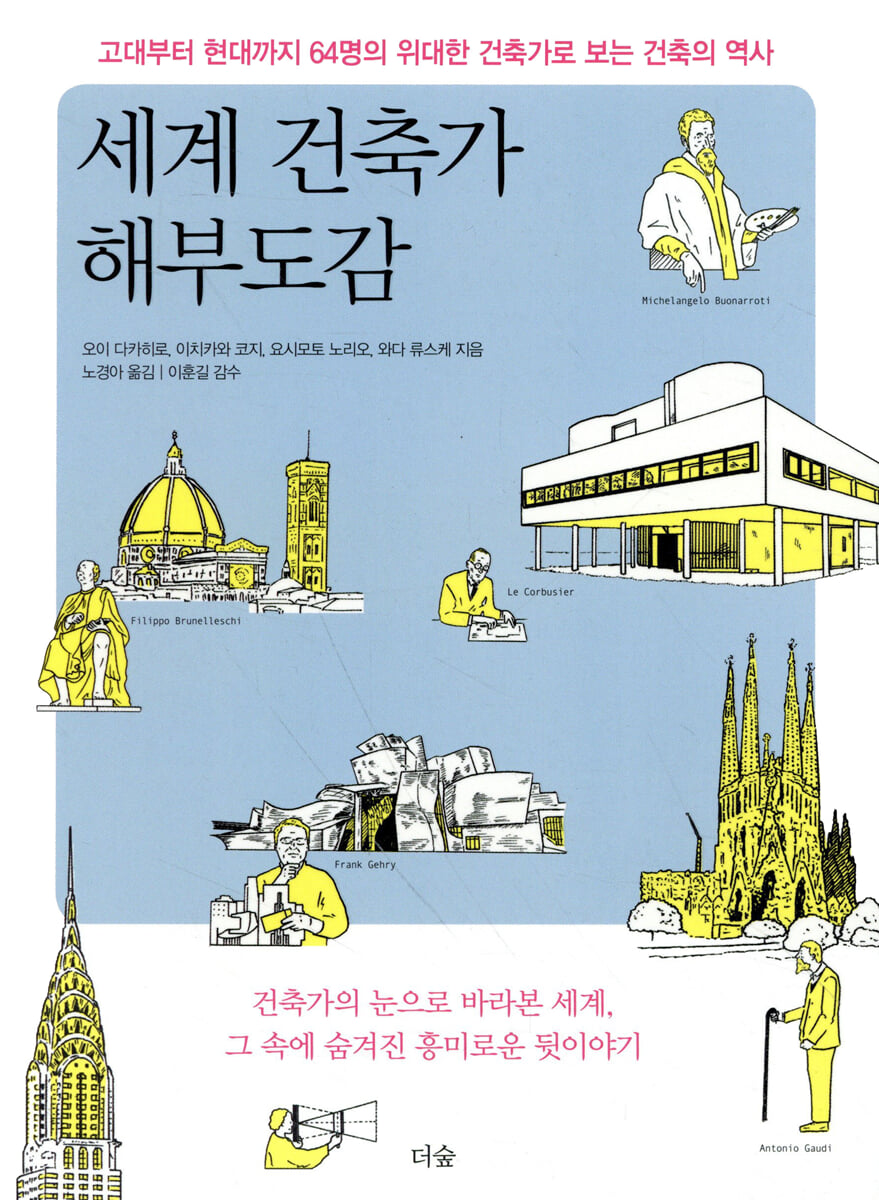 |
Description
Book Introduction
From Michelangelo to Gaudi and Frank Gehry
A global tour of architecture and humanities with illustrations
From ancient times to the present, the fascinating and hidden stories of world-renowned architects and buildings have been published in one volume, 『World Architectural Anatomy Guide』.
A total of 64 architects and over 200 buildings, including Michelangelo, Gaudi, Mies van der Rohe, Le Corbusier, Frank Gehry, and Zaha Hadid, are beautifully presented in 220 illustrations.
From lesser-known ancient and early medieval architecture to Renaissance architects and contemporary architects still active today, this parade of familiar and unfamiliar figures and works offers readers both joy and fresh enjoyment.
Moreover, by examining the various aspects of architectural history that have changed over time, the history of the world comes into view at a glance, and through the history intertwined with architecture, you embark on a unique humanities journey.
This is an architectural textbook that can be read by everyone, including those studying or enjoying architecture, as well as those interested in history that we may not have known about.
Moreover, unlike existing architectural history books filled with large, cold-feeling photographic plates, this book is filled with warm, vibrant illustrations that highlight the characteristics of architecture, which will not only help readers understand better but also stimulate their imagination.
A global tour of architecture and humanities with illustrations
From ancient times to the present, the fascinating and hidden stories of world-renowned architects and buildings have been published in one volume, 『World Architectural Anatomy Guide』.
A total of 64 architects and over 200 buildings, including Michelangelo, Gaudi, Mies van der Rohe, Le Corbusier, Frank Gehry, and Zaha Hadid, are beautifully presented in 220 illustrations.
From lesser-known ancient and early medieval architecture to Renaissance architects and contemporary architects still active today, this parade of familiar and unfamiliar figures and works offers readers both joy and fresh enjoyment.
Moreover, by examining the various aspects of architectural history that have changed over time, the history of the world comes into view at a glance, and through the history intertwined with architecture, you embark on a unique humanities journey.
This is an architectural textbook that can be read by everyone, including those studying or enjoying architecture, as well as those interested in history that we may not have known about.
Moreover, unlike existing architectural history books filled with large, cold-feeling photographic plates, this book is filled with warm, vibrant illustrations that highlight the characteristics of architecture, which will not only help readers understand better but also stimulate their imagination.
- You can preview some of the book's contents.
Preview
index
Chapter 1 / Major Architecture of Ancient and Medieval Times
Ancient Egyptian architecture/Ancient Greek architecture/Ancient Roman architecture/Early Christian and Byzantine architecture/Romanesque architecture/Gothic architecture
Chapter 2: Architects of the Renaissance
Filippo Brunelleschi/Leon Battista Alberti/Donato Bramante/Michelangelo Buonarroti/Mimar Sinan/Giulio Romano/Andrea Palladio/Inigo Jones/Postnik Yakovlev
Chapter 3: Architects of the 17th Century
Giovanni Lorenzo Bernini/Francesco Borromini/François Mansard/Christopher Wren/Johann Bernhard Fischer von Erlach/Gabriel Germain Beaufranc/Francesco Bartolomeo Rastrelli
Chapter 4: Architects of the 18th and early 19th centuries
Jacques Germain Soufflot/Giovanni Battista Piranesi/Claude Nicolas Ledoux/John Nash/John Sohn/Karl Friedrich Schinkel/Joseph Paxton/Gottfried Semper/Augustus Welby Pugin/Eugène Viollet-le-Duc/Charles Garnier
Chapter 5: Architects of the Late 19th and 20th Centuries
Philip Webb/Otto Wagner/Antonio Gaudí/Louis Sullivan/Victor Horta/Frank Lloyd Wright/Charles Rennie Mackintosh/Peter Behrens/Edwin Lutyens/Adolf Loos/Erich Mendelsohn/William Van Allen
Chapter 6 / Architects of the 20th Century
Walter Gropius/Mies van der Rohe/Le Corbusier/Gerrit Thomas Rietveld/Konstantin Melnikov/Richard Buckminster Fuller/Alvar Aalto/Louis Kahn/Luis Barragán/Oscar Niemeyer/Io Ming Pei/Jorn Utzon/Robert Venturi/James Stirling
Chapter 7: Architects of the 20th and 21st Centuries
Frank Gehry/SOM/Peter Eisenman/Norman Foster/Renzo Piano/Peter Zumthor/Rem Koolhaas/Jean Nouvel/Zaha Hadid/Herzog & de Meuron/Santiago Calatrava
Search
References
Reviews
Ancient Egyptian architecture/Ancient Greek architecture/Ancient Roman architecture/Early Christian and Byzantine architecture/Romanesque architecture/Gothic architecture
Chapter 2: Architects of the Renaissance
Filippo Brunelleschi/Leon Battista Alberti/Donato Bramante/Michelangelo Buonarroti/Mimar Sinan/Giulio Romano/Andrea Palladio/Inigo Jones/Postnik Yakovlev
Chapter 3: Architects of the 17th Century
Giovanni Lorenzo Bernini/Francesco Borromini/François Mansard/Christopher Wren/Johann Bernhard Fischer von Erlach/Gabriel Germain Beaufranc/Francesco Bartolomeo Rastrelli
Chapter 4: Architects of the 18th and early 19th centuries
Jacques Germain Soufflot/Giovanni Battista Piranesi/Claude Nicolas Ledoux/John Nash/John Sohn/Karl Friedrich Schinkel/Joseph Paxton/Gottfried Semper/Augustus Welby Pugin/Eugène Viollet-le-Duc/Charles Garnier
Chapter 5: Architects of the Late 19th and 20th Centuries
Philip Webb/Otto Wagner/Antonio Gaudí/Louis Sullivan/Victor Horta/Frank Lloyd Wright/Charles Rennie Mackintosh/Peter Behrens/Edwin Lutyens/Adolf Loos/Erich Mendelsohn/William Van Allen
Chapter 6 / Architects of the 20th Century
Walter Gropius/Mies van der Rohe/Le Corbusier/Gerrit Thomas Rietveld/Konstantin Melnikov/Richard Buckminster Fuller/Alvar Aalto/Louis Kahn/Luis Barragán/Oscar Niemeyer/Io Ming Pei/Jorn Utzon/Robert Venturi/James Stirling
Chapter 7: Architects of the 20th and 21st Centuries
Frank Gehry/SOM/Peter Eisenman/Norman Foster/Renzo Piano/Peter Zumthor/Rem Koolhaas/Jean Nouvel/Zaha Hadid/Herzog & de Meuron/Santiago Calatrava
Search
References
Reviews
Detailed image

Into the book
The city of Rome was founded in 753 BC.
The period from then until 395 AD, when the Roman Empire was divided into east and west, was the period of ancient Roman architecture, characterized by the use of concrete to build walls, vaults, and domes.
Architects of this era built strong walls by filling the interior with concrete and also favored the use of arches.
An arch, when extended, becomes a vault, and when rotated, it becomes a dome.
Representative works include the Domus Aurea by the architect Severus and the Palace of Domitian by Rabirius, and the Pantheon is also famous for its masterpiece using a dome.
- From 'Ancient Roman Architecture'
Mimar Sinan is a particularly notable architect in the history of Islamic architecture.
This is because he served as the chief architect of the Ottoman court for about 50 years and served three sultans (monarchs of the Islamic world).
He made patrons of not only the Ottoman family but also local ministers and merchants, and built as many as 400 to 500 structures in a vast area, including Istanbul, Eastern Europe, and the Kingdom of Syria.
Among them, the Selimiye Mosque is considered by Sinan himself to be the greatest work of art.
- From 'Mimar Sinan'
In 1851, Semper defined the four basic elements of architecture in his book, The Four Elements of Architecture: ‘hearth,’ ‘floor,’ ‘roof,’ and ‘membrane (wall)’.
What is important here is that he tried to explain the principles of architecture by corresponding material processing techniques to each component of the building, such as metalworking and pottery making for the furnace, stone processing for the floor, wood processing for the roof, and fabric production for the membrane.
This idea caused the architectural world to break away from the mythical worldview of classical architecture.
And architecture presented a completely new set of values that emerged from human technical activity.
- From 'Gottfried Semper'
The period from then until 395 AD, when the Roman Empire was divided into east and west, was the period of ancient Roman architecture, characterized by the use of concrete to build walls, vaults, and domes.
Architects of this era built strong walls by filling the interior with concrete and also favored the use of arches.
An arch, when extended, becomes a vault, and when rotated, it becomes a dome.
Representative works include the Domus Aurea by the architect Severus and the Palace of Domitian by Rabirius, and the Pantheon is also famous for its masterpiece using a dome.
- From 'Ancient Roman Architecture'
Mimar Sinan is a particularly notable architect in the history of Islamic architecture.
This is because he served as the chief architect of the Ottoman court for about 50 years and served three sultans (monarchs of the Islamic world).
He made patrons of not only the Ottoman family but also local ministers and merchants, and built as many as 400 to 500 structures in a vast area, including Istanbul, Eastern Europe, and the Kingdom of Syria.
Among them, the Selimiye Mosque is considered by Sinan himself to be the greatest work of art.
- From 'Mimar Sinan'
In 1851, Semper defined the four basic elements of architecture in his book, The Four Elements of Architecture: ‘hearth,’ ‘floor,’ ‘roof,’ and ‘membrane (wall)’.
What is important here is that he tried to explain the principles of architecture by corresponding material processing techniques to each component of the building, such as metalworking and pottery making for the furnace, stone processing for the floor, wood processing for the roof, and fabric production for the membrane.
This idea caused the architectural world to break away from the mythical worldview of classical architecture.
And architecture presented a completely new set of values that emerged from human technical activity.
- From 'Gottfried Semper'
--- From the text
Publisher's Review
“How did historical architects create masterpieces?”
Discover the lives and works of architects who shaped their time, all in one volume.
Architects each have different reasons for becoming architects.
There are cases like Brunelleschi, who started out as a sculptor and then turned to architecture after winning a dome design competition, and there are cases like Turkish architect Mimar Sinan, who went on expeditions as an engineer in the military and then became an architect.
Christopher Wren, who rebuilt London after the Great Fire of 1663, was an astronomer.
Some architects keep pace with the times and produce works that fit the times, while others rise above conventions.
Among them, there are architects who have made a name for themselves with their extraordinary insight.
François Mansard, a representative architect, gained fame by designing a unique roof called the 'Mansard roof' while accepting the Baroque style in 17th century France, when the Baroque style was popular.
Additionally, Renzo Piano took a provocative approach to conventional architecture by revealing huge escalators, structural frames, and ducts on the façade.
The Centre Pompidou, located in the heart of Paris, France, has significantly changed the values of architecture.
In this way, countless architects throughout history have walked their own paths within the flow of the times and the ideas that inspired them.
And this process is fully reflected in the buildings they left behind.
This book closely follows their footsteps, providing a wealth of new information and insights into their lives and works.
Follow the flow of the times or go against it
See the history of the world through the achievements of architects.
While there are architects who have risen above convention, there are also architects who have not been able to fully express their intentions in the flow of time.
Gaudi is a representative example.
Before he started building the Sagrada Familia, which is currently under construction, he experienced the pain of the unfinished underground chapel of the Colonia Güell church and the Park Güell.
Zaha Hadid, best known to us for DDP (Dongdaemun Digital Plaza), became widely known after winning the Pritzker Prize, but before that, she had only received attention for her experimental designs and had hardly ever produced any realized works.
The works of Gaudi and Hadid, completed through many twists and turns, give us many insights.
What architects have achieved is not only buildings.
Architects have changed everything from the urban landscape to the flow of time.
Frank Gehry, through the Guggenheim Museum Bilbao, created a cultural facility that not only revitalized the culture but also the city's economy, becoming the protagonist of the so-called 'Bilbao Effect'.
He revived a small Spanish town that had been in decline, and influenced the construction of a series of iconic buildings around the world.
Reading 『World Architectural Anatomy Guide』, you will feel that the buildings in the city that you had passed by without paying attention are dynamic, like living organisms.
Through the life of an architect, we can see architecture not as a static building, but as a moving history.
Discover the lives and works of architects who shaped their time, all in one volume.
Architects each have different reasons for becoming architects.
There are cases like Brunelleschi, who started out as a sculptor and then turned to architecture after winning a dome design competition, and there are cases like Turkish architect Mimar Sinan, who went on expeditions as an engineer in the military and then became an architect.
Christopher Wren, who rebuilt London after the Great Fire of 1663, was an astronomer.
Some architects keep pace with the times and produce works that fit the times, while others rise above conventions.
Among them, there are architects who have made a name for themselves with their extraordinary insight.
François Mansard, a representative architect, gained fame by designing a unique roof called the 'Mansard roof' while accepting the Baroque style in 17th century France, when the Baroque style was popular.
Additionally, Renzo Piano took a provocative approach to conventional architecture by revealing huge escalators, structural frames, and ducts on the façade.
The Centre Pompidou, located in the heart of Paris, France, has significantly changed the values of architecture.
In this way, countless architects throughout history have walked their own paths within the flow of the times and the ideas that inspired them.
And this process is fully reflected in the buildings they left behind.
This book closely follows their footsteps, providing a wealth of new information and insights into their lives and works.
Follow the flow of the times or go against it
See the history of the world through the achievements of architects.
While there are architects who have risen above convention, there are also architects who have not been able to fully express their intentions in the flow of time.
Gaudi is a representative example.
Before he started building the Sagrada Familia, which is currently under construction, he experienced the pain of the unfinished underground chapel of the Colonia Güell church and the Park Güell.
Zaha Hadid, best known to us for DDP (Dongdaemun Digital Plaza), became widely known after winning the Pritzker Prize, but before that, she had only received attention for her experimental designs and had hardly ever produced any realized works.
The works of Gaudi and Hadid, completed through many twists and turns, give us many insights.
What architects have achieved is not only buildings.
Architects have changed everything from the urban landscape to the flow of time.
Frank Gehry, through the Guggenheim Museum Bilbao, created a cultural facility that not only revitalized the culture but also the city's economy, becoming the protagonist of the so-called 'Bilbao Effect'.
He revived a small Spanish town that had been in decline, and influenced the construction of a series of iconic buildings around the world.
Reading 『World Architectural Anatomy Guide』, you will feel that the buildings in the city that you had passed by without paying attention are dynamic, like living organisms.
Through the life of an architect, we can see architecture not as a static building, but as a moving history.
GOODS SPECIFICS
- Date of issue: April 1, 2019
- Page count, weight, size: 184 pages | 239g | 152*209*20mm
- ISBN13: 9791186900840
- ISBN10: 1186900849
You may also like
카테고리
korean


korean

![GQ KOREA Mark (Monthly): December [2025]](http://librairie.coreenne.fr/cdn/shop/files/8ef265dbbfbf186523ed75ba7319009d.jpg?v=1765340328&width=3840)


