

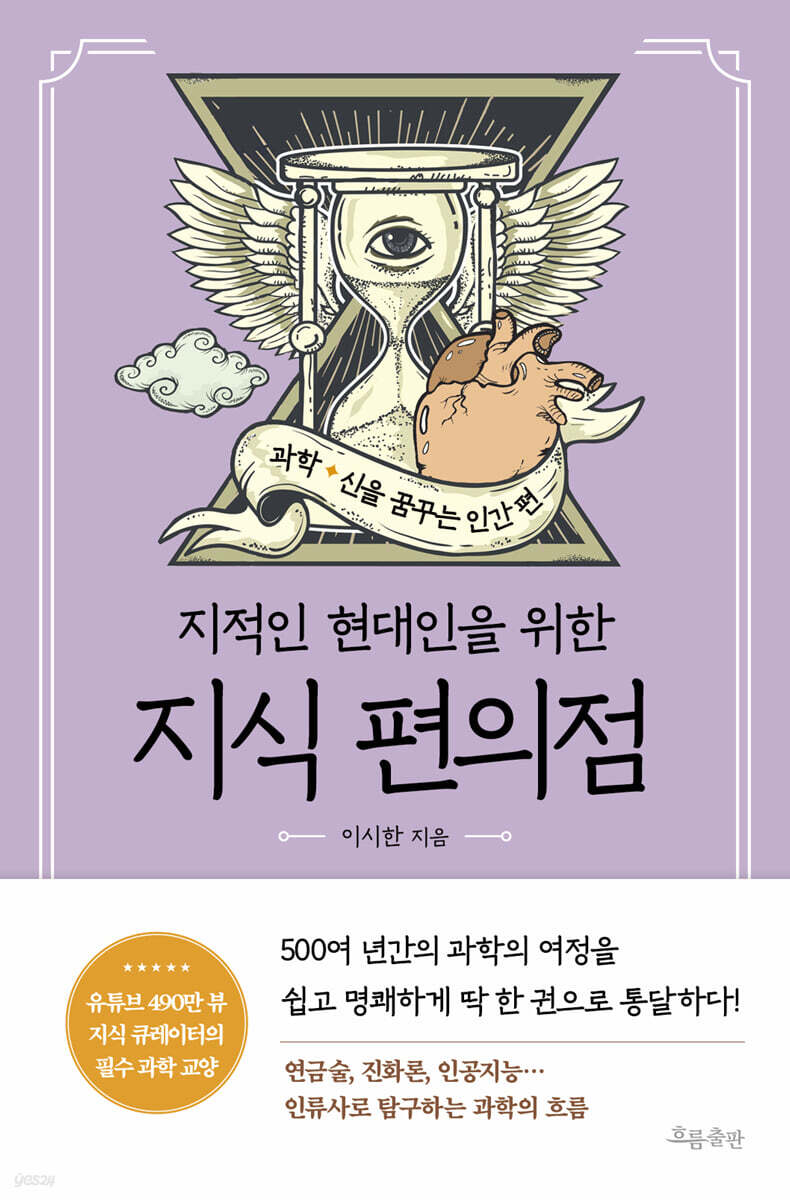
Knowledge Convenience Store: Science, the Human Dreaming of God
 |
Description
Book Introduction
The 'Knowledge Convenience Store' series, which provides only the knowledge you need to know.
Now it's science!
Everything you need to know about science at a glance with these 14 must-read classics.
The "Knowledge Convenience Store" series, the easiest introduction to liberal arts for modern people thirsting for an intellectual life, has returned with the final volume, "Science: A Human Who Dreams of God," following the first volume, "The Thinking Human," and the second volume, "Literature: A Human's Life."
This book explores the science that has had a profound impact at turning points in human history through 14 classics of philosophy and science.
From the beginnings of scientific thought ignited by Aristotle, to the theory of evolution, the discovery of the universe and DNA, and artificial intelligence, this book provides a comprehensive overview of the vast body of scientific knowledge spanning East and West, past and present, in a single volume.
The author, with his characteristically witty writing style, extracts only the key points and explains them, from the new paradigms proposed by contemporary scientists to the social background and the backstory of science that must be understood together.
In answering the question, “How far will science take humanity to evolve?”, this book will enable us to envision the future to come.
Now it's science!
Everything you need to know about science at a glance with these 14 must-read classics.
The "Knowledge Convenience Store" series, the easiest introduction to liberal arts for modern people thirsting for an intellectual life, has returned with the final volume, "Science: A Human Who Dreams of God," following the first volume, "The Thinking Human," and the second volume, "Literature: A Human's Life."
This book explores the science that has had a profound impact at turning points in human history through 14 classics of philosophy and science.
From the beginnings of scientific thought ignited by Aristotle, to the theory of evolution, the discovery of the universe and DNA, and artificial intelligence, this book provides a comprehensive overview of the vast body of scientific knowledge spanning East and West, past and present, in a single volume.
The author, with his characteristically witty writing style, extracts only the key points and explains them, from the new paradigms proposed by contemporary scientists to the social background and the backstory of science that must be understood together.
In answering the question, “How far will science take humanity to evolve?”, this book will enable us to envision the future to come.
- You can preview some of the book's contents.
Preview
index
Introduction | How far will science take humanity to evolve?
Guide to this book
Chapter 1: Where is humanity headed after riding on science?
1.
An ordinary day when I met Lucifer Morningstar.
Johann Wolfgang von Goethe's Faust
2.
What does humanity want to become?
Yuval Harari's "Homo Deus"
Chapter 2: Traces of Science and Technology That Changed Life
3.
An attempt to treat what is as what is
Aristotle's Nicomachean Ethics
4.
The undying spark of science
alchemy
5.
Nature's counterattack that turns the tables
pest
6.
An investment that never loses
Age of Exploration and Technology
7.
The information revolution was hotter than the Internet revolution.
Gutenberg's printing press
Chapter 3: Humans Betray God
8.
The last medieval man and the first modern man
René Descartes' Discourse on Method
9.
The realization that it's fair
Isaac Newton's Principia, Charles Darwin's Origin of Species
10.
Become conscious of the unconscious
Sigmund Freud's The Interpretation of Dreams
Chapter 4: The More You Know, the More Confusing Science Gets
11.
I don't know in part, but I know in whole
Werner Heisenberg's "The Part and the Whole"
12.
Science is true, but it is not the truth.
Thomas Kuhn, The Structure of Scientific Revolutions
13.
The last bastion of absoluteness crumbles
Stephen Hawking's A Brief History of Time
Chapter 5: The Shadow of Science and Technology
14.
Gaia's headache
Jeremy Rifkin's Entropy
15.
The sound of a silenced warning bell
Rachel Carson's Silent Spring
Chapter 6: Is a New World Coming?
16.
The Blueprint of Humanity
James Watson's The Double Helix
17.
The Ship of Theseus Dilemma
Ray Kurzweil's "The Singularity Is Near"
Chapter 7: Humans Dream of God
18.
What does science sacrifice?
Those Who Walk Away from Omelas
Guide to this book
Chapter 1: Where is humanity headed after riding on science?
1.
An ordinary day when I met Lucifer Morningstar.
Johann Wolfgang von Goethe's Faust
2.
What does humanity want to become?
Yuval Harari's "Homo Deus"
Chapter 2: Traces of Science and Technology That Changed Life
3.
An attempt to treat what is as what is
Aristotle's Nicomachean Ethics
4.
The undying spark of science
alchemy
5.
Nature's counterattack that turns the tables
pest
6.
An investment that never loses
Age of Exploration and Technology
7.
The information revolution was hotter than the Internet revolution.
Gutenberg's printing press
Chapter 3: Humans Betray God
8.
The last medieval man and the first modern man
René Descartes' Discourse on Method
9.
The realization that it's fair
Isaac Newton's Principia, Charles Darwin's Origin of Species
10.
Become conscious of the unconscious
Sigmund Freud's The Interpretation of Dreams
Chapter 4: The More You Know, the More Confusing Science Gets
11.
I don't know in part, but I know in whole
Werner Heisenberg's "The Part and the Whole"
12.
Science is true, but it is not the truth.
Thomas Kuhn, The Structure of Scientific Revolutions
13.
The last bastion of absoluteness crumbles
Stephen Hawking's A Brief History of Time
Chapter 5: The Shadow of Science and Technology
14.
Gaia's headache
Jeremy Rifkin's Entropy
15.
The sound of a silenced warning bell
Rachel Carson's Silent Spring
Chapter 6: Is a New World Coming?
16.
The Blueprint of Humanity
James Watson's The Double Helix
17.
The Ship of Theseus Dilemma
Ray Kurzweil's "The Singularity Is Near"
Chapter 7: Humans Dream of God
18.
What does science sacrifice?
Those Who Walk Away from Omelas
Detailed image

Into the book
Through science, humans are discovering the mysteries of life and the secrets of the universe.
Science allows us to transcend boundaries that humans have been told are impossible.
But I wonder if that line is one that should not be crossed, or if it is just a line that shows a limit.
It's true that science has shown superior results than any other approach in terms of challenging boundaries. But when you cross the line, is there a price or a reward that awaits you?
---From "Faust"
We know Descartes as a philosopher, but he was also a famous mathematician and scientist.
Even during this period, science and philosophy were not very separate fields.
His true achievement was to bring the God-centered way of thinking to a human-centered one, and to help people find their own self.
Thinking about the self as a standard of thought is very modern compared to the previous times when it was important whether the standard of thought was in accordance with God's will.
---From "Introduction to the Method"
There is a backstory to the publication of 『The Origin of Species』.
A year before its publication, the young scholar Alfred Wallace sent a letter to Darwin.
He asked me to take a look at the topic he was researching these days.
But the topic was the theory of evolution by natural selection that Darwin had been studying.
It was a big deal for Darwin.
I've been researching this for a while, but I've been keeping an eye on it and decided not to publish it until I've thoroughly collected all the evidence, out of concern for religious persecution.
If this continues, we will lose the player.
---From "The Origin of Species"
The Structure of Scientific Revolutions is one of the most influential books of the 20th century.
This book explains how the stages of scientific development were achieved, but its true significance lies in its claim to have broken the absoluteness of science.
Before this book, science was considered absolute truth, and the development of science was thought to be a process of linear progress.
But after this book came out, I realized that science was the result of the beliefs of the scientists of the time.
---From "The Structure of Scientific Revolutions"
Since Watson and Crick discovered the structure of DNA, many advances have been made.
Among them, I think what has changed most drastically is human consciousness.
There is a growing number of people who believe that they can control and rearrange their genes to become better people.
A future in which science transforms into technology and makes humans more than human seems not too far off.
However, there is a major ontological question: can a human created artificially like this truly be considered a normal human being?
Are humans who are programmed, genetically engineered, and born with a custom design not human? But that doesn't mean they're robots.
Science allows us to transcend boundaries that humans have been told are impossible.
But I wonder if that line is one that should not be crossed, or if it is just a line that shows a limit.
It's true that science has shown superior results than any other approach in terms of challenging boundaries. But when you cross the line, is there a price or a reward that awaits you?
---From "Faust"
We know Descartes as a philosopher, but he was also a famous mathematician and scientist.
Even during this period, science and philosophy were not very separate fields.
His true achievement was to bring the God-centered way of thinking to a human-centered one, and to help people find their own self.
Thinking about the self as a standard of thought is very modern compared to the previous times when it was important whether the standard of thought was in accordance with God's will.
---From "Introduction to the Method"
There is a backstory to the publication of 『The Origin of Species』.
A year before its publication, the young scholar Alfred Wallace sent a letter to Darwin.
He asked me to take a look at the topic he was researching these days.
But the topic was the theory of evolution by natural selection that Darwin had been studying.
It was a big deal for Darwin.
I've been researching this for a while, but I've been keeping an eye on it and decided not to publish it until I've thoroughly collected all the evidence, out of concern for religious persecution.
If this continues, we will lose the player.
---From "The Origin of Species"
The Structure of Scientific Revolutions is one of the most influential books of the 20th century.
This book explains how the stages of scientific development were achieved, but its true significance lies in its claim to have broken the absoluteness of science.
Before this book, science was considered absolute truth, and the development of science was thought to be a process of linear progress.
But after this book came out, I realized that science was the result of the beliefs of the scientists of the time.
---From "The Structure of Scientific Revolutions"
Since Watson and Crick discovered the structure of DNA, many advances have been made.
Among them, I think what has changed most drastically is human consciousness.
There is a growing number of people who believe that they can control and rearrange their genes to become better people.
A future in which science transforms into technology and makes humans more than human seems not too far off.
However, there is a major ontological question: can a human created artificially like this truly be considered a normal human being?
Are humans who are programmed, genetically engineered, and born with a custom design not human? But that doesn't mean they're robots.
---From "The Double Helix"
Publisher's Review
Contains only the knowledge necessary for modern people.
The final installment of the highly acclaimed "Knowledge Convenience Store" series, "Science," has been released!
“I don’t know where to start reading the classics, and they’re so difficult that I keep putting them off.”
“I wish someone would read the brick book for me and summarize it for me.”
The "Knowledge Convenience Store" series was designed to help modern people, thirsty for intellectual experiences, easily understand essential classics within a single context.
It has been praised by numerous readers as an introductory book to liberal arts that anyone can use, even those who have no background knowledge or have never read the classics.
In the first, 'Thinking Human', the humanities knowledge that has created a social system through philosophy is conveyed, and in the second, 'Literature, Human Life', classical literature is linked to the journey of a human being, drawing the trajectory of life.
In the final installment of the series, "Science, the Human Dreaming of God," we ask the question of what it means to be human through science in a world where artificial intelligence has been achieved.
Like the previous series, in which author Lee Si-han, a knowledge curator, carefully selected classics and explained them in their essential points, this book also introduces a carefully selected 14 volumes of major philosophy and science books that have transcended the ages.
It is full of interesting elements that lower the barrier to entry to science, such as explaining difficult scientific concepts using comparisons to popular movies and telling behind-the-scenes stories about the struggles among scientists during the writing of science books.
If you want the easiest science textbook, and want to learn the essentials of vast knowledge efficiently, I recommend starting with this book.
Not only will you be immersed in the fun of science, you will also be able to feel the joy of intellectual growth.
The easiest introduction to science for intellectuals
From alchemy to artificial intelligence
One book can teach you the same knowledge as ten books.
Science has become an inseparable part of human life, with events such as the Go match with AlphaGo, the birth of genetically edited humans, and the launch of space rockets becoming topics of public debate.
As science becomes a natural topic of conversation in everyday life, acquiring scientific knowledge has become an essential skill for modern people.
"Knowledge Convenience Store: Science, the Human Dreaming of God" is a book that reinterprets scientific knowledge so that the macroscopic flow of science can be grasped at a glance by linking it to 14 classic books.
From ancient alchemy and the beginnings of scientific thought by Aristotle, through the sensational era of evolutionary theory, to the modern era with the discovery of the universe and DNA, this book focuses on scientists and their writings that have marked turning points in human history.
The great benefit of this book is that it allows one to master centuries of works in a single volume, regardless of the field, such as philosophy, physics, astronomy, and chemistry.
The analysis goes beyond the original text and the profound insights that grasp the context of the times meet the needs of readers who want to understand complex knowledge clearly.
The author does not stop at simply explaining scientific knowledge or the plot of a classic.
It presents a perspective that we should consider for the future, based on how humans have utilized science.
Opening with the question, “How far will science take humanity to evolve?”, the book is divided into seven chapters based on the periods in human history when science became a topic of debate.
The pace of scientific and technological advancement and its application to human life is faster than we think.
The author suggests that the reader should consider whether future humans dream of becoming gods who transcend all abilities, and through this book, he allows the reader to discover their own insights.
A knowledge convenience store where you can learn everything you need to know, from essential knowledge to the truths of life.
As knowledge that was scattered like fragments is organized into one, your perspective on the world will expand beyond studying science.
The final installment of the highly acclaimed "Knowledge Convenience Store" series, "Science," has been released!
“I don’t know where to start reading the classics, and they’re so difficult that I keep putting them off.”
“I wish someone would read the brick book for me and summarize it for me.”
The "Knowledge Convenience Store" series was designed to help modern people, thirsty for intellectual experiences, easily understand essential classics within a single context.
It has been praised by numerous readers as an introductory book to liberal arts that anyone can use, even those who have no background knowledge or have never read the classics.
In the first, 'Thinking Human', the humanities knowledge that has created a social system through philosophy is conveyed, and in the second, 'Literature, Human Life', classical literature is linked to the journey of a human being, drawing the trajectory of life.
In the final installment of the series, "Science, the Human Dreaming of God," we ask the question of what it means to be human through science in a world where artificial intelligence has been achieved.
Like the previous series, in which author Lee Si-han, a knowledge curator, carefully selected classics and explained them in their essential points, this book also introduces a carefully selected 14 volumes of major philosophy and science books that have transcended the ages.
It is full of interesting elements that lower the barrier to entry to science, such as explaining difficult scientific concepts using comparisons to popular movies and telling behind-the-scenes stories about the struggles among scientists during the writing of science books.
If you want the easiest science textbook, and want to learn the essentials of vast knowledge efficiently, I recommend starting with this book.
Not only will you be immersed in the fun of science, you will also be able to feel the joy of intellectual growth.
The easiest introduction to science for intellectuals
From alchemy to artificial intelligence
One book can teach you the same knowledge as ten books.
Science has become an inseparable part of human life, with events such as the Go match with AlphaGo, the birth of genetically edited humans, and the launch of space rockets becoming topics of public debate.
As science becomes a natural topic of conversation in everyday life, acquiring scientific knowledge has become an essential skill for modern people.
"Knowledge Convenience Store: Science, the Human Dreaming of God" is a book that reinterprets scientific knowledge so that the macroscopic flow of science can be grasped at a glance by linking it to 14 classic books.
From ancient alchemy and the beginnings of scientific thought by Aristotle, through the sensational era of evolutionary theory, to the modern era with the discovery of the universe and DNA, this book focuses on scientists and their writings that have marked turning points in human history.
The great benefit of this book is that it allows one to master centuries of works in a single volume, regardless of the field, such as philosophy, physics, astronomy, and chemistry.
The analysis goes beyond the original text and the profound insights that grasp the context of the times meet the needs of readers who want to understand complex knowledge clearly.
The author does not stop at simply explaining scientific knowledge or the plot of a classic.
It presents a perspective that we should consider for the future, based on how humans have utilized science.
Opening with the question, “How far will science take humanity to evolve?”, the book is divided into seven chapters based on the periods in human history when science became a topic of debate.
The pace of scientific and technological advancement and its application to human life is faster than we think.
The author suggests that the reader should consider whether future humans dream of becoming gods who transcend all abilities, and through this book, he allows the reader to discover their own insights.
A knowledge convenience store where you can learn everything you need to know, from essential knowledge to the truths of life.
As knowledge that was scattered like fragments is organized into one, your perspective on the world will expand beyond studying science.
GOODS SPECIFICS
- Publication date: November 25, 2022
- Page count, weight, size: 288 pages | 376g | 135*205*18mm
- ISBN13: 9788965965442
- ISBN10: 8965965446
You may also like
카테고리
korean


korean

![GQ KOREA Mark (Monthly): December [2025]](http://librairie.coreenne.fr/cdn/shop/files/8ef265dbbfbf186523ed75ba7319009d.jpg?v=1765340328&width=3840)


