

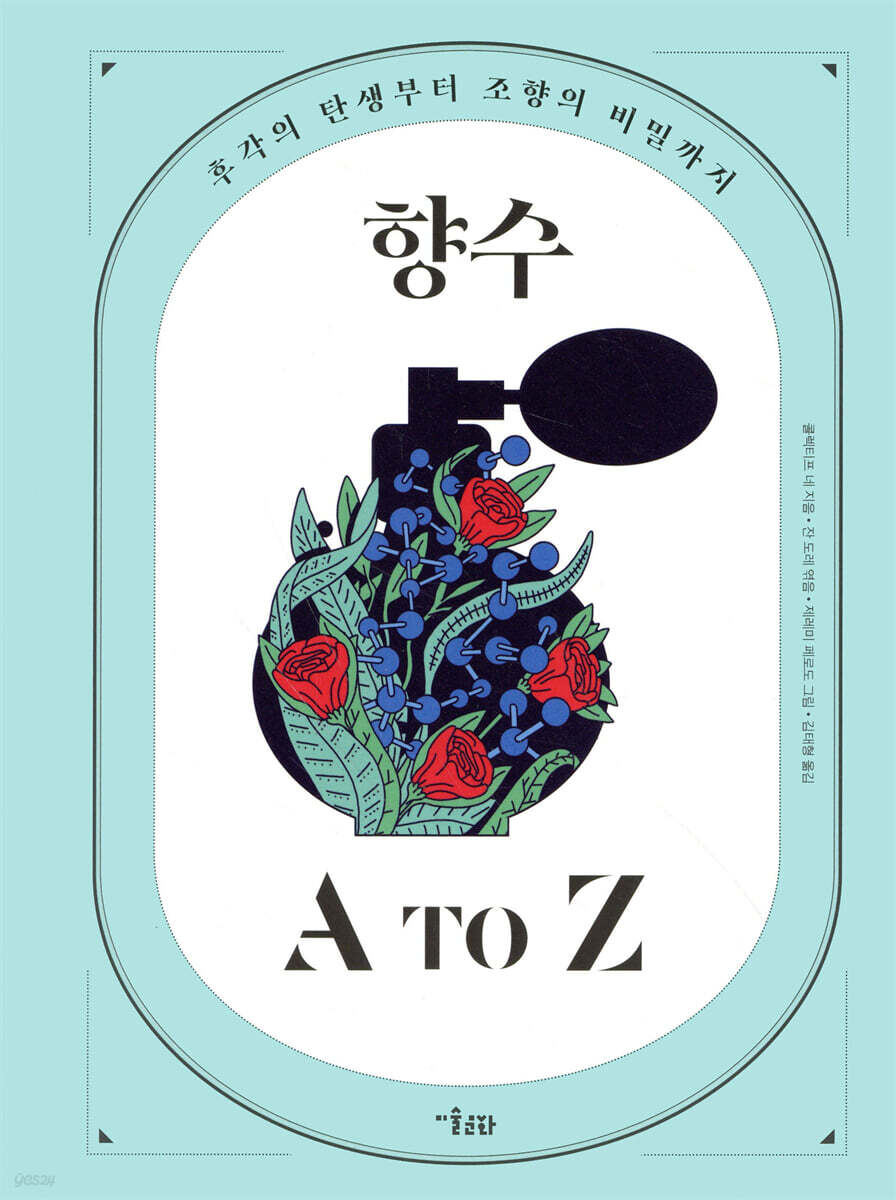
Perfume A to Z
 |
Description
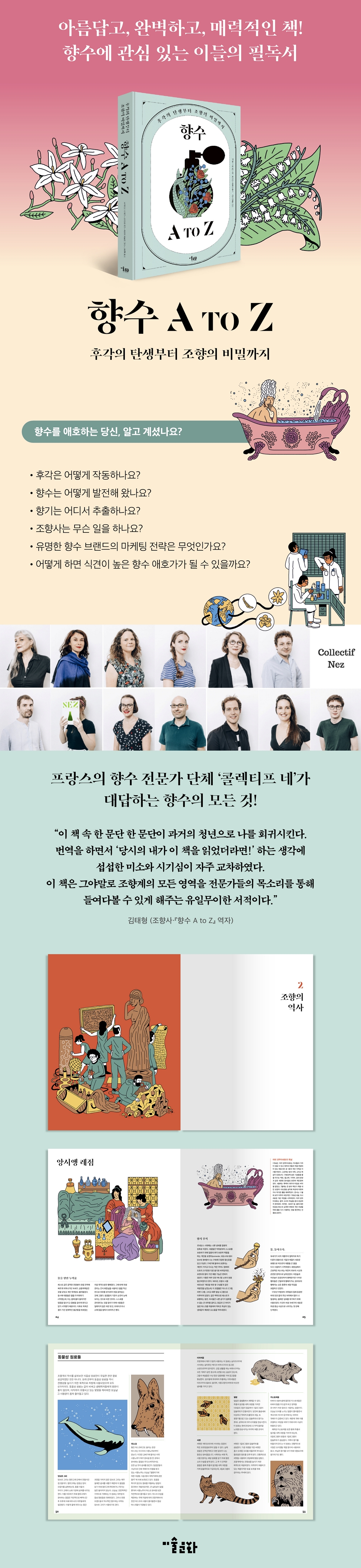
Book Introduction
From the history of perfume to the birth of new perfumes
Everything you didn't know about perfume!
From ancient to modern perfumes, all in one volume.
Since ancient times, a good scent has been a sign of divinity.
Unlike the scent coming from one's own body, humans have always considered fragrant scents to be divine, sacred, and revered them.
By using good scents through perfume, humans were able to communicate with God and get one step closer to God.
Perfume was thought to possess the power of transformation, enabling humans to become gods.
Perfume was not just a pleasant scent, but a medium connecting gods and humans.
Since ancient times, when fragrant trees and resins were offered to the gods, good incense was instinctively considered sacred, and it was something that only priests could make, and it was also a remedy for curing diseases.
But as time passed, the perfume became more and more popular among the public.
In the Middle Ages, perfume was used solely for religious purposes, but sometimes it was also used willingly for a provocative atmosphere that went against convention.
As more and more people began using perfume, various types of perfume were developed and various methods for making perfume were also developed.
As technology developed, perfumes, which had previously relied solely on natural extracts, were able to create numerous fragrances using different compounds through chemical reactions.
It was a revolution in steering.
This led to the development of numerous fragrances, and as mass production became possible through machines, they experienced a revival among various brands and designers.
Since ancient times, in search of good fragrances, people have searched for various animals and plants in the Mediterranean, starting from Italy, Turkey, the Middle East, Spain, and Egypt, and have found various methods to extract fragrances from them.
Perfumers have been constantly striving to create synthetic fragrances to replace natural fragrances, which have limitations in producing the quantities needed.
This book shows the efforts that perfumers put into extracting various ingredients such as rose, vanilla, bergamot, jasmine, and musk, which we are familiar with.
It also explains the characteristics and usage of each ingredient, helping readers slowly immerse themselves in the seemingly complex world of fragrance.
The job of a perfumer involves handling fragrances directly, but also involves working in various fields such as purchasing raw materials, analyzing and evaluating fragrances, and working together to create a single product.
We will walk you through the entire process of creating a product, including examples of what we need to think about and do for the brand, product, and marketing, and you will feel as if you were creating your own perfume.
We are familiar with brands like Chanel, Lancome, and Dior, as well as familiar brands and products such as No. 5, Kseju, Amour Amour, and Arpege.
We are now learning that even the products we are familiar with have gone through the process of countless perfumers improving the prescriptions and evaluating scent samples to create perfumes with their own unique fragrant characteristics.
Everything you didn't know about perfume!
From ancient to modern perfumes, all in one volume.
Since ancient times, a good scent has been a sign of divinity.
Unlike the scent coming from one's own body, humans have always considered fragrant scents to be divine, sacred, and revered them.
By using good scents through perfume, humans were able to communicate with God and get one step closer to God.
Perfume was thought to possess the power of transformation, enabling humans to become gods.
Perfume was not just a pleasant scent, but a medium connecting gods and humans.
Since ancient times, when fragrant trees and resins were offered to the gods, good incense was instinctively considered sacred, and it was something that only priests could make, and it was also a remedy for curing diseases.
But as time passed, the perfume became more and more popular among the public.
In the Middle Ages, perfume was used solely for religious purposes, but sometimes it was also used willingly for a provocative atmosphere that went against convention.
As more and more people began using perfume, various types of perfume were developed and various methods for making perfume were also developed.
As technology developed, perfumes, which had previously relied solely on natural extracts, were able to create numerous fragrances using different compounds through chemical reactions.
It was a revolution in steering.
This led to the development of numerous fragrances, and as mass production became possible through machines, they experienced a revival among various brands and designers.
Since ancient times, in search of good fragrances, people have searched for various animals and plants in the Mediterranean, starting from Italy, Turkey, the Middle East, Spain, and Egypt, and have found various methods to extract fragrances from them.
Perfumers have been constantly striving to create synthetic fragrances to replace natural fragrances, which have limitations in producing the quantities needed.
This book shows the efforts that perfumers put into extracting various ingredients such as rose, vanilla, bergamot, jasmine, and musk, which we are familiar with.
It also explains the characteristics and usage of each ingredient, helping readers slowly immerse themselves in the seemingly complex world of fragrance.
The job of a perfumer involves handling fragrances directly, but also involves working in various fields such as purchasing raw materials, analyzing and evaluating fragrances, and working together to create a single product.
We will walk you through the entire process of creating a product, including examples of what we need to think about and do for the brand, product, and marketing, and you will feel as if you were creating your own perfume.
We are familiar with brands like Chanel, Lancome, and Dior, as well as familiar brands and products such as No. 5, Kseju, Amour Amour, and Arpege.
We are now learning that even the products we are familiar with have gone through the process of countless perfumers improving the prescriptions and evaluating scent samples to create perfumes with their own unique fragrant characteristics.
- You can preview some of the book's contents.
Preview
index
1.
The dynamics of smell
2.
History of steering
3.
Raw materials for fragrance
4.
The profession of a steer
5.
Development of perfume
6.
Perfume manufacturing
7.
Perfume distribution
8.
Mass Perfumery
9.
Niche perfumery
10.
The Life of Perfume
11.
A Guide for Perfume Lovers
supplement
- Unique questions and preconceptions
- Perfume Glossary
- Learn more
The dynamics of smell
2.
History of steering
3.
Raw materials for fragrance
4.
The profession of a steer
5.
Development of perfume
6.
Perfume manufacturing
7.
Perfume distribution
8.
Mass Perfumery
9.
Niche perfumery
10.
The Life of Perfume
11.
A Guide for Perfume Lovers
supplement
- Unique questions and preconceptions
- Perfume Glossary
- Learn more
Detailed image
Into the book
Even just tens of thousands of years ago, humans had to survive in nature on an equal footing with other animals.
For this reason, it can be said that the olfactory system was originally designed to satisfy very basic needs connected with life and death.
The sense of smell was primarily used to detect and reject vital information, such as the smell of rotting meat, and to respond quickly and effectively to dangers such as fire or predators, such as whether to fight or flee.
--- p.15
With the advent of Christianity in medieval Europe, the popular imagination about perfume came to an end.
Ancient religions did not prohibit the use of perfume for non-religious purposes, that is, for aesthetic pleasure or seduction.
However, in Christianity, the action of Mary Magdalene, who poured perfume on Jesus' feet, resulted in the establishment of the idea that perfume should only be used for religious purposes.
In particular, using perfume to seduce a partner was considered sacrilegious.
Also, before Pasteur's research was published in the late 19th century, people believed that bad smells spread disease and that good smells prevented it.
For these religious and cultural reasons, in Western countries under the influence of Christianity, perfumes were mainly used for the prevention and treatment of diseases.
This does not mean that perfume was never used to seduce a partner.
However, this would have clearly created a provocative atmosphere that went against convention.
--- p.22
A look at the history of perfumery reveals that plant-based ingredients were not the only suppliers of natural fragrances.
For a long time, animal-based ingredients have also been used in prescriptions to enhance the lingering fragrance, and there are six of them in total.
Animal-based ingredients are expensive, have a bad reputation among ecologists, and, except for a few that are still in circulation, their use is gradually decreasing today.
--- p.52
The development of a perfume begins with a brand's desire to create a perfume.
Eventually, one day, a recipe is ready for mass production, and the fragrance is soon bottled and sent to stores.
In between lies the work of the helmsman and the entire department, which typically takes years.
--- p.99
Between the ideal of perfume and market share, the mass perfume industry is an industry designed to please the masses while realizing the ideal, giving form to imagination.
Mass perfume marketing is inherently somewhat volatile, constantly shifting between strong market demands and the desire for innovation.
--- p.149
Niche perfumeries are a collection of brands that have small distribution networks, place a high value on artistic freedom, and are not affiliated with any luxury, cosmetics, or other groups.
Typically, these perfumeries are not heavily influenced by mass market trends, focus on creative approaches, and present a vision for a more personal fragrance.
But the economic realities behind independent brands are quite different from those faced by selective perfumeries.
--- p.162
Natural resources are being depleted and regulations are increasing.
Research and development (R&D) has now become a secret weapon to win the war in the perfume market.
In a highly competitive red ocean, perfume is one of the most profitable and popular accessories among luxury goods.
The life of a perfume is never smooth.
Unlike diamonds, it is very rare for fragrance prescriptions to last forever.
As products disappear from the market, perfume lovers strive to preserve the scent heritage that might otherwise be forgotten in people's memories.
The perfume bottle contains another story.
Even if a perfume has the same name, its bottle must be replaced regularly to keep up with the latest fashions.
For this reason, it can be said that the olfactory system was originally designed to satisfy very basic needs connected with life and death.
The sense of smell was primarily used to detect and reject vital information, such as the smell of rotting meat, and to respond quickly and effectively to dangers such as fire or predators, such as whether to fight or flee.
--- p.15
With the advent of Christianity in medieval Europe, the popular imagination about perfume came to an end.
Ancient religions did not prohibit the use of perfume for non-religious purposes, that is, for aesthetic pleasure or seduction.
However, in Christianity, the action of Mary Magdalene, who poured perfume on Jesus' feet, resulted in the establishment of the idea that perfume should only be used for religious purposes.
In particular, using perfume to seduce a partner was considered sacrilegious.
Also, before Pasteur's research was published in the late 19th century, people believed that bad smells spread disease and that good smells prevented it.
For these religious and cultural reasons, in Western countries under the influence of Christianity, perfumes were mainly used for the prevention and treatment of diseases.
This does not mean that perfume was never used to seduce a partner.
However, this would have clearly created a provocative atmosphere that went against convention.
--- p.22
A look at the history of perfumery reveals that plant-based ingredients were not the only suppliers of natural fragrances.
For a long time, animal-based ingredients have also been used in prescriptions to enhance the lingering fragrance, and there are six of them in total.
Animal-based ingredients are expensive, have a bad reputation among ecologists, and, except for a few that are still in circulation, their use is gradually decreasing today.
--- p.52
The development of a perfume begins with a brand's desire to create a perfume.
Eventually, one day, a recipe is ready for mass production, and the fragrance is soon bottled and sent to stores.
In between lies the work of the helmsman and the entire department, which typically takes years.
--- p.99
Between the ideal of perfume and market share, the mass perfume industry is an industry designed to please the masses while realizing the ideal, giving form to imagination.
Mass perfume marketing is inherently somewhat volatile, constantly shifting between strong market demands and the desire for innovation.
--- p.149
Niche perfumeries are a collection of brands that have small distribution networks, place a high value on artistic freedom, and are not affiliated with any luxury, cosmetics, or other groups.
Typically, these perfumeries are not heavily influenced by mass market trends, focus on creative approaches, and present a vision for a more personal fragrance.
But the economic realities behind independent brands are quite different from those faced by selective perfumeries.
--- p.162
Natural resources are being depleted and regulations are increasing.
Research and development (R&D) has now become a secret weapon to win the war in the perfume market.
In a highly competitive red ocean, perfume is one of the most profitable and popular accessories among luxury goods.
The life of a perfume is never smooth.
Unlike diamonds, it is very rare for fragrance prescriptions to last forever.
As products disappear from the market, perfume lovers strive to preserve the scent heritage that might otherwise be forgotten in people's memories.
The perfume bottle contains another story.
Even if a perfume has the same name, its bottle must be replaced regularly to keep up with the latest fashions.
--- p.181
Publisher's Review
From the sweet scent that makes your day happy
Even the captivating scent that stirs the heart.
The delicate art of steering
Another world born from the perfumer's fingertips: perfume.
Everything About Fragrance, Guided by an Egyptian Perfumer
From the history of perfume to the birth of new perfumes
Everything you didn't know about perfume!
From ancient to modern perfumes, all in one volume.
Since ancient times, a good scent has been a sign of divinity.
Unlike the scent coming from one's own body, humans have always considered fragrant scents to be divine, sacred, and revered them.
By using good scents through perfume, humans were able to communicate with God and get one step closer to God.
Perfume was thought to possess the power of transformation, enabling humans to become gods.
Perfume was not just a pleasant scent, but a medium connecting gods and humans.
Since ancient times, when fragrant trees and resins were offered to the gods, good incense was instinctively considered sacred, and it was something that only priests could make, and it was also a remedy for curing diseases.
But as time passed, the perfume became more and more popular among the public.
In the Middle Ages, perfume was used solely for religious purposes, but sometimes it was also used willingly for a provocative atmosphere that went against convention.
As more and more people began using perfume, various types of perfume were developed and various methods for making perfume were also developed.
As technology developed, perfumes, which had previously relied solely on natural extracts, were able to create numerous fragrances using different compounds through chemical reactions.
It was a revolution in steering.
This led to the development of numerous fragrances, and as mass production became possible through machines, they experienced a revival among various brands and designers.
Since ancient times, in search of good fragrances, people have searched for various animals and plants in the Mediterranean, starting from Italy, Turkey, the Middle East, Spain, and Egypt, and have found various methods to extract fragrances from them.
Perfumers have been constantly striving to create synthetic fragrances to replace natural fragrances, which have limitations in producing the quantities needed.
This book shows the efforts that perfumers put into extracting various ingredients such as rose, vanilla, bergamot, jasmine, and musk, which we are familiar with.
It also explains the characteristics and usage of each ingredient, helping readers slowly immerse themselves in the seemingly complex world of fragrance.
The job of a perfumer involves handling fragrances directly, but also involves working in various fields such as purchasing raw materials, analyzing and evaluating fragrances, and working together to create a single product.
We will walk you through the entire process of creating a product, including examples of what we need to think about and do for the brand, product, and marketing, and you will feel as if you were creating your own perfume.
We are familiar with brands like Chanel, Lancome, and Dior, as well as familiar brands and products such as No. 5, Kseju, Amour Amour, and Arpege.
We are now learning that even the products we are familiar with have gone through the process of countless perfumers improving the prescriptions and evaluating scent samples to create perfumes with their own unique fragrant characteristics.
Not only perfume, but also the perfume industry that was hidden behind it.
A general textbook that you can understand at a glance
This book covers the history of perfume, the raw materials and extraction methods of fragrance, how to become a perfumer, the process of producing perfume, and the countless efforts of people who go through the process of creating a perfume, for the general public interested in perfume or for those who dream of becoming a perfumer or designer.
We also tried to capture the difficulties, reality, and vividness of the field through interviews with current workers.
This is a passage that lets us know that the weight of the perfume we lightly spray is not that light.
For modern people, perfume is one of the means of expressing myself.
Among the numerous perfumes, find a scent you like or one that suits you and use it.
When choosing a perfume, the history behind the scent, the production and extraction methods of the raw materials, and the inspiration and intentions of the perfumer and designer will become new criteria for choosing a perfume.
The book details how perfumes, after passing through the hands of perfumers, enter the manufacturing stage, pass various regulations, and are delivered to consumers, as well as which stores they end up in.
Here, we explain various methods, such as online investment, media promotion, and various promotional tools, to introduce perfume to the public, helping you, as a consumer, walk along the path that perfume takes to us.
Even the captivating scent that stirs the heart.
The delicate art of steering
Another world born from the perfumer's fingertips: perfume.
Everything About Fragrance, Guided by an Egyptian Perfumer
From the history of perfume to the birth of new perfumes
Everything you didn't know about perfume!
From ancient to modern perfumes, all in one volume.
Since ancient times, a good scent has been a sign of divinity.
Unlike the scent coming from one's own body, humans have always considered fragrant scents to be divine, sacred, and revered them.
By using good scents through perfume, humans were able to communicate with God and get one step closer to God.
Perfume was thought to possess the power of transformation, enabling humans to become gods.
Perfume was not just a pleasant scent, but a medium connecting gods and humans.
Since ancient times, when fragrant trees and resins were offered to the gods, good incense was instinctively considered sacred, and it was something that only priests could make, and it was also a remedy for curing diseases.
But as time passed, the perfume became more and more popular among the public.
In the Middle Ages, perfume was used solely for religious purposes, but sometimes it was also used willingly for a provocative atmosphere that went against convention.
As more and more people began using perfume, various types of perfume were developed and various methods for making perfume were also developed.
As technology developed, perfumes, which had previously relied solely on natural extracts, were able to create numerous fragrances using different compounds through chemical reactions.
It was a revolution in steering.
This led to the development of numerous fragrances, and as mass production became possible through machines, they experienced a revival among various brands and designers.
Since ancient times, in search of good fragrances, people have searched for various animals and plants in the Mediterranean, starting from Italy, Turkey, the Middle East, Spain, and Egypt, and have found various methods to extract fragrances from them.
Perfumers have been constantly striving to create synthetic fragrances to replace natural fragrances, which have limitations in producing the quantities needed.
This book shows the efforts that perfumers put into extracting various ingredients such as rose, vanilla, bergamot, jasmine, and musk, which we are familiar with.
It also explains the characteristics and usage of each ingredient, helping readers slowly immerse themselves in the seemingly complex world of fragrance.
The job of a perfumer involves handling fragrances directly, but also involves working in various fields such as purchasing raw materials, analyzing and evaluating fragrances, and working together to create a single product.
We will walk you through the entire process of creating a product, including examples of what we need to think about and do for the brand, product, and marketing, and you will feel as if you were creating your own perfume.
We are familiar with brands like Chanel, Lancome, and Dior, as well as familiar brands and products such as No. 5, Kseju, Amour Amour, and Arpege.
We are now learning that even the products we are familiar with have gone through the process of countless perfumers improving the prescriptions and evaluating scent samples to create perfumes with their own unique fragrant characteristics.
Not only perfume, but also the perfume industry that was hidden behind it.
A general textbook that you can understand at a glance
This book covers the history of perfume, the raw materials and extraction methods of fragrance, how to become a perfumer, the process of producing perfume, and the countless efforts of people who go through the process of creating a perfume, for the general public interested in perfume or for those who dream of becoming a perfumer or designer.
We also tried to capture the difficulties, reality, and vividness of the field through interviews with current workers.
This is a passage that lets us know that the weight of the perfume we lightly spray is not that light.
For modern people, perfume is one of the means of expressing myself.
Among the numerous perfumes, find a scent you like or one that suits you and use it.
When choosing a perfume, the history behind the scent, the production and extraction methods of the raw materials, and the inspiration and intentions of the perfumer and designer will become new criteria for choosing a perfume.
The book details how perfumes, after passing through the hands of perfumers, enter the manufacturing stage, pass various regulations, and are delivered to consumers, as well as which stores they end up in.
Here, we explain various methods, such as online investment, media promotion, and various promotional tools, to introduce perfume to the public, helping you, as a consumer, walk along the path that perfume takes to us.
GOODS SPECIFICS
- Publication date: April 22, 2022
- Format: Hardcover book binding method guide
- Page count, weight, size: 232 pages | 678g | 175*240*20mm
- ISBN13: 9791185954868
- ISBN10: 1185954864
You may also like
카테고리
korean


korean

![GQ KOREA Mark (Monthly): December [2025]](http://librairie.coreenne.fr/cdn/shop/files/8ef265dbbfbf186523ed75ba7319009d.jpg?v=1765340328&width=3840)


