

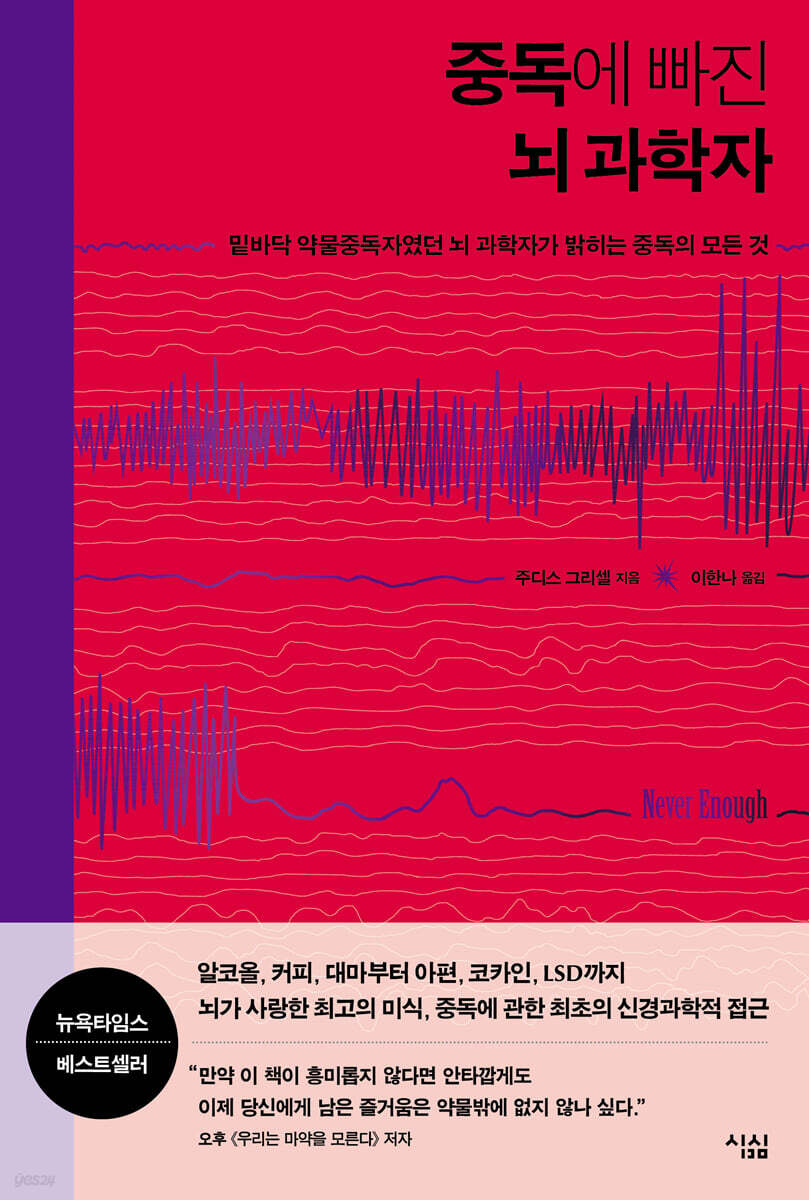
The addicted brain scientist
 |
Description
Book Introduction
[New York Times] Bestseller From the psychology of addiction to the neuroscience of addiction. Everything You Need to Know About Addiction: From a Drug Addict to a Neuroscientist Who Researches Addiction A book titled "The Addicted Brain Scientist" was written by a drug addict who experienced rock bottom for over 20 years and became a brain scientist studying addiction. The author of this book, Judith Grissel, is a world-renowned neuroscientist. In this book, he honestly and boldly reveals his experiences of being addicted to alcohol and various other drugs at the age of thirteen, and what he discovered later as a scientist. This book, both an autobiographical essay by an addict and a meticulously researched scientific study of the neuroscience of addiction, will not only enlighten those who have wondered who, how, and why they become addicted to drugs, but also reveal that the brain's workings remain a mystery. Moreover, in a time when drugs are more abundant than ever, we propose personal and social ways for people to live free from addiction. |
- You can preview some of the book's contents.
Preview
index
Introduction
From a chronic addict to a brain scientist studying addiction│Entering the abyss of addiction│All this freedom
The End│All recovery begins at the bottom.
1.
The best delicacies loved by the brain
How the Brain Gets Addicted | Dopamine in the Mesolimbic System, the Pleasure Center | The Potential of Drugs of Abuse That Transcends Evolution | Three Laws That Define Addictive Drugs
2.
Overly Excellent Learning Ability: Neuroadaptation
The brain counterbalances both joy and sorrow. Why the first glass and cigarette taste the best. The brain's ability to learn to create withdrawal and cravings. No brain is free from addiction.
3.
The leading addictive drug: marijuana
Cannabis is too perfect for me│Cannabis' amazing grip that makes every synapse dance│The intense and colorful backside of cannabis: amotivation syndrome
4.
The Hellish Swaying Bridge Between Dream and Reality: Opium
A cruel and predictable love story│A life without opium is better than death│How does 'dreamlike time' help us survive│Environmental cues that turn pain sensitivity on and off│Addiction depends on context│Pleasure obtained from drugs always comes with a price
5.
The simplest and most destructive, mankind's eternal friend: alcohol.
Can't we celebrate the best moments without a toast? │Carrots and sticks won't stop it. │How alcohol fills the hole in the soul. │The pleasant and unpleasant effects of alcohol. │How the liquor industry encourages drinking.
6.
Popular Prescription Drugs: Sedatives
The Illusion of Safety and Security│The Causes of Marilyn Monroe, Jimi Hendrix, and Michael Jackson│Sedatives Don't Solve Insomnia and Anxiety
7.
Energy Loans for Those Who Live Only for Today: Stimulants
Who doesn't love a feeling of activity? │ Caffeine, the world's favorite psychoactive drug │ Why quitting smoking feels harder than dying │ Cocaine: A runaway train heading for ruin │ From nasal decongestant to the blacklist of the drug world │ How ecstasy causes permanent brain damage
8.
An invitation to a mysterious and unpredictable world: psychedelics
Can LSD Save Humanity? Psychedelics Turn Bad Hallucinations into Positive Experiences? Could Psychedelics Be the Escape? A New Possibility for Treating Anxiety and Depression
9.
Where there's a will, there's a way: Other Drugs of Abuse
Anything to get high│A variety of natural stimulants loved by humans│Dissociative anesthetics that separate the senses from the self│Drugs of caution hidden in the veil│New, stronger: drugs that are constantly evolving│Whether it's a club drug or a treatment for narcolepsy│A lethal refuge for the desperate│Forbidden illegal compounds
10.
Why am I addicted?
Four Reasons Why I Became an Addict│The Biological Substrate of Addiction│The Epigenome, Which Recalls Ancestral Experiences│The Impact of Childhood Drug Use on the Brain│Are There Certain Personalities That Are Vulnerable to Addiction│Strong and Certain Factors That Push Us to Addiction│The Paths to Addiction Are as Diverse as the Number of Addicts
11.
Finding a solution to addiction
How far has neuroscience advanced? │Practical and ethical issues │The ultimate path to recovery │Reckless or innovative │The causes of addiction lie outside the brain │Connecting with others
Acknowledgements
Huzhou
From a chronic addict to a brain scientist studying addiction│Entering the abyss of addiction│All this freedom
The End│All recovery begins at the bottom.
1.
The best delicacies loved by the brain
How the Brain Gets Addicted | Dopamine in the Mesolimbic System, the Pleasure Center | The Potential of Drugs of Abuse That Transcends Evolution | Three Laws That Define Addictive Drugs
2.
Overly Excellent Learning Ability: Neuroadaptation
The brain counterbalances both joy and sorrow. Why the first glass and cigarette taste the best. The brain's ability to learn to create withdrawal and cravings. No brain is free from addiction.
3.
The leading addictive drug: marijuana
Cannabis is too perfect for me│Cannabis' amazing grip that makes every synapse dance│The intense and colorful backside of cannabis: amotivation syndrome
4.
The Hellish Swaying Bridge Between Dream and Reality: Opium
A cruel and predictable love story│A life without opium is better than death│How does 'dreamlike time' help us survive│Environmental cues that turn pain sensitivity on and off│Addiction depends on context│Pleasure obtained from drugs always comes with a price
5.
The simplest and most destructive, mankind's eternal friend: alcohol.
Can't we celebrate the best moments without a toast? │Carrots and sticks won't stop it. │How alcohol fills the hole in the soul. │The pleasant and unpleasant effects of alcohol. │How the liquor industry encourages drinking.
6.
Popular Prescription Drugs: Sedatives
The Illusion of Safety and Security│The Causes of Marilyn Monroe, Jimi Hendrix, and Michael Jackson│Sedatives Don't Solve Insomnia and Anxiety
7.
Energy Loans for Those Who Live Only for Today: Stimulants
Who doesn't love a feeling of activity? │ Caffeine, the world's favorite psychoactive drug │ Why quitting smoking feels harder than dying │ Cocaine: A runaway train heading for ruin │ From nasal decongestant to the blacklist of the drug world │ How ecstasy causes permanent brain damage
8.
An invitation to a mysterious and unpredictable world: psychedelics
Can LSD Save Humanity? Psychedelics Turn Bad Hallucinations into Positive Experiences? Could Psychedelics Be the Escape? A New Possibility for Treating Anxiety and Depression
9.
Where there's a will, there's a way: Other Drugs of Abuse
Anything to get high│A variety of natural stimulants loved by humans│Dissociative anesthetics that separate the senses from the self│Drugs of caution hidden in the veil│New, stronger: drugs that are constantly evolving│Whether it's a club drug or a treatment for narcolepsy│A lethal refuge for the desperate│Forbidden illegal compounds
10.
Why am I addicted?
Four Reasons Why I Became an Addict│The Biological Substrate of Addiction│The Epigenome, Which Recalls Ancestral Experiences│The Impact of Childhood Drug Use on the Brain│Are There Certain Personalities That Are Vulnerable to Addiction│Strong and Certain Factors That Push Us to Addiction│The Paths to Addiction Are as Diverse as the Number of Addicts
11.
Finding a solution to addiction
How far has neuroscience advanced? │Practical and ethical issues │The ultimate path to recovery │Reckless or innovative │The causes of addiction lie outside the brain │Connecting with others
Acknowledgements
Huzhou
Detailed image
Into the book
This book summarizes what I've learned over the past 20 years studying the neuroscience of addiction.
I must regretfully say that, although I have research funding from the National Institutes of Health and a DEA license to use controlled substances, I have not been able to solve the problem.
But research has taught me a lot about the differences people like me have before they even touch drugs, and how addictive drugs affect our brains.
I hope the information I share will help those close to drug addicts, their caregivers, and public policymakers make wiser choices.
This might even help those who are directly suffering, as it is fairly obvious that drugs and the like cannot solve the problem.
--- p.7~8
Globally, addiction is one of the world's most devastating health problems, affecting one in five people over the age of 15.
From a purely economic perspective, it costs five times more than AIDS and twice as much as cancer.
These figures mean that 10 percent of all U.S. health care spending is spent on preventing, diagnosing, and treating addictive diseases, and the statistics for most other Western cultures are equally terrifying.
--- p.8~9
Ultimately, while the paths to addiction are as varied as the number of addicts, common principles of brain function underlie all compulsive use.
My goal in writing this book is to share these principles and offer a starting point for a shift in the biological impasse that perpetuates substance use and abuse.
--- p.10
The first time I got drunk at age thirteen, I felt like Eve must have felt after tasting an apple.
Or perhaps it was the feeling a bird might have felt after hatching from a cage and gaining unexpected freedom.
The sudden shift in perspective that came after I downed two liters of wine in my friend's basement gave me the confidence that life and I would somehow be okay.
Just as darkness allows light to shine through, and sadness allows joy to shine through, alcohol unconsciously made me aware of my desperate struggle for self-acceptance and purpose, and my inability to navigate the complex world of relationships, fears, and hopes.
At the same time, it felt like the key to solving all the suffering that was blooming wildly was being handed to me on a pillow as soft as silk.
--- p.11
According to George Koob, director of the National Institute on Alcohol Abuse and Alcoholism, there are two ways to become an alcoholic.
Either you're born an addict or you drink a lot.
Dr. Coop isn't trying to be pedantic, and considering that anyone can fit into either category, it helps explain why this condition is so common.
I know that many people in my situation are prone to addiction even before they take their first sip.
Anyone with a nervous system also knows that tolerance and dependence (the hallmarks of addiction) develop when exposed to psychoactive drugs at a certain level.
Unfortunately, there is still no scientific model that can clearly explain the circumstances that led to my complete and utter fall into the abyss, with no home or hope.
--- p.15
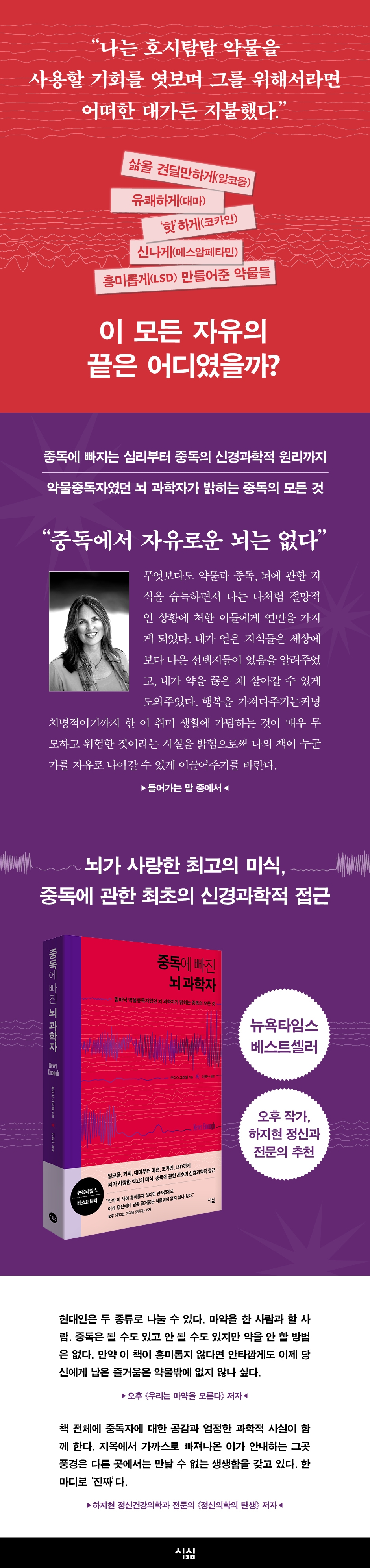
I was always on the lookout for an opportunity to use psychotropic drugs, and I would pay any price for it.
Only these guidelines justified my actions, and virtually every moment was filled with the purpose of avoiding the awareness that comes with sobriety.
If my first drink gave me peace of mind, the first drug I tried gave me pure pleasure.
Alcohol made life bearable, but marijuana made it very pleasant.
Cocaine also changed my life in a 'hot' way, methamphetamine in an exciting way, and LSD in an interesting way.
In exchange for all this drug magic, I sold myself out little by little.
--- p.15~16
Cocaine assaulted my taste buds and hearing before I even felt its presence.
A strangely sharp taste was felt on the back of my tongue, and a fire alarm-like sound was blaring in my ears.
And then I felt it! A wave of warm joy came, much richer than when I inhaled through my nose.
My body and brain gradually became warm and moist, and I felt a sense of joy, and I felt grateful for the beauty of life.
Not to brag, after a few minutes I ended up taking charge of the syringe so that I wouldn't have to skip my turn.
Although it happened a little later, this habit of using cocaine resulted in hitting rock bottom earlier.
--- p.21
As I gained knowledge about drugs, addiction, and the brain, I began to feel compassion for those in desperate situations like mine.
The knowledge I gained helped me stay drug-free by showing me that there are better options in the world.
I hope my book will lead someone to freedom by revealing that engaging in this hobby, which far from bringing happiness, can be extremely reckless and dangerous.
--- p.31
If alcohol is a sledgehammer, aka a hammer, and cocaine is a laser (which it is), then marijuana is a can of bright red paint.
There are at least two reasons why this analogy holds true.
First, as is well known, cannabis makes us experience the properties of various environmental stimuli with great intensity: music sounds wonderful, food tastes delicious, jokes seem amusing, and all colors that we see seem brilliant.
Second, the effects of the drug are variable and widespread rather than subtle and specific.
It's like using a 4-inch brush to dab 20 liters of paint on all your neural pathways.
I must regretfully say that, although I have research funding from the National Institutes of Health and a DEA license to use controlled substances, I have not been able to solve the problem.
But research has taught me a lot about the differences people like me have before they even touch drugs, and how addictive drugs affect our brains.
I hope the information I share will help those close to drug addicts, their caregivers, and public policymakers make wiser choices.
This might even help those who are directly suffering, as it is fairly obvious that drugs and the like cannot solve the problem.
--- p.7~8
Globally, addiction is one of the world's most devastating health problems, affecting one in five people over the age of 15.
From a purely economic perspective, it costs five times more than AIDS and twice as much as cancer.
These figures mean that 10 percent of all U.S. health care spending is spent on preventing, diagnosing, and treating addictive diseases, and the statistics for most other Western cultures are equally terrifying.
--- p.8~9
Ultimately, while the paths to addiction are as varied as the number of addicts, common principles of brain function underlie all compulsive use.
My goal in writing this book is to share these principles and offer a starting point for a shift in the biological impasse that perpetuates substance use and abuse.
--- p.10
The first time I got drunk at age thirteen, I felt like Eve must have felt after tasting an apple.
Or perhaps it was the feeling a bird might have felt after hatching from a cage and gaining unexpected freedom.
The sudden shift in perspective that came after I downed two liters of wine in my friend's basement gave me the confidence that life and I would somehow be okay.
Just as darkness allows light to shine through, and sadness allows joy to shine through, alcohol unconsciously made me aware of my desperate struggle for self-acceptance and purpose, and my inability to navigate the complex world of relationships, fears, and hopes.
At the same time, it felt like the key to solving all the suffering that was blooming wildly was being handed to me on a pillow as soft as silk.
--- p.11
According to George Koob, director of the National Institute on Alcohol Abuse and Alcoholism, there are two ways to become an alcoholic.
Either you're born an addict or you drink a lot.
Dr. Coop isn't trying to be pedantic, and considering that anyone can fit into either category, it helps explain why this condition is so common.
I know that many people in my situation are prone to addiction even before they take their first sip.
Anyone with a nervous system also knows that tolerance and dependence (the hallmarks of addiction) develop when exposed to psychoactive drugs at a certain level.
Unfortunately, there is still no scientific model that can clearly explain the circumstances that led to my complete and utter fall into the abyss, with no home or hope.
--- p.15
I was always on the lookout for an opportunity to use psychotropic drugs, and I would pay any price for it.
Only these guidelines justified my actions, and virtually every moment was filled with the purpose of avoiding the awareness that comes with sobriety.
If my first drink gave me peace of mind, the first drug I tried gave me pure pleasure.
Alcohol made life bearable, but marijuana made it very pleasant.
Cocaine also changed my life in a 'hot' way, methamphetamine in an exciting way, and LSD in an interesting way.
In exchange for all this drug magic, I sold myself out little by little.
--- p.15~16
Cocaine assaulted my taste buds and hearing before I even felt its presence.
A strangely sharp taste was felt on the back of my tongue, and a fire alarm-like sound was blaring in my ears.
And then I felt it! A wave of warm joy came, much richer than when I inhaled through my nose.
My body and brain gradually became warm and moist, and I felt a sense of joy, and I felt grateful for the beauty of life.
Not to brag, after a few minutes I ended up taking charge of the syringe so that I wouldn't have to skip my turn.
Although it happened a little later, this habit of using cocaine resulted in hitting rock bottom earlier.
--- p.21
As I gained knowledge about drugs, addiction, and the brain, I began to feel compassion for those in desperate situations like mine.
The knowledge I gained helped me stay drug-free by showing me that there are better options in the world.
I hope my book will lead someone to freedom by revealing that engaging in this hobby, which far from bringing happiness, can be extremely reckless and dangerous.
--- p.31
If alcohol is a sledgehammer, aka a hammer, and cocaine is a laser (which it is), then marijuana is a can of bright red paint.
There are at least two reasons why this analogy holds true.
First, as is well known, cannabis makes us experience the properties of various environmental stimuli with great intensity: music sounds wonderful, food tastes delicious, jokes seem amusing, and all colors that we see seem brilliant.
Second, the effects of the drug are variable and widespread rather than subtle and specific.
It's like using a 4-inch brush to dab 20 liters of paint on all your neural pathways.
--- p.88~89
Publisher's Review
[New York Times] Bestseller
“There is no brain free from addiction.”
From the psychology of addiction to the neuroscience of addiction.
Everything You Need to Know About Addiction: A Drug Addict Turns into a Brain Scientist Who Researches Addiction
If my first drink gave me peace of mind, the first drug I tried gave me pure pleasure.
Alcohol made life bearable, but marijuana made it very pleasant.
Cocaine also changed my life in a 'hot' way, methamphetamine in an exciting way, and LSD in an interesting way.
In exchange for all this drug magic, I sold myself little by little. (pp. 16-17)
Globally, addiction affects one in five people over the age of 15, and the annual cost of addiction treatment and prevention is five times that of AIDS and twice that of cancer.
In the United States, about a quarter of all deaths are due to drug overdose, and the number of drug overdose deaths in 2020 increased by about 29.4% compared to 2019 due to the impact of COVID-19.
Despite the remarkable advancements in science, countless people still experience momentary pleasure through addiction while suffering endless pain.
People often think that addiction is caused by a weak personality.
It means that because you are weak-minded, you cannot make rational choices that involve patience and moderation.
This conclusion was previously considered valid.
But with the advent of the era of brain science, the hypothesis was completely overturned.
When we talk about the causes of addiction, the concepts of mental strength, personality, and personal responsibility no longer apply.
It is believed that addicts are merely victims of a biological abnormality, and that the very idea that there is any 'choice' may be an illusion.
In this book, Grissel says, “The path to addiction is as diverse as the number of addicts, but there are general principles of brain function underlying all compulsive use.” He raises the most pressing questions about addiction, such as, “Why do we become addicted?”, “What are the biological causes of addiction?”, “Are some people more vulnerable to addiction?”, and “Can we solve addiction?”, and clearly answers them based on the latest discoveries and knowledge in neuroscience, biology, psychiatry, and pharmacology.
Moreover, this book suggests personal and social strategies for people to live free from addiction in a time when drugs are more abundant than ever before.
This book summarizes what I've learned over the past 20 years studying the neuroscience of addiction.
I must regretfully say that, although I have research funding from the National Institutes of Health and a DEA license to use controlled substances, I have not been able to solve the problem.
But research has taught me a lot about the differences people like me have before they even touch drugs, and how addictive drugs affect our brains.
I hope the information I share will help those close to drug addicts, their caregivers, and public policymakers make wiser choices.
This might even help those who are directly suffering, since it's fairly obvious that medication and the like can't solve the problem (pp. 7-8).
The book is divided into three main parts, following an introduction that introduces the author's journey from drug addict to neuroscientist specializing in addiction research.
Chapters 1 and 2 explain what characteristics of the brain cause addiction.
Chapters 3 through 9 cover the mechanisms of action of each type of drug, and introduce anecdotes and neuroscience research results related to this.
Finally, Chapters 10 and 11 present factors that can easily lead to addiction and suggest solutions to address the problem of addiction.
From alcohol, coffee, and marijuana to opium, cocaine, and LSD.
A brain scientist who was an all-round drug addict tells us
The sometimes fascinating, sometimes tragic world of addiction
This book is full of descriptions of drugs that you wouldn't know about unless you experienced them firsthand.
As you become absorbed in the author's overwhelming experiences and experience the effects of drugs indirectly, a tingling fear of drugs and addiction creeps up the back of your neck as the world spins around you.
Psychiatrist Ha Ji-hyun said about this, “Those who study from books are beginners, those who learn through observation are intermediate, and those who have experienced it firsthand are experts.
(…) The scenery there, guided by someone who barely escaped from hell, has a vividness that cannot be found anywhere else,” he said.
After his first drink at age thirteen, Grisel experienced a freedom he had never imagined, along with a feeling “like Eve felt after tasting an apple.”
The relief he felt for the first time was a great comfort and mental antidote to Grisel.
He began to become passionate about alcohol and other various drugs.
Any change that drugs brought to our monotonous and boring lives was seen as a dramatic improvement.
He was passionate about all drugs, going all the way down the spectrum of addictions, including alcohol, marijuana, cocaine, methamphetamine, and LSD.
Cocaine assaulted my taste buds and hearing before I even felt its presence.
A strangely sharp taste was felt on the back of my tongue, and a fire alarm-like sound was blaring in my ears.
And then I felt it! A wave of warm joy came, much richer than when I inhaled through my nose.
My body and brain gradually became warm and moist, and I felt a sense of joy, and I felt grateful for the beauty of life.
Not to brag, after a few minutes I ended up taking charge of the syringe so that I wouldn't have to skip my turn.
Although it happened a little later, this cocaine habit resulted in hitting rock bottom earlier. (p. 21)
Grisel, homeless and unemployed, was always on the lookout for an opportunity to use psychotropic drugs, and he was willing to pay any price for it.
Despite suffering countless tragedies—being chased by federal agents, losing a friend, being kicked out of school and home, and suffering withdrawal symptoms—he remained drug-free.
Then one day, Grisel sees a bottomless abyss reflected in his own eyes in the mirror.
It was far more miserable than the emptiness he had suffered so far.
He turned back to smoke a joint, but couldn't shake off the creepy feeling he had that day.
He recalls that time as the moment when he hit his 'bottom'.
Afterwards, Grisel experiences a clear, drug-free state thanks to a series of environmental factors.
And we stand at the crossroads of corruption and renewal.
The price of quitting drugs seemed too high, but after much deliberation, he chose a new life without drugs.
While studying addiction, he realized that it was a biological problem and decided to treat his own addiction.
At that point, I had already been kicked out of three schools, but with what some might consider an extraordinary willpower, I went on to graduate school to earn a PhD in behavioral neuroscience and become an expert in the neurobiology, chemistry, and genetics of addictive behavior.
Such achievements may not seem particularly remarkable to most addicts, who have firsthand experience that they will do anything to achieve their goals and are fully prepared to make any sacrifices.
Ultimately, it took me seven years to graduate from college, including a year of dramatic change that began at a treatment center, and another seven years to earn my doctorate. (p. 7)
How the Brain Gets Addicted
The Brain's Favorite Food: The First Neuroscientific Approach to Addiction
In this book, the author describes addiction as “the brain’s favorite delicacy,” and explains how the brain reacts to addictive substances through the discovery of the central nervous system related to pleasure (page 44).
In 1950, two Canadian researchers discovered a pleasure area in the rat brain and named it the "reward center."
In a follow-up experiment, when the rats were allowed to press a bar that stimulated their reward center, they did virtually nothing but press the bar frantically.
Even when hungry, he didn't even bother with food, and he was indifferent to mating.
In some cases, the focus was so focused on stimulating brain regions that people died from starvation and sleep. (pp. 45-46)
The similarity to drug addiction was immediately apparent, and decades of research revealed that the electrical stimulation they administered stimulated the release of dopamine in the nucleus accumbens.
Numerous studies have since shown that dopamine, released in the nucleus accumbens by addictive substances (including chocolate and hot sauce), is linked to the pleasure they produce.
Why is it so hard to break free once you're addicted? To explain, the author introduces three laws of addictive drugs.
First, all drugs work only by speeding up or slowing down neural activity that is already occurring in the body, and second, all drugs have side effects.
And the third law, which has the most to do with addiction, is that the brain 'adapts' to counteract the effects of any drug that affects it.
This causes tolerance, dependence, and withdrawal symptoms.
We can easily find examples in our daily lives, for example, it's the same principle that makes us feel tired if we don't drink coffee as soon as we wake up every morning.
This is because the brain adapts to the caffeine rush every morning, suppressing the natural awakening that normally greets a new day. (p. 56)
The release of dopamine and the brain's counteracting action are both a driving force and a source of headache for habitual drug users.
This is because, in order to maintain the concentration of dopamine, you crave drugs, but if you are repeatedly exposed to the same stimulus, the range of change gradually decreases, so even if you are exposed to the drug, you cannot experience the same change as before.
The brain always reacts in a way that promotes a state that is the opposite of the effect the drug is intended to produce.
Therefore, for people who use medication regularly, the only way to find normalcy is to take the medication.
The high gradually becomes shorter in duration, and the purpose of drug use becomes solely to avoid withdrawal symptoms (p. 57).
In addition, the brain's learning ability is involved.
The brain is so well organized to counteract the effects of stimuli that when the same stimulus is repeated, instead of waiting for a real change to occur, it uses its extraordinary learning skills to anticipate the change and weaken the drug's effects before it even takes effect.
Environmental and temporal characteristics have an impact here.
For example, let's say you go to a bar every Friday after work and drink with the same people.
Then, the effects of alcohol will be reduced when consumed at a specific time, place, and with specific people.
And if you don't drink on Friday, you'll feel tense and irritable due to cravings and withdrawal symptoms caused by the pre-existing offsetting effect (pp. 76-78).
Intense, colorful, thrilling and dangerous,
How Addictive Substances Eat Away the Brain
1.
Cannabis, the leading addictive drug
In this book, Grissel describes, “If alcohol is a sledgehammer, aka a hammer, and cocaine is a laser, then marijuana is a can of bright red paint” (p. 88). This is because the effects of drugs are variable and widespread, rather than subtle and specific.
Unlike other drugs that act only on a small area of the brain, THC, the active ingredient in cannabis, acts throughout the brain, in some areas affecting all synapses in that area.
Because of this, what would normally be ordinary sights, sounds, tastes, and thoughts take on absurdly extraordinary properties due to the mechanism of THC.
Not long after I fell in love with cannabis, I once had a riceroni that was so delicious I couldn't believe how it could still be on grocery store shelves.
Right now, you wouldn't find it delicious unless you'd been backpacking for at least a week, but when all the synapses in your body are primed for a crucial stimulus, every bite feels exceptional, every piece of music seems out of this world, and every idea sparks your mind.
What a wonderful remedy this is, especially for those who dread a monotonous life to the point of death! (p. 96)
2.
Opium, the hellish suspension bridge between dreams and reality
When we say opium, it sounds like a very distant drug, but in fact, all narcotic painkillers are a general term for opioid drugs.
Thousands of opioid-related tragedies still occur around the world every day, and one in five Americans will use opioids at least once in their lifetime.
Opium has gained attention due to the surge in related deaths and the use of the drug by celebrities such as Heath Ledger, Prince, and Philip Seymour Hoffman.
Opium's tolerance is incredibly strong and it is notorious for its terrifying withdrawal symptoms, making it difficult for addicts to quit.
The tolerance to opium is incredibly strong.
Addicts can take doses that are 150 times higher than the recommended dose, which would be lethal to someone who is not used to drugs, and still feel barely "normal" rather than intoxicated.
Animal studies have shown that it takes a "washout" period of nearly six days for fully tolerant animals to regain half their original sensitivity to morphine and begin to feel the effects of the drug (not to mention that half the effects are not very satisfying for users). (p. 123)
3.
The simplest and most destructive, mankind's eternal friend, alcohol.
Alcohol is probably the most common and familiar drug.
Humans have been making and drinking alcohol for at least 10,000 years, and in some periods, natural alcoholic beverages were even used as part of rituals.
Alcohol slows neural activity throughout the brain by inhibiting the activity of glutamate receptors, the primary excitatory neurotransmitter, thereby exerting broad effects on cognition, emotion, memory, and movement.
Alcohol use contributes significantly to not only overdoses but also traffic accidents, domestic violence, and other forms of violence, yet alcohol consumption continues to rise, and the alcohol industry continues to seek out new consumers to encourage drinking.
Alcohol acts on the nerves much like a hammer.
Alcohol affects virtually every aspect of neural function by acting on numerous targets throughout the brain.
A drink or two can help people become less sensitive, and as anxiety decreases, tension can also be released.
But if it goes beyond that, the cortex's supervisory function stops and the 'emotional' areas under the cortex become free from their usual control and lose their ability to suppress.
When your blood alcohol level reaches the legal limit, you become lethargic and your speech and physical coordination are impaired.
If you drink more, you may lose consciousness. (pp. 149-150)
4.
Popular prescription drugs, tranquilizers
After its launch in 1955, sedative-hypnotics quickly became best-sellers, accounting for one-third of all prescription drugs within two years.
Initially, these drugs were thought to be non-addictive, but it was soon discovered that withdrawal symptoms due to tolerance and cravings were very severe.
Regardless, tranquilizers have been selling like hotcakes, and use of these highly addictive drugs is now greater than ever.
The author suggests that people have maintained an inseparable relationship with sedatives despite serious problems, and that we should now consider other ways to help those suffering from insomnia or anxiety.
Unlike drugs, this method doesn't make the problem worse.
What I liked most about using sedatives was that it made me feel like I was far away from my emotions.
During the time when I was deeply depressed, my grandfather passed away and I was called to the funeral.
(…) I attended the funeral in a daze, completely soaked in Quaalude.
(…)
I tried to 'correct' my expression and 'act correctly' according to the situation (which was the biggest challenge at the time, along with staying sober), imitating the mourners and adjusting my eye, nose, and mouth muscles to resemble their facial muscles, trying to somehow make an appropriate expression.
It wasn't until years later, after I'd been treated and stopped taking medication for several years, that I finally had the chance to truly grieve, and I spent two days sobbing alone. (pp. 169-170)
5.
Energy loans and stimulants for those who live only for today
Stimulants that increase activity are the most popular psychoactive drugs and are in many ways readily available.
Although there is some controversy over whether it is addictive, caffeine is by far the most popular of them all.
Although regular use can lead to some tolerance, and dependence and cravings are highly likely, it is not considered harmful and therefore does not meet one of the key criteria for addiction, namely harmfulness.
Moreover, unlike other psychoactive drugs, it is legal almost everywhere and is not subject to any particular regulations.
Besides caffeine, other well-known stimulants include nicotine and cocaine.
Cocaine's effect of increasing the time dopamine remains in the synapse is so powerful that it overwhelms everything else, and has been called a runaway train to ruin.
My house is full of coffee paraphernalia, from special grinders to coffee makers, special filters, and even special cups that I sometimes pack in my travel bag.
The first time my 'bottom' was revealed was when I was camping in the desert.
There was plenty of water, but I never dreamed that the burner would break.
Eating cold refried beans or oatmeal was fine, but what could you do without coffee?
In the end, I lost my dignity.
On the morning of the second day since I hadn't had coffee, I decided to at least eat some coffee grounds, so I scooped up a generous spoonful and gulped it down.
It didn't taste good, and the gritted-teeth smile I gave wasn't pretty, but after 15 minutes, I felt better. My LSD psychedelic journey helped me realize, at a crucial time in my psychosocial development, that I wasn't the center of the world.
How comforting it was! (pp. 195-196)
6.
An invitation to an unpredictable and mysterious world: psychedelic hallucinations.
Psychedelic natural compounds such as psilocybin, mescaline, and DMT have been used by indigenous peoples in sacred ceremonies for thousands of years.
On the other hand, LSD, which was accidentally created by Albert Hoffman in 1938, is a synthetic compound.
Hoffman claimed that LSD was no different from natural compounds, and after his discovery he continued to use small doses, promoting its "sacred" value as a way to achieve "mystical experiences of a deeper and more comprehensive reality."
He called LSD, which allows for hallucinatory experiences that bring intense emotions and mystical enlightenment, a "cure for the soul."
Moreover, perhaps because I was temporarily freed from my egocentric delusions, I became more aware of the inner self of each and every living being in this world, the surrounding periphery, and the existence of the infinite and astonishing energy that permeates them all.
Although it is not as intense as when I experienced hallucinations, this feeling still remains within me.
And because of this long-lasting halo effect, I agree to some extent with those who argue that psychedelics are merely aids to enlightenment, not things in themselves.
Confusing the two is like calling a finger pointing at the moon the moon (pp. 238-239).
Why am I addicted?
From biological substrates to external factors, neuroscientists reveal the causes of addiction.
After studying the neuroscience of addiction for over 30 years, the author discovered that there are four reasons why people become addicted.
These are genetically inherited biological predisposition, exposure to drugs, especially drug contact experiences during adolescence, and a predisposing environment.
Grissel says that while not all of these are necessary to become addicted, once you reach a threshold for any of them, it's virtually impossible to go back to your original state.
Therefore, when exposure to any addictive drug reaches a certain level, anyone can develop the three major characteristics of addiction: tolerance, dependence, and craving.
However, if the biological predisposition is very pronounced, if the drug is started during adolescence, or if certain risk factors are present, addiction can occur with even less exposure. (p. 287)
How do we know that addiction has a biological basis? There are two main reasons.
First, it was found that the more DNA a person shares with an addict, the higher the risk of addiction.
While typical siblings share 50 percent of their DNA, identical twins are all the same, and if one twin becomes addicted, the other is twice as likely to experience a similar experience as typical siblings.
Second, if a biological child of an addict is adopted into a family without a family history of addiction immediately after birth, the risk of addiction is still high even if, aside from biological risk factors, they are not exposed to a particularly dangerous environment compared to others (p. 288).
As this book explains, addiction can be a combination of an innate predisposition to dozens of risky sequences and an epigenetic imprint that extends beyond that.
Neurobiological individual differences also influence the tendency to exercise moderation.
Innate differences in serotonin activity or mesolimbic dopamine, when combined with other factors, can have profound consequences, leading some individuals to experience the allure of drugs more strongly than others, whether due to innate tendencies, experience, or a combination of the two (p. 305).
The author says that despite the time and effort science has put into identifying the causes of addiction, it still can't provide a clear answer to the question, "Why me?"
This is because many factors directly impact our lives while also influencing each other, forming a complex web of interactions like a spider's web. (p. 312) Therefore, the paths to addiction are as diverse as the number of addicts, and we can never be certain who will become addicted and who will not.
By looking closely at a problem, we discover problems with our hypotheses, but at the same time, we ask better and better questions.
So I can confidently say that there is no such thing as a 'gene' that determines addiction, and that it is even less likely that someone will become addicted because they are 'mentally weak'.
(Page 312)
“The opposite of addiction is not simply not being intoxicated,
“It is a state where you can choose the direction of your own life.”
Drawing on all this experience, knowledge, and insight, the author argues that despite the remarkable advances in neuroscience, it is unlikely that a problem as complex and challenging as addiction will be solved anytime soon.
Still, addiction must be addressed, so some resort to restricting the addicts' choices, such as withholding overdose antidotes from repeat drug abusers or using deep brain stimulation.
But these coercive methods raise practical and ethical concerns.
Not only is it difficult to decide when, for whom, and at what level of addiction to use these interventions, but we also know how dangerous it is to arbitrarily restrict the behavior of others, and how valuable individual freedom is, even if mistakes are made.
Thus, Grissel says that the ultimate path to recovery lies in nothing other than freedom.
It is only by providing social support and a variety of alternatives, rather than restricting physical freedom through medical intervention, that addicts can learn to choose life over death.
Grisel says that when he was struggling with addiction, it was human love and connection with others that changed him.
He said that his father's heart, which wanted to be kind to him, twisted and opened up his lonely heart, which was armed with rationalization and justification.
The most intimate and influential thing in our lives is our connection with others.
Through his own experience, Grisel asks the question:
Shouldn't what we need to do to overcome addiction be not to wait for medical treatment or external solutions, but to first reach out to those around us who need help?
The author says, “The opposite of addiction is not simply being sober, but being able to choose the direction of your life.”
This is heartfelt advice from someone who has experienced it, hoping that more people will break free from addiction and enjoy true freedom.
“There is no brain free from addiction.”
From the psychology of addiction to the neuroscience of addiction.
Everything You Need to Know About Addiction: A Drug Addict Turns into a Brain Scientist Who Researches Addiction
If my first drink gave me peace of mind, the first drug I tried gave me pure pleasure.
Alcohol made life bearable, but marijuana made it very pleasant.
Cocaine also changed my life in a 'hot' way, methamphetamine in an exciting way, and LSD in an interesting way.
In exchange for all this drug magic, I sold myself little by little. (pp. 16-17)
Globally, addiction affects one in five people over the age of 15, and the annual cost of addiction treatment and prevention is five times that of AIDS and twice that of cancer.
In the United States, about a quarter of all deaths are due to drug overdose, and the number of drug overdose deaths in 2020 increased by about 29.4% compared to 2019 due to the impact of COVID-19.
Despite the remarkable advancements in science, countless people still experience momentary pleasure through addiction while suffering endless pain.
People often think that addiction is caused by a weak personality.
It means that because you are weak-minded, you cannot make rational choices that involve patience and moderation.
This conclusion was previously considered valid.
But with the advent of the era of brain science, the hypothesis was completely overturned.
When we talk about the causes of addiction, the concepts of mental strength, personality, and personal responsibility no longer apply.
It is believed that addicts are merely victims of a biological abnormality, and that the very idea that there is any 'choice' may be an illusion.
In this book, Grissel says, “The path to addiction is as diverse as the number of addicts, but there are general principles of brain function underlying all compulsive use.” He raises the most pressing questions about addiction, such as, “Why do we become addicted?”, “What are the biological causes of addiction?”, “Are some people more vulnerable to addiction?”, and “Can we solve addiction?”, and clearly answers them based on the latest discoveries and knowledge in neuroscience, biology, psychiatry, and pharmacology.
Moreover, this book suggests personal and social strategies for people to live free from addiction in a time when drugs are more abundant than ever before.
This book summarizes what I've learned over the past 20 years studying the neuroscience of addiction.
I must regretfully say that, although I have research funding from the National Institutes of Health and a DEA license to use controlled substances, I have not been able to solve the problem.
But research has taught me a lot about the differences people like me have before they even touch drugs, and how addictive drugs affect our brains.
I hope the information I share will help those close to drug addicts, their caregivers, and public policymakers make wiser choices.
This might even help those who are directly suffering, since it's fairly obvious that medication and the like can't solve the problem (pp. 7-8).
The book is divided into three main parts, following an introduction that introduces the author's journey from drug addict to neuroscientist specializing in addiction research.
Chapters 1 and 2 explain what characteristics of the brain cause addiction.
Chapters 3 through 9 cover the mechanisms of action of each type of drug, and introduce anecdotes and neuroscience research results related to this.
Finally, Chapters 10 and 11 present factors that can easily lead to addiction and suggest solutions to address the problem of addiction.
From alcohol, coffee, and marijuana to opium, cocaine, and LSD.
A brain scientist who was an all-round drug addict tells us
The sometimes fascinating, sometimes tragic world of addiction
This book is full of descriptions of drugs that you wouldn't know about unless you experienced them firsthand.
As you become absorbed in the author's overwhelming experiences and experience the effects of drugs indirectly, a tingling fear of drugs and addiction creeps up the back of your neck as the world spins around you.
Psychiatrist Ha Ji-hyun said about this, “Those who study from books are beginners, those who learn through observation are intermediate, and those who have experienced it firsthand are experts.
(…) The scenery there, guided by someone who barely escaped from hell, has a vividness that cannot be found anywhere else,” he said.
After his first drink at age thirteen, Grisel experienced a freedom he had never imagined, along with a feeling “like Eve felt after tasting an apple.”
The relief he felt for the first time was a great comfort and mental antidote to Grisel.
He began to become passionate about alcohol and other various drugs.
Any change that drugs brought to our monotonous and boring lives was seen as a dramatic improvement.
He was passionate about all drugs, going all the way down the spectrum of addictions, including alcohol, marijuana, cocaine, methamphetamine, and LSD.
Cocaine assaulted my taste buds and hearing before I even felt its presence.
A strangely sharp taste was felt on the back of my tongue, and a fire alarm-like sound was blaring in my ears.
And then I felt it! A wave of warm joy came, much richer than when I inhaled through my nose.
My body and brain gradually became warm and moist, and I felt a sense of joy, and I felt grateful for the beauty of life.
Not to brag, after a few minutes I ended up taking charge of the syringe so that I wouldn't have to skip my turn.
Although it happened a little later, this cocaine habit resulted in hitting rock bottom earlier. (p. 21)
Grisel, homeless and unemployed, was always on the lookout for an opportunity to use psychotropic drugs, and he was willing to pay any price for it.
Despite suffering countless tragedies—being chased by federal agents, losing a friend, being kicked out of school and home, and suffering withdrawal symptoms—he remained drug-free.
Then one day, Grisel sees a bottomless abyss reflected in his own eyes in the mirror.
It was far more miserable than the emptiness he had suffered so far.
He turned back to smoke a joint, but couldn't shake off the creepy feeling he had that day.
He recalls that time as the moment when he hit his 'bottom'.
Afterwards, Grisel experiences a clear, drug-free state thanks to a series of environmental factors.
And we stand at the crossroads of corruption and renewal.
The price of quitting drugs seemed too high, but after much deliberation, he chose a new life without drugs.
While studying addiction, he realized that it was a biological problem and decided to treat his own addiction.
At that point, I had already been kicked out of three schools, but with what some might consider an extraordinary willpower, I went on to graduate school to earn a PhD in behavioral neuroscience and become an expert in the neurobiology, chemistry, and genetics of addictive behavior.
Such achievements may not seem particularly remarkable to most addicts, who have firsthand experience that they will do anything to achieve their goals and are fully prepared to make any sacrifices.
Ultimately, it took me seven years to graduate from college, including a year of dramatic change that began at a treatment center, and another seven years to earn my doctorate. (p. 7)
How the Brain Gets Addicted
The Brain's Favorite Food: The First Neuroscientific Approach to Addiction
In this book, the author describes addiction as “the brain’s favorite delicacy,” and explains how the brain reacts to addictive substances through the discovery of the central nervous system related to pleasure (page 44).
In 1950, two Canadian researchers discovered a pleasure area in the rat brain and named it the "reward center."
In a follow-up experiment, when the rats were allowed to press a bar that stimulated their reward center, they did virtually nothing but press the bar frantically.
Even when hungry, he didn't even bother with food, and he was indifferent to mating.
In some cases, the focus was so focused on stimulating brain regions that people died from starvation and sleep. (pp. 45-46)
The similarity to drug addiction was immediately apparent, and decades of research revealed that the electrical stimulation they administered stimulated the release of dopamine in the nucleus accumbens.
Numerous studies have since shown that dopamine, released in the nucleus accumbens by addictive substances (including chocolate and hot sauce), is linked to the pleasure they produce.
Why is it so hard to break free once you're addicted? To explain, the author introduces three laws of addictive drugs.
First, all drugs work only by speeding up or slowing down neural activity that is already occurring in the body, and second, all drugs have side effects.
And the third law, which has the most to do with addiction, is that the brain 'adapts' to counteract the effects of any drug that affects it.
This causes tolerance, dependence, and withdrawal symptoms.
We can easily find examples in our daily lives, for example, it's the same principle that makes us feel tired if we don't drink coffee as soon as we wake up every morning.
This is because the brain adapts to the caffeine rush every morning, suppressing the natural awakening that normally greets a new day. (p. 56)
The release of dopamine and the brain's counteracting action are both a driving force and a source of headache for habitual drug users.
This is because, in order to maintain the concentration of dopamine, you crave drugs, but if you are repeatedly exposed to the same stimulus, the range of change gradually decreases, so even if you are exposed to the drug, you cannot experience the same change as before.
The brain always reacts in a way that promotes a state that is the opposite of the effect the drug is intended to produce.
Therefore, for people who use medication regularly, the only way to find normalcy is to take the medication.
The high gradually becomes shorter in duration, and the purpose of drug use becomes solely to avoid withdrawal symptoms (p. 57).
In addition, the brain's learning ability is involved.
The brain is so well organized to counteract the effects of stimuli that when the same stimulus is repeated, instead of waiting for a real change to occur, it uses its extraordinary learning skills to anticipate the change and weaken the drug's effects before it even takes effect.
Environmental and temporal characteristics have an impact here.
For example, let's say you go to a bar every Friday after work and drink with the same people.
Then, the effects of alcohol will be reduced when consumed at a specific time, place, and with specific people.
And if you don't drink on Friday, you'll feel tense and irritable due to cravings and withdrawal symptoms caused by the pre-existing offsetting effect (pp. 76-78).
Intense, colorful, thrilling and dangerous,
How Addictive Substances Eat Away the Brain
1.
Cannabis, the leading addictive drug
In this book, Grissel describes, “If alcohol is a sledgehammer, aka a hammer, and cocaine is a laser, then marijuana is a can of bright red paint” (p. 88). This is because the effects of drugs are variable and widespread, rather than subtle and specific.
Unlike other drugs that act only on a small area of the brain, THC, the active ingredient in cannabis, acts throughout the brain, in some areas affecting all synapses in that area.
Because of this, what would normally be ordinary sights, sounds, tastes, and thoughts take on absurdly extraordinary properties due to the mechanism of THC.
Not long after I fell in love with cannabis, I once had a riceroni that was so delicious I couldn't believe how it could still be on grocery store shelves.
Right now, you wouldn't find it delicious unless you'd been backpacking for at least a week, but when all the synapses in your body are primed for a crucial stimulus, every bite feels exceptional, every piece of music seems out of this world, and every idea sparks your mind.
What a wonderful remedy this is, especially for those who dread a monotonous life to the point of death! (p. 96)
2.
Opium, the hellish suspension bridge between dreams and reality
When we say opium, it sounds like a very distant drug, but in fact, all narcotic painkillers are a general term for opioid drugs.
Thousands of opioid-related tragedies still occur around the world every day, and one in five Americans will use opioids at least once in their lifetime.
Opium has gained attention due to the surge in related deaths and the use of the drug by celebrities such as Heath Ledger, Prince, and Philip Seymour Hoffman.
Opium's tolerance is incredibly strong and it is notorious for its terrifying withdrawal symptoms, making it difficult for addicts to quit.
The tolerance to opium is incredibly strong.
Addicts can take doses that are 150 times higher than the recommended dose, which would be lethal to someone who is not used to drugs, and still feel barely "normal" rather than intoxicated.
Animal studies have shown that it takes a "washout" period of nearly six days for fully tolerant animals to regain half their original sensitivity to morphine and begin to feel the effects of the drug (not to mention that half the effects are not very satisfying for users). (p. 123)
3.
The simplest and most destructive, mankind's eternal friend, alcohol.
Alcohol is probably the most common and familiar drug.
Humans have been making and drinking alcohol for at least 10,000 years, and in some periods, natural alcoholic beverages were even used as part of rituals.
Alcohol slows neural activity throughout the brain by inhibiting the activity of glutamate receptors, the primary excitatory neurotransmitter, thereby exerting broad effects on cognition, emotion, memory, and movement.
Alcohol use contributes significantly to not only overdoses but also traffic accidents, domestic violence, and other forms of violence, yet alcohol consumption continues to rise, and the alcohol industry continues to seek out new consumers to encourage drinking.
Alcohol acts on the nerves much like a hammer.
Alcohol affects virtually every aspect of neural function by acting on numerous targets throughout the brain.
A drink or two can help people become less sensitive, and as anxiety decreases, tension can also be released.
But if it goes beyond that, the cortex's supervisory function stops and the 'emotional' areas under the cortex become free from their usual control and lose their ability to suppress.
When your blood alcohol level reaches the legal limit, you become lethargic and your speech and physical coordination are impaired.
If you drink more, you may lose consciousness. (pp. 149-150)
4.
Popular prescription drugs, tranquilizers
After its launch in 1955, sedative-hypnotics quickly became best-sellers, accounting for one-third of all prescription drugs within two years.
Initially, these drugs were thought to be non-addictive, but it was soon discovered that withdrawal symptoms due to tolerance and cravings were very severe.
Regardless, tranquilizers have been selling like hotcakes, and use of these highly addictive drugs is now greater than ever.
The author suggests that people have maintained an inseparable relationship with sedatives despite serious problems, and that we should now consider other ways to help those suffering from insomnia or anxiety.
Unlike drugs, this method doesn't make the problem worse.
What I liked most about using sedatives was that it made me feel like I was far away from my emotions.
During the time when I was deeply depressed, my grandfather passed away and I was called to the funeral.
(…) I attended the funeral in a daze, completely soaked in Quaalude.
(…)
I tried to 'correct' my expression and 'act correctly' according to the situation (which was the biggest challenge at the time, along with staying sober), imitating the mourners and adjusting my eye, nose, and mouth muscles to resemble their facial muscles, trying to somehow make an appropriate expression.
It wasn't until years later, after I'd been treated and stopped taking medication for several years, that I finally had the chance to truly grieve, and I spent two days sobbing alone. (pp. 169-170)
5.
Energy loans and stimulants for those who live only for today
Stimulants that increase activity are the most popular psychoactive drugs and are in many ways readily available.
Although there is some controversy over whether it is addictive, caffeine is by far the most popular of them all.
Although regular use can lead to some tolerance, and dependence and cravings are highly likely, it is not considered harmful and therefore does not meet one of the key criteria for addiction, namely harmfulness.
Moreover, unlike other psychoactive drugs, it is legal almost everywhere and is not subject to any particular regulations.
Besides caffeine, other well-known stimulants include nicotine and cocaine.
Cocaine's effect of increasing the time dopamine remains in the synapse is so powerful that it overwhelms everything else, and has been called a runaway train to ruin.
My house is full of coffee paraphernalia, from special grinders to coffee makers, special filters, and even special cups that I sometimes pack in my travel bag.
The first time my 'bottom' was revealed was when I was camping in the desert.
There was plenty of water, but I never dreamed that the burner would break.
Eating cold refried beans or oatmeal was fine, but what could you do without coffee?
In the end, I lost my dignity.
On the morning of the second day since I hadn't had coffee, I decided to at least eat some coffee grounds, so I scooped up a generous spoonful and gulped it down.
It didn't taste good, and the gritted-teeth smile I gave wasn't pretty, but after 15 minutes, I felt better. My LSD psychedelic journey helped me realize, at a crucial time in my psychosocial development, that I wasn't the center of the world.
How comforting it was! (pp. 195-196)
6.
An invitation to an unpredictable and mysterious world: psychedelic hallucinations.
Psychedelic natural compounds such as psilocybin, mescaline, and DMT have been used by indigenous peoples in sacred ceremonies for thousands of years.
On the other hand, LSD, which was accidentally created by Albert Hoffman in 1938, is a synthetic compound.
Hoffman claimed that LSD was no different from natural compounds, and after his discovery he continued to use small doses, promoting its "sacred" value as a way to achieve "mystical experiences of a deeper and more comprehensive reality."
He called LSD, which allows for hallucinatory experiences that bring intense emotions and mystical enlightenment, a "cure for the soul."
Moreover, perhaps because I was temporarily freed from my egocentric delusions, I became more aware of the inner self of each and every living being in this world, the surrounding periphery, and the existence of the infinite and astonishing energy that permeates them all.
Although it is not as intense as when I experienced hallucinations, this feeling still remains within me.
And because of this long-lasting halo effect, I agree to some extent with those who argue that psychedelics are merely aids to enlightenment, not things in themselves.
Confusing the two is like calling a finger pointing at the moon the moon (pp. 238-239).
Why am I addicted?
From biological substrates to external factors, neuroscientists reveal the causes of addiction.
After studying the neuroscience of addiction for over 30 years, the author discovered that there are four reasons why people become addicted.
These are genetically inherited biological predisposition, exposure to drugs, especially drug contact experiences during adolescence, and a predisposing environment.
Grissel says that while not all of these are necessary to become addicted, once you reach a threshold for any of them, it's virtually impossible to go back to your original state.
Therefore, when exposure to any addictive drug reaches a certain level, anyone can develop the three major characteristics of addiction: tolerance, dependence, and craving.
However, if the biological predisposition is very pronounced, if the drug is started during adolescence, or if certain risk factors are present, addiction can occur with even less exposure. (p. 287)
How do we know that addiction has a biological basis? There are two main reasons.
First, it was found that the more DNA a person shares with an addict, the higher the risk of addiction.
While typical siblings share 50 percent of their DNA, identical twins are all the same, and if one twin becomes addicted, the other is twice as likely to experience a similar experience as typical siblings.
Second, if a biological child of an addict is adopted into a family without a family history of addiction immediately after birth, the risk of addiction is still high even if, aside from biological risk factors, they are not exposed to a particularly dangerous environment compared to others (p. 288).
As this book explains, addiction can be a combination of an innate predisposition to dozens of risky sequences and an epigenetic imprint that extends beyond that.
Neurobiological individual differences also influence the tendency to exercise moderation.
Innate differences in serotonin activity or mesolimbic dopamine, when combined with other factors, can have profound consequences, leading some individuals to experience the allure of drugs more strongly than others, whether due to innate tendencies, experience, or a combination of the two (p. 305).
The author says that despite the time and effort science has put into identifying the causes of addiction, it still can't provide a clear answer to the question, "Why me?"
This is because many factors directly impact our lives while also influencing each other, forming a complex web of interactions like a spider's web. (p. 312) Therefore, the paths to addiction are as diverse as the number of addicts, and we can never be certain who will become addicted and who will not.
By looking closely at a problem, we discover problems with our hypotheses, but at the same time, we ask better and better questions.
So I can confidently say that there is no such thing as a 'gene' that determines addiction, and that it is even less likely that someone will become addicted because they are 'mentally weak'.
(Page 312)
“The opposite of addiction is not simply not being intoxicated,
“It is a state where you can choose the direction of your own life.”
Drawing on all this experience, knowledge, and insight, the author argues that despite the remarkable advances in neuroscience, it is unlikely that a problem as complex and challenging as addiction will be solved anytime soon.
Still, addiction must be addressed, so some resort to restricting the addicts' choices, such as withholding overdose antidotes from repeat drug abusers or using deep brain stimulation.
But these coercive methods raise practical and ethical concerns.
Not only is it difficult to decide when, for whom, and at what level of addiction to use these interventions, but we also know how dangerous it is to arbitrarily restrict the behavior of others, and how valuable individual freedom is, even if mistakes are made.
Thus, Grissel says that the ultimate path to recovery lies in nothing other than freedom.
It is only by providing social support and a variety of alternatives, rather than restricting physical freedom through medical intervention, that addicts can learn to choose life over death.
Grisel says that when he was struggling with addiction, it was human love and connection with others that changed him.
He said that his father's heart, which wanted to be kind to him, twisted and opened up his lonely heart, which was armed with rationalization and justification.
The most intimate and influential thing in our lives is our connection with others.
Through his own experience, Grisel asks the question:
Shouldn't what we need to do to overcome addiction be not to wait for medical treatment or external solutions, but to first reach out to those around us who need help?
The author says, “The opposite of addiction is not simply being sober, but being able to choose the direction of your life.”
This is heartfelt advice from someone who has experienced it, hoping that more people will break free from addiction and enjoy true freedom.
GOODS SPECIFICS
- Publication date: December 21, 2021
- Page count, weight, size: 360 pages | 484g | 145*215*30mm
- ISBN13: 9791156759324
- ISBN10: 1156759323
You may also like
카테고리
korean


korean

![GQ KOREA Mark (Monthly): December [2025]](http://librairie.coreenne.fr/cdn/shop/files/8ef265dbbfbf186523ed75ba7319009d.jpg?v=1765340328&width=3840)


