

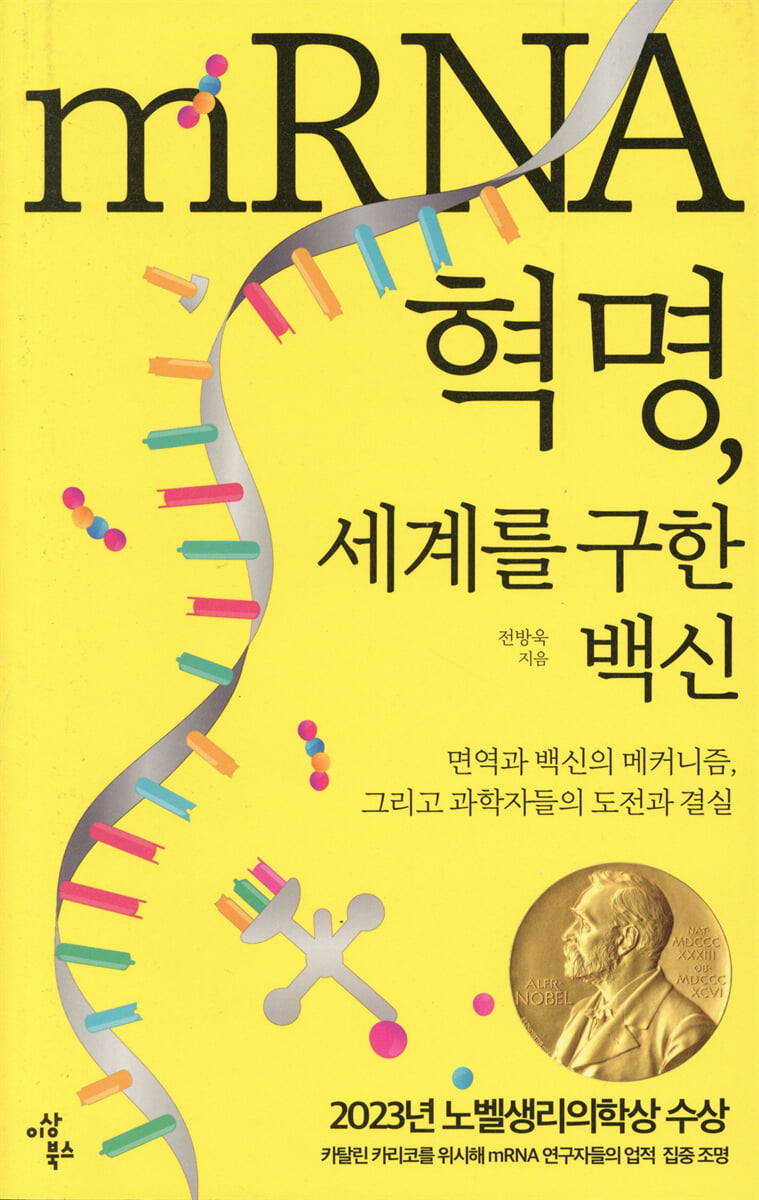
The mRNA Revolution: The Vaccine That Saved the World
 |
Description
Book Introduction
The novel coronavirus entered preclinical testing just 66 days after its sequence was announced!
That would not have been possible without mRNA technology.
The source technology for a new vaccine is revealed through a long-term research process by scientists.
The novel coronavirus disease (COVID-19), which first emerged in Wuhan, China in 2019, shows no signs of abating, with confirmed cases exceeding 230 million and deaths exceeding 5 million worldwide as of October 2021.
In the absence of a suitable treatment, it is difficult to control COVID-19 with only social distancing, personal hygiene, quarantine, and lockdowns.
This is a situation where a vaccine is desperately needed.
Fortunately, on January 9, 2020, just two days after the World Health Organization announced the spread of COVID-19, Chinese scientists released the genetic sequence of the novel coronavirus, and based on this, the US National Institutes of Health and the US biotechnology company Moderna designed the first mRNA vaccine candidate just two days later.
And this vaccine candidate entered clinical trials in a world record-breaking time of 66 days.
Since then, two types of vaccines have received emergency use authorization and are currently being administered to people around the world.
Had the vaccination rollout not been so rapid, the number of COVID-19 victims would have exploded even further. In that sense, mRNA vaccines can truly be called world-saving vaccines.
This book first explains the basic principles of mRNA vaccines, commonly referred to as the "Pfizer vaccine" or "Moderna vaccine," and then examines in detail the research process and results of several scientists who quickly came together during the COVID-19 pandemic emergency to develop mRNA vaccines.
In particular, it meticulously documents the 40-year research history of a female scientist from Hungary named Katalin Kariko.
Without the original technology of Catalin Kariko, who believed in the potential of mRNA, which no one had paid attention to, and continued research even under difficult circumstances, the mRNA vaccine to combat the pandemic would not have been developed.
That would not have been possible without mRNA technology.
The source technology for a new vaccine is revealed through a long-term research process by scientists.
The novel coronavirus disease (COVID-19), which first emerged in Wuhan, China in 2019, shows no signs of abating, with confirmed cases exceeding 230 million and deaths exceeding 5 million worldwide as of October 2021.
In the absence of a suitable treatment, it is difficult to control COVID-19 with only social distancing, personal hygiene, quarantine, and lockdowns.
This is a situation where a vaccine is desperately needed.
Fortunately, on January 9, 2020, just two days after the World Health Organization announced the spread of COVID-19, Chinese scientists released the genetic sequence of the novel coronavirus, and based on this, the US National Institutes of Health and the US biotechnology company Moderna designed the first mRNA vaccine candidate just two days later.
And this vaccine candidate entered clinical trials in a world record-breaking time of 66 days.
Since then, two types of vaccines have received emergency use authorization and are currently being administered to people around the world.
Had the vaccination rollout not been so rapid, the number of COVID-19 victims would have exploded even further. In that sense, mRNA vaccines can truly be called world-saving vaccines.
This book first explains the basic principles of mRNA vaccines, commonly referred to as the "Pfizer vaccine" or "Moderna vaccine," and then examines in detail the research process and results of several scientists who quickly came together during the COVID-19 pandemic emergency to develop mRNA vaccines.
In particular, it meticulously documents the 40-year research history of a female scientist from Hungary named Katalin Kariko.
Without the original technology of Catalin Kariko, who believed in the potential of mRNA, which no one had paid attention to, and continued research even under difficult circumstances, the mRNA vaccine to combat the pandemic would not have been developed.
- You can preview some of the book's contents.
Preview
index
Author's Preface
Chapter 1: Fundamentals of Immunity and Vaccines
Chapter 2: A Long and Dangerous Road
Chapter 3: Catalin Kariko: The mRNA Dream
Chapter 4: Catalin Kariko: Challenges and Adversities
Chapter 5: Catalin Kariko: Success Finally Arrives
Chapter 6: The Secret of Spike
Chapter 7: Another Innovation: Lipid Nanoparticles
Chapter 8: Development of a Novel Coronavirus mRNA Vaccine
Chapter 9: Production of mRNA Vaccines
Chapter 10: Current Status and Future of mRNA Vaccine Research
Appendix: Glossary of Terms
References
Search
Chapter 1: Fundamentals of Immunity and Vaccines
Chapter 2: A Long and Dangerous Road
Chapter 3: Catalin Kariko: The mRNA Dream
Chapter 4: Catalin Kariko: Challenges and Adversities
Chapter 5: Catalin Kariko: Success Finally Arrives
Chapter 6: The Secret of Spike
Chapter 7: Another Innovation: Lipid Nanoparticles
Chapter 8: Development of a Novel Coronavirus mRNA Vaccine
Chapter 9: Production of mRNA Vaccines
Chapter 10: Current Status and Future of mRNA Vaccine Research
Appendix: Glossary of Terms
References
Search
Detailed image
Into the book
Based on decades of basic and applied research, scientists have developed a vaccine that can be administered to people through clinical trials in the shortest possible time by inserting mRNA that evades the cellular immune system by modifying the uridine base in the spike protein's genetic information to 1-methylpseudouridine, allowing it to maintain its pre-fusion form, into lipid nanoparticles.
--- p.39-40
When Catalin Kariko, then 22 years old in 1976, heard about mRNA, he exclaimed, "Wow, this is a pretty cool molecule."
Kariko intuited that this molecule had limitless potential from the fact that mRNA instructed cells what to do.
We thought that if we could manipulate mRNA, we could give the cell new instructions that we wanted.
If we could change that message, we could make the cells do whatever we want.
--- p.54
On January 11, 2020, Chinese scientists published the complete genome sequence of the novel coronavirus online.
In just two days, Corbett and his team designed a COVID-19 vaccine candidate, mRNA-1273.
And just 66 days after the genetic code of the novel coronavirus was determined, this vaccine candidate set a world record by entering preclinical testing.
--- p.86
Although Corbett did not specifically study the MERS coronavirus with the novel coronavirus in mind, it was able to respond quickly to COVID-19 with a vaccine because it had sufficient prior knowledge about the development of a MERS coronavirus vaccine.
This approach has helped to rapidly develop several vaccines overall.
--- p.92
Corbett's research team began production of Moderna's vaccine in accordance with the pharmaceutical manufacturing and quality control standards for Phase 1 clinical trials while conducting research to understand immunogenicity in animal models.
So, as soon as Moderna determined the mRNA-1273 sequence, they started manufacturing, started production, and were able to ship the drug for clinical trials within a short period of time, just one month.
This demonstrates how powerful mRNA gene-based platforms are when considering rapid vaccine development.
Thus, phase 1 clinical trials began 66 days after the announcement of the novel coronavirus's base sequence.
--- p.136-137
In conclusion, the mRNA-1273 vaccine showed 94.1% efficacy in preventing COVID-19 and had no safety issues except for transient local and systemic reactions.
On December 18, 2020, the FDA granted emergency use authorization for Moderna's two-dose vaccine.
Since then, many people around the world have received the vaccine developed in Corbett's laboratory.
--- p.141
Interest in mRNA-based technologies for infectious disease prevention is growing. Technological advances in RNA biology, chemistry, stability, and delivery have accelerated the development of fully synthetic mRNA vaccines.
Alternative platforms to replace existing vaccines with mRNA vaccines are attracting increasing attention, driven by the demonstration of robust, durable, and safe immune responses observed in animal models and the success of early human clinical trials.
Along with these encouraging results, the outlook for mRNA vaccines is also very promising industrially, as the manufacturing process is generally simple and development and manufacturing costs are low.
--- p.39-40
When Catalin Kariko, then 22 years old in 1976, heard about mRNA, he exclaimed, "Wow, this is a pretty cool molecule."
Kariko intuited that this molecule had limitless potential from the fact that mRNA instructed cells what to do.
We thought that if we could manipulate mRNA, we could give the cell new instructions that we wanted.
If we could change that message, we could make the cells do whatever we want.
--- p.54
On January 11, 2020, Chinese scientists published the complete genome sequence of the novel coronavirus online.
In just two days, Corbett and his team designed a COVID-19 vaccine candidate, mRNA-1273.
And just 66 days after the genetic code of the novel coronavirus was determined, this vaccine candidate set a world record by entering preclinical testing.
--- p.86
Although Corbett did not specifically study the MERS coronavirus with the novel coronavirus in mind, it was able to respond quickly to COVID-19 with a vaccine because it had sufficient prior knowledge about the development of a MERS coronavirus vaccine.
This approach has helped to rapidly develop several vaccines overall.
--- p.92
Corbett's research team began production of Moderna's vaccine in accordance with the pharmaceutical manufacturing and quality control standards for Phase 1 clinical trials while conducting research to understand immunogenicity in animal models.
So, as soon as Moderna determined the mRNA-1273 sequence, they started manufacturing, started production, and were able to ship the drug for clinical trials within a short period of time, just one month.
This demonstrates how powerful mRNA gene-based platforms are when considering rapid vaccine development.
Thus, phase 1 clinical trials began 66 days after the announcement of the novel coronavirus's base sequence.
--- p.136-137
In conclusion, the mRNA-1273 vaccine showed 94.1% efficacy in preventing COVID-19 and had no safety issues except for transient local and systemic reactions.
On December 18, 2020, the FDA granted emergency use authorization for Moderna's two-dose vaccine.
Since then, many people around the world have received the vaccine developed in Corbett's laboratory.
--- p.141
Interest in mRNA-based technologies for infectious disease prevention is growing. Technological advances in RNA biology, chemistry, stability, and delivery have accelerated the development of fully synthetic mRNA vaccines.
Alternative platforms to replace existing vaccines with mRNA vaccines are attracting increasing attention, driven by the demonstration of robust, durable, and safe immune responses observed in animal models and the success of early human clinical trials.
Along with these encouraging results, the outlook for mRNA vaccines is also very promising industrially, as the manufacturing process is generally simple and development and manufacturing costs are low.
--- p.168-169
Publisher's Review
Beyond the COVID-19 Vaccine, Uncovering the Amazing Potential of mRNA!
Chapter 1, "Fundamentals of Immunity and Vaccines," explains the overall mechanisms of immunity and the role of vaccines. Chapter 2, "The Long and Hard Road," examines the innovations in three areas leading to the development of mRNA vaccines: antigen structural research, nucleotide modification, and lipid nanoparticle packaging, and the contributions of numerous scientists, both known and unknown.
Chapters 3 through 5 examine the life of Catalin Kariko, who is considered the greatest contributor to the development of mRNA vaccines, and provide a scientific explanation of his research and achievements.
Catalin Kariko attempted groundbreaking research despite a lack of support and funding, even giving up tenure to continue the project.
Chapter 6, “The Secret Behind the Spike,” tells the story of how a research team at the National Institutes of Health’s Vaccine Research Center, led by another female scientist named Kizmekia Corbett, discovered the structure of the coronavirus protein antigen before fusion, and, in collaboration with Moderna, designed and developed a vaccine with superior neutralizing titers (the antibody dilution that neutralizes 50% of the antigen) and survival in lethal challenge tests (a test that verifies the effectiveness of a vaccine or treatment by exposing it to a live virus), and how it went through clinical trials and reached actual vaccination.
Chapter 7, “Another Innovation: Lipid Nanoparticles,” covers the development of lipid nanoparticles using cationic protamine and polymers to deliver unstable mRNA into cells, the principles of lipid nanoparticles, various efforts to improve delivery capabilities, and the application of these to mRNA vaccine delivery.
Chapter 8, “Development of a Novel Coronavirus mRNA Vaccine,” examines how these innovations ultimately led to the development of a COVID-19 vaccine, focusing on proof-of-principle trials, preclinical studies, and human clinical trials.
Chapter 9, “Production of mRNA Vaccines,” divides the commercial-scale mRNA vaccine manufacturing process into drug substance production and drug product manufacturing, explaining the advantages of the mRNA vaccine platform, DNA template production, in vitro transcription reaction, purification and formulation, mRNA-lipid nanoparticle manufacturing, bottling, and final quality control.
Chapter 10, “Current Status and Future of mRNA Vaccine Research,” covers the progress of vaccine development, vaccine structure, mechanism of action, development of vaccines for infectious disease prevention, development of commercial mRNA vaccines such as Pfizer/BioNTech and CureVac, non-replicating and self-replicating vaccines, and cancer vaccines, and forecasts the future.
It's easy to think that mRNA vaccines didn't exist before the advent of the COVID-19 mRNA vaccine, but that's not true.
mRNA for cancer immunotherapy and infectious disease prevention has been progressively developed across multiple sectors, from preclinical testing to generating initial clinical data.
These studies have been instrumental in demonstrating that large-scale mRNA production is feasible according to clinical trial drug manufacturing and quality control standards and that mRNA vaccines have a favorable safety profile.
Since the first delivery of mRNA into animal models, the field has advanced rapidly and has shown promise as a next-generation biopharmaceutical for vaccine development.
mRNA vaccines are considered one of the most important and promising next-generation vaccines due to their rapid development capabilities, high efficacy, safety, and low manufacturing costs.
It is expected that mRNA therapeutics used in vaccines will be more effectively utilized in the future not only as vaccines but also in preventing or treating diseases such as cancer.
A spotlight on the life of Dr. Catalin Kariko!
A Testimonial for Dr. Catalin Kariko and His Research
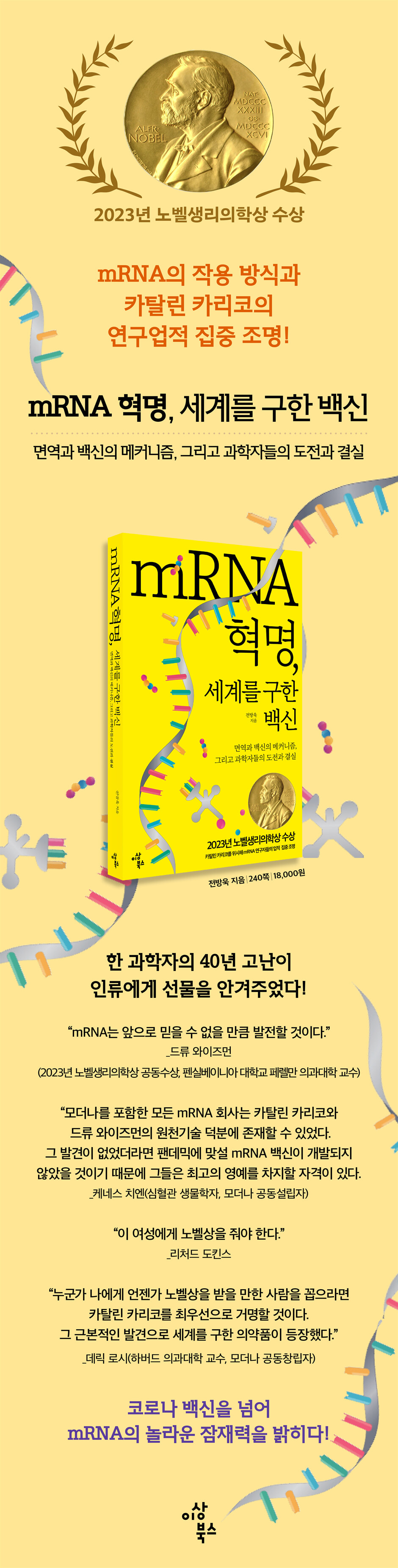
“All mRNA companies, including Moderna, owe their existence to the fundamental technologies of Catalin Kariko and Drew Wiseman.
They deserve the top honors, as without their discovery, mRNA vaccines to combat the pandemic would not have been developed.
Kenneth Tsien (cardiovascular biologist, co-founder of Moderna)
“This woman should be given the Nobel Prize.”
Richard Dawkins (biologist, author of The Selfish Gene)
“If someone were to ask me who I think would one day win the Nobel Prize, I would name Catalin Kariko first.
“That fundamental discovery led to the development of medicines that saved the world.”
Derek Rossi (Professor, Harvard Medical School, Co-Founder, Moderna)
Chapter 1, "Fundamentals of Immunity and Vaccines," explains the overall mechanisms of immunity and the role of vaccines. Chapter 2, "The Long and Hard Road," examines the innovations in three areas leading to the development of mRNA vaccines: antigen structural research, nucleotide modification, and lipid nanoparticle packaging, and the contributions of numerous scientists, both known and unknown.
Chapters 3 through 5 examine the life of Catalin Kariko, who is considered the greatest contributor to the development of mRNA vaccines, and provide a scientific explanation of his research and achievements.
Catalin Kariko attempted groundbreaking research despite a lack of support and funding, even giving up tenure to continue the project.
Chapter 6, “The Secret Behind the Spike,” tells the story of how a research team at the National Institutes of Health’s Vaccine Research Center, led by another female scientist named Kizmekia Corbett, discovered the structure of the coronavirus protein antigen before fusion, and, in collaboration with Moderna, designed and developed a vaccine with superior neutralizing titers (the antibody dilution that neutralizes 50% of the antigen) and survival in lethal challenge tests (a test that verifies the effectiveness of a vaccine or treatment by exposing it to a live virus), and how it went through clinical trials and reached actual vaccination.
Chapter 7, “Another Innovation: Lipid Nanoparticles,” covers the development of lipid nanoparticles using cationic protamine and polymers to deliver unstable mRNA into cells, the principles of lipid nanoparticles, various efforts to improve delivery capabilities, and the application of these to mRNA vaccine delivery.
Chapter 8, “Development of a Novel Coronavirus mRNA Vaccine,” examines how these innovations ultimately led to the development of a COVID-19 vaccine, focusing on proof-of-principle trials, preclinical studies, and human clinical trials.
Chapter 9, “Production of mRNA Vaccines,” divides the commercial-scale mRNA vaccine manufacturing process into drug substance production and drug product manufacturing, explaining the advantages of the mRNA vaccine platform, DNA template production, in vitro transcription reaction, purification and formulation, mRNA-lipid nanoparticle manufacturing, bottling, and final quality control.
Chapter 10, “Current Status and Future of mRNA Vaccine Research,” covers the progress of vaccine development, vaccine structure, mechanism of action, development of vaccines for infectious disease prevention, development of commercial mRNA vaccines such as Pfizer/BioNTech and CureVac, non-replicating and self-replicating vaccines, and cancer vaccines, and forecasts the future.
It's easy to think that mRNA vaccines didn't exist before the advent of the COVID-19 mRNA vaccine, but that's not true.
mRNA for cancer immunotherapy and infectious disease prevention has been progressively developed across multiple sectors, from preclinical testing to generating initial clinical data.
These studies have been instrumental in demonstrating that large-scale mRNA production is feasible according to clinical trial drug manufacturing and quality control standards and that mRNA vaccines have a favorable safety profile.
Since the first delivery of mRNA into animal models, the field has advanced rapidly and has shown promise as a next-generation biopharmaceutical for vaccine development.
mRNA vaccines are considered one of the most important and promising next-generation vaccines due to their rapid development capabilities, high efficacy, safety, and low manufacturing costs.
It is expected that mRNA therapeutics used in vaccines will be more effectively utilized in the future not only as vaccines but also in preventing or treating diseases such as cancer.
A spotlight on the life of Dr. Catalin Kariko!
A Testimonial for Dr. Catalin Kariko and His Research
“All mRNA companies, including Moderna, owe their existence to the fundamental technologies of Catalin Kariko and Drew Wiseman.
They deserve the top honors, as without their discovery, mRNA vaccines to combat the pandemic would not have been developed.
Kenneth Tsien (cardiovascular biologist, co-founder of Moderna)
“This woman should be given the Nobel Prize.”
Richard Dawkins (biologist, author of The Selfish Gene)
“If someone were to ask me who I think would one day win the Nobel Prize, I would name Catalin Kariko first.
“That fundamental discovery led to the development of medicines that saved the world.”
Derek Rossi (Professor, Harvard Medical School, Co-Founder, Moderna)
GOODS SPECIFICS
- Publication date: October 25, 2021
- Page count, weight, size: 240 pages | 342g | 153*224*20mm
- ISBN13: 9788993690842
- ISBN10: 8993690847
You may also like
카테고리
korean


korean

![GQ KOREA Mark (Monthly): December [2025]](http://librairie.coreenne.fr/cdn/shop/files/8ef265dbbfbf186523ed75ba7319009d.jpg?v=1765340328&width=3840)


