

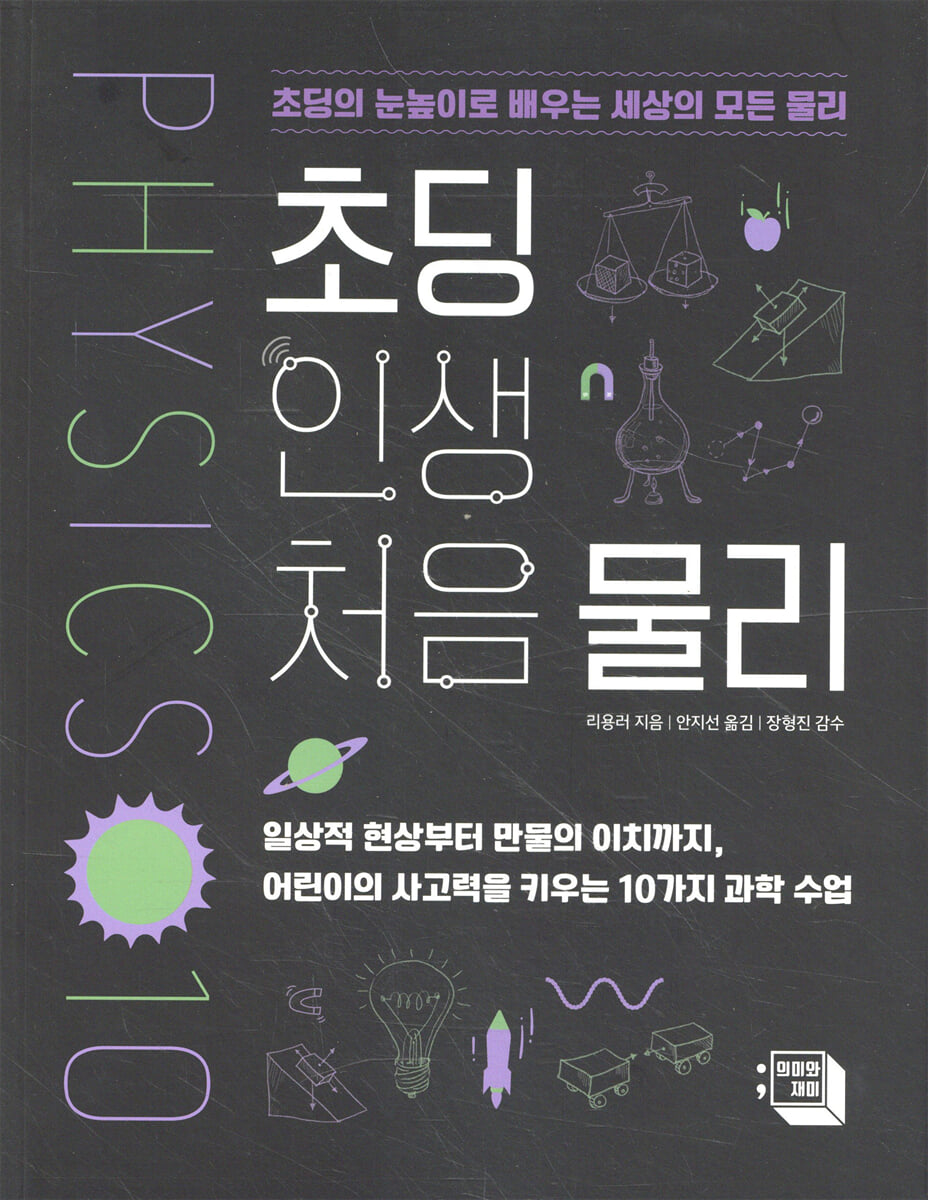
My first physics class in elementary school
 |
Description
Book Introduction
From everyday phenomena to the laws of all things,
10 Science Lessons to Develop Kids' Thinking Skills
Do you think science is difficult? Physics seems even harder?
that's right.
Science is a difficult subject.
But the world around us is full of physical laws.
It's like an unknown world full of adventure.
Even if it may seem difficult at first, if we follow in the footsteps of scientists, we will soon find ourselves thinking and dreaming like scientists.
The book that will be your first step is 『Elementary School Student's First Physics』!
10 Science Lessons to Develop Kids' Thinking Skills
Do you think science is difficult? Physics seems even harder?
that's right.
Science is a difficult subject.
But the world around us is full of physical laws.
It's like an unknown world full of adventure.
Even if it may seem difficult at first, if we follow in the footsteps of scientists, we will soon find ourselves thinking and dreaming like scientists.
The book that will be your first step is 『Elementary School Student's First Physics』!
- You can preview some of the book's contents.
Preview
index
Opening Remarks: The First Step to Discovering All the Physics of the World
PHISICS 01 Mechanics
PHISICS 02 Thermodynamics
PHISICS 03 Optics
PHISICS 04 Oscillation & Wave
PHISICS 05 Electromagnetics
PHISICS 06 Fluid mechanics
PHISICS 07 Atomic Physics
PHISICS 08 History of Optics
PHISICS 09 Theory of relativity
PHISICS 10 Quantum mechanics
PHISICS 01 Mechanics
PHISICS 02 Thermodynamics
PHISICS 03 Optics
PHISICS 04 Oscillation & Wave
PHISICS 05 Electromagnetics
PHISICS 06 Fluid mechanics
PHISICS 07 Atomic Physics
PHISICS 08 History of Optics
PHISICS 09 Theory of relativity
PHISICS 10 Quantum mechanics
Detailed image

Into the book
When a force is applied to an object, the object's motion changes.
Force can make an object move faster or slower, or change the direction in which an object moves.
This is Newton's second law.
Newton's second law is also called the law of acceleration.
--- p.19 From "Dynamics"
Water can turn into ice or water vapor, all because the water molecules move in all directions.
All objects in the world are made up of molecules.
--- p.50 From "Thermodynamics"
Because the sun is so far away, it takes about 8 minutes for light from the sun to reach our eyes.
Although we can see the sun when we open our eyes, it is actually the sun from 8 minutes ago.
Some stars are much farther away than the Sun, and their light can take tens of thousands of years to reach our eyes.
The stars we look at are already tens of thousands of years old.
--- p.64 From "Optics"
When waves encounter obstacles, they reflect and return. This phenomenon is called wave reflection. If you shout "Yahoo" loudly in a wide, wide mountain valley, you can hear the sound returning. The sound we send out hits a mountain in the distance and the sound waves return.
--- p.88 From “Vibration and Waves”
Almost every object in the world is made up of molecules.
And molecules are made up of atoms.
So, what are atoms made of? In the center of the atom is a very small nucleus.
The nucleus has a positive charge.
There are countless electrons outside the nucleus.
These electrons are negatively charged and quickly revolve around the nucleus. In this way, atoms are made up of a nucleus and electrons.
--- p.153 From “Atomic Physics”
Special relativity is the theory that time, space, and mass all change due to speed.
This is a theory that Einstein announced when he was 26 years old.
So what creates gravity? Ten years later, Einstein's answer to this question was general relativity.
--- p.212 From "Theory of Relativity"
Einstein said, "God does not play dice."
It is clearly wrong to interpret quantum mechanics in terms of possibilities.
Force can make an object move faster or slower, or change the direction in which an object moves.
This is Newton's second law.
Newton's second law is also called the law of acceleration.
--- p.19 From "Dynamics"
Water can turn into ice or water vapor, all because the water molecules move in all directions.
All objects in the world are made up of molecules.
--- p.50 From "Thermodynamics"
Because the sun is so far away, it takes about 8 minutes for light from the sun to reach our eyes.
Although we can see the sun when we open our eyes, it is actually the sun from 8 minutes ago.
Some stars are much farther away than the Sun, and their light can take tens of thousands of years to reach our eyes.
The stars we look at are already tens of thousands of years old.
--- p.64 From "Optics"
When waves encounter obstacles, they reflect and return. This phenomenon is called wave reflection. If you shout "Yahoo" loudly in a wide, wide mountain valley, you can hear the sound returning. The sound we send out hits a mountain in the distance and the sound waves return.
--- p.88 From “Vibration and Waves”
Almost every object in the world is made up of molecules.
And molecules are made up of atoms.
So, what are atoms made of? In the center of the atom is a very small nucleus.
The nucleus has a positive charge.
There are countless electrons outside the nucleus.
These electrons are negatively charged and quickly revolve around the nucleus. In this way, atoms are made up of a nucleus and electrons.
--- p.153 From “Atomic Physics”
Special relativity is the theory that time, space, and mass all change due to speed.
This is a theory that Einstein announced when he was 26 years old.
So what creates gravity? Ten years later, Einstein's answer to this question was general relativity.
--- p.212 From "Theory of Relativity"
Einstein said, "God does not play dice."
It is clearly wrong to interpret quantum mechanics in terms of possibilities.
--- p.240 From "Quantum Mechanics"
Publisher's Review
Life physics lessons couldn't be easier.
The first step to encountering all the physics of the world
People think that physics is a subject full of complex formulas and grand theories.
Of course, there are many formulas and it is an area that requires profound theories to be understood.
But every discipline has its stages.
The physics that this book 'tries to show' is neither that difficult nor complicated.
Instead, it is 'Easy Physics' that broadly covers the entire field of physics, and as you read, your scientific thinking skills will gradually improve.
Friendly pictures and short sentences, read them and you'll soon become a physics doctor!
Before the preconception that it was difficult developed, physics, which I encountered in elementary school, was just a mysterious magic.
Like an unknown world full of adventure.
Just by looking at the names of gravity, light waves, electromagnetic waves, molecules, atoms, and the universal gravitation that makes up the universe, you can read about great scientific achievements as if you were reading a fairy tale.
This book will serve as a guide to the science books our children will read throughout their lives.
Because the physics terms and scientists' names that pass by your ears will become the seeds of knowledge in countless books you will read in the future.
As children in lower grades of elementary school learn through pictures, and as they learn through short sentences and pictures together, they grow into children who think and imagine like scientists.
Just by reading short sentences as if looking at a picture book, the child soon becomes a little scientist.
Knowledge builds up step by step through 10 topics!
From light to profound, expand your thinking and develop your creativity.
The world we live in is full of physical laws.
From everyday phenomena like gravity, acceleration, and vibration to invisible phenomena like atomic energy, relativity, and quantum mechanics, there is nothing that is not connected to physical theory.
From the easy to the difficult, from theories already proven to be humanly possible to phenomena yet to be solved.
As I learn about the physical phenomena I'm curious about one by one, I feel my thoughts growing bigger and bigger.
As countless scientists have done.
"Elementary School Student's First Physics" explains the history and achievements of science through 10 areas of physics.
It covers a wide range of topics, from mechanics and thermodynamics, which are part of orthodox physics, to relativity and quantum mechanics, which are the biggest topics in modern physics, in a broad and easy-to-understand manner.
It thoroughly covers everyday physics areas such as optics, vibrations and waves, electromagnetism, fluid dynamics, and atomic physics, and even shows the history of optics, which shows the intense research process of scientists.
The basics of physics that are useful even for adults!
Physics, something I've always wanted to look into, even though I don't have the confidence to study it in depth.
The moment you think it's too late is the moment when it's fastest.
Forget the physics you've been glossing over so far, go back to the perspective of an elementary school student, and learn all the physics in the world from the basics again.
Then it won't be too late to move on to adult reading.
This book is a very useful and faithful primer even for adults who neglected physics during their youth.
The first step to encountering all the physics of the world
People think that physics is a subject full of complex formulas and grand theories.
Of course, there are many formulas and it is an area that requires profound theories to be understood.
But every discipline has its stages.
The physics that this book 'tries to show' is neither that difficult nor complicated.
Instead, it is 'Easy Physics' that broadly covers the entire field of physics, and as you read, your scientific thinking skills will gradually improve.
Friendly pictures and short sentences, read them and you'll soon become a physics doctor!
Before the preconception that it was difficult developed, physics, which I encountered in elementary school, was just a mysterious magic.
Like an unknown world full of adventure.
Just by looking at the names of gravity, light waves, electromagnetic waves, molecules, atoms, and the universal gravitation that makes up the universe, you can read about great scientific achievements as if you were reading a fairy tale.
This book will serve as a guide to the science books our children will read throughout their lives.
Because the physics terms and scientists' names that pass by your ears will become the seeds of knowledge in countless books you will read in the future.
As children in lower grades of elementary school learn through pictures, and as they learn through short sentences and pictures together, they grow into children who think and imagine like scientists.
Just by reading short sentences as if looking at a picture book, the child soon becomes a little scientist.
Knowledge builds up step by step through 10 topics!
From light to profound, expand your thinking and develop your creativity.
The world we live in is full of physical laws.
From everyday phenomena like gravity, acceleration, and vibration to invisible phenomena like atomic energy, relativity, and quantum mechanics, there is nothing that is not connected to physical theory.
From the easy to the difficult, from theories already proven to be humanly possible to phenomena yet to be solved.
As I learn about the physical phenomena I'm curious about one by one, I feel my thoughts growing bigger and bigger.
As countless scientists have done.
"Elementary School Student's First Physics" explains the history and achievements of science through 10 areas of physics.
It covers a wide range of topics, from mechanics and thermodynamics, which are part of orthodox physics, to relativity and quantum mechanics, which are the biggest topics in modern physics, in a broad and easy-to-understand manner.
It thoroughly covers everyday physics areas such as optics, vibrations and waves, electromagnetism, fluid dynamics, and atomic physics, and even shows the history of optics, which shows the intense research process of scientists.
The basics of physics that are useful even for adults!
Physics, something I've always wanted to look into, even though I don't have the confidence to study it in depth.
The moment you think it's too late is the moment when it's fastest.
Forget the physics you've been glossing over so far, go back to the perspective of an elementary school student, and learn all the physics in the world from the basics again.
Then it won't be too late to move on to adult reading.
This book is a very useful and faithful primer even for adults who neglected physics during their youth.
GOODS SPECIFICS
- Publication date: September 20, 2021
- Page count, weight, size: 248 pages | 510g | 170*220*16mm
- ISBN13: 9791197258268
- ISBN10: 1197258264
- KC Certification: Certification Type: Conformity Confirmation
You may also like
카테고리
korean


korean

![GQ KOREA Mark (Monthly): December [2025]](http://librairie.coreenne.fr/cdn/shop/files/8ef265dbbfbf186523ed75ba7319009d.jpg?v=1765340328&width=3840)


