

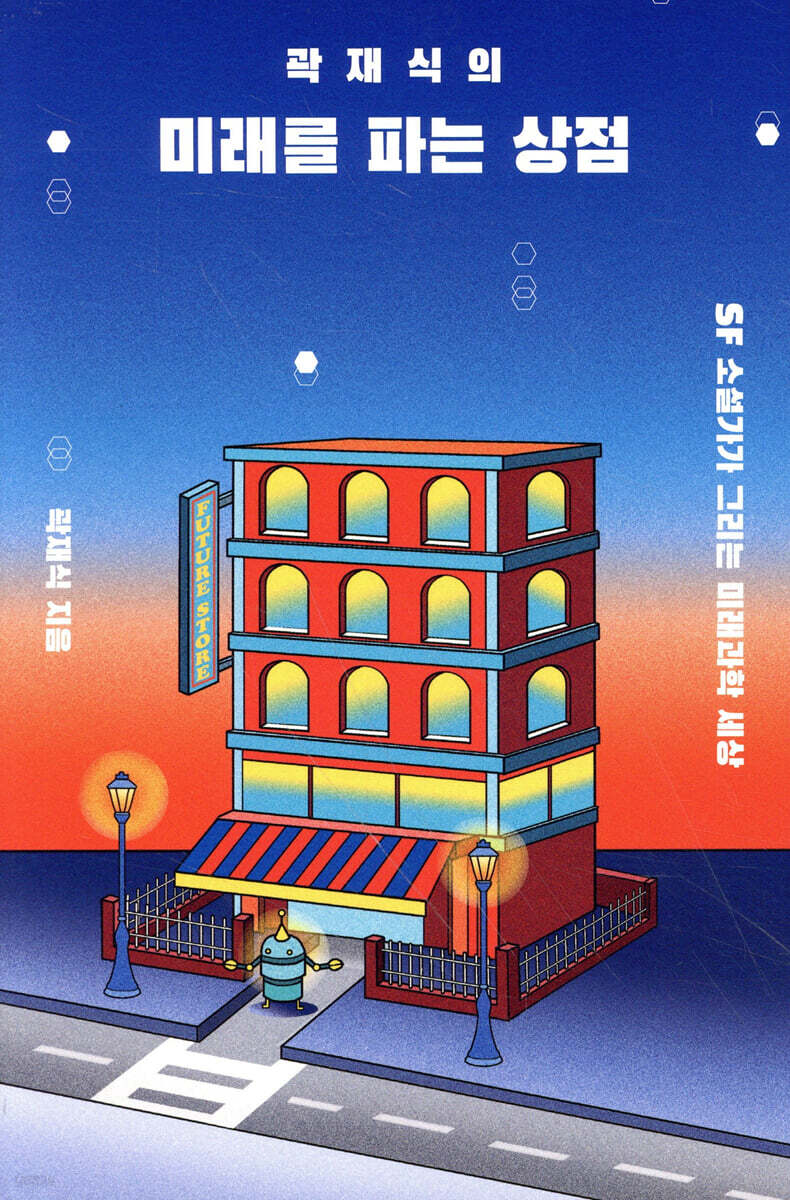
Kwak Jae-sik's Future Store
 |
Description
Book Introduction
The future store of 2050 predicted by writer Kwak Jae-sik,
15 Things That Will Change the World
A new work by author Jae-sik Kwak, who has written a variety of books across the fields of science fiction and non-fiction, including 『Encyclopedia of Korean Monsters』, 『The Greatest Bet on Earth』, and 『Jae-sik Kwak's Germ Expo』.
"Kwak Jae-sik's Future Store" is a book that examines the novel items found in a future store and explains what kind of science and technology will be needed.
This is not a far-fetched story about the future, but rather a concrete imaginative interpretation of what will actually be sold in the home appliance, food, and miscellaneous goods corners of the future 3 to 30 years from now.
By reviving prehistoric fruits, we learn about the principles of gene editing, and by predicting how autonomous public transportation will change and how our living areas will expand through autonomous taxis that ride in the sky, we can predict how autonomous vehicles will change and expand our living areas.
As we read the humorous explanation of the "principles" of objects seen in science fiction by Kwak Jae-sik, a masterful storyteller, readers can envision not only technological advancements but also social, cultural, and economic changes.
15 Things That Will Change the World
A new work by author Jae-sik Kwak, who has written a variety of books across the fields of science fiction and non-fiction, including 『Encyclopedia of Korean Monsters』, 『The Greatest Bet on Earth』, and 『Jae-sik Kwak's Germ Expo』.
"Kwak Jae-sik's Future Store" is a book that examines the novel items found in a future store and explains what kind of science and technology will be needed.
This is not a far-fetched story about the future, but rather a concrete imaginative interpretation of what will actually be sold in the home appliance, food, and miscellaneous goods corners of the future 3 to 30 years from now.
By reviving prehistoric fruits, we learn about the principles of gene editing, and by predicting how autonomous public transportation will change and how our living areas will expand through autonomous taxis that ride in the sky, we can predict how autonomous vehicles will change and expand our living areas.
As we read the humorous explanation of the "principles" of objects seen in science fiction by Kwak Jae-sik, a masterful storyteller, readers can envision not only technological advancements but also social, cultural, and economic changes.
- You can preview some of the book's contents.
Preview
index
In order for science fiction novels to become reality,
A Minimal Guide to the Future
●1st floor_Home appliance corner
Clothes that charge your smartphone × Future batteries
Beneath all future technologies lies the battery. A bibimbap of physics, chemistry, electrical engineering, and all other disciplines. Technologies that may be less visible, but bring the future closer.
A robot clerk more comfortable than a human × an intelligent robot
Robots are more convenient because they are not human. │ Robots that can be easily used in everyday life. │ Robot cultural assets that dream of becoming human cultural assets.
Computers for everyone × Ultra-low-cost displays
The Power of Cheaper Technology│Technology to Spread to a Wider World│Flying Cars or Apple-Picking Robots?
A Joseon Dynasty water clock revived with 3D printing
A Joseon Dynasty doll that moves on its own│An era where dolls and food can be downloaded from the Internet│A 3D printer that changes the landscape of historical sites
●2nd floor_grocery corner
Sea-raised beef × artificial meat
Meat from factories, not farms│The ingredients that make up all living things in the world│Pumpkin instead of beef, factory workers instead of cowboys
Micro-farms built one by one × Smart Farms
Anyone, Anywhere Can Have Their Own Farm│Smart Farms Where Computers and Robots Weed│Buildings Transformed into Real Forests
Prehistoric fruit ready to eat × gene editing
All the creatures of the world expressed in four blocks│Making tomatoes as healthy as ginseng│Efforts toward safer genetic modification
Water purifier that turns seawater into fresh water × Nanotechnology
The technology to cut and paste one-millionth of a millimeter | The magic that turns gold from water and reverses aging | A machine that diagnoses health through the breath of a person
●3rd floor_Miscellaneous goods corner
Fuel for the world, rot fuel × biofuel
Fuel from Living Creatures│Weeds into Gasoline, Bacteria into Gasoline, Garbage into Gasoline│Trash Brings Peace to the Middle East
Flying unmanned taxis × autonomous vehicles
If a computer takes over the steering wheel of a car equipped with radar│The roads of the future will be safer│Can cars fly?
Hacking Keyboard for Elementary School Students × Future Education Using 5G
Learning Hacking at School? │ Internet Classes Gaining More Attention at Schools │ A Place Where Any Student Can Relax
Green Window Film × Climate Change Adaptation Technology
As the weather changed, the world changed. │Cooler homes in summer and warmer homes in winter. From outer space to the ends of the Earth, efforts to prepare for the weather.
●Exit_Cash register and special sales corner
Buildings delivered by courier × Modular architecture
Affordable homes for everyone | A tower soaring high to live alongside robots | Tiny robots exploring sewers
Moon Base and Mars Base × Space Life
People living on the moon│The moon is a port for entering the distant universe│Turning the deserts of Mars into flower gardens
Letter to Aliens × Exploration of the Outer Solar System
How close are the stars in the night sky? How can we reach other stars? On the day we reach the stars
References
A Minimal Guide to the Future
●1st floor_Home appliance corner
Clothes that charge your smartphone × Future batteries
Beneath all future technologies lies the battery. A bibimbap of physics, chemistry, electrical engineering, and all other disciplines. Technologies that may be less visible, but bring the future closer.
A robot clerk more comfortable than a human × an intelligent robot
Robots are more convenient because they are not human. │ Robots that can be easily used in everyday life. │ Robot cultural assets that dream of becoming human cultural assets.
Computers for everyone × Ultra-low-cost displays
The Power of Cheaper Technology│Technology to Spread to a Wider World│Flying Cars or Apple-Picking Robots?
A Joseon Dynasty water clock revived with 3D printing
A Joseon Dynasty doll that moves on its own│An era where dolls and food can be downloaded from the Internet│A 3D printer that changes the landscape of historical sites
●2nd floor_grocery corner
Sea-raised beef × artificial meat
Meat from factories, not farms│The ingredients that make up all living things in the world│Pumpkin instead of beef, factory workers instead of cowboys
Micro-farms built one by one × Smart Farms
Anyone, Anywhere Can Have Their Own Farm│Smart Farms Where Computers and Robots Weed│Buildings Transformed into Real Forests
Prehistoric fruit ready to eat × gene editing
All the creatures of the world expressed in four blocks│Making tomatoes as healthy as ginseng│Efforts toward safer genetic modification
Water purifier that turns seawater into fresh water × Nanotechnology
The technology to cut and paste one-millionth of a millimeter | The magic that turns gold from water and reverses aging | A machine that diagnoses health through the breath of a person
●3rd floor_Miscellaneous goods corner
Fuel for the world, rot fuel × biofuel
Fuel from Living Creatures│Weeds into Gasoline, Bacteria into Gasoline, Garbage into Gasoline│Trash Brings Peace to the Middle East
Flying unmanned taxis × autonomous vehicles
If a computer takes over the steering wheel of a car equipped with radar│The roads of the future will be safer│Can cars fly?
Hacking Keyboard for Elementary School Students × Future Education Using 5G
Learning Hacking at School? │ Internet Classes Gaining More Attention at Schools │ A Place Where Any Student Can Relax
Green Window Film × Climate Change Adaptation Technology
As the weather changed, the world changed. │Cooler homes in summer and warmer homes in winter. From outer space to the ends of the Earth, efforts to prepare for the weather.
●Exit_Cash register and special sales corner
Buildings delivered by courier × Modular architecture
Affordable homes for everyone | A tower soaring high to live alongside robots | Tiny robots exploring sewers
Moon Base and Mars Base × Space Life
People living on the moon│The moon is a port for entering the distant universe│Turning the deserts of Mars into flower gardens
Letter to Aliens × Exploration of the Outer Solar System
How close are the stars in the night sky? How can we reach other stars? On the day we reach the stars
References
Into the book
When you think about it that way, the way batteries have evolved, along with the development of smartphones, drones, robots, and electric cars, is a wonderful example of how scientific and technological advancements in seemingly unrelated fields can bring about changes that completely change the world.
The world-changing impact of devices like smartphones isn't something that can be achieved simply by programmers diligently developing smartphone software or semiconductor engineers working hard.
The foundation should be research in chemistry and physics, which may not seem to have much to do with smartphones right now.
--- p.23, from “1st floor home appliance corner”
Inside the store, there were robots moving around diligently.
The robots were sweeping and mopping the floor.
When people look at the displayed items and put them down, after a while, they go back to that location, put the items back in their place, and organize them.
Robots' memories are different from humans' memories
The device is much more detailed and accurate.
So, robots are better than people at putting things back in their original places.
Moreover, they don't get bored or make mistakes even when they return the same object to the same spot hundreds or thousands of times.
--- p.29, from “1st floor home appliance corner”
When artificial intelligence programs and robots first started to flood the world, there was a lot of opinion that humans should focus on the emotional realm that robots cannot imitate, because robots have no emotions and AI will inevitably lack the human bond that humans have.
But the truth is that robots and artificial intelligence really started to gain popularity because they were not human, and therefore could be emotionally comfortable.
Surprisingly, artificial intelligence robots first achieved great success in areas that delve into emotions.
--- p.34, from “1st floor home appliance corner”
The first thing that caught my eye was charcoal.
Yes, when it comes to meat, charcoal is the way to go.
I was trying to decide which packaged charcoal to buy.
First of all, my eyes were drawn to the cheap products.
But the cheapest one had the coolest sticker on it.
“What does this mean?”
When I spoke to the robot clerk who was diligently organizing the items, the robot said, "It's a weather protection mark."
The world-changing impact of devices like smartphones isn't something that can be achieved simply by programmers diligently developing smartphone software or semiconductor engineers working hard.
The foundation should be research in chemistry and physics, which may not seem to have much to do with smartphones right now.
--- p.23, from “1st floor home appliance corner”
Inside the store, there were robots moving around diligently.
The robots were sweeping and mopping the floor.
When people look at the displayed items and put them down, after a while, they go back to that location, put the items back in their place, and organize them.
Robots' memories are different from humans' memories
The device is much more detailed and accurate.
So, robots are better than people at putting things back in their original places.
Moreover, they don't get bored or make mistakes even when they return the same object to the same spot hundreds or thousands of times.
--- p.29, from “1st floor home appliance corner”
When artificial intelligence programs and robots first started to flood the world, there was a lot of opinion that humans should focus on the emotional realm that robots cannot imitate, because robots have no emotions and AI will inevitably lack the human bond that humans have.
But the truth is that robots and artificial intelligence really started to gain popularity because they were not human, and therefore could be emotionally comfortable.
Surprisingly, artificial intelligence robots first achieved great success in areas that delve into emotions.
--- p.34, from “1st floor home appliance corner”
The first thing that caught my eye was charcoal.
Yes, when it comes to meat, charcoal is the way to go.
I was trying to decide which packaged charcoal to buy.
First of all, my eyes were drawn to the cheap products.
But the cheapest one had the coolest sticker on it.
“What does this mean?”
When I spoke to the robot clerk who was diligently organizing the items, the robot said, "It's a weather protection mark."
--- p.121, from “3rd floor miscellaneous goods corner”
Publisher's Review
Can robot clerks capture human emotions?
How would factory-grown meat change agriculture?
A multi-faceted view of the future
The main flow of the book is to browse the items on each floor of a three-story store in the future.
The first floor is a corner selling future home appliances.
There are clothes that act as batteries, computers that have abandoned spec competition and entered price competition, and water clocks recreated with 3D printers. In particular, we look at which basic industries need to develop before flashy technologies.
In this future store, robot clerks greet us.
However, it is not a cold, repetitive robot as you might imagine.
Author Kwak Jae-sik cites the example of ELIZA, a program that could converse with computers in the 1960s, and predicts that people will feel more comfortable with machines and artificial intelligence, and that artificial intelligence will be most successful in the emotional realm.
The second floor is a corner selling new food ingredients for the future era.
We explore how far artificial meat, smart farms, and nanotechnology have come and what the future holds, exploring ocean-raised beef, micro-farms at home, and gene-edited fruit.
It's not just about technological advancements; it also connects them to social, cultural, and economic changes, such as what future farmers will do as new ingredients emerge, how new agriculture will change relations between nations, and whether new technologies can be easily disseminated to those accustomed to traditional agriculture.
The third floor is a corner selling miscellaneous goods such as charcoal for barbecue, hacking keyboards for elementary school students, and window films.
In particular, author Kwak Jae-sik says that in the future, helping the environment itself will be a product's competitive edge.
Biofuels certified as helping combat climate change are the best-selling, and interior products related to green architecture are popular.
Watching people in the future struggle to overcome climate change shows us that the future isn't all glamorous and wonderful.
The final checkout counter and special sales corner can be considered a culmination of the techniques discussed above.
It covers how to build apartments so that robots can easily deliver goods, what technologies are needed to live on a lunar base, and what spacecraft technologies are needed to explore the outer solar system.
In particular, the section on the need to develop biofuels, nanotechnology, and smart agriculture technologies to reach the moon highlights the importance of freely mixing technologies from various fields.
“The spaceship in the author’s work
When can I ride it?
Conditions for imagination to become reality
As science fiction is a genre that deals with science, it must reflect the characteristics of reality to some extent.
Perhaps that is why, while writing science fiction novels, author Kwak Jae-sik is often asked, “When do you think the objects in your works will become possible in reality?”
This book can be said to be the result of author Kwak Jae-sik's contemplation on the answer.
He predicts 15 new things that will emerge in the next 3 to 30 years and discusses how the world will change because of them.
As an excellent storyteller, he stands out with his unique imagination and storytelling skills, while also not neglecting the scientific basis of his experience as an engineer and chemical company researcher.
We have imagined mysterious objects of the future in many science fiction novels and movies.
The future is always curious and mysterious.
Through this book, let's find out how quickly the future we once thought was just a miracle has arrived, and how and when it will be realized.
"I've written a lot of science fiction novels while working as a writer.
When you think of science fiction, don't you easily picture spaceships, ray guns, and adventures with aliens? I, too, love those kinds of stories.
Perhaps that's why people often ask science fiction writers about the future.
“When do you think we’ll be able to ride the spaceships in your works?” Many people may ask this question.
(Omitted) This book is the result of thinking about the answer after I had the opportunity to write about it.
In this book, I write about going to a store that sells various trendy items in the future world and looking around the store.
And as we walked around the store, we explained what the future would look like and how the world would change because of those things."
― From “Entering”
How would factory-grown meat change agriculture?
A multi-faceted view of the future
The main flow of the book is to browse the items on each floor of a three-story store in the future.
The first floor is a corner selling future home appliances.
There are clothes that act as batteries, computers that have abandoned spec competition and entered price competition, and water clocks recreated with 3D printers. In particular, we look at which basic industries need to develop before flashy technologies.
In this future store, robot clerks greet us.
However, it is not a cold, repetitive robot as you might imagine.
Author Kwak Jae-sik cites the example of ELIZA, a program that could converse with computers in the 1960s, and predicts that people will feel more comfortable with machines and artificial intelligence, and that artificial intelligence will be most successful in the emotional realm.
The second floor is a corner selling new food ingredients for the future era.
We explore how far artificial meat, smart farms, and nanotechnology have come and what the future holds, exploring ocean-raised beef, micro-farms at home, and gene-edited fruit.
It's not just about technological advancements; it also connects them to social, cultural, and economic changes, such as what future farmers will do as new ingredients emerge, how new agriculture will change relations between nations, and whether new technologies can be easily disseminated to those accustomed to traditional agriculture.
The third floor is a corner selling miscellaneous goods such as charcoal for barbecue, hacking keyboards for elementary school students, and window films.
In particular, author Kwak Jae-sik says that in the future, helping the environment itself will be a product's competitive edge.
Biofuels certified as helping combat climate change are the best-selling, and interior products related to green architecture are popular.
Watching people in the future struggle to overcome climate change shows us that the future isn't all glamorous and wonderful.
The final checkout counter and special sales corner can be considered a culmination of the techniques discussed above.
It covers how to build apartments so that robots can easily deliver goods, what technologies are needed to live on a lunar base, and what spacecraft technologies are needed to explore the outer solar system.
In particular, the section on the need to develop biofuels, nanotechnology, and smart agriculture technologies to reach the moon highlights the importance of freely mixing technologies from various fields.
“The spaceship in the author’s work
When can I ride it?
Conditions for imagination to become reality
As science fiction is a genre that deals with science, it must reflect the characteristics of reality to some extent.
Perhaps that is why, while writing science fiction novels, author Kwak Jae-sik is often asked, “When do you think the objects in your works will become possible in reality?”
This book can be said to be the result of author Kwak Jae-sik's contemplation on the answer.
He predicts 15 new things that will emerge in the next 3 to 30 years and discusses how the world will change because of them.
As an excellent storyteller, he stands out with his unique imagination and storytelling skills, while also not neglecting the scientific basis of his experience as an engineer and chemical company researcher.
We have imagined mysterious objects of the future in many science fiction novels and movies.
The future is always curious and mysterious.
Through this book, let's find out how quickly the future we once thought was just a miracle has arrived, and how and when it will be realized.
"I've written a lot of science fiction novels while working as a writer.
When you think of science fiction, don't you easily picture spaceships, ray guns, and adventures with aliens? I, too, love those kinds of stories.
Perhaps that's why people often ask science fiction writers about the future.
“When do you think we’ll be able to ride the spaceships in your works?” Many people may ask this question.
(Omitted) This book is the result of thinking about the answer after I had the opportunity to write about it.
In this book, I write about going to a store that sells various trendy items in the future world and looking around the store.
And as we walked around the store, we explained what the future would look like and how the world would change because of those things."
― From “Entering”
GOODS SPECIFICS
- Publication date: December 28, 2020
- Page count, weight, size: 248 pages | 376g | 140*210*20mm
- ISBN13: 9791156333074
- ISBN10: 1156333075
You may also like
카테고리
korean


korean

![GQ KOREA Mark (Monthly): December [2025]](http://librairie.coreenne.fr/cdn/shop/files/8ef265dbbfbf186523ed75ba7319009d.jpg?v=1765340328&width=3840)


