

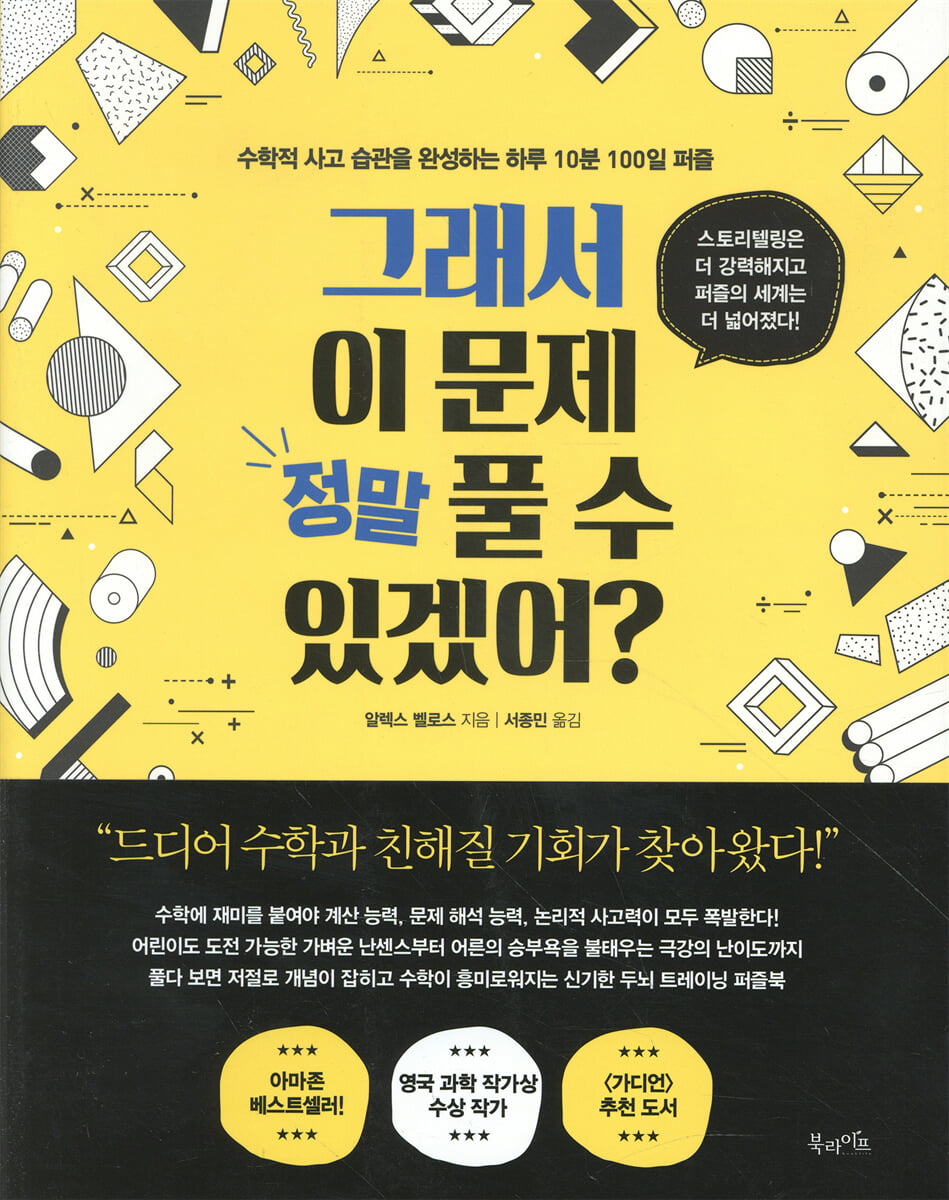
So can we really solve this problem?
 |
Description
Book Introduction
“Finally, the opportunity to become familiar with math has arrived!” Alex Bellos, author of Can You Solve This?, which has been praised as the best puzzle book and has given puzzle enthusiasts a thrilling experience. He is a puzzle master who has contributed puzzle problems to the Guardian every Monday since 2015, and is a leading British popular mathematician and winner of the British Science Writer's Award. He returns with "So, can you really solve this problem?" This time, if you hold onto 100 math puzzles, you will be able to properly feel the pain and pleasure of squeezing your brain. In the process, you can naturally grasp mathematical concepts and experience mathematics as an interesting subject. When you find enjoyment in math, your calculation skills, problem-solving skills, and logical thinking skills will all explode! From easy nonsense that even children can tackle to challenging, challenging puzzles that will ignite the competitive spirit of adults, this amazing brain-training puzzle book will help you grasp the concepts and become more interested in math. |
- You can preview some of the book's contents.
Preview
index
[Book] So can you really solve this problem?
prolog
Chapter 1.
Puzzle Zoo: Animal Quiz
*Tasting Problem 1.
Number Riddles
001 What if three rabbits had ears on both sides?
002 How to make a dead dog come back to life and move?
003 How many pairs of rabbits will there be in one year?
004 How many offspring does a female rabbit have in her lifetime?
005 How can a frog reach the last lotus leaf?
006 How can a camel safely cross the desert?
007 How to save the endangered antelope?
008 How to divide 13 camels without hurting them?
009 Which animal is slower, a camel or a horse?
010 How far did the fly move in a zigzag pattern?
011 Which ant will survive until the very end?
012 How can a snail reach the end of a rubber band?
013 What if animals look in the opposite direction?
014 How to protect your bed from bugs?
015 Why did the parrot keep its mouth shut?
016 Which color chameleon will survive?
017 What if a spider eats a fly for lunch?
018 How can a meerkat see its entire body in a mirror?
019 How many days will it take to find the cat?
020 How can a postman ward off a vicious dog?
021 How long does it take for X bacteria to eat all of Y bacteria?
022 How can a duck avoid being caught by a fox?
023 How can a logical lion fill his hungry stomach?
024 Which pig will eat more?
025 How many mice need to find a poisoned bottle of wine?
Chapter 2.
I'm a mathematician, get me out of here: survival problem
*Tasting Problem 2.
tricky grid
026 How to survive on a burning island?
027 What if the steering wheel of an 8-ton truck breaks?
028 How to rescue hostages from pirates?
029 How to escape from the dungeon?
030 How to safely ship a ring?
031 How to unlock the lock?
032 How to make sure the password is correct?
033 How to power on all buttons?
034 What if three suspicious people were to guard the safe?
How to verify that you are from the same organization using a 035 number password?
036 How to untangle a knot without twisting your body?
037 How to wear pants so that the inside of the zipper is visible?
038 What is the area of the rectangle in the giant maze?
039 How to escape from the arrow maze?
040 What if all the guards follow the prison rules?
041 Which envelope should I choose to survive?
042 How to find the missing number from 1 to 100?
043 How to fail at making 100 first?
044 How to choose the right path at a fork in the road?
045 What the heck? Is that so? No?
046 How to save the life of a death row inmate?
047 Is it a red hat or a blue hat?
048 Majority Report and Remember the Name?
049 Have we all been to the lamp room?
050 What are the odds of finding my name tag in 100 drawers?
Chapter 3.
Cakes, Cubes, and the Cobbler's Knife: Geometry Problems
*Tasting Problem 3.
Noisy riddles
051 How to pack a Calisong without damaging it?
052 How to divide the remaining cake into two equal parts?
053 What if 5 people share the cake equally?
054 How do you cut a donut into 9 pieces by cutting it 3 times?
055 Separate triangles and the birth of stars?
056 How to make a square out of a rectangle?
057 How to make the chair square?
058 How to transform spades into hearts?
059 How to make a square by gluing a broken vase?
060 Make a square out of a square?
061 How many squares are in Mrs. Perkins' quilt?
062 How to make a sphinx with reptiles?
063 How to divide magical animals into the same shape?
064 What is the area of the overlapping part of two squares?
065 When a triangle is divided into four parts, what is the area of one piece?
066 What is Katrina's Arbelos and its area?
067 What is the area of the equilateral triangle in Katrina's cross?
068 What is the angle between two touching line segments on a cube?
069 What does the hexagonal cross-section of a Menger sponge look like?
070 What is the shape of an object passing through a unique stopper?
071 What if we overlap one side of each pyramid?
072 What is the length of the thread wrapping the rod?
073 What color is the bear living at the starting point?
074 What date did you return from your 18-day trip around the world?
075 How much whiskey is left exactly?
Chapter 4.
Sleepless nights and sibling rivalries
*Tasting Problem 4.
Bongard Puzzle
076 How to increase the odds of choosing dark chocolate cookies?
077 How to get 1 white pebble first?
078 How many socks are in the drawer?
079 How much change is in your pocket?
080 How to divide a bag of potatoes into two equally?
081 What is the minimum number of candies that can be divided into 15 bags?
082 What is the probability that the ball remaining in the bag is white?
083 Bertrand's Box Paradox and the Probability of a Black Coin Remaining?
084 What if you diet with dice?
085 What if you could make money by rolling dice?
086 Which of the following coin toss records is fake?
087 What are the possible gender combinations for 4 children?
088 Who would be the first to object to the pregnancy, the husband or the wife?
089 What is the probability of having two sons or two daughters?
090 What is the probability that the baby will be a girl born in an even year?
091 What position in line do firstborn twins usually stand in?
092 What are the five numbers that have a range of 5?
093 Statistics can lie too?
094 How many people participated in the marathon?
095 How to join Fight Club?
096 How to make a big knot with blades of grass?
097 How to choose the paper with the largest number written on it?
098 What are the chances that a prisoner will be pardoned?
099 What is your choice in the Monty Quandant problem?
Surviving 100 Russian Roulette Games?
Answers and Explanations
List of puzzles and their sources
Acknowledgements
prolog
Chapter 1.
Puzzle Zoo: Animal Quiz
*Tasting Problem 1.
Number Riddles
001 What if three rabbits had ears on both sides?
002 How to make a dead dog come back to life and move?
003 How many pairs of rabbits will there be in one year?
004 How many offspring does a female rabbit have in her lifetime?
005 How can a frog reach the last lotus leaf?
006 How can a camel safely cross the desert?
007 How to save the endangered antelope?
008 How to divide 13 camels without hurting them?
009 Which animal is slower, a camel or a horse?
010 How far did the fly move in a zigzag pattern?
011 Which ant will survive until the very end?
012 How can a snail reach the end of a rubber band?
013 What if animals look in the opposite direction?
014 How to protect your bed from bugs?
015 Why did the parrot keep its mouth shut?
016 Which color chameleon will survive?
017 What if a spider eats a fly for lunch?
018 How can a meerkat see its entire body in a mirror?
019 How many days will it take to find the cat?
020 How can a postman ward off a vicious dog?
021 How long does it take for X bacteria to eat all of Y bacteria?
022 How can a duck avoid being caught by a fox?
023 How can a logical lion fill his hungry stomach?
024 Which pig will eat more?
025 How many mice need to find a poisoned bottle of wine?
Chapter 2.
I'm a mathematician, get me out of here: survival problem
*Tasting Problem 2.
tricky grid
026 How to survive on a burning island?
027 What if the steering wheel of an 8-ton truck breaks?
028 How to rescue hostages from pirates?
029 How to escape from the dungeon?
030 How to safely ship a ring?
031 How to unlock the lock?
032 How to make sure the password is correct?
033 How to power on all buttons?
034 What if three suspicious people were to guard the safe?
How to verify that you are from the same organization using a 035 number password?
036 How to untangle a knot without twisting your body?
037 How to wear pants so that the inside of the zipper is visible?
038 What is the area of the rectangle in the giant maze?
039 How to escape from the arrow maze?
040 What if all the guards follow the prison rules?
041 Which envelope should I choose to survive?
042 How to find the missing number from 1 to 100?
043 How to fail at making 100 first?
044 How to choose the right path at a fork in the road?
045 What the heck? Is that so? No?
046 How to save the life of a death row inmate?
047 Is it a red hat or a blue hat?
048 Majority Report and Remember the Name?
049 Have we all been to the lamp room?
050 What are the odds of finding my name tag in 100 drawers?
Chapter 3.
Cakes, Cubes, and the Cobbler's Knife: Geometry Problems
*Tasting Problem 3.
Noisy riddles
051 How to pack a Calisong without damaging it?
052 How to divide the remaining cake into two equal parts?
053 What if 5 people share the cake equally?
054 How do you cut a donut into 9 pieces by cutting it 3 times?
055 Separate triangles and the birth of stars?
056 How to make a square out of a rectangle?
057 How to make the chair square?
058 How to transform spades into hearts?
059 How to make a square by gluing a broken vase?
060 Make a square out of a square?
061 How many squares are in Mrs. Perkins' quilt?
062 How to make a sphinx with reptiles?
063 How to divide magical animals into the same shape?
064 What is the area of the overlapping part of two squares?
065 When a triangle is divided into four parts, what is the area of one piece?
066 What is Katrina's Arbelos and its area?
067 What is the area of the equilateral triangle in Katrina's cross?
068 What is the angle between two touching line segments on a cube?
069 What does the hexagonal cross-section of a Menger sponge look like?
070 What is the shape of an object passing through a unique stopper?
071 What if we overlap one side of each pyramid?
072 What is the length of the thread wrapping the rod?
073 What color is the bear living at the starting point?
074 What date did you return from your 18-day trip around the world?
075 How much whiskey is left exactly?
Chapter 4.
Sleepless nights and sibling rivalries
*Tasting Problem 4.
Bongard Puzzle
076 How to increase the odds of choosing dark chocolate cookies?
077 How to get 1 white pebble first?
078 How many socks are in the drawer?
079 How much change is in your pocket?
080 How to divide a bag of potatoes into two equally?
081 What is the minimum number of candies that can be divided into 15 bags?
082 What is the probability that the ball remaining in the bag is white?
083 Bertrand's Box Paradox and the Probability of a Black Coin Remaining?
084 What if you diet with dice?
085 What if you could make money by rolling dice?
086 Which of the following coin toss records is fake?
087 What are the possible gender combinations for 4 children?
088 Who would be the first to object to the pregnancy, the husband or the wife?
089 What is the probability of having two sons or two daughters?
090 What is the probability that the baby will be a girl born in an even year?
091 What position in line do firstborn twins usually stand in?
092 What are the five numbers that have a range of 5?
093 Statistics can lie too?
094 How many people participated in the marathon?
095 How to join Fight Club?
096 How to make a big knot with blades of grass?
097 How to choose the paper with the largest number written on it?
098 What are the chances that a prisoner will be pardoned?
099 What is your choice in the Monty Quandant problem?
Surviving 100 Russian Roulette Games?
Answers and Explanations
List of puzzles and their sources
Acknowledgements
Detailed image

Into the book
I wrote this book to share the joy of problem solving.
A good puzzle not only stimulates creative thinking, but also inspires wonder and curiosity about the world.
We've carefully selected problems that will surprise you as a problem solver or contain interesting patterns or ideas.
Puzzles are a versatile medium that encompasses a wide variety of genres, so I hope this book tickles your brain in many ways.
--- p.11, from “Prologue”
Alcuin's camel quiz is a good example of how something that started out as a fun exercise evolved into a major field of mathematical research.
Camels, which used to drink water and eat grain, were upgraded to gas-fueled machines in the 20th century.
(……) This puzzle can be used in exploration missions or war.
In fact, the first detailed study of this puzzle was conducted in 1946 under the auspices of the U.S. Army Air Corps.
If you've ever had to carry your own fuel on an exploration mission—whether it's navigating the Southern Ocean, traversing hostile airspace, or exploring new corners of the solar system—you've probably wrestled with this same transportation conundrum.
--- p.34~35, 「Chapter 1.
From "Puzzle Zoo: Animal Quiz"
Almost all of Josephus's problems in the West feature people drowning.
In Japan, on the other hand, the Josephus issue was reborn as an allegory about pride.
A farmer had a first wife, a second wife, and the children they had.
To decide who would inherit the farmer's property, the children formed a circle and counted their numbers, each time eliminating the tenth person, so that the last remaining person would inherit all the property.
A woman began to count down the number of her children to make them her heirs, but was too proud and made a mistake, excluding all of her children.
--- p.82, Chapter 2.
I am a mathematician.
From "Get Me Out of Here: A Survival Issue"
The phenomenon of 'a moment of unintentional change' in the direction of vision resembles the moment of enlightenment required to solve a geometric puzzle.
(……) You look at the picture and try to find clues.
Even if it seems like a dead end, you will suddenly feel a magical feeling.
It's the moment when you suddenly realize that you've been looking for the answer for a long time.
The direction seems to change here and there.
You may feel an unknown feeling.
The answer was always right in front of me.
The answers to geometry puzzles will pop out of the bookshelf the moment you look at them properly.
--- p.124~125, 「Chapter 3.
From "Cakes, Cubes, and the Shoemaker's Knife: Geometry Problems"
Bernoulli's insight that the outcome of a single random event cannot be predicted, but the outcome of the same event repeated many times can be predicted and will produce an outcome with approximately the same probability is also known as the law of large numbers.
This law is one of the fundamental concepts of probability theory.
Probability, the branch of mathematics that studies randomness, underpins so many aspects of modern life, from medicine to financial markets, from particle physics to weather forecasting.
Based on Bernoulli's pebble-pulling thought experiment, puzzles have emerged in which objects are randomly pulled out of a jar-like container.
One of them is a puzzle where you have to take cookies out of a box.
A good puzzle not only stimulates creative thinking, but also inspires wonder and curiosity about the world.
We've carefully selected problems that will surprise you as a problem solver or contain interesting patterns or ideas.
Puzzles are a versatile medium that encompasses a wide variety of genres, so I hope this book tickles your brain in many ways.
--- p.11, from “Prologue”
Alcuin's camel quiz is a good example of how something that started out as a fun exercise evolved into a major field of mathematical research.
Camels, which used to drink water and eat grain, were upgraded to gas-fueled machines in the 20th century.
(……) This puzzle can be used in exploration missions or war.
In fact, the first detailed study of this puzzle was conducted in 1946 under the auspices of the U.S. Army Air Corps.
If you've ever had to carry your own fuel on an exploration mission—whether it's navigating the Southern Ocean, traversing hostile airspace, or exploring new corners of the solar system—you've probably wrestled with this same transportation conundrum.
--- p.34~35, 「Chapter 1.
From "Puzzle Zoo: Animal Quiz"
Almost all of Josephus's problems in the West feature people drowning.
In Japan, on the other hand, the Josephus issue was reborn as an allegory about pride.
A farmer had a first wife, a second wife, and the children they had.
To decide who would inherit the farmer's property, the children formed a circle and counted their numbers, each time eliminating the tenth person, so that the last remaining person would inherit all the property.
A woman began to count down the number of her children to make them her heirs, but was too proud and made a mistake, excluding all of her children.
--- p.82, Chapter 2.
I am a mathematician.
From "Get Me Out of Here: A Survival Issue"
The phenomenon of 'a moment of unintentional change' in the direction of vision resembles the moment of enlightenment required to solve a geometric puzzle.
(……) You look at the picture and try to find clues.
Even if it seems like a dead end, you will suddenly feel a magical feeling.
It's the moment when you suddenly realize that you've been looking for the answer for a long time.
The direction seems to change here and there.
You may feel an unknown feeling.
The answer was always right in front of me.
The answers to geometry puzzles will pop out of the bookshelf the moment you look at them properly.
--- p.124~125, 「Chapter 3.
From "Cakes, Cubes, and the Shoemaker's Knife: Geometry Problems"
Bernoulli's insight that the outcome of a single random event cannot be predicted, but the outcome of the same event repeated many times can be predicted and will produce an outcome with approximately the same probability is also known as the law of large numbers.
This law is one of the fundamental concepts of probability theory.
Probability, the branch of mathematics that studies randomness, underpins so many aspects of modern life, from medicine to financial markets, from particle physics to weather forecasting.
Based on Bernoulli's pebble-pulling thought experiment, puzzles have emerged in which objects are randomly pulled out of a jar-like container.
One of them is a puzzle where you have to take cookies out of a box.
--- p.181~182, 「Chapter 4.
From "Sleepless Nights and Sibling Rivalry: Probability Puzzles"
From "Sleepless Nights and Sibling Rivalry: Probability Puzzles"
Publisher's Review
From mild nonsense to extremely challenging challenges that will ignite your competitive spirit.
A fun brain training book with Alex Bellows, a leading British popular mathematician.
★Sequel to the Sejong Book Selection, "Can You Solve This Problem?"
★A surprisingly engaging puzzle! A refreshingly clear explanation!
★The best math puzzle book of this era, loved even by math teachers.
Broadcaster Oh Sang-jin also highly praised it, saying, "This book will save your hair that was getting stiff!"
"Can You Solve This Problem?" is back after two years with an upgraded look!
Alex Bellos, author of Can You Solve This?, which has been praised as the best puzzle book and has given puzzle enthusiasts a thrilling experience.
He is a puzzle master who has contributed puzzle problems to the Guardian every Monday since 2015, and is a leading British popular mathematician who won the British Science Writer's Award. He returns with "So, can you really solve this problem?"
This time, if you hold onto 100 math puzzles, you will be able to properly feel the pain and pleasure of squeezing your brain.
In the process, you can naturally grasp mathematical concepts and experience mathematics as an interesting subject.
The previous work, "Can You Solve This Problem?", is a puzzle book that compiles 125 brain game puzzles that span a wide range of knowledge, including mathematics, science, history, society, and economics, and human history. It became a bestseller on Amazon UK immediately after its publication.
Since then, it has been translated into over 20 languages and has been a hit with many math enthusiasts. In Korea, since its publication in 2018, it has steadily attracted readers' attention and has become a bestseller in the science section of major bookstores, demonstrating its growth as the quintessential math puzzle book.
Why has this book been chosen by readers all over the world?
First, it piqued readers' interest by showcasing interesting puzzles from various eras and places, including ancient China, medieval Europe, Victorian England, and modern Asia. Second, it added the joy of storytelling to math books, which were previously filled with only problem-solving, through its rich reading material, including hidden backstories and histories within the puzzles, and its detailed explanations.
Recognized for its unique structure and solid content, "Can You Solve This Problem?" was selected for the 2019 Sejong Book Culture Category by the Korea Publication Industry Promotion Agency.
The recently published 『So, Can You Really Solve This Problem?』 also retains all the strengths of its predecessor.
The storytelling has been enriched to make reading more enjoyable, and the puzzles have been carefully selected to help train the brain and improve mathematical thinking skills, making the moments of problem-solving even more thrilling.
From children who are afraid of math to adults who are so rigid that they only reach for a calculator, anyone who wants to become familiar with math should not hesitate and throw down the gauntlet in this book.
You will be captivated by the charm of developing mathematical thinking skills just by solving puzzles.
The storytelling has become more powerful and the puzzle world has expanded.
Tighten, stretch, and twist your brain to make it more flexible!
A man left behind 13 camels as an inheritance.
He also left a will stating that the eldest should get half, the second a third, and the youngest a fourth. How can he divide it without causing the camel great pain?
Is this really a solvable problem? Dividing 13 live camels into groups of two, three, or four seems like a nonsensical problem, absurd from the start.
But if you use your mathematical thinking to the max, you can come up with a way to end the three siblings' fight over the inheritance, so you can't give up easily.
The answer to this question, which stimulates a strong competitive spirit, can be found in "So, can you really solve this problem?"
"So, Can You Really Solve This?" contains 100 puzzles, each of which is divided into four themes: animal puzzles, escape and survival puzzles, geometry puzzles, and probability puzzles.
All puzzles are categorized by topic, but the order in which they are listed and their difficulty level are not related.
So you can read them in order or pick and choose whichever you like.
Instead, I hope you'll remember that none of the puzzles require difficult mathematical formulas or complex solution processes, and that you'll solve them accordingly.
The answer will suddenly appear when you use your insight, thinking skills, logic, and creativity.
“My goal with this book was to introduce puzzles that offer something to learn, whether it's a new concept, a clever strategy, or just a surprise.
I also wanted to share my sense of humor with you, while igniting your creativity, sparking your curiosity, and sharpening your logical reasoning skills.
Most of the problems in real life have no answers.
Fortunately, I can provide answers to the questions listed here.”
The beauty of puzzles is that they deliberately lead us to wrong ideas, or they play with our minds in ways that seem right but are completely wrong.
But the process of fighting against problems that lead you in the wrong direction and finding the right answer is both exciting and useful.
Not only does it provide the joy of problem solving, it also makes your brain smarter and more versatile, and teaches you how to think clearly.
Isn't this precisely the powerful strength and positive function of puzzles?
Join Alex Bellos as he delves into the world of puzzles.
By developing your ability to see the world from various angles through puzzles, you will be able to obtain a guide that will help you correctly solve real-world problems.
A fun brain training book with Alex Bellows, a leading British popular mathematician.
★Sequel to the Sejong Book Selection, "Can You Solve This Problem?"
★A surprisingly engaging puzzle! A refreshingly clear explanation!
★The best math puzzle book of this era, loved even by math teachers.
Broadcaster Oh Sang-jin also highly praised it, saying, "This book will save your hair that was getting stiff!"
"Can You Solve This Problem?" is back after two years with an upgraded look!
Alex Bellos, author of Can You Solve This?, which has been praised as the best puzzle book and has given puzzle enthusiasts a thrilling experience.
He is a puzzle master who has contributed puzzle problems to the Guardian every Monday since 2015, and is a leading British popular mathematician who won the British Science Writer's Award. He returns with "So, can you really solve this problem?"
This time, if you hold onto 100 math puzzles, you will be able to properly feel the pain and pleasure of squeezing your brain.
In the process, you can naturally grasp mathematical concepts and experience mathematics as an interesting subject.
The previous work, "Can You Solve This Problem?", is a puzzle book that compiles 125 brain game puzzles that span a wide range of knowledge, including mathematics, science, history, society, and economics, and human history. It became a bestseller on Amazon UK immediately after its publication.
Since then, it has been translated into over 20 languages and has been a hit with many math enthusiasts. In Korea, since its publication in 2018, it has steadily attracted readers' attention and has become a bestseller in the science section of major bookstores, demonstrating its growth as the quintessential math puzzle book.
Why has this book been chosen by readers all over the world?
First, it piqued readers' interest by showcasing interesting puzzles from various eras and places, including ancient China, medieval Europe, Victorian England, and modern Asia. Second, it added the joy of storytelling to math books, which were previously filled with only problem-solving, through its rich reading material, including hidden backstories and histories within the puzzles, and its detailed explanations.
Recognized for its unique structure and solid content, "Can You Solve This Problem?" was selected for the 2019 Sejong Book Culture Category by the Korea Publication Industry Promotion Agency.
The recently published 『So, Can You Really Solve This Problem?』 also retains all the strengths of its predecessor.
The storytelling has been enriched to make reading more enjoyable, and the puzzles have been carefully selected to help train the brain and improve mathematical thinking skills, making the moments of problem-solving even more thrilling.
From children who are afraid of math to adults who are so rigid that they only reach for a calculator, anyone who wants to become familiar with math should not hesitate and throw down the gauntlet in this book.
You will be captivated by the charm of developing mathematical thinking skills just by solving puzzles.
The storytelling has become more powerful and the puzzle world has expanded.
Tighten, stretch, and twist your brain to make it more flexible!
A man left behind 13 camels as an inheritance.
He also left a will stating that the eldest should get half, the second a third, and the youngest a fourth. How can he divide it without causing the camel great pain?
Is this really a solvable problem? Dividing 13 live camels into groups of two, three, or four seems like a nonsensical problem, absurd from the start.
But if you use your mathematical thinking to the max, you can come up with a way to end the three siblings' fight over the inheritance, so you can't give up easily.
The answer to this question, which stimulates a strong competitive spirit, can be found in "So, can you really solve this problem?"
"So, Can You Really Solve This?" contains 100 puzzles, each of which is divided into four themes: animal puzzles, escape and survival puzzles, geometry puzzles, and probability puzzles.
All puzzles are categorized by topic, but the order in which they are listed and their difficulty level are not related.
So you can read them in order or pick and choose whichever you like.
Instead, I hope you'll remember that none of the puzzles require difficult mathematical formulas or complex solution processes, and that you'll solve them accordingly.
The answer will suddenly appear when you use your insight, thinking skills, logic, and creativity.
“My goal with this book was to introduce puzzles that offer something to learn, whether it's a new concept, a clever strategy, or just a surprise.
I also wanted to share my sense of humor with you, while igniting your creativity, sparking your curiosity, and sharpening your logical reasoning skills.
Most of the problems in real life have no answers.
Fortunately, I can provide answers to the questions listed here.”
The beauty of puzzles is that they deliberately lead us to wrong ideas, or they play with our minds in ways that seem right but are completely wrong.
But the process of fighting against problems that lead you in the wrong direction and finding the right answer is both exciting and useful.
Not only does it provide the joy of problem solving, it also makes your brain smarter and more versatile, and teaches you how to think clearly.
Isn't this precisely the powerful strength and positive function of puzzles?
Join Alex Bellos as he delves into the world of puzzles.
By developing your ability to see the world from various angles through puzzles, you will be able to obtain a guide that will help you correctly solve real-world problems.
GOODS SPECIFICS
- Publication date: December 22, 2020
- Page count, weight, size: 336 pages | 584g | 162*205*30mm
- ISBN13: 9791191013085
- ISBN10: 1191013081
You may also like
카테고리
korean


korean

![GQ KOREA Mark (Monthly): December [2025]](http://librairie.coreenne.fr/cdn/shop/files/8ef265dbbfbf186523ed75ba7319009d.jpg?v=1765340328&width=3840)


