

Thinking about Peter Zumthor's architecture
 |
Description
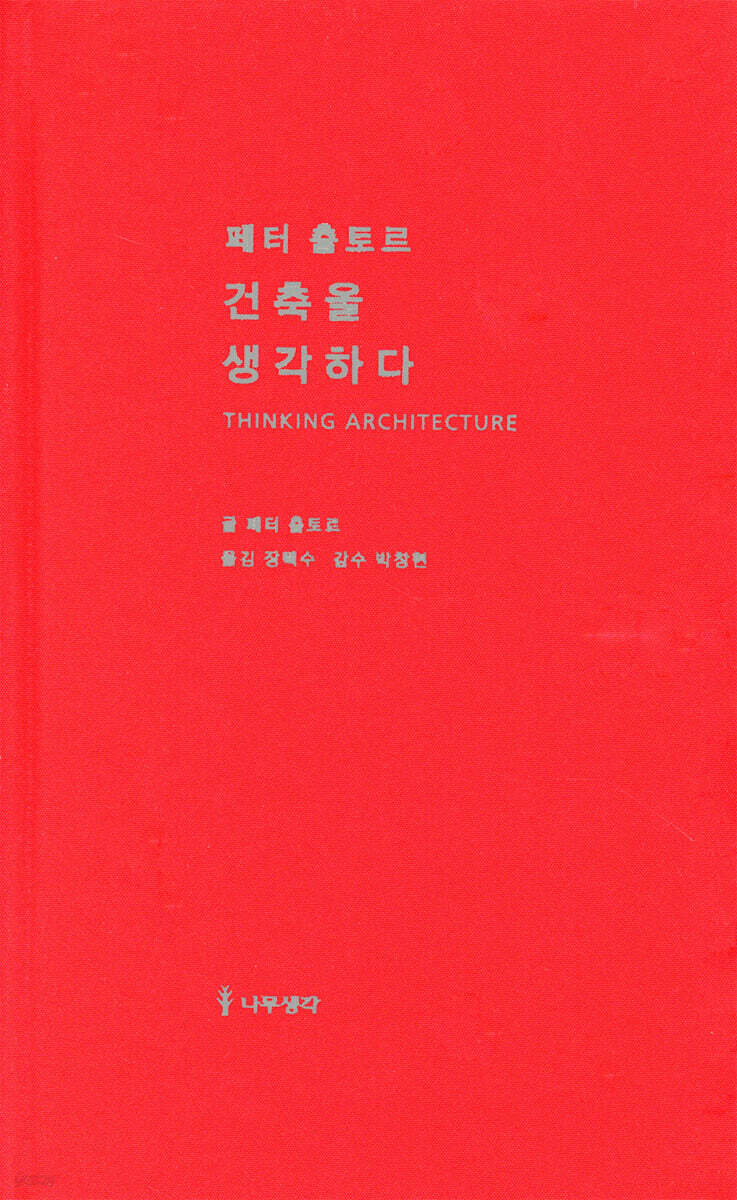
Book Introduction
In this book, Chumthor emphasizes that simply by remaining true to one's true nature, one can create a space that inspires profound inspiration.
That is why he is so obsessed with understanding the characteristics of the materials he uses in construction and making the most of their unique properties.
Because of this, Chumthor's works have a solemn and dignified feel.
It can be said to be a great product created by the master's craftsmanship.
I highly recommend this book by this veteran, a representative of modern architecture, to anyone interested in the humanities, not just architecture students, or anyone interested in the homes we live in and the spaces we want to inhabit.
You will be able to deeply glimpse the sublime thoughts and philosophy of Chumthor, who expresses the presence of architecture through communication with the air, sound, light, and materials that surround us.
That is why he is so obsessed with understanding the characteristics of the materials he uses in construction and making the most of their unique properties.
Because of this, Chumthor's works have a solemn and dignified feel.
It can be said to be a great product created by the master's craftsmanship.
I highly recommend this book by this veteran, a representative of modern architecture, to anyone interested in the humanities, not just architecture students, or anyone interested in the homes we live in and the spaces we want to inhabit.
You will be able to deeply glimpse the sublime thoughts and philosophy of Chumthor, who expresses the presence of architecture through communication with the air, sound, light, and materials that surround us.
- You can preview some of the book's contents.
Preview
index
A way of looking at things
The essence of beauty
From passion for things to things themselves
The body of architecture
Education and Learning in Architecture
Does beauty have a form?
The magic of substance
Light in the Landscape
Architecture and Landscape
Rice House
The essence of beauty
From passion for things to things themselves
The body of architecture
Education and Learning in Architecture
Does beauty have a form?
The magic of substance
Light in the Landscape
Architecture and Landscape
Rice House
Into the book
Memory is a repository of architectural atmosphere and images that we refer to whenever we do architectural work.
When I design a building, I often find myself lost in memories that have now become hazy with the passage of time.
I recall what the architectural situation in my memory was like and what it meant to me at the time, and I ponder how to revive the vibrant atmosphere created by the various objects, each with its own unique location and form, into reality. --- p.8
There is a secret behind the building's existence.
Of course, the building just sits there.
We don't show any particular interest in buildings.
But can you imagine what it would be like without the building where it stands? These buildings seem firmly rooted in the ground.
It conveys this message with the impression that it has become completely part of the surrounding environment.
“I am exactly as you see me.
“I belong here.” I have a strong desire to design buildings that, over time, naturally become part of the form and history of the place.
Every new building intervenes in a specific historical context.
To increase the degree of intervention, new buildings must be endowed with properties that enable meaningful dialogue with the existing context. --- p.17
Because, in my opinion, a good building is one that absorbs the traces of human life and displays its own richness.
Traces of time appearing on materials, countless scratches on the surface, surfaces that have lost their luster, and blunted edges come to mind.
But when I close my eyes and try to forget these physical traces and the feeling I had when I first encountered them, I am left with a completely different impression, a deeper feeling.
The awareness of time passing, the awareness of the life that was in that space and room, and the special atmosphere of that space remain.
At such moments, the aesthetic and practical value of architecture, its stylistic and historical significance, are of no importance. --- p.24
Good design lies within ourselves and our ability to understand the world emotionally and rationally.
Good architectural design is both sensuous and intellectual.
We experience architecture before we even hear the word architecture.
The roots of architectural understanding lie in architectural experience.
Our rooms, our homes, our streets, our towns, our cities, our landscapes.
We experience all of this unconsciously from an early age.
Then, as time passes, you compare the countryside, city, and house you experience later with your previous experiences.
The roots of architecture as we know it lie in childhood.
Its roots lie in our history.
Students must learn to work consciously, recalling their own architectural experiences. --- p.65
When building something within a landscape, it is important to ensure that the building's materials blend in with the historical materials that grew within that landscape.
The physical properties of a built building must resonate with the physical properties of the area.
I am particularly sensitive to the relationship between place, material, and time and space.
Materials and constructions must be related to the place and sometimes come from that place.
Otherwise, it feels like the landscape won't tolerate the new building.
When I design a building, I often find myself lost in memories that have now become hazy with the passage of time.
I recall what the architectural situation in my memory was like and what it meant to me at the time, and I ponder how to revive the vibrant atmosphere created by the various objects, each with its own unique location and form, into reality. --- p.8
There is a secret behind the building's existence.
Of course, the building just sits there.
We don't show any particular interest in buildings.
But can you imagine what it would be like without the building where it stands? These buildings seem firmly rooted in the ground.
It conveys this message with the impression that it has become completely part of the surrounding environment.
“I am exactly as you see me.
“I belong here.” I have a strong desire to design buildings that, over time, naturally become part of the form and history of the place.
Every new building intervenes in a specific historical context.
To increase the degree of intervention, new buildings must be endowed with properties that enable meaningful dialogue with the existing context. --- p.17
Because, in my opinion, a good building is one that absorbs the traces of human life and displays its own richness.
Traces of time appearing on materials, countless scratches on the surface, surfaces that have lost their luster, and blunted edges come to mind.
But when I close my eyes and try to forget these physical traces and the feeling I had when I first encountered them, I am left with a completely different impression, a deeper feeling.
The awareness of time passing, the awareness of the life that was in that space and room, and the special atmosphere of that space remain.
At such moments, the aesthetic and practical value of architecture, its stylistic and historical significance, are of no importance. --- p.24
Good design lies within ourselves and our ability to understand the world emotionally and rationally.
Good architectural design is both sensuous and intellectual.
We experience architecture before we even hear the word architecture.
The roots of architectural understanding lie in architectural experience.
Our rooms, our homes, our streets, our towns, our cities, our landscapes.
We experience all of this unconsciously from an early age.
Then, as time passes, you compare the countryside, city, and house you experience later with your previous experiences.
The roots of architecture as we know it lie in childhood.
Its roots lie in our history.
Students must learn to work consciously, recalling their own architectural experiences. --- p.65
When building something within a landscape, it is important to ensure that the building's materials blend in with the historical materials that grew within that landscape.
The physical properties of a built building must resonate with the physical properties of the area.
I am particularly sensitive to the relationship between place, material, and time and space.
Materials and constructions must be related to the place and sometimes come from that place.
Otherwise, it feels like the landscape won't tolerate the new building.
--- p.99
Publisher's Review
Peter Zumthor: A Timeless Presence
Peter Zumthor was born in 1943 in Basel, Switzerland, the son of a cabinetmaker.
Zumthor, who opened an architectural office in Haldenstein in 1979, expressed a high level of architectural thought that transcended time and space through works such as the Vals Baths in Graubünden, Switzerland and the Columba Museum, and was honored with the Pritzker Prize, known as the "Nobel Prize" of architecture, in 2009.
Sir Peter Palumbo, then chairman of the Pritzker Prize jury, praised Zumthor's architectural work in a commentary that said, "Zumthor's work, with its splendid façade and its embrace of place, demonstrates that an architect can pursue the virtues of 'humility' and 'guts' at the same time."
There are many renowned masters representing the architectural world.
But why do the architectural ideas and aesthetics of Peter Zumthor, a man almost a hermit, resonate with so many today? Why do so many architecture students in modern architecture regard him as a role model and admire his work? The answers to these questions are contained in "Contemplating Peter Zumthor's Architecture," a must-read alongside Zumthor's previous work, "Peter Zumthor Atmosphere."
Peter Zumthor: Thinking about Architecture
Peter Zumthor, the great Swiss architect, is a legendary figure among architects leading modern architecture.
I haven't designed any internationally renowned large-scale buildings, nor do I work across the East and West.
However, Zumthor's 'small buildings' serve as a landmark that indicates the direction in which architects should move forward today.
It is a truly 'integrated' building that is in harmony with its surroundings and does not intimidate people or the landscape.
Peter Zumthor's Reflections on Architecture, a collection of Zumthor's representative lectures, is a book that comprehensively presents his architectural philosophy, experiences, and thoughts.
In this book, Chumthor says, “Architecture is not a means or symbol for an object unrelated to its essence.
In a society that values the non-essential, architecture must speak the language of architecture while opposing and resisting the waste of form and meaning,” he said, clearly revealing his philosophy on architecture.
In short, architecture reflects the biographical experiences that an individual goes through in life.
This does not require any ostentatious or flashy decorations.
Because architecture has a life of its own and becomes one with the place.
In fact, the architectural answer that Chumthor offers is clear and resolute.
Regarding this, Thomas J., Chairman of the Hyatt Foundation, said:
Pritzker also says the following:
“Peter Zumthor is a great architect who is respected among architects all over the world.
His architectural works are uncompromising and uncompromising.
It is very strong and has a timeless presence.
Chumthor has a talent for combining his rigorous and clear thinking with poetic inspiration.
“Because of this, his buildings are constantly inspiring.”
Moderation, firmness, and tranquility
Zumthor's architectural philosophy can be seen in his masterpiece, the Vals Baths.
There is restraint, determination, and calmness.
The Bals Hot Springs is a building that is half-hidden in the sloping ground, allowing the building to blend naturally into the landscape of the land surrounded by mountains.
All that is exposed is the grass-covered roof and the main façade, made from gneiss quarried from the Vals region.
The Bals Hot Springs, which took full advantage of the slope to create a building shape, looks more like the hot springs hidden within were carved out of the mountain rather than the building that the architect envisioned.
“Before starting the hot spring project, I thought about what it would mean to have a hot spring here.
The hot spring water must have been gushing out from this mountain long before we existed.
So I pictured that hot spring springing up from the mountain.
Just as the hot springs and mountains have existed here for tens of thousands of centuries, the Vals Hot Springs were not built, but rather were there from the beginning.”
In “Peter Zumthor Thinks About Architecture,” Zumthor conveys that “image” is a powerful means of approaching architectural form.
The images that Chumthor speaks of are images stored in each person's memory.
In other words, it is about expressing one's own memories, experiences, and imagination regarding architectural forms.
In his lectures, Chumthor encourages students to create designs based on their own experiences.
This is because we believe that the power to create good designs already exists within us.
His architectural philosophy is that experiencing things does not remain within the individual experience, but can be defined as a universal experience.
In this book, Chumthor emphasizes that simply by remaining true to one's true nature, one can create a space that inspires profound inspiration.
That is why he is so obsessed with understanding the characteristics of the materials he uses in construction and making the most of their unique properties.
Because of this, Chumthor's works have a solemn and dignified feel.
It can be said to be a great product created by the master's craftsmanship.
I highly recommend this book by this veteran, a representative of modern architecture, to anyone interested in the humanities, not just architecture students, or anyone interested in the homes we live in and the spaces we want to inhabit.
You will be able to deeply glimpse the sublime thoughts and philosophy of Chumthor, who expresses the presence of architecture through communication with the air, sound, light, and materials that surround us.
Architectural sketches by Peter Zumthor
Vals Thermal Baths, Graubünden, Switzerland (1996)
Every year, more than 40,000 tourists visit Vals to enjoy the Vals hot springs.
Chumthor designed the building structure to 'hide' along the hot spring water vein.
A concrete retaining wall, finished with gneiss from a quarry just below the village, surrounds the water.
It is a space like a pious temple where nothing can be added or taken away.
Bruder Klaus Chapel, Germany (2007)
The Bruder Klaus Chapel, a light gray concrete building nestled in the middle of a plain, epitomizes Zumthor's architectural philosophy.
At the request of a farmer, a church was built in the middle of a wheat field, with space for only one person.
112 long cylindrical timbers were driven in and erected around a circle, and then concrete was poured over them.
After the concrete hardened, the wooden formwork was burned away over a three-week period, leaving behind dark, creased ridges and traces of bark.
As you enter the building, a mysterious light falls from the ceiling, creating a unique atmosphere.
Columba Museum, Germany (2007)
It is an art museum where history lives and breathes.
The old structures on the lower level are what remains of St. Columba's Church, which was destroyed by bombing during World War II.
The concrete walls, with their understated decoration, are merely minimal supports built upon a long history.
Zumthor sought to find the essence of the Columba Museum not in its architectural appearance, but in the works exhibited within it.
Peter Zumthor was born in 1943 in Basel, Switzerland, the son of a cabinetmaker.
Zumthor, who opened an architectural office in Haldenstein in 1979, expressed a high level of architectural thought that transcended time and space through works such as the Vals Baths in Graubünden, Switzerland and the Columba Museum, and was honored with the Pritzker Prize, known as the "Nobel Prize" of architecture, in 2009.
Sir Peter Palumbo, then chairman of the Pritzker Prize jury, praised Zumthor's architectural work in a commentary that said, "Zumthor's work, with its splendid façade and its embrace of place, demonstrates that an architect can pursue the virtues of 'humility' and 'guts' at the same time."
There are many renowned masters representing the architectural world.
But why do the architectural ideas and aesthetics of Peter Zumthor, a man almost a hermit, resonate with so many today? Why do so many architecture students in modern architecture regard him as a role model and admire his work? The answers to these questions are contained in "Contemplating Peter Zumthor's Architecture," a must-read alongside Zumthor's previous work, "Peter Zumthor Atmosphere."
Peter Zumthor: Thinking about Architecture
Peter Zumthor, the great Swiss architect, is a legendary figure among architects leading modern architecture.
I haven't designed any internationally renowned large-scale buildings, nor do I work across the East and West.
However, Zumthor's 'small buildings' serve as a landmark that indicates the direction in which architects should move forward today.
It is a truly 'integrated' building that is in harmony with its surroundings and does not intimidate people or the landscape.
Peter Zumthor's Reflections on Architecture, a collection of Zumthor's representative lectures, is a book that comprehensively presents his architectural philosophy, experiences, and thoughts.
In this book, Chumthor says, “Architecture is not a means or symbol for an object unrelated to its essence.
In a society that values the non-essential, architecture must speak the language of architecture while opposing and resisting the waste of form and meaning,” he said, clearly revealing his philosophy on architecture.
In short, architecture reflects the biographical experiences that an individual goes through in life.
This does not require any ostentatious or flashy decorations.
Because architecture has a life of its own and becomes one with the place.
In fact, the architectural answer that Chumthor offers is clear and resolute.
Regarding this, Thomas J., Chairman of the Hyatt Foundation, said:
Pritzker also says the following:
“Peter Zumthor is a great architect who is respected among architects all over the world.
His architectural works are uncompromising and uncompromising.
It is very strong and has a timeless presence.
Chumthor has a talent for combining his rigorous and clear thinking with poetic inspiration.
“Because of this, his buildings are constantly inspiring.”
Moderation, firmness, and tranquility
Zumthor's architectural philosophy can be seen in his masterpiece, the Vals Baths.
There is restraint, determination, and calmness.
The Bals Hot Springs is a building that is half-hidden in the sloping ground, allowing the building to blend naturally into the landscape of the land surrounded by mountains.
All that is exposed is the grass-covered roof and the main façade, made from gneiss quarried from the Vals region.
The Bals Hot Springs, which took full advantage of the slope to create a building shape, looks more like the hot springs hidden within were carved out of the mountain rather than the building that the architect envisioned.
“Before starting the hot spring project, I thought about what it would mean to have a hot spring here.
The hot spring water must have been gushing out from this mountain long before we existed.
So I pictured that hot spring springing up from the mountain.
Just as the hot springs and mountains have existed here for tens of thousands of centuries, the Vals Hot Springs were not built, but rather were there from the beginning.”
In “Peter Zumthor Thinks About Architecture,” Zumthor conveys that “image” is a powerful means of approaching architectural form.
The images that Chumthor speaks of are images stored in each person's memory.
In other words, it is about expressing one's own memories, experiences, and imagination regarding architectural forms.
In his lectures, Chumthor encourages students to create designs based on their own experiences.
This is because we believe that the power to create good designs already exists within us.
His architectural philosophy is that experiencing things does not remain within the individual experience, but can be defined as a universal experience.
In this book, Chumthor emphasizes that simply by remaining true to one's true nature, one can create a space that inspires profound inspiration.
That is why he is so obsessed with understanding the characteristics of the materials he uses in construction and making the most of their unique properties.
Because of this, Chumthor's works have a solemn and dignified feel.
It can be said to be a great product created by the master's craftsmanship.
I highly recommend this book by this veteran, a representative of modern architecture, to anyone interested in the humanities, not just architecture students, or anyone interested in the homes we live in and the spaces we want to inhabit.
You will be able to deeply glimpse the sublime thoughts and philosophy of Chumthor, who expresses the presence of architecture through communication with the air, sound, light, and materials that surround us.
Architectural sketches by Peter Zumthor
Vals Thermal Baths, Graubünden, Switzerland (1996)
Every year, more than 40,000 tourists visit Vals to enjoy the Vals hot springs.
Chumthor designed the building structure to 'hide' along the hot spring water vein.
A concrete retaining wall, finished with gneiss from a quarry just below the village, surrounds the water.
It is a space like a pious temple where nothing can be added or taken away.
Bruder Klaus Chapel, Germany (2007)
The Bruder Klaus Chapel, a light gray concrete building nestled in the middle of a plain, epitomizes Zumthor's architectural philosophy.
At the request of a farmer, a church was built in the middle of a wheat field, with space for only one person.
112 long cylindrical timbers were driven in and erected around a circle, and then concrete was poured over them.
After the concrete hardened, the wooden formwork was burned away over a three-week period, leaving behind dark, creased ridges and traces of bark.
As you enter the building, a mysterious light falls from the ceiling, creating a unique atmosphere.
Columba Museum, Germany (2007)
It is an art museum where history lives and breathes.
The old structures on the lower level are what remains of St. Columba's Church, which was destroyed by bombing during World War II.
The concrete walls, with their understated decoration, are merely minimal supports built upon a long history.
Zumthor sought to find the essence of the Columba Museum not in its architectural appearance, but in the works exhibited within it.
GOODS SPECIFICS
- Date of issue: October 31, 2013
- Format: Hardcover book binding method guide
- Page count, weight, size: 112 pages | 394g | 140*230*20mm
- ISBN13: 9788959373468
- ISBN10: 895937346X
You may also like
카테고리
korean


korean

![GQ KOREA Mark (Monthly): December [2025]](http://librairie.coreenne.fr/cdn/shop/files/8ef265dbbfbf186523ed75ba7319009d.jpg?v=1765340328&width=3840)


