

Fly to the Moon
 |
Description
Book Introduction
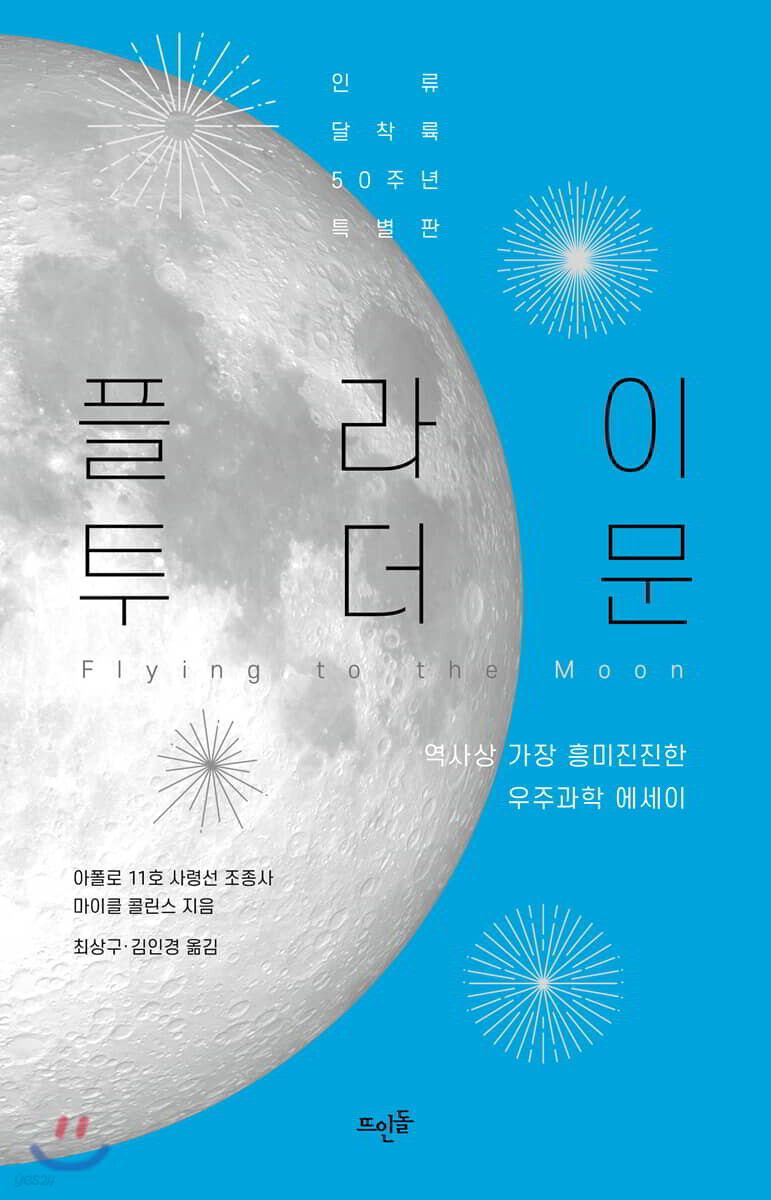
A vivid account of the struggles of those who went to the moon, written firsthand by Apollo 11 Command Module Pilot Michael Collins.
It was published as a revised and expanded special edition to commemorate the 50th anniversary of the first human moon landing.
It features a foreword by astronaut Scott Kelly, the longest-lived continuous spaceflight astronaut, rare photos not readily available through search engines, and newly discovered space science knowledge.
Michael Collins vividly and wittily depicts the long journey from being selected as an astronaut to the feat of landing on the moon, without a moment to be bored.
Although the moon landing took place 50 years ago, readers of this book will be able to share the thrilling experience of being in space with Michael Collins.
It was published as a revised and expanded special edition to commemorate the 50th anniversary of the first human moon landing.
It features a foreword by astronaut Scott Kelly, the longest-lived continuous spaceflight astronaut, rare photos not readily available through search engines, and newly discovered space science knowledge.
Michael Collins vividly and wittily depicts the long journey from being selected as an astronaut to the feat of landing on the moon, without a moment to be bored.
Although the moon landing took place 50 years ago, readers of this book will be able to share the thrilling experience of being in space with Michael Collins.
- You can preview some of the book's contents.
Preview
index
Entry 004
To the Revised Edition - Set sail! 008
July 20, 1969 011
The First Gateway to Your Dream: Pilot School 023
Unpredictable situations as numerous as the stars in the sky 037
Astronaut's Special Outdoor Class 051
14 new astronauts are now on mission 067
If an emergency occurs in space 085
Dreaming of an ecstatic spacewalk 099
First Night in Space 113
Apollo 7, the first manned spacecraft, takes to the skies 143
The countdown to the moon landing begins 159
Humanity's first footprint on the moon—it was just a small beginning. 175
If there were a small village in space 213
235 People You Should Know
To the Revised Edition - Set sail! 008
July 20, 1969 011
The First Gateway to Your Dream: Pilot School 023
Unpredictable situations as numerous as the stars in the sky 037
Astronaut's Special Outdoor Class 051
14 new astronauts are now on mission 067
If an emergency occurs in space 085
Dreaming of an ecstatic spacewalk 099
First Night in Space 113
Apollo 7, the first manned spacecraft, takes to the skies 143
The countdown to the moon landing begins 159
Humanity's first footprint on the moon—it was just a small beginning. 175
If there were a small village in space 213
235 People You Should Know
Detailed image

Into the book
When mankind first set foot on the moon, John F.
It was eight years after President Kennedy announced his plan for a manned lunar mission.
It took me six years to learn everything I needed to know about space travel to become a NASA astronaut.
Moreover, you have to pass the final exam to be able to fly into space, so it is by no means a short period of time.
In the process, I was able to learn some very interesting knowledge, such as how to solve hunger in the jungle and how to get rid of fleas.
--- p.21
The first hurdle to be overcome to be selected as an astronaut was a week-long physical examination.
I spent a week anxious that they might find something wrong somewhere in my body.
There were many things about the test itself that were not pleasant.
They would take about a liter of something similar to blood and put the cold liquid in my ears to make me dizzy.
A series of tests followed, the reasons for which could not even be guessed.
In a test to determine my heart condition, I had to get into a circular device and spin it with my steps.
The slope gradually became steeper.
It was only when my heart rate reached 180 beats per minute that they signaled me to stop.
I also took a questionnaire test to find out my psychological state, and then had a consultation with a psychologist.
There were some weird questions, for example:
“Are you a slacker or a know-it-all? You have to choose one.” I answered that I was a know-it-all, because I never wanted to be a “slacker,” but it was an answer I gave reluctantly.
--- p.33~34
Spaceship pilots use 'flight simulators' to prepare for unexpected emergencies.
The simulator is connected to a computer and is an exact replica of the interior of a spaceship.
Sitting in the simulator's cockpit gives you the exact same experience as piloting a real spaceship.
When the pilot manipulates a dial or changes occur on the spacecraft, the computer recreates the exact same situation as would occur on a real spacecraft.
For example, if an oxygen tank starts leaking, the numbers on the oxygen pressure gauge will start to decrease, giving the astronauts a clue as to what part is wrong.
The instructor, operating the simulator's computer, creates one situation and then presents another problem immediately after until the astronaut has mastered the response.
--- p.96
There are hundreds of little details we need to take care of before we fly.
One of them was to design an emblem symbolizing our flight and to name the spaceship.
NASA didn't care much about the name of the spacecraft.
So, after the Mercury spacecraft, the Gemini spacecraft were simply called by numbers (Gemini 10, etc.), but this time, it was not possible to just call it Apollo 11.
This is because if the command module and the lander were flying separately, it would be impossible to tell them apart by radioing them as Apollo 11.
Apollo 9's command module was called "Gumdrop" and the lander was called "Spider" based on their respective appearances.
We wanted a name that was a little more dignified, but also reflected the significance of our flight.
Rather than depicting the spaceship itself, we wanted the emblem to represent that our moon landing symbolized peace.
The symbol of America is the eagle.
One night I found a picture of an eagle landing on the ground in National Geographic.
The surface of the moon is drawn at the bottom of the picture, and the Earth is drawn small in the background.
But I made one mistake when drawing the Earth.
If the direction of the sun is correct, the shape of the Earth should be A, but the shape of the Earth I drew was B.
No one noticed my mistake and it was used as the official emblem.
--- p.170~171
There wasn't much of a problem other than not knowing exactly where Neil and Buzz were.
When I turned on the lights on the Columbia, I saw that the cockpit had become a rather cozy place.
An even bigger change, of course, was that I was left alone on the spaceship.
But I didn't feel lonely or alienated.
Because I am on a very important mission and I know that without me, Neil and Buzz's safe return to Earth is absolutely impossible.
I had a sense of pride in flying in lunar orbit, waiting for Neil and Buzz's return.
Pride was strong enough to overcome anything, not just loneliness.
The two climbers who are challenging the world's highest moon mountain can do so with peace of mind because they have a base camp called Columbia.
There was one more reason why I didn't feel lonely.
It was my solo flight experience of the past 20 years.
But I had to admit that the moment I flew on the far side of the moon, which is invisible from Earth, was quite different from all my previous flights.
It is a time of literal solitude, cut off from everything in this world.
It was eight years after President Kennedy announced his plan for a manned lunar mission.
It took me six years to learn everything I needed to know about space travel to become a NASA astronaut.
Moreover, you have to pass the final exam to be able to fly into space, so it is by no means a short period of time.
In the process, I was able to learn some very interesting knowledge, such as how to solve hunger in the jungle and how to get rid of fleas.
--- p.21
The first hurdle to be overcome to be selected as an astronaut was a week-long physical examination.
I spent a week anxious that they might find something wrong somewhere in my body.
There were many things about the test itself that were not pleasant.
They would take about a liter of something similar to blood and put the cold liquid in my ears to make me dizzy.
A series of tests followed, the reasons for which could not even be guessed.
In a test to determine my heart condition, I had to get into a circular device and spin it with my steps.
The slope gradually became steeper.
It was only when my heart rate reached 180 beats per minute that they signaled me to stop.
I also took a questionnaire test to find out my psychological state, and then had a consultation with a psychologist.
There were some weird questions, for example:
“Are you a slacker or a know-it-all? You have to choose one.” I answered that I was a know-it-all, because I never wanted to be a “slacker,” but it was an answer I gave reluctantly.
--- p.33~34
Spaceship pilots use 'flight simulators' to prepare for unexpected emergencies.
The simulator is connected to a computer and is an exact replica of the interior of a spaceship.
Sitting in the simulator's cockpit gives you the exact same experience as piloting a real spaceship.
When the pilot manipulates a dial or changes occur on the spacecraft, the computer recreates the exact same situation as would occur on a real spacecraft.
For example, if an oxygen tank starts leaking, the numbers on the oxygen pressure gauge will start to decrease, giving the astronauts a clue as to what part is wrong.
The instructor, operating the simulator's computer, creates one situation and then presents another problem immediately after until the astronaut has mastered the response.
--- p.96
There are hundreds of little details we need to take care of before we fly.
One of them was to design an emblem symbolizing our flight and to name the spaceship.
NASA didn't care much about the name of the spacecraft.
So, after the Mercury spacecraft, the Gemini spacecraft were simply called by numbers (Gemini 10, etc.), but this time, it was not possible to just call it Apollo 11.
This is because if the command module and the lander were flying separately, it would be impossible to tell them apart by radioing them as Apollo 11.
Apollo 9's command module was called "Gumdrop" and the lander was called "Spider" based on their respective appearances.
We wanted a name that was a little more dignified, but also reflected the significance of our flight.
Rather than depicting the spaceship itself, we wanted the emblem to represent that our moon landing symbolized peace.
The symbol of America is the eagle.
One night I found a picture of an eagle landing on the ground in National Geographic.
The surface of the moon is drawn at the bottom of the picture, and the Earth is drawn small in the background.
But I made one mistake when drawing the Earth.
If the direction of the sun is correct, the shape of the Earth should be A, but the shape of the Earth I drew was B.
No one noticed my mistake and it was used as the official emblem.
--- p.170~171
There wasn't much of a problem other than not knowing exactly where Neil and Buzz were.
When I turned on the lights on the Columbia, I saw that the cockpit had become a rather cozy place.
An even bigger change, of course, was that I was left alone on the spaceship.
But I didn't feel lonely or alienated.
Because I am on a very important mission and I know that without me, Neil and Buzz's safe return to Earth is absolutely impossible.
I had a sense of pride in flying in lunar orbit, waiting for Neil and Buzz's return.
Pride was strong enough to overcome anything, not just loneliness.
The two climbers who are challenging the world's highest moon mountain can do so with peace of mind because they have a base camp called Columbia.
There was one more reason why I didn't feel lonely.
It was my solo flight experience of the past 20 years.
But I had to admit that the moment I flew on the far side of the moon, which is invisible from Earth, was quite different from all my previous flights.
It is a time of literal solitude, cut off from everything in this world.
--- p.197
Publisher's Review
Special Edition for the 50th Anniversary of the Moon Landing
Written by Apollo 11 Command Module Pilot Michael Collins himself,
The vivid struggles of those who went to the moon
In 1969, mankind arrived at the unknown world called the moon.
And 50 years have passed in the blink of an eye.
Books and news stories are pouring in highlighting this great achievement.
From the first successful moon landing, all the spotlight was on Neil Armstrong and Buzz Aldrin, who set foot on the moon.
But there was one more person who went to the moon with them.
Apollo 11 Command Module Pilot Michael Collins.
On July 20, 1969, when Neil Armstrong and Buzz Aldrin, aboard the lunar module, took the first human steps on the lunar surface, he remained in the command module, orbiting the moon 97 kilometers above.
He returned to the far side of the moon alone in the command module and observed the moon for 48 minutes while radio contact was lost.
And he left this note:
“Only God and I know this place.”
This book is a collection of space science essays written by Michael Collins, who, although he never set foot on the moon, did his best as a command module pilot and is living the happiest life of the three astronauts.
He vividly captured in one book the life of an astronaut, his own experiences of space flight, and the stories of those who accomplished this feat together.
Astronaut Scott Kelly, who wrote the book's foreword, describes Michael Collins this way:
Neil Armstrong's introverted personality was quite famous.
He sought to avoid media and public attention and rarely appeared in public until his death in 2012.
Buzz Aldrin was a different story, actively seeking opportunities to talk about his experiences in space and the future of spaceflight.
Mike was positioned at the perfect balance between the two.
He was more affable and extroverted than Armstrong, but much more calm and introverted than Aldrin.
Mike never walked on the moon (he certainly had the chance to do so later, but he gave it to someone else), and his picture never appeared on a postage stamp.
But in one of the greatest moments in American history, Mike played a role just as crucial as Neil Armstrong or Buzz Aldrin, and without him piloting the command module, the moon landing would not have been possible.
There are countless books about the moon landing, but none describe space flight as detailed, accurately, and beautifully as this one.
Michael Collins provides a true account of astronaut life, drawing on his own experiences without sugarcoating or embellishing his accomplishments.
At that moment, when all communication was lost, I was completely alone, the only person who could not see the planet from which I was born.
But I wasn't afraid.
Rather, I felt better as I gained confidence and satisfaction.
I saw stars through the window.
Nothing else was visible.
I knew where the moon was, but it was difficult to discern its surface with my eyes in the pitch-black darkness.
Without overthinking it, the dark, starless area seen through the spaceship window was where the moon was.
For that moment, it felt more like I was floating alone on the night sea in a small boat than flying in a spaceship.
There, in the sky, there are stars, and below, there is black darkness.
This book was first published in the United States in 1976, conveying the journey of mankind's moon landing and its meaning to countless readers around the world. It was published as a special revised and expanded edition to commemorate the 50th anniversary of the moon landing.
Featuring a foreword by astronaut Scott Kelly, the longest-lived spaceflighter, and featuring rare, searchable photos, the book actively incorporates newly discovered space science knowledge.
And you can even hear serious suggestions about the future of space science from the Apollo 11 Command Module pilot.
A detailed and witty depiction of the journey from astronaut selection to accomplishment.
Living near an airport and often seeing airplanes flying by, the nine-year-old boy, like most children of that time, imagined becoming a pilot and flying freely across the blue sky.
What sets me apart from other kids is that I achieved my dream.
Michael Collins, who used to play by building and flying model airplanes, became an Air Force pilot.
And he dreams of being an astronaut who can fly a spaceship higher and faster than the pilot.
After countless tests, he is finally selected as an astronaut.
There was a lot to learn and master in order to fly in space.
There were things I had to learn at my desk, but there were also things I had to learn by going around and looking for things.
When I studied geology, all I did was observe rocks in the lab, but I had to go out and see the rock formation process firsthand.
We also had to deal with the possibility of an emergency landing during the return trip.
I learned how to survive in the jungle and how to avoid the scorching sun in the desert.
I discovered the taste of iguana, which I had only thought of as disgusting, and even made clothes out of parachutes.
In this way, Michael Collins vividly tells the story of the six years of intense study and research to become an astronaut, and the story of passing the final exam.
In addition, the discomfort of having to wear a hot and stuffy spacesuit, the contagious nature of airsickness, the incident where an astronaut failed to escape from a jet plane and crashed, the memory of having to press buttons as many as 850 times a day, and the crash in space, etc., various stories that appear during the training process as an astronaut and the journey to achieve the feat of Apollo 11 lead readers into the exciting world of space.
Embracing the unfamiliarity of space science with the familiarity of essay writing.
The ignition process of a launch vehicle, methods for measuring the distance between planets, rendezvous and docking of spacecraft, the history of space exploration…
Michael Collins naturally explains difficult and rigid space science knowledge by incorporating it into his own experiences, such as the first night in space, the view of the 'new Earth' from space, and the 90-minute experience of traveling around the world from space.
The universe, which had seemed unfamiliar, now appears vivid and interesting, like a painting.
Dr. Jaeseung Jeong praised this book as the most beautiful essay on space science.
“What makes this book so beautiful is that it captures all the time he spent trying to leave Earth and experience space, and all the moments he saw and felt in space.” Michael Collins may not have set foot on the moon, but he has spent his entire life preparing for that great step.
And he did his best in his role as command module pilot to help the other two astronauts accomplish the task of landing on the moon.
This book contains the entire process of those struggles, without any exaggeration.
Written by Apollo 11 Command Module Pilot Michael Collins himself,
The vivid struggles of those who went to the moon
In 1969, mankind arrived at the unknown world called the moon.
And 50 years have passed in the blink of an eye.
Books and news stories are pouring in highlighting this great achievement.
From the first successful moon landing, all the spotlight was on Neil Armstrong and Buzz Aldrin, who set foot on the moon.
But there was one more person who went to the moon with them.
Apollo 11 Command Module Pilot Michael Collins.
On July 20, 1969, when Neil Armstrong and Buzz Aldrin, aboard the lunar module, took the first human steps on the lunar surface, he remained in the command module, orbiting the moon 97 kilometers above.
He returned to the far side of the moon alone in the command module and observed the moon for 48 minutes while radio contact was lost.
And he left this note:
“Only God and I know this place.”
This book is a collection of space science essays written by Michael Collins, who, although he never set foot on the moon, did his best as a command module pilot and is living the happiest life of the three astronauts.
He vividly captured in one book the life of an astronaut, his own experiences of space flight, and the stories of those who accomplished this feat together.
Astronaut Scott Kelly, who wrote the book's foreword, describes Michael Collins this way:
Neil Armstrong's introverted personality was quite famous.
He sought to avoid media and public attention and rarely appeared in public until his death in 2012.
Buzz Aldrin was a different story, actively seeking opportunities to talk about his experiences in space and the future of spaceflight.
Mike was positioned at the perfect balance between the two.
He was more affable and extroverted than Armstrong, but much more calm and introverted than Aldrin.
Mike never walked on the moon (he certainly had the chance to do so later, but he gave it to someone else), and his picture never appeared on a postage stamp.
But in one of the greatest moments in American history, Mike played a role just as crucial as Neil Armstrong or Buzz Aldrin, and without him piloting the command module, the moon landing would not have been possible.
There are countless books about the moon landing, but none describe space flight as detailed, accurately, and beautifully as this one.
Michael Collins provides a true account of astronaut life, drawing on his own experiences without sugarcoating or embellishing his accomplishments.
At that moment, when all communication was lost, I was completely alone, the only person who could not see the planet from which I was born.
But I wasn't afraid.
Rather, I felt better as I gained confidence and satisfaction.
I saw stars through the window.
Nothing else was visible.
I knew where the moon was, but it was difficult to discern its surface with my eyes in the pitch-black darkness.
Without overthinking it, the dark, starless area seen through the spaceship window was where the moon was.
For that moment, it felt more like I was floating alone on the night sea in a small boat than flying in a spaceship.
There, in the sky, there are stars, and below, there is black darkness.
This book was first published in the United States in 1976, conveying the journey of mankind's moon landing and its meaning to countless readers around the world. It was published as a special revised and expanded edition to commemorate the 50th anniversary of the moon landing.
Featuring a foreword by astronaut Scott Kelly, the longest-lived spaceflighter, and featuring rare, searchable photos, the book actively incorporates newly discovered space science knowledge.
And you can even hear serious suggestions about the future of space science from the Apollo 11 Command Module pilot.
A detailed and witty depiction of the journey from astronaut selection to accomplishment.
Living near an airport and often seeing airplanes flying by, the nine-year-old boy, like most children of that time, imagined becoming a pilot and flying freely across the blue sky.
What sets me apart from other kids is that I achieved my dream.
Michael Collins, who used to play by building and flying model airplanes, became an Air Force pilot.
And he dreams of being an astronaut who can fly a spaceship higher and faster than the pilot.
After countless tests, he is finally selected as an astronaut.
There was a lot to learn and master in order to fly in space.
There were things I had to learn at my desk, but there were also things I had to learn by going around and looking for things.
When I studied geology, all I did was observe rocks in the lab, but I had to go out and see the rock formation process firsthand.
We also had to deal with the possibility of an emergency landing during the return trip.
I learned how to survive in the jungle and how to avoid the scorching sun in the desert.
I discovered the taste of iguana, which I had only thought of as disgusting, and even made clothes out of parachutes.
In this way, Michael Collins vividly tells the story of the six years of intense study and research to become an astronaut, and the story of passing the final exam.
In addition, the discomfort of having to wear a hot and stuffy spacesuit, the contagious nature of airsickness, the incident where an astronaut failed to escape from a jet plane and crashed, the memory of having to press buttons as many as 850 times a day, and the crash in space, etc., various stories that appear during the training process as an astronaut and the journey to achieve the feat of Apollo 11 lead readers into the exciting world of space.
Embracing the unfamiliarity of space science with the familiarity of essay writing.
The ignition process of a launch vehicle, methods for measuring the distance between planets, rendezvous and docking of spacecraft, the history of space exploration…
Michael Collins naturally explains difficult and rigid space science knowledge by incorporating it into his own experiences, such as the first night in space, the view of the 'new Earth' from space, and the 90-minute experience of traveling around the world from space.
The universe, which had seemed unfamiliar, now appears vivid and interesting, like a painting.
Dr. Jaeseung Jeong praised this book as the most beautiful essay on space science.
“What makes this book so beautiful is that it captures all the time he spent trying to leave Earth and experience space, and all the moments he saw and felt in space.” Michael Collins may not have set foot on the moon, but he has spent his entire life preparing for that great step.
And he did his best in his role as command module pilot to help the other two astronauts accomplish the task of landing on the moon.
This book contains the entire process of those struggles, without any exaggeration.
GOODS SPECIFICS
- Date of issue: July 31, 2019
- Page count, weight, size: 264 pages | 464g | 135*210*20mm
- ISBN13: 9788958077220
- ISBN10: 8958077220
You may also like
카테고리
korean


korean

![GQ KOREA Mark (Monthly): December [2025]](http://librairie.coreenne.fr/cdn/shop/files/8ef265dbbfbf186523ed75ba7319009d.jpg?v=1765340328&width=3840)


