

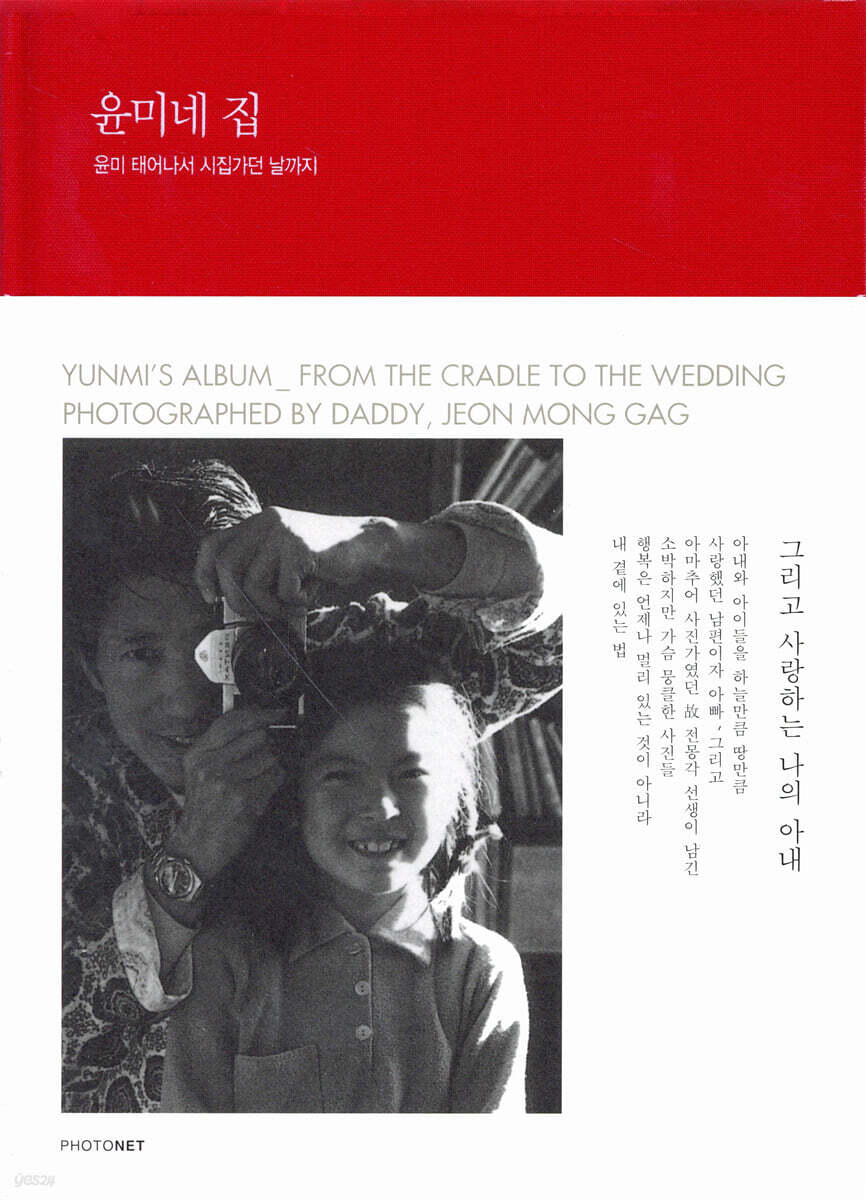
Yoonmi's house
 |
Description
Book Introduction
Photo collection of the late Jeon Mong-gak
Photo books by amateurs, not professionals, have their own charm.
"Yunmi's House" is a photo book that contains photos taken as a hobby by the author, who worked as a civil engineer, built the Gyeongbu Expressway, and worked as a university professor.
As the subtitle, ‘From the birth of Yunmi to the day she got married,’ suggests, the photo album contains the growth of the eldest daughter, Yunmi.
『Yunmi's House』, written by the author as a photographer and a commoner, and filled with her love for her family, is being republished 20 years after its first publication in 1990.
This book includes not only the photos that were included in the first edition, but also the photos and manuscript of 'My Wife' that author Jeon Mong-gak organized before he passed away.
The author's last wish was said to be to collect photos of his beloved wife and publish them in a photo book.
The photographs created as part of that work are included with the author's text.
In modern society, where family ties are diminishing day by day, this photo album, filled with love for family, will resonate deeply with society.
Photo books by amateurs, not professionals, have their own charm.
"Yunmi's House" is a photo book that contains photos taken as a hobby by the author, who worked as a civil engineer, built the Gyeongbu Expressway, and worked as a university professor.
As the subtitle, ‘From the birth of Yunmi to the day she got married,’ suggests, the photo album contains the growth of the eldest daughter, Yunmi.
『Yunmi's House』, written by the author as a photographer and a commoner, and filled with her love for her family, is being republished 20 years after its first publication in 1990.
This book includes not only the photos that were included in the first edition, but also the photos and manuscript of 'My Wife' that author Jeon Mong-gak organized before he passed away.
The author's last wish was said to be to collect photos of his beloved wife and publish them in a photo book.
The photographs created as part of that work are included with the author's text.
In modern society, where family ties are diminishing day by day, this photo album, filled with love for family, will resonate deeply with society.
- You can preview some of the book's contents.
Preview
Publisher's Review
“I, who was always being nagged by people around me for not being able to get married, have now become a proud father of one daughter and two sons.
After giving birth to the children, I raised them with the natural human emotions by holding them, carrying them, rolling them around, rubbing them, and if that wasn't enough, tickling them, pinching them, and biting them.
When I was in the study room, the whole house was filled with the sound of children's laughter.
Drawn by that sound, I would often secretly run to the children and roll around with them.
It really looked like a house where people lived.
I was thinking that I should leave this kind of atmosphere of people living here as a small biography for our future.
So whenever I came home, the camera was always by my side.” - From the book
The late Jeon Mong-gak's (passed away in 2006) work, "Yunmi's House," shows what true amateurism is.
The perseverance of amateur photographer Jeon Mong-gak, who captured the lives of his daughters for 26 years (from 1964 to 1989) from birth until they were married, is beyond respect.
Not only is there persistence, but 『Yoonmi's House』 is also filled with the warm gaze of teacher Jeon Mong-gak, who watches over the growth of his eldest daughter, Yoonmi.
The subtitle is 'From the day Yoonmi was born to the day she got married.'
Neither the outstanding composition, the brilliant ideas, nor the clear picture quality can surpass the heartbreaking fatherly love.
"Yunmi's House" teaches us that the most important thing in photography is the warmth (including persistence) of the photographer looking at the subject through the lens.
The first edition of "Yunmi's House" was published in 1990 with a print run of approximately 1,000 copies, edited by photographer Joo Myeong-deok.
This photo book, published for the 'Yoonmi's House' photo exhibition, was not easily available in bookstores.
However, 『Yunmi's House』 has been on people's lips for a long time.
Many people searched through used bookstores to find a copy of “Yunmi’s House” and left messages on photography club bulletin boards asking, “I really want to get a copy of ‘Yunmi’s House.’”
In an age overflowing with sophisticated and glamorous images, this photo book, which tells the story of a father who achieved his dream of capturing his daughter's life from birth until she got married and publishing it in a photo book, is proof that many people recognized the value of the book.
"Yunmi's House" is a photo collection that deserves to be re-evaluated for its depiction of middle-class life from the mid-1960s to the late 1980s, a period when the scars of the Korean War had not yet fully healed.
With each turn of the page, you can observe not only the children growing up, but also the transformation of Seoul.
The photos showing the gradual improvement of life in 'Yunmi's House', which started in a single room, are a valuable 'record' of modern Korean history.
Seonwoo Jung-ho, the president of Gwangju Institute of Science and Technology, who was close to Professor Jeon Mong-gak, said, “In this sense, ‘Yunmi’s House’ has historicity.
It shows what processes our society went through in the 1960s, how the middle class was structured, and how the lives of this middle class changed.
“It is a story of an ordinary family, but it is also a very valuable photo collection as a historical record,” he said.
『Yunmi's House』, which is being republished after 20 years, includes not only the photos from the first edition, but also the photos and manuscript of 'My Wife' that Jeon Mong-gak had organized before he passed away.
Mr. Jeon Mong-gak's last wish was to collect the photos of his beloved wife and make them into a photo album.
The photos of 'My Wife', meticulously organized in five files, were created in a darkroom even when he was unable to control his body due to pancreatic cancer.
Some of them are included along with the writings that Jeon Mong-gak left for his wife.
"Yunmi's House" is a simple yet precious photo album that allows us to reflect on the meaning of happiness and photography in an age where life is becoming increasingly harsh and we only pursue flashy images.
The photographic history of the late Jeon Mong-gak, a man who loved photography
It is surprising that a book of which only about 1,000 copies were produced, and which was only sold in Korea, has quietly continued to live on through word of mouth for 20 years.
A mid-career photographer cited "Yunmi's House" as the most valuable textbook in his classes.
The life of a young man who meets the love of his life, builds a simple family, has children, marries them off, welcomes grandchildren, and finally leaves his loved ones behind to end his life is beautifully captured in "Yunmi's House."
Even though they share rice in a dented pot, sleep sideways in a small room, and occasionally show a weary expression, there is always a happy atmosphere in 『Yunmi's House』.
Jeon Mong-gak was born in Yongchon, North Pyongan Province in 1931.
He has always had a camera in his hand since he bought one with a scholarship he received in his senior year of college.
I met many great photography friends while discussing and shooting with people who love photography overseas.
The Modern Photography Research Association he was a member of was the birthplace of modern Korean photography. This group was founded in 1955 by Lee Hae-moon, Lee Hyeong-rok, Jeong Beom-tae, Son Gyu-moon, Han Yeong-su, and Ahn Jong-chil, and was dissolved after three exhibitions, and was born in 1960 along with Salon Arus.
Shinsunhoe, which advocated a new perspective, was a pioneering photography group that, based on realism, believed that writers could tell stories through the recording of facts, broke away from the mainstream practice of creating beautiful images and brought cameras into everyday life.
In addition to Jeon Mong-gak, veteran photographers who have led modern Korean photography to this day, such as Park Young-sook, Joo Myeong-deok, and Hwang Gyu-tae, as well as prominent photojournalists who worked on the desks of daily newspapers, such as Jo Cheon-yong, have all passed through the Modern Photography Research Association.
In 1957, when he was deeply immersed in photography, the Gyeongbokgung Museum of Art held the exhibition 'The Family of Man'.
This exhibition, which was first planned by American photographer Edward Steichen and presented at the Museum of Modern Art in New York in 1955, was a large-scale exhibition comprised of over 500 photographs by 273 photographers, and moved many people by appealing to the universality that all humans are one family, regardless of their appearance or environment.
After the Korean War, more than 100,000 people flocked to this exhibition in Seoul, a city with a population of less than 2 million.
In the 1960s in Korea, when there was an absolute lack of materials for researching works, pictorial magazines such as Look and Life, which had opened the era of visual culture after World War II, were excellent teaching materials for photographers. In the West, which had industrialized before us, interest in the changes in the 'family' in the 1960s and 1970s deepened, and many magazines addressed this topic.
Several impressive single volumes have also been published, such as 'Family, Ridge press book, 1965' (a collection of work by anthropologist Margaret Mead and photographer Ken Heyman).
It can be inferred that the awareness of the importance of recording reality gained while participating in the Modern Photography Research Association, the recognition of the power of photography through the Human Family Exhibition, and the shared value of family themes gained while encountering Western pictorial magazines served as the foundation for the young Jeon Mong-gak, who was just starting to build a family, to later compile “Yunmi’s House.”
Even while building the Gyeongbu Expressway as a civil engineer and nurturing students as a university professor, he never put down his camera.
I believe that 『Yunmi's House』, which he published with his love for his family as a photographer while living as a commoner, will be a valuable guide to how an amateur photographer can make a big impact on society.
After giving birth to the children, I raised them with the natural human emotions by holding them, carrying them, rolling them around, rubbing them, and if that wasn't enough, tickling them, pinching them, and biting them.
When I was in the study room, the whole house was filled with the sound of children's laughter.
Drawn by that sound, I would often secretly run to the children and roll around with them.
It really looked like a house where people lived.
I was thinking that I should leave this kind of atmosphere of people living here as a small biography for our future.
So whenever I came home, the camera was always by my side.” - From the book
The late Jeon Mong-gak's (passed away in 2006) work, "Yunmi's House," shows what true amateurism is.
The perseverance of amateur photographer Jeon Mong-gak, who captured the lives of his daughters for 26 years (from 1964 to 1989) from birth until they were married, is beyond respect.
Not only is there persistence, but 『Yoonmi's House』 is also filled with the warm gaze of teacher Jeon Mong-gak, who watches over the growth of his eldest daughter, Yoonmi.
The subtitle is 'From the day Yoonmi was born to the day she got married.'
Neither the outstanding composition, the brilliant ideas, nor the clear picture quality can surpass the heartbreaking fatherly love.
"Yunmi's House" teaches us that the most important thing in photography is the warmth (including persistence) of the photographer looking at the subject through the lens.
The first edition of "Yunmi's House" was published in 1990 with a print run of approximately 1,000 copies, edited by photographer Joo Myeong-deok.
This photo book, published for the 'Yoonmi's House' photo exhibition, was not easily available in bookstores.
However, 『Yunmi's House』 has been on people's lips for a long time.
Many people searched through used bookstores to find a copy of “Yunmi’s House” and left messages on photography club bulletin boards asking, “I really want to get a copy of ‘Yunmi’s House.’”
In an age overflowing with sophisticated and glamorous images, this photo book, which tells the story of a father who achieved his dream of capturing his daughter's life from birth until she got married and publishing it in a photo book, is proof that many people recognized the value of the book.
"Yunmi's House" is a photo collection that deserves to be re-evaluated for its depiction of middle-class life from the mid-1960s to the late 1980s, a period when the scars of the Korean War had not yet fully healed.
With each turn of the page, you can observe not only the children growing up, but also the transformation of Seoul.
The photos showing the gradual improvement of life in 'Yunmi's House', which started in a single room, are a valuable 'record' of modern Korean history.
Seonwoo Jung-ho, the president of Gwangju Institute of Science and Technology, who was close to Professor Jeon Mong-gak, said, “In this sense, ‘Yunmi’s House’ has historicity.
It shows what processes our society went through in the 1960s, how the middle class was structured, and how the lives of this middle class changed.
“It is a story of an ordinary family, but it is also a very valuable photo collection as a historical record,” he said.
『Yunmi's House』, which is being republished after 20 years, includes not only the photos from the first edition, but also the photos and manuscript of 'My Wife' that Jeon Mong-gak had organized before he passed away.
Mr. Jeon Mong-gak's last wish was to collect the photos of his beloved wife and make them into a photo album.
The photos of 'My Wife', meticulously organized in five files, were created in a darkroom even when he was unable to control his body due to pancreatic cancer.
Some of them are included along with the writings that Jeon Mong-gak left for his wife.
"Yunmi's House" is a simple yet precious photo album that allows us to reflect on the meaning of happiness and photography in an age where life is becoming increasingly harsh and we only pursue flashy images.
The photographic history of the late Jeon Mong-gak, a man who loved photography
It is surprising that a book of which only about 1,000 copies were produced, and which was only sold in Korea, has quietly continued to live on through word of mouth for 20 years.
A mid-career photographer cited "Yunmi's House" as the most valuable textbook in his classes.
The life of a young man who meets the love of his life, builds a simple family, has children, marries them off, welcomes grandchildren, and finally leaves his loved ones behind to end his life is beautifully captured in "Yunmi's House."
Even though they share rice in a dented pot, sleep sideways in a small room, and occasionally show a weary expression, there is always a happy atmosphere in 『Yunmi's House』.
Jeon Mong-gak was born in Yongchon, North Pyongan Province in 1931.
He has always had a camera in his hand since he bought one with a scholarship he received in his senior year of college.
I met many great photography friends while discussing and shooting with people who love photography overseas.
The Modern Photography Research Association he was a member of was the birthplace of modern Korean photography. This group was founded in 1955 by Lee Hae-moon, Lee Hyeong-rok, Jeong Beom-tae, Son Gyu-moon, Han Yeong-su, and Ahn Jong-chil, and was dissolved after three exhibitions, and was born in 1960 along with Salon Arus.
Shinsunhoe, which advocated a new perspective, was a pioneering photography group that, based on realism, believed that writers could tell stories through the recording of facts, broke away from the mainstream practice of creating beautiful images and brought cameras into everyday life.
In addition to Jeon Mong-gak, veteran photographers who have led modern Korean photography to this day, such as Park Young-sook, Joo Myeong-deok, and Hwang Gyu-tae, as well as prominent photojournalists who worked on the desks of daily newspapers, such as Jo Cheon-yong, have all passed through the Modern Photography Research Association.
In 1957, when he was deeply immersed in photography, the Gyeongbokgung Museum of Art held the exhibition 'The Family of Man'.
This exhibition, which was first planned by American photographer Edward Steichen and presented at the Museum of Modern Art in New York in 1955, was a large-scale exhibition comprised of over 500 photographs by 273 photographers, and moved many people by appealing to the universality that all humans are one family, regardless of their appearance or environment.
After the Korean War, more than 100,000 people flocked to this exhibition in Seoul, a city with a population of less than 2 million.
In the 1960s in Korea, when there was an absolute lack of materials for researching works, pictorial magazines such as Look and Life, which had opened the era of visual culture after World War II, were excellent teaching materials for photographers. In the West, which had industrialized before us, interest in the changes in the 'family' in the 1960s and 1970s deepened, and many magazines addressed this topic.
Several impressive single volumes have also been published, such as 'Family, Ridge press book, 1965' (a collection of work by anthropologist Margaret Mead and photographer Ken Heyman).
It can be inferred that the awareness of the importance of recording reality gained while participating in the Modern Photography Research Association, the recognition of the power of photography through the Human Family Exhibition, and the shared value of family themes gained while encountering Western pictorial magazines served as the foundation for the young Jeon Mong-gak, who was just starting to build a family, to later compile “Yunmi’s House.”
Even while building the Gyeongbu Expressway as a civil engineer and nurturing students as a university professor, he never put down his camera.
I believe that 『Yunmi's House』, which he published with his love for his family as a photographer while living as a commoner, will be a valuable guide to how an amateur photographer can make a big impact on society.
GOODS SPECIFICS
- Date of issue: January 1, 2010
- Page count, weight, size: 208 pages | 992g | 188*254*20mm
- ISBN13: 9788993818086
- ISBN10: 8993818088
You may also like
카테고리
korean


korean

![GQ KOREA Mark (Monthly): December [2025]](http://librairie.coreenne.fr/cdn/shop/files/8ef265dbbfbf186523ed75ba7319009d.jpg?v=1765340328&width=3840)


