

Isaac Newton's Optics
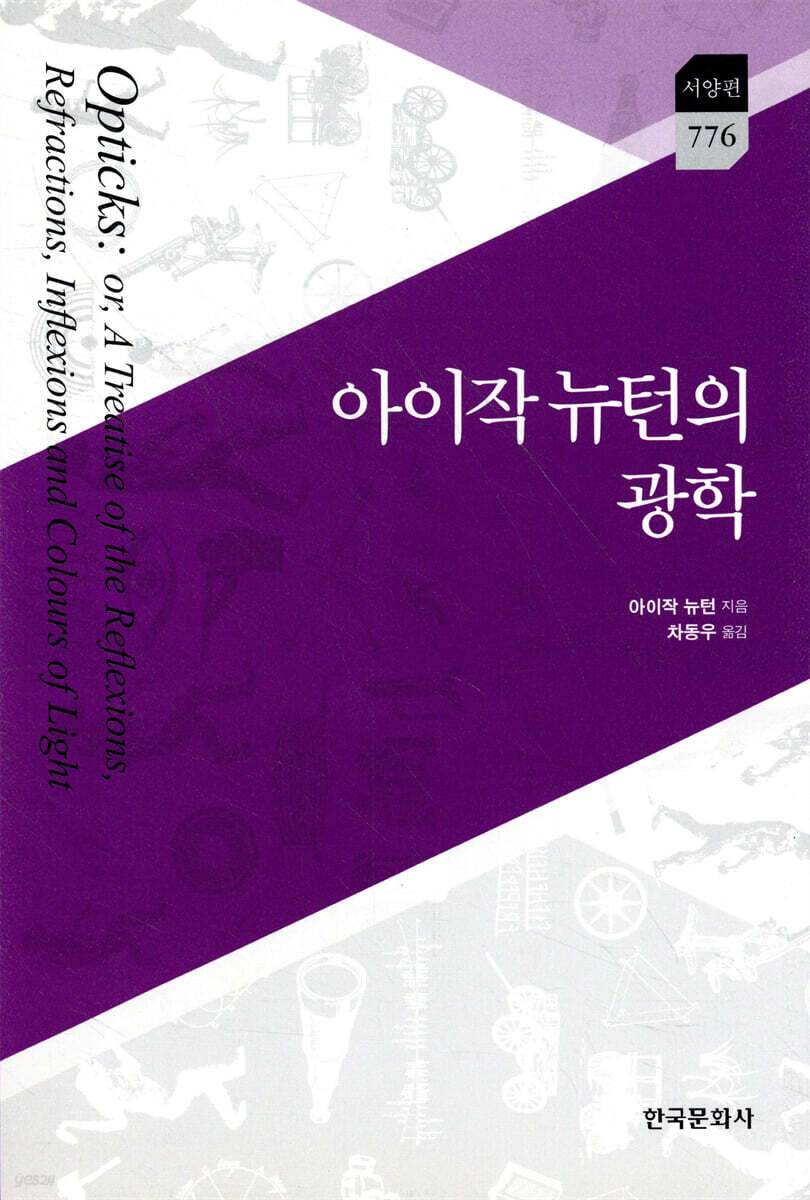 |
Description
Book Introduction
In Opticks, Newton argued that light is a particle.
However, after Thomas Young of England proved in 1803 that light is a wave, the claim that light is a particle lost its ground.
So, Newton's first book, Principia, was considered a must-read for scientists, but even until the late 19th century, Newton's Opticks was considered a book of interest only to historians of science.
However, ironically, as soon as the 20th century began, Newton's theory of gravity in the Principia was proven to be incorrect by Einstein's theory of general relativity, while the claim that light is a particle in the Opticks was proven to be correct by Einstein as well.
Einstein solved the photoelectric effect problem by using Planck's light quantum hypothesis, which was known at the time, assuming that the energy of light is proportional to the frequency of light. This was the same as saying that light is a particle rather than a wave, as in Opticks.
But surprisingly, 200 years earlier, in Opticks, Newton's argument that light is a particle was based on the fact that the angle at which light is refracted in a prism differs depending on its color, and the color of light represents the frequency of its vibration.
However, after Thomas Young of England proved in 1803 that light is a wave, the claim that light is a particle lost its ground.
So, Newton's first book, Principia, was considered a must-read for scientists, but even until the late 19th century, Newton's Opticks was considered a book of interest only to historians of science.
However, ironically, as soon as the 20th century began, Newton's theory of gravity in the Principia was proven to be incorrect by Einstein's theory of general relativity, while the claim that light is a particle in the Opticks was proven to be correct by Einstein as well.
Einstein solved the photoelectric effect problem by using Planck's light quantum hypothesis, which was known at the time, assuming that the energy of light is proportional to the frequency of light. This was the same as saying that light is a particle rather than a wave, as in Opticks.
But surprisingly, 200 years earlier, in Opticks, Newton's argument that light is a particle was based on the fact that the angle at which light is refracted in a prism differs depending on its color, and the color of light represents the frequency of its vibration.
- You can preview some of the book's contents.
Preview
index
Translator's Note
Isaac Newton's Preface 1
Isaac Newton's Preface 2
Preface to the Fourth Edition
Volume 1
Part 1
Part 2
Volume 2
Part 1
Part 2
Part 3
Part 4
Volume 3
Part 1
Americas
Isaac Newton's Preface 1
Isaac Newton's Preface 2
Preface to the Fourth Edition
Volume 1
Part 1
Part 2
Volume 2
Part 1
Part 2
Part 3
Part 4
Volume 3
Part 1
Americas
Publisher's Review
Sir Isaac Newton, the original author of this book, was one of the greatest scientists in human history. He was born in 1642 to a wealthy yeomanry family in the village of Woolsthorpe, Lincolnshire, England.
Newton was educated at schools in Lincolnshire, entered Cambridge University in 1661, and graduated in 1665. In 1667, he was appointed a fellow of Cambridge University, and in 1669, he was appointed Lucasian Professor of Mathematics, succeeding Isaac Barrow, a professor of mathematics who had recognized Newton's abilities since his university days.
Afterwards, Newton served as a professor at Cambridge University for 27 years until 1696.
Newton recalled that the two years he spent in his hometown of Lincolnshire, from 1665 to 1666, after graduating from Cambridge University, during the Black Death outbreak in London, were 'the peak of my intuition, and I devoted myself more to mathematics and philosophy than at any time since.'
During this period, Newton practically completed most of the material contained in his masterpiece, Principia Mathematicala, but it was not published until 1687.
Newton was appointed Master of the Mint in 1696, moving from Cambridge to London, and three years later he was appointed Master of the Mint again, a position he held until his death in 1727.
He also served as a Fellow of the Royal Society from 1671, was elected President of the Society in 1703, and was re-elected every year until his death.
In 1704, the year after he was elected President of the Royal Society, he published Opticks, another of his two most important works, along with the Principia, and the following year, in 1705, he was knighted by Queen Anne of England at Cambridge, the first honor ever given to a scientist in Britain.
The physics proposed by Newton began to be recognized not only in England but throughout Europe even during his lifetime, and Newton became the most respected natural philosopher in Europe.
Some historians have argued that the scientific community lost one of its most important figures when Newton switched careers from scholar to government official, but in fact Newton himself was not averse to being treated as a celebrity in London society rather than in the university community.
He enjoyed conversing with the high-ranking officials who continually requested interviews, and in his spare time he supervised the publication of revised editions of his two works, the Principia and Optics.
In addition, Newton devoted all his efforts to reforming the British monetary system, and faithfully carried out his duties as Master of the Mint and Commissioner of the Royal Mint.
Newton also spent his later years receiving unprecedented public acclaim, which continued until his death at the age of 85.
Newton never married and lived frugally throughout his life, but when he died in 1727, his funeral was more magnificent and solemn than anyone else's.
His body was carried by the Lord President, two dukes and three earls, and laid to rest in Westminster Abbey, where a monument to him was erected.
While a student at Cambridge, Newton became interested in the nature of light.
And after reading a paper on the diffraction of light by the Italian priest and physicist Grimaldi, which states that light passing through a small hole travels in a cone, he bought his first prism and began conducting elaborate experiments on light.
At that time, the French philosopher Descartes claimed that light was a wave and that the diffraction of light discovered by Grimaldi was proof that light was a wave, but Newton wanted to refute that.
Newton thought that the diffraction observed by Grimaldi was simply a new aspect of refraction.
Scholars who defended the claim that light is a wave at the time explained that white light changes into a spectrum of various colors when passed through a prism because the light becomes impure as it passes through the prism.
This meant that the more light passed through the glass, the more impure it became.
To refute such claims, Newton passed white light through a prism, splitting the spectrum into several colors, and then passed it through another prism turned upside down, observing that white light emerged again as a result.
This showed that the splitting of light into different colors through a prism is absolutely not because the glass impures the light.
Since all scholars at the time believed that light was clearly either a particle or a wave, Newton used an experiment that failed to prove that light was a wave to prove that light was a particle.
After a series of elaborate experiments, Newton concluded that light was made up of particles of different colors, and that when these all combined, the light appeared white.
Newton showed that light refracts at different angles for each color in a prism.
He also knew that when illuminated by light of one color, all objects appear to be the same color, and that light of one color retains its color no matter how many times it is reflected or refracted.
So he concluded that color is not a property of an object, but a property of the light reflected from the object.
Newton was extremely introverted and was usually reluctant to publish his research results, but in 1672, the year after he became a fellow of the Royal Society, he presented a paper to the Royal Society arguing that light was a particle.
However, Newton's claim that light is a particle faced many objections.
Hooke, also a fellow of the Royal Society, repeated Grimaldi's diffraction experiment and argued that the experiment could only be explained if light were a wave rather than a particle.
Many scholars sympathized with Hooke, and some who attempted to repeat Newton's prism experiment reported that they could not obtain the same results as Newton.
Such doubts were further amplified by the fact that Newton did not disclose the details of his experiments, such as the dimensions of the prism, the material it was made of, or how it was conducted.
Newton did not participate in any debate about the nature of light for nearly 30 years after Hooke's refutation.
However, in 1704, a year after the death of his strongest opponent, Hooke, and the year he was elected President of the Royal Society, he refined his theory of light and published it in a book titled Opticks.
Earlier in the book, Newton described in detail how he performed his prism experiment.
So after this book was published, many other scholars were able to obtain the same results as Newton in experiments on light using prisms.
Newton also showed that the interference and diffraction of light, which Huygens had explained with his wave theory, could be explained equally well with his particle theory.
After the publication of Opticks, Newton's theory of light gained wider acceptance, but some scholars remained unconvinced.
Physics is a field that deals with the fundamental laws of natural phenomena, and those fundamental laws are the famous Newton's laws of motion, known as F=ma.
Newton's laws of motion were announced quite dramatically in 1687 in the Principia.
At the time, people were very curious about why Kepler's three laws of planetary motion, published in the early 17th century, were valid.
At that time, people believed that all the stars belonging to the heavenly world where gods live revolved around the Earth in perfect circles.
But I could never understand why Kepler's laws, which state that planets revolve not around the Earth but around the Sun, and that they do so in elliptical orbits rather than circular ones, hold true.
In the Principia, Newton proposed the law of universal gravitation, which states that the sun attracts the planets, along with the laws of motion. By substituting the force calculated according to that law into the force F in F=ma and solving the equation, he was able to perfectly explain why all three of Kepler's laws of planetary motion hold true.
And soon it became known that Newton's laws of motion were the fundamental laws of nature, explaining not only the movement of planets but also the movement of all objects that make up nature.
Thus, people came to believe that they had discovered the correct and ultimate truth about nature, and Newton's first book, Principia, came to be recognized as the most important book in human history.
However, the fate of Newton's second book, Optics, which he revised repeatedly until just before his death, was different from that of Principia.
In 1672, Newton published a paper arguing that light was a particle, but soon became embroiled in a heated debate with opponents, including Hooke, who argued that light was a wave.
Newton was a man who could not stand being drawn into such controversy, and for thirty years after the initial controversy, he did not intervene at all in the discussion about the nature of light.
However, in 1704, the year after Hooke's death in 1703, Newton published Opticks.
『Optics』 contained detailed accounts of the experiments he had conducted over several decades, and detailed explanations of the properties of light, such as reflection, refraction, diffraction, and color, obtained through these experiments.
In this book, Newton presented evidence that light is a particle and explained various properties of light from the perspective of light being a particle.
Although several scholars, such as Hooke and Huygens, continued to argue that light was a wave, the idea that light was a particle gained some traction in the 18th century, mainly in England, thanks to Newton's authority as a scientist.
However, in 1803, after British scholar Thomas Young demonstrated that light is a wave by showing an interference pattern created by sunlight passing through a gap between thin cards placed closely together, the claim that light is a particle lost its ground.
And for over a century thereafter, while no one disputed the brilliance of much of Newton's Opticks, people believed that Newton had argued for a particle theory of light, which, unfortunately, was never correct.
So, Newton's Principia was always considered a must-read for every scientist, but even until the late 19th century, Newton's Opticks was considered a book of interest only to historians of science.
However, ironically, as soon as the 20th century began, Newton's theory of gravity in the Principia was proven to be wrong by Einstein's theory of general relativity, and on the other hand, the claim that light is a particle in the Opticks was proven to be correct by Einstein, who also explained how the photoelectric effect occurs.
Einstein solved the photoelectric effect problem by using Planck's light quantum hypothesis, which was known at the time, assuming that the energy of light is proportional to the frequency of light, which was the same as saying that light is a particle rather than a wave.
But surprisingly, 200 years before that, Newton's argument that light is a particle was based on the fact that the angle at which light is refracted in a prism differs depending on its color, and the color of light represents the frequency of its vibration.
Newton's Principia is written in Latin in a rigid manner, as if it were a mathematical proof, but Newton's Opticks is written in plain English in a friendly manner.
Newton published the first edition of Opticks in 1704 and continued to refine it, resulting in a revised edition in 1717, a third edition in 1721, and a final fourth edition in 1730, which included revisions made by Newton just before his death in 1727.
And then, after being forgotten for 200 years, in 1931, the fourth and final revised edition was reprinted by the American publisher Bell and Sons, which included a preface by Einstein.
In his preface, Einstein wrote that anyone who has the time and leisure to read Newton's Opticks will be able to vividly experience the wondrous events that the great Newton experienced in his youth, and that for Newton, nature was like an open book, and he could read that book, and therefore nature, without any difficulty.
Einstein also recommended that readers read Newton's Opticks, saying that in this book Newton acts as if he were an experimenter, a theorist, a technician, and an artist all in one.
Newton was educated at schools in Lincolnshire, entered Cambridge University in 1661, and graduated in 1665. In 1667, he was appointed a fellow of Cambridge University, and in 1669, he was appointed Lucasian Professor of Mathematics, succeeding Isaac Barrow, a professor of mathematics who had recognized Newton's abilities since his university days.
Afterwards, Newton served as a professor at Cambridge University for 27 years until 1696.
Newton recalled that the two years he spent in his hometown of Lincolnshire, from 1665 to 1666, after graduating from Cambridge University, during the Black Death outbreak in London, were 'the peak of my intuition, and I devoted myself more to mathematics and philosophy than at any time since.'
During this period, Newton practically completed most of the material contained in his masterpiece, Principia Mathematicala, but it was not published until 1687.
Newton was appointed Master of the Mint in 1696, moving from Cambridge to London, and three years later he was appointed Master of the Mint again, a position he held until his death in 1727.
He also served as a Fellow of the Royal Society from 1671, was elected President of the Society in 1703, and was re-elected every year until his death.
In 1704, the year after he was elected President of the Royal Society, he published Opticks, another of his two most important works, along with the Principia, and the following year, in 1705, he was knighted by Queen Anne of England at Cambridge, the first honor ever given to a scientist in Britain.
The physics proposed by Newton began to be recognized not only in England but throughout Europe even during his lifetime, and Newton became the most respected natural philosopher in Europe.
Some historians have argued that the scientific community lost one of its most important figures when Newton switched careers from scholar to government official, but in fact Newton himself was not averse to being treated as a celebrity in London society rather than in the university community.
He enjoyed conversing with the high-ranking officials who continually requested interviews, and in his spare time he supervised the publication of revised editions of his two works, the Principia and Optics.
In addition, Newton devoted all his efforts to reforming the British monetary system, and faithfully carried out his duties as Master of the Mint and Commissioner of the Royal Mint.
Newton also spent his later years receiving unprecedented public acclaim, which continued until his death at the age of 85.
Newton never married and lived frugally throughout his life, but when he died in 1727, his funeral was more magnificent and solemn than anyone else's.
His body was carried by the Lord President, two dukes and three earls, and laid to rest in Westminster Abbey, where a monument to him was erected.
While a student at Cambridge, Newton became interested in the nature of light.
And after reading a paper on the diffraction of light by the Italian priest and physicist Grimaldi, which states that light passing through a small hole travels in a cone, he bought his first prism and began conducting elaborate experiments on light.
At that time, the French philosopher Descartes claimed that light was a wave and that the diffraction of light discovered by Grimaldi was proof that light was a wave, but Newton wanted to refute that.
Newton thought that the diffraction observed by Grimaldi was simply a new aspect of refraction.
Scholars who defended the claim that light is a wave at the time explained that white light changes into a spectrum of various colors when passed through a prism because the light becomes impure as it passes through the prism.
This meant that the more light passed through the glass, the more impure it became.
To refute such claims, Newton passed white light through a prism, splitting the spectrum into several colors, and then passed it through another prism turned upside down, observing that white light emerged again as a result.
This showed that the splitting of light into different colors through a prism is absolutely not because the glass impures the light.
Since all scholars at the time believed that light was clearly either a particle or a wave, Newton used an experiment that failed to prove that light was a wave to prove that light was a particle.
After a series of elaborate experiments, Newton concluded that light was made up of particles of different colors, and that when these all combined, the light appeared white.
Newton showed that light refracts at different angles for each color in a prism.
He also knew that when illuminated by light of one color, all objects appear to be the same color, and that light of one color retains its color no matter how many times it is reflected or refracted.
So he concluded that color is not a property of an object, but a property of the light reflected from the object.
Newton was extremely introverted and was usually reluctant to publish his research results, but in 1672, the year after he became a fellow of the Royal Society, he presented a paper to the Royal Society arguing that light was a particle.
However, Newton's claim that light is a particle faced many objections.
Hooke, also a fellow of the Royal Society, repeated Grimaldi's diffraction experiment and argued that the experiment could only be explained if light were a wave rather than a particle.
Many scholars sympathized with Hooke, and some who attempted to repeat Newton's prism experiment reported that they could not obtain the same results as Newton.
Such doubts were further amplified by the fact that Newton did not disclose the details of his experiments, such as the dimensions of the prism, the material it was made of, or how it was conducted.
Newton did not participate in any debate about the nature of light for nearly 30 years after Hooke's refutation.
However, in 1704, a year after the death of his strongest opponent, Hooke, and the year he was elected President of the Royal Society, he refined his theory of light and published it in a book titled Opticks.
Earlier in the book, Newton described in detail how he performed his prism experiment.
So after this book was published, many other scholars were able to obtain the same results as Newton in experiments on light using prisms.
Newton also showed that the interference and diffraction of light, which Huygens had explained with his wave theory, could be explained equally well with his particle theory.
After the publication of Opticks, Newton's theory of light gained wider acceptance, but some scholars remained unconvinced.
Physics is a field that deals with the fundamental laws of natural phenomena, and those fundamental laws are the famous Newton's laws of motion, known as F=ma.
Newton's laws of motion were announced quite dramatically in 1687 in the Principia.
At the time, people were very curious about why Kepler's three laws of planetary motion, published in the early 17th century, were valid.
At that time, people believed that all the stars belonging to the heavenly world where gods live revolved around the Earth in perfect circles.
But I could never understand why Kepler's laws, which state that planets revolve not around the Earth but around the Sun, and that they do so in elliptical orbits rather than circular ones, hold true.
In the Principia, Newton proposed the law of universal gravitation, which states that the sun attracts the planets, along with the laws of motion. By substituting the force calculated according to that law into the force F in F=ma and solving the equation, he was able to perfectly explain why all three of Kepler's laws of planetary motion hold true.
And soon it became known that Newton's laws of motion were the fundamental laws of nature, explaining not only the movement of planets but also the movement of all objects that make up nature.
Thus, people came to believe that they had discovered the correct and ultimate truth about nature, and Newton's first book, Principia, came to be recognized as the most important book in human history.
However, the fate of Newton's second book, Optics, which he revised repeatedly until just before his death, was different from that of Principia.
In 1672, Newton published a paper arguing that light was a particle, but soon became embroiled in a heated debate with opponents, including Hooke, who argued that light was a wave.
Newton was a man who could not stand being drawn into such controversy, and for thirty years after the initial controversy, he did not intervene at all in the discussion about the nature of light.
However, in 1704, the year after Hooke's death in 1703, Newton published Opticks.
『Optics』 contained detailed accounts of the experiments he had conducted over several decades, and detailed explanations of the properties of light, such as reflection, refraction, diffraction, and color, obtained through these experiments.
In this book, Newton presented evidence that light is a particle and explained various properties of light from the perspective of light being a particle.
Although several scholars, such as Hooke and Huygens, continued to argue that light was a wave, the idea that light was a particle gained some traction in the 18th century, mainly in England, thanks to Newton's authority as a scientist.
However, in 1803, after British scholar Thomas Young demonstrated that light is a wave by showing an interference pattern created by sunlight passing through a gap between thin cards placed closely together, the claim that light is a particle lost its ground.
And for over a century thereafter, while no one disputed the brilliance of much of Newton's Opticks, people believed that Newton had argued for a particle theory of light, which, unfortunately, was never correct.
So, Newton's Principia was always considered a must-read for every scientist, but even until the late 19th century, Newton's Opticks was considered a book of interest only to historians of science.
However, ironically, as soon as the 20th century began, Newton's theory of gravity in the Principia was proven to be wrong by Einstein's theory of general relativity, and on the other hand, the claim that light is a particle in the Opticks was proven to be correct by Einstein, who also explained how the photoelectric effect occurs.
Einstein solved the photoelectric effect problem by using Planck's light quantum hypothesis, which was known at the time, assuming that the energy of light is proportional to the frequency of light, which was the same as saying that light is a particle rather than a wave.
But surprisingly, 200 years before that, Newton's argument that light is a particle was based on the fact that the angle at which light is refracted in a prism differs depending on its color, and the color of light represents the frequency of its vibration.
Newton's Principia is written in Latin in a rigid manner, as if it were a mathematical proof, but Newton's Opticks is written in plain English in a friendly manner.
Newton published the first edition of Opticks in 1704 and continued to refine it, resulting in a revised edition in 1717, a third edition in 1721, and a final fourth edition in 1730, which included revisions made by Newton just before his death in 1727.
And then, after being forgotten for 200 years, in 1931, the fourth and final revised edition was reprinted by the American publisher Bell and Sons, which included a preface by Einstein.
In his preface, Einstein wrote that anyone who has the time and leisure to read Newton's Opticks will be able to vividly experience the wondrous events that the great Newton experienced in his youth, and that for Newton, nature was like an open book, and he could read that book, and therefore nature, without any difficulty.
Einstein also recommended that readers read Newton's Opticks, saying that in this book Newton acts as if he were an experimenter, a theorist, a technician, and an artist all in one.
GOODS SPECIFICS
- Publication date: November 10, 2018
- Page count, weight, size: 410 pages | 153*225*30mm
- ISBN13: 9788968176883
- ISBN10: 8968176884
You may also like
카테고리
korean


korean

![GQ KOREA Mark (Monthly): December [2025]](http://librairie.coreenne.fr/cdn/shop/files/8ef265dbbfbf186523ed75ba7319009d.jpg?v=1765340328&width=3840)


