

Thank you
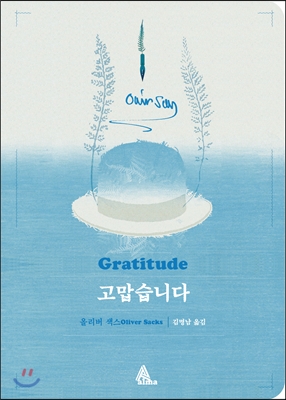 |
Description
Book Introduction
I love motorcycles and the periodic table,
Oliver Sacks, an outsider addicted to amphetamines
He was eighty-two years old and facing death.
We extend our warmest gratitude to all of you for life.
When Oliver Sacks passed away last August, the world's media mourned.
It wasn't just because he was a brilliant neuroscientist or the bestselling author of The Man Who Mistook His Wife for a Hat, Musicophilia, and On the Move.
It was a deep lament at the fact that the intellectuals of this era, who looked upon and embraced wounded people with warmth until the last moment of their lives, can no longer be with us.
No writer has been more successful in capturing medical and human drama with such honesty and fluidity than Oliver Sacks.
In essays written in the last months of his life, he movingly explores his feelings about ending life and accepting death.
“It is the destiny of all human beings to exist as unique individuals, to find their own path, to live their own lives, and to die their own deaths.”
Perhaps Oliver Sacks' calm voice in "Thank You" conveys a deeper emotion. Like his story, the four essays in this book are warm hymns, each singing of gratitude for the uniqueness of human beings and the gift of life.
If his autobiography, "On the Move," was a passionate and vivid memoir of Oliver Sacks's pursuit of endless adventure and uninterrupted life, "Thank You" is his final greeting to his loved ones in his final moments.
Oliver Sacks, an outsider addicted to amphetamines
He was eighty-two years old and facing death.
We extend our warmest gratitude to all of you for life.
When Oliver Sacks passed away last August, the world's media mourned.
It wasn't just because he was a brilliant neuroscientist or the bestselling author of The Man Who Mistook His Wife for a Hat, Musicophilia, and On the Move.
It was a deep lament at the fact that the intellectuals of this era, who looked upon and embraced wounded people with warmth until the last moment of their lives, can no longer be with us.
No writer has been more successful in capturing medical and human drama with such honesty and fluidity than Oliver Sacks.
In essays written in the last months of his life, he movingly explores his feelings about ending life and accepting death.
“It is the destiny of all human beings to exist as unique individuals, to find their own path, to live their own lives, and to die their own deaths.”
Perhaps Oliver Sacks' calm voice in "Thank You" conveys a deeper emotion. Like his story, the four essays in this book are warm hymns, each singing of gratitude for the uniqueness of human beings and the gift of life.
If his autobiography, "On the Move," was a passionate and vivid memoir of Oliver Sacks's pursuit of endless adventure and uninterrupted life, "Thank You" is his final greeting to his loved ones in his final moments.
- You can preview some of the book's contents.
Preview
index
Entering _11
Mercury_15
My Own Life _25
My Periodic Table _35
Sabbath _47
Translator's Note _65
Gratitude _81
Mercury_15
My Own Life _25
My Periodic Table _35
Sabbath _47
Translator's Note _65
Gratitude _81
Detailed image
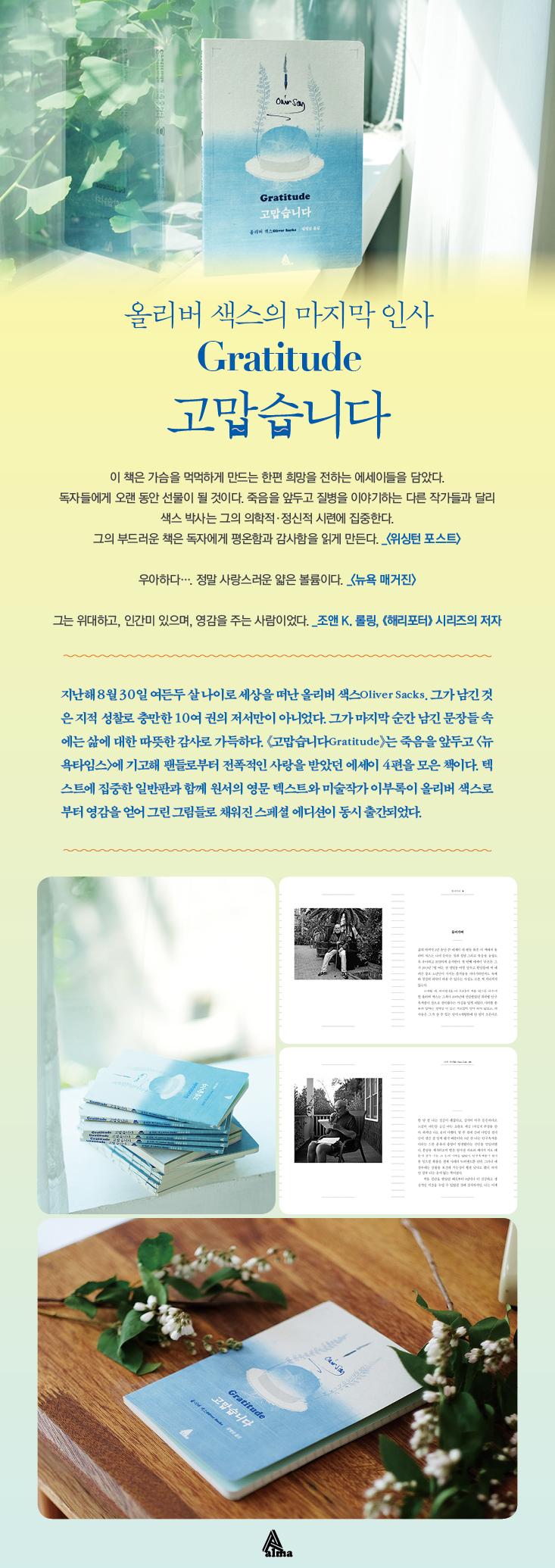
Into the book
For a long time, all kinds of memories flooded my mind.
There were good memories and bad memories, but most of them were memories I was grateful for.
Gratitude for what I have received from others, and gratitude that I have been able to give back even a little.
--- p.16
I've had so many experiences—some wonderful, some terrible—and I'm grateful. I've written a dozen books, received countless letters from friends, colleagues, and readers, and enjoyed, as Nathaniel Hawthorne put it, "communion with the world."
What I regret is that I wasted (and am still wasting) so much time.
It's also a shame that even at eighty, I'm still as terribly shy as I was when I was twenty.
I regret not being able to speak any language other than my native language, and I also regret not having traveled and experienced other cultures more extensively, as I should have.
--- p.17
By the age of eighty, the signs of decline become all too evident.
Responses are slightly slower and names are often blurry.
Well, we need to conserve energy.
Despite this, I still often feel full of energy and vitality and don't feel 'old' at all.
Perhaps, with luck, we will have a few more years of decent health and the freedom to pursue what Freud called the two most important things in life: love and work.
When it's finally time to go, I hope to work until the very end, like Francis Crick did.
When Creek heard the news that his colon cancer had returned, he initially said nothing.
I just stared off into the distance for a minute or so, then immediately went back to the thoughts I was previously absorbed in.
When people pestered him a few weeks later about his diagnosis, Crick simply said, “Everything that has a beginning has an end.”
He died at the age of eighty-eight, still deeply immersed in his most creative work.
--- p.19
How I live the remaining few months is up to me.
I must live in the richest, deepest, and most productive way possible.
I find encouraging the words of one of my favorite philosophers, David Hume, who, at the age of sixty-five, learned that he was ill and would soon die, and wrote a short autobiography in one day in April 1776, which he titled "My Life."
--- p.26
Rather, I feel a stronger sense of being alive.
I hope and anticipate that in the time remaining, I will strengthen my friendships, say goodbye to loved ones, write more, travel if I have the energy, and gain new levels of understanding and insight.
--- p.27~28
I won't pretend I'm not afraid.
But the emotion I feel more strongly than anything else is gratitude.
I loved and was loved.
I have received a lot from others, and I have given back a little bit.
I read, I traveled, I thought, I wrote.
I enjoyed interacting with the world.
I especially enjoyed the special fellowship with writers and readers.
Above all, I lived as a sentient being, a thinking animal, on this beautiful planet.
That in itself was a tremendous privilege and adventure.
--- p.29
I told my friends Kate and Alan.
“I hope I can see a night sky like that again when I die.”
“We’ll take you out in a wheelchair,” his friends replied.
--- p.35
Since I wrote in February that I had metastatic cancer, I have received a lot of comfort.
Hundreds of letters poured in, many expressing their affection and gratitude, and it filled me with the feeling that perhaps (despite all the circumstances) I had lived a good and useful life.
I am still very happy and grateful for all the comfort.
Yet, none of them have struck me as strongly as a starry night sky.
--- p.35~36
Bismuth is element number 83.
I don't think I'll live to see my 83rd birthday.
But somehow, the sight of '83' all around me feels hopeful.
It's somehow encouraging.
Moreover, I have a special fondness for bismuth, a plain gray metal that even metal lovers often overlook.
As a doctor, my nature of being drawn to patients who are mistreated or treated insignificantly extends to the world of inorganic matter, and here, too, I find myself drawn to bismuth.
--- p.39
He said this:
“Observing the Sabbath is a very beautiful act.
That's impossible unless you're religious.
It's not just about improving society.
“It is time to improve the quality of your life.”
In December 2005, Robert Zorn was awarded the Nobel Prize for his fundamental research in economics over the past 50 years.
He must have been a difficult guest for the Nobel Committee.
He went to Stockholm with numerous children and grandchildren, and he had to provide them all with special kosher utensils and food, as well as specially made clothing in accordance with the Bible's prohibition against mixing wool and linen.
--- p.54~55
To be honest, I was a little worried about visiting my Orthodox Jewish relatives with my lover Billy.
My mother's words had been echoing in my head all this time.
But they also gave Billy a warm welcome.
Even among Orthodox Jews, the extent of the shift in attitudes was evident when Robert John invited Billy and me to share the first Shabbat meal with his family.
--- p.54
Now, weakened, short of breath, my once-strong muscles melted away by cancer, I feel increasingly supernatural.
My thoughts are drawn to the question of what a good and worthwhile life is, rather than something material or spiritual.
The question is what it means to feel peace within yourself.
My thoughts keep wandering back to the Sabbath, the day of rest, the seventh day of the week, and even the seventh day of a person's life.
To the day when we can rest with a proud heart, feeling that we have done all we had to do.
There were good memories and bad memories, but most of them were memories I was grateful for.
Gratitude for what I have received from others, and gratitude that I have been able to give back even a little.
--- p.16
I've had so many experiences—some wonderful, some terrible—and I'm grateful. I've written a dozen books, received countless letters from friends, colleagues, and readers, and enjoyed, as Nathaniel Hawthorne put it, "communion with the world."
What I regret is that I wasted (and am still wasting) so much time.
It's also a shame that even at eighty, I'm still as terribly shy as I was when I was twenty.
I regret not being able to speak any language other than my native language, and I also regret not having traveled and experienced other cultures more extensively, as I should have.
--- p.17
By the age of eighty, the signs of decline become all too evident.
Responses are slightly slower and names are often blurry.
Well, we need to conserve energy.
Despite this, I still often feel full of energy and vitality and don't feel 'old' at all.
Perhaps, with luck, we will have a few more years of decent health and the freedom to pursue what Freud called the two most important things in life: love and work.
When it's finally time to go, I hope to work until the very end, like Francis Crick did.
When Creek heard the news that his colon cancer had returned, he initially said nothing.
I just stared off into the distance for a minute or so, then immediately went back to the thoughts I was previously absorbed in.
When people pestered him a few weeks later about his diagnosis, Crick simply said, “Everything that has a beginning has an end.”
He died at the age of eighty-eight, still deeply immersed in his most creative work.
--- p.19
How I live the remaining few months is up to me.
I must live in the richest, deepest, and most productive way possible.
I find encouraging the words of one of my favorite philosophers, David Hume, who, at the age of sixty-five, learned that he was ill and would soon die, and wrote a short autobiography in one day in April 1776, which he titled "My Life."
--- p.26
Rather, I feel a stronger sense of being alive.
I hope and anticipate that in the time remaining, I will strengthen my friendships, say goodbye to loved ones, write more, travel if I have the energy, and gain new levels of understanding and insight.
--- p.27~28
I won't pretend I'm not afraid.
But the emotion I feel more strongly than anything else is gratitude.
I loved and was loved.
I have received a lot from others, and I have given back a little bit.
I read, I traveled, I thought, I wrote.
I enjoyed interacting with the world.
I especially enjoyed the special fellowship with writers and readers.
Above all, I lived as a sentient being, a thinking animal, on this beautiful planet.
That in itself was a tremendous privilege and adventure.
--- p.29
I told my friends Kate and Alan.
“I hope I can see a night sky like that again when I die.”
“We’ll take you out in a wheelchair,” his friends replied.
--- p.35
Since I wrote in February that I had metastatic cancer, I have received a lot of comfort.
Hundreds of letters poured in, many expressing their affection and gratitude, and it filled me with the feeling that perhaps (despite all the circumstances) I had lived a good and useful life.
I am still very happy and grateful for all the comfort.
Yet, none of them have struck me as strongly as a starry night sky.
--- p.35~36
Bismuth is element number 83.
I don't think I'll live to see my 83rd birthday.
But somehow, the sight of '83' all around me feels hopeful.
It's somehow encouraging.
Moreover, I have a special fondness for bismuth, a plain gray metal that even metal lovers often overlook.
As a doctor, my nature of being drawn to patients who are mistreated or treated insignificantly extends to the world of inorganic matter, and here, too, I find myself drawn to bismuth.
--- p.39
He said this:
“Observing the Sabbath is a very beautiful act.
That's impossible unless you're religious.
It's not just about improving society.
“It is time to improve the quality of your life.”
In December 2005, Robert Zorn was awarded the Nobel Prize for his fundamental research in economics over the past 50 years.
He must have been a difficult guest for the Nobel Committee.
He went to Stockholm with numerous children and grandchildren, and he had to provide them all with special kosher utensils and food, as well as specially made clothing in accordance with the Bible's prohibition against mixing wool and linen.
--- p.54~55
To be honest, I was a little worried about visiting my Orthodox Jewish relatives with my lover Billy.
My mother's words had been echoing in my head all this time.
But they also gave Billy a warm welcome.
Even among Orthodox Jews, the extent of the shift in attitudes was evident when Robert John invited Billy and me to share the first Shabbat meal with his family.
--- p.54
Now, weakened, short of breath, my once-strong muscles melted away by cancer, I feel increasingly supernatural.
My thoughts are drawn to the question of what a good and worthwhile life is, rather than something material or spiritual.
The question is what it means to feel peace within yourself.
My thoughts keep wandering back to the Sabbath, the day of rest, the seventh day of the week, and even the seventh day of a person's life.
To the day when we can rest with a proud heart, feeling that we have done all we had to do.
--- p.56
Publisher's Review
I love motorcycles and the periodic table,
Oliver Sacks, an outsider addicted to amphetamines
He was eighty-two years old and facing death.
We extend our warmest gratitude to all of you for life.
Oliver Sacks's Last Farewell
Oliver Sacks, who passed away on August 30th of last year at the age of 82.
What he left behind were not just a dozen or so books full of intellectual reflection.
The sentences he left behind in his final moments are filled with warm gratitude for life.
《Gratitude》 is a collection of four essays that he contributed to the New York Times before his death and which were widely loved by fans.
A special edition (26,000 won) was published, featuring the original English text and illustrations, along with a text-focused general edition (6,500 won).
I won't pretend I'm not afraid.
But the emotion I feel more strongly than anything else is gratitude.
I loved and was loved.
I have received a lot from others, and I have given back a little bit.
I read, I traveled, I thought, I wrote.
I enjoyed interacting with the world.
I especially enjoyed the special fellowship with writers and readers.
Above all, I lived as a sentient being, a thinking animal, on this beautiful planet.
That in itself was a tremendous privilege and adventure.
_From the main text 'My Life'
Oliver Sacks was unlike any other doctor, unlike any other writer.
He was drawn to homes for the sick, to institutions housing the most frail and infirm, and to the interaction with the unusual and the 'abnormal'.
He wanted to see humans in many different forms, and in his own, almost anachronistic, way.
That is, face-to-face, time-consuming, and away from today's thriving computer and algorithmic tools.
And he showed us what he saw through his writings.
Atul Gawande, author of How to Die
When Oliver Sacks passed away last August, the world's media mourned.
It wasn't just because he was a brilliant neuroscientist or the bestselling author of The Man Who Mistook His Wife for a Hat, Musicophilia, and On the Move.
It was a deep lament at the fact that the intellectuals of this era, who looked upon and embraced wounded people with warmth until the last moment of their lives, can no longer be with us.
No writer has been more successful in capturing medical and human drama with such honesty and fluidity than Oliver Sacks.
In essays written in the last months of his life, he movingly explores his feelings about ending life and accepting death.
"To exist as unique individuals, to find our own path, to live our own lives, and to die our own deaths—this is the destiny bestowed upon all of us." Perhaps Oliver Sacks's calm voice in "Thank You" conveys a deeper emotion. Like his story, the four essays in this book are warm hymns, each singling out for our uniqueness as human beings and expressing gratitude for the gift of life.
If his autobiography, "On the Move," was a passionate and vivid memoir of Oliver Sacks's pursuit of endless adventure and uninterrupted life, "Thank You" is his final greeting to his loved ones in his final moments.
A grateful reflection on love, life, and death
A collection of four essays written shortly before Oliver Sacks's death, "Thank You" speaks with surprising calmness about the natural aging process, the illnesses we face as if by accident, and the inevitable death that we all must accept.
Even though there is no actual voice, Oliver Sacks' voice is felt in the sentences and paragraphs as being flat, soft, and quiet.
Translator Kim Myeong-nam also focused on maximizing the nuances of Oliver Sacks's work.
The first essay, "Mercury," was written by Oliver Sacks a few days before his eightieth birthday in July 2013 and speaks of the joys that only old age can offer.
In the spring of 2015, Oliver Sacks finished the final manuscript of his autobiography, On the Move, only to learn that the rare ocular melanoma he had been diagnosed with in 2005 had metastasized to his liver, and doctors had given him only six months to live.
Oliver Sacks spent the next few days writing his second essay, "My Life," in which he expressed his gratitude for having lived a good life.
In his third essay, "My Periodic Table," written in early summer 2015, he reflects deeply on his extraordinary love for the periodic table of elements and the fact that he is destined to die soon.
In August, his health deteriorated rapidly, and in the final essay of the book, "Sabbath," Oliver Sacks reflects silently on his life and family, willingly embracing the Sabbath of life (death).
On August 30, 2015, two weeks after writing his last essay, Oliver Sacks passed away.
He was a great, humane and inspiring man.
_Joanne K.
Rowling, author of the Harry Potter series
"Thank You" is a collection of four essays written by Oliver Sacks, who passed away at the age of eighty-two on August 30th of last year, and contributed to the New York Times shortly before his death.
His writings, filled with a warm appreciation for life, captivated many readers as well as fans who mourned his death, and were published and garnered attention in countries around the world, including the United States, England, and France.
In Korea, a special edition that featured the original English text and illustrations was published simultaneously with a text-focused general edition.
Translator's Note
Oliver in My Little Bookshelf
There is a space in my small bookshelf devoted solely to Oliver Sacks' books.
The more I think about it, the more grateful I am that all ten or so books by Sachs, one of the most beloved neurologists and writers of our time, have been translated into Korean.
And now, at the very end of that space, I put this thin book.
Sax was diagnosed with a terminal illness shortly after completing his autobiography, reflecting on his eighty years of life.
The essays in this book were written later, as is well explained in the forewords by Kate Edgar and Bill Hayes.
Bill Hayes was Sachs's lover in his later years, and Kate Edgar was his personal editor and secretary for many years.
It was under their care that Sax wrote his final writings, and now the two remaining individuals have put together this book as a final gift to the readers on his behalf.
Holding in my hand a book so thin it's a final gift, I can't help but ask, even though I know it's just a silly thought.
What if he had more time? Sachs was diagnosed in December 2014 and died in August 2015, giving him exactly eight months to get his life in order.
But if he had been given even two or three more years, what would he have written? True to his reputation for weaving together the medical drama of illness and the human drama of disease, simultaneously revealing the unique and universal aspects of human existence, wouldn't he have observed and analyzed his own declining body and mind, as if through a third-person lens, while simultaneously telling his story of adapting to the changes of old age with his usual humor and intellectual optimism? It's a pity that I haven't had the chance to read the book on old age and death written by this man, who was called the poet of medicine, as if I had lost a book that already existed.
But in this book, which is the best he could write in eight months, we can read even the unwritten stories.
With little time left, there is no room to waste a single word on unimportant things. These refined and refined sentences warmly capture the image of a human being facing death, filled with fear, regret, and, above all, gratitude.
If this book is your first introduction to author Oliver Sacks, you're in luck.
All the anecdotes mentioned here, briefly, are written in their own books, so there is a long list to read.
If you're curious about the story of how he thought he'd die at forty, you can read "I Picked My Legs Up Out of Bed." The story of the hospital stay that helped him overcome his amphetamine addiction is in "Awakening." You can read more about his love affair with the periodic table in "Uncle Tungsten."
Of course, we cannot leave out the autobiography "On the Move," which is the prequel or main part of this book.
And for readers who already love sex… well, I guess I don’t need to say much more.
I can imagine many readers, like me, tucking this book away on their shelves, among the many other books by Saxe.
It is the culmination of what Sax calls the "special fellowship with readers," which he says is the most enjoyable thing in his life.
And we can feel, to borrow Sachs's words, that our time in this company with such a writer, "living as sentient beings and thinking animals on this beautiful planet," was "in itself an enormous privilege and adventure."
These final writings by Sachs, who wrote over 1,000 diaries and even more letters in beautiful fountain pen calligraphy throughout his life, are his farewell letters to the world and to us.
Of all his books on the shelf, I probably think of this little book most often.
It will be like that as time goes by.
No, as time goes by and I get older, it will become more and more like that.
Translated by Kim Myeong-nam
Foreign media reviews of "Thank You"
This book contains essays that are both heartbreaking and hopeful.
It will be a gift to readers for a long time.
Unlike other writers who discuss illness in the face of death, Dr. Sacks focuses on his medical and psychological ordeals.
His gentle books leave readers with a sense of peace and gratitude.
_[Washington Post]
Elegant… .
It's a really lovely thin volume.
_[New York Magazine]
He was a neuroscientist and author who passed away last August.
Four essays he wrote for the New York Times between 2013 and 2015 remain, allowing us to examine his life and death.
Sax's entire life is compiled into this slim book.
_[Newsday]
This book turns sorrow into joy _[The Advocate]
This is a valuable little book for anyone who loves Oliver Sacks.
_[The Millstone]
"Thank You" is a bittersweet, yet absolutely beautiful read.
_[Brainpickings.org]
A man faces his life and death with loving humor, acceptance, and warm gratitude.
If you are already familiar with his writings, you will come to a thoughtful and evolved conclusion.
If not, this little book would be a wonderful introduction that you simply cannot part with.
_[The Dispatch]
For readers who are more curious about Oliver Sacks
In his autobiography, On the Move, Oliver Sacks described himself as shy, face-blind, and physically fit, but timid, anxious, introverted, and passive.
Moreover, I always felt unappreciated by my parents and thought I was intellectually inferior to my friends.
These shortcomings and defects (as the world calls them) weighed him down and weighed him down in sensitive areas.
For example, the “disgusting thing” thrown by a mother after finding out that a man is gay.
The words “You should never have been born” were instilled in me as a sense of guilt, and they followed me throughout my life, acting as oppression.
Episodes about family and sexual identity also appear in the final essay of "Thank You," "Sabbath."
Oliver Sacks first began to realize himself as a doctor when he met “real people” with “real problems” in his clinical practice.
“The anatomy and physiology I studied at Oxford University’s medical school were of no help whatsoever in the real world.
I had to learn all of this from scratch: meeting patients, listening to their stories, trying to enter (or at least imagine) their experiences and predicaments, caring for them, and taking responsibility for them.
The patients were real people with very real problems, very painful problems (and often at critical junctures), each with their own desperate circumstances.
Therefore, medical practice is not simply a matter of diagnosis and treatment, but also faces much more serious problems.
There are situations where we must ask questions about the quality of life, and even whether it is meaningful to continue living.”
This was also the case when I was trying to escape the double life I had led for four years, living as a doctor and an addict, relying on drugs to forget the pain of a broken heart.
Oliver Sacks' condition improved as soon as he began his clinical practice, and he gradually overcame his drug addiction as he felt a sense of joy and, above all, a sense of ownership and responsibility while doing his best and being fascinated by his patients.
Perhaps this is the result of identifying one's own deficiencies and flaws with the suffering of patients, or perhaps it is the result of compassion and empathy born from an awareness of the common root of human weakness.
“For me, there are no uninteresting or worthless patients.
They are everywhere, vivid and distinct.
“I have never met a patient who didn’t teach me something new, who didn’t awaken emotions I didn’t know I had, who didn’t spark new trains of thought.”
In this way, he went from the lowest to the highest and found affirmation of humanity there.
Some people suffered from severe migraines, lost their memory or color, lost their sense of body, or became frozen in Parkinson's disease.
He wanted to give back to those who were unable to maintain the most basic daily lives and social relationships a life as close to life as possible.
He realized that this was the essence of medicine and healthcare.
Their differences are not 'abnormalities' but specialness, and this difference is not something to be excluded or avoided, but rather the very essence of humanity that we must live together in harmony with.
Here we too find enlightenment from Sax.
That each and every one of us (including patients) is a free spirit, an independent human being with our own individuality and passion, with our own “real” problems.
That we are all precious and dignified beings who deserve to love and be loved.
Transparent intelligence, warm humanity
Beginning with his first book, Migraine (1970), and continuing with Awakening (1973), I Picked Up My Leg Out of Bed (1984), The Man Who Mistook His Wife for a Hat (1985), I Saw Voices (1989), Anthropologists on Mars (1995), The Island of Colorblindness (1997), Uncle Tungsten (2001), The Oaxaca Journal (2002), Musicophilia (2007), The Mind's Eye (2010), Hallucinations (2012), and his autobiography, On the Move (2015) and Thank You (2016), Oliver Sacks's writing is astonishing and astonishing, living up to his reputation as a "poet of medicine."
Because 'everything in the world was an adventure', he was always full of curiosity and interest in everything, a keen observer, a sincere listener, and a creative person with an unpredictable power of association.
From his childhood fascination with chemistry and biology to his intellectual pursuits in medicine, anatomy, biochemistry, physiology, and neurology; to his physical challenges of motorcycling, swimming, scuba diving, and weightlifting; and his questions and understanding of human society and the natural world, he was a natural traveler, adventurer, and explorer.
In all of these, Sax often delves into extremes and goes very 'far'.
Above all, Oliver Sacks was a man of wide openness, without any prejudice or boundaries.
As a 'socially vulnerable', 'minority', and 'heretic' who was homosexual and a drug addict, he faced condemnation, criticism, guilt, and self-destruction, but he did not get buried in it or give in to it.
Rather, by willingly accepting such aspects as they are, and thereby elevating 'exceptionality' to 'universality', we have moved toward a greater understanding and positivity toward humanity and the world.
Oliver Sacks's writing is also very transparent and honest, much like his life, and as dramatic as a novel, yet very human.
Reviews of his books are always full of admiration.
It's truly heartwarming.
…Sax writes not only with an understanding of medicine and science, but also with compassion for patients and philosophical insight into their emotional dilemmas.
…His writing, which offers a pleasure 'unlike any other', as Sax puts it, is a gift to his readers.
The gift of erudition, compassion, and endless understanding of the joys, trials, and comforts of the human condition.
_[New York Times]
Sax tells his story with such honesty, candidness, and boldness that readers can't help but fall in love with him.
What else can we do but fall in love when someone like Sax offers such an honest gift? _[Los Angeles Review of Books]
Sax's passion for life was extraordinary.
_[The Independent]
He lived a truly fulfilling and beyond life.
_[Guardian]
No matter what he's writing about, whether it's his struggles to understand what his patients are going through or his love of swimming and photography, Sachs always seems open to learning more.
He shows great interest and curiosity in everyone and everything he meets.
He is a great storyteller.
_[San Francisco Chronicle]
As he learns to accept his unique patients, Oliver Sacks learns to accept himself.
Oliver Sacks is a man who can never be replaced.
_[Newsday]
Oliver Sacks, an outsider addicted to amphetamines
He was eighty-two years old and facing death.
We extend our warmest gratitude to all of you for life.
Oliver Sacks's Last Farewell
Oliver Sacks, who passed away on August 30th of last year at the age of 82.
What he left behind were not just a dozen or so books full of intellectual reflection.
The sentences he left behind in his final moments are filled with warm gratitude for life.
《Gratitude》 is a collection of four essays that he contributed to the New York Times before his death and which were widely loved by fans.
A special edition (26,000 won) was published, featuring the original English text and illustrations, along with a text-focused general edition (6,500 won).
I won't pretend I'm not afraid.
But the emotion I feel more strongly than anything else is gratitude.
I loved and was loved.
I have received a lot from others, and I have given back a little bit.
I read, I traveled, I thought, I wrote.
I enjoyed interacting with the world.
I especially enjoyed the special fellowship with writers and readers.
Above all, I lived as a sentient being, a thinking animal, on this beautiful planet.
That in itself was a tremendous privilege and adventure.
_From the main text 'My Life'
Oliver Sacks was unlike any other doctor, unlike any other writer.
He was drawn to homes for the sick, to institutions housing the most frail and infirm, and to the interaction with the unusual and the 'abnormal'.
He wanted to see humans in many different forms, and in his own, almost anachronistic, way.
That is, face-to-face, time-consuming, and away from today's thriving computer and algorithmic tools.
And he showed us what he saw through his writings.
Atul Gawande, author of How to Die
When Oliver Sacks passed away last August, the world's media mourned.
It wasn't just because he was a brilliant neuroscientist or the bestselling author of The Man Who Mistook His Wife for a Hat, Musicophilia, and On the Move.
It was a deep lament at the fact that the intellectuals of this era, who looked upon and embraced wounded people with warmth until the last moment of their lives, can no longer be with us.
No writer has been more successful in capturing medical and human drama with such honesty and fluidity than Oliver Sacks.
In essays written in the last months of his life, he movingly explores his feelings about ending life and accepting death.
"To exist as unique individuals, to find our own path, to live our own lives, and to die our own deaths—this is the destiny bestowed upon all of us." Perhaps Oliver Sacks's calm voice in "Thank You" conveys a deeper emotion. Like his story, the four essays in this book are warm hymns, each singling out for our uniqueness as human beings and expressing gratitude for the gift of life.
If his autobiography, "On the Move," was a passionate and vivid memoir of Oliver Sacks's pursuit of endless adventure and uninterrupted life, "Thank You" is his final greeting to his loved ones in his final moments.
A grateful reflection on love, life, and death
A collection of four essays written shortly before Oliver Sacks's death, "Thank You" speaks with surprising calmness about the natural aging process, the illnesses we face as if by accident, and the inevitable death that we all must accept.
Even though there is no actual voice, Oliver Sacks' voice is felt in the sentences and paragraphs as being flat, soft, and quiet.
Translator Kim Myeong-nam also focused on maximizing the nuances of Oliver Sacks's work.
The first essay, "Mercury," was written by Oliver Sacks a few days before his eightieth birthday in July 2013 and speaks of the joys that only old age can offer.
In the spring of 2015, Oliver Sacks finished the final manuscript of his autobiography, On the Move, only to learn that the rare ocular melanoma he had been diagnosed with in 2005 had metastasized to his liver, and doctors had given him only six months to live.
Oliver Sacks spent the next few days writing his second essay, "My Life," in which he expressed his gratitude for having lived a good life.
In his third essay, "My Periodic Table," written in early summer 2015, he reflects deeply on his extraordinary love for the periodic table of elements and the fact that he is destined to die soon.
In August, his health deteriorated rapidly, and in the final essay of the book, "Sabbath," Oliver Sacks reflects silently on his life and family, willingly embracing the Sabbath of life (death).
On August 30, 2015, two weeks after writing his last essay, Oliver Sacks passed away.
He was a great, humane and inspiring man.
_Joanne K.
Rowling, author of the Harry Potter series
"Thank You" is a collection of four essays written by Oliver Sacks, who passed away at the age of eighty-two on August 30th of last year, and contributed to the New York Times shortly before his death.
His writings, filled with a warm appreciation for life, captivated many readers as well as fans who mourned his death, and were published and garnered attention in countries around the world, including the United States, England, and France.
In Korea, a special edition that featured the original English text and illustrations was published simultaneously with a text-focused general edition.
Translator's Note
Oliver in My Little Bookshelf
There is a space in my small bookshelf devoted solely to Oliver Sacks' books.
The more I think about it, the more grateful I am that all ten or so books by Sachs, one of the most beloved neurologists and writers of our time, have been translated into Korean.
And now, at the very end of that space, I put this thin book.
Sax was diagnosed with a terminal illness shortly after completing his autobiography, reflecting on his eighty years of life.
The essays in this book were written later, as is well explained in the forewords by Kate Edgar and Bill Hayes.
Bill Hayes was Sachs's lover in his later years, and Kate Edgar was his personal editor and secretary for many years.
It was under their care that Sax wrote his final writings, and now the two remaining individuals have put together this book as a final gift to the readers on his behalf.
Holding in my hand a book so thin it's a final gift, I can't help but ask, even though I know it's just a silly thought.
What if he had more time? Sachs was diagnosed in December 2014 and died in August 2015, giving him exactly eight months to get his life in order.
But if he had been given even two or three more years, what would he have written? True to his reputation for weaving together the medical drama of illness and the human drama of disease, simultaneously revealing the unique and universal aspects of human existence, wouldn't he have observed and analyzed his own declining body and mind, as if through a third-person lens, while simultaneously telling his story of adapting to the changes of old age with his usual humor and intellectual optimism? It's a pity that I haven't had the chance to read the book on old age and death written by this man, who was called the poet of medicine, as if I had lost a book that already existed.
But in this book, which is the best he could write in eight months, we can read even the unwritten stories.
With little time left, there is no room to waste a single word on unimportant things. These refined and refined sentences warmly capture the image of a human being facing death, filled with fear, regret, and, above all, gratitude.
If this book is your first introduction to author Oliver Sacks, you're in luck.
All the anecdotes mentioned here, briefly, are written in their own books, so there is a long list to read.
If you're curious about the story of how he thought he'd die at forty, you can read "I Picked My Legs Up Out of Bed." The story of the hospital stay that helped him overcome his amphetamine addiction is in "Awakening." You can read more about his love affair with the periodic table in "Uncle Tungsten."
Of course, we cannot leave out the autobiography "On the Move," which is the prequel or main part of this book.
And for readers who already love sex… well, I guess I don’t need to say much more.
I can imagine many readers, like me, tucking this book away on their shelves, among the many other books by Saxe.
It is the culmination of what Sax calls the "special fellowship with readers," which he says is the most enjoyable thing in his life.
And we can feel, to borrow Sachs's words, that our time in this company with such a writer, "living as sentient beings and thinking animals on this beautiful planet," was "in itself an enormous privilege and adventure."
These final writings by Sachs, who wrote over 1,000 diaries and even more letters in beautiful fountain pen calligraphy throughout his life, are his farewell letters to the world and to us.
Of all his books on the shelf, I probably think of this little book most often.
It will be like that as time goes by.
No, as time goes by and I get older, it will become more and more like that.
Translated by Kim Myeong-nam
Foreign media reviews of "Thank You"
This book contains essays that are both heartbreaking and hopeful.
It will be a gift to readers for a long time.
Unlike other writers who discuss illness in the face of death, Dr. Sacks focuses on his medical and psychological ordeals.
His gentle books leave readers with a sense of peace and gratitude.
_[Washington Post]
Elegant… .
It's a really lovely thin volume.
_[New York Magazine]
He was a neuroscientist and author who passed away last August.
Four essays he wrote for the New York Times between 2013 and 2015 remain, allowing us to examine his life and death.
Sax's entire life is compiled into this slim book.
_[Newsday]
This book turns sorrow into joy _[The Advocate]
This is a valuable little book for anyone who loves Oliver Sacks.
_[The Millstone]
"Thank You" is a bittersweet, yet absolutely beautiful read.
_[Brainpickings.org]
A man faces his life and death with loving humor, acceptance, and warm gratitude.
If you are already familiar with his writings, you will come to a thoughtful and evolved conclusion.
If not, this little book would be a wonderful introduction that you simply cannot part with.
_[The Dispatch]
For readers who are more curious about Oliver Sacks
In his autobiography, On the Move, Oliver Sacks described himself as shy, face-blind, and physically fit, but timid, anxious, introverted, and passive.
Moreover, I always felt unappreciated by my parents and thought I was intellectually inferior to my friends.
These shortcomings and defects (as the world calls them) weighed him down and weighed him down in sensitive areas.
For example, the “disgusting thing” thrown by a mother after finding out that a man is gay.
The words “You should never have been born” were instilled in me as a sense of guilt, and they followed me throughout my life, acting as oppression.
Episodes about family and sexual identity also appear in the final essay of "Thank You," "Sabbath."
Oliver Sacks first began to realize himself as a doctor when he met “real people” with “real problems” in his clinical practice.
“The anatomy and physiology I studied at Oxford University’s medical school were of no help whatsoever in the real world.
I had to learn all of this from scratch: meeting patients, listening to their stories, trying to enter (or at least imagine) their experiences and predicaments, caring for them, and taking responsibility for them.
The patients were real people with very real problems, very painful problems (and often at critical junctures), each with their own desperate circumstances.
Therefore, medical practice is not simply a matter of diagnosis and treatment, but also faces much more serious problems.
There are situations where we must ask questions about the quality of life, and even whether it is meaningful to continue living.”
This was also the case when I was trying to escape the double life I had led for four years, living as a doctor and an addict, relying on drugs to forget the pain of a broken heart.
Oliver Sacks' condition improved as soon as he began his clinical practice, and he gradually overcame his drug addiction as he felt a sense of joy and, above all, a sense of ownership and responsibility while doing his best and being fascinated by his patients.
Perhaps this is the result of identifying one's own deficiencies and flaws with the suffering of patients, or perhaps it is the result of compassion and empathy born from an awareness of the common root of human weakness.
“For me, there are no uninteresting or worthless patients.
They are everywhere, vivid and distinct.
“I have never met a patient who didn’t teach me something new, who didn’t awaken emotions I didn’t know I had, who didn’t spark new trains of thought.”
In this way, he went from the lowest to the highest and found affirmation of humanity there.
Some people suffered from severe migraines, lost their memory or color, lost their sense of body, or became frozen in Parkinson's disease.
He wanted to give back to those who were unable to maintain the most basic daily lives and social relationships a life as close to life as possible.
He realized that this was the essence of medicine and healthcare.
Their differences are not 'abnormalities' but specialness, and this difference is not something to be excluded or avoided, but rather the very essence of humanity that we must live together in harmony with.
Here we too find enlightenment from Sax.
That each and every one of us (including patients) is a free spirit, an independent human being with our own individuality and passion, with our own “real” problems.
That we are all precious and dignified beings who deserve to love and be loved.
Transparent intelligence, warm humanity
Beginning with his first book, Migraine (1970), and continuing with Awakening (1973), I Picked Up My Leg Out of Bed (1984), The Man Who Mistook His Wife for a Hat (1985), I Saw Voices (1989), Anthropologists on Mars (1995), The Island of Colorblindness (1997), Uncle Tungsten (2001), The Oaxaca Journal (2002), Musicophilia (2007), The Mind's Eye (2010), Hallucinations (2012), and his autobiography, On the Move (2015) and Thank You (2016), Oliver Sacks's writing is astonishing and astonishing, living up to his reputation as a "poet of medicine."
Because 'everything in the world was an adventure', he was always full of curiosity and interest in everything, a keen observer, a sincere listener, and a creative person with an unpredictable power of association.
From his childhood fascination with chemistry and biology to his intellectual pursuits in medicine, anatomy, biochemistry, physiology, and neurology; to his physical challenges of motorcycling, swimming, scuba diving, and weightlifting; and his questions and understanding of human society and the natural world, he was a natural traveler, adventurer, and explorer.
In all of these, Sax often delves into extremes and goes very 'far'.
Above all, Oliver Sacks was a man of wide openness, without any prejudice or boundaries.
As a 'socially vulnerable', 'minority', and 'heretic' who was homosexual and a drug addict, he faced condemnation, criticism, guilt, and self-destruction, but he did not get buried in it or give in to it.
Rather, by willingly accepting such aspects as they are, and thereby elevating 'exceptionality' to 'universality', we have moved toward a greater understanding and positivity toward humanity and the world.
Oliver Sacks's writing is also very transparent and honest, much like his life, and as dramatic as a novel, yet very human.
Reviews of his books are always full of admiration.
It's truly heartwarming.
…Sax writes not only with an understanding of medicine and science, but also with compassion for patients and philosophical insight into their emotional dilemmas.
…His writing, which offers a pleasure 'unlike any other', as Sax puts it, is a gift to his readers.
The gift of erudition, compassion, and endless understanding of the joys, trials, and comforts of the human condition.
_[New York Times]
Sax tells his story with such honesty, candidness, and boldness that readers can't help but fall in love with him.
What else can we do but fall in love when someone like Sax offers such an honest gift? _[Los Angeles Review of Books]
Sax's passion for life was extraordinary.
_[The Independent]
He lived a truly fulfilling and beyond life.
_[Guardian]
No matter what he's writing about, whether it's his struggles to understand what his patients are going through or his love of swimming and photography, Sachs always seems open to learning more.
He shows great interest and curiosity in everyone and everything he meets.
He is a great storyteller.
_[San Francisco Chronicle]
As he learns to accept his unique patients, Oliver Sacks learns to accept himself.
Oliver Sacks is a man who can never be replaced.
_[Newsday]
GOODS SPECIFICS
- Date of publication: May 28, 2016
- Page count, weight, size: 64 pages | 92g | 127*178*5mm
- ISBN13: 9791159920059
- ISBN10: 1159920052
You may also like
카테고리
korean


korean

![GQ KOREA Mark (Monthly): December [2025]](http://librairie.coreenne.fr/cdn/shop/files/8ef265dbbfbf186523ed75ba7319009d.jpg?v=1765340328&width=3840)


