

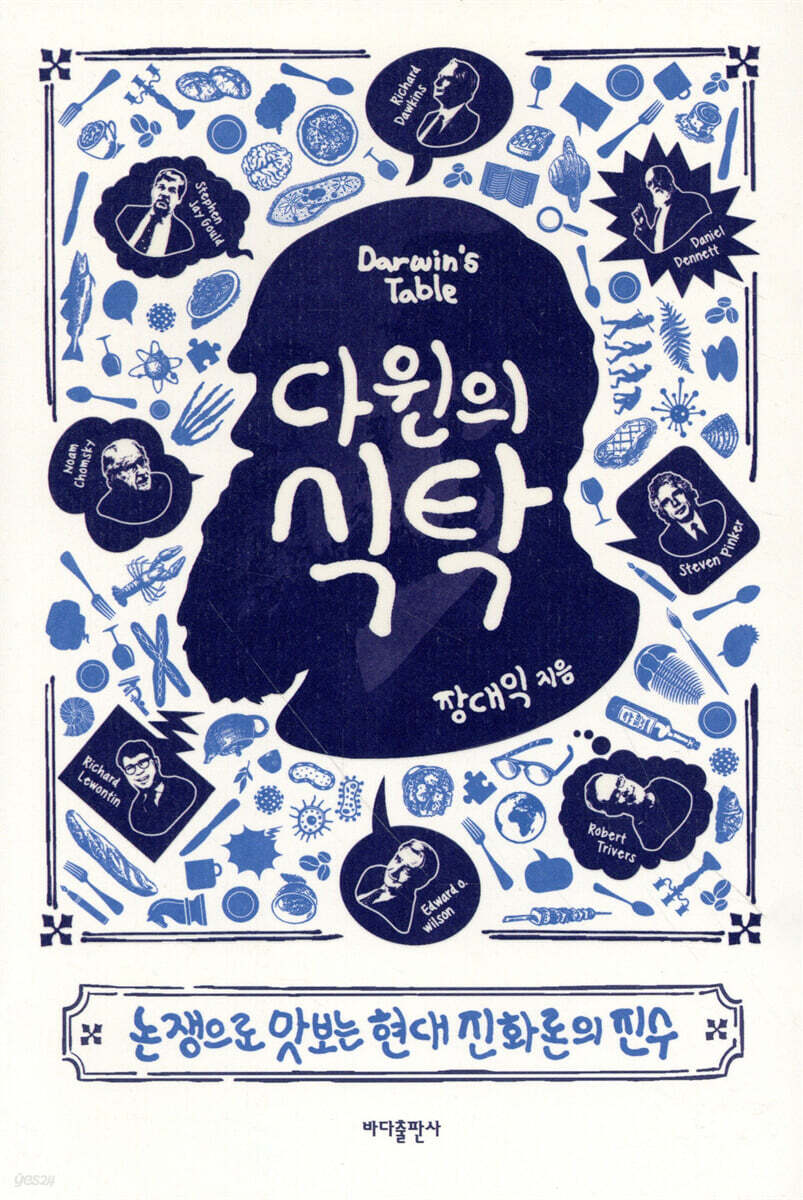
Darwin's Table
 |
Description
Book Introduction
The essence of modern evolutionary theory learned through debate
The expanded and expanded edition of "Darwin's Table" is published.
Professor Jang Dae-ik of Seoul National University, who has proposed a new "anthropology" that goes beyond the framework of the humanities and encompasses scientific inquiry, and has been at the forefront of popularizing science as a new guideline for liberal arts in our time, has republished his book "Darwin's Table" in an expanded and enlarged edition.
First published in 2008, Darwin's Table delved deeply into the debate surrounding the theory of evolution, while also garnering attention for its factional setting of the debate between leading figures in modern evolutionary theory.
It also received favorable reviews for raising the standard of domestic science books by explaining the issues of modern evolution theory in a way that the general public can easily digest while never missing important points.
The expanded edition of Darwin's Table includes a new section at the beginning titled "This is Evolution," which can be called "Evolution for Beginners," for readers who find it difficult to follow the high-level arguments in the main text.
Darwin's avatar appears and explains the basic concepts of evolution, the mechanism of natural selection, why evolution is a proven scientific fact, and why creationism is not science.
This provides basic knowledge to readers who lack a foundation in evolutionary theory.
Additionally, in the latter part of the book, a new section titled “A Deeper Reading of Gould” was added to balance the “A Deeper Reading of Dawkins” section in the first edition, allowing readers to examine the opinions of the two leading scholars in evolutionary theory.
Finally, we include an interview with Edward Wilson, conducted by the author at Harvard University on November 12, 2013.
Through "The Conquerors of the Earth," we can hear Wilson's views and explanations criticizing Hamilton's theory of kin selection.
★ 2010 Republic of Korea Science and Culture Award
★ 2009 Korea Science and Technology Book Award Writing Award
★ 2009 Korea Foundation for the Advancement of Science and Creativity Outstanding Science Book
★ Selected as the 2008 Hankyoreh Book of the Year
The expanded and expanded edition of "Darwin's Table" is published.
Professor Jang Dae-ik of Seoul National University, who has proposed a new "anthropology" that goes beyond the framework of the humanities and encompasses scientific inquiry, and has been at the forefront of popularizing science as a new guideline for liberal arts in our time, has republished his book "Darwin's Table" in an expanded and enlarged edition.
First published in 2008, Darwin's Table delved deeply into the debate surrounding the theory of evolution, while also garnering attention for its factional setting of the debate between leading figures in modern evolutionary theory.
It also received favorable reviews for raising the standard of domestic science books by explaining the issues of modern evolution theory in a way that the general public can easily digest while never missing important points.
The expanded edition of Darwin's Table includes a new section at the beginning titled "This is Evolution," which can be called "Evolution for Beginners," for readers who find it difficult to follow the high-level arguments in the main text.
Darwin's avatar appears and explains the basic concepts of evolution, the mechanism of natural selection, why evolution is a proven scientific fact, and why creationism is not science.
This provides basic knowledge to readers who lack a foundation in evolutionary theory.
Additionally, in the latter part of the book, a new section titled “A Deeper Reading of Gould” was added to balance the “A Deeper Reading of Dawkins” section in the first edition, allowing readers to examine the opinions of the two leading scholars in evolutionary theory.
Finally, we include an interview with Edward Wilson, conducted by the author at Harvard University on November 12, 2013.
Through "The Conquerors of the Earth," we can hear Wilson's views and explanations criticizing Hamilton's theory of kin selection.
★ 2010 Republic of Korea Science and Culture Award
★ 2009 Korea Science and Technology Book Award Writing Award
★ 2009 Korea Foundation for the Advancement of Science and Creativity Outstanding Science Book
★ Selected as the 2008 Hankyoreh Book of the Year
index
MENU
Hamilton's Funeral and Darwin's Table - 006
APPETIZER
This is evolution - 019
MAIN DISHES
ㆍ First day
The Power of Natural Selection: Is Rape an Adaptation? - 064
ㆍ Second day
The Evolution of Cooperation: Can Selfish Genes Explain Mother Teresa? - 096
ㆍ Third day
Genes, Environment, and Development: In Search of the Truth About Genes - 134
ㆍ Fourth day
The Pace and Pattern of Evolution: Is Evolution a 100-Meter Race or a Long Jump? - 166
ㆍ Fifth day
Evolution and Progress: From Bacteria to Einstein - 200
ㆍ Day 6_Rest
The Tree of Evolution: Under the Tree of Evolution - 233
ㆍ Last day_Public lecture
Evolution and Religion: Who Are Darwin's True Descendants? - 236
Epilogue
Gould Goes to DiMaggio's Side - 264
ㆍ Table review
Science is a fiercely contested issue - 266
DESSERT
Reading Dawkins Deeply - 277
Gould's Deep Reading - 312
Edward Wilson Interview - 353
Announcing the Expanded Edition of Darwin's Table - 364
Words of Thanks - 368
Materials used to make this book - 370
Search - 400
Hamilton's Funeral and Darwin's Table - 006
APPETIZER
This is evolution - 019
MAIN DISHES
ㆍ First day
The Power of Natural Selection: Is Rape an Adaptation? - 064
ㆍ Second day
The Evolution of Cooperation: Can Selfish Genes Explain Mother Teresa? - 096
ㆍ Third day
Genes, Environment, and Development: In Search of the Truth About Genes - 134
ㆍ Fourth day
The Pace and Pattern of Evolution: Is Evolution a 100-Meter Race or a Long Jump? - 166
ㆍ Fifth day
Evolution and Progress: From Bacteria to Einstein - 200
ㆍ Day 6_Rest
The Tree of Evolution: Under the Tree of Evolution - 233
ㆍ Last day_Public lecture
Evolution and Religion: Who Are Darwin's True Descendants? - 236
Epilogue
Gould Goes to DiMaggio's Side - 264
ㆍ Table review
Science is a fiercely contested issue - 266
DESSERT
Reading Dawkins Deeply - 277
Gould's Deep Reading - 312
Edward Wilson Interview - 353
Announcing the Expanded Edition of Darwin's Table - 364
Words of Thanks - 368
Materials used to make this book - 370
Search - 400
Publisher's Review
Science is communication
A dazzling intellectual feast presented by 26 evolutionary giants.
On May 20, 2002, the death of Dr. William Hamilton, an evolutionary biologist at Oxford University, was announced.
He was infected with malaria during his research in Congo, Africa.
Dr. Hamilton, who is called the 'theoretical father' of sociobiology, behavioral ecology, and evolutionary psychology, proposed the 'inclusive fitness theory', which reinterprets the theory of natural selection from the perspective of genes, created the 'parasite theory', which states that sex evolved as a host strategy to cope with the invasion of parasites, and developed the sexual selection theory, clearly explaining why peacock feathers are so colorful.
His funeral, held at New College Chapel, Oxford University, England, to commemorate his death, which shaped the framework of modern evolutionary theory, was attended by leading evolutionary scholars, including Richard Dawkins, Stephen Jay Gould, Richard Lewontin, Edward Wilson, Steven Pinker, Neil Eldredge, Daniel Dennett, Susan Oyama, Kim Stirelny, Sean Carroll, and David Wilson.
By chance, they decide to have a week-long debate on evolution, with the BBC broadcasting their extravagant dinner live.
It is a feast of intellect presented by Darwin's descendants.
Through the fierce debates between leading evolutionary theorists, led by Richard Dawkins and Stephen Jay Gould, two leaders who have divided the field of evolutionary biology, you can see the true face of evolutionary theory that is active outside of textbooks.
Science is a debate
Learning Evolution Through Debate
Like all scientific theories, evolution was born with controversy.
Even in 1909, when The Origin of Species celebrated its fiftieth anniversary, the controversy persisted, and even in the 1940s, when there was talk of a "synthesis" in evolutionary theory, discontent still existed.
Since the 1970s, there has been a sharp conflict surrounding punctuated equilibrium theory, the selfish gene theory, and sociobiology.
But through this rigorous process, the theory of evolution has continuously evolved over the past 150 years.
This is the true picture of evolution in action.
As a scientific theory, the theory of evolution is not fixed in a single dogma, but rather a process of finding the optimal answer through fierce debate among various scholars based on various theories.
In this book, the author introduces modern evolutionary giants, including Dawkins and Gould, and engages in a fierce debate on key issues in modern evolutionary theory, including adaptation, cooperation, development, progress, and religion.
Through this debate, the author emphasizes that scientific knowledge evolves not through a winner-take-all race to claim the "right answer," but through fierce and rational debate in search of the answer.
What debates are taking place at the forefront of evolutionary theory?
Day One | The Power of Natural Selection - Is Rape Adaptive?
Since Darwin first introduced the mechanism of 'natural selection' in 'The Origin of Species', natural selection has been evaluated as the most original and important concept in evolutionary theory as well as biology in general.
Since Darwin, few biologists have denied the mechanism of natural selection.
Evolutionary biologists generally call the products of natural selection 'adaptations.'
However, there is still debate about how powerful the power of natural selection really is.
In particular, there is a sharp conflict over how much of the human mind and behavior is an adaptation of natural selection.
Those who believe in the powerful force of natural selection call themselves "adaptationists," while those who are skeptical of its power call themselves "anti-adaptationists."
For example, according to behavioral ecologist Randy Thornhill's book, The Natural History of Rape, men's rape behavior is an adaptive behavior that increases their reproductive success.
Although there were some statistical errors, Sonhill's claim became a major issue in evolutionary biology and behavioral ecology.
Here, you can experience a fierce debate between leading evolutionary scholars on this claim, which has sparked great controversy not only in women's studies but also in the humanities and social sciences as a whole.
Adaptationists, including Richard Dawkins and Edward Wilson, and anti-adaptationists, including Stephen Jay Gould and Richard Lewontin, debate the question of adaptation surrounding human behavior and the mind.
Day Two | The Evolution of Cooperation - Can Selfish Genes Explain Mother Teresa?
At what level does natural selection operate? At the gene, at the individual, or at the population level? This article revisits natural selection, focusing primarily on the unit of its operation.
In particular, with regard to cooperative behavior, it is questionable to what extent the evolution of such behavior is due to natural selection.
Scholars who advocate group selection theory argue that it is the morality of the group, not the morality of the individual, that leads to altruistic behavior.
However, opponents argue that behaviors that are perceived as benefiting the group actually evolved because they provided greater benefits to the individual.
Richard Dawkins, in The Selfish Gene, explains that altruistic individuals evolved for the benefit of the genetic level.
According to him, natural selection ultimately acts on genes.
On the other hand, Gould has criticized Dawkins' claims as not only untrue but also dangerous.
Here, a sharp conflict unfolds between genetic selection theory and group selection theory, which explain altruistic cooperative behavior.
Day 3 | Genes, Environment, and Development _ In Search of the Truth About Genes
This is truly the age of genes.
Genetic discourse is so widespread that controversies surrounding stem cells, human cloning, genetic diagnosis and treatment, genetically modified crops (GMOs), and the human genome project are regular topics in the media.
Terms like 'obesity gene', 'gay gene', 'adventure-seeking gene', 'suicide gene', and 'adultery gene' have appeared.
Of course, on the one hand, there are voices of concern that are wary of so-called 'genetic determinism' or 'genetic reductionism'.
Here, there is a clash between the Richard Dawkins camp, which defends the evolutionary concept of genes by emphasizing that genes are the subject of specific differences, and the Gould camp, which criticizes genetic determinism by asserting the interaction between genes and the environment.
A fascinating debate unfolds about what genes are and what role they play in heredity, development, and evolution.
Day Four | The Rate and Pattern of Evolution - Is Evolution a 100-Meter Race or a Long Jump?
Darwin said that the evolution of life is a grand and orderly process that progresses so gradually that no one can live to witness it.
This Darwinian theory of evolution is called 'gradualism'.
But he too pondered the possibility of leapfrogging evolution because of the discontinuous fossil record.
After that, active research on this topic was conducted in each field.
In 1972, Stephen Jay Gould and Niels Eldredge proposed 'punctuated equilibrium' as an alternative to Darwin's gradualism.
Evolution is not gradual, but occurs in 'leaps'.
Since then, in the field of evolutionary biology, a debate has been ignited over the speed and pattern of evolution, and research on the mechanism of leapfrog evolution has been actively conducted, and the relationship between large-scale evolution and microevolution has become an important question.
The person who has most strongly opposed punctuated equilibrium theory is Richard Dawkins.
He attacks punctuated equilibrium theory through The Blind Watchmaker.
They are dividing the views on the tempo of evolution into the 'constant velocity theory' and the 'punctuated equilibrium theory' and forcing people to choose between them.
Rather, they criticize Gould for acting as if he were some great revolutionary, arguing that the recent fossil record supports a gradual evolutionary pattern.
Day Five | Evolution and Progress - From Bacteria to Einstein
Does life progress? Many people use "evolution" synonymously with "progress."
Is this truly true? Aristotle aligned the "great chain of being"—from inanimate objects to plants and animals, to humans and angels—and placed humans at the highest point of the natural world.
Since then, most evolutionists in the 19th century have also seen progress as the core of evolution.
In fact, Darwin was cautious about using the term evolution.
He used the expression 'succession with variation' up to the fifth edition of 'On the Origin of Species', and barely accepted the expression 'evolution' in the final edition, the sixth edition.
Gould uses the example of the drinking man model to argue that the appearance that life has evolved toward increasing complexity is a kind of optical illusion.
Of course, even though the maximum complexity has increased as a result, it should not be interpreted as a 'trend'.
Dawkins points out that the existing concept of progress is anthropocentric, and suggests the possibility of a concept of progress that is free from anthropocentric perspectives.
Does the evolution of life truly have a direction and a trend? This debate extends into the differing views of science between Dawkins and Gould, leading to a complex scientific debate.
Final Day Public Lecture | Evolution and Religion - Who Are Darwin's True Descendants?
In his final public lecture and general discussion, Dawkins presents on the topic, "Why is religion a mental virus?"
Dawkins calls religion a "parasitic meme" or a "mental virus," defining it as a parasite that replicates its information by using the human mind as a host.
Just as cells and computers infected with a virus stop functioning normally and start operating according to the virus's commands, humans infected with a mental virus modify their behavior in a way that spreads the virus further.
According to Dawkins, religion is transmitted from generation to generation through culture and learning, and is a key mechanism that leads the human mind to irrationality.
Gould discusses the topic, "Why is Darwin's theory of evolution incomplete?"
He points out that traditional Darwinism emphasizes natural selection at the individual level, accepts natural selection as the most important factor in evolutionary change, and assumes that the entire history of life can be explained by gradual changes at the individual level.
This foundation became even more solid after the 'modern synthesis' of the early 20th century.
Gould points out the limitations of modern synthesis and complements Darwin's theory of evolution by focusing on genetic constraints and contingency.
A dazzling intellectual feast presented by 26 evolutionary giants.
On May 20, 2002, the death of Dr. William Hamilton, an evolutionary biologist at Oxford University, was announced.
He was infected with malaria during his research in Congo, Africa.
Dr. Hamilton, who is called the 'theoretical father' of sociobiology, behavioral ecology, and evolutionary psychology, proposed the 'inclusive fitness theory', which reinterprets the theory of natural selection from the perspective of genes, created the 'parasite theory', which states that sex evolved as a host strategy to cope with the invasion of parasites, and developed the sexual selection theory, clearly explaining why peacock feathers are so colorful.
His funeral, held at New College Chapel, Oxford University, England, to commemorate his death, which shaped the framework of modern evolutionary theory, was attended by leading evolutionary scholars, including Richard Dawkins, Stephen Jay Gould, Richard Lewontin, Edward Wilson, Steven Pinker, Neil Eldredge, Daniel Dennett, Susan Oyama, Kim Stirelny, Sean Carroll, and David Wilson.
By chance, they decide to have a week-long debate on evolution, with the BBC broadcasting their extravagant dinner live.
It is a feast of intellect presented by Darwin's descendants.
Through the fierce debates between leading evolutionary theorists, led by Richard Dawkins and Stephen Jay Gould, two leaders who have divided the field of evolutionary biology, you can see the true face of evolutionary theory that is active outside of textbooks.
Science is a debate
Learning Evolution Through Debate
Like all scientific theories, evolution was born with controversy.
Even in 1909, when The Origin of Species celebrated its fiftieth anniversary, the controversy persisted, and even in the 1940s, when there was talk of a "synthesis" in evolutionary theory, discontent still existed.
Since the 1970s, there has been a sharp conflict surrounding punctuated equilibrium theory, the selfish gene theory, and sociobiology.
But through this rigorous process, the theory of evolution has continuously evolved over the past 150 years.
This is the true picture of evolution in action.
As a scientific theory, the theory of evolution is not fixed in a single dogma, but rather a process of finding the optimal answer through fierce debate among various scholars based on various theories.
In this book, the author introduces modern evolutionary giants, including Dawkins and Gould, and engages in a fierce debate on key issues in modern evolutionary theory, including adaptation, cooperation, development, progress, and religion.
Through this debate, the author emphasizes that scientific knowledge evolves not through a winner-take-all race to claim the "right answer," but through fierce and rational debate in search of the answer.
What debates are taking place at the forefront of evolutionary theory?
Day One | The Power of Natural Selection - Is Rape Adaptive?
Since Darwin first introduced the mechanism of 'natural selection' in 'The Origin of Species', natural selection has been evaluated as the most original and important concept in evolutionary theory as well as biology in general.
Since Darwin, few biologists have denied the mechanism of natural selection.
Evolutionary biologists generally call the products of natural selection 'adaptations.'
However, there is still debate about how powerful the power of natural selection really is.
In particular, there is a sharp conflict over how much of the human mind and behavior is an adaptation of natural selection.
Those who believe in the powerful force of natural selection call themselves "adaptationists," while those who are skeptical of its power call themselves "anti-adaptationists."
For example, according to behavioral ecologist Randy Thornhill's book, The Natural History of Rape, men's rape behavior is an adaptive behavior that increases their reproductive success.
Although there were some statistical errors, Sonhill's claim became a major issue in evolutionary biology and behavioral ecology.
Here, you can experience a fierce debate between leading evolutionary scholars on this claim, which has sparked great controversy not only in women's studies but also in the humanities and social sciences as a whole.
Adaptationists, including Richard Dawkins and Edward Wilson, and anti-adaptationists, including Stephen Jay Gould and Richard Lewontin, debate the question of adaptation surrounding human behavior and the mind.
Day Two | The Evolution of Cooperation - Can Selfish Genes Explain Mother Teresa?
At what level does natural selection operate? At the gene, at the individual, or at the population level? This article revisits natural selection, focusing primarily on the unit of its operation.
In particular, with regard to cooperative behavior, it is questionable to what extent the evolution of such behavior is due to natural selection.
Scholars who advocate group selection theory argue that it is the morality of the group, not the morality of the individual, that leads to altruistic behavior.
However, opponents argue that behaviors that are perceived as benefiting the group actually evolved because they provided greater benefits to the individual.
Richard Dawkins, in The Selfish Gene, explains that altruistic individuals evolved for the benefit of the genetic level.
According to him, natural selection ultimately acts on genes.
On the other hand, Gould has criticized Dawkins' claims as not only untrue but also dangerous.
Here, a sharp conflict unfolds between genetic selection theory and group selection theory, which explain altruistic cooperative behavior.
Day 3 | Genes, Environment, and Development _ In Search of the Truth About Genes
This is truly the age of genes.
Genetic discourse is so widespread that controversies surrounding stem cells, human cloning, genetic diagnosis and treatment, genetically modified crops (GMOs), and the human genome project are regular topics in the media.
Terms like 'obesity gene', 'gay gene', 'adventure-seeking gene', 'suicide gene', and 'adultery gene' have appeared.
Of course, on the one hand, there are voices of concern that are wary of so-called 'genetic determinism' or 'genetic reductionism'.
Here, there is a clash between the Richard Dawkins camp, which defends the evolutionary concept of genes by emphasizing that genes are the subject of specific differences, and the Gould camp, which criticizes genetic determinism by asserting the interaction between genes and the environment.
A fascinating debate unfolds about what genes are and what role they play in heredity, development, and evolution.
Day Four | The Rate and Pattern of Evolution - Is Evolution a 100-Meter Race or a Long Jump?
Darwin said that the evolution of life is a grand and orderly process that progresses so gradually that no one can live to witness it.
This Darwinian theory of evolution is called 'gradualism'.
But he too pondered the possibility of leapfrogging evolution because of the discontinuous fossil record.
After that, active research on this topic was conducted in each field.
In 1972, Stephen Jay Gould and Niels Eldredge proposed 'punctuated equilibrium' as an alternative to Darwin's gradualism.
Evolution is not gradual, but occurs in 'leaps'.
Since then, in the field of evolutionary biology, a debate has been ignited over the speed and pattern of evolution, and research on the mechanism of leapfrog evolution has been actively conducted, and the relationship between large-scale evolution and microevolution has become an important question.
The person who has most strongly opposed punctuated equilibrium theory is Richard Dawkins.
He attacks punctuated equilibrium theory through The Blind Watchmaker.
They are dividing the views on the tempo of evolution into the 'constant velocity theory' and the 'punctuated equilibrium theory' and forcing people to choose between them.
Rather, they criticize Gould for acting as if he were some great revolutionary, arguing that the recent fossil record supports a gradual evolutionary pattern.
Day Five | Evolution and Progress - From Bacteria to Einstein
Does life progress? Many people use "evolution" synonymously with "progress."
Is this truly true? Aristotle aligned the "great chain of being"—from inanimate objects to plants and animals, to humans and angels—and placed humans at the highest point of the natural world.
Since then, most evolutionists in the 19th century have also seen progress as the core of evolution.
In fact, Darwin was cautious about using the term evolution.
He used the expression 'succession with variation' up to the fifth edition of 'On the Origin of Species', and barely accepted the expression 'evolution' in the final edition, the sixth edition.
Gould uses the example of the drinking man model to argue that the appearance that life has evolved toward increasing complexity is a kind of optical illusion.
Of course, even though the maximum complexity has increased as a result, it should not be interpreted as a 'trend'.
Dawkins points out that the existing concept of progress is anthropocentric, and suggests the possibility of a concept of progress that is free from anthropocentric perspectives.
Does the evolution of life truly have a direction and a trend? This debate extends into the differing views of science between Dawkins and Gould, leading to a complex scientific debate.
Final Day Public Lecture | Evolution and Religion - Who Are Darwin's True Descendants?
In his final public lecture and general discussion, Dawkins presents on the topic, "Why is religion a mental virus?"
Dawkins calls religion a "parasitic meme" or a "mental virus," defining it as a parasite that replicates its information by using the human mind as a host.
Just as cells and computers infected with a virus stop functioning normally and start operating according to the virus's commands, humans infected with a mental virus modify their behavior in a way that spreads the virus further.
According to Dawkins, religion is transmitted from generation to generation through culture and learning, and is a key mechanism that leads the human mind to irrationality.
Gould discusses the topic, "Why is Darwin's theory of evolution incomplete?"
He points out that traditional Darwinism emphasizes natural selection at the individual level, accepts natural selection as the most important factor in evolutionary change, and assumes that the entire history of life can be explained by gradual changes at the individual level.
This foundation became even more solid after the 'modern synthesis' of the early 20th century.
Gould points out the limitations of modern synthesis and complements Darwin's theory of evolution by focusing on genetic constraints and contingency.
GOODS SPECIFICS
- Date of issue: November 5, 2015
- Page count, weight, size: 407 pages | 600g | 152*225*20mm
- ISBN13: 9788955618013
- ISBN10: 8955618018
You may also like
카테고리
korean


korean

![GQ KOREA Mark (Monthly): December [2025]](http://librairie.coreenne.fr/cdn/shop/files/8ef265dbbfbf186523ed75ba7319009d.jpg?v=1765340328&width=3840)


