

Icesis
 |
Description
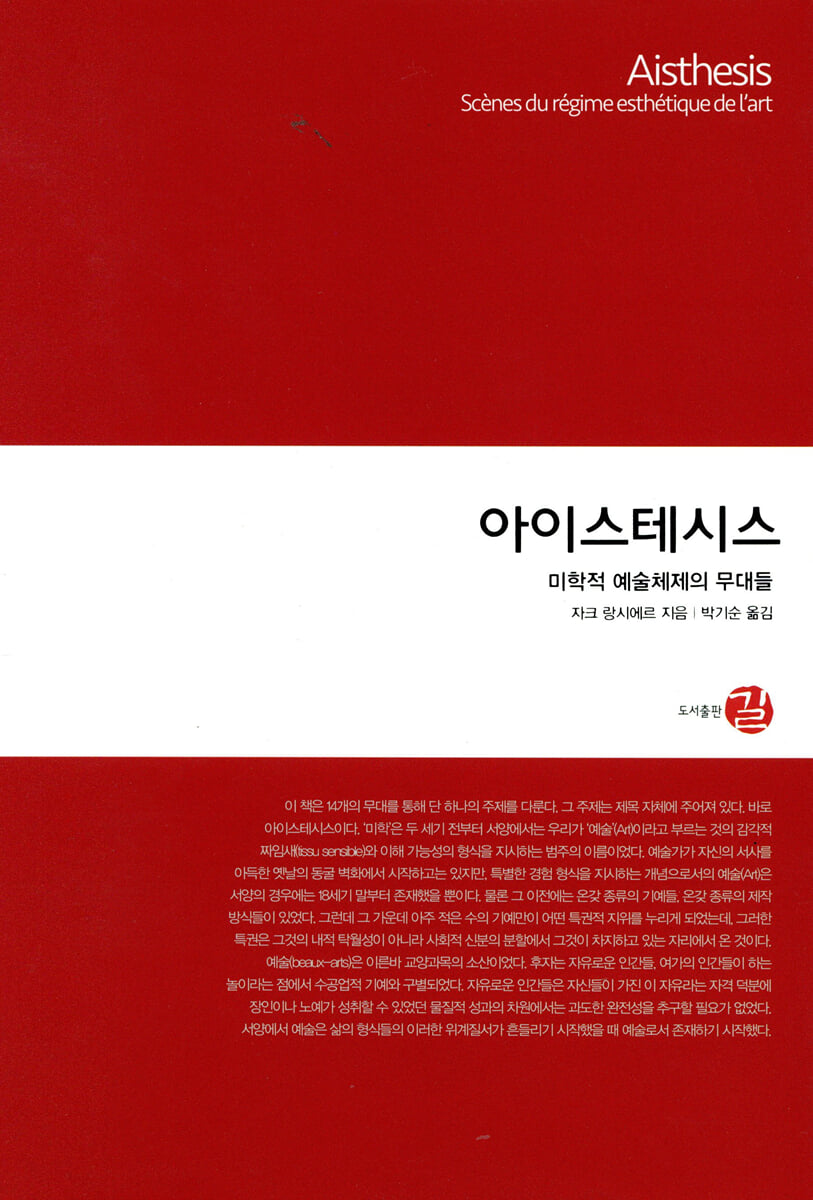
Book Introduction
Aesthesis, the culmination of Rancière's aesthetics and artistic thought
Jacques Rancière, in his political philosophy work Discord, understood ‘politics’ as a synonym for democracy.
Now, in his aesthetic masterpiece, Aesthesia, he presents ‘aesthetics’ as identical to democracy.
In other words, through this book, we come to confirm that aesthetics is nothing other than a democratic system.
As can be seen from the subtitle, ‘Stages of the Aesthetic Art System,’ this book is composed of ‘stages.’
The fourteen stages featured here cover major artistic events from the historical period from the mid-18th century to the mid-20th century.
In this respect, this book focuses on the art of a period that has traditionally been described and analyzed through the term 'modern'.
However, in this book, Rancière presents a new narrative that replaces the existing discourse on ‘modernism’ or ‘modernity’ through the unique method of ‘stage.’
The narrative can be read as a 'counter-history' (contre-histoire) against artistic modernity, as discussed in the 'Prelude' section of this book.
Rancière, who presents a new aesthetic discourse as a counter-history, ultimately explores ontological democracy.
First and foremost, he repeatedly emphasizes that when we break free from the norms of reason that establish a hierarchy by distinguishing between the useful and the harmful, the meaningful and the meaningless, the big and the small, etc., everything appears equal.
For him, the aesthetic system is a system of thought that explores and presents this equality.
This point is revealed above all in the dismantling of the traditional view that hierarchically distinguishes genres according to the subject of reproduction.
As is well known, until the modern era, historical paintings depicting myths, biblical stories, and major historical events, as well as portraits of royalty and nobility, were considered noble genres that dealt with noble subjects, whereas genre paintings depicting the everyday lives of common people, landscapes depicting natural objects, and still lifes depicting the most useless and dead objects were considered vulgar genres.
However, in the aesthetic system, art does not discriminate between the subjects it represents.
The aesthetic gaze is indifferent and detached from them.
But paradoxically, this detachment is nothing other than the egalitarian gaze that the world gives attention to everything.
Now, in this gaze, everything becomes equally an object of artistic representation.
Thus, as Rancière cites, “everything that makes up the universe, from the most noble to the most humble, from the Sistine Madonna of heaven to the Flemish drunkard,” has an “equal” right to belong to the artistic realm.
Jacques Rancière, in his political philosophy work Discord, understood ‘politics’ as a synonym for democracy.
Now, in his aesthetic masterpiece, Aesthesia, he presents ‘aesthetics’ as identical to democracy.
In other words, through this book, we come to confirm that aesthetics is nothing other than a democratic system.
As can be seen from the subtitle, ‘Stages of the Aesthetic Art System,’ this book is composed of ‘stages.’
The fourteen stages featured here cover major artistic events from the historical period from the mid-18th century to the mid-20th century.
In this respect, this book focuses on the art of a period that has traditionally been described and analyzed through the term 'modern'.
However, in this book, Rancière presents a new narrative that replaces the existing discourse on ‘modernism’ or ‘modernity’ through the unique method of ‘stage.’
The narrative can be read as a 'counter-history' (contre-histoire) against artistic modernity, as discussed in the 'Prelude' section of this book.
Rancière, who presents a new aesthetic discourse as a counter-history, ultimately explores ontological democracy.
First and foremost, he repeatedly emphasizes that when we break free from the norms of reason that establish a hierarchy by distinguishing between the useful and the harmful, the meaningful and the meaningless, the big and the small, etc., everything appears equal.
For him, the aesthetic system is a system of thought that explores and presents this equality.
This point is revealed above all in the dismantling of the traditional view that hierarchically distinguishes genres according to the subject of reproduction.
As is well known, until the modern era, historical paintings depicting myths, biblical stories, and major historical events, as well as portraits of royalty and nobility, were considered noble genres that dealt with noble subjects, whereas genre paintings depicting the everyday lives of common people, landscapes depicting natural objects, and still lifes depicting the most useless and dead objects were considered vulgar genres.
However, in the aesthetic system, art does not discriminate between the subjects it represents.
The aesthetic gaze is indifferent and detached from them.
But paradoxically, this detachment is nothing other than the egalitarian gaze that the world gives attention to everything.
Now, in this gaze, everything becomes equally an object of artistic representation.
Thus, as Rancière cites, “everything that makes up the universe, from the most noble to the most humble, from the Sistine Madonna of heaven to the Flemish drunkard,” has an “equal” right to belong to the artistic realm.
index
Overture 5
Chapter 1: The Separation of Beauty - Dresden, 1764
Chapter 2: The Young Gods of the Streets - Munich-Berlin, 1828, 53
Chapter 3: The Commoner's Sky - Paris, 1830, 79
Chapter 4: Poets of the New World—Boston, 1841—New York, 1855
Chapter 5: Acrobats Who Challenge the Impossible - Paris, 1879
Chapter 6: The Dance of Light - Théâtre des Folies-Bergère, Paris, 1893, 155
Chapter 7: The Floating Pole - Paris, 1894–95
Chapter 8: Decorative Art as Social Art: Temples, Houses, and Factories—Paris, London, and Berlin 209
Chapter 9: Masters of the Surface - Paris, 1902 239
Chapter 10: The Stairs to the Temple - Moscow-Dresden, 1912 263
Chapter 11: The Machine and Its Shadow - Hollywood, 1916 291
Chapter 12: The Greatness of the Moment - New York, 1921, 313
Chapter 13: Seeing Things Through Things - Moscow, 1926, 339
Chapter 14: The Cruel Splendor of Being - Hale County, 1936 - New York, 1941
Translator's Note: Rancière's Concept of the Stage and Egalitarianism 391
Translator's Note 455
Search 459
Chapter 1: The Separation of Beauty - Dresden, 1764
Chapter 2: The Young Gods of the Streets - Munich-Berlin, 1828, 53
Chapter 3: The Commoner's Sky - Paris, 1830, 79
Chapter 4: Poets of the New World—Boston, 1841—New York, 1855
Chapter 5: Acrobats Who Challenge the Impossible - Paris, 1879
Chapter 6: The Dance of Light - Théâtre des Folies-Bergère, Paris, 1893, 155
Chapter 7: The Floating Pole - Paris, 1894–95
Chapter 8: Decorative Art as Social Art: Temples, Houses, and Factories—Paris, London, and Berlin 209
Chapter 9: Masters of the Surface - Paris, 1902 239
Chapter 10: The Stairs to the Temple - Moscow-Dresden, 1912 263
Chapter 11: The Machine and Its Shadow - Hollywood, 1916 291
Chapter 12: The Greatness of the Moment - New York, 1921, 313
Chapter 13: Seeing Things Through Things - Moscow, 1926, 339
Chapter 14: The Cruel Splendor of Being - Hale County, 1936 - New York, 1941
Translator's Note: Rancière's Concept of the Stage and Egalitarianism 391
Translator's Note 455
Search 459
Publisher's Review
Exploring Ontological Democracy: An Aesthetic System Based on Equality
This became possible through what Rancière called ‘aesthetic separation.’
This separation occurred, on the one hand, through institutional changes such as the full-scale development of art museums in the 18th century, and, on the other hand, through corresponding changes in perspective and thinking about things.
Etymologically, the museum, which means a temple for the Muses, the goddess of art, can be defined, as a temple by its very nature, as a 'space of separation', a 'sacred space' separated from the secular and social.
The physical separation of the art museum from the social space becomes a symbolic space that enables new perspectives.
For example, when artifacts from ancient civilizations, such as vases, coins, or shields, are placed in a separate place like an art museum, they lose their original purpose and usefulness.
Our gaze, looking at them from a 'few steps away' in an art museum, cannot help but have both a temporal distance from the era in which they were produced and a spatial distance from the context of their lives.
Therefore, unless we are archaeologists who explore them as traces and testimonies of past civilizations, we are indifferent to their purpose and for whom they were created.
In this respect, our gaze is detached from the 'story' or 'exemplary value' contained in the relics or reproduced subjects placed before us.
Rather, what stands out in each object through the new aesthetic perspective is its symbolic capacity.
Everything in this world, no matter how small or insignificant it may seem, expresses the breath and vibration of the whole in its own way.
Rancière emphasizes this point of view by defining it as symbolism, and to the extent that symbolism is understood in this way, “symbolist poetics can be said to be egalitarian poetics.”
Whitman's poetic thesis, "A blade of grass is worth the labor of the stars," could be said to be an aesthetic expression of this ontological democracy.
Flaubert also said that Madame Bovary is a book that talks about nothing, emphasizing that there are no longer any beautiful or vulgar themes in art.
So he writes, like Whitman, “We can pour great love into the history of a blade of grass.”
Why only blades of grass? This time, leaves are summoned to aesthetically argue for ontological equality.
In a letter to his lover Louise Collet, Flaubert affirms the 'microscopic equality' of things, saying that although the leaves are different, they sway 'all together'.
However, this equality or this democracy should not be confused with political democracy.
Although Flaubert was not a democrat politically, he was a champion of ontological democracy and a representative of 'literary democracy' in that he practiced this democracy through literature.
In this way, Rancière is a more certain advocate of ‘democracy’ than anyone else.
In fact, Rancière argues that the separation between decorative and pure art, between craftsman and artist, can no longer be established, saying:
The plant motifs engraved on Gallé and Lalique's ornaments, the poster designs of Cheret, and the dancing draperies of Roy Fuller represent "a great democracy of natural forms."
Because these various sensory forms have the ability and right to manifest a supersensible meaning beyond themselves, and through this they constitute the entire world with infinitely rich meaning.
A serious question about the political nature of the artistry of the aesthetic system, and metapolitics.
But what does Rancière's aesthetic democracy have to do with political democracy? In fact, as Rancière repeatedly clarifies, art does not acquire political character through its social-critical function.
Political democracy is based on the equal right of all human beings to speak.
Aesthetic democracy, on the other hand, is based on the equal right of things to speak, on their equal capacity for symbolization.
Therefore, there is no direct connection between the two.
So, what is the political nature of art within an aesthetic system? Ultimately, this boils down to the question of the politics of autonomous art, a topic also addressed by Friedrich Schiller.
In principle, autonomous art is established through a break with the norms and rules that govern life.
However, it should be noted that this disconnection is not a separation from life itself.
Rather, it should be understood as an infiltration into the lives of those who have not been recognized for their rights within the logic of social life, and an expansion of life through it.
Schiller defines the state of aesthetic experience that enables this expansion of life and the world as the 'aesthetic state.'
According to him, it is this very state of mind that leads humans to unlimited freedom without any limitations.
In this sense, the aesthetic state can be said to be the generative foundation that makes everything possible.
Also, in this respect, it could be considered an 'aesthetic state of nature'.
Just as the state of nature is a state of freedom and equality in which everyone enjoys equal rights because it is free from hierarchical order, and thus is the genesis of all political communities, the aesthetic state established in autonomous art is also the genesis condition of all possible sensory communities.
In this way, we discover here what could be called a 'parallelism between politics and aesthetics'.
This is because both are formed from the same root of the modern ideals of freedom and equality, but are nothing more than two different expressions of it.
This parallelism explains why art, in some sense, is not directly related to politics.
Yet, no matter how pure an art it is, art is ‘fundamentally’ related to politics.
And the subject of politics is human beings.
But this human being becomes a human being in the full sense of the word in an aesthetic state.
In other words, humans are created and expanded there.
This is why aesthetic training and education for humans are necessary.
In this respect, Rancière calls the politics inherent in the art of the aesthetic regime ‘metapolitics.’
This became possible through what Rancière called ‘aesthetic separation.’
This separation occurred, on the one hand, through institutional changes such as the full-scale development of art museums in the 18th century, and, on the other hand, through corresponding changes in perspective and thinking about things.
Etymologically, the museum, which means a temple for the Muses, the goddess of art, can be defined, as a temple by its very nature, as a 'space of separation', a 'sacred space' separated from the secular and social.
The physical separation of the art museum from the social space becomes a symbolic space that enables new perspectives.
For example, when artifacts from ancient civilizations, such as vases, coins, or shields, are placed in a separate place like an art museum, they lose their original purpose and usefulness.
Our gaze, looking at them from a 'few steps away' in an art museum, cannot help but have both a temporal distance from the era in which they were produced and a spatial distance from the context of their lives.
Therefore, unless we are archaeologists who explore them as traces and testimonies of past civilizations, we are indifferent to their purpose and for whom they were created.
In this respect, our gaze is detached from the 'story' or 'exemplary value' contained in the relics or reproduced subjects placed before us.
Rather, what stands out in each object through the new aesthetic perspective is its symbolic capacity.
Everything in this world, no matter how small or insignificant it may seem, expresses the breath and vibration of the whole in its own way.
Rancière emphasizes this point of view by defining it as symbolism, and to the extent that symbolism is understood in this way, “symbolist poetics can be said to be egalitarian poetics.”
Whitman's poetic thesis, "A blade of grass is worth the labor of the stars," could be said to be an aesthetic expression of this ontological democracy.
Flaubert also said that Madame Bovary is a book that talks about nothing, emphasizing that there are no longer any beautiful or vulgar themes in art.
So he writes, like Whitman, “We can pour great love into the history of a blade of grass.”
Why only blades of grass? This time, leaves are summoned to aesthetically argue for ontological equality.
In a letter to his lover Louise Collet, Flaubert affirms the 'microscopic equality' of things, saying that although the leaves are different, they sway 'all together'.
However, this equality or this democracy should not be confused with political democracy.
Although Flaubert was not a democrat politically, he was a champion of ontological democracy and a representative of 'literary democracy' in that he practiced this democracy through literature.
In this way, Rancière is a more certain advocate of ‘democracy’ than anyone else.
In fact, Rancière argues that the separation between decorative and pure art, between craftsman and artist, can no longer be established, saying:
The plant motifs engraved on Gallé and Lalique's ornaments, the poster designs of Cheret, and the dancing draperies of Roy Fuller represent "a great democracy of natural forms."
Because these various sensory forms have the ability and right to manifest a supersensible meaning beyond themselves, and through this they constitute the entire world with infinitely rich meaning.
A serious question about the political nature of the artistry of the aesthetic system, and metapolitics.
But what does Rancière's aesthetic democracy have to do with political democracy? In fact, as Rancière repeatedly clarifies, art does not acquire political character through its social-critical function.
Political democracy is based on the equal right of all human beings to speak.
Aesthetic democracy, on the other hand, is based on the equal right of things to speak, on their equal capacity for symbolization.
Therefore, there is no direct connection between the two.
So, what is the political nature of art within an aesthetic system? Ultimately, this boils down to the question of the politics of autonomous art, a topic also addressed by Friedrich Schiller.
In principle, autonomous art is established through a break with the norms and rules that govern life.
However, it should be noted that this disconnection is not a separation from life itself.
Rather, it should be understood as an infiltration into the lives of those who have not been recognized for their rights within the logic of social life, and an expansion of life through it.
Schiller defines the state of aesthetic experience that enables this expansion of life and the world as the 'aesthetic state.'
According to him, it is this very state of mind that leads humans to unlimited freedom without any limitations.
In this sense, the aesthetic state can be said to be the generative foundation that makes everything possible.
Also, in this respect, it could be considered an 'aesthetic state of nature'.
Just as the state of nature is a state of freedom and equality in which everyone enjoys equal rights because it is free from hierarchical order, and thus is the genesis of all political communities, the aesthetic state established in autonomous art is also the genesis condition of all possible sensory communities.
In this way, we discover here what could be called a 'parallelism between politics and aesthetics'.
This is because both are formed from the same root of the modern ideals of freedom and equality, but are nothing more than two different expressions of it.
This parallelism explains why art, in some sense, is not directly related to politics.
Yet, no matter how pure an art it is, art is ‘fundamentally’ related to politics.
And the subject of politics is human beings.
But this human being becomes a human being in the full sense of the word in an aesthetic state.
In other words, humans are created and expanded there.
This is why aesthetic training and education for humans are necessary.
In this respect, Rancière calls the politics inherent in the art of the aesthetic regime ‘metapolitics.’
GOODS SPECIFICS
- Date of issue: October 16, 2024
- Format: Hardcover book binding method guide
- Page count, weight, size: 468 pages | 152*225*30mm
- ISBN13: 9788964452813
- ISBN10: 896445281X
You may also like
카테고리
korean


korean

![GQ KOREA Mark (Monthly): December [2025]](http://librairie.coreenne.fr/cdn/shop/files/8ef265dbbfbf186523ed75ba7319009d.jpg?v=1765340328&width=3840)


