

The missing spoon
 |
Description
Book Introduction
Hidden in the periodic table
Politics, history, money, alchemy, poison, crime, love, and science!
Why did Gandhi hate iodine? Why does nitrogen peacefully kill humans? Is there an element that robs artists of their inspiration? If we don't view the periodic table as something we learn in chemistry class and have to memorize, it holds fascinating, strange, and even chilling stories.
This book traces every element on the periodic table, including gold, silicon, tungsten, and carbon, and shows how they have influenced history, economics, mythology, war, art, medicine, and the lives of scientists.
Beginning with the author's fascination with mercury and awakening to the magic of the elements, this book explores the history, etymology, alchemy, mythology, literature, forensic toxicology, and psychology of each element.
According to the author, the periodic table has its own grammar, and if you read between the lines carefully, you can read some very surprising and new stories.
The author's writing style, which brings the periodic table to life, instantly changes the prejudice of readers that chemistry is difficult and rigid.
If we change the idea of the periodic table as a flat diagram posted on classroom walls or textbooks to something three-dimensional, anyone can enjoy the story of the elements with this book.
Politics, history, money, alchemy, poison, crime, love, and science!
Why did Gandhi hate iodine? Why does nitrogen peacefully kill humans? Is there an element that robs artists of their inspiration? If we don't view the periodic table as something we learn in chemistry class and have to memorize, it holds fascinating, strange, and even chilling stories.
This book traces every element on the periodic table, including gold, silicon, tungsten, and carbon, and shows how they have influenced history, economics, mythology, war, art, medicine, and the lives of scientists.
Beginning with the author's fascination with mercury and awakening to the magic of the elements, this book explores the history, etymology, alchemy, mythology, literature, forensic toxicology, and psychology of each element.
According to the author, the periodic table has its own grammar, and if you read between the lines carefully, you can read some very surprising and new stories.
The author's writing style, which brings the periodic table to life, instantly changes the prejudice of readers that chemistry is difficult and rigid.
If we change the idea of the periodic table as a flat diagram posted on classroom walls or textbooks to something three-dimensional, anyone can enjoy the story of the elements with this book.
- You can preview some of the book's contents.
Preview
index
preface
Chapter 1: The Structure and Birth of the Periodic Table
Geographic location is destiny
Elements that are like twins and black sheep: The Genealogy of the Elements
Galapagos Islands of the periodic table
Chapter 2: Creation and Decomposition of Atoms
Where did atoms come from? "We're all made of stardust."
Elements used in war
The periodic table completed with an explosion
The Expansion of the Periodic Table and the Spread of the Cold War
Chapter 3: Confusion Surrounding the Periodic Table: The Emergence of Complexity
From physics to biology
Hallway of Toxic Elements: "Ouch, Ouch"
The Elements That Create Miracle Medicines
The Tricks of the Elements
Chapter 4 Elements of Human Character
political elements
Elements used as money
Artistic elements
Element of Madness
Chapter 5: Elemental Science: Present and Future
The strange behavior of elements at extremely low temperatures
The Orb of Glory: The Science of Bubbles
An absurdly precise tool
Beyond the periodic table
Notes│References│Acknowledgments│Translator's Note│Index│Periodic Table of Elements
Chapter 1: The Structure and Birth of the Periodic Table
Geographic location is destiny
Elements that are like twins and black sheep: The Genealogy of the Elements
Galapagos Islands of the periodic table
Chapter 2: Creation and Decomposition of Atoms
Where did atoms come from? "We're all made of stardust."
Elements used in war
The periodic table completed with an explosion
The Expansion of the Periodic Table and the Spread of the Cold War
Chapter 3: Confusion Surrounding the Periodic Table: The Emergence of Complexity
From physics to biology
Hallway of Toxic Elements: "Ouch, Ouch"
The Elements That Create Miracle Medicines
The Tricks of the Elements
Chapter 4 Elements of Human Character
political elements
Elements used as money
Artistic elements
Element of Madness
Chapter 5: Elemental Science: Present and Future
The strange behavior of elements at extremely low temperatures
The Orb of Glory: The Science of Bubbles
An absurdly precise tool
Beyond the periodic table
Notes│References│Acknowledgments│Translator's Note│Index│Periodic Table of Elements
Publisher's Review
★ Amazon Science Top 10 Books of 2010!
★ New York Times Bestseller!
“Sam Kean is as funny as Bill Bryson.” _New Scientist
“This story is not just a fun read; it teaches you how to understand the periodic table in a way you will never find in a textbook or instructional guide.
We eat and breathe the elements of the periodic table.
People bet and lose huge amounts of money on the elements in the periodic table.
Philosophers use the periodic table to find meaning in science.
The periodic table poisons people and breeds war.
Between hydrogen at the top left and the artificial elements at the bottom, you will encounter bubbles, bombs, money, alchemy, politics, history, poison, crime, and love.
And you can even get a little science involved.” _From the preface
The periodic table and politics, history, money, alchemy, poison, crime, love, and science
Why did Gandhi hate iodine? Why did the Japanese use cadmium missiles to kill Godzilla? How did tellurium spark history's most bizarre gold rush?
Every element on the periodic table has its own interesting, strange, and eerie story.
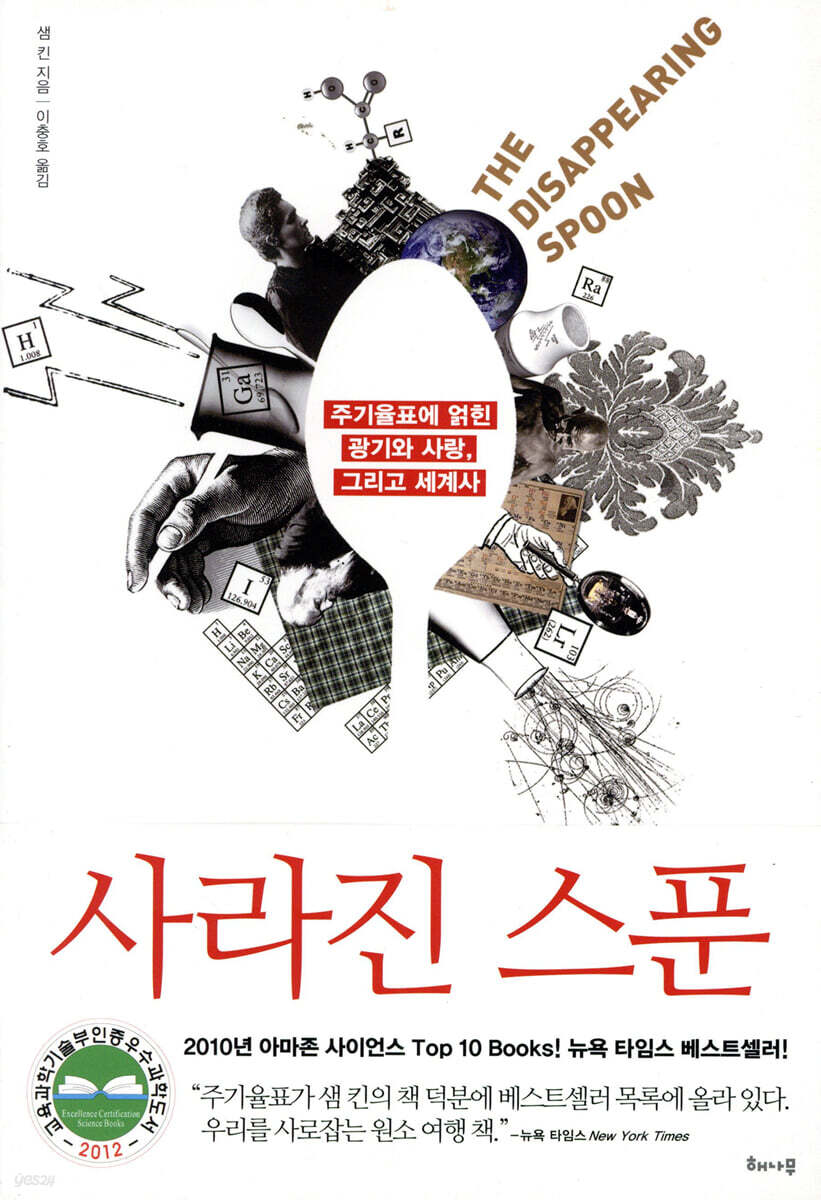
Sam Keen's The Disappearing Spoon (original title: The Disappearing Spoon: And Other True Tales of Madness, Love, and the History of the World from the Periodic Table of the Elements) is a book that traces each element on the periodic table and tells the stories behind them with witty banter.
The story of the elements by Sam Keen, a young storyteller who burst onto the scene in 2010, is a fascinating blend of the history of elemental discovery, the history of greed and adventure, and anecdotes about scientists.
Just as everything in this world is made of elements, this book is characterized by overflowing stories of history, economics, mythology, war, art, medicine, and science.
Passion, adventure, betrayal, and greed are intertwined in this endless story of elements that bubbles up like bubbles.
For the author, who discovers history, etymology, alchemy, mythology, literature, forensic toxicology, and psychology in a single element called 'mercury,' the periodic table is "a fascinating storybook."
The periodic table has its own grammar, and if you read between the lines carefully, you can read some very surprising and new stories.
The story moves from the smallest atom to the universe and galaxies, and it spans continents, encompassing not only the life of an individual but also the history of the Earth spanning hundreds of billions of years.
Perhaps many readers will be captivated by the author's writing style, which breathes life into the flat periodic table, and change their prejudice that chemistry is difficult and rigid.
The periodic table is a list of all the elements that exist in the universe.
The author explores the elements from the east and works his way west, or from the top and works his way down, uncovering interesting stories along the way.
For example, if you make a spoon out of gallium, which is solid at room temperature, and put it in a hot cup of tea, the spoon will disappear because of its low melting point.
Fritz Haber, like Faust, created artificial fertilizers using nitrogen and saved millions of lives, but he also developed poisonous gases using bromine and chlorine and killed hundreds of thousands of people.
Stanisław Marcin Ulam spent his time playing cards when he developed the Monte Carlo method, which became the basis for the invention of the hydrogen bomb.
This is similar to the method used by many scientists' wives to calculate random numbers with a pencil when creating the atomic bomb.
A U.S. Senate candidate who believed in the antibacterial properties of silver developed silver dermatitis, a condition that caused his skin to turn blue.
As if dressed up for Halloween.
There are also many dramatic elemental stories.
If his son had not been in the lab with James Watson and Francis Crick, Linus Pauling would probably have won his third Nobel Prize for first discovering the double helix structure of DNA, and would have joined the ranks of great scientists like Newton and Einstein as a chemist.
Nobel laureate Enrico Fermi suffered a ruptured lung at age 53 after inhaling too much sweet but toxic beryllium dust during an experiment.
In the case of the outstanding female physicist Lise Meitner, she was the first scientist to discover nuclear fission, but she did not receive the Nobel Prize due to the absurd ignorance and lack of understanding of the Nobel Prize committee.
Wilhelm Röntgen suffered for a long time, wondering if he was crazy, after discovering that X-rays could show the bones in the palm of his hand, until he regained confidence when he discovered that his wife could also see X-rays.
The scientific fraud committed by Stanley Pons and Martin Fleischmann, who became notorious fraudsters by claiming cold fusion, is absurd.
Like this, Sam Keen's element stories show us that the periodic table isn't just for boring science textbooks.
According to him, the periodic table, humanity's greatest intellectual asset, is not a chart that only appears on the walls of high school classrooms.
Anyone can enjoy the periodic table if they use their imagination enough.
Interesting examples of elemental stories contained in books
- Molybdenum and the Greedy War: Molybdenum is an effective element for making weapons by strengthening steel.
The only source of molybdenum was a mine in Bartlett Mountain, Colorado, owned by a feisty banker named Otis King during World War I.
Recognizing the importance of molybdenum, the German company Metalgesellschaft instructed its Colorado chief executive, Max Schott, to get his hands on Mount Bartlett.
Short then sent out violent enforcers to threaten the miners' wives and children, attack Otis King with a knife and a pickaxe, and throw him off a steep cliff.
Max Short would stop at nothing to sabotage King, short of outright murder.
King barely survived, but could not withstand Max Short's persistent attacks and harassment, and eventually sold the mine to Short for the paltry price of $40,000.
- The duality of tungsten and Portugal: Nazi Germany needed a lot of tungsten to make missiles.
Who supplied Germany with tungsten during World War II? It was none other than Portugal, a country that remained ostensibly neutral.
Portuguese dictator Antónioud Oliveira Salazar made huge profits by exporting tungsten to both the Axis and Allied powers.
Tungsten was transported through Spain, and much of the gold seized from Jews by the Nazis was laundered in banks in Lisbon and Switzerland.
Even hard-line Britain, which had been reluctant to interfere in the tungsten trade used to kill its own soldiers, finally took a hard line against the iron-fisted dictator Salazar under aggressive pressure from the United States.
- Tantalum, niobium and the tragedy of Congo: Tantalum and niobium, which are produced in large quantities in Congo, are used in small cell phones.
The influx of cash into Congo from the mining of tantalum and niobium has irreversibly escalated decades of accumulating ethnic conflict.
There is nothing worse than money pouring into a country without a proper government.
Ruthless capitalism has taken over, and everything, including life, can be bought and sold for money.
Huge camps were built everywhere, housing prostitutes who lived like slaves, and huge sums of money were paid for their bloody murders.
Since the mid-1990s, more than 5 million people have died in Congo, the largest loss of life since World War II.
- History of Thallium and Poisoning: Element 81, thallium, is the most lethal element in the periodic table.
Once thallium enters the body, it removes the potassium mask and prevents the proteins from functioning properly.
And by moving around the body like a Mongol cavalryman, a single atom can cause widespread damage.
This thallium has a gruesome history, having been used to kill spies, orphans, and wealthy great-aunts.
Although it ended in failure, the CIA also used thallium in an attempt to assassinate Fidel Castro in Cuba.
They tried to kill Castro by sprinkling talcum powder mixed with thallium on his socks.
- The bizarre deaths of NASA headquarters technicians and nitrogen: In 1981, five NASA headquarters technicians collapsed simultaneously, as if performing a ballet, after being placed in a nitrogen-filled chamber.
And three of them passed away.
Nitrogen not only prevented neurons and heart cells from absorbing fresh oxygen, but also hastened the technicians' deaths by pushing out the small amount of oxygen stored in the cells for emergencies.
The technicians did not struggle despite the lack of oxygen.
This is because our bodies are sensitive to carbon, but not to nitrogen.
Nitrogen has no odor or color, and does not form acid in the bloodstream.
We breathe nitrogen in and out easily, our lungs feel no harm, and nitrogen flows in and out freely without touching any of our psychological tripwires.
Nitrogen bypasses our body's security systems and “mercifully kills” us.
- Iodine and Gandhi's feud: In 1930, Gandhi took part in the Salt March to protest the salt tax imposed by the British government.
At that time, Indians simply collected seawater, evaporated it, and put the dried salt in sacks to sell on the streets.
However, the British government greedily imposed an 8.2 percent tax on all salt produced.
At the same time, the British government ordered the addition of iodine to salt.
Because adding iodine could prevent millions of children from being born with birth defects.
However, the perception that the iodized salt imposed on India by the West was a remnant of colonialism spread widely, and as non-iodized salt was distributed, birth defects increased.
- Tellurium and the Strange Gold Rush: When gold was discovered in large quantities at Hannan's Find (now Kalgoorlie), Australia, people flocked to the area.
During mining, calaverite, a tellurium compound with a yellowish sheen, was also found, but everyone thought it was useless and discarded it or used it as bricks.
It was then discovered that when this rock melted, gold was extracted from the compound.
Then more people flocked to Hannansfind.
On May 29, 1896, chaos finally broke out.
People rushed to the garbage heaps, looked for calaverite among the discarded rocks, tore up the pavement that covered the pits, and tore up the sidewalks.
The miner, who had built a chimney and fireplace with bricks mixed with gold and tellurium to build a new house, did not hesitate to destroy the house.
- Lithium and Lost Inspiration: Robert Lowell was a poet of travelogues.
Those around him thought Lowell's eccentricities were an outburst of poetic inspiration.
However, doctors diagnosed Lowell with bipolar disorder, a chemical imbalance, and prescribed lithium.
Lithium works by regulating proteins that control the biological clock, preventing mania from rising or depression from worsening.
Afterwards, those around him believed that instead of giving Lowell health, lithium had stunted his art and turned the mad genius into an ordinary human being.
Praise poured in from overseas media
“Sam Kean brings a delightful laugh like Bill Bryson.
…a vivid history of chemical elements and the people who appeared in the process of their discovery.” - New Scientist
“The periodic table is on the bestseller list thanks to Sam Keen’s book.
“A captivating elemental journey, with a burst of brilliance as unrefined sodium falls into the water…” - The New York Times
“On a hot summer day, with a cool gin and tonic, a non-fiction book that leaves an intellectual impression.
“A book about the human history hidden behind the periodic table.” - Time
“In biology, there have often been instances where a writer possessed both the eye and the skill to capture the charm and fun of science, but in chemistry, it seems to have happened only once, very rarely.
Sam Keen's book is full of interesting insights.
“I wish I had taken a chemistry class after reading this book.”
-Mark Kurlansky, author of "Salt"
“Sam Kean’s writing comes to me like a little electric shock, a spark flying.
…Sam Keen breathes such life into science that you'll find yourself turning each page, unable to wait to see what happens next.”
- Boston Globe
“It calmly and interestingly explains the tricks of the periodic table, such as how heavy substances like lead can turn into gold.
…has the rich anecdotes of Oliver Sacks and the popular appeal of Malcolm Gladwell.”
- Entertainment Weekly
“With a steady stream of interesting facts, Sam Keen delivers his debut with wit and flair, ensuring readers will be entertained.” - Publishers Weekly
“If Sam Keen were in charge of planning the chemistry curriculum, we would all be a little more interested in the often thrilling and sometimes shocking interactions between protons and electrons.”
- Minneapolis Star-Tribune
“A provocative book… cleverly planned and accessible.” - The Guardian
“One of the most readable and entertaining books on science ever published.” - U.S. Express
K. Express)
“A book that puts an end to the idea that science is boring.”
- Chemical & Engineering News
“It is at times humorous and tragic, at times intriguing and satirical.
Sam Keen captures structures that are often thought of as purely utilitarian with a human perspective that is both ingenious and never tiresome.” - Seed
“(Sam Keen) has done a remarkable job.
He made highly technical scientific material accessible, placed well-known and lesser-known discoveries in historical context, and told the stories of the lives of scientists, both men and women, in a captivating way.”
-Austin American-Statesman
“If you ever had to stare somewhat listlessly at the periodic table on the wall of a chemistry lab in high school, this book is for you.
“This book conveys the meaning and glory of the symbols and numbers of chemical elements in a simple, clear, and quick way.” - Bill McKibben, author of Earth
“The author is a wonderful storyteller with a wealth of stories to tell.… In fact, Sam Keen manages to make the vast history of science, spanning nearly 150 years, all seem fascinating.
“Fun and enlightening.” - Kirkus Reviews
“A must-read for the summer of 2010.” - LA Times
A Times)
“This book celebrates the beauty of the periodic table and shines a bright light on it.
“Follow Sam Keen’s humorous yet accessible journey into the complex geography of chemical elements, wandering through astronomy, biology, and history. Learn about neon rain and gas fields, meet both hard-nosed and selfless scientists, and before the book is over, dive into every chemistry topic except the arcane.” — Bill Streever, author of Cold
“Sam Keen writes in a quirky yet readable style… Highly recommended for anyone looking for both information and entertainment.” - Library Journal
★ New York Times Bestseller!
“Sam Kean is as funny as Bill Bryson.” _New Scientist
“This story is not just a fun read; it teaches you how to understand the periodic table in a way you will never find in a textbook or instructional guide.
We eat and breathe the elements of the periodic table.
People bet and lose huge amounts of money on the elements in the periodic table.
Philosophers use the periodic table to find meaning in science.
The periodic table poisons people and breeds war.
Between hydrogen at the top left and the artificial elements at the bottom, you will encounter bubbles, bombs, money, alchemy, politics, history, poison, crime, and love.
And you can even get a little science involved.” _From the preface
The periodic table and politics, history, money, alchemy, poison, crime, love, and science
Why did Gandhi hate iodine? Why did the Japanese use cadmium missiles to kill Godzilla? How did tellurium spark history's most bizarre gold rush?
Every element on the periodic table has its own interesting, strange, and eerie story.
Sam Keen's The Disappearing Spoon (original title: The Disappearing Spoon: And Other True Tales of Madness, Love, and the History of the World from the Periodic Table of the Elements) is a book that traces each element on the periodic table and tells the stories behind them with witty banter.
The story of the elements by Sam Keen, a young storyteller who burst onto the scene in 2010, is a fascinating blend of the history of elemental discovery, the history of greed and adventure, and anecdotes about scientists.
Just as everything in this world is made of elements, this book is characterized by overflowing stories of history, economics, mythology, war, art, medicine, and science.
Passion, adventure, betrayal, and greed are intertwined in this endless story of elements that bubbles up like bubbles.
For the author, who discovers history, etymology, alchemy, mythology, literature, forensic toxicology, and psychology in a single element called 'mercury,' the periodic table is "a fascinating storybook."
The periodic table has its own grammar, and if you read between the lines carefully, you can read some very surprising and new stories.
The story moves from the smallest atom to the universe and galaxies, and it spans continents, encompassing not only the life of an individual but also the history of the Earth spanning hundreds of billions of years.
Perhaps many readers will be captivated by the author's writing style, which breathes life into the flat periodic table, and change their prejudice that chemistry is difficult and rigid.
The periodic table is a list of all the elements that exist in the universe.
The author explores the elements from the east and works his way west, or from the top and works his way down, uncovering interesting stories along the way.
For example, if you make a spoon out of gallium, which is solid at room temperature, and put it in a hot cup of tea, the spoon will disappear because of its low melting point.
Fritz Haber, like Faust, created artificial fertilizers using nitrogen and saved millions of lives, but he also developed poisonous gases using bromine and chlorine and killed hundreds of thousands of people.
Stanisław Marcin Ulam spent his time playing cards when he developed the Monte Carlo method, which became the basis for the invention of the hydrogen bomb.
This is similar to the method used by many scientists' wives to calculate random numbers with a pencil when creating the atomic bomb.
A U.S. Senate candidate who believed in the antibacterial properties of silver developed silver dermatitis, a condition that caused his skin to turn blue.
As if dressed up for Halloween.
There are also many dramatic elemental stories.
If his son had not been in the lab with James Watson and Francis Crick, Linus Pauling would probably have won his third Nobel Prize for first discovering the double helix structure of DNA, and would have joined the ranks of great scientists like Newton and Einstein as a chemist.
Nobel laureate Enrico Fermi suffered a ruptured lung at age 53 after inhaling too much sweet but toxic beryllium dust during an experiment.
In the case of the outstanding female physicist Lise Meitner, she was the first scientist to discover nuclear fission, but she did not receive the Nobel Prize due to the absurd ignorance and lack of understanding of the Nobel Prize committee.
Wilhelm Röntgen suffered for a long time, wondering if he was crazy, after discovering that X-rays could show the bones in the palm of his hand, until he regained confidence when he discovered that his wife could also see X-rays.
The scientific fraud committed by Stanley Pons and Martin Fleischmann, who became notorious fraudsters by claiming cold fusion, is absurd.
Like this, Sam Keen's element stories show us that the periodic table isn't just for boring science textbooks.
According to him, the periodic table, humanity's greatest intellectual asset, is not a chart that only appears on the walls of high school classrooms.
Anyone can enjoy the periodic table if they use their imagination enough.
Interesting examples of elemental stories contained in books
- Molybdenum and the Greedy War: Molybdenum is an effective element for making weapons by strengthening steel.
The only source of molybdenum was a mine in Bartlett Mountain, Colorado, owned by a feisty banker named Otis King during World War I.
Recognizing the importance of molybdenum, the German company Metalgesellschaft instructed its Colorado chief executive, Max Schott, to get his hands on Mount Bartlett.
Short then sent out violent enforcers to threaten the miners' wives and children, attack Otis King with a knife and a pickaxe, and throw him off a steep cliff.
Max Short would stop at nothing to sabotage King, short of outright murder.
King barely survived, but could not withstand Max Short's persistent attacks and harassment, and eventually sold the mine to Short for the paltry price of $40,000.
- The duality of tungsten and Portugal: Nazi Germany needed a lot of tungsten to make missiles.
Who supplied Germany with tungsten during World War II? It was none other than Portugal, a country that remained ostensibly neutral.
Portuguese dictator Antónioud Oliveira Salazar made huge profits by exporting tungsten to both the Axis and Allied powers.
Tungsten was transported through Spain, and much of the gold seized from Jews by the Nazis was laundered in banks in Lisbon and Switzerland.
Even hard-line Britain, which had been reluctant to interfere in the tungsten trade used to kill its own soldiers, finally took a hard line against the iron-fisted dictator Salazar under aggressive pressure from the United States.
- Tantalum, niobium and the tragedy of Congo: Tantalum and niobium, which are produced in large quantities in Congo, are used in small cell phones.
The influx of cash into Congo from the mining of tantalum and niobium has irreversibly escalated decades of accumulating ethnic conflict.
There is nothing worse than money pouring into a country without a proper government.
Ruthless capitalism has taken over, and everything, including life, can be bought and sold for money.
Huge camps were built everywhere, housing prostitutes who lived like slaves, and huge sums of money were paid for their bloody murders.
Since the mid-1990s, more than 5 million people have died in Congo, the largest loss of life since World War II.
- History of Thallium and Poisoning: Element 81, thallium, is the most lethal element in the periodic table.
Once thallium enters the body, it removes the potassium mask and prevents the proteins from functioning properly.
And by moving around the body like a Mongol cavalryman, a single atom can cause widespread damage.
This thallium has a gruesome history, having been used to kill spies, orphans, and wealthy great-aunts.
Although it ended in failure, the CIA also used thallium in an attempt to assassinate Fidel Castro in Cuba.
They tried to kill Castro by sprinkling talcum powder mixed with thallium on his socks.
- The bizarre deaths of NASA headquarters technicians and nitrogen: In 1981, five NASA headquarters technicians collapsed simultaneously, as if performing a ballet, after being placed in a nitrogen-filled chamber.
And three of them passed away.
Nitrogen not only prevented neurons and heart cells from absorbing fresh oxygen, but also hastened the technicians' deaths by pushing out the small amount of oxygen stored in the cells for emergencies.
The technicians did not struggle despite the lack of oxygen.
This is because our bodies are sensitive to carbon, but not to nitrogen.
Nitrogen has no odor or color, and does not form acid in the bloodstream.
We breathe nitrogen in and out easily, our lungs feel no harm, and nitrogen flows in and out freely without touching any of our psychological tripwires.
Nitrogen bypasses our body's security systems and “mercifully kills” us.
- Iodine and Gandhi's feud: In 1930, Gandhi took part in the Salt March to protest the salt tax imposed by the British government.
At that time, Indians simply collected seawater, evaporated it, and put the dried salt in sacks to sell on the streets.
However, the British government greedily imposed an 8.2 percent tax on all salt produced.
At the same time, the British government ordered the addition of iodine to salt.
Because adding iodine could prevent millions of children from being born with birth defects.
However, the perception that the iodized salt imposed on India by the West was a remnant of colonialism spread widely, and as non-iodized salt was distributed, birth defects increased.
- Tellurium and the Strange Gold Rush: When gold was discovered in large quantities at Hannan's Find (now Kalgoorlie), Australia, people flocked to the area.
During mining, calaverite, a tellurium compound with a yellowish sheen, was also found, but everyone thought it was useless and discarded it or used it as bricks.
It was then discovered that when this rock melted, gold was extracted from the compound.
Then more people flocked to Hannansfind.
On May 29, 1896, chaos finally broke out.
People rushed to the garbage heaps, looked for calaverite among the discarded rocks, tore up the pavement that covered the pits, and tore up the sidewalks.
The miner, who had built a chimney and fireplace with bricks mixed with gold and tellurium to build a new house, did not hesitate to destroy the house.
- Lithium and Lost Inspiration: Robert Lowell was a poet of travelogues.
Those around him thought Lowell's eccentricities were an outburst of poetic inspiration.
However, doctors diagnosed Lowell with bipolar disorder, a chemical imbalance, and prescribed lithium.
Lithium works by regulating proteins that control the biological clock, preventing mania from rising or depression from worsening.
Afterwards, those around him believed that instead of giving Lowell health, lithium had stunted his art and turned the mad genius into an ordinary human being.
Praise poured in from overseas media
“Sam Kean brings a delightful laugh like Bill Bryson.
…a vivid history of chemical elements and the people who appeared in the process of their discovery.” - New Scientist
“The periodic table is on the bestseller list thanks to Sam Keen’s book.
“A captivating elemental journey, with a burst of brilliance as unrefined sodium falls into the water…” - The New York Times
“On a hot summer day, with a cool gin and tonic, a non-fiction book that leaves an intellectual impression.
“A book about the human history hidden behind the periodic table.” - Time
“In biology, there have often been instances where a writer possessed both the eye and the skill to capture the charm and fun of science, but in chemistry, it seems to have happened only once, very rarely.
Sam Keen's book is full of interesting insights.
“I wish I had taken a chemistry class after reading this book.”
-Mark Kurlansky, author of "Salt"
“Sam Kean’s writing comes to me like a little electric shock, a spark flying.
…Sam Keen breathes such life into science that you'll find yourself turning each page, unable to wait to see what happens next.”
- Boston Globe
“It calmly and interestingly explains the tricks of the periodic table, such as how heavy substances like lead can turn into gold.
…has the rich anecdotes of Oliver Sacks and the popular appeal of Malcolm Gladwell.”
- Entertainment Weekly
“With a steady stream of interesting facts, Sam Keen delivers his debut with wit and flair, ensuring readers will be entertained.” - Publishers Weekly
“If Sam Keen were in charge of planning the chemistry curriculum, we would all be a little more interested in the often thrilling and sometimes shocking interactions between protons and electrons.”
- Minneapolis Star-Tribune
“A provocative book… cleverly planned and accessible.” - The Guardian
“One of the most readable and entertaining books on science ever published.” - U.S. Express
K. Express)
“A book that puts an end to the idea that science is boring.”
- Chemical & Engineering News
“It is at times humorous and tragic, at times intriguing and satirical.
Sam Keen captures structures that are often thought of as purely utilitarian with a human perspective that is both ingenious and never tiresome.” - Seed
“(Sam Keen) has done a remarkable job.
He made highly technical scientific material accessible, placed well-known and lesser-known discoveries in historical context, and told the stories of the lives of scientists, both men and women, in a captivating way.”
-Austin American-Statesman
“If you ever had to stare somewhat listlessly at the periodic table on the wall of a chemistry lab in high school, this book is for you.
“This book conveys the meaning and glory of the symbols and numbers of chemical elements in a simple, clear, and quick way.” - Bill McKibben, author of Earth
“The author is a wonderful storyteller with a wealth of stories to tell.… In fact, Sam Keen manages to make the vast history of science, spanning nearly 150 years, all seem fascinating.
“Fun and enlightening.” - Kirkus Reviews
“A must-read for the summer of 2010.” - LA Times
A Times)
“This book celebrates the beauty of the periodic table and shines a bright light on it.
“Follow Sam Keen’s humorous yet accessible journey into the complex geography of chemical elements, wandering through astronomy, biology, and history. Learn about neon rain and gas fields, meet both hard-nosed and selfless scientists, and before the book is over, dive into every chemistry topic except the arcane.” — Bill Streever, author of Cold
“Sam Keen writes in a quirky yet readable style… Highly recommended for anyone looking for both information and entertainment.” - Library Journal
GOODS SPECIFICS
- Date of publication: October 28, 2011
- Page count, weight, size: 497 pages | 740g | 153*224*30mm
- ISBN13: 9788956055510
- ISBN10: 8956055513
You may also like
카테고리
korean


korean

![GQ KOREA Mark (Monthly): December [2025]](http://librairie.coreenne.fr/cdn/shop/files/8ef265dbbfbf186523ed75ba7319009d.jpg?v=1765340328&width=3840)


