

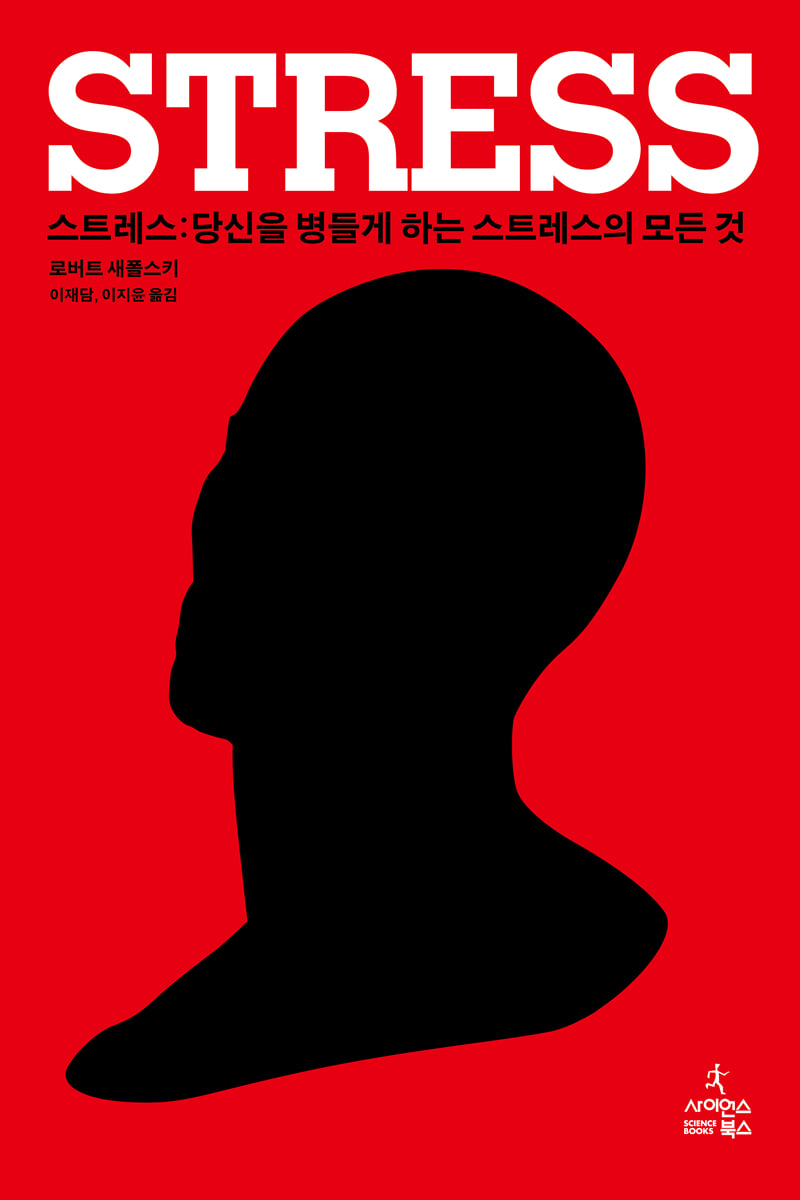
STRESS
 |
Description
Book Introduction
Everything you need to know about stress, from the causes of stress and stress-related diseases to effective stress management methods, from a stress expert!
Dr. Robert Sapolsky, a renowned neuroendocrinologist and primatologist who has studied stress for over 30 years, accurately identifies the causes of stress and introduces coping methods to effectively manage stress.
It is said that modern people are under a lot of stress and that excessive stress can harm their health.
However, the author says that if we understand the mechanism by which the stress response occurs in the human body, stress is not an incurable disease that can never be overcome.
By compiling the research findings on stress, this book introduces a method to find a smart stress coping method tailored to each individual by thoroughly understanding stress, rather than the existing self-help or practical books that simply list stress management methods.
The author emphasizes that change has already begun with the simple act of genuinely wanting to change something and making an effort to do so, and that the moment you take the first step toward breaking free from the swamp of stress, you can overcome a lot of stress.
Dr. Robert Sapolsky, a renowned neuroendocrinologist and primatologist who has studied stress for over 30 years, accurately identifies the causes of stress and introduces coping methods to effectively manage stress.
It is said that modern people are under a lot of stress and that excessive stress can harm their health.
However, the author says that if we understand the mechanism by which the stress response occurs in the human body, stress is not an incurable disease that can never be overcome.
By compiling the research findings on stress, this book introduces a method to find a smart stress coping method tailored to each individual by thoroughly understanding stress, rather than the existing self-help or practical books that simply list stress management methods.
The author emphasizes that change has already begun with the simple act of genuinely wanting to change something and making an effort to do so, and that the moment you take the first step toward breaking free from the swamp of stress, you can overcome a lot of stress.
- You can preview some of the book's contents.
Preview
index
preface
1.
Stress and You
2.
Stress and the Brain
3.
Stress and the Heart
4.
Stress and Energy Metabolism
5.
Stress and Digestion
6.
Stress and Growth
7.
Stress and Sex
8.
Stress and Immunity
9.
Stress and pain
10.
Stress and Memory
11.
Stress and sleep
12.
Stress and Aging
13.
mental stress
14.
stress and depression
15.
Stress and Personality
16.
Stress and Addiction
17.
Stress and social hierarchy
18.
Managing Stress
Note
Further Reading
Pictorial copyright
1.
Stress and You
2.
Stress and the Brain
3.
Stress and the Heart
4.
Stress and Energy Metabolism
5.
Stress and Digestion
6.
Stress and Growth
7.
Stress and Sex
8.
Stress and Immunity
9.
Stress and pain
10.
Stress and Memory
11.
Stress and sleep
12.
Stress and Aging
13.
mental stress
14.
stress and depression
15.
Stress and Personality
16.
Stress and Addiction
17.
Stress and social hierarchy
18.
Managing Stress
Note
Further Reading
Pictorial copyright
Publisher's Review
Are you losing sleep all night worrying about tomorrow's meeting?
Are you suffering from chronic indigestion due to the daily falling stock prices?
Are you sick and tired of being stuck in a traffic jam for two hours?
The list of stressors plaguing modern people is endless, from minor parking disputes in the alley in front of our house to promotions at work, children's education, home ownership, and even the economic downturn.
We live with chronic stress, to the point where we routinely say, “Oh, I’m so stressed!” and suffer from various diseases caused by it. However, we do not even know what stress is or how harmful it is to our body and mind.
In such a stressful world, is it impossible to live stress-free? Is it truly impossible to escape the swamp of stress? Dr. Robert Sapolsky, a renowned neuroendocrinologist and primatologist who has studied stress for over 30 years, argues that if we accurately identify the causes of stress and understand the mechanisms that drive the stress response within the body, stress is not an incurable disease.
『STRESS: Everything About Stress That Makes You Sick (Why Zebra Don't Get Ulcers)』, published by Science Books, warns that stress, which is so common that it is easily overlooked, can cause serious illnesses such as heart disease, high blood pressure, and degenerative brain diseases, not just indigestion or migraines. It also introduces stress coping methods that can effectively manage stress.
Stress and You
Close your eyes and think of things that stress you out.
Conflicts with your boss at work, loan interest, stock market crash, anxiety about retirement…
What causes your blood pressure to fluctuate dozens of times a day, and leaves you breathing heavily and blushing, is often not an immediate physical threat, but rather a psychological or socioeconomic problem.
Sometimes it's not something that's right in front of us, it's something that hasn't even happened yet, and it's something that's in the distant future and we don't even know if it will actually happen or not.
So why does simply thinking about events that don't directly harm my body cause my heart rate to spike, my back to ache, my digestion to suffer, and if prolonged, a feeling of lethargy and fatigue to set in? To truly understand the stress response, Dr. Sapolsky, a stress expert, recommends turning to the African savanna.
On a warm, sunny autumn afternoon, you are leisurely strolling through a meadow, wondering what to eat for a snack as you begin to feel hungry.
Just as I was about to step onto the edge of the forest, thinking that there were fruit trees in the nearby forest, alas! I bumped into a lion napping under a tree.
When faced with an unexpected emergency, every organ in your body immediately shifts gears to cope with the crisis.
The digestive tract stops functioning and the respiratory rate increases rapidly.
Secretion of sex hormones is suppressed, while epinephrine, norepinephrine, and glucocorticoids are released into the bloodstream.
Step, save me, the heart rate increases further to jump and supply oxygen and energy to the leg muscles.
Originally, the stress response was designed to mobilize the body's internal organs in emergency situations, such as encountering an enemy, so that the body can quickly escape from the enemy.
The need to rapidly mobilize energy from storage sites and deliver it to major muscles as quickly as possible increases heart rate, blood pressure, and respiratory rate, and long-term plans such as digestion, immunity, and reproduction are postponed for the time being.
But when we humans left the wilds of Africa, we shed most of the physical stress that comes directly to our bodies, like encountering lions or being bitten by snakes hiding under rocks.
Instead, with the development of society, we have come to bear more diverse and sophisticated mental stress.
The stress response, which serves to protect our lives from enemies in emergency situations, has become an enemy that makes our bodies and minds sick as the stress that causes it has become distorted and chronic.
Stress and Disease
It has long been known that chronic stress is harmful to our bodies and minds.
However, because stressful events are commonplace and occur on a daily basis, the extent of their impact and their severity are not well known.
As recently reported by foreign media, a study by the Karolinska Institute in Sweden found that employees working under a boss with poor leadership are 25 percent more likely to develop heart disease than others, and the actual link between stress and various diseases has been frequently reported in recent years.
The author of this book, Dr. Sapolsky, is at the center of stress physiology, which studies how stress, a chronic disease of modern people, can cause more serious and even fatal diseases such as heart disease, high blood pressure, and stomach ulcers.
For over 30 years, Dr. Sapolsky has studied the correlation between groups and stress through the wild baboon society in Kenya, Africa, which has a high degree of sociality similar to humans and experiences various stresses due to inter-individual relationships such as dominance hierarchies. At the same time, he has also studied the connection between stress and brain disease, such as proving for the first time in the world through experiments on rats at Stanford University School of Medicine that stress destroys nerve cells in the hippocampus of the brain.
Dr. Sapolsky, a world-renowned stress expert who regularly writes for various daily newspapers and magazines aimed at the general public as well as professional academic journals including medical and scientific journals, has compiled the results of his research on stress to publish a unique encyclopedia of stress that seeks to help individuals find wise stress coping methods tailored to them by thoroughly understanding stress, rather than the existing self-help or practical books that simply list stress management methods.
First, this book informs us about the physical and mental illnesses that can be caused by stress, the principles and mechanisms of stress response, and the severity of the illnesses that result from it.
In the process, while mobilizing medical concepts and knowledge that may be somewhat difficult for the general public, it introduces the changes in various body systems such as the cardiovascular, nervous, and immune systems that occur due to changes in hormonal secretion during stress in an easy-to-understand manner through popular writing armed with witty humor, as The New York Times commented, “If you mix Jane Goodall with a comedian, she would write like Sapolsky.”
It also details how this stress, when repeated and chronic, can cause various diseases, and furthermore, how it is related to aging and mental illnesses such as depression and anxiety disorders.
Stress and Management
So how should we cope with these numerous stresses that can lead to potentially fatal illnesses? Dr. Sapolsky recommends first examining the specific patterns that cause psychological stress in modern people and identifying their exact causes.
First, when it comes to occupational stress, loss of control is central.
The feeling of loss of control over one's own work, due to obeying demands and orders dictated from above in a large organization, is a source of stress regardless of one's occupation, whether one is a professional musician in a prestigious and admired orchestra or a machinist assembling simple parts on a conveyor belt.
And in relation to things happening around us, it was found that the predictability of whether we actually knew that something would happen in advance or not, and whether we had ways to relieve our dissatisfaction by relying on friends, colleagues, and family, or through hobbies and various social activities were related to stress.
Therefore, having more control and predictability in your life, and relieving your frustrations through hobbies like appropriate exercise, conversations with friends and family, and social interaction can be a huge help in relieving stress.
Dr. Sapolsky suggests the 80/20 rule as a principle for stress management.
In retail, it is said that “20 percent of customers make 80 percent of the complaints,” and in criminology, “20 percent of criminals commit 80 percent of the crimes.” This 80/20 rule, which has been introduced in various variations throughout society, can be applied to stress management to say that “the first 20 percent of your effort relieves 80 percent of your stress.”
No matter how much friends or family members try to desperately help someone who is stressed and in pain, nothing will change unless the person truly wants and is determined to help.
In fact, this is a fundamental truth known not only to mental health professionals but to everyone.
It is a well-known fact, as evidenced by the widely accepted 80/20 rule, that change can begin with the simple act of genuinely wanting to change something and making an effort to do so.
But perhaps because stress is so commonplace in our modern lives, we don't realize the seriousness of how it harms our bodies and minds, so we just easily ignore it and don't even feel like trying to change it.
Dr. Sapolsky says at the end of the book:
Let's go back to the list at the beginning of the first chapter of all the things we all think stress us out about: traffic congestion, money worries, overwork, and relationship anxiety.
None of these are 'realistic' enough to be understood by a zebra or a lion.
In our privileged lives, we are peculiarly smart enough to create these stresses, and peculiarly dumb enough to let them, too often, rule our lives.
It is also clear that we possess the potential to be uniquely wise enough to be able to neutralize the influence of such stresses. - From the text
Even rats can dramatically change their chances of getting sick by changing the way they perceive the world.
Even baboons, who suffer from various mental stresses due to fierce competition among dominant groups, wisely relieve stress through social relationships with family and colleagues.
It may sound too ordinary or trivial, but that is precisely what makes the truth shine.
“It’s time to look away from doctors and their ability to clean up the mess later and realize our own ability to prevent some of these problems in small steps in our daily lives.” You, who have taken the first step toward escaping the swamp of stress, are already not halfway there, but much more than that, you are already 80 percent there.
Are you suffering from chronic indigestion due to the daily falling stock prices?
Are you sick and tired of being stuck in a traffic jam for two hours?
The list of stressors plaguing modern people is endless, from minor parking disputes in the alley in front of our house to promotions at work, children's education, home ownership, and even the economic downturn.
We live with chronic stress, to the point where we routinely say, “Oh, I’m so stressed!” and suffer from various diseases caused by it. However, we do not even know what stress is or how harmful it is to our body and mind.
In such a stressful world, is it impossible to live stress-free? Is it truly impossible to escape the swamp of stress? Dr. Robert Sapolsky, a renowned neuroendocrinologist and primatologist who has studied stress for over 30 years, argues that if we accurately identify the causes of stress and understand the mechanisms that drive the stress response within the body, stress is not an incurable disease.
『STRESS: Everything About Stress That Makes You Sick (Why Zebra Don't Get Ulcers)』, published by Science Books, warns that stress, which is so common that it is easily overlooked, can cause serious illnesses such as heart disease, high blood pressure, and degenerative brain diseases, not just indigestion or migraines. It also introduces stress coping methods that can effectively manage stress.
Stress and You
Close your eyes and think of things that stress you out.
Conflicts with your boss at work, loan interest, stock market crash, anxiety about retirement…
What causes your blood pressure to fluctuate dozens of times a day, and leaves you breathing heavily and blushing, is often not an immediate physical threat, but rather a psychological or socioeconomic problem.
Sometimes it's not something that's right in front of us, it's something that hasn't even happened yet, and it's something that's in the distant future and we don't even know if it will actually happen or not.
So why does simply thinking about events that don't directly harm my body cause my heart rate to spike, my back to ache, my digestion to suffer, and if prolonged, a feeling of lethargy and fatigue to set in? To truly understand the stress response, Dr. Sapolsky, a stress expert, recommends turning to the African savanna.
On a warm, sunny autumn afternoon, you are leisurely strolling through a meadow, wondering what to eat for a snack as you begin to feel hungry.
Just as I was about to step onto the edge of the forest, thinking that there were fruit trees in the nearby forest, alas! I bumped into a lion napping under a tree.
When faced with an unexpected emergency, every organ in your body immediately shifts gears to cope with the crisis.
The digestive tract stops functioning and the respiratory rate increases rapidly.
Secretion of sex hormones is suppressed, while epinephrine, norepinephrine, and glucocorticoids are released into the bloodstream.
Step, save me, the heart rate increases further to jump and supply oxygen and energy to the leg muscles.
Originally, the stress response was designed to mobilize the body's internal organs in emergency situations, such as encountering an enemy, so that the body can quickly escape from the enemy.
The need to rapidly mobilize energy from storage sites and deliver it to major muscles as quickly as possible increases heart rate, blood pressure, and respiratory rate, and long-term plans such as digestion, immunity, and reproduction are postponed for the time being.
But when we humans left the wilds of Africa, we shed most of the physical stress that comes directly to our bodies, like encountering lions or being bitten by snakes hiding under rocks.
Instead, with the development of society, we have come to bear more diverse and sophisticated mental stress.
The stress response, which serves to protect our lives from enemies in emergency situations, has become an enemy that makes our bodies and minds sick as the stress that causes it has become distorted and chronic.
Stress and Disease
It has long been known that chronic stress is harmful to our bodies and minds.
However, because stressful events are commonplace and occur on a daily basis, the extent of their impact and their severity are not well known.
As recently reported by foreign media, a study by the Karolinska Institute in Sweden found that employees working under a boss with poor leadership are 25 percent more likely to develop heart disease than others, and the actual link between stress and various diseases has been frequently reported in recent years.
The author of this book, Dr. Sapolsky, is at the center of stress physiology, which studies how stress, a chronic disease of modern people, can cause more serious and even fatal diseases such as heart disease, high blood pressure, and stomach ulcers.
For over 30 years, Dr. Sapolsky has studied the correlation between groups and stress through the wild baboon society in Kenya, Africa, which has a high degree of sociality similar to humans and experiences various stresses due to inter-individual relationships such as dominance hierarchies. At the same time, he has also studied the connection between stress and brain disease, such as proving for the first time in the world through experiments on rats at Stanford University School of Medicine that stress destroys nerve cells in the hippocampus of the brain.
Dr. Sapolsky, a world-renowned stress expert who regularly writes for various daily newspapers and magazines aimed at the general public as well as professional academic journals including medical and scientific journals, has compiled the results of his research on stress to publish a unique encyclopedia of stress that seeks to help individuals find wise stress coping methods tailored to them by thoroughly understanding stress, rather than the existing self-help or practical books that simply list stress management methods.
First, this book informs us about the physical and mental illnesses that can be caused by stress, the principles and mechanisms of stress response, and the severity of the illnesses that result from it.
In the process, while mobilizing medical concepts and knowledge that may be somewhat difficult for the general public, it introduces the changes in various body systems such as the cardiovascular, nervous, and immune systems that occur due to changes in hormonal secretion during stress in an easy-to-understand manner through popular writing armed with witty humor, as The New York Times commented, “If you mix Jane Goodall with a comedian, she would write like Sapolsky.”
It also details how this stress, when repeated and chronic, can cause various diseases, and furthermore, how it is related to aging and mental illnesses such as depression and anxiety disorders.
Stress and Management
So how should we cope with these numerous stresses that can lead to potentially fatal illnesses? Dr. Sapolsky recommends first examining the specific patterns that cause psychological stress in modern people and identifying their exact causes.
First, when it comes to occupational stress, loss of control is central.
The feeling of loss of control over one's own work, due to obeying demands and orders dictated from above in a large organization, is a source of stress regardless of one's occupation, whether one is a professional musician in a prestigious and admired orchestra or a machinist assembling simple parts on a conveyor belt.
And in relation to things happening around us, it was found that the predictability of whether we actually knew that something would happen in advance or not, and whether we had ways to relieve our dissatisfaction by relying on friends, colleagues, and family, or through hobbies and various social activities were related to stress.
Therefore, having more control and predictability in your life, and relieving your frustrations through hobbies like appropriate exercise, conversations with friends and family, and social interaction can be a huge help in relieving stress.
Dr. Sapolsky suggests the 80/20 rule as a principle for stress management.
In retail, it is said that “20 percent of customers make 80 percent of the complaints,” and in criminology, “20 percent of criminals commit 80 percent of the crimes.” This 80/20 rule, which has been introduced in various variations throughout society, can be applied to stress management to say that “the first 20 percent of your effort relieves 80 percent of your stress.”
No matter how much friends or family members try to desperately help someone who is stressed and in pain, nothing will change unless the person truly wants and is determined to help.
In fact, this is a fundamental truth known not only to mental health professionals but to everyone.
It is a well-known fact, as evidenced by the widely accepted 80/20 rule, that change can begin with the simple act of genuinely wanting to change something and making an effort to do so.
But perhaps because stress is so commonplace in our modern lives, we don't realize the seriousness of how it harms our bodies and minds, so we just easily ignore it and don't even feel like trying to change it.
Dr. Sapolsky says at the end of the book:
Let's go back to the list at the beginning of the first chapter of all the things we all think stress us out about: traffic congestion, money worries, overwork, and relationship anxiety.
None of these are 'realistic' enough to be understood by a zebra or a lion.
In our privileged lives, we are peculiarly smart enough to create these stresses, and peculiarly dumb enough to let them, too often, rule our lives.
It is also clear that we possess the potential to be uniquely wise enough to be able to neutralize the influence of such stresses. - From the text
Even rats can dramatically change their chances of getting sick by changing the way they perceive the world.
Even baboons, who suffer from various mental stresses due to fierce competition among dominant groups, wisely relieve stress through social relationships with family and colleagues.
It may sound too ordinary or trivial, but that is precisely what makes the truth shine.
“It’s time to look away from doctors and their ability to clean up the mess later and realize our own ability to prevent some of these problems in small steps in our daily lives.” You, who have taken the first step toward escaping the swamp of stress, are already not halfway there, but much more than that, you are already 80 percent there.
GOODS SPECIFICS
- Date of issue: November 28, 2008
- Format: Hardcover book binding method guide
- Page count, weight, size: 760 pages | 1,010g | 142*214*40mm
- ISBN13: 9788983712325
- ISBN10: 8983712325
You may also like
카테고리
korean


korean

![ELLE 엘르 스페셜 에디션 A형 : 12월 [2025]](http://librairie.coreenne.fr/cdn/shop/files/b8e27a3de6c9538896439686c6b0e8fb.jpg?v=1766436872&width=3840)


