

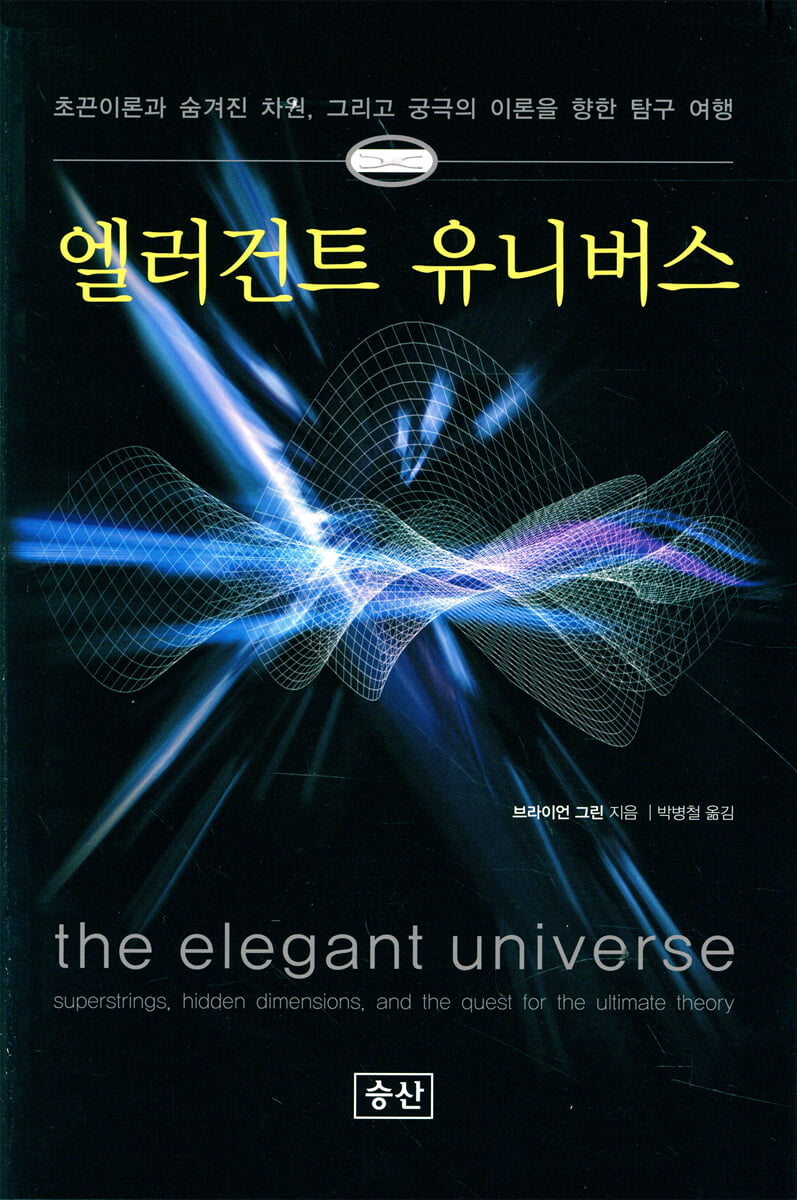
Elegant Universe
 |
Description
Book Introduction
Isn't this what it means to elegantly explain string theory, a cutting-edge theory in physics?
Author Brian Greene perfectly digests the mysteries of string theory in one book.
This book explains cutting-edge theoretical physics, known for being the most difficult, using simple and clear language rather than grandiose expressions. Through this book, you will be able to see and feel the profound principles of the universe up close.
Author Brian Greene perfectly digests the mysteries of string theory in one book.
This book explains cutting-edge theoretical physics, known for being the most difficult, using simple and clear language rather than grandiose expressions. Through this book, you will be able to see and feel the profound principles of the universe up close.
- You can preview some of the book's contents.
Preview
index
Part 1: At the Edge of Knowledge
Chapter 1: Tie it tightly with a string
Part 2: Time, Space, and the Dilemma of Quantum
Chapter 2: Time, Space, and the Eye of the Observer
Chapter 3: Warps and Ripples
Chapter 4: The Mysterious Microscopic World
Chapter 5: The Need for a New Theory Emerges
: General relativity vs. quantum mechanics
Part 3: Symphony of the Universe
Chapter 6 It's Just Music
: The Essence of Superstring Theory
Chapter 7 Superstring Theory What exactly does the "Super" in Superstring mean?
Chapter 8: In Search of Dimensions Beyond What the Eye Can See
Chapter 9 Experimental Evidence
Part 4: String Theory and the Structure of Spacetime
Chapter 10: Quantum Geometry
Chapter 11: Tearing the Fabric of Space
Chapter 12 Beyond String Theory: In Search of M-Theory
Chapter 13 Black Holes from a String/M-Theory Perspective
Chapter 14 Cosmology
Part 5: 21st Century Unification Theory
Chapter 15: Future Prospects
Huzhou
Glossary
Translator's Note
index
Chapter 1: Tie it tightly with a string
Part 2: Time, Space, and the Dilemma of Quantum
Chapter 2: Time, Space, and the Eye of the Observer
Chapter 3: Warps and Ripples
Chapter 4: The Mysterious Microscopic World
Chapter 5: The Need for a New Theory Emerges
: General relativity vs. quantum mechanics
Part 3: Symphony of the Universe
Chapter 6 It's Just Music
: The Essence of Superstring Theory
Chapter 7 Superstring Theory What exactly does the "Super" in Superstring mean?
Chapter 8: In Search of Dimensions Beyond What the Eye Can See
Chapter 9 Experimental Evidence
Part 4: String Theory and the Structure of Spacetime
Chapter 10: Quantum Geometry
Chapter 11: Tearing the Fabric of Space
Chapter 12 Beyond String Theory: In Search of M-Theory
Chapter 13 Black Holes from a String/M-Theory Perspective
Chapter 14 Cosmology
Part 5: 21st Century Unification Theory
Chapter 15: Future Prospects
Huzhou
Glossary
Translator's Note
index
Into the book
The surface of granite is very rough and uneven on a microscopic scale, but our palms cannot detect variations in such small areas, so it feels smooth.
In other words, microscopic variations are completely ignored by the 'macroscopic palmar dullness'.
Similarly, strings also have a finite size in space, so it is impossible to obtain information from a smaller area.
That is, the structure of a region smaller than the Planck length cannot be explored using a string.
Like a palm resting on a granite surface, the string cannot detect the fluctuations of the gravitational field occurring in the ultra-fine domain.
Quantum fluctuations in the gravitational field are clearly a phenomenon that exists, but since there is no way in principle to verify them, there is no need to worry about the discrepancy between general relativity and quantum mechanics.
No, that wasn't a problem at all in the first place.
Moreover, the troublesome 'infinity' problem that has always arisen from point particles when understanding gravity from a quantum mechanical perspective has been neatly solved with the advent of string theory.
In other words, microscopic variations are completely ignored by the 'macroscopic palmar dullness'.
Similarly, strings also have a finite size in space, so it is impossible to obtain information from a smaller area.
That is, the structure of a region smaller than the Planck length cannot be explored using a string.
Like a palm resting on a granite surface, the string cannot detect the fluctuations of the gravitational field occurring in the ultra-fine domain.
Quantum fluctuations in the gravitational field are clearly a phenomenon that exists, but since there is no way in principle to verify them, there is no need to worry about the discrepancy between general relativity and quantum mechanics.
No, that wasn't a problem at all in the first place.
Moreover, the troublesome 'infinity' problem that has always arisen from point particles when understanding gravity from a quantum mechanical perspective has been neatly solved with the advent of string theory.
--- pp.242-243
GOODS SPECIFICS
- Date of issue: March 11, 2002
- Page count, weight, size: 592 pages | 1,043g | 153*224*35mm
- ISBN13: 9788988907283
- ISBN10: 8988907280
You may also like
카테고리
korean


korean

![GQ KOREA Mark (Monthly): December [2025]](http://librairie.coreenne.fr/cdn/shop/files/8ef265dbbfbf186523ed75ba7319009d.jpg?v=1765340328&width=3840)


