

Feynman's QED Lectures for the General Public
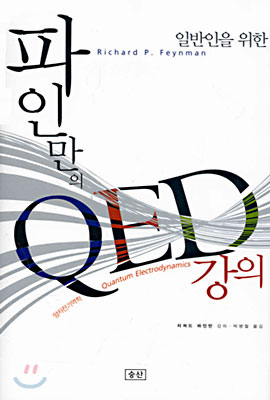 |
Description
Book Introduction
The title clearly states that it is a QED lecture for the general public, but in the end, the general public doesn't even know what QED is. Is this a problem of a lack of English skills or a lack of scientific knowledge?
What kind of 'ordinary person' would be interested in quantum electrodynamics and decide to pore over a book?
Sometimes I worry that I'm misunderstanding something.
But it is none other than Feynman.
A synonym for certainty and clarity.
And a confident, well-rounded look.
I am confident that if you are prepared to give yourself a little headache, you will find it very enjoyable to read.
First, let's put aside our worries about difficult math.
The first condition of quantum electrodynamics is the destruction of conventional viewpoints.
Therefore, I think it is at a level that high school students who have learned about the properties of light can read.
It would be good to read it with the mindset of letting go of the burden of having to know everything - if you could know everything by reading this one book, what good would a physicist be? - and just learning what you can.
What kind of 'ordinary person' would be interested in quantum electrodynamics and decide to pore over a book?
Sometimes I worry that I'm misunderstanding something.
But it is none other than Feynman.
A synonym for certainty and clarity.
And a confident, well-rounded look.
I am confident that if you are prepared to give yourself a little headache, you will find it very enjoyable to read.
First, let's put aside our worries about difficult math.
The first condition of quantum electrodynamics is the destruction of conventional viewpoints.
Therefore, I think it is at a level that high school students who have learned about the properties of light can read.
It would be good to read it with the mindset of letting go of the burden of having to know everything - if you could know everything by reading this one book, what good would a physicist be? - and just learning what you can.
index
First day initiation
-Physics before quantum electrodynamics
-The emergence of quantum electrodynamics
-Perfect quantum electrodynamics
-For the audience who is already bored
-How to explain quantum electrodynamics?
-Light: a mass of photons
-Photomultiplier: particle nature of light
-The amazing reflection of light
-An even more amazing double-sided reflection phenomenon
-All-rounder: Arrow Physics
-The identity of the arrow: probability amplitude
Day 2: Photons (particles that make up light)
-Why are the angle of incidence and the angle of reflection the same?
-The Magic of Light: Diffraction Grating
-Refraction phenomenon explained by quantum electrodynamics
-The Thinking Photon: In Search of Shortcuts
-The principle of a magnifying glass
-Probability of complex events: multiplication of arrows
-Reflective phenomenon seen again: complex events
-Double-sided reflection phenomenon as a complex event
-A great example: propagating photons?
-Note! The arrows represent the probability of one event occurring.
-The natural phenomena we observe are ultimately just one event.
Day 3: Interaction of Light and Matter
-Duality of light
-Electrons also have duality
-Feynman's space-time diagram
-Three basic diagrams
- Electron-electron collision
-Scattering of light
-Partial reflection
-Light transmission
-Diversity of nature
-Self-bipolar intelligence
-If you consider polarization
The remaining story of the fourth day
-Renormalization
-The mystery of the coupling constant e
-Protons and neutrons
-Strong interaction
-weak interaction
-Repeating particle families
-Physics before quantum electrodynamics
-The emergence of quantum electrodynamics
-Perfect quantum electrodynamics
-For the audience who is already bored
-How to explain quantum electrodynamics?
-Light: a mass of photons
-Photomultiplier: particle nature of light
-The amazing reflection of light
-An even more amazing double-sided reflection phenomenon
-All-rounder: Arrow Physics
-The identity of the arrow: probability amplitude
Day 2: Photons (particles that make up light)
-Why are the angle of incidence and the angle of reflection the same?
-The Magic of Light: Diffraction Grating
-Refraction phenomenon explained by quantum electrodynamics
-The Thinking Photon: In Search of Shortcuts
-The principle of a magnifying glass
-Probability of complex events: multiplication of arrows
-Reflective phenomenon seen again: complex events
-Double-sided reflection phenomenon as a complex event
-A great example: propagating photons?
-Note! The arrows represent the probability of one event occurring.
-The natural phenomena we observe are ultimately just one event.
Day 3: Interaction of Light and Matter
-Duality of light
-Electrons also have duality
-Feynman's space-time diagram
-Three basic diagrams
- Electron-electron collision
-Scattering of light
-Partial reflection
-Light transmission
-Diversity of nature
-Self-bipolar intelligence
-If you consider polarization
The remaining story of the fourth day
-Renormalization
-The mystery of the coupling constant e
-Protons and neutrons
-Strong interaction
-weak interaction
-Repeating particle families
Into the book
Finally, let's look again at the number 1.00115965221 that I told you about in the first lecture. This number represents the reaction of an electron to an external magnetic field and is called the magnetic dipole moment.
When Dirac first calculated this number using the rules of quantum electrodynamics, he got a surprisingly simple answer using the formula E(A->B).
From now on, let's set the value that Dirac calculated as the basic unit, that is, 1.0.
The first-order approximation method for finding the magnetic dipole moment of an electron is very simple.
It can be represented as a picture of an electron moving from one point in spacetime to another, combining with a photon from a magnet.
Years later it was discovered that this value was not exactly 1.0, but rather slightly larger, around 1.00116.
This modified value was first obtained by Schwinger in 1948 and was J^2/2π.
This value is due to the various ways in which electrons move from place to place.
When Dirac first calculated this number using the rules of quantum electrodynamics, he got a surprisingly simple answer using the formula E(A->B).
From now on, let's set the value that Dirac calculated as the basic unit, that is, 1.0.
The first-order approximation method for finding the magnetic dipole moment of an electron is very simple.
It can be represented as a picture of an electron moving from one point in spacetime to another, combining with a photon from a magnet.
Years later it was discovered that this value was not exactly 1.0, but rather slightly larger, around 1.00116.
This modified value was first obtained by Schwinger in 1948 and was J^2/2π.
This value is due to the various ways in which electrons move from place to place.
--- p.171
Publisher's Review
This universe is maintained in order by hidden laws.
If only what is visible were real, this world would collapse immediately.
- Richard Feynman -
“This famous lecture, given at the California Institute of Technology on December 29, 1959, and sponsored by the American Physical Society, outlined the future of miniaturization.
This was a lecture by Feynman, the 'father of nanotechnology (NT),' which was decades ahead of its time.
"
Advanced countries such as the United States, Japan, and Europe are devoting all their national efforts to researching nanotechnology (NT), and starting this year, Korea has also decided to invest a total of 1.5 trillion won over the next 10 years to elevate nanotechnology, currently in the basic research stage, to the level of the five advanced countries. - Newspaper report
This year marks the 101st anniversary of the birth of quantum mechanics.
We plan to publish a book that will help intellectuals, college students, and even middle and high school students easily understand the mysterious world of quantum electrodynamics before it is too late.
Book Introduction
Light travels in a straight line
The angle of incidence and the angle of reflection are equal for light.
The speed of light is 300,000 kilometers per second.
Students should memorize the formulas one by one to solve problems faster without any doubts about the above.
It is a well-known fact that memorization ability is linked to test scores.
Students who are accustomed to summarizing key points do not have time to think deeply.
Here's someone who provides food for thought.
That person was Richard Feynman, who tackled fundamental questions like: Why does light travel in a straight line? Why are the angles of incidence and reflection equal? Does light travel faster than 300,000 kilometers per second?
Feynman was more proud of being an educator than of the Nobel Prize he received during his lifetime, and he never refused to give lectures to young students, even when invited by prestigious organizations.
Feynman gave this book QED (Quantum Electrodynamics) to his friend AG, who was curious about physics.
I wrote this to answer Mertner's persistent questions.
The reason was that I felt that it was not something that could be covered in an hour or a day when lecturing to a friend who was an ordinary person about light and matter.
In the book, Feynman explains the world of QED, a field notorious for being difficult even for physicists, to the general public, using his excellent sense of humor and eloquence, in a surprisingly easy-to-understand manner, over four days of lectures.
For readers who have always been dissatisfied with general books on quantum physics, string theory, cosmology, and the like, Feynman's book will likely be an exception.
Feynman does not give analytical explanations, he just talks about physics and experiments.
Feynman will guide readers into a world they've never seen before, a world that defies common sense, without resorting to mathematical symbols, complex numbers, models, wave mechanics, or probability analysis.
What is QED (Quantum Electrodynamics)?
Soon after quantum mechanics was proven to be able to predict the properties of atoms, mathematical tools were developed to understand electromagnetic phenomena.
The result is quantum electrodynamics.
Quantum electrodynamics was first born around 1930 through the research of Paul Adrian Maurice Dirac, Werner Heisenberg, and others.
However, for nearly 20 years, it has only produced inaccurate results or approximations.
Quantum electrodynamics was formalized to a new level of accuracy, and among the several key figures who contributed to this, the most prominent was Richard Feynman.
He, who called himself a "partial man," was a prominent theoretical physicist of the 20th century who, like the philosopher Ludwig Wittgenstein, lacked formal knowledge of ongoing research but possessed profound intuition and a remarkable talent for setting up problems and working on them.
Feynman turned his attention to quantum electrodynamics, working with Bethe as an assistant professor at Cornell University from 1945 onwards.
Feynman's revision of quantum electrodynamics was a significant event in postwar physics.
The existing theory is not wrong, but as Feynman once explained, “If you try to solve it by calculation, you end up with a very complicated equation that is too difficult to solve.
You can get a very good approximation, but if you try to refine it to get a more accurate solution, infinitesimals start popping up.” While it is true that electrons behave in predictable ways in electromagnetic fields, trying to describe them in quantum mechanical terms essentially involves the emission and absorption of an infinite number of protons—known as virtual particles because they are imperceptible to our senses.
Despite numerous attempts by figures like Wolfgang Pauli and Werner Heisenberg, the calculations continued to yield impossible solutions.
Yet the theory on which it was based could not be attacked.
Feynman's unique approach involved using a series of diagrams (later called Feynman diagrams) to track electrons, photons, and the photons they absorb or emit.
These are the fundamental motions described by quantum electrodynamics.
Feynman diagrams allowed us to 'renormalize' numbers and eliminate unnecessary infinities by making abstract calculations concrete.
As a result of this 'path integral' method, quantum electrodynamics was completely reborn, and today it can be calculated with an amazing accuracy of up to 10-9.
In 1965, Feynman received the Noble Prize in Physics.
Around the same time, he was joined by Julian Seymour Schwinger and Sin-Itero Tomonaga, who reformulated quantum electrodynamics in a similar way.
Feynman's method was the simplest and most intuitive, and his diagrams were widely used to solve problems involving elementary particles.
Feynman moved to the California Institute of Technology (CalTech) in 1951 and became a world-renowned theoretical physicist.
His achievements also include the theory explaining the strange properties of liquid helium, which defies gravity at ultra-low temperatures.
Also, by explaining 'Superfluidity', we have almost reached an understanding of the phenomena related to Superconductivity.
Superconductivity was discovered in 1957 by John Bardeen and Leon N. Cooper.
Cooper, John R. Schrieffer
It was revealed by Schrieffer.
Feynman also developed a theory about the workings of the 'weak force', which was demonstrated by beta decay, the gradual disintegration of radioactive elements.
Feynman discovered that the law of parity conservation does not hold in weak interactions, and experienced a moment he could describe as "the first and only time in my life I've discovered a law of nature that no one else knew about."
His friend and Caltech colleague Murray Gell-Mann criticized Feynman's hubris.
However, Gell-Mann and Feynman developed a general theory of weak interactions, which they first published in 1958 as "Fermi Interaction Theory."
In general, quantum electrodynamics, and Feynman himself, contributed to the development of Gell-Mann's quantum chromodynamics, which explains the structure of atomic particles.
If only what is visible were real, this world would collapse immediately.
- Richard Feynman -
“This famous lecture, given at the California Institute of Technology on December 29, 1959, and sponsored by the American Physical Society, outlined the future of miniaturization.
This was a lecture by Feynman, the 'father of nanotechnology (NT),' which was decades ahead of its time.
"
Advanced countries such as the United States, Japan, and Europe are devoting all their national efforts to researching nanotechnology (NT), and starting this year, Korea has also decided to invest a total of 1.5 trillion won over the next 10 years to elevate nanotechnology, currently in the basic research stage, to the level of the five advanced countries. - Newspaper report
This year marks the 101st anniversary of the birth of quantum mechanics.
We plan to publish a book that will help intellectuals, college students, and even middle and high school students easily understand the mysterious world of quantum electrodynamics before it is too late.
Book Introduction
Light travels in a straight line
The angle of incidence and the angle of reflection are equal for light.
The speed of light is 300,000 kilometers per second.
Students should memorize the formulas one by one to solve problems faster without any doubts about the above.
It is a well-known fact that memorization ability is linked to test scores.
Students who are accustomed to summarizing key points do not have time to think deeply.
Here's someone who provides food for thought.
That person was Richard Feynman, who tackled fundamental questions like: Why does light travel in a straight line? Why are the angles of incidence and reflection equal? Does light travel faster than 300,000 kilometers per second?
Feynman was more proud of being an educator than of the Nobel Prize he received during his lifetime, and he never refused to give lectures to young students, even when invited by prestigious organizations.
Feynman gave this book QED (Quantum Electrodynamics) to his friend AG, who was curious about physics.
I wrote this to answer Mertner's persistent questions.
The reason was that I felt that it was not something that could be covered in an hour or a day when lecturing to a friend who was an ordinary person about light and matter.
In the book, Feynman explains the world of QED, a field notorious for being difficult even for physicists, to the general public, using his excellent sense of humor and eloquence, in a surprisingly easy-to-understand manner, over four days of lectures.
For readers who have always been dissatisfied with general books on quantum physics, string theory, cosmology, and the like, Feynman's book will likely be an exception.
Feynman does not give analytical explanations, he just talks about physics and experiments.
Feynman will guide readers into a world they've never seen before, a world that defies common sense, without resorting to mathematical symbols, complex numbers, models, wave mechanics, or probability analysis.
What is QED (Quantum Electrodynamics)?
Soon after quantum mechanics was proven to be able to predict the properties of atoms, mathematical tools were developed to understand electromagnetic phenomena.
The result is quantum electrodynamics.
Quantum electrodynamics was first born around 1930 through the research of Paul Adrian Maurice Dirac, Werner Heisenberg, and others.
However, for nearly 20 years, it has only produced inaccurate results or approximations.
Quantum electrodynamics was formalized to a new level of accuracy, and among the several key figures who contributed to this, the most prominent was Richard Feynman.
He, who called himself a "partial man," was a prominent theoretical physicist of the 20th century who, like the philosopher Ludwig Wittgenstein, lacked formal knowledge of ongoing research but possessed profound intuition and a remarkable talent for setting up problems and working on them.
Feynman turned his attention to quantum electrodynamics, working with Bethe as an assistant professor at Cornell University from 1945 onwards.
Feynman's revision of quantum electrodynamics was a significant event in postwar physics.
The existing theory is not wrong, but as Feynman once explained, “If you try to solve it by calculation, you end up with a very complicated equation that is too difficult to solve.
You can get a very good approximation, but if you try to refine it to get a more accurate solution, infinitesimals start popping up.” While it is true that electrons behave in predictable ways in electromagnetic fields, trying to describe them in quantum mechanical terms essentially involves the emission and absorption of an infinite number of protons—known as virtual particles because they are imperceptible to our senses.
Despite numerous attempts by figures like Wolfgang Pauli and Werner Heisenberg, the calculations continued to yield impossible solutions.
Yet the theory on which it was based could not be attacked.
Feynman's unique approach involved using a series of diagrams (later called Feynman diagrams) to track electrons, photons, and the photons they absorb or emit.
These are the fundamental motions described by quantum electrodynamics.
Feynman diagrams allowed us to 'renormalize' numbers and eliminate unnecessary infinities by making abstract calculations concrete.
As a result of this 'path integral' method, quantum electrodynamics was completely reborn, and today it can be calculated with an amazing accuracy of up to 10-9.
In 1965, Feynman received the Noble Prize in Physics.
Around the same time, he was joined by Julian Seymour Schwinger and Sin-Itero Tomonaga, who reformulated quantum electrodynamics in a similar way.
Feynman's method was the simplest and most intuitive, and his diagrams were widely used to solve problems involving elementary particles.
Feynman moved to the California Institute of Technology (CalTech) in 1951 and became a world-renowned theoretical physicist.
His achievements also include the theory explaining the strange properties of liquid helium, which defies gravity at ultra-low temperatures.
Also, by explaining 'Superfluidity', we have almost reached an understanding of the phenomena related to Superconductivity.
Superconductivity was discovered in 1957 by John Bardeen and Leon N. Cooper.
Cooper, John R. Schrieffer
It was revealed by Schrieffer.
Feynman also developed a theory about the workings of the 'weak force', which was demonstrated by beta decay, the gradual disintegration of radioactive elements.
Feynman discovered that the law of parity conservation does not hold in weak interactions, and experienced a moment he could describe as "the first and only time in my life I've discovered a law of nature that no one else knew about."
His friend and Caltech colleague Murray Gell-Mann criticized Feynman's hubris.
However, Gell-Mann and Feynman developed a general theory of weak interactions, which they first published in 1958 as "Fermi Interaction Theory."
In general, quantum electrodynamics, and Feynman himself, contributed to the development of Gell-Mann's quantum chromodynamics, which explains the structure of atomic particles.
GOODS SPECIFICS
- Date of issue: August 31, 2001
- Page count, weight, size: 226 pages | 534g | 153*224*20mm
- ISBN13: 9788988907184
- ISBN10: 8988907183
You may also like
카테고리
korean


korean

![GQ KOREA Mark (Monthly): December [2025]](http://librairie.coreenne.fr/cdn/shop/files/8ef265dbbfbf186523ed75ba7319009d.jpg?v=1765340328&width=3840)


