

Math Reader 1
 |
Description
Book Introduction
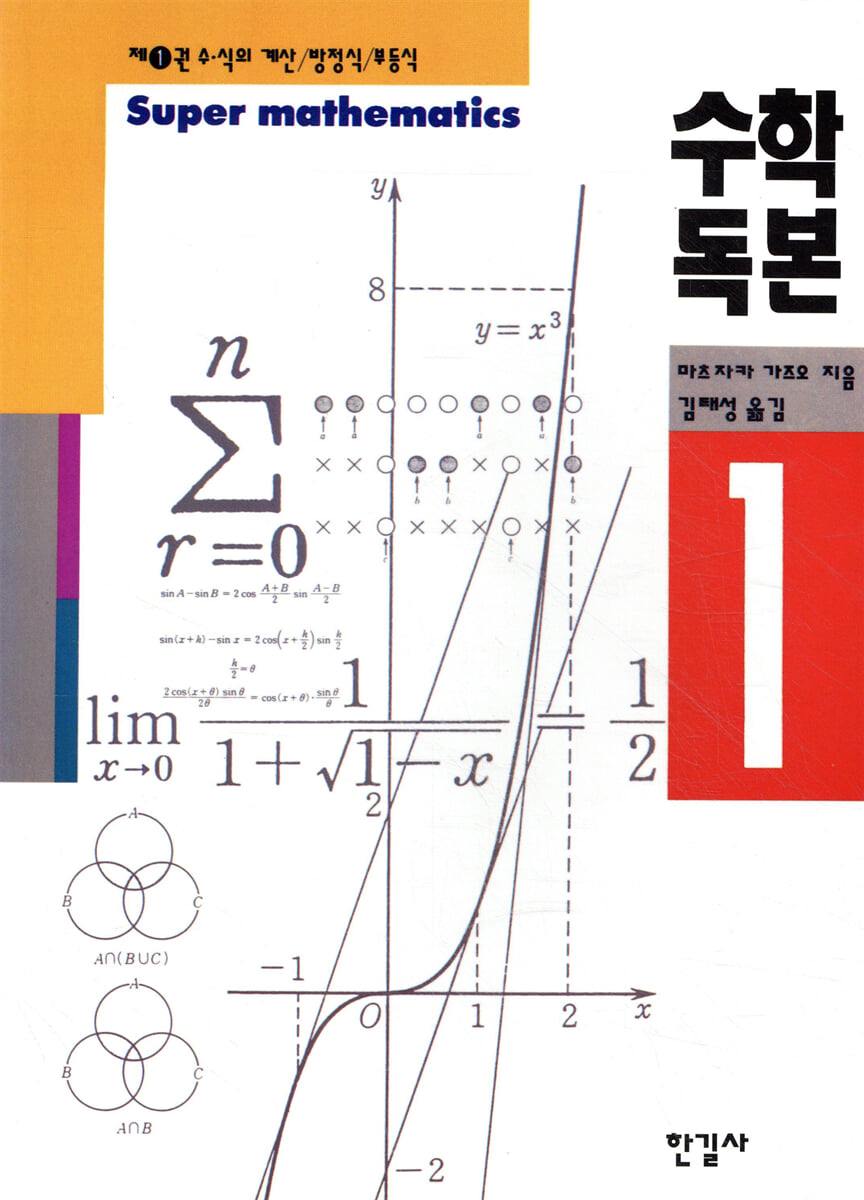
This textbook is a 'new mathematics textbook' written by the author through a synthesis of his past research and education, providing a new understanding of mathematics from the basics.
Unlike ordinary mathematics books, this book is much more free-flowing in its content, and if you follow the author's thoughts that mathematics is a flow, not a trick, you will naturally encounter a clear flow called mathematics.
Unlike ordinary mathematics books, this book is much more free-flowing in its content, and if you follow the author's thoughts that mathematics is a flow, not a trick, you will naturally encounter a clear flow called mathematics.
- You can preview some of the book's contents.
Preview
index
1.
Math starts here: Numbers
2.
The Use of Letters and Symbols: Calculating Expressions
3.
Unleash the Power of Mathematics: Equations
4.
Size relationship: inequality
Math starts here: Numbers
2.
The Use of Letters and Symbols: Calculating Expressions
3.
Unleash the Power of Mathematics: Equations
4.
Size relationship: inequality
Into the book
*Euclid's algorithm
To find the greatest common divisor of two positive numbers a and b, as already mentioned, you can factorize a and b.
But as I've already said, factoring isn't that simple when we're dealing with only paper and pencil at our desks.
A more practical method for finding the greatest common divisor of two positive numbers a and b is 'Euclidean algorithm'.
Here's how it goes:
Now, a≥b, and the quotient of a divided by b is q, and the remainder is r.
That is, if a=bq+r, 0≤r0, then r=a-bq in the equation above, so if e is any common divisor of a and b, then a-bq on the right side is divisible by e, and therefore r is divisible by e.
Therefore, e is a common divisor of b and r.
Meanwhile, if e' is any common divisor of b and r, then in the equation a=bq+r, e' divides a, and therefore e' is a common divisor of a and b.
From this, we can see that the common divisor of a and b is the common divisor of b and r, and conversely, the common divisor of b and r is the common divisor of a and b.
Therefore, the set of all common divisors of a and b is identical to the set of all common divisors of b and r.
From this we can see that (greatest common divisor of a, b) = (greatest common divisor of b, r).
Next, let the remainder of b divided by r be r1, and for the same reason as explained above, if r1=0, then r becomes the greatest common divisor of b and r, and if r1>0, then (greatest common divisor of a, b) = (greatest common divisor of b, r) = (greatest common divisor of r, r1).
If we continue this method until it is divisible, we can definitely find the greatest common divisor of a and b through a finite number of divisions.
The method described above is Euclid's algorithm.
This is a famous method known since ancient times.
In fact, this is already clearly written in Euclid's book 'Elements' introduced earlier...
To find the greatest common divisor of two positive numbers a and b, as already mentioned, you can factorize a and b.
But as I've already said, factoring isn't that simple when we're dealing with only paper and pencil at our desks.
A more practical method for finding the greatest common divisor of two positive numbers a and b is 'Euclidean algorithm'.
Here's how it goes:
Now, a≥b, and the quotient of a divided by b is q, and the remainder is r.
That is, if a=bq+r, 0≤r0, then r=a-bq in the equation above, so if e is any common divisor of a and b, then a-bq on the right side is divisible by e, and therefore r is divisible by e.
Therefore, e is a common divisor of b and r.
Meanwhile, if e' is any common divisor of b and r, then in the equation a=bq+r, e' divides a, and therefore e' is a common divisor of a and b.
From this, we can see that the common divisor of a and b is the common divisor of b and r, and conversely, the common divisor of b and r is the common divisor of a and b.
Therefore, the set of all common divisors of a and b is identical to the set of all common divisors of b and r.
From this we can see that (greatest common divisor of a, b) = (greatest common divisor of b, r).
Next, let the remainder of b divided by r be r1, and for the same reason as explained above, if r1=0, then r becomes the greatest common divisor of b and r, and if r1>0, then (greatest common divisor of a, b) = (greatest common divisor of b, r) = (greatest common divisor of r, r1).
If we continue this method until it is divisible, we can definitely find the greatest common divisor of a and b through a finite number of divisions.
The method described above is Euclid's algorithm.
This is a famous method known since ancient times.
In fact, this is already clearly written in Euclid's book 'Elements' introduced earlier...
--- p.38-39
*Euclid's algorithm
To find the greatest common divisor of two positive numbers a and b, as already mentioned, you can factorize a and b.
But as I've already said, factoring isn't that simple when we're dealing with only paper and pencil at our desks.
A more practical method for finding the greatest common divisor of two positive numbers a and b is 'Euclidean algorithm'.
Here's how it goes:
Now, a≥b, and the quotient of a divided by b is q, and the remainder is r.
That is, if a=bq+r, 0≤r0, then r=a-bq in the equation above, so if e is any common divisor of a and b, then a-bq on the right side is divisible by e, and therefore r is divisible by e.
Therefore, e is a common divisor of b and r.
Meanwhile, if e' is any common divisor of b and r, then in the equation a=bq+r, e' divides a, and therefore e' is a common divisor of a and b.
From this, we can see that the common divisor of a and b is the common divisor of b and r, and conversely, the common divisor of b and r is the common divisor of a and b.
Therefore, the set of all common divisors of a and b is identical to the set of all common divisors of b and r.
From this we can see that (greatest common divisor of a, b) = (greatest common divisor of b, r).
Next, let the remainder of b divided by r be r1, and for the same reason as explained above, if r1=0, then r becomes the greatest common divisor of b and r, and if r1>0, then (greatest common divisor of a, b) = (greatest common divisor of b, r) = (greatest common divisor of r, r1).
If we continue this method until it is divisible, we can definitely find the greatest common divisor of a and b through a finite number of divisions.
The method described above is Euclid's algorithm.
This is a famous method known since ancient times.
In fact, this is already clearly written in Euclid's book 'Elements' introduced earlier...
*Euclid's algorithm
To find the greatest common divisor of two positive numbers a and b, as already mentioned, you can factorize a and b.
But as I've already said, factoring isn't that simple when we're dealing with only paper and pencil at our desks.
A more practical method for finding the greatest common divisor of two positive numbers a and b is 'Euclidean algorithm'.
Here's how it goes:
Now, a≥b, and the quotient of a divided by b is q, and the remainder is r.
That is, if a=bq+r, 0≤r0, then r=a-bq in the equation above, so if e is any common divisor of a and b, then a-bq on the right side is divisible by e, and therefore r is divisible by e.
Therefore, e is a common divisor of b and r.
Meanwhile, if e' is any common divisor of b and r, then in the equation a=bq+r, e' divides a, and therefore e' is a common divisor of a and b.
From this, we can see that the common divisor of a and b is the common divisor of b and r, and conversely, the common divisor of b and r is the common divisor of a and b.
Therefore, the set of all common divisors of a and b is identical to the set of all common divisors of b and r.
From this we can see that (greatest common divisor of a, b) = (greatest common divisor of b, r).
Next, let the remainder of b divided by r be r1, and for the same reason as explained above, if r1=0, then r becomes the greatest common divisor of b and r, and if r1>0, then (greatest common divisor of a, b) = (greatest common divisor of b, r) = (greatest common divisor of r, r1).
If we continue this method until it is divisible, we can definitely find the greatest common divisor of a and b through a finite number of divisions.
The method described above is Euclid's algorithm.
This is a famous method known since ancient times.
In fact, this is already clearly written in Euclid's book 'Elements' introduced earlier...
To find the greatest common divisor of two positive numbers a and b, as already mentioned, you can factorize a and b.
But as I've already said, factoring isn't that simple when we're dealing with only paper and pencil at our desks.
A more practical method for finding the greatest common divisor of two positive numbers a and b is 'Euclidean algorithm'.
Here's how it goes:
Now, a≥b, and the quotient of a divided by b is q, and the remainder is r.
That is, if a=bq+r, 0≤r0, then r=a-bq in the equation above, so if e is any common divisor of a and b, then a-bq on the right side is divisible by e, and therefore r is divisible by e.
Therefore, e is a common divisor of b and r.
Meanwhile, if e' is any common divisor of b and r, then in the equation a=bq+r, e' divides a, and therefore e' is a common divisor of a and b.
From this, we can see that the common divisor of a and b is the common divisor of b and r, and conversely, the common divisor of b and r is the common divisor of a and b.
Therefore, the set of all common divisors of a and b is identical to the set of all common divisors of b and r.
From this we can see that (greatest common divisor of a, b) = (greatest common divisor of b, r).
Next, let the remainder of b divided by r be r1, and for the same reason as explained above, if r1=0, then r becomes the greatest common divisor of b and r, and if r1>0, then (greatest common divisor of a, b) = (greatest common divisor of b, r) = (greatest common divisor of r, r1).
If we continue this method until it is divisible, we can definitely find the greatest common divisor of a and b through a finite number of divisions.
The method described above is Euclid's algorithm.
This is a famous method known since ancient times.
In fact, this is already clearly written in Euclid's book 'Elements' introduced earlier...
*Euclid's algorithm
To find the greatest common divisor of two positive numbers a and b, as already mentioned, you can factorize a and b.
But as I've already said, factoring isn't that simple when we're dealing with only paper and pencil at our desks.
A more practical method for finding the greatest common divisor of two positive numbers a and b is 'Euclidean algorithm'.
Here's how it goes:
Now, a≥b, and the quotient of a divided by b is q, and the remainder is r.
That is, if a=bq+r, 0≤r0, then r=a-bq in the equation above, so if e is any common divisor of a and b, then a-bq on the right side is divisible by e, and therefore r is divisible by e.
Therefore, e is a common divisor of b and r.
Meanwhile, if e' is any common divisor of b and r, then in the equation a=bq+r, e' divides a, and therefore e' is a common divisor of a and b.
From this, we can see that the common divisor of a and b is the common divisor of b and r, and conversely, the common divisor of b and r is the common divisor of a and b.
Therefore, the set of all common divisors of a and b is identical to the set of all common divisors of b and r.
From this we can see that (greatest common divisor of a, b) = (greatest common divisor of b, r).
Next, let the remainder of b divided by r be r1, and for the same reason as explained above, if r1=0, then r becomes the greatest common divisor of b and r, and if r1>0, then (greatest common divisor of a, b) = (greatest common divisor of b, r) = (greatest common divisor of r, r1).
If we continue this method until it is divisible, we can definitely find the greatest common divisor of a and b through a finite number of divisions.
The method described above is Euclid's algorithm.
This is a famous method known since ancient times.
In fact, this is already clearly written in Euclid's book 'Elements' introduced earlier...
--- p.38-39
GOODS SPECIFICS
- Date of issue: February 18, 2004
- Page count, weight, size: 236 pages | 568g | 188*257*20mm
- ISBN13: 9788935640379
- ISBN10: 8935640379
You may also like
카테고리
korean


korean

![GQ KOREA Mark (Monthly): December [2025]](http://librairie.coreenne.fr/cdn/shop/files/8ef265dbbfbf186523ed75ba7319009d.jpg?v=1765340328&width=3840)


