

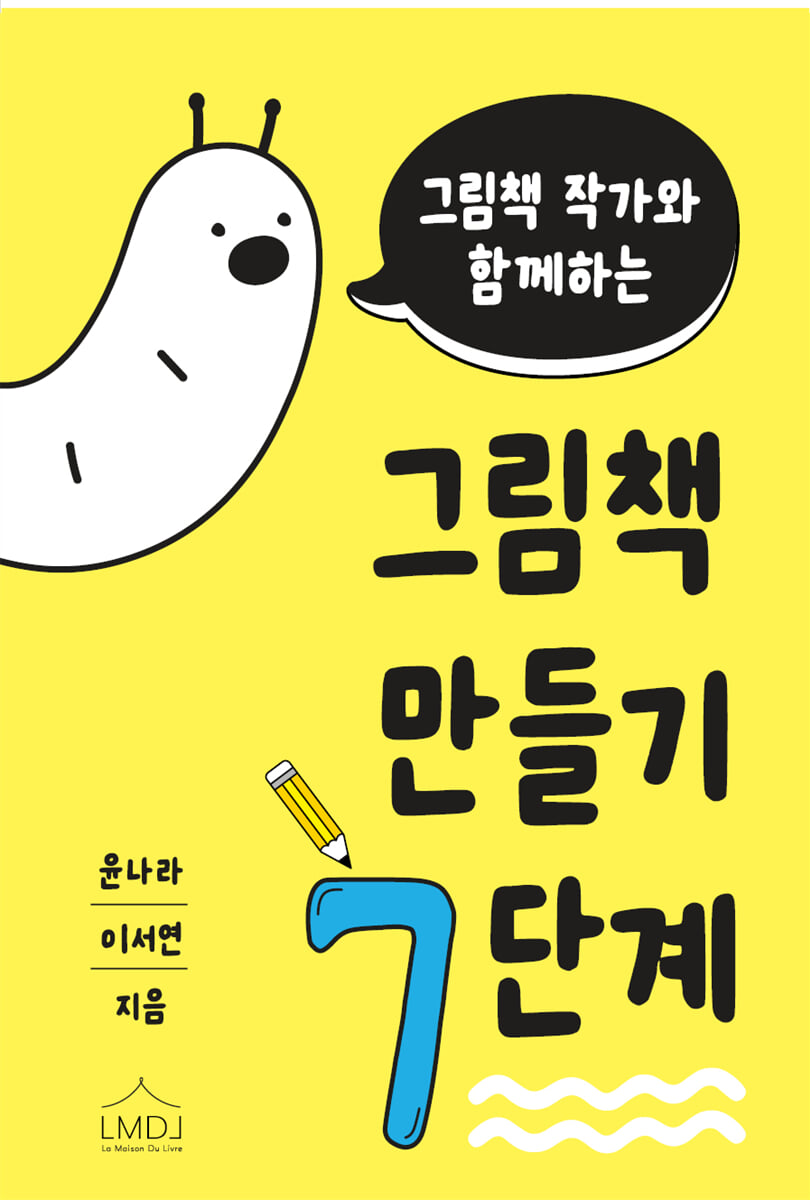
7 Steps to Creating a Picture Book with a Picture Book Author
 |
Description
Book Introduction
How to make a picture book?
Introduced by picture book authors Na-ra Yoon and Seo-yeon Lee
7 steps to making a picture book!
"Everyone needs a minimal guide to completing a picture book."
《7 Steps to Creating a Picture Book》 was created based on picture book creation classes held with a wide range of people, from those trying to draw for the first time to authors with published experience, from those aged 7 to those in their 70s.
For everyone, creating a picture book is a creative activity that involves drawing new pictures and creating stories.
"7 Steps to Creating a Picture Book" explains each step for beginners, from planning the content of a picture book, drawing the pictures, writing the text, and producing the actual book, and provides practical tips and real-world examples to aid understanding.
Introduced by picture book authors Na-ra Yoon and Seo-yeon Lee
7 steps to making a picture book!
"Everyone needs a minimal guide to completing a picture book."
《7 Steps to Creating a Picture Book》 was created based on picture book creation classes held with a wide range of people, from those trying to draw for the first time to authors with published experience, from those aged 7 to those in their 70s.
For everyone, creating a picture book is a creative activity that involves drawing new pictures and creating stories.
"7 Steps to Creating a Picture Book" explains each step for beginners, from planning the content of a picture book, drawing the pictures, writing the text, and producing the actual book, and provides practical tips and real-world examples to aid understanding.
- You can preview some of the book's contents.
Preview
index
Introduction - Lesson 6: Creating a Picture Book in 7 Steps
Picture Book Production Guidelines - 11 Ways to Use This Book
At a glance - Full configuration 14
Step 1.
Picture Book Walk
View 18
Falling in love 28
Practical Assignment | Collect a List of Picture Books, 34 Subjects and Topics of Interest
Authors' Talk 1 | What Picture Books Do You Like? 36
Appendix | Stories from Experience 44
Step 2.
Planting an idea
Explore Ideas 48
Choosing a Material 56
Practical Assignment | Finding Materials and Topics, Creating a Story 66
Writers' Talk 2 | How do you develop an idea into a story? 70
Appendix | Story in Pictures 78
Step 3.
Sprouting a scene
Drawing a Scene Lightly 82
Drawing a Scene Meticulously 86
Hands-on Assignment | Exploring Materials 90
Artists' Dialogue 3 | How to Draw Well? 92
Appendix | Materials and Appraisals 98
Step 4.
Storytelling
Characters: The Role of the Protagonist 102
Background: Time and Space 114
Event: Characteristics of Picture Book Stories 120
Practical Assignments | Creating Characters, Organizing Background Information, and Reviewing the Story 128
Authors' Dialogue 4 | What are the roles of setting and characters in picture books? 130
Appendix | Background Story 136
Step 5.
Grasp the storyboard stem
Creating a Storyboard 140
Rhythm of Picture Books 146
Practical Assignment | Creating a Storyboard 150
Authors' Dialogue 5 | How to Determine the Length of a Picture Book? 152
Appendix | Using the Spreadsheet Configuration 156
Step 6.
Painting Blossoms
Sketching 161
Coloring 170
Practice Assignments | Basic Object Practice 174
Artists' Dialogue 6 | What materials should I use when drawing? 178
Appendix | Drawing Screens in Different Sizes 186
Step 7.
Bearing fruit
Cover Design 190
Printing and Production 196
Practical Assignment | Title Writing, Cover Design 202
Authors' Dialogue 7 | How to Ensure Effective Evaluation and Feedback? 204
Appendix | Various Cover Designs 214
Picture Book Production Guidelines - 11 Ways to Use This Book
At a glance - Full configuration 14
Step 1.
Picture Book Walk
View 18
Falling in love 28
Practical Assignment | Collect a List of Picture Books, 34 Subjects and Topics of Interest
Authors' Talk 1 | What Picture Books Do You Like? 36
Appendix | Stories from Experience 44
Step 2.
Planting an idea
Explore Ideas 48
Choosing a Material 56
Practical Assignment | Finding Materials and Topics, Creating a Story 66
Writers' Talk 2 | How do you develop an idea into a story? 70
Appendix | Story in Pictures 78
Step 3.
Sprouting a scene
Drawing a Scene Lightly 82
Drawing a Scene Meticulously 86
Hands-on Assignment | Exploring Materials 90
Artists' Dialogue 3 | How to Draw Well? 92
Appendix | Materials and Appraisals 98
Step 4.
Storytelling
Characters: The Role of the Protagonist 102
Background: Time and Space 114
Event: Characteristics of Picture Book Stories 120
Practical Assignments | Creating Characters, Organizing Background Information, and Reviewing the Story 128
Authors' Dialogue 4 | What are the roles of setting and characters in picture books? 130
Appendix | Background Story 136
Step 5.
Grasp the storyboard stem
Creating a Storyboard 140
Rhythm of Picture Books 146
Practical Assignment | Creating a Storyboard 150
Authors' Dialogue 5 | How to Determine the Length of a Picture Book? 152
Appendix | Using the Spreadsheet Configuration 156
Step 6.
Painting Blossoms
Sketching 161
Coloring 170
Practice Assignments | Basic Object Practice 174
Artists' Dialogue 6 | What materials should I use when drawing? 178
Appendix | Drawing Screens in Different Sizes 186
Step 7.
Bearing fruit
Cover Design 190
Printing and Production 196
Practical Assignment | Title Writing, Cover Design 202
Authors' Dialogue 7 | How to Ensure Effective Evaluation and Feedback? 204
Appendix | Various Cover Designs 214
Into the book
“Ideas are everywhere.
It exists everywhere in our daily lives, in movies and novels, and even in old memories and recollections.
As the scope is vast, the method of obtaining materials also varies from person to person.
Some people are inspired by social issues, while others delve deep into their own hearts to find themes.
Some people create picture books using playful wordplay, while others create scenes without words, simply by arranging visual elements.
From everyday experiences, special events, simple thoughts, to deep emotions.
Anything that sparks the idea of creating a picture book can become an idea for a picture book.”
--- p.47
“For example, if it is a picture book based on the theme of ‘night,’ you can create scenes that fit that time, such as a dark night sky or a space that quickly brightens with a small light.
Indoor landscapes may be less affected by time than outdoors, but they are still not immune to change.
Even indoors, you can express day and night light differently.
The same goes for seasons.
The types of furniture and flower pots may vary depending on the season.
The background can also be used as a device to reveal the character of the main character.
It is about revealing the character through the overall interior or the type, design, and color of the props placed in the room.
“The more specific the time and space setting of the story, the better.”
--- p.114
“If I try to draw the main character’s appearance, which I had only written about, I may not be able to express it in an attractive way.
At this time, you can change the protagonist to something you can draw better.
“We teach students to develop a flexible work attitude so that they can work in a variety of mediums, from text to pictures.”
--- p.127
“When similar compositions and lines are repeated, the message of the picture book is strengthened.
The pleasure of reading and seeing is doubled by the repetitive rhymes and rhythm.
If you properly understand the structure of a picture book, you can work with the spread layout like this.
Picture books are a field with endless possibilities for interpretation and use, as they are structured so that the left and right pages are separated while being read simultaneously.
“If you consider how the story is arranged while considering the reader’s reading style according to the picture book structure, you can create an even better picture book.”
--- p.157
“It’s not necessary to necessarily separate sketch and coloring materials.
You can use pencil as your main material and color it only in the parts you want to highlight.
Depending on the student's taste, several ingredients can be mixed and used.
However, since it is difficult to guide you through all these details, I think the materials are a major part of the student's responsibility.
“A drawing develops as much as you learn and try.”
It exists everywhere in our daily lives, in movies and novels, and even in old memories and recollections.
As the scope is vast, the method of obtaining materials also varies from person to person.
Some people are inspired by social issues, while others delve deep into their own hearts to find themes.
Some people create picture books using playful wordplay, while others create scenes without words, simply by arranging visual elements.
From everyday experiences, special events, simple thoughts, to deep emotions.
Anything that sparks the idea of creating a picture book can become an idea for a picture book.”
--- p.47
“For example, if it is a picture book based on the theme of ‘night,’ you can create scenes that fit that time, such as a dark night sky or a space that quickly brightens with a small light.
Indoor landscapes may be less affected by time than outdoors, but they are still not immune to change.
Even indoors, you can express day and night light differently.
The same goes for seasons.
The types of furniture and flower pots may vary depending on the season.
The background can also be used as a device to reveal the character of the main character.
It is about revealing the character through the overall interior or the type, design, and color of the props placed in the room.
“The more specific the time and space setting of the story, the better.”
--- p.114
“If I try to draw the main character’s appearance, which I had only written about, I may not be able to express it in an attractive way.
At this time, you can change the protagonist to something you can draw better.
“We teach students to develop a flexible work attitude so that they can work in a variety of mediums, from text to pictures.”
--- p.127
“When similar compositions and lines are repeated, the message of the picture book is strengthened.
The pleasure of reading and seeing is doubled by the repetitive rhymes and rhythm.
If you properly understand the structure of a picture book, you can work with the spread layout like this.
Picture books are a field with endless possibilities for interpretation and use, as they are structured so that the left and right pages are separated while being read simultaneously.
“If you consider how the story is arranged while considering the reader’s reading style according to the picture book structure, you can create an even better picture book.”
--- p.157
“It’s not necessary to necessarily separate sketch and coloring materials.
You can use pencil as your main material and color it only in the parts you want to highlight.
Depending on the student's taste, several ingredients can be mixed and used.
However, since it is difficult to guide you through all these details, I think the materials are a major part of the student's responsibility.
“A drawing develops as much as you learn and try.”
--- p.179
Publisher's Review
Step 1.
Picture Book Walk
Let's look at the picture book first.
Picture books are storybooks composed of text and pictures, and come in a wide variety of formats.
There are also picture books without words, books with repetitive scenes, and books that are like comic books.
It is important to develop your own perspective and find your own taste by looking at various picture books yourself.
Let's look at picture books of various subjects and genres and analyze the pictures and stories.
And learn about the relationship between pictures and text, and how the two elements complement or contrast each other.
Based on this, you can design your own picture book.
Step 2.
Planting an idea
Next, we explore material for the story.
Ideas can come from many places: everyday life, movies, novels, memories, etc.
Anything can be a picture book idea, whether it's a social issue, an emotion, or a pun.
After trying several methods to find ideas and finding one that works for you and writing it down, choose one material and create a simple story.
Step 3.
Sprouting a scene
Pictures are a key element in picture books, and while there are 'picture books without words', there are no 'picture books without pictures'.
Pictures are an important visual element that conveys content.
To draw a picture, you can draw a scene to match the text, but conversely, a story can be born from a picture.
Here you will explore different methods, including pencil, colored pencil, oil pastel, and digital, and find your own way to draw.
Step 4.
Storytelling
‘Characters, background, and events’ are the main elements that make up a story.
In order for readers to become immersed in a picture book, the author must construct the story well.
To do this, it is important to understand the roles of the main elements that make up a story: ‘characters, background, and events.’
First, we examine the main character and the temporal and spatial background, compare the picture book story to the animation, and then develop the story with expert advice.
Step 5.
Grasp the storyboard stem
In this step, you will learn the role, considerations, and types of storyboards.
Storyboarding is the process of planning scenes, helping you visualize and understand the overall flow before you start drawing.
Use the thumbnail to make a rough sketch and estimate the position of the text.
After completing your storyboard, you should check the flow and rhythm and make sure your intention is well conveyed.
Step 6.
Painting Blossoms
The two elements that make up a picture are ‘shape’ and ‘color’.
Learn how to sketch and color to achieve both elements well.
There are many different painting styles, and it's important to find the materials and style that works for you.
Step 7.
Bearing fruit
The final step is to print and produce the book.
We'll give you tips for creating covers for physical books and a guide on what to consider when creating the actual text.
In particular, the cover is the first encounter with the reader, so the title and cover illustration should be able to attract the reader's attention.
You can come up with a title first and then draw the cover, or use an impressive scene from the inside as the cover.
After completing the cover design, it moves on to the printing and production stage, which has a major impact on the completeness of the picture book.
Includes practical assignments and conversations with authors!
In "7 Steps to Creating a Picture Book," you can think more deeply about your work by solving "Thinking" questions at the end of each step in the text, and you can also develop your work through practical assignment worksheets for each step.
The authors' dialogue chapter contains stories that authors Yoon Na-ra and Lee Seo-yeon, who co-wrote this book, have pondered while working on the picture book.
Hear the honest voices of picture book authors as they share their moments of inspiration, the challenges and joys they experience while actually working, and join them in the world of picture book creation!
Picture Book Walk
Let's look at the picture book first.
Picture books are storybooks composed of text and pictures, and come in a wide variety of formats.
There are also picture books without words, books with repetitive scenes, and books that are like comic books.
It is important to develop your own perspective and find your own taste by looking at various picture books yourself.
Let's look at picture books of various subjects and genres and analyze the pictures and stories.
And learn about the relationship between pictures and text, and how the two elements complement or contrast each other.
Based on this, you can design your own picture book.
Step 2.
Planting an idea
Next, we explore material for the story.
Ideas can come from many places: everyday life, movies, novels, memories, etc.
Anything can be a picture book idea, whether it's a social issue, an emotion, or a pun.
After trying several methods to find ideas and finding one that works for you and writing it down, choose one material and create a simple story.
Step 3.
Sprouting a scene
Pictures are a key element in picture books, and while there are 'picture books without words', there are no 'picture books without pictures'.
Pictures are an important visual element that conveys content.
To draw a picture, you can draw a scene to match the text, but conversely, a story can be born from a picture.
Here you will explore different methods, including pencil, colored pencil, oil pastel, and digital, and find your own way to draw.
Step 4.
Storytelling
‘Characters, background, and events’ are the main elements that make up a story.
In order for readers to become immersed in a picture book, the author must construct the story well.
To do this, it is important to understand the roles of the main elements that make up a story: ‘characters, background, and events.’
First, we examine the main character and the temporal and spatial background, compare the picture book story to the animation, and then develop the story with expert advice.
Step 5.
Grasp the storyboard stem
In this step, you will learn the role, considerations, and types of storyboards.
Storyboarding is the process of planning scenes, helping you visualize and understand the overall flow before you start drawing.
Use the thumbnail to make a rough sketch and estimate the position of the text.
After completing your storyboard, you should check the flow and rhythm and make sure your intention is well conveyed.
Step 6.
Painting Blossoms
The two elements that make up a picture are ‘shape’ and ‘color’.
Learn how to sketch and color to achieve both elements well.
There are many different painting styles, and it's important to find the materials and style that works for you.
Step 7.
Bearing fruit
The final step is to print and produce the book.
We'll give you tips for creating covers for physical books and a guide on what to consider when creating the actual text.
In particular, the cover is the first encounter with the reader, so the title and cover illustration should be able to attract the reader's attention.
You can come up with a title first and then draw the cover, or use an impressive scene from the inside as the cover.
After completing the cover design, it moves on to the printing and production stage, which has a major impact on the completeness of the picture book.
Includes practical assignments and conversations with authors!
In "7 Steps to Creating a Picture Book," you can think more deeply about your work by solving "Thinking" questions at the end of each step in the text, and you can also develop your work through practical assignment worksheets for each step.
The authors' dialogue chapter contains stories that authors Yoon Na-ra and Lee Seo-yeon, who co-wrote this book, have pondered while working on the picture book.
Hear the honest voices of picture book authors as they share their moments of inspiration, the challenges and joys they experience while actually working, and join them in the world of picture book creation!
GOODS SPECIFICS
- Date of issue: March 31, 2025
- Page count, weight, size: 210 pages | 418g | 153*225*20mm
- ISBN13: 9791199117600
You may also like
카테고리
korean


korean

![GQ KOREA Mark (Monthly): December [2025]](http://librairie.coreenne.fr/cdn/shop/files/8ef265dbbfbf186523ed75ba7319009d.jpg?v=1765340328&width=3840)


