

A new perspective on plants
 |
Description
Book Introduction
While observing and drawing nature
We have new eyes
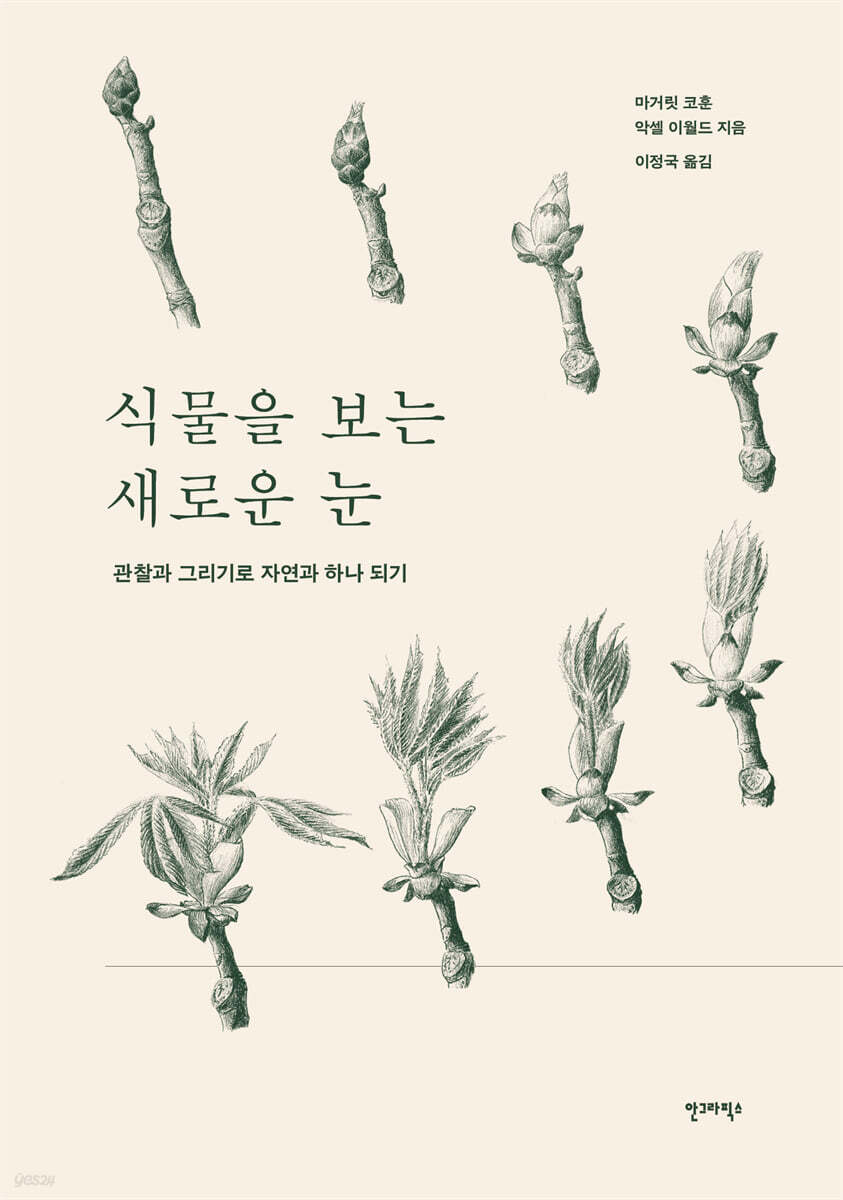
"A New Eye for Seeing Plants" is a book that presents a new way of seeing nature by traveling through the four seasons through the practice of observing and drawing nature.
Inspiring illustrations and simple observation exercises combine to teach you how to 'see' with new perspectives.
This book builds on Goethe's holistic approach, which opens the door to new ways of practicing science as an art.
Nature observation and artistic activities complement each other and help us perceive things more deeply.
The book is filled with detailed facts about plants, artistic insights, and beautifully illustrated illustrations of a wide range of plants, from seeds and sprouts to flowers and fruits.
It also functions as a practical guide, with helpful suggestions scattered throughout to encourage readers to practice drawing on their own.
The author also states that the usefulness of this book lies in ‘active participation.’
We have new eyes
"A New Eye for Seeing Plants" is a book that presents a new way of seeing nature by traveling through the four seasons through the practice of observing and drawing nature.
Inspiring illustrations and simple observation exercises combine to teach you how to 'see' with new perspectives.
This book builds on Goethe's holistic approach, which opens the door to new ways of practicing science as an art.
Nature observation and artistic activities complement each other and help us perceive things more deeply.
The book is filled with detailed facts about plants, artistic insights, and beautifully illustrated illustrations of a wide range of plants, from seeds and sprouts to flowers and fruits.
It also functions as a practical guide, with helpful suggestions scattered throughout to encourage readers to practice drawing on their own.
The author also states that the usefulness of this book lies in ‘active participation.’
- You can preview some of the book's contents.
Preview
index
Header
Opening remarks
1 Is it a question of life or not?
2 Is this the beginning or the end?
3 Becoming of a Plant
4 Jump into summer
5 Summer Blooms
6 Autumn Fruits
7 A New Perspective on Plants
Appendix 1 Preservation of Plant Specimens and Creating Leaf Orders
Appendix 2: Book List and Study Locations
Translator's Note
Translator's note
Opening remarks
1 Is it a question of life or not?
2 Is this the beginning or the end?
3 Becoming of a Plant
4 Jump into summer
5 Summer Blooms
6 Autumn Fruits
7 A New Perspective on Plants
Appendix 1 Preservation of Plant Specimens and Creating Leaf Orders
Appendix 2: Book List and Study Locations
Translator's Note
Translator's note
Detailed image

Into the book
This book is more of a workbook than a collection of information.
Therefore, the usefulness of the book lies in ‘active participation.’
Readers can take the book into nature, observe nature, check it out, and confirm what is described in the book.
This book presents a number of practices and exercises that we hope will spark your creative action and inspire you to devise your own transformational methods.
--- p.9
Goethe experienced that both art and science arise from or are directed towards the 'primal source of all being' that gave birth to the universe.
He developed a method of observing plants by turning from art to science, or by using art in doing science, and thereby made possible what Kant had declared impossible.
--- p.21
Go out for a winter walk and find an oak tree that is fully grown and in good condition.
Choose the direction that best allows you to savor the view.
Although it may be cold, stand for 30-40 minutes and observe closely, then summarize what you see, including the overall appearance, angle of bend, growth pattern, and proportions.
…let’s go home, have a cup of tea, and draw from memory.
Such detailed observational activities can be more easily observed when small groups share what they have done together.
--- p.39~40
It's wonderful to see plants growing strong and robust every day in early summer.
Try drawing a small sprout every day for a certain period of time.
Or observe and draw seeds sprouting during the winter.
…daily or whenever you notice a change, quickly sketch the entire plant and compare it with your previous drawing.
Let your imagination slide into the gaps between the pictures, and, with material expression, up and out,
Let yourself flow with the movement of the plant as it unfolds in a spiral.
--- p.77
Just as each leaf within a whole plant is an expression, each plant within the whole plant world is an expression.
Likewise, every moment of the year is a moment of the whole cycle of the seasons.
--- p.101~102
When you walk in a garden, stroll along a hedge, or cross a summer meadow, you will probably feel like 'talking to the flowers'.
As we have done so far, we first go to a place where flowers bloom and study their surroundings, growing habits, and each part until we become sufficiently 'familiar' with them, so that we can get to know the flower.
Open your sketchbook and draw quick line drawings of the whole plant and its parts, especially the flowers.
You need to know how the plant grows and how it expresses itself in each season.
--- p.133
We can simplify this journey as follows:
Plants start from dots (seeds) and progress to lines (roots and stems).
The lines spread out into planes (leaves) at rhythmic intervals and become increasingly three-dimensional as they move towards the flowers.
The flower is made up of planes where the lines (petioles) have disappeared.
The flower is simply surrounded by two-dimensional planes, the flower and sepals, making it resemble a three-dimensional solid.
It is in the fruit that the plant acquires a complete, three-dimensional 'body' with everything it needs.
In that central space of darkness, new growth occurs.
--- p.159
What does still life really mean? Still life depicts life.
It is about drawing a life that is at rest.
The life of nature, constantly changing and developing, is captured for a moment on the artist's canvas.
As in the fruit, so in the still life the natural process has come to an end.
… … Is that so? Isn't life simply a matter of sitting back, restrained, waiting, like tiny seeds within protruding fruits, eager for a new beginning? Isn't "still life" the same as "still alive"?
Therefore, the usefulness of the book lies in ‘active participation.’
Readers can take the book into nature, observe nature, check it out, and confirm what is described in the book.
This book presents a number of practices and exercises that we hope will spark your creative action and inspire you to devise your own transformational methods.
--- p.9
Goethe experienced that both art and science arise from or are directed towards the 'primal source of all being' that gave birth to the universe.
He developed a method of observing plants by turning from art to science, or by using art in doing science, and thereby made possible what Kant had declared impossible.
--- p.21
Go out for a winter walk and find an oak tree that is fully grown and in good condition.
Choose the direction that best allows you to savor the view.
Although it may be cold, stand for 30-40 minutes and observe closely, then summarize what you see, including the overall appearance, angle of bend, growth pattern, and proportions.
…let’s go home, have a cup of tea, and draw from memory.
Such detailed observational activities can be more easily observed when small groups share what they have done together.
--- p.39~40
It's wonderful to see plants growing strong and robust every day in early summer.
Try drawing a small sprout every day for a certain period of time.
Or observe and draw seeds sprouting during the winter.
…daily or whenever you notice a change, quickly sketch the entire plant and compare it with your previous drawing.
Let your imagination slide into the gaps between the pictures, and, with material expression, up and out,
Let yourself flow with the movement of the plant as it unfolds in a spiral.
--- p.77
Just as each leaf within a whole plant is an expression, each plant within the whole plant world is an expression.
Likewise, every moment of the year is a moment of the whole cycle of the seasons.
--- p.101~102
When you walk in a garden, stroll along a hedge, or cross a summer meadow, you will probably feel like 'talking to the flowers'.
As we have done so far, we first go to a place where flowers bloom and study their surroundings, growing habits, and each part until we become sufficiently 'familiar' with them, so that we can get to know the flower.
Open your sketchbook and draw quick line drawings of the whole plant and its parts, especially the flowers.
You need to know how the plant grows and how it expresses itself in each season.
--- p.133
We can simplify this journey as follows:
Plants start from dots (seeds) and progress to lines (roots and stems).
The lines spread out into planes (leaves) at rhythmic intervals and become increasingly three-dimensional as they move towards the flowers.
The flower is made up of planes where the lines (petioles) have disappeared.
The flower is simply surrounded by two-dimensional planes, the flower and sepals, making it resemble a three-dimensional solid.
It is in the fruit that the plant acquires a complete, three-dimensional 'body' with everything it needs.
In that central space of darkness, new growth occurs.
--- p.159
What does still life really mean? Still life depicts life.
It is about drawing a life that is at rest.
The life of nature, constantly changing and developing, is captured for a moment on the artist's canvas.
As in the fruit, so in the still life the natural process has come to an end.
… … Is that so? Isn't life simply a matter of sitting back, restrained, waiting, like tiny seeds within protruding fruits, eager for a new beginning? Isn't "still life" the same as "still alive"?
--- p.162
Publisher's Review
The seasons in the book begin in late autumn or early winter, around the time of potato digging, and pass through midwinter, spring, and summer, returning to autumn, when the delicious fruits are harvested.
It follows the order of the seasons, but the reading order is not fixed.
You can read it according to the current season, or you can start from the beginning and then return to the chapter that suits the current season.
One thing is certain: this journey will inspire and inspire us.
“If this book inspires in readers a sense of wonder and active interest in the living world of plants, and a willingness to creatively participate in its growth and development, we will be proud to have planted a seed in them for a new cognitive system—a seed that will grow into a ‘new eye for plants.’”
It follows the order of the seasons, but the reading order is not fixed.
You can read it according to the current season, or you can start from the beginning and then return to the chapter that suits the current season.
One thing is certain: this journey will inspire and inspire us.
“If this book inspires in readers a sense of wonder and active interest in the living world of plants, and a willingness to creatively participate in its growth and development, we will be proud to have planted a seed in them for a new cognitive system—a seed that will grow into a ‘new eye for plants.’”
GOODS SPECIFICS
- Date of issue: January 8, 2025
- Page count, weight, size: 200 pages | 508g | 181*256*16mm
- ISBN13: 9791168230897
You may also like
카테고리
korean


korean

![GQ KOREA Mark (Monthly): December [2025]](http://librairie.coreenne.fr/cdn/shop/files/8ef265dbbfbf186523ed75ba7319009d.jpg?v=1765340328&width=3840)


