

In all senses: Klangkunst
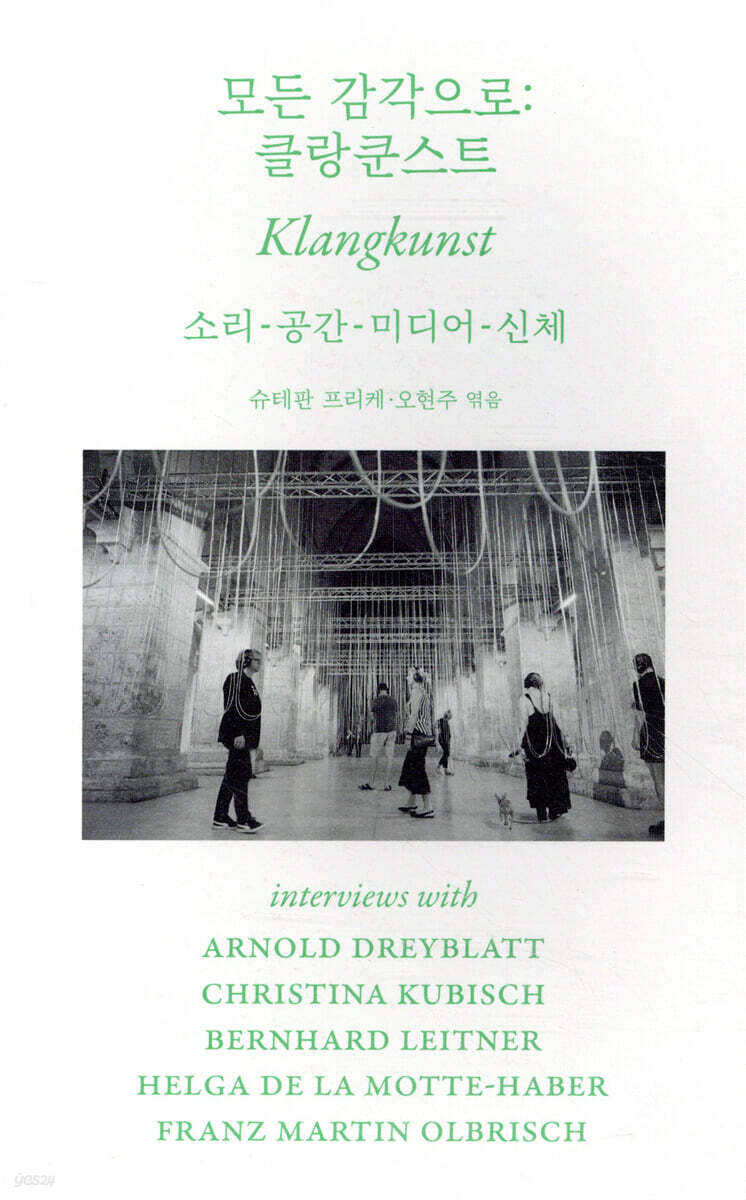 |
Description
Book Introduction
The sound of Klangkunst that could not be translated into sound art
“Klangkunst:
Life and Nature, Sound - Sounds composed in an aesthetic laboratory are considered visual objects of art, closely connected to the elaborately arranged spaces.
Sensing and seeing differently, the discovery and surprise in between.
Klangkunst is an interactive art form that raises new questions and evokes new experiences.
Contemporary art has emerged as a new genre by breaking the conventions, order, and norms of existing art.
It practiced the spirit of the avant-garde with different perspectives, experiments, and materials, and even attempted collaboration with different senses.
A representative example is sound art, or ‘artwork made of sound.’
Unfortunately, sound art, which is a form of visual art that uses both auditory and visual elements, and is primarily performed by visual artists rather than musicians, is not widely known in Korea, except for partial definitions (such as collaboration between visual and auditory art) and representative artists such as Nam June Paik, Raunschenberg, and John Cage.
The etymology and meaning of sound art, a modern art genre born from the collaboration of fine art and music, can be found in the German word Klangkunst. (The Korean word 'art' also finds its origins in the German word kunst, not the English-speaking word 'art'.) The translated word 'Klangkunst', 'sound art', can be directly translated into Korean as 'sound art', but the word 'klang' contains more elementary meanings of sound such as 'tone' and 'clearness' in addition to simply 'sound'.
Sound art is a term used internationally and is a concept that can naturally take root in Korea.
However, Klangkunst in Germany, the home of 'sound art' and a still active sound art creative scene, was, from the perspective of Oh Hyun-joo, a more challenging subject, worthy of delving into the essence of terminology and genre.
Because Klangkunst is clearly of a different nature from sound art.
This book is a compilation of interviews with five former members of Klangkunst, who are considered to have shaped the early spirit and form of the sound artist, in Germany, the birthplace of Klangkunst, and Berlin, the spiritual home of the sound artist.
Each of the five criminals is linked to a topic of contemporary art, such as sound, space, media, and the body.
This book is a publication of sound art, or Klangkunst, which is virtually non-existent in Korean publishing, and I hope it will open up broader horizons.
“Klangkunst:
Life and Nature, Sound - Sounds composed in an aesthetic laboratory are considered visual objects of art, closely connected to the elaborately arranged spaces.
Sensing and seeing differently, the discovery and surprise in between.
Klangkunst is an interactive art form that raises new questions and evokes new experiences.
Contemporary art has emerged as a new genre by breaking the conventions, order, and norms of existing art.
It practiced the spirit of the avant-garde with different perspectives, experiments, and materials, and even attempted collaboration with different senses.
A representative example is sound art, or ‘artwork made of sound.’
Unfortunately, sound art, which is a form of visual art that uses both auditory and visual elements, and is primarily performed by visual artists rather than musicians, is not widely known in Korea, except for partial definitions (such as collaboration between visual and auditory art) and representative artists such as Nam June Paik, Raunschenberg, and John Cage.
The etymology and meaning of sound art, a modern art genre born from the collaboration of fine art and music, can be found in the German word Klangkunst. (The Korean word 'art' also finds its origins in the German word kunst, not the English-speaking word 'art'.) The translated word 'Klangkunst', 'sound art', can be directly translated into Korean as 'sound art', but the word 'klang' contains more elementary meanings of sound such as 'tone' and 'clearness' in addition to simply 'sound'.
Sound art is a term used internationally and is a concept that can naturally take root in Korea.
However, Klangkunst in Germany, the home of 'sound art' and a still active sound art creative scene, was, from the perspective of Oh Hyun-joo, a more challenging subject, worthy of delving into the essence of terminology and genre.
Because Klangkunst is clearly of a different nature from sound art.
This book is a compilation of interviews with five former members of Klangkunst, who are considered to have shaped the early spirit and form of the sound artist, in Germany, the birthplace of Klangkunst, and Berlin, the spiritual home of the sound artist.
Each of the five criminals is linked to a topic of contemporary art, such as sound, space, media, and the body.
This book is a publication of sound art, or Klangkunst, which is virtually non-existent in Korean publishing, and I hope it will open up broader horizons.
- You can preview some of the book's contents.
Preview
index
7 Introduction
Sound Art or Klangkunst
― Oh Hyun-joo
13 “I hear better through my knees than through my calves.”
― Bernhard Leitner
51 “Klangkusnt is my life.”
― Christian Kubisch
99 “Our ears also need to be tuned.”
― Arnold Dreyblatt
133 “All sound and visual events must be included in the subject.”
― Franz Martin Olbrisch
181 “Klangkunst, that is a field that must be pioneered.”
― Helga de la Motte-Haber
195 back door
A term originating from East Germany (DDR) - 'Klangkunst'
― Stefan Fricke
Sound Art or Klangkunst
― Oh Hyun-joo
13 “I hear better through my knees than through my calves.”
― Bernhard Leitner
51 “Klangkusnt is my life.”
― Christian Kubisch
99 “Our ears also need to be tuned.”
― Arnold Dreyblatt
133 “All sound and visual events must be included in the subject.”
― Franz Martin Olbrisch
181 “Klangkunst, that is a field that must be pioneered.”
― Helga de la Motte-Haber
195 back door
A term originating from East Germany (DDR) - 'Klangkunst'
― Stefan Fricke
Into the book
One day I asked Stefan Fricke:
“What on earth is Klangkunst and what is Sound Art?”
And he answered like this.
“In fact, ‘art’ is more important than any other term.”
In 2011, I went to Germany with the desire to do something that combined music and art.
Sound art, experienced through numerous exhibitions and festivals in Germany, one of its roots.
But the deeper I delved into this field, the more I worked as an artist in this scene, the more I encountered the work of other artist-composers, the more the answer to this question became unanswerable.
In Korea, the genre that combines sound and art is generally called 'sound art', and its types also exist within a very diverse spectrum.
For example, experimental compositions based on various sounds/tonals can also be sound art, and presenting video art in conjunction with them can also be the same concept.
That is, it has various forms, such as experimental art forms centered on hearing, or art that can be perceived through both the senses of sight and hearing.
Therefore, we can see a phenomenon where the direction of artists or event organizers varies greatly depending on their artistic roots, which can give the impression that the term is being used excessively.
In any case, the concept of 'sound art' used in Korea is a term used internationally and is also a concept that can naturally be established in Korea.
However, as a country in Germany, one of the birthplaces of sound art and home to a vibrant scene, the criteria for Klangkunst felt a bit more demanding to me, which is why I wanted to re-examine the essence of this term and genre.
This is because it clearly has a different nature from ‘sound art’.
One of the questions that arises is, what on earth is Klangkunst?
---From "Oh Hyun-joo's 'Preface'"
Stefan Fricke: It's a genre with many historical roots.
John Cage is a unique figure in the new music (Neue Musik/modern music), Klangkunst, Radiophonik Ars Acoustica, and countless trends in the visual arts.
So where, then, do you think, are the other roots of Klangkunst's formation? This has often been studied by scholars, and (unsurprisingly) can be traced back to Futurism and parts of 1920s Dadaism.
Of course, it is also found in Fluxus in the 1960s.
You can agree with this view, but you don't have to.
Kristina Kubiš: I see it as having completely different roots, apart from all the historical and cultural aspects.
It occurred to me that my artist friends Hans Peter Kuhn (*1952), Rudolf Julius (1939-2011) and I were all from northern Germany.
It's not a place with a lot of noise.
The landscape there is flat.
It's always windy and rainy, but there's little change.
Still, there were some really cool sounds.
This area has influenced what we do.
What is certain is that it was a post-war period when much was destroyed and all parts were in a state of upheaval.
And of course, it becomes a special biography that tells where and how we grew up.
In the 1970s, it was still possible to be hostile to something.
You could be against classical music, you could be against music education.
As a woman, I could have opposed men.
There were so many different things to resist.
And this resistance could be creative and lead to good results.
It's no longer an easy task, especially for young artists today.
---From "Interview with Kristina Kubisch"
Oh Hyun-joo: What is the most important thing in artistic creation? Bernhard Leitner: Curiosity.
The most important prerequisite for any work of art is an inherent curiosity.
For example, curiosity stems from questions like, “What is possible?” or “What happened? How can we understand it?”
Don't you think it's virtually impossible to talk about art without curiosity? This applies to all areas of art.
If you are not curious about the body's movements in space, you may not be interested in dance or you may have considered ballet unnecessary.
But if you're curious about what's going on there, if you're curious about the spatial transformations of the dancers, for example, you'll be delighted to look at it and discover something.
Curiosity and discovery are so interconnected.
---From "An Interview with Bernhard Leitner"
Oh Hyun-joo: When you work, do your art and music influence each other?
Arnold Draibrat: Are you a composer or a visual artist? The world still divides you like that.
Many people don't understand that both are possible.
People who know me as a musician often have no idea that I'm an artist.
Some people who know this fact think that my artistic activities are a waste of time and that I should just focus on music.
People in the art world often describe my music as 'cute'.
I used to play around with these two positions a bit.
Someone called me and said, “I’d like to invite you to Amsterdam next year.”
I asked, “Are you talking about a music/sound performance or an art performance?”
When I got the answer, “It’s music,” I said, “Please wait a moment!” and then made a sound like I was hanging up.
Then I pick up the phone again and say, "Hi! You said you wanted to talk about a music project?"
When I do this, everyone gets completely confused, as if I'm dealing with twins.
In fact, it's a shame that making music and working on art are so separate.
Things are slowly changing now that a younger generation is emerging who thinks differently, but most institutions still treat it this way.
Recently, I created a work called 'Warm-Up' (Warm-Up, 2021), which intensively studied the orchestra's warm-up session, or tuning process.
As a minimalist, I am very interested in this part.
Unfortunately, this tuning took less than a minute each time, even though it should have been a much longer process.
I created an installation that could showcase this tuning process in the context of visual art.
We are currently discussing a project with an orchestra to perform it.
This is one of those projects that started in art and evolved into music.
You could say that there are different variations for musical context and artistic context.
“What on earth is Klangkunst and what is Sound Art?”
And he answered like this.
“In fact, ‘art’ is more important than any other term.”
In 2011, I went to Germany with the desire to do something that combined music and art.
Sound art, experienced through numerous exhibitions and festivals in Germany, one of its roots.
But the deeper I delved into this field, the more I worked as an artist in this scene, the more I encountered the work of other artist-composers, the more the answer to this question became unanswerable.
In Korea, the genre that combines sound and art is generally called 'sound art', and its types also exist within a very diverse spectrum.
For example, experimental compositions based on various sounds/tonals can also be sound art, and presenting video art in conjunction with them can also be the same concept.
That is, it has various forms, such as experimental art forms centered on hearing, or art that can be perceived through both the senses of sight and hearing.
Therefore, we can see a phenomenon where the direction of artists or event organizers varies greatly depending on their artistic roots, which can give the impression that the term is being used excessively.
In any case, the concept of 'sound art' used in Korea is a term used internationally and is also a concept that can naturally be established in Korea.
However, as a country in Germany, one of the birthplaces of sound art and home to a vibrant scene, the criteria for Klangkunst felt a bit more demanding to me, which is why I wanted to re-examine the essence of this term and genre.
This is because it clearly has a different nature from ‘sound art’.
One of the questions that arises is, what on earth is Klangkunst?
---From "Oh Hyun-joo's 'Preface'"
Stefan Fricke: It's a genre with many historical roots.
John Cage is a unique figure in the new music (Neue Musik/modern music), Klangkunst, Radiophonik Ars Acoustica, and countless trends in the visual arts.
So where, then, do you think, are the other roots of Klangkunst's formation? This has often been studied by scholars, and (unsurprisingly) can be traced back to Futurism and parts of 1920s Dadaism.
Of course, it is also found in Fluxus in the 1960s.
You can agree with this view, but you don't have to.
Kristina Kubiš: I see it as having completely different roots, apart from all the historical and cultural aspects.
It occurred to me that my artist friends Hans Peter Kuhn (*1952), Rudolf Julius (1939-2011) and I were all from northern Germany.
It's not a place with a lot of noise.
The landscape there is flat.
It's always windy and rainy, but there's little change.
Still, there were some really cool sounds.
This area has influenced what we do.
What is certain is that it was a post-war period when much was destroyed and all parts were in a state of upheaval.
And of course, it becomes a special biography that tells where and how we grew up.
In the 1970s, it was still possible to be hostile to something.
You could be against classical music, you could be against music education.
As a woman, I could have opposed men.
There were so many different things to resist.
And this resistance could be creative and lead to good results.
It's no longer an easy task, especially for young artists today.
---From "Interview with Kristina Kubisch"
Oh Hyun-joo: What is the most important thing in artistic creation? Bernhard Leitner: Curiosity.
The most important prerequisite for any work of art is an inherent curiosity.
For example, curiosity stems from questions like, “What is possible?” or “What happened? How can we understand it?”
Don't you think it's virtually impossible to talk about art without curiosity? This applies to all areas of art.
If you are not curious about the body's movements in space, you may not be interested in dance or you may have considered ballet unnecessary.
But if you're curious about what's going on there, if you're curious about the spatial transformations of the dancers, for example, you'll be delighted to look at it and discover something.
Curiosity and discovery are so interconnected.
---From "An Interview with Bernhard Leitner"
Oh Hyun-joo: When you work, do your art and music influence each other?
Arnold Draibrat: Are you a composer or a visual artist? The world still divides you like that.
Many people don't understand that both are possible.
People who know me as a musician often have no idea that I'm an artist.
Some people who know this fact think that my artistic activities are a waste of time and that I should just focus on music.
People in the art world often describe my music as 'cute'.
I used to play around with these two positions a bit.
Someone called me and said, “I’d like to invite you to Amsterdam next year.”
I asked, “Are you talking about a music/sound performance or an art performance?”
When I got the answer, “It’s music,” I said, “Please wait a moment!” and then made a sound like I was hanging up.
Then I pick up the phone again and say, "Hi! You said you wanted to talk about a music project?"
When I do this, everyone gets completely confused, as if I'm dealing with twins.
In fact, it's a shame that making music and working on art are so separate.
Things are slowly changing now that a younger generation is emerging who thinks differently, but most institutions still treat it this way.
Recently, I created a work called 'Warm-Up' (Warm-Up, 2021), which intensively studied the orchestra's warm-up session, or tuning process.
As a minimalist, I am very interested in this part.
Unfortunately, this tuning took less than a minute each time, even though it should have been a much longer process.
I created an installation that could showcase this tuning process in the context of visual art.
We are currently discussing a project with an orchestra to perform it.
This is one of those projects that started in art and evolved into music.
You could say that there are different variations for musical context and artistic context.
---From "An Interview with Arnold Drablatt"
Publisher's Review
Bernhard Leitner
Born in 1938 in Feldkirch, Vorarlberg, Austria, he spent his childhood in Innsbruck, Tirol, the capital of Tyrol.
He studied architecture at the Technische Universitat Wien from 1956 to 1963, and after receiving his diploma, worked in architectural offices in Paris for three years and then in Vienna.
He moved to New York in 1968 and worked as an urban designer at the New York City Department of City Planning from 1969 to 1971. In 1972, he was appointed associate professor at New York University, where he continued to teach until 1981.
He worked as an artist in Berlin (West Germany) for four years from 1982, and in 1987 he was appointed professor of cross-media art at the University of Applied Arts Vienna (Universitat fur angewandte Kunst Wien), where he taught students until 2005.
He currently works in Vienna and Gaindorf, Niederosterreich, where he built a large studio in a converted former flour mill in 1993 and the experimental and exhibition space &Tonraumhalle&, which he opened in 2022 together with his son, architect and lighting designer Lukas Leitner.
Bernhard Leitner has been a member of the Board of Trustees of the Akademie der Kunste, the German Federal Academy of Arts, since 2016.
www.bernhardleitner.at
Christina Kubisch
Born in Bremen, Germany in 1944, he studied at the KRH Sonderborg Academy of Fine Arts (Akademie der Bildenden Kunste Stuttgart) in 1967/68.
He studied painting under the tutelage of Dr. Sonderborg, flute and music at the music academies in Hamburg, Germany, Graz, Austria, and Zurich, Switzerland, from 1969 to 1974, and art under the Swiss artist and educator Serge Stauffer at the Freie Kunstschule Zurich from 1972 to 1974.
In 1974, he moved to Milan, Italy, where he studied composition under Franco Donatoni at the Conservatorio Giuseppe Verdi in Milan, and studied electronic music, receiving a diploma in 1976.
From 1974 to 1980 he worked with the Italian artist Fabrizio Plessi, and in 1987 he moved to Berlin (West Germany).
He taught at the Jan van Eyck-Akademie in Maastricht, Netherlands, in 1989, at the Kunstakademie Munster, Germany, in 1990/91, at the Hochschule der Kunste Berlin, West Berlin, from 1991 to 1994, and at the Ecole Nationale Superieure des Beaux-Arts Paris, in 1994/95.
In 1994 he was appointed Professor of Audiovisual Arts at the Hochschule der Bildenden Kunste Saar in Saarbrücken, Germany, where he taught until 2013.
Christina Kubisch has been a member of the German Academy of Arts (Akademie der Kunste), the German Federal Art Promotion Agency, since 1997 and currently lives and works in Berlin.
https://christinakubisch.de
Arnold Dreyblatt
Born in New York in 1953, he studied literary and media criticism at the State University of New York at New Paltz (1970–1974) and electronic music composition with Joel Chadabe at the University at Albany (SUNY).
In 1974/75, he studied video art at the Media Studies Center, University at Buffalo, SUNY, Buffalo, NY (MA, 1976), and also participated in summer composition workshops with Pauline Oliveros, Morton Feldman, and John Cage.
From 1975 to 1977, he returned to New York, where he worked as an assistant to composer La Monte Young and received private lessons, and also worked as an assistant to video artist Shigeko Kubota and Nam June Paik.
In 1979, he founded and performed with the ensemble &The Orchestra of Excited Strings&, and studied composition with Alvin Lucier at Wesleyan University in Connecticut from 1980 to 1982 (MA, 1982). From 1983 to 1986, he lived in West Berlin and Budapest on an overseas project scholarship, and from 1987 to 1989, he lived in Liège, Belgium.
He has lived in Berlin since 1989.
In 1996 he taught media art at the University of Lüneburg, in 1998/99 at the Kunsthochschule Berlin-Weißensee, and from 2001 to 2003 at the Hochschule der Bildenden Kunste Saar in Saarbrücken.
In 2009, he was appointed Professor of Media Art at the Muthesius Kunsthochschule in Kiel, Germany, where he taught until 2022. Since 2007, he has been a member of the Akademie der Kunste, the German Federal Academy of Arts, where he has been active.
www.dreyblatt.net
Franz Martin Olbrisch
Born in Mullheim an der Ruhr, Germany in 1952, he trained as a surveyor and then studied composition at the Hochschule der Kunste in West-Berlin with Frank Michael Beyer from 1979 to 1985.
From 1986 to 1992, he taught music theory at the Kirchenmusikschule der evangelischen Landeskirche Berlin-Brandenburg, and from 1988 to 2008, he lectured on composition and studio technique at the Berlin University of the Arts.
From 1999 to 2004, he taught audio communication at the Technische Universitat Berlin and gave several lectures at the International Summer Course for New Music (Darmstadter Ferienkurse) of the International Festival of Contemporary Music in Darmstadt.
In 2008, he was appointed professor of composition at the Dresden University of Music (Hochschule fur Musik Carl Maria von Weber), where he continues to teach and nurture students.
At the same time, he served as the director of the Dongguk University Electronic Music Studio until 2020, and as the vice president of the German branch of the International Society for Contemporary Music (ISCM) from 2011 to 2021.
Since 2013, he has been serving as a member of the Saxon Academy of Arts in Germany.
Franz Martin Olbrisch lives in Berlin and works on several projects with his wife, the video artist Beate Olbrisch (*1951).
http://olbrisch-online.de
Helga de la Motte-Haber
Born in Ludwigshafen am Rhein, Germany in 1938, he studied psychology (Diplom) in Mainz, Germany and Vienna, Austria from 1957 to 1961.
He then continued his studies in Hamburg, Germany, and taught at the Technische Universitat Berlin from 1968 to 1972.
(Acquired German professorship in 1971) Starting as a professor at the Cologne University of Education (Padagogische Hochschule Koln) in 1972, he served as a professor of systems musicology at the Technical University of Berlin (Technische Universitat Berlin) from 1978 to 2005.
In 1982, he co-founded the German Society for Music Psychology (Deutsche Gesellschaft fur Musikpsychologie).
In 2015, he was awarded an honorary doctorate from the Hochschule fur Musik, Theater und Medien Hannover, Germany.
Helga de la Motte-Haber, who lives in Berlin, has been dedicated to the study of sound art since 1980 and has written and edited numerous scholarly publications on the subject.
Born in 1938 in Feldkirch, Vorarlberg, Austria, he spent his childhood in Innsbruck, Tirol, the capital of Tyrol.
He studied architecture at the Technische Universitat Wien from 1956 to 1963, and after receiving his diploma, worked in architectural offices in Paris for three years and then in Vienna.
He moved to New York in 1968 and worked as an urban designer at the New York City Department of City Planning from 1969 to 1971. In 1972, he was appointed associate professor at New York University, where he continued to teach until 1981.
He worked as an artist in Berlin (West Germany) for four years from 1982, and in 1987 he was appointed professor of cross-media art at the University of Applied Arts Vienna (Universitat fur angewandte Kunst Wien), where he taught students until 2005.
He currently works in Vienna and Gaindorf, Niederosterreich, where he built a large studio in a converted former flour mill in 1993 and the experimental and exhibition space &Tonraumhalle&, which he opened in 2022 together with his son, architect and lighting designer Lukas Leitner.
Bernhard Leitner has been a member of the Board of Trustees of the Akademie der Kunste, the German Federal Academy of Arts, since 2016.
www.bernhardleitner.at
Christina Kubisch
Born in Bremen, Germany in 1944, he studied at the KRH Sonderborg Academy of Fine Arts (Akademie der Bildenden Kunste Stuttgart) in 1967/68.
He studied painting under the tutelage of Dr. Sonderborg, flute and music at the music academies in Hamburg, Germany, Graz, Austria, and Zurich, Switzerland, from 1969 to 1974, and art under the Swiss artist and educator Serge Stauffer at the Freie Kunstschule Zurich from 1972 to 1974.
In 1974, he moved to Milan, Italy, where he studied composition under Franco Donatoni at the Conservatorio Giuseppe Verdi in Milan, and studied electronic music, receiving a diploma in 1976.
From 1974 to 1980 he worked with the Italian artist Fabrizio Plessi, and in 1987 he moved to Berlin (West Germany).
He taught at the Jan van Eyck-Akademie in Maastricht, Netherlands, in 1989, at the Kunstakademie Munster, Germany, in 1990/91, at the Hochschule der Kunste Berlin, West Berlin, from 1991 to 1994, and at the Ecole Nationale Superieure des Beaux-Arts Paris, in 1994/95.
In 1994 he was appointed Professor of Audiovisual Arts at the Hochschule der Bildenden Kunste Saar in Saarbrücken, Germany, where he taught until 2013.
Christina Kubisch has been a member of the German Academy of Arts (Akademie der Kunste), the German Federal Art Promotion Agency, since 1997 and currently lives and works in Berlin.
https://christinakubisch.de
Arnold Dreyblatt
Born in New York in 1953, he studied literary and media criticism at the State University of New York at New Paltz (1970–1974) and electronic music composition with Joel Chadabe at the University at Albany (SUNY).
In 1974/75, he studied video art at the Media Studies Center, University at Buffalo, SUNY, Buffalo, NY (MA, 1976), and also participated in summer composition workshops with Pauline Oliveros, Morton Feldman, and John Cage.
From 1975 to 1977, he returned to New York, where he worked as an assistant to composer La Monte Young and received private lessons, and also worked as an assistant to video artist Shigeko Kubota and Nam June Paik.
In 1979, he founded and performed with the ensemble &The Orchestra of Excited Strings&, and studied composition with Alvin Lucier at Wesleyan University in Connecticut from 1980 to 1982 (MA, 1982). From 1983 to 1986, he lived in West Berlin and Budapest on an overseas project scholarship, and from 1987 to 1989, he lived in Liège, Belgium.
He has lived in Berlin since 1989.
In 1996 he taught media art at the University of Lüneburg, in 1998/99 at the Kunsthochschule Berlin-Weißensee, and from 2001 to 2003 at the Hochschule der Bildenden Kunste Saar in Saarbrücken.
In 2009, he was appointed Professor of Media Art at the Muthesius Kunsthochschule in Kiel, Germany, where he taught until 2022. Since 2007, he has been a member of the Akademie der Kunste, the German Federal Academy of Arts, where he has been active.
www.dreyblatt.net
Franz Martin Olbrisch
Born in Mullheim an der Ruhr, Germany in 1952, he trained as a surveyor and then studied composition at the Hochschule der Kunste in West-Berlin with Frank Michael Beyer from 1979 to 1985.
From 1986 to 1992, he taught music theory at the Kirchenmusikschule der evangelischen Landeskirche Berlin-Brandenburg, and from 1988 to 2008, he lectured on composition and studio technique at the Berlin University of the Arts.
From 1999 to 2004, he taught audio communication at the Technische Universitat Berlin and gave several lectures at the International Summer Course for New Music (Darmstadter Ferienkurse) of the International Festival of Contemporary Music in Darmstadt.
In 2008, he was appointed professor of composition at the Dresden University of Music (Hochschule fur Musik Carl Maria von Weber), where he continues to teach and nurture students.
At the same time, he served as the director of the Dongguk University Electronic Music Studio until 2020, and as the vice president of the German branch of the International Society for Contemporary Music (ISCM) from 2011 to 2021.
Since 2013, he has been serving as a member of the Saxon Academy of Arts in Germany.
Franz Martin Olbrisch lives in Berlin and works on several projects with his wife, the video artist Beate Olbrisch (*1951).
http://olbrisch-online.de
Helga de la Motte-Haber
Born in Ludwigshafen am Rhein, Germany in 1938, he studied psychology (Diplom) in Mainz, Germany and Vienna, Austria from 1957 to 1961.
He then continued his studies in Hamburg, Germany, and taught at the Technische Universitat Berlin from 1968 to 1972.
(Acquired German professorship in 1971) Starting as a professor at the Cologne University of Education (Padagogische Hochschule Koln) in 1972, he served as a professor of systems musicology at the Technical University of Berlin (Technische Universitat Berlin) from 1978 to 2005.
In 1982, he co-founded the German Society for Music Psychology (Deutsche Gesellschaft fur Musikpsychologie).
In 2015, he was awarded an honorary doctorate from the Hochschule fur Musik, Theater und Medien Hannover, Germany.
Helga de la Motte-Haber, who lives in Berlin, has been dedicated to the study of sound art since 1980 and has written and edited numerous scholarly publications on the subject.
GOODS SPECIFICS
- Date of issue: November 18, 2024
- Page count, weight, size: 200 pages | 288g | 130*205*11mm
- ISBN13: 9791197785375
- ISBN10: 119778537X
You may also like
카테고리
korean


korean

![GQ KOREA Mark (Monthly): December [2025]](http://librairie.coreenne.fr/cdn/shop/files/8ef265dbbfbf186523ed75ba7319009d.jpg?v=1765340328&width=3840)


