

The latest Korean wild mushroom guide
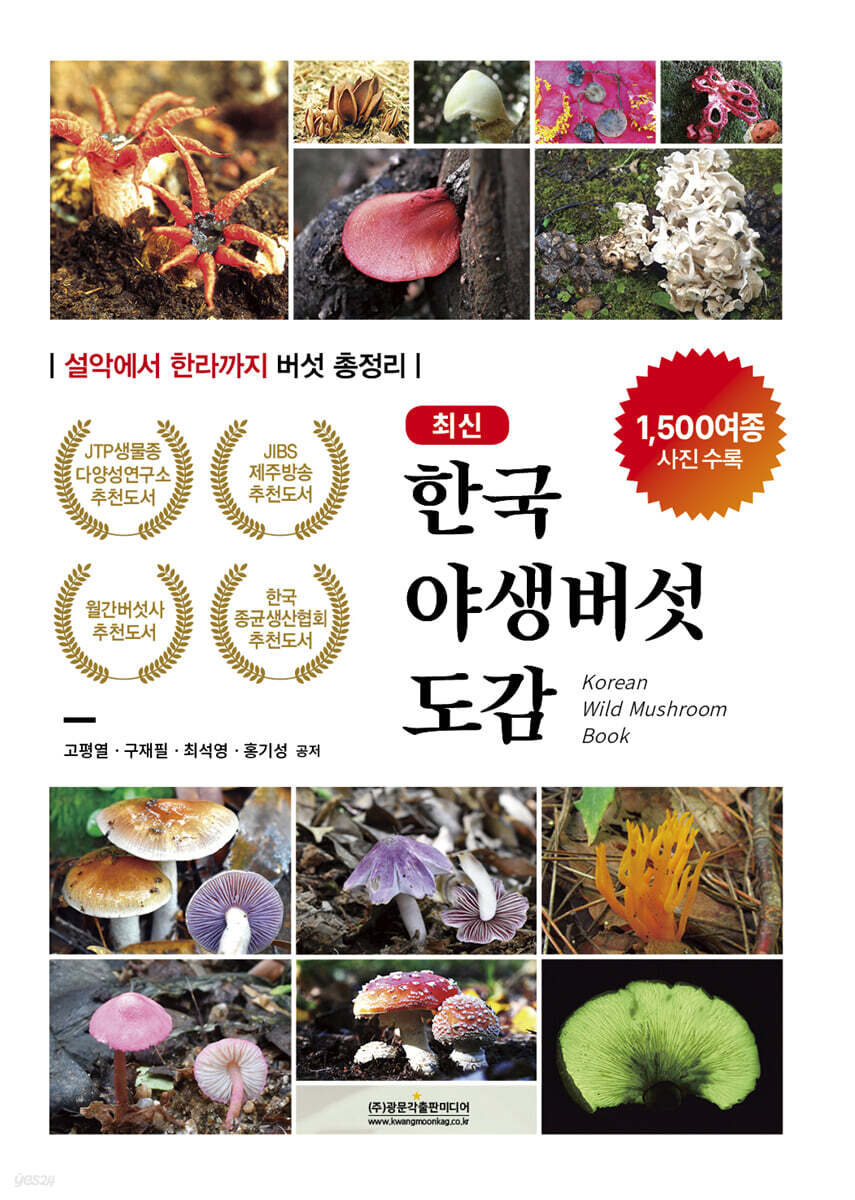 |
Description
Book Introduction
A revised edition of the 『Korean Wild Mushroom Encyclopedia』 published in June 2021.
The latest edition was published by adding new species to the existing ones and supplementing the content overall.
This latest edition includes 187 new species, bringing the total to 1,517 species.
This is the most extensive wild mushroom guide published in Korea, and it pursues both practicality for field use and academic value.
Among the newly included mushrooms, there are many new species that have not yet been recorded in Korea, and species that have not yet been officially reported to the academic world are listed with new names for convenience.
This guide has been designed to include as many photos and detailed information on as many species as possible so that it can be used as a basic resource for mushroom identification.
We sincerely hope that this guide will increase understanding of mushroom ecology and contribute to the utilization and conservation of mushroom resources.
The latest edition was published by adding new species to the existing ones and supplementing the content overall.
This latest edition includes 187 new species, bringing the total to 1,517 species.
This is the most extensive wild mushroom guide published in Korea, and it pursues both practicality for field use and academic value.
Among the newly included mushrooms, there are many new species that have not yet been recorded in Korea, and species that have not yet been officially reported to the academic world are listed with new names for convenience.
This guide has been designed to include as many photos and detailed information on as many species as possible so that it can be used as a basic resource for mushroom identification.
We sincerely hope that this guide will increase understanding of mushroom ecology and contribute to the utilization and conservation of mushroom resources.
index
About the latest edition
preface
Know and see
BASIDIOMYCOTA
AGARICOMYCETES
AGARICALES
Agaricaceae
Agaricus
Chlorophyllum
Coprinus
Crucibulum
Cyathus
Cystoderma
Cystodermella
Cystolepiota
Echinoderma
Lepiota
Leucoagaricus
Leucocoprinus
Macrolepiota
Melanophyllum
Nidula
Phaeolepiota
Tulostoma
Amanitaceae
Amanita
Limacella
Saproamanita
Bolbitlaceae
Bolbitius
Conocybe
Descolea
Panaeolus
Honey mushroom family Callistosporiaceae
Callistosporium
Macrocybe
Clavariaceae
Clavaria
Clavulinopsis
Mucronella
Ramariopsis
Clitocybaceae
Clitocybe
Collybia
Cortinariaceae
Cortinarius
Pyrrhoglossum
Thaxterogaster
Butterfly mushroom family Crepidotaceae
Crepidotus
Cup Mushrooms and Cyphellaceae
Cheimonophyllum
Gloeostereum
Entolomataceae
Clitocella
Clitopilus
Entoloma (Rhodophyllus)
Fistulinaceae
Fistulina
Hydnangiaceae
Laccaria
Hygrophoraceae
Ampulloclitocybe
Cuphophyllus
Gliophorus
Humidicutis
Hygrocybe
Hygrophorus
Lichenomphalia
Porpolomopsis
Hymenogastraceae
Deconica
Flammula
Galerina genus
Gymnopilus
Incertae sedis
Delicatula
Gamundia
Gerronema
Gloioxanthomyces
Henningsomyces
Infundibulicybe
Lepista (genus Lepista)
Leucocybe
Orange mushroom genus Loreleia
Melanoleuca
Paralepistopsis
Rectipilus
Singerocybe
Squamanita
Synnematomyces
Inocybaceae
Flammulaster
Inocybe
Inosperma
Phaeomarasmius
Simocybe
Lycoperdaceae
Bovista (Bovista genus)
Calvatia
Lycoperdon
Lypophllaceae
Asterophora
Calocybe
Hypsizygus
Lyophyllum
Ossicaulis
Tricholomella
Macrocystidiaceae
Macrocystidia
Marasmiaceae
Baeospora
Calytella
Campanella
Chaetocalathus
Crinipellis
Hydropus
Marasmius
Megacollybia
Micromphale
paramarasmius
Pleurocybella
Rhodocollybia
Tetrapyrgos
Mycenaceae
Atheniella
Favolaschia
Hemimycena
Mycena
Panellus
Roridomyces
Tectella
Xeromphalina
Omphalotaceae
Collybiopsis
Gymnopus
Lentinula dentata
Marasmiellus
Mycetinis
Omphalotus
Phyllotopsidaceae
Phyllotopsis
Physalacriaceae
Armillaria
Cryptomarasmius
Cylindrobasidium
Cyptotrama
Desarmillaria
Flammulina
Gloiocephala
Hymenopellis
Mucidula
Paraxerula
Physalacria
Rhodotus
Strobilurus
Xerula
Pleurotaceae
Hohenbuehelia
Pleulotus
Resupinatus
Pluteaceae
Pluteus
Volvariella
Porotheleaceae
Phloeomana
Psathyrellaceae
Coprinellus
Coprinopsis
Cystoagaricus
Homophron
Lacrymaria
Parasola
Psathyrella
Pterulaceae
Pterula
Pterulicium
Radulomycetaceae
Radulomyces
Sarcomyxaceae
Sarcomyxa
Schizophyllaceae
Porodisculus
Schizophyllum
Strophariaceae
Agrocybe
Hebeloma
Hypholoma
Kuehneromyces
Leratiomyces
Pholiota
Psilocybe
Stropharia
Tricholomataceae
Arrhenia
Aspropaxillus
Tricholoma
Tricholosporum
Tricholomopsis
Tubariaceae
Cyclocybe
Tubaria
Typhulaceae, family Typhulaceae
Typhula
AMYLOCORTICIALES
Amylocorticiaceae
Mushroom genus Plicaturopsis
ATHELIALES
Atheliaceae
Piloderma
AURICULARIALES
Auriculariaceae
Auricularia
Elmerina
Exdia
Heterochaete
Pseudohydnum
BOLETALES
Boletaceae
Aureoboletus
Austroboletus
Baorangia
Boletellus
Boletus
Chalciporus
Chiua
Cyanoboletus
Harrya
Heimioporus
Hortiboletus
Imleria (brown net mushroom)
Leccinellum
Leccinum
Mucilopilus
Neoboletus
Octaviania
Phylloporus
Porphyrellus
Pseudoaustroboletus
Pseudoboletus
Pulveroboletus
Retiboletus
Rugiboletus
Strobilomyces
Sutorius
Tylopilus
Xanthoconium
Xerocomellus
Xerocomus
Calostomataceae
Calostoma
Diplocystidiaceae
Astraeus
Gomphidiaceae
Chroogomphus
Gomphidius
Gyroporaceae
Gyroporus
Hygrophoropsidaceae
Hygrohyphoropsis
Leucogyrophana
Paxillaceae
Alpova
Gyrodon
Meiorganum
Melanogaster
Paxillus
Rhizopogonaceae
Rhizopogon
Sclerodermataceae
Pisolithus
Scleroderma
Suilaceae
Suilus
Ginkgo biloba and Tapinellaceae
Pseudomerulius
Tapinella
Antharellales
Hydnaceae
Cantharellus
Clavulina
Craterellus
Hydnum
Multiclavula
Pseudocraterellus
CORTICIALLES
Corticiaceae
Corticium
Erythricium
Vuilleminiaceae
Vuilleminia
GEASTRALES
Geastraceae
Geastrum
Sphaaerobolus
GLOEOPHYLLALES
Gloeophyllaceae
Gloeophyllum
Neolentinus
GOMPHALES
Clavariadelphaceae
Clavariadelphus
Gomphaceae
Gloeocantharellus
Phaeoclavulina (brown spore mushroom)
Ramaria
Turbinellus
Lentariaceae
Lentaria
Hymenochatales
Hymenochaetaceae
Coltricia
Coltriciella
Fulboderma
Fuscoporia
Hydnoporia
Hymenochaete
Hymenochaetopsis
Inonotus
Onnia
Phellinopsis
Phellinus
Sanghuangporus
Trichaptum
Oxyporaceae
Oxyporos, a white mushroom
Rickenellaceae
Alloclavaria
Cotylidia
Resinicium
Rickenella
Schizoporaceae
Schizopora
Xylodon
PHALLALES
Phallaceae
Aseroe
Clathrus
Ileodictyon
Kobayasia
Lysurus
Mutinus
Phallus
Pseudocolus
POLYPORALES
Cerrenaceae
Cerrena
Dacryobolaceae
Postia
Fomitopsidaceae
Antrodia
Brunneoporus
Daedalea
Fomitopsis
Laetiporus
Phaeplus
Wolfiporia
Ganodermataceae
Ganoderma
Grifolaceae
Grifora
Hyphodermataceae
Hyphoderma
Incertae sedis
bulbillomyces
Calcipostia
Climacocystis
Gyrophanopsis
Hypochnicium
Mycoleptodonoides
Incrustoporiaceae
Skeletocutis
Tyromyces
Irpicaceae
Ceriporia
Gloeoporus
Irpex
Meruliopsis
Vitreoporus
Ischnodermataceae
Ischnoderma
Meripilaceae
Loweomyces
Rigidoporus
Meruliaceae
Climacodon
Crustodontia
Hydnophlebia
Irpiciporus
Mycoacia
Phlebia
Panaceae
Panus
Phanerochaetaceae
Bjerkandera
Hapalopilus
Phlebiopsis
Terana (blue-purple fur cap mushroom)
Podoscyphaceae
Abortiporus
Polyporaceae
Abundisporuss
Cerioporus
Cryptoporus
Cyanosporus
Daedaleopsis
Favolus
Fomes of the genus Horseshoe Mushroom
Lentinus
Lenzites
Lopharia
Microporus
Neofavolus
Perenniporia
Perenniporiopsis
Picipes (black-footed mushroom)
Podofomes
Polyporus
Poronidulus
Pseudofavolus
Pycnoporus
Trametes
Trametopsis, a mushroom in the genus Youdo Songpyeon
Truncospora
Vanderbylia
Pycnoporellaceae
Pycnoporellus
Sparassidaceae
Sparassis
Steccherinaceae
Junghuhnia
Metuloidea
Nigroporus
Steccherinum
Russulales
Albatrellaceae
Albatrellus
Auriscalpiaceae
Artomyces
Ausriscalpium
Lentinellus
Root fungus family Bondarzewiaceae
Bondarzewia
Heterobasidion
Hericiaceae
Hericium
Incertae sedis
Neoalbatrellus
Polypus
Peniophoraceae
Peniophora
Russulaceae
Lactarius
Lactifluus
Russula
Stereaceae
Aleurodiscus
Stereum
Xylobolus
Sebacinales
Konjac mushroom and Sebacinacese
Sebacina genus
STEREOPSIDALES
Stereopsidaceae
Stereopsis
THELEPHORALES
Bankeraceae
Boletopsis
Hydnellum
Sarcodon
Thelephoraceae
Phellodon
Polyozellus
Thelephora
ATRACTIELLOMYCETES
ATRACTIELLALES
Phleogenaceae
Helicogloea
Red-necked DACRYMYCETES
DACRYMYCETALES
Dacrymycetaceae
Calocera
Dacrymycetes
Dacryopinax
Ditiola
Guepiniopsis
TREMELLOMYCETES
FILOBASIDIALES
Filobasidiaceae
Syzygospora
TREMELLALES
Sirobasidiaceae
Sirobasidium
Tremellaceae
Phaeotremella
Tremella
PUCCINIOMYCOTINA
PUCCINIOMYCETES
HELICOBASIDIALES
Helicobasidiaceae
Helicobasidium
PUCCINIALES
Cronartiaceae
Cronartium
Gymnosporangiaceae
Gymnosporangium
Phragmidiaceae
Phragmidium
Pucciniaceae
Stereostratum
Raveneliaceae
Nyssopsora
USTILAGINOMYCOTINA
EXOBASIDIOMYCETES
EXOBASIDIALES
Exobasidiaceae
Exobasidium
USTILAGINOMYCETES
USTILAGINALES
Ustilaginaceae
Bambusiomyces
Ustilago
ASCOMYCOTA
Mokmijeong INCERTAE SEDIS
Mokmijeong/Gwamijeong Incertae sedis
Anthina
DOCHIDEOMYCETES
Hysteriales
Hysteriaceae
Hysterium
Mokmijeong INCERTAE SEDIS
Mokmijeong/Gwamijeong Incertae sedis
Catinella
MYTILINIDIALES
Gloniaceae
Glonium
PATELLARIALES
Patellariaceae
Rhytidhysteron
PLEOSPORALES
Leptosphaeriaceae
Leptosphaeria, a genus of thin-walled mushrooms
Melanommataceae
Byssosphaeria (black mushroom)
Shiraiaceae
Shiraia
Cordyceps sinensis EUROTIOMYCETES
Cordyceps militaris EUROTIALES
Aspergillaceae
Penicilliopsis
Elaphomycetaceae
Elaphomyces
Pseudotulostoma
Trichocomaceae
Trichocoma
LECANOROMYCETES
OSTROPALES
Stictidaceae
Stictis
LEOTIOMYCETES
HELOTIALES
Cenangiaceae
Chlorencoelia
Encoelia
Chlorociboriaceae
Chlorociboria
Chlorospleniaceae
Chlorosplenium
Cordieritidaceae
Cordierites
Dermateaceae
Dermea
Pezicula
Drepanopezizaceae
Diplocarpon
Gelatinodiscaceae
Ascocoryne, a genus of short-stemmed cap mushrooms
Neobulgaria
Helotiaceae
Cenangium, a genus of thin-spotted mushrooms
Cyathicula
Dicephalospora
Hymenoscyphus
Patunellaria
Hyaloscyphaceae
Arachnopeziza
Lachnum
Incertae sedis
Cistella
Lachnaceae
Brunnipila
Erioscyphella
Mitrulaceae
Mitrula
Mollisiaceae
Mollisia
Pezizellaceae
Pezizella
Rutstroemiaceae
Lanzia
Rutstroemia
Sclerotiniaceae
Ciboria
Ciborinia
Dumontinia
Scleromitrula
Stromatinia
Solenopeziaceae
Trichopeziza
Tricladiaceae
Cudoniella
Vibrisseaceae
Vibrissea
LEOTIALES
Leotiaceae
Leotia
Microglossum
PHACIDIALES
Phacidiaceae
Bulgaria
RHYTISMATALES
Cudoniaceae
Cudonia
Spathularia
Rhytismataceae
Coccomyces
Colpoma
Geoglossomycetes
GEOGLOSSALES
Geoglossaceae
Geoglosum
Trichoglossum
OSTROPOMYCETIDAE, subclass of small-mouthed mushrooms
OSTROPALES (small-mouthed mushroom order)
Stictidaceae
Karstenia genus
ORBILIOMYCETES
ORBILIALES
Orbiliaceae
Hyalorbilia
Orbilia
PEZIZOMYCEYES
PEZIZALES
Ascobolaceae
Ascobolus
Caloscyphaceae
Caloscypha
Discinaceae
Discina
Gyromitra
Hydnotrya
Neogyromitra
Hevellaceae
Hevella
Morchellaceae
Disciotis
Imaia
Morchella
Verpa
Pezizaceae
Adellphella
Calycina
Chromelosporium
Legaliana
Mattirolomyces
Pachyella
Peziza
Phylloscypha
Pyronemataceae
Aleuria
Anthracobia
Humaria
Melastiza
Scutellinia
Sphaerosporella
Sowerbyella
Trichaleurina
Trichophaea
Rhiziaceae
Rhizina
Sarcoscyphaceae
Cookeina
Microstoma
Phillipsia
Pythya
Sarcoscypha
Sarcosomataceae
Galiella
Urnula
Tarzettaceae
Tarzetta
Tuberaceae
Tuber
Wynneaceae
Wynnea
NEOLECTOMYCETES
NEOLECTALES
Neolectaceae
Neolecta
Cordyceps sinensis SORDARIOMYCETES
Cordyceps militaris HYPOCREOMYCETIDAE
BOLINIALES
Boliniaceae
Camarops
Ceratostomella
CORONOPHORALES
Chaetosphaerellaceae
Chaetosphaerella
Black plate mushroom and Nitschkiaceae
Acanthonitschkea
Nitschkia (black plate mushroom)
DIAPORTHALES
Diaporthaceae
Diaporthe
Gnomoniaceae
Gnomonia
Cordyceps militaris HYPOCREALES
Red-skinned mushrooms and Bionectriaceae
Nectriopsis
Clavicipitaceae
Aciculosporium
Metarhizium
Cordycipitaceae
Akanthomyces
Beauveria
Cordyceps
Gibellula
Cordyceps sinensis Isaria
Hypocreaceae
Hypocrea
Hypomyces, a parasitic fungus
Podostroma
Syspastospora
Trichoderma
Nectriaceae
Cosmospora
Dialonectria
Fusicolla, a sap yeast
Nectria
Neonectria
Thelonectria
Niessliaceae
Melanopsamma
Ophiocordycipitaceae
Hirsutella
Hymenostilbe
Ophiocordyceps
Polycephalomyces
Tolypcladium
XYLARIALES
Diatrypaceae
Diatrype
Diatrypella
Eutypella
Peroneutypa (Broom-smelling mushroom)
Graphostromataceae
Biscogniauxia
Camillea
Hypoxylaceae
Annulohypoxylon (black-ringed round mushroom)
Hypoxylon
Jackrogersella
Xylariaceae
Astrocystis
Collodiscula
Daldinia
Entonaema
Kretzschmaria
Rosellinia
Xylaria
LECANOROMYCETES
UMBILICARIALES
Umbilicariaceae
Umbilicaria
ENTOMOPHTHOROMYCOTA
ENTOMOPHTHORACDEAE
ENTOMOPHTHORALES
Entomophthoraceae
Entomophthora
[supplement]
Slime mold
lichens
Mushroom Glossary
Find country name
Find scientific names
References
preface
Know and see
BASIDIOMYCOTA
AGARICOMYCETES
AGARICALES
Agaricaceae
Agaricus
Chlorophyllum
Coprinus
Crucibulum
Cyathus
Cystoderma
Cystodermella
Cystolepiota
Echinoderma
Lepiota
Leucoagaricus
Leucocoprinus
Macrolepiota
Melanophyllum
Nidula
Phaeolepiota
Tulostoma
Amanitaceae
Amanita
Limacella
Saproamanita
Bolbitlaceae
Bolbitius
Conocybe
Descolea
Panaeolus
Honey mushroom family Callistosporiaceae
Callistosporium
Macrocybe
Clavariaceae
Clavaria
Clavulinopsis
Mucronella
Ramariopsis
Clitocybaceae
Clitocybe
Collybia
Cortinariaceae
Cortinarius
Pyrrhoglossum
Thaxterogaster
Butterfly mushroom family Crepidotaceae
Crepidotus
Cup Mushrooms and Cyphellaceae
Cheimonophyllum
Gloeostereum
Entolomataceae
Clitocella
Clitopilus
Entoloma (Rhodophyllus)
Fistulinaceae
Fistulina
Hydnangiaceae
Laccaria
Hygrophoraceae
Ampulloclitocybe
Cuphophyllus
Gliophorus
Humidicutis
Hygrocybe
Hygrophorus
Lichenomphalia
Porpolomopsis
Hymenogastraceae
Deconica
Flammula
Galerina genus
Gymnopilus
Incertae sedis
Delicatula
Gamundia
Gerronema
Gloioxanthomyces
Henningsomyces
Infundibulicybe
Lepista (genus Lepista)
Leucocybe
Orange mushroom genus Loreleia
Melanoleuca
Paralepistopsis
Rectipilus
Singerocybe
Squamanita
Synnematomyces
Inocybaceae
Flammulaster
Inocybe
Inosperma
Phaeomarasmius
Simocybe
Lycoperdaceae
Bovista (Bovista genus)
Calvatia
Lycoperdon
Lypophllaceae
Asterophora
Calocybe
Hypsizygus
Lyophyllum
Ossicaulis
Tricholomella
Macrocystidiaceae
Macrocystidia
Marasmiaceae
Baeospora
Calytella
Campanella
Chaetocalathus
Crinipellis
Hydropus
Marasmius
Megacollybia
Micromphale
paramarasmius
Pleurocybella
Rhodocollybia
Tetrapyrgos
Mycenaceae
Atheniella
Favolaschia
Hemimycena
Mycena
Panellus
Roridomyces
Tectella
Xeromphalina
Omphalotaceae
Collybiopsis
Gymnopus
Lentinula dentata
Marasmiellus
Mycetinis
Omphalotus
Phyllotopsidaceae
Phyllotopsis
Physalacriaceae
Armillaria
Cryptomarasmius
Cylindrobasidium
Cyptotrama
Desarmillaria
Flammulina
Gloiocephala
Hymenopellis
Mucidula
Paraxerula
Physalacria
Rhodotus
Strobilurus
Xerula
Pleurotaceae
Hohenbuehelia
Pleulotus
Resupinatus
Pluteaceae
Pluteus
Volvariella
Porotheleaceae
Phloeomana
Psathyrellaceae
Coprinellus
Coprinopsis
Cystoagaricus
Homophron
Lacrymaria
Parasola
Psathyrella
Pterulaceae
Pterula
Pterulicium
Radulomycetaceae
Radulomyces
Sarcomyxaceae
Sarcomyxa
Schizophyllaceae
Porodisculus
Schizophyllum
Strophariaceae
Agrocybe
Hebeloma
Hypholoma
Kuehneromyces
Leratiomyces
Pholiota
Psilocybe
Stropharia
Tricholomataceae
Arrhenia
Aspropaxillus
Tricholoma
Tricholosporum
Tricholomopsis
Tubariaceae
Cyclocybe
Tubaria
Typhulaceae, family Typhulaceae
Typhula
AMYLOCORTICIALES
Amylocorticiaceae
Mushroom genus Plicaturopsis
ATHELIALES
Atheliaceae
Piloderma
AURICULARIALES
Auriculariaceae
Auricularia
Elmerina
Exdia
Heterochaete
Pseudohydnum
BOLETALES
Boletaceae
Aureoboletus
Austroboletus
Baorangia
Boletellus
Boletus
Chalciporus
Chiua
Cyanoboletus
Harrya
Heimioporus
Hortiboletus
Imleria (brown net mushroom)
Leccinellum
Leccinum
Mucilopilus
Neoboletus
Octaviania
Phylloporus
Porphyrellus
Pseudoaustroboletus
Pseudoboletus
Pulveroboletus
Retiboletus
Rugiboletus
Strobilomyces
Sutorius
Tylopilus
Xanthoconium
Xerocomellus
Xerocomus
Calostomataceae
Calostoma
Diplocystidiaceae
Astraeus
Gomphidiaceae
Chroogomphus
Gomphidius
Gyroporaceae
Gyroporus
Hygrophoropsidaceae
Hygrohyphoropsis
Leucogyrophana
Paxillaceae
Alpova
Gyrodon
Meiorganum
Melanogaster
Paxillus
Rhizopogonaceae
Rhizopogon
Sclerodermataceae
Pisolithus
Scleroderma
Suilaceae
Suilus
Ginkgo biloba and Tapinellaceae
Pseudomerulius
Tapinella
Antharellales
Hydnaceae
Cantharellus
Clavulina
Craterellus
Hydnum
Multiclavula
Pseudocraterellus
CORTICIALLES
Corticiaceae
Corticium
Erythricium
Vuilleminiaceae
Vuilleminia
GEASTRALES
Geastraceae
Geastrum
Sphaaerobolus
GLOEOPHYLLALES
Gloeophyllaceae
Gloeophyllum
Neolentinus
GOMPHALES
Clavariadelphaceae
Clavariadelphus
Gomphaceae
Gloeocantharellus
Phaeoclavulina (brown spore mushroom)
Ramaria
Turbinellus
Lentariaceae
Lentaria
Hymenochatales
Hymenochaetaceae
Coltricia
Coltriciella
Fulboderma
Fuscoporia
Hydnoporia
Hymenochaete
Hymenochaetopsis
Inonotus
Onnia
Phellinopsis
Phellinus
Sanghuangporus
Trichaptum
Oxyporaceae
Oxyporos, a white mushroom
Rickenellaceae
Alloclavaria
Cotylidia
Resinicium
Rickenella
Schizoporaceae
Schizopora
Xylodon
PHALLALES
Phallaceae
Aseroe
Clathrus
Ileodictyon
Kobayasia
Lysurus
Mutinus
Phallus
Pseudocolus
POLYPORALES
Cerrenaceae
Cerrena
Dacryobolaceae
Postia
Fomitopsidaceae
Antrodia
Brunneoporus
Daedalea
Fomitopsis
Laetiporus
Phaeplus
Wolfiporia
Ganodermataceae
Ganoderma
Grifolaceae
Grifora
Hyphodermataceae
Hyphoderma
Incertae sedis
bulbillomyces
Calcipostia
Climacocystis
Gyrophanopsis
Hypochnicium
Mycoleptodonoides
Incrustoporiaceae
Skeletocutis
Tyromyces
Irpicaceae
Ceriporia
Gloeoporus
Irpex
Meruliopsis
Vitreoporus
Ischnodermataceae
Ischnoderma
Meripilaceae
Loweomyces
Rigidoporus
Meruliaceae
Climacodon
Crustodontia
Hydnophlebia
Irpiciporus
Mycoacia
Phlebia
Panaceae
Panus
Phanerochaetaceae
Bjerkandera
Hapalopilus
Phlebiopsis
Terana (blue-purple fur cap mushroom)
Podoscyphaceae
Abortiporus
Polyporaceae
Abundisporuss
Cerioporus
Cryptoporus
Cyanosporus
Daedaleopsis
Favolus
Fomes of the genus Horseshoe Mushroom
Lentinus
Lenzites
Lopharia
Microporus
Neofavolus
Perenniporia
Perenniporiopsis
Picipes (black-footed mushroom)
Podofomes
Polyporus
Poronidulus
Pseudofavolus
Pycnoporus
Trametes
Trametopsis, a mushroom in the genus Youdo Songpyeon
Truncospora
Vanderbylia
Pycnoporellaceae
Pycnoporellus
Sparassidaceae
Sparassis
Steccherinaceae
Junghuhnia
Metuloidea
Nigroporus
Steccherinum
Russulales
Albatrellaceae
Albatrellus
Auriscalpiaceae
Artomyces
Ausriscalpium
Lentinellus
Root fungus family Bondarzewiaceae
Bondarzewia
Heterobasidion
Hericiaceae
Hericium
Incertae sedis
Neoalbatrellus
Polypus
Peniophoraceae
Peniophora
Russulaceae
Lactarius
Lactifluus
Russula
Stereaceae
Aleurodiscus
Stereum
Xylobolus
Sebacinales
Konjac mushroom and Sebacinacese
Sebacina genus
STEREOPSIDALES
Stereopsidaceae
Stereopsis
THELEPHORALES
Bankeraceae
Boletopsis
Hydnellum
Sarcodon
Thelephoraceae
Phellodon
Polyozellus
Thelephora
ATRACTIELLOMYCETES
ATRACTIELLALES
Phleogenaceae
Helicogloea
Red-necked DACRYMYCETES
DACRYMYCETALES
Dacrymycetaceae
Calocera
Dacrymycetes
Dacryopinax
Ditiola
Guepiniopsis
TREMELLOMYCETES
FILOBASIDIALES
Filobasidiaceae
Syzygospora
TREMELLALES
Sirobasidiaceae
Sirobasidium
Tremellaceae
Phaeotremella
Tremella
PUCCINIOMYCOTINA
PUCCINIOMYCETES
HELICOBASIDIALES
Helicobasidiaceae
Helicobasidium
PUCCINIALES
Cronartiaceae
Cronartium
Gymnosporangiaceae
Gymnosporangium
Phragmidiaceae
Phragmidium
Pucciniaceae
Stereostratum
Raveneliaceae
Nyssopsora
USTILAGINOMYCOTINA
EXOBASIDIOMYCETES
EXOBASIDIALES
Exobasidiaceae
Exobasidium
USTILAGINOMYCETES
USTILAGINALES
Ustilaginaceae
Bambusiomyces
Ustilago
ASCOMYCOTA
Mokmijeong INCERTAE SEDIS
Mokmijeong/Gwamijeong Incertae sedis
Anthina
DOCHIDEOMYCETES
Hysteriales
Hysteriaceae
Hysterium
Mokmijeong INCERTAE SEDIS
Mokmijeong/Gwamijeong Incertae sedis
Catinella
MYTILINIDIALES
Gloniaceae
Glonium
PATELLARIALES
Patellariaceae
Rhytidhysteron
PLEOSPORALES
Leptosphaeriaceae
Leptosphaeria, a genus of thin-walled mushrooms
Melanommataceae
Byssosphaeria (black mushroom)
Shiraiaceae
Shiraia
Cordyceps sinensis EUROTIOMYCETES
Cordyceps militaris EUROTIALES
Aspergillaceae
Penicilliopsis
Elaphomycetaceae
Elaphomyces
Pseudotulostoma
Trichocomaceae
Trichocoma
LECANOROMYCETES
OSTROPALES
Stictidaceae
Stictis
LEOTIOMYCETES
HELOTIALES
Cenangiaceae
Chlorencoelia
Encoelia
Chlorociboriaceae
Chlorociboria
Chlorospleniaceae
Chlorosplenium
Cordieritidaceae
Cordierites
Dermateaceae
Dermea
Pezicula
Drepanopezizaceae
Diplocarpon
Gelatinodiscaceae
Ascocoryne, a genus of short-stemmed cap mushrooms
Neobulgaria
Helotiaceae
Cenangium, a genus of thin-spotted mushrooms
Cyathicula
Dicephalospora
Hymenoscyphus
Patunellaria
Hyaloscyphaceae
Arachnopeziza
Lachnum
Incertae sedis
Cistella
Lachnaceae
Brunnipila
Erioscyphella
Mitrulaceae
Mitrula
Mollisiaceae
Mollisia
Pezizellaceae
Pezizella
Rutstroemiaceae
Lanzia
Rutstroemia
Sclerotiniaceae
Ciboria
Ciborinia
Dumontinia
Scleromitrula
Stromatinia
Solenopeziaceae
Trichopeziza
Tricladiaceae
Cudoniella
Vibrisseaceae
Vibrissea
LEOTIALES
Leotiaceae
Leotia
Microglossum
PHACIDIALES
Phacidiaceae
Bulgaria
RHYTISMATALES
Cudoniaceae
Cudonia
Spathularia
Rhytismataceae
Coccomyces
Colpoma
Geoglossomycetes
GEOGLOSSALES
Geoglossaceae
Geoglosum
Trichoglossum
OSTROPOMYCETIDAE, subclass of small-mouthed mushrooms
OSTROPALES (small-mouthed mushroom order)
Stictidaceae
Karstenia genus
ORBILIOMYCETES
ORBILIALES
Orbiliaceae
Hyalorbilia
Orbilia
PEZIZOMYCEYES
PEZIZALES
Ascobolaceae
Ascobolus
Caloscyphaceae
Caloscypha
Discinaceae
Discina
Gyromitra
Hydnotrya
Neogyromitra
Hevellaceae
Hevella
Morchellaceae
Disciotis
Imaia
Morchella
Verpa
Pezizaceae
Adellphella
Calycina
Chromelosporium
Legaliana
Mattirolomyces
Pachyella
Peziza
Phylloscypha
Pyronemataceae
Aleuria
Anthracobia
Humaria
Melastiza
Scutellinia
Sphaerosporella
Sowerbyella
Trichaleurina
Trichophaea
Rhiziaceae
Rhizina
Sarcoscyphaceae
Cookeina
Microstoma
Phillipsia
Pythya
Sarcoscypha
Sarcosomataceae
Galiella
Urnula
Tarzettaceae
Tarzetta
Tuberaceae
Tuber
Wynneaceae
Wynnea
NEOLECTOMYCETES
NEOLECTALES
Neolectaceae
Neolecta
Cordyceps sinensis SORDARIOMYCETES
Cordyceps militaris HYPOCREOMYCETIDAE
BOLINIALES
Boliniaceae
Camarops
Ceratostomella
CORONOPHORALES
Chaetosphaerellaceae
Chaetosphaerella
Black plate mushroom and Nitschkiaceae
Acanthonitschkea
Nitschkia (black plate mushroom)
DIAPORTHALES
Diaporthaceae
Diaporthe
Gnomoniaceae
Gnomonia
Cordyceps militaris HYPOCREALES
Red-skinned mushrooms and Bionectriaceae
Nectriopsis
Clavicipitaceae
Aciculosporium
Metarhizium
Cordycipitaceae
Akanthomyces
Beauveria
Cordyceps
Gibellula
Cordyceps sinensis Isaria
Hypocreaceae
Hypocrea
Hypomyces, a parasitic fungus
Podostroma
Syspastospora
Trichoderma
Nectriaceae
Cosmospora
Dialonectria
Fusicolla, a sap yeast
Nectria
Neonectria
Thelonectria
Niessliaceae
Melanopsamma
Ophiocordycipitaceae
Hirsutella
Hymenostilbe
Ophiocordyceps
Polycephalomyces
Tolypcladium
XYLARIALES
Diatrypaceae
Diatrype
Diatrypella
Eutypella
Peroneutypa (Broom-smelling mushroom)
Graphostromataceae
Biscogniauxia
Camillea
Hypoxylaceae
Annulohypoxylon (black-ringed round mushroom)
Hypoxylon
Jackrogersella
Xylariaceae
Astrocystis
Collodiscula
Daldinia
Entonaema
Kretzschmaria
Rosellinia
Xylaria
LECANOROMYCETES
UMBILICARIALES
Umbilicariaceae
Umbilicaria
ENTOMOPHTHOROMYCOTA
ENTOMOPHTHORACDEAE
ENTOMOPHTHORALES
Entomophthoraceae
Entomophthora
[supplement]
Slime mold
lichens
Mushroom Glossary
Find country name
Find scientific names
References
Publisher's Review
A Complete Guide to Mushrooms from Seorak to Halla
Contains over 1,500 photos
Four years have already passed since the publication of the Korean Wild Mushroom Guide in June 2021.
Meanwhile, the identification of mushrooms has rapidly shifted from the existing method of relying on ecological characteristics, morphology, and microscopic observation to a molecular phylogenetic method based on DNA analysis.
Accordingly, there were major changes in the classification system, such as many species being reclassified and moved to new taxa, and scientific and national names being changed.
However, the revision of the domestic mushroom list does not sufficiently respond to these academic changes.
As a result, in addition to the national name, there are various names such as the official name, temporary name, and tentative name, which is causing confusion among mushroom enthusiasts and the general public.
In principle, the national name should be listed in the National Institute of Biological Resources' 'National Species List', but the listing is being delayed due to various administrative and academic reasons.
In addition, new mushrooms are continuously being discovered throughout the country, the number of species is steadily increasing, and there are many cases where errors or insufficient descriptions are found in existing guides, so the need for an updated edition of the Korean Wild Mushroom Guide has been raised.
Accordingly, this book has been published in its latest edition by adding new species to the existing ones and supplementing the content overall.
Currently, there are approximately 2,200 mushroom species officially registered in Korea, but some of these species have insufficient or inaccurate photographic data, making them difficult to utilize in practice.
Moreover, countless unrecorded species that have not yet been named are being discovered in the wild, and accurate identification and organization of these species are urgently needed.
However, it is very unfortunate that this work is being delayed due to limitations in research conditions.
Against this backdrop, there are frequent instances of amateurs hastily identifying with or arbitrarily using names, and this is an inevitable reality resulting from the absence of standardized information and a lack of research foundation.
Mushrooms are a group of organisms that play a very important role in the ecosystem, such as symbiosis and material circulation.
Recognizing this importance, we hope that basic mushroom research will be conducted more actively.
This latest edition includes 187 new species, bringing the total to 1,517 species.
This is the most extensive wild mushroom guide published in Korea, and it pursues both practicality for field use and academic value.
Among the newly included mushrooms, there are many new species that have not yet been recorded in Korea, and species that have not yet been officially reported to the academic world are listed with new names for convenience.
We also hope that these will be officially announced and registered in the national register in the near future.
Many readers, as amateurs, take the first step of sympathy by simply seeing the mushroom's appearance in the field.
However, accurate identification requires microscopic observation and DNA analysis, which are not readily accessible to the general public.
This leads to judging whether something is edible based solely on its appearance, which can lead to significant errors.
In particular, determining whether something is edible or not is a matter directly related to life and must be approached with extreme caution.
This guide has been designed to include as many photos and detailed information on as many species as possible so that it can be used as a basic resource for mushroom identification.
We sincerely hope that this guide will increase understanding of mushroom ecology and contribute to the utilization and conservation of mushroom resources.
Finally, I would like to thank Kim Young-jin for providing many photos and information for the latest edition, and Baek Hyeong-woo and Lee Jae-seong for providing photos.
Contains over 1,500 photos
Four years have already passed since the publication of the Korean Wild Mushroom Guide in June 2021.
Meanwhile, the identification of mushrooms has rapidly shifted from the existing method of relying on ecological characteristics, morphology, and microscopic observation to a molecular phylogenetic method based on DNA analysis.
Accordingly, there were major changes in the classification system, such as many species being reclassified and moved to new taxa, and scientific and national names being changed.
However, the revision of the domestic mushroom list does not sufficiently respond to these academic changes.
As a result, in addition to the national name, there are various names such as the official name, temporary name, and tentative name, which is causing confusion among mushroom enthusiasts and the general public.
In principle, the national name should be listed in the National Institute of Biological Resources' 'National Species List', but the listing is being delayed due to various administrative and academic reasons.
In addition, new mushrooms are continuously being discovered throughout the country, the number of species is steadily increasing, and there are many cases where errors or insufficient descriptions are found in existing guides, so the need for an updated edition of the Korean Wild Mushroom Guide has been raised.
Accordingly, this book has been published in its latest edition by adding new species to the existing ones and supplementing the content overall.
Currently, there are approximately 2,200 mushroom species officially registered in Korea, but some of these species have insufficient or inaccurate photographic data, making them difficult to utilize in practice.
Moreover, countless unrecorded species that have not yet been named are being discovered in the wild, and accurate identification and organization of these species are urgently needed.
However, it is very unfortunate that this work is being delayed due to limitations in research conditions.
Against this backdrop, there are frequent instances of amateurs hastily identifying with or arbitrarily using names, and this is an inevitable reality resulting from the absence of standardized information and a lack of research foundation.
Mushrooms are a group of organisms that play a very important role in the ecosystem, such as symbiosis and material circulation.
Recognizing this importance, we hope that basic mushroom research will be conducted more actively.
This latest edition includes 187 new species, bringing the total to 1,517 species.
This is the most extensive wild mushroom guide published in Korea, and it pursues both practicality for field use and academic value.
Among the newly included mushrooms, there are many new species that have not yet been recorded in Korea, and species that have not yet been officially reported to the academic world are listed with new names for convenience.
We also hope that these will be officially announced and registered in the national register in the near future.
Many readers, as amateurs, take the first step of sympathy by simply seeing the mushroom's appearance in the field.
However, accurate identification requires microscopic observation and DNA analysis, which are not readily accessible to the general public.
This leads to judging whether something is edible based solely on its appearance, which can lead to significant errors.
In particular, determining whether something is edible or not is a matter directly related to life and must be approached with extreme caution.
This guide has been designed to include as many photos and detailed information on as many species as possible so that it can be used as a basic resource for mushroom identification.
We sincerely hope that this guide will increase understanding of mushroom ecology and contribute to the utilization and conservation of mushroom resources.
Finally, I would like to thank Kim Young-jin for providing many photos and information for the latest edition, and Baek Hyeong-woo and Lee Jae-seong for providing photos.
GOODS SPECIFICS
- Date of issue: November 20, 2025
- Format: Hardcover book binding method guide
- Page count, weight, size: 584 pages | 174*245*35mm
- ISBN13: 9791193205754
- ISBN10: 1193205751
You may also like
카테고리
korean


korean

![GQ KOREA Mark (Monthly): December [2025]](http://librairie.coreenne.fr/cdn/shop/files/8ef265dbbfbf186523ed75ba7319009d.jpg?v=1765340328&width=3840)


