

The Actor's Work on Himself 2 (Stanislavski Complete Works 3)
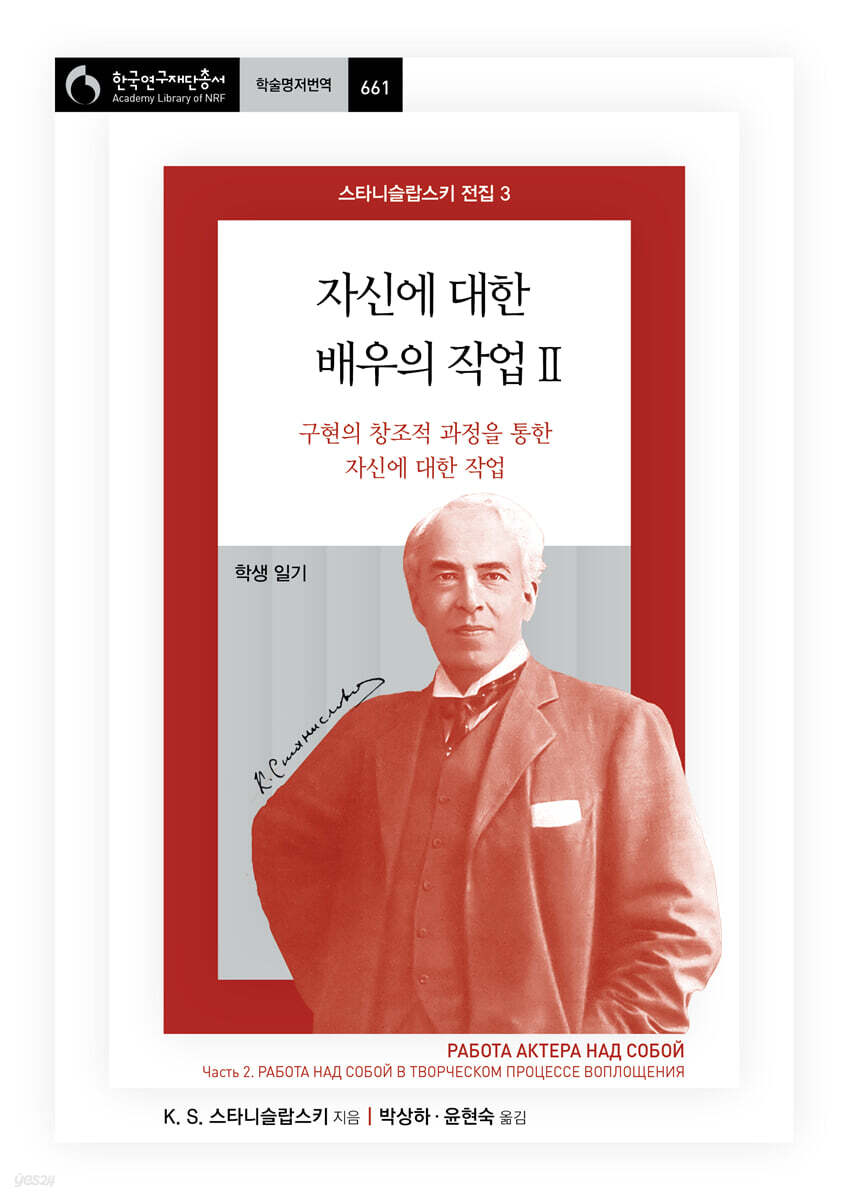 |
Description
Book Introduction
A Guide to the Stanislavsky System
A physical and expressive practical study of the actor's 'embodiment'
Konstantin Sergeyevich Stanislavsky was a revolutionary in the art of modern acting and a pioneer of acting theory.
As an actor, director, and acting educator, he is an absolute figure in the development of theatrical arts, especially acting arts.
Because we cannot discuss the art of theater or the art of acting without mentioning him.
He was a lifelong comrade of theatrical art, V.
Together with I. Nemirovich-Danchenko, he founded the Moscow Art Theatre and created the Stanislavsky System, which is now adopted by acting schools around the world, and spread it directly and indirectly through his students.
His 'system' still has a profound influence on the development of theatre and acting arts today, and continues to inspire many theatre artists.
Volume 3 of the complete works is the sequel to Volume 2, titled "Working on Oneself through the Creative Process of Implementation," which is part 2 of "The Actor's Work on Oneself."
This book, following Volume 2, is the result of Stanislavsky's practical work on the importance and necessity of 'realization' in the actor's creative process.
If Volume 2 of the complete collection is a practical study of the mental, internal, and psychological aspects of 'experience' in the actor's creative process, Volume 3 of the complete collection is a practical study of the physical, external, and expressive aspects of 'realization.'
Therefore, volumes 2 and 3 are one volume divided into parts 1 and 2, as Stanislavski stated.
This is because ‘experience’ and ‘implementation’ are not separate, but rather combined and fused.
This book is also written in the form of a diary by Nazbanov, a student who was a stenographer, about Mr. Tortsov's class, and consists of 12 chapters.
A physical and expressive practical study of the actor's 'embodiment'
Konstantin Sergeyevich Stanislavsky was a revolutionary in the art of modern acting and a pioneer of acting theory.
As an actor, director, and acting educator, he is an absolute figure in the development of theatrical arts, especially acting arts.
Because we cannot discuss the art of theater or the art of acting without mentioning him.
He was a lifelong comrade of theatrical art, V.
Together with I. Nemirovich-Danchenko, he founded the Moscow Art Theatre and created the Stanislavsky System, which is now adopted by acting schools around the world, and spread it directly and indirectly through his students.
His 'system' still has a profound influence on the development of theatre and acting arts today, and continues to inspire many theatre artists.
Volume 3 of the complete works is the sequel to Volume 2, titled "Working on Oneself through the Creative Process of Implementation," which is part 2 of "The Actor's Work on Oneself."
This book, following Volume 2, is the result of Stanislavsky's practical work on the importance and necessity of 'realization' in the actor's creative process.
If Volume 2 of the complete collection is a practical study of the mental, internal, and psychological aspects of 'experience' in the actor's creative process, Volume 3 of the complete collection is a practical study of the physical, external, and expressive aspects of 'realization.'
Therefore, volumes 2 and 3 are one volume divided into parts 1 and 2, as Stanislavski stated.
This is because ‘experience’ and ‘implementation’ are not separate, but rather combined and fused.
This book is also written in the form of a diary by Nazbanov, a student who was a stenographer, about Mr. Tortsov's class, and consists of 12 chapters.
- You can preview some of the book's contents.
Preview
index
Editor's Preface
Working on yourself through the creative process of implementing Part 2
Chapter 1 Moving to Implementation
Chapter 2: Developing Body Expression
Chapter 3 Sound and Speech
Chapter 4: The Actor's Outlook and the Role's Outlook
Chapter 5 Tempo-Rhythm
Chapter 6: Logic and Consistency
Chapter 7 Characterization
Chapter 8: Moderation and Perfection
Chapter 9: Stage Charm and Stage Temptation
Chapter 10 Ethics and Discipline
Chapter 11 Stage Self-Awareness
Chapter 12 [Conclusion of the Dialogue]
Appendix 1: Additional Materials for Volume 3
Appendix 2: Materials for 'Systems' Training
annotation
Working on yourself through the creative process of implementing Part 2
Chapter 1 Moving to Implementation
Chapter 2: Developing Body Expression
Chapter 3 Sound and Speech
Chapter 4: The Actor's Outlook and the Role's Outlook
Chapter 5 Tempo-Rhythm
Chapter 6: Logic and Consistency
Chapter 7 Characterization
Chapter 8: Moderation and Perfection
Chapter 9: Stage Charm and Stage Temptation
Chapter 10 Ethics and Discipline
Chapter 11 Stage Self-Awareness
Chapter 12 [Conclusion of the Dialogue]
Appendix 1: Additional Materials for Volume 3
Appendix 2: Materials for 'Systems' Training
annotation
Into the book
By examining our gait, we realized that we had become aware of our own and others' shortcomings and had forgotten how to walk.
We had to relearn this important and difficult skill like children.
… … Everything was interconnected and in harmony!
--- p.67
Actions are performed, and the lines of the role are pronounced as if according to the calculations of a hidden mental 'metronome' within us.
Create an unbroken line where the stressed syllables and movements we indicate match our mental calculations, whether consciously or unconsciously.
--- p.214
Characterization is like a mask that hides the actor-human.
In this masked form he can reveal his most intimate and vivid mental details.
This is the characterization attribute that is important to us.
--- p.318
Actors have a duty to convey and spread beauty even in their daily lives.
Otherwise, you will be creating with one hand and destroying with the other.
Recognize this from your first year in the arts and prepare yourself to fulfill this mission.
Develop in yourself the patience, ethics, and discipline necessary for a public figure who brings beauty, sublimity, and nobleness to the world.
--- p.363
All these elements of external stage self-awareness must be well trained and prepared so that the physical organs for implementation, that is, the physical nature of the actor, can be as delicate, flexible, precise, clear, and plastic as the capricious emotions and the elusive mental world of the role he has to express.
--- p.384
Creativity is our natural necessity, otherwise we should not be able to create by the 'system'.
But surprisingly, when we step onto the stage, we lose what nature has given us, and instead of creating, we begin to deviate, to pretend, to act, to express.
What on earth makes us like this?
--- p.434
'System' is a reference book.
Please unfold and read.
The 'system' is a guide, not a philosophy.
The moment philosophy begins, the 'system' ends.
Watch the 'system' at home, and throw it all away on stage.
We had to relearn this important and difficult skill like children.
… … Everything was interconnected and in harmony!
--- p.67
Actions are performed, and the lines of the role are pronounced as if according to the calculations of a hidden mental 'metronome' within us.
Create an unbroken line where the stressed syllables and movements we indicate match our mental calculations, whether consciously or unconsciously.
--- p.214
Characterization is like a mask that hides the actor-human.
In this masked form he can reveal his most intimate and vivid mental details.
This is the characterization attribute that is important to us.
--- p.318
Actors have a duty to convey and spread beauty even in their daily lives.
Otherwise, you will be creating with one hand and destroying with the other.
Recognize this from your first year in the arts and prepare yourself to fulfill this mission.
Develop in yourself the patience, ethics, and discipline necessary for a public figure who brings beauty, sublimity, and nobleness to the world.
--- p.363
All these elements of external stage self-awareness must be well trained and prepared so that the physical organs for implementation, that is, the physical nature of the actor, can be as delicate, flexible, precise, clear, and plastic as the capricious emotions and the elusive mental world of the role he has to express.
--- p.384
Creativity is our natural necessity, otherwise we should not be able to create by the 'system'.
But surprisingly, when we step onto the stage, we lose what nature has given us, and instead of creating, we begin to deviate, to pretend, to act, to express.
What on earth makes us like this?
--- p.434
'System' is a reference book.
Please unfold and read.
The 'system' is a guide, not a philosophy.
The moment philosophy begins, the 'system' ends.
Watch the 'system' at home, and throw it all away on stage.
--- p.441
Publisher's Review
Fully encounter the artistic world of Stanislavsky
The first complete translation of the Russian original (8 volumes) in Korea
K., a master of 20th century theater.
S. Stanislavski's complete works are being published in Korean for the first time in complete translation.
Stanislavski's Complete Works (hereafter referred to as the "Complete Works", 8 volumes) were translated and published in various countries around the world in the early to mid-last century, but this is the first time that the complete Russian original has been translated in Korea.
The Korean edition of the complete works was based on the complete works published by the Russian State Publishing House of Arts between 1954 and 1961, preserving the value of the original text as much as possible.
The translation was done by Professor Park Sang-ha of the Korea National University of Arts and Professor Yoon Hyun-sook of Hankuk University of Foreign Studies.
Konstantin Sergeyevich Stanislavsky (1863–1938) was a Russian actor, director, and acting educator, and one of the most influential figures in the development of modern theatrical art, especially acting.
He founded the Moscow Art Theatre and created the Stanislavsky System, the most common acting method still used in acting schools around the world today.
The Stanislavski system is sometimes called the bible of acting, and thanks to this 'system', Stanislavski is also considered the most outstanding theorist in the history of acting after Aristotle.
His system still has a profound influence on the development of theatrical art and continues to inspire many theatre practitioners.
The Korean edition of the complete works was edited to faithfully preserve the content and structure of the Russian original in order to convey the author Stanislavsky and the editors' intentions as accurately as possible.
We thoroughly reviewed the existing translation for errors, omissions, and mistranslations and corrected any mistakes.
In particular, we focused on establishing consistency and unity in the use of translated terms to establish the term 'system', which is being used interchangeably in domestic theater schools and fields.
The bible of acting, leading actor education worldwide.
The Stanislavski System, which theorized the creative nature of actors
The 'Stanislavski System' is the most common acting method adopted by acting schools around the world today.
Stanislavsky worked tirelessly throughout his life to establish a holistic and harmonious system based on the laws of the actor's creative nature.
He established theories based on his experience gained through practical work, and developed a methodology for authentic acting by combining theory and practical work.
He laid the foundation for modern acting techniques by suggesting various acting techniques such as 'what if' and 'action without an object'.
The 'system' originated and took root, above all, on the foundations of Russian democratic theatrical culture.
The history of the creation of the 'system' is inextricably linked to the development of the 'Moscow Art Theatre'.
The Moscow Art Theatre dreamed of innovation in stage art and pursued experimental plays centered on the works of contemporary writers such as Chekhov and Gorky.
During this process, Stanislavsky, together with his colleagues including Nemirovich-Danchenko, conducted long-term research and experiments, and developed a systematic methodology called the "system" to elicit the creativity of actors and enhance the authenticity of the work.
In that sense, the 'system' is not simply an individual's theory, but a result that has been continuously verified and developed on the experimental stage called the 'Moscow Art Theatre'.
The success of the Moscow Art Theatre at the time aroused interest in Stanislavsky's "system," which soon became established as the militant ideological and creative program of the Art Theatre.
Stanislavski directed the works of many authors and played numerous roles, putting into practice and developing the 'system'.
In particular, the effect of the 'system' was maximized through the characters in Chekhov's plays, and furthermore, the possibility of the 'system' was proven by expanding its scope to the opera stage.
Even today, the 'system' remains an important guideline for many theater people.
The three volumes of the complete works, which are the core of the 'system', are written in the form of a diary by Nazbanov, a student actor who was a stenographer.
This book provides a detailed curriculum based on the 'system' that student actors and teachers (such as Mr. Tortsov and Assistant Professor Rachmanov) encounter in actual classrooms at drama schools, providing in-depth insight into acting education and is considered a must-read in the theater world.
The first complete translation of the Russian original (8 volumes) in Korea
K., a master of 20th century theater.
S. Stanislavski's complete works are being published in Korean for the first time in complete translation.
Stanislavski's Complete Works (hereafter referred to as the "Complete Works", 8 volumes) were translated and published in various countries around the world in the early to mid-last century, but this is the first time that the complete Russian original has been translated in Korea.
The Korean edition of the complete works was based on the complete works published by the Russian State Publishing House of Arts between 1954 and 1961, preserving the value of the original text as much as possible.
The translation was done by Professor Park Sang-ha of the Korea National University of Arts and Professor Yoon Hyun-sook of Hankuk University of Foreign Studies.
Konstantin Sergeyevich Stanislavsky (1863–1938) was a Russian actor, director, and acting educator, and one of the most influential figures in the development of modern theatrical art, especially acting.
He founded the Moscow Art Theatre and created the Stanislavsky System, the most common acting method still used in acting schools around the world today.
The Stanislavski system is sometimes called the bible of acting, and thanks to this 'system', Stanislavski is also considered the most outstanding theorist in the history of acting after Aristotle.
His system still has a profound influence on the development of theatrical art and continues to inspire many theatre practitioners.
The Korean edition of the complete works was edited to faithfully preserve the content and structure of the Russian original in order to convey the author Stanislavsky and the editors' intentions as accurately as possible.
We thoroughly reviewed the existing translation for errors, omissions, and mistranslations and corrected any mistakes.
In particular, we focused on establishing consistency and unity in the use of translated terms to establish the term 'system', which is being used interchangeably in domestic theater schools and fields.
The bible of acting, leading actor education worldwide.
The Stanislavski System, which theorized the creative nature of actors
The 'Stanislavski System' is the most common acting method adopted by acting schools around the world today.
Stanislavsky worked tirelessly throughout his life to establish a holistic and harmonious system based on the laws of the actor's creative nature.
He established theories based on his experience gained through practical work, and developed a methodology for authentic acting by combining theory and practical work.
He laid the foundation for modern acting techniques by suggesting various acting techniques such as 'what if' and 'action without an object'.
The 'system' originated and took root, above all, on the foundations of Russian democratic theatrical culture.
The history of the creation of the 'system' is inextricably linked to the development of the 'Moscow Art Theatre'.
The Moscow Art Theatre dreamed of innovation in stage art and pursued experimental plays centered on the works of contemporary writers such as Chekhov and Gorky.
During this process, Stanislavsky, together with his colleagues including Nemirovich-Danchenko, conducted long-term research and experiments, and developed a systematic methodology called the "system" to elicit the creativity of actors and enhance the authenticity of the work.
In that sense, the 'system' is not simply an individual's theory, but a result that has been continuously verified and developed on the experimental stage called the 'Moscow Art Theatre'.
The success of the Moscow Art Theatre at the time aroused interest in Stanislavsky's "system," which soon became established as the militant ideological and creative program of the Art Theatre.
Stanislavski directed the works of many authors and played numerous roles, putting into practice and developing the 'system'.
In particular, the effect of the 'system' was maximized through the characters in Chekhov's plays, and furthermore, the possibility of the 'system' was proven by expanding its scope to the opera stage.
Even today, the 'system' remains an important guideline for many theater people.
The three volumes of the complete works, which are the core of the 'system', are written in the form of a diary by Nazbanov, a student actor who was a stenographer.
This book provides a detailed curriculum based on the 'system' that student actors and teachers (such as Mr. Tortsov and Assistant Professor Rachmanov) encounter in actual classrooms at drama schools, providing in-depth insight into acting education and is considered a must-read in the theater world.
GOODS SPECIFICS
- Date of issue: November 8, 2024
- Format: Hardcover book binding method guide
- Page count, weight, size: 664 pages | 152*214*35mm
- ISBN13: 9788957339497
- ISBN10: 8957339493
You may also like
카테고리
korean


korean

![GQ KOREA Mark (Monthly): December [2025]](http://librairie.coreenne.fr/cdn/shop/files/8ef265dbbfbf186523ed75ba7319009d.jpg?v=1765340328&width=3840)


