

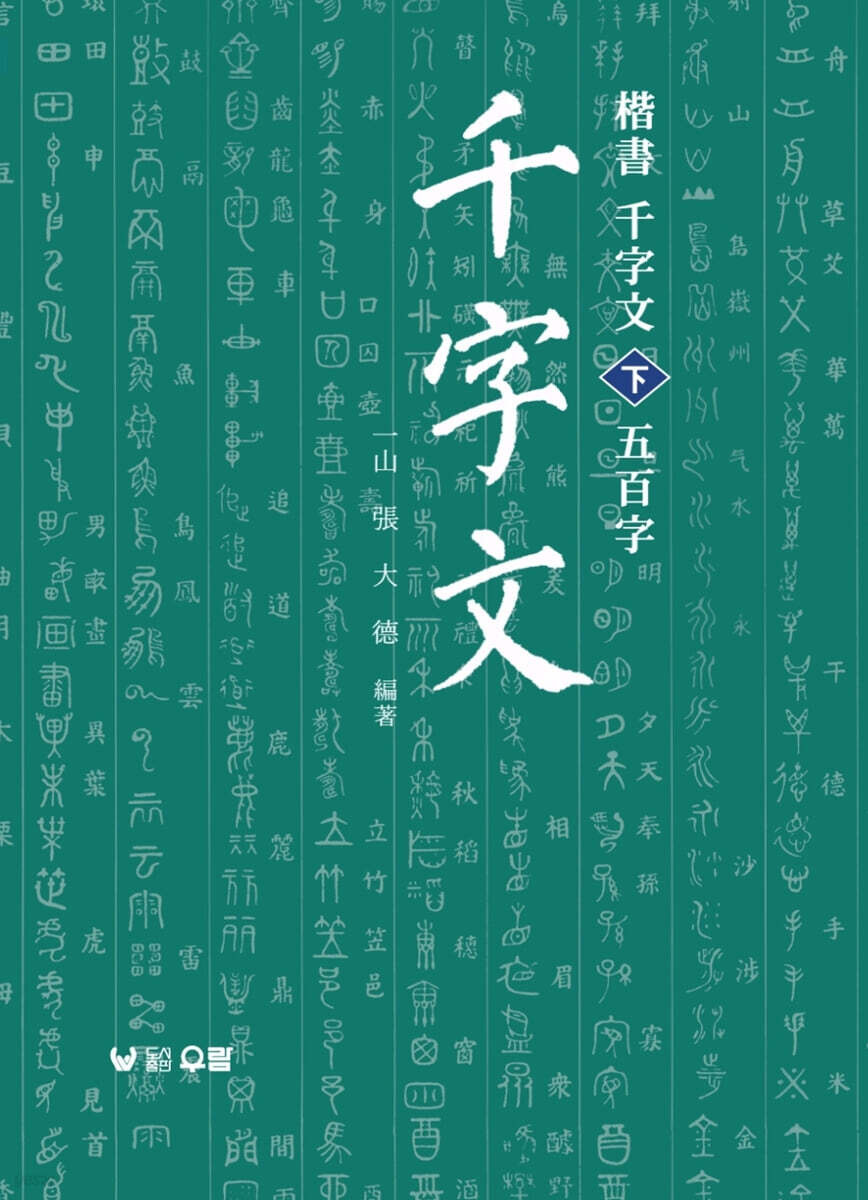
So, Thousand Character Classic (Part 2) 500 characters
 |
Description
Book Introduction
※ The thousand-character script published this time consists of three volumes: Haeseo, Haengseo, and Choseo.
Therefore, please note that each volume includes technical content explaining all the contents of the essays recorded in the chapters, including year, line, and beginning.
1.
By looking at the diagrams, we have pointed out all the parts that beginners may overlook, so that you can complete the method of construction through this one book.
1.
The effect of the illustrations is that they imprint the structure and style of the font on the minds of beginners through repeated explanations, which is a characteristic of this book.
1.
By taking the advantages of An Jin-gyeong's and Guyangsun's calligraphy methods, techniques such as Nobong and Jangbong, Gol and Yuk, Naeham, and Hyangbae are expressed together, allowing for the study of various calligraphy methods.
1.
It was written by the author to guide his students, and it has helped them avoid the difficulties that beginners face, such as weathering and wear, and because it adheres to the ancient law, it serves as a guide to the classics.
1.
Running script adopted Wang Xizhi's calligraphy style, and in the process of passing down the style, it was corrected to correct some parts that had become somewhat forced due to the use of later generations' scrapbooking and patchwork.
1.
In the process of later generations collecting Wang Xizhi's calligraphy, some parts that were somewhat incomprehensible were discovered, so the author rewrote them in his own calligraphy style based on Wang Xizhi's calligraphy style to make them easier for beginners to understand.
1.
The size of the script in Haeseo and Haengseo was designed from the perspective of a beginner, and was arranged in an appropriate size so that even the smallest details could be seen, which is a characteristic not found in other Thousand Character Classics.
1.
The running script was written based on Wang Xizhi's calligraphy style, allowing for easy understanding of the overall flow through the natural connection of brush strokes, thus allowing beginners to easily resolve the difficulties they would have encountered in writing epitaphs.
1.
The cursive script was passed down to later generations with the mission of showing the solemnity of Jiyeong's calligraphy, and every dot and stroke is imbued with sincerity.
1.
Because the small letters in the cursive script are enlarged, it is easy to find the expressions and techniques of Jiyeong, which is very helpful for learning.
1.
The cursive script explains Jiyeong's character and calligraphy in detail in the introduction, allowing beginners to broaden their knowledge of the history and theory of calligraphy.
1.
Since diligently mastering this "Jiyong Choseo Thousand Character Classic" can serve as a guide for advancing to other cursive scripts, this "Jiyong Choseo Thousand Character Classic" was adopted as a required subject.
Therefore, please note that each volume includes technical content explaining all the contents of the essays recorded in the chapters, including year, line, and beginning.
1.
By looking at the diagrams, we have pointed out all the parts that beginners may overlook, so that you can complete the method of construction through this one book.
1.
The effect of the illustrations is that they imprint the structure and style of the font on the minds of beginners through repeated explanations, which is a characteristic of this book.
1.
By taking the advantages of An Jin-gyeong's and Guyangsun's calligraphy methods, techniques such as Nobong and Jangbong, Gol and Yuk, Naeham, and Hyangbae are expressed together, allowing for the study of various calligraphy methods.
1.
It was written by the author to guide his students, and it has helped them avoid the difficulties that beginners face, such as weathering and wear, and because it adheres to the ancient law, it serves as a guide to the classics.
1.
Running script adopted Wang Xizhi's calligraphy style, and in the process of passing down the style, it was corrected to correct some parts that had become somewhat forced due to the use of later generations' scrapbooking and patchwork.
1.
In the process of later generations collecting Wang Xizhi's calligraphy, some parts that were somewhat incomprehensible were discovered, so the author rewrote them in his own calligraphy style based on Wang Xizhi's calligraphy style to make them easier for beginners to understand.
1.
The size of the script in Haeseo and Haengseo was designed from the perspective of a beginner, and was arranged in an appropriate size so that even the smallest details could be seen, which is a characteristic not found in other Thousand Character Classics.
1.
The running script was written based on Wang Xizhi's calligraphy style, allowing for easy understanding of the overall flow through the natural connection of brush strokes, thus allowing beginners to easily resolve the difficulties they would have encountered in writing epitaphs.
1.
The cursive script was passed down to later generations with the mission of showing the solemnity of Jiyeong's calligraphy, and every dot and stroke is imbued with sincerity.
1.
Because the small letters in the cursive script are enlarged, it is easy to find the expressions and techniques of Jiyeong, which is very helpful for learning.
1.
The cursive script explains Jiyeong's character and calligraphy in detail in the introduction, allowing beginners to broaden their knowledge of the history and theory of calligraphy.
1.
Since diligently mastering this "Jiyong Choseo Thousand Character Classic" can serve as a guide for advancing to other cursive scripts, this "Jiyong Choseo Thousand Character Classic" was adopted as a required subject.
- You can preview some of the book's contents.
Preview
index
About the structure of this book 5p
Preface 7p
The Birth and Background of the Thousand-Character Classic (10 pages)
About the picture explanation (13p)
Preface 7p
The Birth and Background of the Thousand-Character Classic (10 pages)
About the picture explanation (13p)
Publisher's Review
Calligraphy is an art in which the writer expresses the emotions that arise in his mind through letters on the page by technically using the brush hairs according to established brushwork techniques.
In terms of technique, the level of skill is revealed by how well one utilizes the subtle action of each individual brush hair.
Also, in terms of spirituality, it is said that the best thing is to transcend worldly limitations and become one with the changes of nature, reaching the realm of nature and divine wind.
In modern times, science and technology have advanced by leaps and bounds, and it is impossible to predict what kind of world humanity will live in in the future.
However, I don't know much about other fields of art, but when it comes to calligraphy, the best is not in the modern, cutting-edge era, but rather in the past, and even more so, in the very distant past.
What is the reason?
I think it's because humans have been faced with the problem of making a living since they were born into this world, and their brains have evolved to be biased in that direction as they pursue convenience.
If calligraphy were directly related to the problem of making a living in the modern era, I think that calligraphers who surpassed ancient times would have emerged not only in China but also in Korea and Japan.
In today's fiercely competitive society, it's truly unfortunate that having a decent job is enough to be considered a winner, but you also have to survive the fierce competition within that job to become a winner.
Around the 1980s, I saw a TV advertisement that said, "If you're not first-rate, you can't survive." Now I can imagine how second-rate and third-rate people live these days.
In these circumstances, it may seem that only those on the outskirts of the competition can take an interest in calligraphy.
But that's not necessarily the case.
In 2020, the term "work and life balance" is often seen on TV these days.
That is, it refers to “balance between work and personal life.”
In our country, during the industrialization period of the 1970s and 1980s, the only issue might have been survival, but these days, we can feel a shift toward a positive and philosophical lifestyle about how to live.
If we have lived so fiercely until now, we deserve a little rest as a reward.
If no one else can provide you with work-life balance, you have to find it yourself.
Everyone knows how scary stress is, even without a doctor's advice, because it comes without you even knowing it.
Work-life balance methods vary depending on individual preference, but if I were to recommend one method among many, this calligraphy would be a good one.
I understand that in today's society, even in the midst of a busy schedule, individuals are given free time according to their own schedules.
At that time, when I sit down with a cup of tea in front of me and smell the subtle scent of ink, I find myself becoming one with the classics and, without even realizing it, becoming one with the people of the past.
When viewed from today's perspective, the old always appears with unadorned purity.
So, in these intense and difficult times, holding a brush and immersing yourself in its purity can be a form of healing.
The classics mentioned here refer to the numerous epitaphs and legal tablets from the Zhou and Han dynasties, the Northern and Southern Dynasties, and the Sui and Tang dynasties in China.
In that era, there were a huge number of famous classical materials called the Five Scripts: Seal, Lei, Regular, Haeng, and Cao.
Although it is impossible to describe all the people and fonts of that time in detail, I hope that you will look up and refer to the fonts of that era one by one later.
Most of the materials related to this have been published by the publishing company "Wooram", selecting only the important basic materials for beginners.
You can easily get all of these at the Insadong calligraphy shop.
In particular, Jiyong's "Jincho Cheonjamun", which is scheduled to be published this time, was compiled by combining regular script and herbal script for beginners and intermediate readers and above.
There are two types of Thousand Character Classic in the calligraphy of famous Chinese families: Zhiyong's True Grass Thousand Character Classic from the Sui Dynasty and Huaisu's Grass Thousand Character Classic from the Tang Dynasty. The reason Zhiyong's Thousand Character Classic was chosen among them is because it is the basic calligraphy style that he faithfully wrote with his heart poured into each and every stroke, wanting to teach the calligraphy style to his students and future generations.
His life and writing style are described in detail later.
In modern times, Han Seok-bong's Thousand Character Classic was widely distributed in Korea and was an indispensable book for those studying Chinese characters, but it became difficult to find it after the Ministry of Education's selection of practical Chinese characters was established.
Here, I would like to briefly touch on Han Seok-bong's Thousand Character Classic.
During the reign of King Seonjo in the mid-Joseon Dynasty, Han Ho's exact position is unknown, but it is said that he was in charge of writing all diplomatic documents during the Imjin War and was praised by the Chinese.
His pen name was Shifeng, and he was fascinated by the calligraphy of Wang Xizhi of the Eastern Jin Dynasty of China. He spent his entire life practicing his calligraphy, and was known as a master calligrapher at the time.
At that time, in China, a man named Zhao Meng was also famous as a famous calligrapher.
Since his pen name is Songseol, his handwriting is called Songseol style.
The Songseol style was popular as a model for calligraphy for a full 200 years, from the end of the Goryeo Dynasty to the beginning of the Joseon Dynasty.
At that time, a great wind of change blew through the academic world.
Song learning (Neo-Confucianism), promoted by scholars such as Cheng Zi and Zhu Zi of the Song Dynasty, was introduced to Joseon.
Initially, the school's voice was not loud, but in the late Joseon Dynasty, the Neo-Confucian school expanded its influence and eventually established a strong base in politics and academia.
To briefly explain the main points of the doctrine they advocate, they say that humans are given a nature from heaven when they are born, and that all phenomena that heaven (nature) causes on its own are seen as nature (the way), and the reason why those phenomena occur is seen as reason.
The reason for all these phenomena is that from the beginning, the opposing energies of yin and yang have been at work, creating all kinds of harmony.
Such natural phenomena are called the nature of heaven, and it is human nature to receive that nature and faithfully follow it.
The nature of heaven can eternally govern the creation of all things because it is impartial and selfless, and for people to completely follow that nature is to practice that impartiality and selflessness.
In other words, what nature does is to create all things without selfishness and to govern them fairly. If people follow this example and live according to their conscience without selfishness, the world will be at peace.
However, although the theory they advocate is a very systematic and profound philosophical doctrine as a method of governing the mind, it cannot overcome the wall of reality when it comes to managing the broad fields of politics, economy, society, and culture.
Moreover, the duality that constantly arises in their minds as they practice fairness and justice, trying to rationalize their selfish desires, leads to their own logic being biased and to the rejection of all other doctrines and cultures.
As this social climate became widespread and free cultural activities became impossible, creativity in all arts, including calligraphy, could not be displayed, and consequently, the development of calligraphy regressed.
In particular, calligraphy was studied and developed by traveling back and forth to China and importing many famous calligraphy styles, but under the rigid structure of the time, there would have been no will or support to do so.
In addition, the calligraphy of Wang Xizhi and Song Xue style that are widely spread in the world have already been corrupted and degraded by passing through countless hands.
In this situation, it is inevitable that Han Seok-bong would have studied the severely damaged font.
So, it had to endure the public opinion that it lacked charm and class.
The anecdote that Han Seok-bong's mother turned off the lights at night and said, "I'll cut the rice cake, so you write," is nothing more than educational material that glorified Han Seok-bong.
What most people call good handwriting is the ability to write a lot.
Anyone who has been writing for several decades will usually be able to achieve good handwriting.
However, calligraphy with class and elegance may appear to the average person as rather old-fashioned.
All art is evaluated differently depending on the eye of the viewer.
That is also the reason why public opinion and expert opinion on Han Seok-bong's handwriting differ.
But it is clear that he has good handwriting.
If Han Seok-bong's Thousand Character Classic is indeed an authentic copy written by him, it would be treated as a tremendous historical treasure.
However, it was not used as a calligraphy textbook because it was manipulated by someone in later generations.
This Thousand Character Classic is written in a four-character phrase format with a rhythm, without a single character being duplicated among the thousand characters, making it easy to memorize.
Therefore, it can be said that it is an essential book that cannot be left out when studying Chinese characters.
However, if the font used in the text had been a famous font from all time, it would have been an essential book, just like its contents. However, it is truly unfortunate that this is not the case.
There are people who find this current situation very regrettable.
He is Jin-ha Son, the CEO of the publishing company Wooram.
As a publisher of calligraphy books, he was struck by the fact that this historically traditional Thousand Character Classic was disappearing, not only as a textbook for studying Chinese characters but also as a textbook for calligraphy. This led him to inquire with the author about the existence of Thousand Character Classic in the calligraphy style of famous families throughout history.
So, when I learned that there was a Jincho Thousand Character Classic by Jiyeong and a cursive Thousand Character Classic by Hoeso, I made a decision right away.
Incidentally, among the many books published by "Wooram," none have been published in cursive script.
So, I came to this conclusion while I was thinking about making that book.
The Thousand Character Classic being created this time is the beginner's Thousand Character Classic (upper and lower) created in the author's own handwriting (Hae and Haeng), and the next one, "Jiyeong Cursive Thousand Character Classic", which is centered around Jiyeong's cursive script, also has Jiyeong's cursive script written alongside it.
Therefore, it was written only as a resource to help people understand what the main character was.
Instead, the parts that can be followed by beginners are decorated with the author's own handwriting.
There is a reason why it has to be that way.
The first reason is that Jiyeong's Jinseo is a type of Haeseo script, but it is close to the running script, and there are many places where the shape of the letters themselves are different compared to today's Jeongja script because it retains the remnants of the Northern and Southern Dynasties period, so it is somewhat difficult to take it as a model for Haeseo script. The second reason is that it is not possible to collect all 1,000 characters in the Haeseo script of the famous families of the past.
So, I had no choice but to publish my own manuscript.
I hope this selection will serve as a stepping stone for beginners to learn the calligraphy of the renowned masters of the past, and I also hope that our Lord, who is leading the development of calligraphy in our country, will be generous in his understanding.
一山張大德
In terms of technique, the level of skill is revealed by how well one utilizes the subtle action of each individual brush hair.
Also, in terms of spirituality, it is said that the best thing is to transcend worldly limitations and become one with the changes of nature, reaching the realm of nature and divine wind.
In modern times, science and technology have advanced by leaps and bounds, and it is impossible to predict what kind of world humanity will live in in the future.
However, I don't know much about other fields of art, but when it comes to calligraphy, the best is not in the modern, cutting-edge era, but rather in the past, and even more so, in the very distant past.
What is the reason?
I think it's because humans have been faced with the problem of making a living since they were born into this world, and their brains have evolved to be biased in that direction as they pursue convenience.
If calligraphy were directly related to the problem of making a living in the modern era, I think that calligraphers who surpassed ancient times would have emerged not only in China but also in Korea and Japan.
In today's fiercely competitive society, it's truly unfortunate that having a decent job is enough to be considered a winner, but you also have to survive the fierce competition within that job to become a winner.
Around the 1980s, I saw a TV advertisement that said, "If you're not first-rate, you can't survive." Now I can imagine how second-rate and third-rate people live these days.
In these circumstances, it may seem that only those on the outskirts of the competition can take an interest in calligraphy.
But that's not necessarily the case.
In 2020, the term "work and life balance" is often seen on TV these days.
That is, it refers to “balance between work and personal life.”
In our country, during the industrialization period of the 1970s and 1980s, the only issue might have been survival, but these days, we can feel a shift toward a positive and philosophical lifestyle about how to live.
If we have lived so fiercely until now, we deserve a little rest as a reward.
If no one else can provide you with work-life balance, you have to find it yourself.
Everyone knows how scary stress is, even without a doctor's advice, because it comes without you even knowing it.
Work-life balance methods vary depending on individual preference, but if I were to recommend one method among many, this calligraphy would be a good one.
I understand that in today's society, even in the midst of a busy schedule, individuals are given free time according to their own schedules.
At that time, when I sit down with a cup of tea in front of me and smell the subtle scent of ink, I find myself becoming one with the classics and, without even realizing it, becoming one with the people of the past.
When viewed from today's perspective, the old always appears with unadorned purity.
So, in these intense and difficult times, holding a brush and immersing yourself in its purity can be a form of healing.
The classics mentioned here refer to the numerous epitaphs and legal tablets from the Zhou and Han dynasties, the Northern and Southern Dynasties, and the Sui and Tang dynasties in China.
In that era, there were a huge number of famous classical materials called the Five Scripts: Seal, Lei, Regular, Haeng, and Cao.
Although it is impossible to describe all the people and fonts of that time in detail, I hope that you will look up and refer to the fonts of that era one by one later.
Most of the materials related to this have been published by the publishing company "Wooram", selecting only the important basic materials for beginners.
You can easily get all of these at the Insadong calligraphy shop.
In particular, Jiyong's "Jincho Cheonjamun", which is scheduled to be published this time, was compiled by combining regular script and herbal script for beginners and intermediate readers and above.
There are two types of Thousand Character Classic in the calligraphy of famous Chinese families: Zhiyong's True Grass Thousand Character Classic from the Sui Dynasty and Huaisu's Grass Thousand Character Classic from the Tang Dynasty. The reason Zhiyong's Thousand Character Classic was chosen among them is because it is the basic calligraphy style that he faithfully wrote with his heart poured into each and every stroke, wanting to teach the calligraphy style to his students and future generations.
His life and writing style are described in detail later.
In modern times, Han Seok-bong's Thousand Character Classic was widely distributed in Korea and was an indispensable book for those studying Chinese characters, but it became difficult to find it after the Ministry of Education's selection of practical Chinese characters was established.
Here, I would like to briefly touch on Han Seok-bong's Thousand Character Classic.
During the reign of King Seonjo in the mid-Joseon Dynasty, Han Ho's exact position is unknown, but it is said that he was in charge of writing all diplomatic documents during the Imjin War and was praised by the Chinese.
His pen name was Shifeng, and he was fascinated by the calligraphy of Wang Xizhi of the Eastern Jin Dynasty of China. He spent his entire life practicing his calligraphy, and was known as a master calligrapher at the time.
At that time, in China, a man named Zhao Meng was also famous as a famous calligrapher.
Since his pen name is Songseol, his handwriting is called Songseol style.
The Songseol style was popular as a model for calligraphy for a full 200 years, from the end of the Goryeo Dynasty to the beginning of the Joseon Dynasty.
At that time, a great wind of change blew through the academic world.
Song learning (Neo-Confucianism), promoted by scholars such as Cheng Zi and Zhu Zi of the Song Dynasty, was introduced to Joseon.
Initially, the school's voice was not loud, but in the late Joseon Dynasty, the Neo-Confucian school expanded its influence and eventually established a strong base in politics and academia.
To briefly explain the main points of the doctrine they advocate, they say that humans are given a nature from heaven when they are born, and that all phenomena that heaven (nature) causes on its own are seen as nature (the way), and the reason why those phenomena occur is seen as reason.
The reason for all these phenomena is that from the beginning, the opposing energies of yin and yang have been at work, creating all kinds of harmony.
Such natural phenomena are called the nature of heaven, and it is human nature to receive that nature and faithfully follow it.
The nature of heaven can eternally govern the creation of all things because it is impartial and selfless, and for people to completely follow that nature is to practice that impartiality and selflessness.
In other words, what nature does is to create all things without selfishness and to govern them fairly. If people follow this example and live according to their conscience without selfishness, the world will be at peace.
However, although the theory they advocate is a very systematic and profound philosophical doctrine as a method of governing the mind, it cannot overcome the wall of reality when it comes to managing the broad fields of politics, economy, society, and culture.
Moreover, the duality that constantly arises in their minds as they practice fairness and justice, trying to rationalize their selfish desires, leads to their own logic being biased and to the rejection of all other doctrines and cultures.
As this social climate became widespread and free cultural activities became impossible, creativity in all arts, including calligraphy, could not be displayed, and consequently, the development of calligraphy regressed.
In particular, calligraphy was studied and developed by traveling back and forth to China and importing many famous calligraphy styles, but under the rigid structure of the time, there would have been no will or support to do so.
In addition, the calligraphy of Wang Xizhi and Song Xue style that are widely spread in the world have already been corrupted and degraded by passing through countless hands.
In this situation, it is inevitable that Han Seok-bong would have studied the severely damaged font.
So, it had to endure the public opinion that it lacked charm and class.
The anecdote that Han Seok-bong's mother turned off the lights at night and said, "I'll cut the rice cake, so you write," is nothing more than educational material that glorified Han Seok-bong.
What most people call good handwriting is the ability to write a lot.
Anyone who has been writing for several decades will usually be able to achieve good handwriting.
However, calligraphy with class and elegance may appear to the average person as rather old-fashioned.
All art is evaluated differently depending on the eye of the viewer.
That is also the reason why public opinion and expert opinion on Han Seok-bong's handwriting differ.
But it is clear that he has good handwriting.
If Han Seok-bong's Thousand Character Classic is indeed an authentic copy written by him, it would be treated as a tremendous historical treasure.
However, it was not used as a calligraphy textbook because it was manipulated by someone in later generations.
This Thousand Character Classic is written in a four-character phrase format with a rhythm, without a single character being duplicated among the thousand characters, making it easy to memorize.
Therefore, it can be said that it is an essential book that cannot be left out when studying Chinese characters.
However, if the font used in the text had been a famous font from all time, it would have been an essential book, just like its contents. However, it is truly unfortunate that this is not the case.
There are people who find this current situation very regrettable.
He is Jin-ha Son, the CEO of the publishing company Wooram.
As a publisher of calligraphy books, he was struck by the fact that this historically traditional Thousand Character Classic was disappearing, not only as a textbook for studying Chinese characters but also as a textbook for calligraphy. This led him to inquire with the author about the existence of Thousand Character Classic in the calligraphy style of famous families throughout history.
So, when I learned that there was a Jincho Thousand Character Classic by Jiyeong and a cursive Thousand Character Classic by Hoeso, I made a decision right away.
Incidentally, among the many books published by "Wooram," none have been published in cursive script.
So, I came to this conclusion while I was thinking about making that book.
The Thousand Character Classic being created this time is the beginner's Thousand Character Classic (upper and lower) created in the author's own handwriting (Hae and Haeng), and the next one, "Jiyeong Cursive Thousand Character Classic", which is centered around Jiyeong's cursive script, also has Jiyeong's cursive script written alongside it.
Therefore, it was written only as a resource to help people understand what the main character was.
Instead, the parts that can be followed by beginners are decorated with the author's own handwriting.
There is a reason why it has to be that way.
The first reason is that Jiyeong's Jinseo is a type of Haeseo script, but it is close to the running script, and there are many places where the shape of the letters themselves are different compared to today's Jeongja script because it retains the remnants of the Northern and Southern Dynasties period, so it is somewhat difficult to take it as a model for Haeseo script. The second reason is that it is not possible to collect all 1,000 characters in the Haeseo script of the famous families of the past.
So, I had no choice but to publish my own manuscript.
I hope this selection will serve as a stepping stone for beginners to learn the calligraphy of the renowned masters of the past, and I also hope that our Lord, who is leading the development of calligraphy in our country, will be generous in his understanding.
一山張大德
GOODS SPECIFICS
- Date of issue: October 31, 2024
- Page count, weight, size: 144 pages | 251*348*20mm
- ISBN13: 9788973639717
- ISBN10: 8973639714
You may also like
카테고리
korean


korean

![GQ KOREA Mark (Monthly): December [2025]](http://librairie.coreenne.fr/cdn/shop/files/8ef265dbbfbf186523ed75ba7319009d.jpg?v=1765340328&width=3840)


