

Mina Perhonen's Design Journey: The Cycle of Memory
 |
Description
Book Introduction
- A word from MD
- [Small inspiration and the specialness of everyday life, Mina Perhonen] A catalog containing everything about Mina Perhonen, starting from the small moments of everyday life.
This exhibition showcases Mina Perhonen's 30-year journey and 100-year future, making everyday life special with small inspirations from nature, daily life, and travel destinations.
The illustrations and interviews with founder Akira Minagawa offer small, heartwarming moments.
- Ahn Hyun-jae, art producer
With small inspirations from nature, daily life, and travel destinations
Mina Perhonen, a brand that makes everyday life special
A 30-year journey and thoughts and cycles toward the next 100 years
Birds chattering among the trees, a girl walking through the forest, light and colors reflected on the water, scraps of paper left behind.
Mina Perhonen's designs begin with small moments of everyday life.
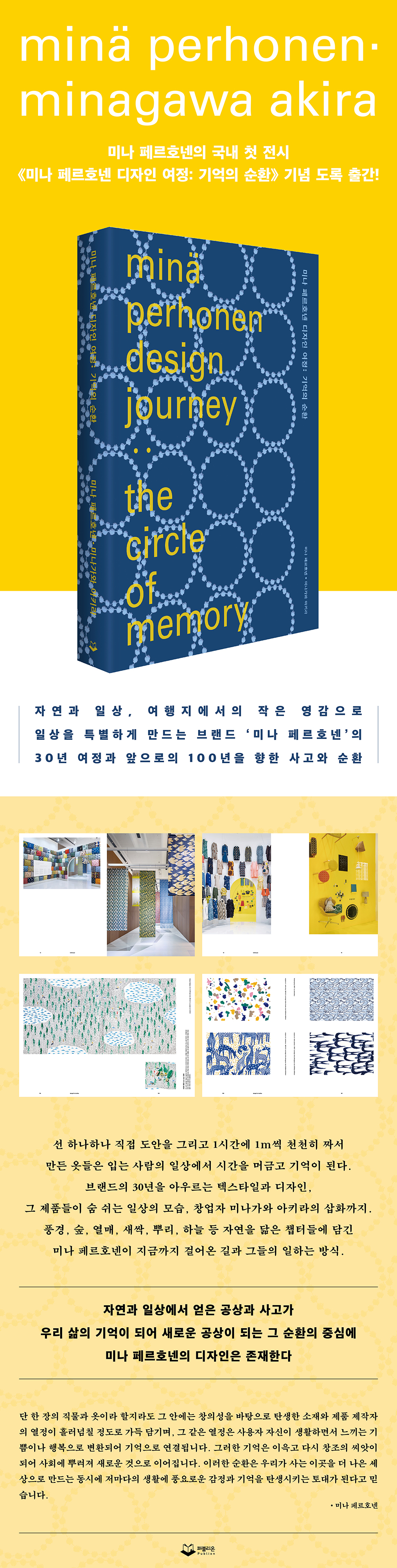
This book, "Mina Perhonen's Design Journey: The Circle of Memory," is a catalog of the exhibition of the same name, "Mina Perhonen's Design Journey: The Circle of Memory," which will be held at the Dongdaemun Design Plaza (DDP) in Seoul from September 12, 2024 to February 6, 2025.
Celebrating its 30th anniversary in 2025, textile-based brand Mina Perhonen was founded in 1995 by designer Akira Minagawa. The brand designs textiles and creates clothing and lifestyle products with the goal of lasting at least 100 years.
This book introduces the design journey of Mina Perhonen and founder Akira Minagawa through 12 chapters, including "Landscape" which contains exhibition scenes, "Fruit" which covers the origins of the signature tambourine and the production process, "Roots" which introduces Akira Minagawa's illustrations, "Seeds" which captures Mina Perhonen's work scenery, and "Water" which contains collaborative works with Korean artists.
The catalog also contains special stories not introduced in the exhibition.
An interview with Minor Connector and Interview Writer Kim Ji-soo and Minagawa Akira is included along with the exhibition review to enhance understanding, and the poem-like sentences that flow like music and touch the heart throughout the catalogue give a glimpse into the thoughts and aspirations regarding design and brands.
This book contains the thoughts and designs of Mina Perhonen and Akira Minagawa, who, with the goal of creating a brand that would last at least 100 years after its founding, quietly drew inspiration from nature, daily life, and experiences by hand, and implemented it through embroidery and fabric to create memories in people's daily lives, and then used those as seeds to move forward.
Mina Perhonen, a brand that makes everyday life special
A 30-year journey and thoughts and cycles toward the next 100 years
Birds chattering among the trees, a girl walking through the forest, light and colors reflected on the water, scraps of paper left behind.
Mina Perhonen's designs begin with small moments of everyday life.
This book, "Mina Perhonen's Design Journey: The Circle of Memory," is a catalog of the exhibition of the same name, "Mina Perhonen's Design Journey: The Circle of Memory," which will be held at the Dongdaemun Design Plaza (DDP) in Seoul from September 12, 2024 to February 6, 2025.
Celebrating its 30th anniversary in 2025, textile-based brand Mina Perhonen was founded in 1995 by designer Akira Minagawa. The brand designs textiles and creates clothing and lifestyle products with the goal of lasting at least 100 years.
This book introduces the design journey of Mina Perhonen and founder Akira Minagawa through 12 chapters, including "Landscape" which contains exhibition scenes, "Fruit" which covers the origins of the signature tambourine and the production process, "Roots" which introduces Akira Minagawa's illustrations, "Seeds" which captures Mina Perhonen's work scenery, and "Water" which contains collaborative works with Korean artists.
The catalog also contains special stories not introduced in the exhibition.
An interview with Minor Connector and Interview Writer Kim Ji-soo and Minagawa Akira is included along with the exhibition review to enhance understanding, and the poem-like sentences that flow like music and touch the heart throughout the catalogue give a glimpse into the thoughts and aspirations regarding design and brands.
This book contains the thoughts and designs of Mina Perhonen and Akira Minagawa, who, with the goal of creating a brand that would last at least 100 years after its founding, quietly drew inspiration from nature, daily life, and experiences by hand, and implemented it through embroidery and fabric to create memories in people's daily lives, and then used those as seeds to move forward.
- You can preview some of the book's contents.
Preview
index
1 Landscape
2 forest design's resounding
3 Fruits? Tambourine
4 Sprout 芽 design for textiles
5 Wind 風 life with mina perhonen
6 roots akira minagawa as an artist
7 Seeds Seeds for designs
8 water 水 with friends in korea
9 Earth memory of clothes
10 Interviews Akira Minagawa X Jisoo Kim
Beyond the Design of Greed, Becoming Part of the Landscape
11 Epilogue
12 Sky emptiness brief history of mina perhonen
2 forest design's resounding
3 Fruits? Tambourine
4 Sprout 芽 design for textiles
5 Wind 風 life with mina perhonen
6 roots akira minagawa as an artist
7 Seeds Seeds for designs
8 water 水 with friends in korea
9 Earth memory of clothes
10 Interviews Akira Minagawa X Jisoo Kim
Beyond the Design of Greed, Becoming Part of the Landscape
11 Epilogue
12 Sky emptiness brief history of mina perhonen
Detailed image
Into the book
Mina Perhonen focuses on the small moments of everyday life: clouds passing over a field, sprouting buds, and sounds drifting along the shore.
Products embodying a thoughtful gaze possess value beyond mere objects, and at the same time, they naturally permeate our daily lives and interact with the world.
Mina Perhonen's dream is that design will be at the center of creating new memories and connecting people.
--- p.4
〈Tambourine〉, like other embroidery patterns by Mina Perhonen, is created by inserting needles as if the machine were following the human hand.
One circle uses 6.93 meters of thread.
It took 9 minutes and 37 seconds to make this circle into one embroidery.
One 13.7m roll of fabric contains 6,760 circles, and it takes about 4 hours and 30 minutes to embroider one roll.
Since its creation in 2000, 643 〈tambourines〉 of different colors and fabrics have been created, totaling 211.5513 km (as of July 31, 2024).
The amount that can be produced at one time is extremely limited, but if it continues for a long time, the factory's production site becomes stable.
We believe that the consistent love of people ultimately leads to high production volumes is important in modern craft manufacturing.
--- p.105
At the print factory.
Prints are living organisms, and temperature and humidity have a significant impact on their completion.
Even if a good design is completed, it cannot be completed to the desired level without detailed discovery or skilled techniques.
After you hand over your original drawings filled with your heartfelt ideas, the people at the printing factory will put them into practice.
Designers and engineers work together to envision a finished image and passionately shape it into form.
--- p.266
A pleasant imagination that we are not exploiting, being exploited, and disappearing in linear time, but rather we are moving through layers of time, becoming each other's roots and wings, and laughing together.
In this way, all the clothes, accessories, furniture, tableware, and fabrics that came out under Mina Perhonen's name come together to form a lush forest without any one of them standing out or being arrogant.
They say that good design is felt through the skin, and according to Mina Perhonen, good design makes me a part of nature, a good memory itself.
The reason this design touches the air beyond the touch of the skin, the memory beyond the touch of desire, is probably because it does not overwhelm anything.
--- p.311
We create things and events from the consciousness of fantasy and thought, which have no form.
And those things and events return to our daily lives as new memories and fantasies.
This cycle may be how humans enjoy and relate to this star through the act of living.
The creative process that exists within that relationship includes the invisible passion of each person's emotions, such as joy, dignity, and gratitude.
I believe that such passion is the source of design's charm.
Products embodying a thoughtful gaze possess value beyond mere objects, and at the same time, they naturally permeate our daily lives and interact with the world.
Mina Perhonen's dream is that design will be at the center of creating new memories and connecting people.
--- p.4
〈Tambourine〉, like other embroidery patterns by Mina Perhonen, is created by inserting needles as if the machine were following the human hand.
One circle uses 6.93 meters of thread.
It took 9 minutes and 37 seconds to make this circle into one embroidery.
One 13.7m roll of fabric contains 6,760 circles, and it takes about 4 hours and 30 minutes to embroider one roll.
Since its creation in 2000, 643 〈tambourines〉 of different colors and fabrics have been created, totaling 211.5513 km (as of July 31, 2024).
The amount that can be produced at one time is extremely limited, but if it continues for a long time, the factory's production site becomes stable.
We believe that the consistent love of people ultimately leads to high production volumes is important in modern craft manufacturing.
--- p.105
At the print factory.
Prints are living organisms, and temperature and humidity have a significant impact on their completion.
Even if a good design is completed, it cannot be completed to the desired level without detailed discovery or skilled techniques.
After you hand over your original drawings filled with your heartfelt ideas, the people at the printing factory will put them into practice.
Designers and engineers work together to envision a finished image and passionately shape it into form.
--- p.266
A pleasant imagination that we are not exploiting, being exploited, and disappearing in linear time, but rather we are moving through layers of time, becoming each other's roots and wings, and laughing together.
In this way, all the clothes, accessories, furniture, tableware, and fabrics that came out under Mina Perhonen's name come together to form a lush forest without any one of them standing out or being arrogant.
They say that good design is felt through the skin, and according to Mina Perhonen, good design makes me a part of nature, a good memory itself.
The reason this design touches the air beyond the touch of the skin, the memory beyond the touch of desire, is probably because it does not overwhelm anything.
--- p.311
We create things and events from the consciousness of fantasy and thought, which have no form.
And those things and events return to our daily lives as new memories and fantasies.
This cycle may be how humans enjoy and relate to this star through the act of living.
The creative process that exists within that relationship includes the invisible passion of each person's emotions, such as joy, dignity, and gratitude.
I believe that such passion is the source of design's charm.
--- p.317
Publisher's Review
· Textile design, the starting point of Mina Perhonen,
A glimpse into their design philosophy, which makes everyday life special through experiences and memories.
The brand name Mina Perhonen is a combination of the Finnish word 'mina' meaning 'me' and 'perhonen' meaning 'butterfly', and it contains the wish to create designs that are light and airy like the beautiful wings of a butterfly.
Mina Perhonen finds motifs in nature and everyday life and designs based on the concept of 'specialness in everyday life' rather than special daily life.
Their starting point is textile design.
This book details the textiles that form the basis of their designs and the story of their creation and expansion.
In "Fruit," the brand's signature pattern, the "tambourine," made up of twenty-five different dots coming together to form a circle, is shown, from the beginning to the process of becoming fabric, and how one design expands into a product.
In addition, "Sprout" offers a glimpse into how the landscapes of memories encountered in daily life and travel destinations are combined with the designer's imagination and reborn as designs through seven original drawings and 68 textiles.
The textiles created in this way have 1,000 different patterns, and including differences in color and fabric, there are approximately 4,950 different types.
Textiles born from the designer's fingertips become flowers, trees, animals, and the sea within the fabric, and expand into clothing, household goods, and furniture.
This exhibition also continues with collaborations with Korean artists, with tambourine patterns embroidered onto Hansan ramie cloth, and Mina Perhonen's designs applied to traditional Korean paper wallets, which are then transformed into furniture.
Perhaps the reason Mina Perhonen's designs remain so enduring and beloved is because they are not swayed by trends or time, but instead, they constantly expand from small fragments of everyday memories, naturally permeating our lives. Even a single textile design sketch reveals their philosophy of emphasizing experience and memory.
· Build up your daily work, constantly think about why, and just do it.
Mina Perhonen's work-life balance conveys her attitude toward work.
In this book, twenty-two poems flow like air.
And those sentences seem to embody the commitments that Mina Perhonen always keeps in mind as she draws designs, creates embroidery, sews clothes, and carries out her daily work.
In particular, the chapter "Seeds" contains images of people who have worked together for a long time in Mina's atelier, embroidery factory, textile factory, and printing factory, along with these sentences, and the delicate depiction of designers and technicians moving forward together, saying, "Let's try it first," to achieve the level of perfection they aim for, is so moving that it feels like something.
It will certainly contain challenges and worries toward something new, failures and successes, perseverance and joy.
And this leads to respect for one another and a respect for labor, and it also leads to activities that connect to life so that even the smallest scrap of cloth is not wasted and can become someone's joy.
Seeing Mina Perhonen work makes me think about how I work now and whether I am putting all my effort into my daily life.
The entire process of a small design becoming an everyday object, being passed on to the user, and then becoming a seed for the cycle to begin again may be an unbroken circle for them.
Just like the tambourine pattern, which is made up of small dots coming together to form circles and those circles coming together to form a circle.
“Let’s move forward
Because I know it's a useless worry
Let's look back
If you look at it differently, the scenery changes
Because I found out that it wasn't one
Close your eyes
If you ask yourself
Because I can see where to go
so
“Let’s give it a try” - Let’s give it a try
· Clothes that cherish memories and accompany life's moments
To become a brand that circulates, expands, and lasts for 100 years.
Mina Perhonen hopes that the clothes she creates will transcend time and stay with the wearer for a long time, connecting design and memory.
In "Forest," that wind is conveyed through 303 garments spanning the Fall/Winter 2024-25 collections from 1995; in "Wind," through the daily lives of those who live and travel through those garments; and in "Soil," through stories that reveal the strong relationship between the garments and their owners.
And this also ties in with the consistent spirit of creating ‘special clothes for everyday life’ rather than clothes for special occasions.
Especially when I read the story of someone who said that when he wears the dress that accompanied his mother on her deathbed, he feels like he is with her, it makes me think about how much a single piece of clothing can influence our lives.
And I also want to share moments of life and cherish memories with such clothes.
In an age overflowing with fast fashion, clothes don't just wear out in an instant. Instead, as time passes, we develop attachments and memories, and those memories are connected to the design.
Isn't this the thought that runs through Mina Perhonen's entire life and the basis of her desire to create a brand that will last for 100 years?
· Illustrations and interviews with founder Akira Minagawa
Brand founder Akira Minagawa is active not only in Mina Perhonen's activities but also in his own creative work.
The catalog includes illustrations that were published for eight years in the Japanese newspaper column “Thinking on Sunday” and illustrations drawn for the newspaper serial novel “Let’s Go to the Forest.”
Akira Minagawa, who transfers whatever comes to mind when sketching onto paper.
These delicate illustrations fully reveal his imaginative world, which is different from his textiles.
Another aspect that can be seen in these illustrations and his activities is consistency.
Where does that consistency come from? Perhaps the answer can be found in our interview with Kim Ji-soo, a mind connector and interview writer.
In an interview, Kim Ji-soo said that while talking with him, she felt that it was “a persistent process of finding one’s aptitude rather than talent, and a method of gradually understanding how things work by getting used to something that suits you rather than something you are good at.”
Compared to the current era in which artificial intelligence threatens the human realm and changes rapidly, the path of Mina Perhonen and Akira Minagawa, who quietly and leisurely draw designs by hand and create objects with delicate designs, may be at the opposite end of the spectrum.
But rather, it may be a method that is not swayed or swept away by any era.
How should we work and live now?
The stories of Mina Perhonen and Akira Minagawa may provide some clues to these questions.
A glimpse into their design philosophy, which makes everyday life special through experiences and memories.
The brand name Mina Perhonen is a combination of the Finnish word 'mina' meaning 'me' and 'perhonen' meaning 'butterfly', and it contains the wish to create designs that are light and airy like the beautiful wings of a butterfly.
Mina Perhonen finds motifs in nature and everyday life and designs based on the concept of 'specialness in everyday life' rather than special daily life.
Their starting point is textile design.
This book details the textiles that form the basis of their designs and the story of their creation and expansion.
In "Fruit," the brand's signature pattern, the "tambourine," made up of twenty-five different dots coming together to form a circle, is shown, from the beginning to the process of becoming fabric, and how one design expands into a product.
In addition, "Sprout" offers a glimpse into how the landscapes of memories encountered in daily life and travel destinations are combined with the designer's imagination and reborn as designs through seven original drawings and 68 textiles.
The textiles created in this way have 1,000 different patterns, and including differences in color and fabric, there are approximately 4,950 different types.
Textiles born from the designer's fingertips become flowers, trees, animals, and the sea within the fabric, and expand into clothing, household goods, and furniture.
This exhibition also continues with collaborations with Korean artists, with tambourine patterns embroidered onto Hansan ramie cloth, and Mina Perhonen's designs applied to traditional Korean paper wallets, which are then transformed into furniture.
Perhaps the reason Mina Perhonen's designs remain so enduring and beloved is because they are not swayed by trends or time, but instead, they constantly expand from small fragments of everyday memories, naturally permeating our lives. Even a single textile design sketch reveals their philosophy of emphasizing experience and memory.
· Build up your daily work, constantly think about why, and just do it.
Mina Perhonen's work-life balance conveys her attitude toward work.
In this book, twenty-two poems flow like air.
And those sentences seem to embody the commitments that Mina Perhonen always keeps in mind as she draws designs, creates embroidery, sews clothes, and carries out her daily work.
In particular, the chapter "Seeds" contains images of people who have worked together for a long time in Mina's atelier, embroidery factory, textile factory, and printing factory, along with these sentences, and the delicate depiction of designers and technicians moving forward together, saying, "Let's try it first," to achieve the level of perfection they aim for, is so moving that it feels like something.
It will certainly contain challenges and worries toward something new, failures and successes, perseverance and joy.
And this leads to respect for one another and a respect for labor, and it also leads to activities that connect to life so that even the smallest scrap of cloth is not wasted and can become someone's joy.
Seeing Mina Perhonen work makes me think about how I work now and whether I am putting all my effort into my daily life.
The entire process of a small design becoming an everyday object, being passed on to the user, and then becoming a seed for the cycle to begin again may be an unbroken circle for them.
Just like the tambourine pattern, which is made up of small dots coming together to form circles and those circles coming together to form a circle.
“Let’s move forward
Because I know it's a useless worry
Let's look back
If you look at it differently, the scenery changes
Because I found out that it wasn't one
Close your eyes
If you ask yourself
Because I can see where to go
so
“Let’s give it a try” - Let’s give it a try
· Clothes that cherish memories and accompany life's moments
To become a brand that circulates, expands, and lasts for 100 years.
Mina Perhonen hopes that the clothes she creates will transcend time and stay with the wearer for a long time, connecting design and memory.
In "Forest," that wind is conveyed through 303 garments spanning the Fall/Winter 2024-25 collections from 1995; in "Wind," through the daily lives of those who live and travel through those garments; and in "Soil," through stories that reveal the strong relationship between the garments and their owners.
And this also ties in with the consistent spirit of creating ‘special clothes for everyday life’ rather than clothes for special occasions.
Especially when I read the story of someone who said that when he wears the dress that accompanied his mother on her deathbed, he feels like he is with her, it makes me think about how much a single piece of clothing can influence our lives.
And I also want to share moments of life and cherish memories with such clothes.
In an age overflowing with fast fashion, clothes don't just wear out in an instant. Instead, as time passes, we develop attachments and memories, and those memories are connected to the design.
Isn't this the thought that runs through Mina Perhonen's entire life and the basis of her desire to create a brand that will last for 100 years?
· Illustrations and interviews with founder Akira Minagawa
Brand founder Akira Minagawa is active not only in Mina Perhonen's activities but also in his own creative work.
The catalog includes illustrations that were published for eight years in the Japanese newspaper column “Thinking on Sunday” and illustrations drawn for the newspaper serial novel “Let’s Go to the Forest.”
Akira Minagawa, who transfers whatever comes to mind when sketching onto paper.
These delicate illustrations fully reveal his imaginative world, which is different from his textiles.
Another aspect that can be seen in these illustrations and his activities is consistency.
Where does that consistency come from? Perhaps the answer can be found in our interview with Kim Ji-soo, a mind connector and interview writer.
In an interview, Kim Ji-soo said that while talking with him, she felt that it was “a persistent process of finding one’s aptitude rather than talent, and a method of gradually understanding how things work by getting used to something that suits you rather than something you are good at.”
Compared to the current era in which artificial intelligence threatens the human realm and changes rapidly, the path of Mina Perhonen and Akira Minagawa, who quietly and leisurely draw designs by hand and create objects with delicate designs, may be at the opposite end of the spectrum.
But rather, it may be a method that is not swayed or swept away by any era.
How should we work and live now?
The stories of Mina Perhonen and Akira Minagawa may provide some clues to these questions.
GOODS SPECIFICS
- Date of issue: November 1, 2024
- Page count, weight, size: 328 pages | 1,580g | 209*290*30mm
- ISBN13: 9791191587722
- ISBN10: 119158772X
You may also like
카테고리
korean


korean

![GQ KOREA Mark (Monthly): December [2025]](http://librairie.coreenne.fr/cdn/shop/files/8ef265dbbfbf186523ed75ba7319009d.jpg?v=1765340328&width=3840)


