

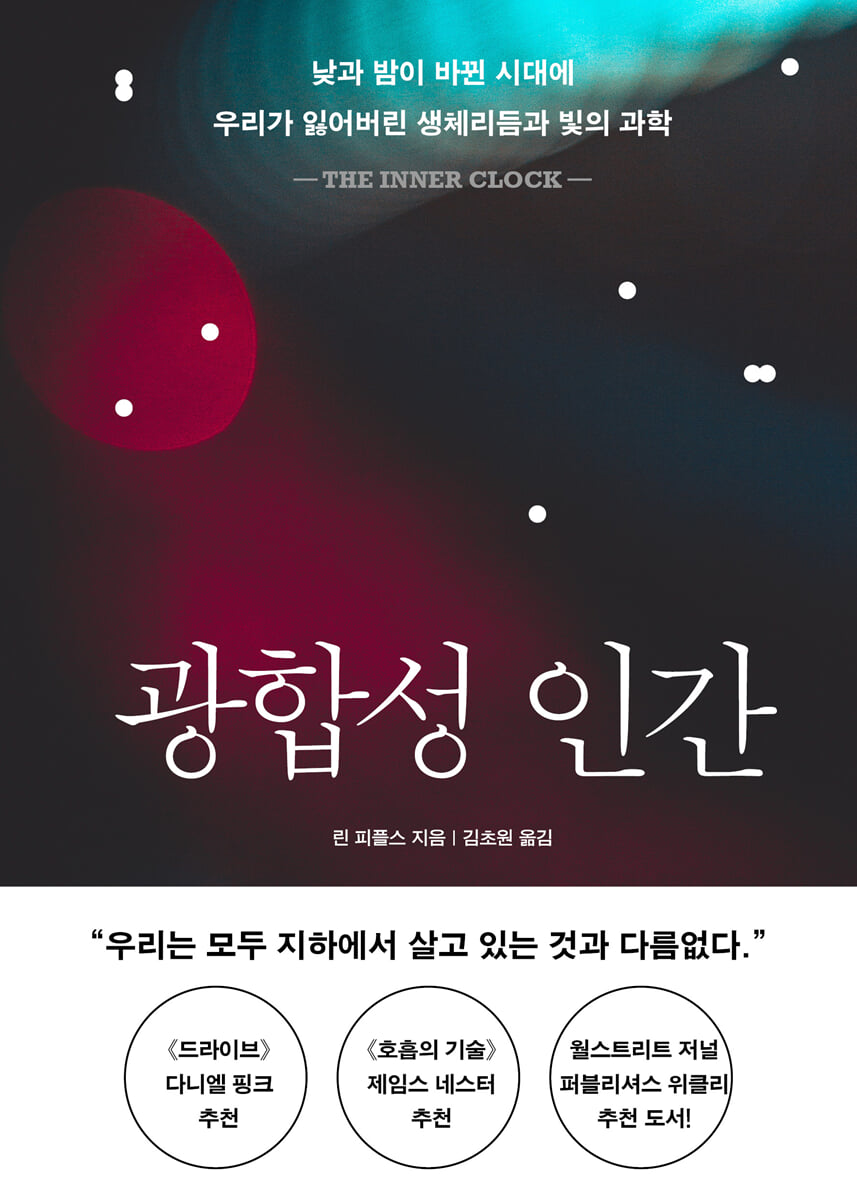
photosynthetic human
 |
Description
Book Introduction
Humans evolved to follow the sunlight
How did I end up living in the dark?
Almost all life on Earth has evolved in response to the cycles of environmental change that occur on Earth, such as the movement of the sun, the change of seasons, and the gravitational pull of the Earth and the moon.
Nature still operates according to these laws.
However, as society developed, humans began to ignore their innate biological rhythms, and technological advancements further distanced humans from the sun.
American science journalist Lynn Peoples points to disrupted biological rhythms as the cause of various illnesses, including insomnia, indigestion, lack of concentration, and depression.
And many research data show that the biggest reason for the disruption of biological rhythm is the absolute lack of sunlight.
This book introduces various studies related to light and biological rhythms, including various light-sensing methods of plants and animals, photoreceptors, and hormones.
This shows how important light is to our bodies, especially how important it is to receive direct sunlight.
The author says that today we suffer from severe light deficiency and are simultaneously exposed to unwanted light pollution.
It provides a wealth of examples of how many everyday factors threaten our right to sunlight, including artificial lighting that pretends to be bright, time systems manipulated for productivity, and air pollution.
Through this book, the author makes us think about the importance of the sun and light, which we have taken for granted.
It also points out the irony that as technology advances, lighting increases but sunlight decreases, and explores what individuals and society can do to recover the lost light.
“The quantity and quality of time we and future generations can enjoy on this beautiful blue planet is at stake.
Now is the time to reconnect everything.
Now is the time to reset and restore our internal biological clock.” - From the text
How did I end up living in the dark?
Almost all life on Earth has evolved in response to the cycles of environmental change that occur on Earth, such as the movement of the sun, the change of seasons, and the gravitational pull of the Earth and the moon.
Nature still operates according to these laws.
However, as society developed, humans began to ignore their innate biological rhythms, and technological advancements further distanced humans from the sun.
American science journalist Lynn Peoples points to disrupted biological rhythms as the cause of various illnesses, including insomnia, indigestion, lack of concentration, and depression.
And many research data show that the biggest reason for the disruption of biological rhythm is the absolute lack of sunlight.
This book introduces various studies related to light and biological rhythms, including various light-sensing methods of plants and animals, photoreceptors, and hormones.
This shows how important light is to our bodies, especially how important it is to receive direct sunlight.
The author says that today we suffer from severe light deficiency and are simultaneously exposed to unwanted light pollution.
It provides a wealth of examples of how many everyday factors threaten our right to sunlight, including artificial lighting that pretends to be bright, time systems manipulated for productivity, and air pollution.
Through this book, the author makes us think about the importance of the sun and light, which we have taken for granted.
It also points out the irony that as technology advances, lighting increases but sunlight decreases, and explores what individuals and society can do to recover the lost light.
“The quantity and quality of time we and future generations can enjoy on this beautiful blue planet is at stake.
Now is the time to reconnect everything.
Now is the time to reset and restore our internal biological clock.” - From the text
- You can preview some of the book's contents.
Preview
index
Entering | The Secret of My Body's Clock That No One Has Told You
Part 1: The Body's Clock Designed by Light
Chapter 1.
People who are losing time
Chapter 2.
The force that moves the clock hands
Chapter 3.
Just the right time to fit the rhythm
Chapter 4.
Sunlight is the cure for depression and insomnia
Part 2: A Life Without Light, a Broken Clock
Chapter 5.
Under artificial light, dark day
Chapter 6.
Too bright a night
Chapter 7.
Circadian Disruptors
Chapter 8.
A clock out of sync
Part 3: Resetting Time
Chapter 9.
Hello, alarm
Chapter 10.
The day is brighter, the night is darker
Chapter 11.
Rewiring my body clock
Chapter 12.
Circadian Medicine: Time is the Medicine
Chapter 13.
Surviving in a Light-Deficient Society
Acknowledgements
References
Part 1: The Body's Clock Designed by Light
Chapter 1.
People who are losing time
Chapter 2.
The force that moves the clock hands
Chapter 3.
Just the right time to fit the rhythm
Chapter 4.
Sunlight is the cure for depression and insomnia
Part 2: A Life Without Light, a Broken Clock
Chapter 5.
Under artificial light, dark day
Chapter 6.
Too bright a night
Chapter 7.
Circadian Disruptors
Chapter 8.
A clock out of sync
Part 3: Resetting Time
Chapter 9.
Hello, alarm
Chapter 10.
The day is brighter, the night is darker
Chapter 11.
Rewiring my body clock
Chapter 12.
Circadian Medicine: Time is the Medicine
Chapter 13.
Surviving in a Light-Deficient Society
Acknowledgements
References
Detailed image

Into the book
The cell's clock genes turn on and off in regular cycles throughout the day, controlling the activity of more than 10,000 genes, which account for about half of the body's non-clock genes.
Circadian rhythms exist throughout our bodies, from the hair follicles on our scalp to the tips of our toes.
(Because men's beards grow faster during the day, the area around the chin becomes darker by the late afternoon.
However, if you shave late at night, your beard will not grow back until early morning.
Even the nose has a circadian rhythm.
These clocks tick in a special relationship with each other and with the brain's central clock.
--- From "Chapter 2: The Power That Moves the Hands of the Clock"
The interest was rekindled in the 20th century as more people began to pay attention to the impact of tall buildings.
In 1913, the New York Times published an article titled “Urban Height Limits Keep Tall Buildings Out of Demand in Europe, and No Height Limits in America.”
The article highlights why major cities, including Boston, Baltimore, Denver, and Los Angeles, have begun insisting that “buildings and streets must meet high standards not only for usability but also for beauty, safety, and health.”
Although New York City did not limit the height of buildings, it did enact a zoning ordinance in 1916 that required buildings to be set back and spaced apart from each other to avoid blocking the sky.
It was also because of this law that the Empire State Building was built in the shape of a wedding cake.
The Equitable Building, built in 1915 on the lower tip of Manhattan, sparked controversy before the Empire State Building was built in the early 1930s.
The massive building, about 160 meters high, was built right next to the street, casting a shadow of 30,000 square meters over the area.
--- From "Chapter 5: Under Artificial Light, Dark Day"
The 1884 conference adopted Greenwich Mean Time as the standard time zone for universal time.
Accordingly, 23 time zones were added, dividing the Earth into 24 parts based on Greenwich.
If we assume that the Earth is divided into 24 parts like an apple, each part corresponds to 15 degrees of longitude, which is 24 times the time it takes for the Earth to rotate in one hour, or 360 degrees, which is the number of degrees the Earth rotates in a day.
In theory, all social clocks on Earth could be up to 30 minutes ahead or behind local solar time.
But reality was different from theory.
Countries soon began to establish and follow time zones based on the new meridian.
However, many leaders continued to redraw time zones for political purposes or arbitrary judgment, and in this process, human biological rhythms were not taken into account at all.
--- From "Chapter 8: The Clock That Went Wrong"
Over 150 years later, research has confirmed that asthma symptoms have a circadian rhythm that is most severe at night in most people, regardless of a person's sleep or other daily patterns.
In 2021, scientists rephrased Dr. Salter's story in modern medical terms.
“Short-acting drugs can be administered at the time of greatest lung function deterioration, reducing side effects and increasing efficacy, rather than dividing the maximum tolerated dose throughout the day.”
Modern medicine not only offers better treatments than those for poisonous plants and herbs, but it can also explain the molecular mechanisms of time-dependent effects without relying on observation or experimentation.
We now know that clocks exist in nearly every cell and organ, and that their orchestra turns countless genes on and off.
--- From "Chapter 12 Circadian Medicine: Time is the Medicine"
The morning people on Mishkin's team didn't welcome the alien daily cycle.
The Martian Sol is much better suited to people with slightly longer circadian rhythms.
In fact, for people at the extreme ends of the circadian type distribution curve, a long Martian day may suit them better than a long Earth day.
As NASA astronaut Kjell Lindgren told me, future missions to Mars may require hiring a lot of night owls.
Circadian rhythms exist throughout our bodies, from the hair follicles on our scalp to the tips of our toes.
(Because men's beards grow faster during the day, the area around the chin becomes darker by the late afternoon.
However, if you shave late at night, your beard will not grow back until early morning.
Even the nose has a circadian rhythm.
These clocks tick in a special relationship with each other and with the brain's central clock.
--- From "Chapter 2: The Power That Moves the Hands of the Clock"
The interest was rekindled in the 20th century as more people began to pay attention to the impact of tall buildings.
In 1913, the New York Times published an article titled “Urban Height Limits Keep Tall Buildings Out of Demand in Europe, and No Height Limits in America.”
The article highlights why major cities, including Boston, Baltimore, Denver, and Los Angeles, have begun insisting that “buildings and streets must meet high standards not only for usability but also for beauty, safety, and health.”
Although New York City did not limit the height of buildings, it did enact a zoning ordinance in 1916 that required buildings to be set back and spaced apart from each other to avoid blocking the sky.
It was also because of this law that the Empire State Building was built in the shape of a wedding cake.
The Equitable Building, built in 1915 on the lower tip of Manhattan, sparked controversy before the Empire State Building was built in the early 1930s.
The massive building, about 160 meters high, was built right next to the street, casting a shadow of 30,000 square meters over the area.
--- From "Chapter 5: Under Artificial Light, Dark Day"
The 1884 conference adopted Greenwich Mean Time as the standard time zone for universal time.
Accordingly, 23 time zones were added, dividing the Earth into 24 parts based on Greenwich.
If we assume that the Earth is divided into 24 parts like an apple, each part corresponds to 15 degrees of longitude, which is 24 times the time it takes for the Earth to rotate in one hour, or 360 degrees, which is the number of degrees the Earth rotates in a day.
In theory, all social clocks on Earth could be up to 30 minutes ahead or behind local solar time.
But reality was different from theory.
Countries soon began to establish and follow time zones based on the new meridian.
However, many leaders continued to redraw time zones for political purposes or arbitrary judgment, and in this process, human biological rhythms were not taken into account at all.
--- From "Chapter 8: The Clock That Went Wrong"
Over 150 years later, research has confirmed that asthma symptoms have a circadian rhythm that is most severe at night in most people, regardless of a person's sleep or other daily patterns.
In 2021, scientists rephrased Dr. Salter's story in modern medical terms.
“Short-acting drugs can be administered at the time of greatest lung function deterioration, reducing side effects and increasing efficacy, rather than dividing the maximum tolerated dose throughout the day.”
Modern medicine not only offers better treatments than those for poisonous plants and herbs, but it can also explain the molecular mechanisms of time-dependent effects without relying on observation or experimentation.
We now know that clocks exist in nearly every cell and organ, and that their orchestra turns countless genes on and off.
--- From "Chapter 12 Circadian Medicine: Time is the Medicine"
The morning people on Mishkin's team didn't welcome the alien daily cycle.
The Martian Sol is much better suited to people with slightly longer circadian rhythms.
In fact, for people at the extreme ends of the circadian type distribution curve, a long Martian day may suit them better than a long Earth day.
As NASA astronaut Kjell Lindgren told me, future missions to Mars may require hiring a lot of night owls.
--- From "Chapter 13: Surviving in a Society Lacking Light"
Publisher's Review
Insomnia, indigestion, lack of concentration, obesity, heart disease, hair loss, depression…
The importance of circadian rhythms and light in guiding our bodies
Why do we struggle to fall asleep every night, barely wake up to the sound of our alarms, and live exhausted? Lynn Peoples, a science journalist with a master's degree in public health from Harvard University who writes about science, health, and the environment, points to a disrupted circadian rhythm as the cause in her book, "The Photosynthetic Man."
While searching for the cause of the problems he experienced in his daily life, such as insomnia, indigestion, and lack of concentration, the author discovered the correlation between biological rhythms and lighting, especially the sun.
The human biological clock moves according to solar time, and insufficient sunlight and excessive artificial light are disrupting the biological rhythm.
To directly investigate the relationship between biological rhythms and light, the author spends ten days in an underground bunker, blocking out even the small lights on the microwave.
Through experiments, the authors confirm that our bodies have an innate biological clock and that light has a significant impact on this clock.
This is particularly evident in studies of shift workers.
The World Health Organization (WHO) has designated night shift work as a possible carcinogen, although it notes that there is still insufficient evidence.
Some studies have found that working night shifts slightly increases the risk of breast, prostate, liver, lung, and colon cancer.
The book also introduces research showing that when there is a problem with the biological rhythm of parent rats, mood disorders appear in the offspring and subsequent offspring.
Circadian rhythms cause not only physical problems but also social problems.
Medical errors, the leading cause of death in the United States, occur more frequently at the hands of night shift workers than day shift workers.
It is becoming increasingly clear that problems such as occupational negligence, accidents, and traffic accidents are linked to biological rhythms.
In addition, Lynn Peoples presents fascinating research and case studies in this book that show how important circadian rhythms and light are to our health and quality of life, such as how to use light to achieve peak performance in sports or exams, the idea that only night owls might be able to adapt to Mars due to differences in circadian rhythms, the time of day when treatments are most effective, and why the Empire State Building is built in the shape of a wedding cake.
The author also emphasizes the importance of light and biological rhythms, while pointing out the time system manipulated for productivity reasons, and the excessive use of artificial light and the corresponding lack of sunlight.
The lights have increased, but the light has disappeared.
Today we use more light than ever before.
However, the amount of time our bodies actually receive the sunlight they need has decreased.
In particular, blue light, which we commonly call blue light, is the most important light for regulating our body's biological rhythm.
The intrinsically photosensitive retinal ganglion cells (ipRGCs) in the eye detect the color and intensity of light and transmit it to our body's biological clock to tell us what time it is on Earth.
ipRGCs contain a light-sensitive protein called melanopsin, and blue light has a short wavelength of about 480 nanometers that most effectively stimulates melanopsin.
However, due to the misconception that blue light is bad for the body, people are unable to receive blue light during the day by using blue light blocking features on glasses, sunglasses, and windows, even though they actually need the strong blue light from the sun.
At night, on the other hand, too much blue light attacks our bodies without us knowing it.
Artificial light, including cell phone, TV, computer screens, and streetlights, is preventing our bodies from falling asleep.
The climate crisis is also contributing to the lack of sunlight.
Because the smoke from frequent forest fires blocks out the sun.
Ironically, LED lighting, which was developed to combat the climate crisis and save energy, is also causing a lack of sunlight.
This is because bright blue LED lights emit a 'pretend' light indoors during the day, and emit a light so bright that it is difficult to sleep at night.
It's time to reset the clock
How can we restore our disrupted biological rhythms? The best way would be to wake up and go to bed in sync with solar time, but in modern society, where 9 to 6 is the norm, living in sync with solar time is difficult.
The author presents practical alternatives that can be implemented in real life.
Small efforts like getting 20-30 minutes of focused sunlight in the morning, eating regularly, controlling the time and intensity of exposure to digital screens or artificial light, taking nutritional supplements if necessary, and cutting back on caffeine can help reset your circadian rhythm.
However, the problems of artificial time systems and artificial lighting, which have the greatest impact on biological rhythms, are difficult to solve through individual efforts alone.
In particular, light pollution caused by artificial lighting poses a major threat not only to humans but also to the Earth's ecosystem.
In this book, the author emphasizes that while individual efforts are necessary to maintain biological rhythms, more active social discussions are needed, including research on lighting technologies that can reduce light pollution and workplace design that takes into account the amount of sunlight.
The importance of circadian rhythms and light in guiding our bodies
Why do we struggle to fall asleep every night, barely wake up to the sound of our alarms, and live exhausted? Lynn Peoples, a science journalist with a master's degree in public health from Harvard University who writes about science, health, and the environment, points to a disrupted circadian rhythm as the cause in her book, "The Photosynthetic Man."
While searching for the cause of the problems he experienced in his daily life, such as insomnia, indigestion, and lack of concentration, the author discovered the correlation between biological rhythms and lighting, especially the sun.
The human biological clock moves according to solar time, and insufficient sunlight and excessive artificial light are disrupting the biological rhythm.
To directly investigate the relationship between biological rhythms and light, the author spends ten days in an underground bunker, blocking out even the small lights on the microwave.
Through experiments, the authors confirm that our bodies have an innate biological clock and that light has a significant impact on this clock.
This is particularly evident in studies of shift workers.
The World Health Organization (WHO) has designated night shift work as a possible carcinogen, although it notes that there is still insufficient evidence.
Some studies have found that working night shifts slightly increases the risk of breast, prostate, liver, lung, and colon cancer.
The book also introduces research showing that when there is a problem with the biological rhythm of parent rats, mood disorders appear in the offspring and subsequent offspring.
Circadian rhythms cause not only physical problems but also social problems.
Medical errors, the leading cause of death in the United States, occur more frequently at the hands of night shift workers than day shift workers.
It is becoming increasingly clear that problems such as occupational negligence, accidents, and traffic accidents are linked to biological rhythms.
In addition, Lynn Peoples presents fascinating research and case studies in this book that show how important circadian rhythms and light are to our health and quality of life, such as how to use light to achieve peak performance in sports or exams, the idea that only night owls might be able to adapt to Mars due to differences in circadian rhythms, the time of day when treatments are most effective, and why the Empire State Building is built in the shape of a wedding cake.
The author also emphasizes the importance of light and biological rhythms, while pointing out the time system manipulated for productivity reasons, and the excessive use of artificial light and the corresponding lack of sunlight.
The lights have increased, but the light has disappeared.
Today we use more light than ever before.
However, the amount of time our bodies actually receive the sunlight they need has decreased.
In particular, blue light, which we commonly call blue light, is the most important light for regulating our body's biological rhythm.
The intrinsically photosensitive retinal ganglion cells (ipRGCs) in the eye detect the color and intensity of light and transmit it to our body's biological clock to tell us what time it is on Earth.
ipRGCs contain a light-sensitive protein called melanopsin, and blue light has a short wavelength of about 480 nanometers that most effectively stimulates melanopsin.
However, due to the misconception that blue light is bad for the body, people are unable to receive blue light during the day by using blue light blocking features on glasses, sunglasses, and windows, even though they actually need the strong blue light from the sun.
At night, on the other hand, too much blue light attacks our bodies without us knowing it.
Artificial light, including cell phone, TV, computer screens, and streetlights, is preventing our bodies from falling asleep.
The climate crisis is also contributing to the lack of sunlight.
Because the smoke from frequent forest fires blocks out the sun.
Ironically, LED lighting, which was developed to combat the climate crisis and save energy, is also causing a lack of sunlight.
This is because bright blue LED lights emit a 'pretend' light indoors during the day, and emit a light so bright that it is difficult to sleep at night.
It's time to reset the clock
How can we restore our disrupted biological rhythms? The best way would be to wake up and go to bed in sync with solar time, but in modern society, where 9 to 6 is the norm, living in sync with solar time is difficult.
The author presents practical alternatives that can be implemented in real life.
Small efforts like getting 20-30 minutes of focused sunlight in the morning, eating regularly, controlling the time and intensity of exposure to digital screens or artificial light, taking nutritional supplements if necessary, and cutting back on caffeine can help reset your circadian rhythm.
However, the problems of artificial time systems and artificial lighting, which have the greatest impact on biological rhythms, are difficult to solve through individual efforts alone.
In particular, light pollution caused by artificial lighting poses a major threat not only to humans but also to the Earth's ecosystem.
In this book, the author emphasizes that while individual efforts are necessary to maintain biological rhythms, more active social discussions are needed, including research on lighting technologies that can reduce light pollution and workplace design that takes into account the amount of sunlight.
GOODS SPECIFICS
- Date of issue: August 28, 2025
- Page count, weight, size: 496 pages | 656g | 150*210*25mm
- ISBN13: 9788965967415
- ISBN10: 8965967414
You may also like
카테고리
korean


korean

![GQ KOREA Mark (Monthly): December [2025]](http://librairie.coreenne.fr/cdn/shop/files/8ef265dbbfbf186523ed75ba7319009d.jpg?v=1765340328&width=3840)


