

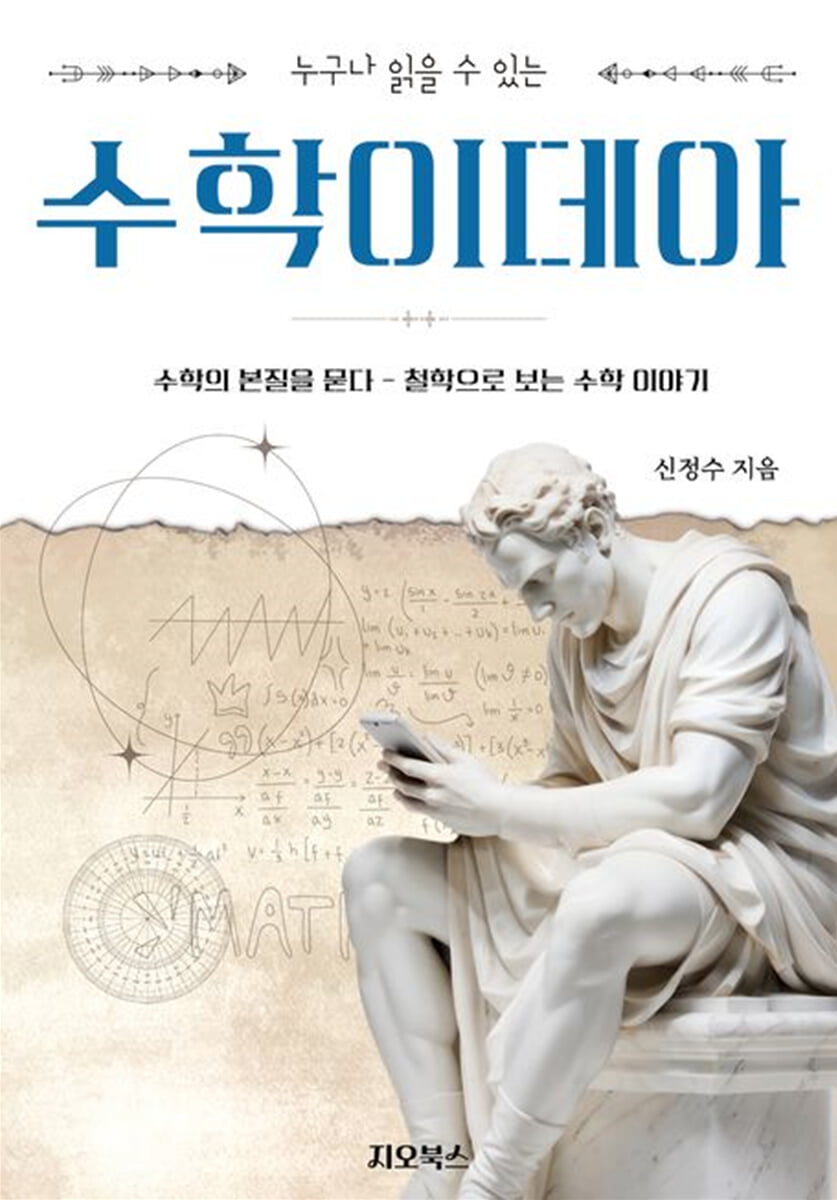
Mathematical Idea
 |
Description
Book Introduction
'What kind of knowledge is mathematics?'
Where did the numbers come from?
Is mathematics an invention or a discovery?
From Plato and Aristotle in ancient times, to Descartes and Locke in modern times, and even to modern mathematical philosophers, mathematics has been at the heart of philosophy, asking questions beyond simple calculations, such as 'what is truth?' and 'how is knowledge possible?'
By following the historical debates of philosophers, the focus is on helping readers think for themselves and develop their own philosophical perspectives.
It can be a meaningful and exciting intellectual journey even for the general educated.
Where did the numbers come from?
Is mathematics an invention or a discovery?
From Plato and Aristotle in ancient times, to Descartes and Locke in modern times, and even to modern mathematical philosophers, mathematics has been at the heart of philosophy, asking questions beyond simple calculations, such as 'what is truth?' and 'how is knowledge possible?'
By following the historical debates of philosophers, the focus is on helping readers think for themselves and develop their own philosophical perspectives.
It can be a meaningful and exciting intellectual journey even for the general educated.
index
Introduction 1
Where on earth did the numbers come from?
Chapter 1: The Two Pillars of Philosophy 13
Plato vs. Aristotle
Chapter 2: The Universals Debate 27
Does the number '2' exist in this world?
Chapter 3: Modern Rationalism and Empiricism 39
Descartes vs. Locke
Chapter 4: What Kind of Knowledge Is Mathematics? 55
Hume vs. Kant
Chapter 5: The Structure of Mathematical Revolutions 71
Thomas Kuhn vs. Bachelard
Chapter 6: On the Nature of Mathematical Research 81
Is it a discovery or an invention?
Chapter 7: Reasoning in Worldly Affairs 93
Induction vs. Deduction
Chapter 8: Probabilistic Judgment 103
Probability and Expected Value
Chapter 9: The Fundamental Laws of Logic 115
The law of contradiction and the law of the excluded middle
Chapter 10: The Utility of Symbolic Logic 127
Conjunctions and logical operations
Chapter 11: Proof in Mathematics 143
Mathematicians' Secret Weapon Revealed
Chapter 12: The Mystery of Infinite Sets 157
Infinite size comparison
Chapter 13: Paradox 173
A Crack in Logic and a New Beginning
Chapter 14: Is Mathematics a Game of Symbols? 185
Formalism in the Philosophy of Mathematics
Chapter 15: Is Mathematics Completely Truthful? 199
Gödel and Turing
Chapter 16: Theo-Intuitionism 211
The excluded middle problem, the concept of mathematical truth
Outgoing Post: No Answer, But the Questions Continue 227
Philosophy of Mathematics in the AI Age
Where on earth did the numbers come from?
Chapter 1: The Two Pillars of Philosophy 13
Plato vs. Aristotle
Chapter 2: The Universals Debate 27
Does the number '2' exist in this world?
Chapter 3: Modern Rationalism and Empiricism 39
Descartes vs. Locke
Chapter 4: What Kind of Knowledge Is Mathematics? 55
Hume vs. Kant
Chapter 5: The Structure of Mathematical Revolutions 71
Thomas Kuhn vs. Bachelard
Chapter 6: On the Nature of Mathematical Research 81
Is it a discovery or an invention?
Chapter 7: Reasoning in Worldly Affairs 93
Induction vs. Deduction
Chapter 8: Probabilistic Judgment 103
Probability and Expected Value
Chapter 9: The Fundamental Laws of Logic 115
The law of contradiction and the law of the excluded middle
Chapter 10: The Utility of Symbolic Logic 127
Conjunctions and logical operations
Chapter 11: Proof in Mathematics 143
Mathematicians' Secret Weapon Revealed
Chapter 12: The Mystery of Infinite Sets 157
Infinite size comparison
Chapter 13: Paradox 173
A Crack in Logic and a New Beginning
Chapter 14: Is Mathematics a Game of Symbols? 185
Formalism in the Philosophy of Mathematics
Chapter 15: Is Mathematics Completely Truthful? 199
Gödel and Turing
Chapter 16: Theo-Intuitionism 211
The excluded middle problem, the concept of mathematical truth
Outgoing Post: No Answer, But the Questions Continue 227
Philosophy of Mathematics in the AI Age
Publisher's Review
Mathematics is one of the oldest and most widely taught subjects in schools.
However, not many people have actually asked fundamental questions like, "What kind of knowledge is mathematics?", "Where did numbers come from?", and "Is mathematics an invention or a discovery?"
Moreover, the fact that one of the important thoughts that runs through the entire history of Western philosophy has been the discussion of the nature and status of mathematics, a unique type of knowledge, is a topic that is often forgotten or overlooked even among philosophy majors.
From Plato and Aristotle in ancient times, to Descartes and Locke in modern times, and even to modern mathematical philosophers, mathematics has been at the heart of philosophy, going beyond simple calculations and asking questions like, "What is truth?" and "How is knowledge possible?"
It is unfortunate, however, that most people who study mathematics, and even those who major in philosophy, rarely have the opportunity to engage with this fascinating and essential discussion.
This book started from such a problem awareness.
Initially, I intended this book to be an introductory book to the philosophy of mathematics for young people, with the goal of writing it in an easily understandable way so that middle and high school students could look at mathematics through a new lens of philosophy.
However, as I continued writing, I became convinced that this topic could be a meaningful and engaging intellectual journey for the general educated public as well. Accordingly, I carefully refined the sentences and structure to ensure an accessible read while maintaining the depth of thought.
This book avoids difficult symbols or technical mathematical theories, and instead focuses on questions such as, "Where do numbers come from?", "Is mathematics a human invention, or is it a real truth that exists somewhere in the universe?", and "Does the concept of infinity actually exist?"
By following the historical debates of philosophers, we focus on helping readers think for themselves and develop their own philosophical perspectives.
Above all, this book is an attempt to revisit the intuitions and questions I had as a pure mathematician before I began studying philosophy, and to translate them into the language of philosophy.
In that respect, I would like to express my deep gratitude to Professor Lim Il-hwan of Hankuk University of Foreign Studies, who opened the door to philosophy to me, a subject I had no idea was even a part of, and led me into the fascinating world of mathematical philosophy.
Without that teaching, this book would never have been started.
I hope this book will provide a new perspective for students who love mathematics and ignite the intellectual curiosity of readers who have felt distant from mathematics.
Let's embark on a journey together to see mathematics through the lens of philosophy, mathematics above mathematics.
However, not many people have actually asked fundamental questions like, "What kind of knowledge is mathematics?", "Where did numbers come from?", and "Is mathematics an invention or a discovery?"
Moreover, the fact that one of the important thoughts that runs through the entire history of Western philosophy has been the discussion of the nature and status of mathematics, a unique type of knowledge, is a topic that is often forgotten or overlooked even among philosophy majors.
From Plato and Aristotle in ancient times, to Descartes and Locke in modern times, and even to modern mathematical philosophers, mathematics has been at the heart of philosophy, going beyond simple calculations and asking questions like, "What is truth?" and "How is knowledge possible?"
It is unfortunate, however, that most people who study mathematics, and even those who major in philosophy, rarely have the opportunity to engage with this fascinating and essential discussion.
This book started from such a problem awareness.
Initially, I intended this book to be an introductory book to the philosophy of mathematics for young people, with the goal of writing it in an easily understandable way so that middle and high school students could look at mathematics through a new lens of philosophy.
However, as I continued writing, I became convinced that this topic could be a meaningful and engaging intellectual journey for the general educated public as well. Accordingly, I carefully refined the sentences and structure to ensure an accessible read while maintaining the depth of thought.
This book avoids difficult symbols or technical mathematical theories, and instead focuses on questions such as, "Where do numbers come from?", "Is mathematics a human invention, or is it a real truth that exists somewhere in the universe?", and "Does the concept of infinity actually exist?"
By following the historical debates of philosophers, we focus on helping readers think for themselves and develop their own philosophical perspectives.
Above all, this book is an attempt to revisit the intuitions and questions I had as a pure mathematician before I began studying philosophy, and to translate them into the language of philosophy.
In that respect, I would like to express my deep gratitude to Professor Lim Il-hwan of Hankuk University of Foreign Studies, who opened the door to philosophy to me, a subject I had no idea was even a part of, and led me into the fascinating world of mathematical philosophy.
Without that teaching, this book would never have been started.
I hope this book will provide a new perspective for students who love mathematics and ignite the intellectual curiosity of readers who have felt distant from mathematics.
Let's embark on a journey together to see mathematics through the lens of philosophy, mathematics above mathematics.
GOODS SPECIFICS
- Date of issue: September 1, 2025
- Page count, weight, size: 254 pages | 150*215*20mm
- ISBN13: 9791194145264
- ISBN10: 1194145264
You may also like
카테고리
korean


korean

![ELLE 엘르 스페셜 에디션 A형 : 12월 [2025]](http://librairie.coreenne.fr/cdn/shop/files/b8e27a3de6c9538896439686c6b0e8fb.jpg?v=1766436872&width=3840)


