

Korean illustrations
 |
Description
Book Introduction
An unexpected discovery,
What a beautiful picture!
There is some misunderstanding between the old paintings called oriental paintings and us today.
It is a picture that does not suit modern people.
That's understandable, because they're all drawn with ink, so there's no color, and they all look similar, so it's hard to tell them apart. And since there are so many Chinese characters, it's just difficult.
But perhaps this sense of distance stems from the fact that the many faces of Korean painting are not properly known. Indeed, there are quite a few paintings that, without even knowing the date of creation or the artist's name, seem undeniably modern.
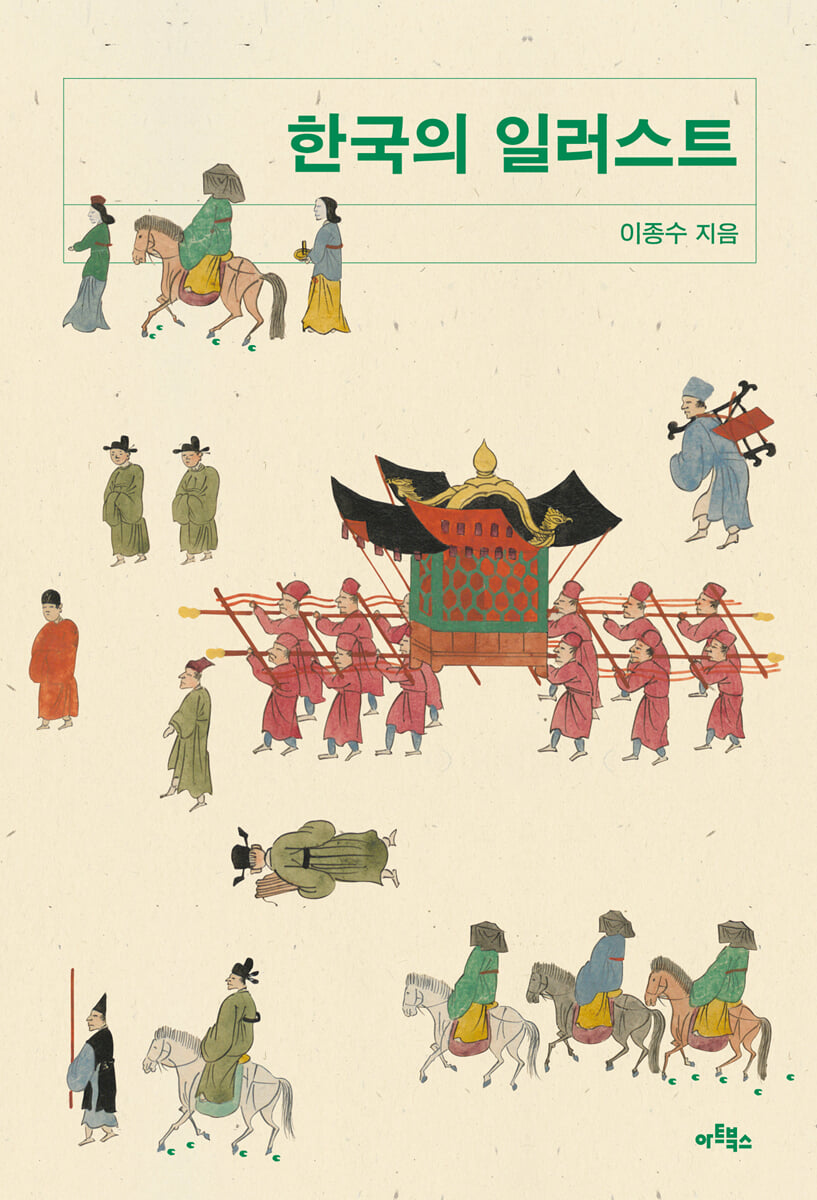
"Korean Illustration" is a book written to allow anyone, regardless of era, to fully enjoy Korean painting with all five senses and appreciate it with their heart.
It is good to open all five senses, seeing, hearing, touching, smelling, and tasting, and enjoy the painting, but also to imagine my own heart and the artist's heart.
The title 'Korean Illustration' was chosen because I hoped to rediscover the charm of Korean painting, which has a refreshing and modern aesthetic that is no less than that of illustrations, which are widely loved for their beautiful and vivid images.
Unexpected discoveries always bring fresh pleasure.
How about discovering new and exciting illustrations in this book, “Korean Illustrations”?
What a beautiful picture!
There is some misunderstanding between the old paintings called oriental paintings and us today.
It is a picture that does not suit modern people.
That's understandable, because they're all drawn with ink, so there's no color, and they all look similar, so it's hard to tell them apart. And since there are so many Chinese characters, it's just difficult.
But perhaps this sense of distance stems from the fact that the many faces of Korean painting are not properly known. Indeed, there are quite a few paintings that, without even knowing the date of creation or the artist's name, seem undeniably modern.
"Korean Illustration" is a book written to allow anyone, regardless of era, to fully enjoy Korean painting with all five senses and appreciate it with their heart.
It is good to open all five senses, seeing, hearing, touching, smelling, and tasting, and enjoy the painting, but also to imagine my own heart and the artist's heart.
The title 'Korean Illustration' was chosen because I hoped to rediscover the charm of Korean painting, which has a refreshing and modern aesthetic that is no less than that of illustrations, which are widely loved for their beautiful and vivid images.
Unexpected discoveries always bring fresh pleasure.
How about discovering new and exciting illustrations in this book, “Korean Illustrations”?
- You can preview some of the book's contents.
Preview
index
Entering_What a pretty picture
I.
Beautiful to look at
Our Story _ Biography, "Plum Blossom Cottage"
Time Becomes Snow _Sim Sa-jeong, "Samilpo"
This Sea _ Lee In-mun, "Chongseokjeong"
Which fan is the prettiest? _Park Ki-jun, "Baekseondo Palgokbyeong"
Like a scene from a story _ Kim Hong-do, "Biseon Sword Dance"
That Moonlit Night _ Kim Hong-do, "Shaolin Moonlight"
Such a blue water _ Jeong Seon, "White Heron Paintings"
Let's Cut Through the Water, Refreshingly _Hong Se-seop, "Hydraulic Island"
Underwater Landscape _ Jang Seung-eop, "Eohhaedo"
A Reality Drawn from Imagination _ Jeong Seon, "Hamheung Bon Palace Song"
Two Lovers Under the Moonlight _ Shin Yun-bok, "Lovers Under the Moonlight"
Believe My Eyes _ Kim Ha-jong, "Myeonggyeongdae"
Bamboo is Green _ Yu Deok-jang, "Snow Bamboo"
Is it a painting or a letter? _Author unknown, "Letters"
The Bride in the Red Palanquin - "Banchado of the Royal Wedding Ceremony of Queen Yeongjo and Queen Sunjo"
II.
Listen sweetly
Autumn's Abundance, or Hardship _ Lee Bang-un, "Empty Wind and the Seven Months of the Year"
Sol Sol, the sound of the pine breeze _ Jang Seung-eop, "Parrot Island"
At that moment, a sound was heard. _Yoo Suk, "Bat Hermit"
The Sound of Spring Coming _ Kim Hong-do, "Chunjakbohee"
Autumn Deepens Between Geese's Cries _ An Jung-sik, "Noando"
Round, Round _ Kim Hong-do, "Mudong"
Even the shade is peaceful _Kim Su-cheol, "Songgye Handamdo"
Even the sound of cicadas is blue and refreshing _Sim Sa-jeong, "Cichungdo"
The Wind on the Tip of a Sword _ Shin Yun-bok, "Dance with Twin Swords"
A Quiet Winter Mountain _ Heo Ryeon, "Seolonggwan"
Gentle, rustling, rustling _Kim Yun-gyeom, "Songpa Hwandodo"
There, the Sound of Autumn _ An Jung-sik, "Seongjaesugan"
Who is the real protagonist? _Kim Deuk-sin et al., "The Procession of the Hwan-eo"
III.
Touch is thrilling
Just Lovely _ Kim Hong-do, "Hwangmyo Nongjeop"
Carrying a Cucumber with Sharp Thorns _ Hong Jin-goo, "Masturbation"
Shall we talk about cats? _Byeon Sang-byeok, "Cat Painting"
Like a fairy tale _(former) Kim Sik, "Old Tree Island"
A Warm Name _ Lee Am, "Mogyeondo"
Quail on an Autumn Day _Choi Buk, "Quail"
Mom or Dad, Who's Better? _Byeon Sang-byeok, "The Unpredictable"
Ah, I want to take a nap. _Kim Deuk-shin, "Mokdong Osu"
This is the first time, a dog like this _Kim Du-ryang, "Black Structure"
Like a commemorative photo from one day _Yoon Du-seo, "Yuha Baekma-do"
The Peak of Summer, the Next Day's Lotus _Sim Sa-jeong, "The Double Affection of Lotus"
A Foggy Day _ Jeong Seon, "Jang-an Yeon-woo"
I want to touch those reeds. _Kim Hong-do, "Sea Exploration and Aging"
Sleeping Bird _ Jo Ji-woon, "Saesangsukjodo"
IV.
Smells fragrant
A watermelon or so _Jeong Seon, "Seo-gwa-tuseo"
Even Fallen Petals Are Fragrant _Shin Myeong-yeon, "Flower Paintings"
Containing the Fragrance of Red _ Kim Soo-chul, "White Pink Lotus"
The Colorful Flavors of Summer _(Former) Shin Saimdang, "Watermelon and Field Mice"
The Season of Ripening Grapes _ Lee Gye-ho, "Grapes"
There must be flowers that bloom without trials. _Kim Soo-chul, "Ja-hwang-yang-guk"
The World of Colorful Butterflies _ Nam Gye-woo, "Flower Butterfly Painting"
Vulgar and Beautiful _ Jang Seung-eop, "Red and White Plum Blossoms"
The Wind Blows _ Jang Seung-eop, "Gukseokdo"
The Moon and Plum Blossoms of This Night _ Eomongryong, "Wolmaedo"
Beyond Symbolism to Lyricism _Sim Sa-jeong, "Maewolmanjeong"
Would a sparrow just pass by an autumn field? _Author unknown, "A Flock of Sparrows"
Spring Comes Like This _Yoon Du-seo, "The Woman Picking Wild Vegetables"
Sometimes it's okay to be sweet - Lee Ha-eung, "The Strange Stone Ink Orchid"
Sour or Sweet? _Hwang Jip-jung, "Muk Grape"
A Simple Ongran _ Oh Gyeong-seok, "Ongran-do"
V.
My heart is ecstatic
Looking down from the sky _Author unknown, "Eohhaedo"
Between Mid-Autumn and Late Autumn _ Kim Du-ryang, "Moonlit Mountain Landscape"
Such a quiet magpie _Josok, "Gomaeseojakdo"
Why Wild Chrysanthemums? _Jeongjo, "Wild Country"
Still Life in My Heart _ Jang Seung-eop, "Gimyeongjeolji"
Sharper and More Fierce _ Kim Jin-woo, "Ink Bamboo Painting"
Peonies Blooming with Ink _ Shim Sa-jeong, "Flower and Bird Painting"
Rainbow Flowers Blossomed _Author Unknown, "Flowers and Birds"
Fire and Rain, A Name Only for You _Kim Jeong-hee, "Fire and Rain"
The Painter's Room _ Kim Hong-do, "Painting of a Poet in a Pouch"
The Pleasure of Being Fooled _ Lee Hyeong-rok, "Book Street"
Ecstatically, faintly like a dream - Lee Jing, "Lee Geum-san-su-do"
The Plum Blossoms We Long For _ Jo Hee-ryong, "Red Plum Blossom Couplet"
The Road to the Peach Blossom Land _ An Jung-sik, "Peach Blossom Land Painting"
Red Sun, White Moon, and Blue Peaks _Author Unknown, "Ilwol Obongdo"
Appendix_Introduction of the Artist
I.
Beautiful to look at
Our Story _ Biography, "Plum Blossom Cottage"
Time Becomes Snow _Sim Sa-jeong, "Samilpo"
This Sea _ Lee In-mun, "Chongseokjeong"
Which fan is the prettiest? _Park Ki-jun, "Baekseondo Palgokbyeong"
Like a scene from a story _ Kim Hong-do, "Biseon Sword Dance"
That Moonlit Night _ Kim Hong-do, "Shaolin Moonlight"
Such a blue water _ Jeong Seon, "White Heron Paintings"
Let's Cut Through the Water, Refreshingly _Hong Se-seop, "Hydraulic Island"
Underwater Landscape _ Jang Seung-eop, "Eohhaedo"
A Reality Drawn from Imagination _ Jeong Seon, "Hamheung Bon Palace Song"
Two Lovers Under the Moonlight _ Shin Yun-bok, "Lovers Under the Moonlight"
Believe My Eyes _ Kim Ha-jong, "Myeonggyeongdae"
Bamboo is Green _ Yu Deok-jang, "Snow Bamboo"
Is it a painting or a letter? _Author unknown, "Letters"
The Bride in the Red Palanquin - "Banchado of the Royal Wedding Ceremony of Queen Yeongjo and Queen Sunjo"
II.
Listen sweetly
Autumn's Abundance, or Hardship _ Lee Bang-un, "Empty Wind and the Seven Months of the Year"
Sol Sol, the sound of the pine breeze _ Jang Seung-eop, "Parrot Island"
At that moment, a sound was heard. _Yoo Suk, "Bat Hermit"
The Sound of Spring Coming _ Kim Hong-do, "Chunjakbohee"
Autumn Deepens Between Geese's Cries _ An Jung-sik, "Noando"
Round, Round _ Kim Hong-do, "Mudong"
Even the shade is peaceful _Kim Su-cheol, "Songgye Handamdo"
Even the sound of cicadas is blue and refreshing _Sim Sa-jeong, "Cichungdo"
The Wind on the Tip of a Sword _ Shin Yun-bok, "Dance with Twin Swords"
A Quiet Winter Mountain _ Heo Ryeon, "Seolonggwan"
Gentle, rustling, rustling _Kim Yun-gyeom, "Songpa Hwandodo"
There, the Sound of Autumn _ An Jung-sik, "Seongjaesugan"
Who is the real protagonist? _Kim Deuk-sin et al., "The Procession of the Hwan-eo"
III.
Touch is thrilling
Just Lovely _ Kim Hong-do, "Hwangmyo Nongjeop"
Carrying a Cucumber with Sharp Thorns _ Hong Jin-goo, "Masturbation"
Shall we talk about cats? _Byeon Sang-byeok, "Cat Painting"
Like a fairy tale _(former) Kim Sik, "Old Tree Island"
A Warm Name _ Lee Am, "Mogyeondo"
Quail on an Autumn Day _Choi Buk, "Quail"
Mom or Dad, Who's Better? _Byeon Sang-byeok, "The Unpredictable"
Ah, I want to take a nap. _Kim Deuk-shin, "Mokdong Osu"
This is the first time, a dog like this _Kim Du-ryang, "Black Structure"
Like a commemorative photo from one day _Yoon Du-seo, "Yuha Baekma-do"
The Peak of Summer, the Next Day's Lotus _Sim Sa-jeong, "The Double Affection of Lotus"
A Foggy Day _ Jeong Seon, "Jang-an Yeon-woo"
I want to touch those reeds. _Kim Hong-do, "Sea Exploration and Aging"
Sleeping Bird _ Jo Ji-woon, "Saesangsukjodo"
IV.
Smells fragrant
A watermelon or so _Jeong Seon, "Seo-gwa-tuseo"
Even Fallen Petals Are Fragrant _Shin Myeong-yeon, "Flower Paintings"
Containing the Fragrance of Red _ Kim Soo-chul, "White Pink Lotus"
The Colorful Flavors of Summer _(Former) Shin Saimdang, "Watermelon and Field Mice"
The Season of Ripening Grapes _ Lee Gye-ho, "Grapes"
There must be flowers that bloom without trials. _Kim Soo-chul, "Ja-hwang-yang-guk"
The World of Colorful Butterflies _ Nam Gye-woo, "Flower Butterfly Painting"
Vulgar and Beautiful _ Jang Seung-eop, "Red and White Plum Blossoms"
The Wind Blows _ Jang Seung-eop, "Gukseokdo"
The Moon and Plum Blossoms of This Night _ Eomongryong, "Wolmaedo"
Beyond Symbolism to Lyricism _Sim Sa-jeong, "Maewolmanjeong"
Would a sparrow just pass by an autumn field? _Author unknown, "A Flock of Sparrows"
Spring Comes Like This _Yoon Du-seo, "The Woman Picking Wild Vegetables"
Sometimes it's okay to be sweet - Lee Ha-eung, "The Strange Stone Ink Orchid"
Sour or Sweet? _Hwang Jip-jung, "Muk Grape"
A Simple Ongran _ Oh Gyeong-seok, "Ongran-do"
V.
My heart is ecstatic
Looking down from the sky _Author unknown, "Eohhaedo"
Between Mid-Autumn and Late Autumn _ Kim Du-ryang, "Moonlit Mountain Landscape"
Such a quiet magpie _Josok, "Gomaeseojakdo"
Why Wild Chrysanthemums? _Jeongjo, "Wild Country"
Still Life in My Heart _ Jang Seung-eop, "Gimyeongjeolji"
Sharper and More Fierce _ Kim Jin-woo, "Ink Bamboo Painting"
Peonies Blooming with Ink _ Shim Sa-jeong, "Flower and Bird Painting"
Rainbow Flowers Blossomed _Author Unknown, "Flowers and Birds"
Fire and Rain, A Name Only for You _Kim Jeong-hee, "Fire and Rain"
The Painter's Room _ Kim Hong-do, "Painting of a Poet in a Pouch"
The Pleasure of Being Fooled _ Lee Hyeong-rok, "Book Street"
Ecstatically, faintly like a dream - Lee Jing, "Lee Geum-san-su-do"
The Plum Blossoms We Long For _ Jo Hee-ryong, "Red Plum Blossom Couplet"
The Road to the Peach Blossom Land _ An Jung-sik, "Peach Blossom Land Painting"
Red Sun, White Moon, and Blue Peaks _Author Unknown, "Ilwol Obongdo"
Appendix_Introduction of the Artist
Detailed image
Into the book
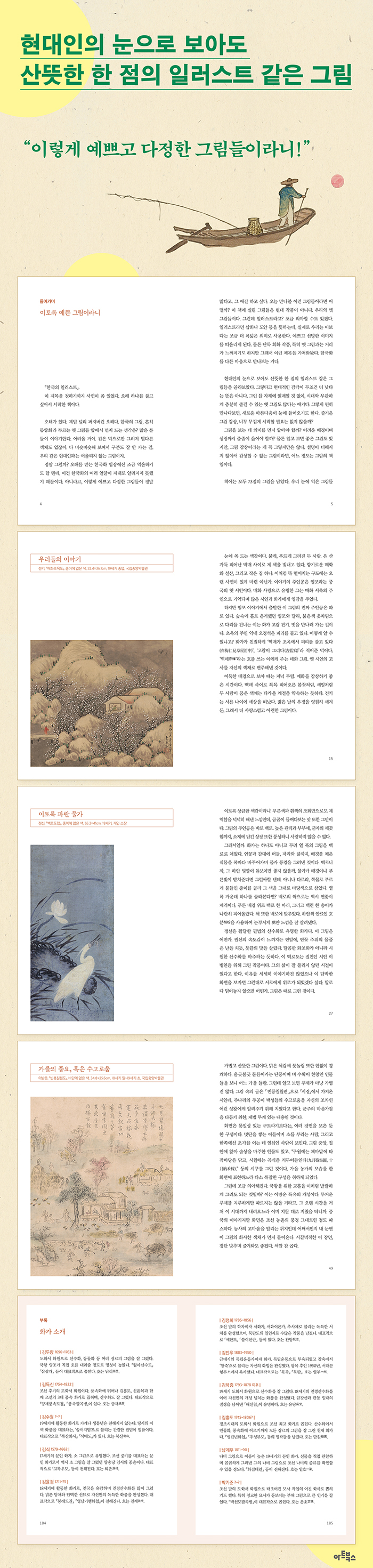
It's a color that catches the eye.
Two people drawn in red and blue.
It is shining its colors among the white plum blossoms that are in full bloom all over the mountain.
Fragrant plum blossoms, snow-covered mountains, and a small house.
There must be a long story behind such a perfect composition.
The protagonist of the story is an ancient Chinese poet named Lin Bu.
Famous for his love of plum blossoms, he is remembered as the owner of the Plum Blossom House and has inspired many poets and painters.
--- p.15
What happened to the painter that day?
If we were to talk about this other world alone among old paintings overflowing with a feast of ink and wash, we would feel a little dizzy.
So ecstatic.
What if we briefly forget the challenges posed by landscape paintings of the past? Where should we begin to read this painting? What does it mean? Questions like these.
You don't have to look at it intently to see what was drawn and how.
--- p.25
A tall pine tree that was pulled up to fit the screen ratio.
A branch was hung diagonally to make effective use of the narrow screen, and a parrot was placed in the most prominent spot.
Since it was a new face that we had brought in, we gave him the center of the screen.
The cool and stable composition, with the green pine needles and the red tail of the parrot, creates a vivid feeling just from the colors alone.
--- p.51
Suddenly I look back.
Judging by the fluttering hem of the clothes, it seems that there was a fair amount of speed.
Well, it's not flat, it's a downhill slope.
I was just about to take one step and the other when I heard a sound.
Perhaps it was a bat up there that caught his footsteps.
It's like a snapshot.
The line drawn is quick and refreshing.
In a scene like this, a detailed description would have been awkward.
The painter put down his brush for the last time, leaving this scene.
Does that mean we should continue the rest?
--- p.53
Sim Sa-jeong is considered the greatest painter of his time.
A scene from a summer day can be created effortlessly.
Even the sound of cicadas resonates refreshingly in his paintings.
The sound of cicadas chirping in the clear breeze.
It resembles the color blue.
Summer is rising to its peak, following that sound.
--- p.63
The wind blows.
The wind is blowing.
The sound fills the screen.
Where did the wind come from?
At first glance, this picture seems to have some kind of backstory.
A child in the middle of the picture, and another person in the room.
Judging by the dim shadow that was coming in fairly close to the door, it seemed that he too was listening to the outside world.
Two people drawn in red and blue.
It is shining its colors among the white plum blossoms that are in full bloom all over the mountain.
Fragrant plum blossoms, snow-covered mountains, and a small house.
There must be a long story behind such a perfect composition.
The protagonist of the story is an ancient Chinese poet named Lin Bu.
Famous for his love of plum blossoms, he is remembered as the owner of the Plum Blossom House and has inspired many poets and painters.
--- p.15
What happened to the painter that day?
If we were to talk about this other world alone among old paintings overflowing with a feast of ink and wash, we would feel a little dizzy.
So ecstatic.
What if we briefly forget the challenges posed by landscape paintings of the past? Where should we begin to read this painting? What does it mean? Questions like these.
You don't have to look at it intently to see what was drawn and how.
--- p.25
A tall pine tree that was pulled up to fit the screen ratio.
A branch was hung diagonally to make effective use of the narrow screen, and a parrot was placed in the most prominent spot.
Since it was a new face that we had brought in, we gave him the center of the screen.
The cool and stable composition, with the green pine needles and the red tail of the parrot, creates a vivid feeling just from the colors alone.
--- p.51
Suddenly I look back.
Judging by the fluttering hem of the clothes, it seems that there was a fair amount of speed.
Well, it's not flat, it's a downhill slope.
I was just about to take one step and the other when I heard a sound.
Perhaps it was a bat up there that caught his footsteps.
It's like a snapshot.
The line drawn is quick and refreshing.
In a scene like this, a detailed description would have been awkward.
The painter put down his brush for the last time, leaving this scene.
Does that mean we should continue the rest?
--- p.53
Sim Sa-jeong is considered the greatest painter of his time.
A scene from a summer day can be created effortlessly.
Even the sound of cicadas resonates refreshingly in his paintings.
The sound of cicadas chirping in the clear breeze.
It resembles the color blue.
Summer is rising to its peak, following that sound.
--- p.63
The wind blows.
The wind is blowing.
The sound fills the screen.
Where did the wind come from?
At first glance, this picture seems to have some kind of backstory.
A child in the middle of the picture, and another person in the room.
Judging by the dim shadow that was coming in fairly close to the door, it seemed that he too was listening to the outside world.
--- p.72
Publisher's Review
Appreciate with all five senses
Our painting, like a single illustration
『Korean Illustration』 is not a book that deals with modern paintings.
All the works included in the book are our old paintings.
When we say "illustration," we usually mean illustrations or designs, but Korean illustrations? That might seem a bit odd.
However, recently, the word 'illustration' has been widely used to refer to pretty and clear images beyond its dictionary meaning.
Then, how about looking at Korean painting from a slightly different perspective?
If we introduce a Korean painting that is like an illustration that looks pretty and beautiful even to our eyes today, wouldn't our old paintings not remain in the past but come closer to us?
With that in mind, I titled the book ‘Korean Illustrations’.
Words encourage a change in thinking, so I hope that the eyes and mind that look at Korean painting will become lighter.
The book consists of five chapters in total.
We selected paintings with keywords that fit the purpose of allowing people to see with their eyes, imagine the taste and scent, recall the sense of touch, and appreciate with their hearts.
Also, in line with the author's intention of 'enjoyable painting appreciation, don't start too heavy', one short appreciation for each painting stands shoulder to shoulder with each other.
Neither the pictures nor the text are difficult or attempt to teach anything, but rather, they simply invite us to sit down and rest for a while, touching our emotions. It has become a beautiful book that we can open to a page that catches our eye and look at the pictures and the text with our eyes and feel.
It starts off slow and light like that.
Should I first understand the meaning of a painting before looking at it? Should I recite the complex background and symbols one by one? Of course, some paintings are truly beautiful once you understand them, but art appreciation isn't always like that.
If a painting cannot be appreciated because it lacks explanation, it is partly the painting's fault._Page 5
Among the 73 paintings in the book, there are some that we are familiar with, but there are also quite a few that we are seeing for the first time or that will surprise us with their unexpected beauty.
There are quite a few paintings that can be believed to be 'modern' works, even if you don't look at the date of creation or the artist's name.
That doesn't mean that a modern sensibility is necessarily better.
This means that there are many old paintings that can be enjoyed regardless of the era, without being bound by the framework itself.
The author subtly emphasizes that if you open your mind, you can appreciate new Korean paintings.
As the author confesses, “I poured my love into the pictures, hoping they would be easy to read,” the book is filled with a gentle love for our paintings.
Basically, the story of Korean painting is told with the purpose of appreciation rather than theory.
However, this does not mean that the information and content of the picture are neglected.
Below the approximately 70 works, basic information such as the artist, title, and year of production is faithfully organized, and for readers who are curious about who the artist is, information about the artist has been organized in an appendix so that they can see it at a glance after viewing the works.
It is a good book that is easy to read but packed with information.
Drawing is fundamentally based on 'vision', but this alone is not fun.
Our body's various senses do not all play separately.
Open all five senses and enjoy the painting. If you look at the painting while connecting it with your mental image, you will soon hear the sweet sounds of birds and the sweet scent of flowers will spread.
Sometimes, by restraining the stimulus, you can experience a new discovery of that sensation.
The author's suggestion to enjoy paintings more by focusing on our senses is not a method of appreciation that applies only to our own paintings.
If you learn how to appreciate art with your senses through this book, you will be able to advance into a wider world of art.
No matter what anyone says, a painting is a painting.
The meaning is good, the background is good, everything is good, but the picture should be viewed as a picture only.
You can start with any picture.
The picture that catches my eye, that's where your story begins._Page 7
Our painting, like a single illustration
『Korean Illustration』 is not a book that deals with modern paintings.
All the works included in the book are our old paintings.
When we say "illustration," we usually mean illustrations or designs, but Korean illustrations? That might seem a bit odd.
However, recently, the word 'illustration' has been widely used to refer to pretty and clear images beyond its dictionary meaning.
Then, how about looking at Korean painting from a slightly different perspective?
If we introduce a Korean painting that is like an illustration that looks pretty and beautiful even to our eyes today, wouldn't our old paintings not remain in the past but come closer to us?
With that in mind, I titled the book ‘Korean Illustrations’.
Words encourage a change in thinking, so I hope that the eyes and mind that look at Korean painting will become lighter.
The book consists of five chapters in total.
We selected paintings with keywords that fit the purpose of allowing people to see with their eyes, imagine the taste and scent, recall the sense of touch, and appreciate with their hearts.
Also, in line with the author's intention of 'enjoyable painting appreciation, don't start too heavy', one short appreciation for each painting stands shoulder to shoulder with each other.
Neither the pictures nor the text are difficult or attempt to teach anything, but rather, they simply invite us to sit down and rest for a while, touching our emotions. It has become a beautiful book that we can open to a page that catches our eye and look at the pictures and the text with our eyes and feel.
It starts off slow and light like that.
Should I first understand the meaning of a painting before looking at it? Should I recite the complex background and symbols one by one? Of course, some paintings are truly beautiful once you understand them, but art appreciation isn't always like that.
If a painting cannot be appreciated because it lacks explanation, it is partly the painting's fault._Page 5
Among the 73 paintings in the book, there are some that we are familiar with, but there are also quite a few that we are seeing for the first time or that will surprise us with their unexpected beauty.
There are quite a few paintings that can be believed to be 'modern' works, even if you don't look at the date of creation or the artist's name.
That doesn't mean that a modern sensibility is necessarily better.
This means that there are many old paintings that can be enjoyed regardless of the era, without being bound by the framework itself.
The author subtly emphasizes that if you open your mind, you can appreciate new Korean paintings.
As the author confesses, “I poured my love into the pictures, hoping they would be easy to read,” the book is filled with a gentle love for our paintings.
Basically, the story of Korean painting is told with the purpose of appreciation rather than theory.
However, this does not mean that the information and content of the picture are neglected.
Below the approximately 70 works, basic information such as the artist, title, and year of production is faithfully organized, and for readers who are curious about who the artist is, information about the artist has been organized in an appendix so that they can see it at a glance after viewing the works.
It is a good book that is easy to read but packed with information.
Drawing is fundamentally based on 'vision', but this alone is not fun.
Our body's various senses do not all play separately.
Open all five senses and enjoy the painting. If you look at the painting while connecting it with your mental image, you will soon hear the sweet sounds of birds and the sweet scent of flowers will spread.
Sometimes, by restraining the stimulus, you can experience a new discovery of that sensation.
The author's suggestion to enjoy paintings more by focusing on our senses is not a method of appreciation that applies only to our own paintings.
If you learn how to appreciate art with your senses through this book, you will be able to advance into a wider world of art.
No matter what anyone says, a painting is a painting.
The meaning is good, the background is good, everything is good, but the picture should be viewed as a picture only.
You can start with any picture.
The picture that catches my eye, that's where your story begins._Page 7
GOODS SPECIFICS
- Date of issue: October 4, 2024
- Page count, weight, size: 192 pages | 128*188*20mm
- ISBN13: 9788961964494
- ISBN10: 8961964496
You may also like
카테고리
korean


korean

![GQ KOREA Mark (Monthly): December [2025]](http://librairie.coreenne.fr/cdn/shop/files/8ef265dbbfbf186523ed75ba7319009d.jpg?v=1765340328&width=3840)


