

AI, Quantum, and Singularity
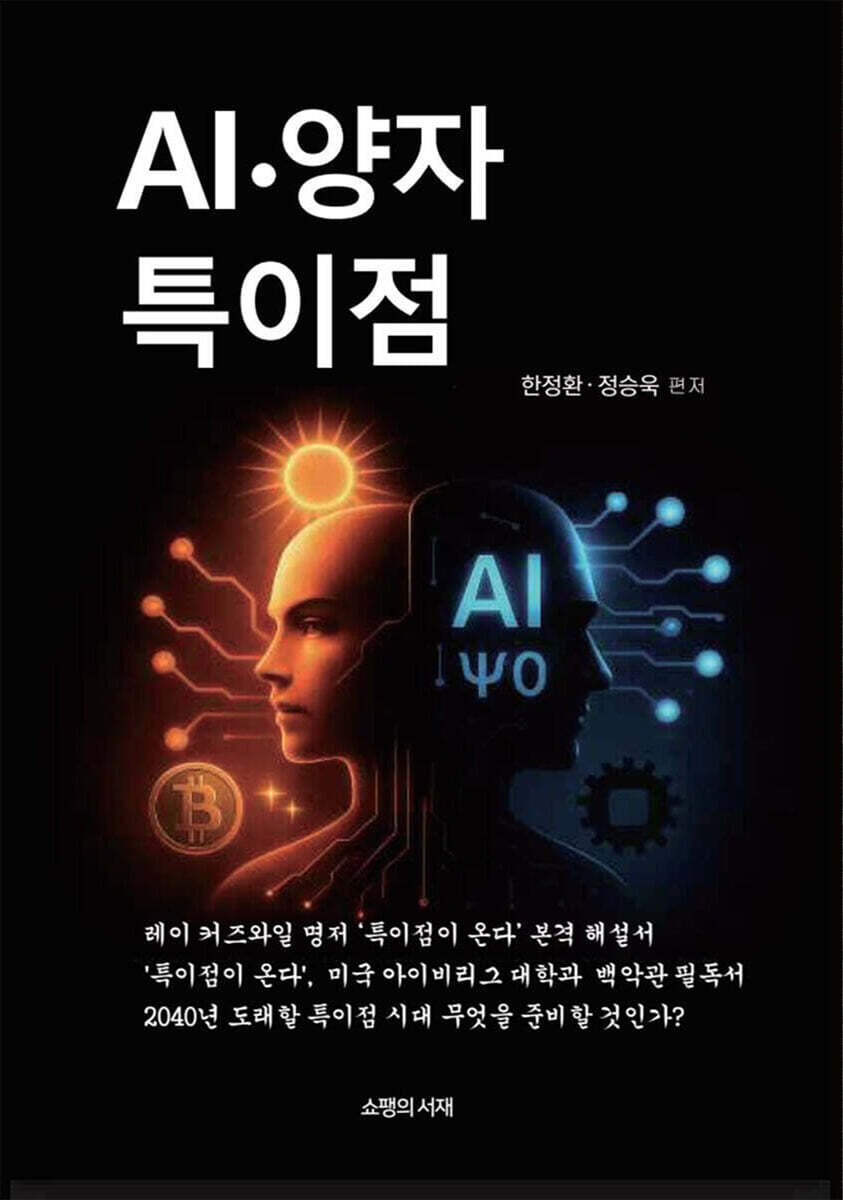 |
Description
Book Introduction
A book that interprets MIT Professor Ray Kurzweil's famous book, 'The Singularity is Near'!
"The Singularity is Near" is a must-read for Ivy League universities and White House officials in the eastern United States!
This book is a more easily explained and supplemented version of the book published in June 2024 by MIT Professor Ray Kurzweil, a world-renowned futurist and renowned AI researcher.
For the general reader, there are many scientific and computer terms, so I tried to explain them in Korean as easily as possible.
This is the point where artificial intelligence (AI) resembles the human brain and shows the possibility of thinking similarly to humans.
To properly utilize general artificial intelligence (AGI), we need to properly understand the human brain.
Professor Ray Kurzweil defines the point at which the human brain and AI synergize to create a new human culture as 'singularity.'
The original book presented how singularity actually occurs in real life.
AI will change the world as it becomes more advanced and develops exponentially.
High-performance computing will become cheaper, human biology will be better understood, and nanoscale engineering will become possible.
In particular, as AI capabilities advance, information accessibility becomes smoother, and human intelligence becomes more closely integrated with AI, a new world will open up.
This event is the singularity that Ray Kurzweil talks about.
In this section, the fears that are being raised about the AI era come to the forefront.
In other words, there is a fear that AI could overwhelm human capabilities and threaten human jobs and even survival itself.
However, Kurzweil would like to point out that in his view, this problem is purely human.
The term singularity is borrowed from mathematics and physics.
In mathematics, a black hole is a point at which a function becomes undefined when divided by zero, and in physics, a black hole is a point at the center of a black hole where the general laws of physics break down to an infinitely dense point.
However, it is important to remember that this term, as used in AI, is used metaphorically.
The reason we use the singularity metaphorically is because the progress of AI cannot keep up with the current level of human intelligence.
However, once the transition occurs, human technology will improve its cognitive abilities quickly enough to coexist with AI.
"The Singularity is Near" is a must-read for Ivy League universities and White House officials in the eastern United States!
This book is a more easily explained and supplemented version of the book published in June 2024 by MIT Professor Ray Kurzweil, a world-renowned futurist and renowned AI researcher.
For the general reader, there are many scientific and computer terms, so I tried to explain them in Korean as easily as possible.
This is the point where artificial intelligence (AI) resembles the human brain and shows the possibility of thinking similarly to humans.
To properly utilize general artificial intelligence (AGI), we need to properly understand the human brain.
Professor Ray Kurzweil defines the point at which the human brain and AI synergize to create a new human culture as 'singularity.'
The original book presented how singularity actually occurs in real life.
AI will change the world as it becomes more advanced and develops exponentially.
High-performance computing will become cheaper, human biology will be better understood, and nanoscale engineering will become possible.
In particular, as AI capabilities advance, information accessibility becomes smoother, and human intelligence becomes more closely integrated with AI, a new world will open up.
This event is the singularity that Ray Kurzweil talks about.
In this section, the fears that are being raised about the AI era come to the forefront.
In other words, there is a fear that AI could overwhelm human capabilities and threaten human jobs and even survival itself.
However, Kurzweil would like to point out that in his view, this problem is purely human.
The term singularity is borrowed from mathematics and physics.
In mathematics, a black hole is a point at which a function becomes undefined when divided by zero, and in physics, a black hole is a point at the center of a black hole where the general laws of physics break down to an infinitely dense point.
However, it is important to remember that this term, as used in AI, is used metaphorically.
The reason we use the singularity metaphorically is because the progress of AI cannot keep up with the current level of human intelligence.
However, once the transition occurs, human technology will improve its cognitive abilities quickly enough to coexist with AI.
index
As you go in
Chapter 1 Introduction
Chapter 2: Reinventing Intelligence
The 'thinking machine' proposed by Turing
Exponential progress in artificial intelligence
Overcoming the complexity limitations of rule-based systems
Basic Overview of Neural Network Algorithms
About 'Perceptron'
Insights from the modular structure of the cerebellum
Formation of AI consciousness
Chapter 3: The Neocortex and Artificial Intelligence
The cerebral cortex
Layers of brain neural network modules
Deep Learning: Reproducing the Capabilities of the Neocortex
How AI understands natural language
Expanding AI's associative capabilities
The emergence of Transformers
AI model with sentence creativity
Zero-shot learning
Three things AI lacks
The role of GPUs and TPUs optimized for AI
Advances in big data and artificial intelligence
The direction of human capabilities and AI development
AI Intelligence Explosion 'FOOM'
Chapter 4: Prospects for Human Brain Simulation
The Limitations and Prospects of the Turing Test
Extending the Brain's Neocortex to the Cloud
The emergence of nanobots
Experience the richness of culture
Basic Concepts of Singularity
Reaching the Singularity and Human Society
human identity
How to preserve human identity
Moravec's Paradox and Artificial Intelligence
Why Brain Emulation Is Needed
AI Convergence and Brain Programming
Chapter 5 How to Reach Biological Age 120?
In silico testing
Misfolding brain proteins cause dementia
Hybrid Thinking and Mind Backup
Convergence of AI and Biotechnology
The possibility of inventing carbon-fixing proteins
The era of AI vaccine development
The process of protein folding in the human body
Onset of dementia and Parkinson's disease
AI Could Lead to Early Detection of Dementia
AI simulations to replace clinical trials
Chapter 6: Nanotechnology and Healthy Longevity
The Path to Healthy Longevity
Generational Breakdown of Life Extension Research
How nanorobots work
Treating incurable diseases with protein design
The challenges of cancer treatment and how to overcome them
Ideas to prevent DNA mutations
Human appearance cultivated by nanobots
Nanobots that enhance brain power
Digital Memory Assistant DMA
The 3D Printing Revolution
The development of vertical farming and artificial intelligence
Chapter 7: The Coming Wave of "Unskilling"
The Mystery of Declining Productivity
Digital Age Productivity Measurement Techniques
The problem of 'consumer surplus'
The rise of yellow journalism
Cryptocurrency Outlook
AI and the Digital Economy of 2050
Disappearing jobs and new jobs
[Appendix] Quantum Computers and AI
Understanding the properties of ions (quanta) and electrons
Google Develops Quantum Chip, Willow
Pros and Cons of Quantum Computers
Development of quantum-resistant cryptography
Comparison of Willow Chip and Ion Trap Methods
Quantum computers depend on error correction technology.
Photonic interconnect technology
The synergy of quantum computers and AI
NVIDIA's scale-up strategy
Is the mind formed from connections between brain cells?
AI will never take away human jobs.
Free will and brain activity
The information that is expressed through consciousness is less than one ten-thousandth.
Why the Consciousness Manifestation System Adopts Sequential Computation
The human brain is a prediction machine
Basal ganglia = future prediction area
Reverse Engineering the Brain
Chapter 1 Introduction
Chapter 2: Reinventing Intelligence
The 'thinking machine' proposed by Turing
Exponential progress in artificial intelligence
Overcoming the complexity limitations of rule-based systems
Basic Overview of Neural Network Algorithms
About 'Perceptron'
Insights from the modular structure of the cerebellum
Formation of AI consciousness
Chapter 3: The Neocortex and Artificial Intelligence
The cerebral cortex
Layers of brain neural network modules
Deep Learning: Reproducing the Capabilities of the Neocortex
How AI understands natural language
Expanding AI's associative capabilities
The emergence of Transformers
AI model with sentence creativity
Zero-shot learning
Three things AI lacks
The role of GPUs and TPUs optimized for AI
Advances in big data and artificial intelligence
The direction of human capabilities and AI development
AI Intelligence Explosion 'FOOM'
Chapter 4: Prospects for Human Brain Simulation
The Limitations and Prospects of the Turing Test
Extending the Brain's Neocortex to the Cloud
The emergence of nanobots
Experience the richness of culture
Basic Concepts of Singularity
Reaching the Singularity and Human Society
human identity
How to preserve human identity
Moravec's Paradox and Artificial Intelligence
Why Brain Emulation Is Needed
AI Convergence and Brain Programming
Chapter 5 How to Reach Biological Age 120?
In silico testing
Misfolding brain proteins cause dementia
Hybrid Thinking and Mind Backup
Convergence of AI and Biotechnology
The possibility of inventing carbon-fixing proteins
The era of AI vaccine development
The process of protein folding in the human body
Onset of dementia and Parkinson's disease
AI Could Lead to Early Detection of Dementia
AI simulations to replace clinical trials
Chapter 6: Nanotechnology and Healthy Longevity
The Path to Healthy Longevity
Generational Breakdown of Life Extension Research
How nanorobots work
Treating incurable diseases with protein design
The challenges of cancer treatment and how to overcome them
Ideas to prevent DNA mutations
Human appearance cultivated by nanobots
Nanobots that enhance brain power
Digital Memory Assistant DMA
The 3D Printing Revolution
The development of vertical farming and artificial intelligence
Chapter 7: The Coming Wave of "Unskilling"
The Mystery of Declining Productivity
Digital Age Productivity Measurement Techniques
The problem of 'consumer surplus'
The rise of yellow journalism
Cryptocurrency Outlook
AI and the Digital Economy of 2050
Disappearing jobs and new jobs
[Appendix] Quantum Computers and AI
Understanding the properties of ions (quanta) and electrons
Google Develops Quantum Chip, Willow
Pros and Cons of Quantum Computers
Development of quantum-resistant cryptography
Comparison of Willow Chip and Ion Trap Methods
Quantum computers depend on error correction technology.
Photonic interconnect technology
The synergy of quantum computers and AI
NVIDIA's scale-up strategy
Is the mind formed from connections between brain cells?
AI will never take away human jobs.
Free will and brain activity
The information that is expressed through consciousness is less than one ten-thousandth.
Why the Consciousness Manifestation System Adopts Sequential Computation
The human brain is a prediction machine
Basal ganglia = future prediction area
Reverse Engineering the Brain
Into the book
The debate between Ray Kurzweil and Marvin Minsky about the future of AI is famous.
Two fundamentally different perspectives confront each other regarding how machines can achieve human intelligence.
The core of the debate is 'computational power' and 'the right algorithm'.
Ray Kurzweil, a proponent of the singularity, argues that to reach human-level complexity, AI would need massive computational power—more than 10¹⁴ calculations per second—to approach the number of neuron connections and their interactions in the brain.
The argument is that by increasing processing power, machines will be able to implement the complex operations of human cognition.
He also emphasized the exponential growth of hardware performance based on Moore's Law, and predicted that if computers could process enough calculations per second, they would be able to perform the same intellectual tasks as humans.
Furthermore, it was thought that human intelligence would arise from "brute force"—that is, if enough data was processed and enough connections were modeled, human-level intelligence would be achieved.
His vision aligns with the current trajectory of machine learning models like GPT and PaLM.
In contrast, Marvin Minsky, who pioneered AI deep learning, argued the exact opposite.
He said that intelligence cannot be achieved through calculations alone, and instead, the most important thing is the quality of the algorithm.
For Minsky, what matters is not how much processing power a machine has, but how well it can mimic the abstract thinking and problem-solving skills of humans—in other words, whether it executes the right algorithms.
Minsky believed that AI could achieve human-level intelligence, even with a processor the size of a Pentium chip (a desktop processor released in 1993), if only the right algorithms were designed.
The idea is that it comes from symbolic AI, the ability to manipulate symbols, infer concepts, and derive logic.
At that time, neither side could prevail.
At the time, neither Kurzweil nor Minsky had the tools they needed to prove their claims.
Kurzweil lacked the computational power (computing source) to prove that human-like intelligence could be achieved, and Minsky lacked the algorithm to prove that the same results could be achieved using symbolic reasoning alone.
Interestingly, the enormous computational power deployed in deep learning (GPT, PaLM, PaLM-E) validates Kurzweil's argument that scale and data are crucial.
The performance of deep learning-based AI, which relies on massive data sets and billions or trillions of parameters, depends on computational power.
Nevertheless, there is still much room for algorithmic efficiency and innovation.
Astronomical computational power and sophisticated algorithms are both essential.
Neither one alone is sufficient to achieve full human-level intelligence.
Combining the computational power and sophisticated inference architectures Kurzweil emphasizes could allow AI to reach human-level reasoning capabilities.
~ 'AI model with sentence creativity'
The human brain evolved to help us survive in complex environments where pattern recognition, decision-making, and creativity are more important than number crunching.
The reason is as follows:
First, the priority of evolution.
Humans had to identify predators, find food, navigate the terrain, and communicate with others.
These tasks required pattern recognition (e.g., spotting a tiger in the bushes or finding edible plants) rather than solving equations.
Fast, flexible thinking was more useful for survival than slow, detailed calculations.
Second, the structure of the brain.
The brain is built for adaptability.
The brain operates as a highly interconnected network of neurons that excels at fuzzy logic (understanding incomplete or uncertain information) rather than precise calculations.
For example, the brain can infer groups of objects without having to memorize all the items.
That is, we can approximate a 'close enough' solution.
Third, compare neurons to transistors.
Neurons (brain cells) are excellent at recognizing complex patterns and associations, but they operate much more slowly than the transistors in a computer.
Transistors are specifically designed to process precise numbers, while neurons are built for flexibility and learning through experience.
Fourth, there are limitations to working memory.
The human brain has a limited working memory, capable of storing only a small amount of information at a time (usually 5 to 9 items).
Therefore, it is difficult to perform complex calculations.
Fifth, development of alternative tools.
Instead of developing advanced computational abilities, humans invented tools such as abacuses, calculators, and computers to handle complex calculations for them.
Thanks to this, the brain can focus on creativity, reasoning, and innovation.
In short, the human brain is designed primarily for adapting to uncertain and dynamic environments, recognizing patterns, and solving practical problems, not for computation.
For accurate calculations, we rely on AI or computers specifically designed for this purpose.
In particular, the statement that “human intelligence is a bundle of various cognitive abilities” has many implications.
It emphasizes that human intelligence is a collection of abilities that vary from person to person.
This provides important implications for the development of artificial intelligence that mimics the human brain.
These unique aspects of human intelligence inspire the development of future specialized AI.
One person may be a mathematical genius but lack social skills, or another may have a great photographic memory but lack creativity.
Likewise, current AI systems are designed to excel in specific areas, rather than being “all-purpose.”
For example, DeepMind's AlphaZero is excellent at chess and Go, but cannot engage in conversation.
ChatGPT-4.o is good at language processing and text generation, but it can't drive a car or analyze visual data.
Therefore, specialized AI development can advance in various directions. It's not about turning AI into an all-powerful "super brain."
It is developed as a collection of specialized systems that each demonstrate outstanding capabilities in their respective fields.
With this in mind, let's speculate on the future direction of AI development.
First, it is the construction of a specialized model.
Just as humans have unique strengths, AI should also focus on specific tasks where it excels.
These include medical diagnostic AI that interprets X-rays or identifies diseases, and creative AI that composes music or designs works of art.
Specialized AI will complement each other and work together to solve complex problems, just like human experts.
Second, there's capability integration. This type integrates specialized AI systems into a cohesive framework.
For example, this is how AI combines language processing (e.g., ChatGPT4.o), vision (e.g., computer vision AI), and decision-making (e.g., AlphaZero) to focus on real-world problems such as autonomous medical surgery support.
Third, overcome weaknesses with AI.
Even humans who excel in one area have limitations in others. AI can complement human weaknesses by complementing areas where individuals struggle.
People with poor memory can use AI personal assistants to compensate. Rather than replacing human intelligence, AI can be developed to bridge gaps in cognitive abilities in specific areas and even augment them.
Fourth, maximizing synergy.
For example, imagine a medical AI system.
One part of the system is trained to analyze medical images (radiology).
Another part is understanding patient records and communicating with doctors and patients.
Then, a predictive model is used to recommend a treatment.
Each part individually excels in a specific area.
Combining these systems would be similar to how human doctors integrate their cognitive abilities to diagnose and treat patients.
As an example of applying the concept of 'bundling' human intelligence to AI, it can be said that imitating the diversity and expertise of human talent is essential for AI development.
~Advances in Big Data and Artificial Intelligence~
Since around 2000, computers have gotten faster at a fairly regular rate.
Every 1.4 years, you can buy a computer that is about twice as fast as your previous one for the same cost.
It's similar to how smartphones and laptops improve in performance every two years.
In particular, the speed of AI learning becomes much faster.
Since 2010, AI model learning speed has doubled every 5.7 months.
In other words, AI processing power doubled in less than half a year.
In terms of development speed, AI is much faster than computers.
From 1952 to 2010, computer capabilities increased approximately 75-fold.
However, from 2010 to 2021, AI learning speeds didn't just increase by 75 times, but by roughly 10 billion times. Why is AI growing so rapidly? It's not because we've invented better computers.
First, parallel computing.
A method has been developed to solve problems faster by using many computer chips together simultaneously.
Connectionism is that.
It's like 100 people working together to put together a big puzzle, not just one person.
Second, as deep learning becomes more useful due to big data, a lot of capital is being invested.
Thanks to the internet, smartphones, and social media, the world is flooded with massive amounts of data.
Data is the training tool that makes AI smarter.
Investors and companies are investing heavily in AI research and development, which has the potential to transform industries.
Traditionally, doctors analyze images to detect signs of disease.
However, it is very difficult to identify early-stage cancer in photographs because the differences between healthy and cancerous tissue are very subtle.
However, AI trained on large data sets learns patterns that are too subtle for humans to detect. By learning thousands of X-rays or MRI images showing both healthy and diseased tissue, AI systems can spot early signs of cancer better than human doctors.
This is because it analyzes massive amounts of data to identify patterns and insights that humans miss.
~Three things AI lacks~
Google is attempting to leap forward in the artificial intelligence (AI) race once again by unveiling 'Gemma 3' on March 12 (local time).
Since the rise of China's DeepSec, economic feasibility and computational efficiency have emerged as important issues in the AI industry, in addition to performance.
In response, Google introduced Gemma 3, an open-source large language model (LLM) that delivers high performance even in a single graphics processing unit (GPU) environment.
AI models can generally perform more complex calculations as the number of parameters increases, but this also slows down processing and increases hardware requirements.
However, Gemma 3 succeeded in reducing the computational burden by maintaining performance by compressing the information learned from the large model and transferring it to a smaller model.
As a result, while DeepSeek R1 uses 671 billion parameters and can optionally activate 37 billion parameters when needed, Gemma3 performs well with only 1 to 27 billion parameters.
Multimodal AI is still in its infancy, but it is one of the technologies expected to fundamentally change the way AI and humans interact.
By mimicking the way humans process senses, it can process information in a more intuitive way, which can be applied in various fields such as medical diagnosis, autonomous driving, and emotional analysis.
In the medical field, a more precise diagnosis is provided by analyzing a patient's symptom records and medical images together.
When applied to autonomous vehicles, it can process road signs, pedestrians, vehicle movements, and even the driver's voice commands in real time.
Furthermore, when applied to industrial robots, they can evolve beyond following work instructions to learning and adapting to their environment on their own.
Two fundamentally different perspectives confront each other regarding how machines can achieve human intelligence.
The core of the debate is 'computational power' and 'the right algorithm'.
Ray Kurzweil, a proponent of the singularity, argues that to reach human-level complexity, AI would need massive computational power—more than 10¹⁴ calculations per second—to approach the number of neuron connections and their interactions in the brain.
The argument is that by increasing processing power, machines will be able to implement the complex operations of human cognition.
He also emphasized the exponential growth of hardware performance based on Moore's Law, and predicted that if computers could process enough calculations per second, they would be able to perform the same intellectual tasks as humans.
Furthermore, it was thought that human intelligence would arise from "brute force"—that is, if enough data was processed and enough connections were modeled, human-level intelligence would be achieved.
His vision aligns with the current trajectory of machine learning models like GPT and PaLM.
In contrast, Marvin Minsky, who pioneered AI deep learning, argued the exact opposite.
He said that intelligence cannot be achieved through calculations alone, and instead, the most important thing is the quality of the algorithm.
For Minsky, what matters is not how much processing power a machine has, but how well it can mimic the abstract thinking and problem-solving skills of humans—in other words, whether it executes the right algorithms.
Minsky believed that AI could achieve human-level intelligence, even with a processor the size of a Pentium chip (a desktop processor released in 1993), if only the right algorithms were designed.
The idea is that it comes from symbolic AI, the ability to manipulate symbols, infer concepts, and derive logic.
At that time, neither side could prevail.
At the time, neither Kurzweil nor Minsky had the tools they needed to prove their claims.
Kurzweil lacked the computational power (computing source) to prove that human-like intelligence could be achieved, and Minsky lacked the algorithm to prove that the same results could be achieved using symbolic reasoning alone.
Interestingly, the enormous computational power deployed in deep learning (GPT, PaLM, PaLM-E) validates Kurzweil's argument that scale and data are crucial.
The performance of deep learning-based AI, which relies on massive data sets and billions or trillions of parameters, depends on computational power.
Nevertheless, there is still much room for algorithmic efficiency and innovation.
Astronomical computational power and sophisticated algorithms are both essential.
Neither one alone is sufficient to achieve full human-level intelligence.
Combining the computational power and sophisticated inference architectures Kurzweil emphasizes could allow AI to reach human-level reasoning capabilities.
~ 'AI model with sentence creativity'
The human brain evolved to help us survive in complex environments where pattern recognition, decision-making, and creativity are more important than number crunching.
The reason is as follows:
First, the priority of evolution.
Humans had to identify predators, find food, navigate the terrain, and communicate with others.
These tasks required pattern recognition (e.g., spotting a tiger in the bushes or finding edible plants) rather than solving equations.
Fast, flexible thinking was more useful for survival than slow, detailed calculations.
Second, the structure of the brain.
The brain is built for adaptability.
The brain operates as a highly interconnected network of neurons that excels at fuzzy logic (understanding incomplete or uncertain information) rather than precise calculations.
For example, the brain can infer groups of objects without having to memorize all the items.
That is, we can approximate a 'close enough' solution.
Third, compare neurons to transistors.
Neurons (brain cells) are excellent at recognizing complex patterns and associations, but they operate much more slowly than the transistors in a computer.
Transistors are specifically designed to process precise numbers, while neurons are built for flexibility and learning through experience.
Fourth, there are limitations to working memory.
The human brain has a limited working memory, capable of storing only a small amount of information at a time (usually 5 to 9 items).
Therefore, it is difficult to perform complex calculations.
Fifth, development of alternative tools.
Instead of developing advanced computational abilities, humans invented tools such as abacuses, calculators, and computers to handle complex calculations for them.
Thanks to this, the brain can focus on creativity, reasoning, and innovation.
In short, the human brain is designed primarily for adapting to uncertain and dynamic environments, recognizing patterns, and solving practical problems, not for computation.
For accurate calculations, we rely on AI or computers specifically designed for this purpose.
In particular, the statement that “human intelligence is a bundle of various cognitive abilities” has many implications.
It emphasizes that human intelligence is a collection of abilities that vary from person to person.
This provides important implications for the development of artificial intelligence that mimics the human brain.
These unique aspects of human intelligence inspire the development of future specialized AI.
One person may be a mathematical genius but lack social skills, or another may have a great photographic memory but lack creativity.
Likewise, current AI systems are designed to excel in specific areas, rather than being “all-purpose.”
For example, DeepMind's AlphaZero is excellent at chess and Go, but cannot engage in conversation.
ChatGPT-4.o is good at language processing and text generation, but it can't drive a car or analyze visual data.
Therefore, specialized AI development can advance in various directions. It's not about turning AI into an all-powerful "super brain."
It is developed as a collection of specialized systems that each demonstrate outstanding capabilities in their respective fields.
With this in mind, let's speculate on the future direction of AI development.
First, it is the construction of a specialized model.
Just as humans have unique strengths, AI should also focus on specific tasks where it excels.
These include medical diagnostic AI that interprets X-rays or identifies diseases, and creative AI that composes music or designs works of art.
Specialized AI will complement each other and work together to solve complex problems, just like human experts.
Second, there's capability integration. This type integrates specialized AI systems into a cohesive framework.
For example, this is how AI combines language processing (e.g., ChatGPT4.o), vision (e.g., computer vision AI), and decision-making (e.g., AlphaZero) to focus on real-world problems such as autonomous medical surgery support.
Third, overcome weaknesses with AI.
Even humans who excel in one area have limitations in others. AI can complement human weaknesses by complementing areas where individuals struggle.
People with poor memory can use AI personal assistants to compensate. Rather than replacing human intelligence, AI can be developed to bridge gaps in cognitive abilities in specific areas and even augment them.
Fourth, maximizing synergy.
For example, imagine a medical AI system.
One part of the system is trained to analyze medical images (radiology).
Another part is understanding patient records and communicating with doctors and patients.
Then, a predictive model is used to recommend a treatment.
Each part individually excels in a specific area.
Combining these systems would be similar to how human doctors integrate their cognitive abilities to diagnose and treat patients.
As an example of applying the concept of 'bundling' human intelligence to AI, it can be said that imitating the diversity and expertise of human talent is essential for AI development.
~Advances in Big Data and Artificial Intelligence~
Since around 2000, computers have gotten faster at a fairly regular rate.
Every 1.4 years, you can buy a computer that is about twice as fast as your previous one for the same cost.
It's similar to how smartphones and laptops improve in performance every two years.
In particular, the speed of AI learning becomes much faster.
Since 2010, AI model learning speed has doubled every 5.7 months.
In other words, AI processing power doubled in less than half a year.
In terms of development speed, AI is much faster than computers.
From 1952 to 2010, computer capabilities increased approximately 75-fold.
However, from 2010 to 2021, AI learning speeds didn't just increase by 75 times, but by roughly 10 billion times. Why is AI growing so rapidly? It's not because we've invented better computers.
First, parallel computing.
A method has been developed to solve problems faster by using many computer chips together simultaneously.
Connectionism is that.
It's like 100 people working together to put together a big puzzle, not just one person.
Second, as deep learning becomes more useful due to big data, a lot of capital is being invested.
Thanks to the internet, smartphones, and social media, the world is flooded with massive amounts of data.
Data is the training tool that makes AI smarter.
Investors and companies are investing heavily in AI research and development, which has the potential to transform industries.
Traditionally, doctors analyze images to detect signs of disease.
However, it is very difficult to identify early-stage cancer in photographs because the differences between healthy and cancerous tissue are very subtle.
However, AI trained on large data sets learns patterns that are too subtle for humans to detect. By learning thousands of X-rays or MRI images showing both healthy and diseased tissue, AI systems can spot early signs of cancer better than human doctors.
This is because it analyzes massive amounts of data to identify patterns and insights that humans miss.
~Three things AI lacks~
Google is attempting to leap forward in the artificial intelligence (AI) race once again by unveiling 'Gemma 3' on March 12 (local time).
Since the rise of China's DeepSec, economic feasibility and computational efficiency have emerged as important issues in the AI industry, in addition to performance.
In response, Google introduced Gemma 3, an open-source large language model (LLM) that delivers high performance even in a single graphics processing unit (GPU) environment.
AI models can generally perform more complex calculations as the number of parameters increases, but this also slows down processing and increases hardware requirements.
However, Gemma 3 succeeded in reducing the computational burden by maintaining performance by compressing the information learned from the large model and transferring it to a smaller model.
As a result, while DeepSeek R1 uses 671 billion parameters and can optionally activate 37 billion parameters when needed, Gemma3 performs well with only 1 to 27 billion parameters.
Multimodal AI is still in its infancy, but it is one of the technologies expected to fundamentally change the way AI and humans interact.
By mimicking the way humans process senses, it can process information in a more intuitive way, which can be applied in various fields such as medical diagnosis, autonomous driving, and emotional analysis.
In the medical field, a more precise diagnosis is provided by analyzing a patient's symptom records and medical images together.
When applied to autonomous vehicles, it can process road signs, pedestrians, vehicle movements, and even the driver's voice commands in real time.
Furthermore, when applied to industrial robots, they can evolve beyond following work instructions to learning and adapting to their environment on their own.
--- From the text
Publisher's Review
Artificial General Intelligence (AGI) will emerge in 2029!
The singularity that will arrive in the 2040s is not a fearful future, but the beginning of a new civilization for humanity!
A clear understanding of quantum computing and AGI, which will transform humanity, is urgently needed.
The future of quantum computers depends more on error correction technology than on the number of qubits.
The tug-of-war between quantum computers and cryptocurrencies has begun.
This book is a more easily explained and supplemented version of the book published in June 2024 by MIT Professor Ray Kurzweil, a world-renowned futurist and renowned AI researcher.
For the general reader, there are many scientific and computer terms, so I tried to explain them in Korean as easily as possible.
This is the point where artificial intelligence (AI) resembles the human brain and shows the possibility of thinking similarly to humans.
To properly utilize general artificial intelligence (AGI), we need to properly understand the human brain.
Professor Ray Kurzweil defines the point at which the human brain and AI synergize to create a new human culture as 'singularity.'
The original book presented how singularity actually occurs in real life.
AI will change the world as it becomes more advanced and develops exponentially.
High-performance computing will become cheaper, human biology will be better understood, and nanoscale engineering will become possible.
In particular, as AI capabilities advance, information accessibility becomes smoother, and human intelligence becomes more closely integrated with AI, a new world will open up.
This event is the singularity that Ray Kurzweil talks about.
In this section, the fears that are being raised about the AI era come to the forefront.
In other words, there is a fear that AI could overwhelm human capabilities and threaten human jobs and even survival itself.
However, Kurzweil would like to point out that in his view, this problem is purely human.
The term singularity is borrowed from mathematics and physics.
In mathematics, a black hole is a point at which a function becomes undefined when divided by zero, and in physics, a black hole is a point at the center of a black hole where the general laws of physics break down to an infinitely dense point.
However, it is important to remember that this term, as used in AI, is used metaphorically.
The reason we use the singularity metaphorically is because the progress of AI cannot keep up with the current level of human intelligence.
However, once the transition occurs, human technology will improve its cognitive abilities quickly enough to coexist with AI.
What is a singularity?
Ray Kurzweil's prediction for the singularity era that will arrive with the advancement of AI is as follows.
According to Kurzweil's prediction, the singularity will arrive around 2040.
Although these changes can be predicted, they have not yet been felt in reality.
Many critics, when Kurzweil's first book was published in 2005, criticized Kurzweil's timeline as overly optimistic, or even argued that a singularity was impossible.
But since then, amazing changes have taken place.
Technological progress continued to accelerate, ignoring skepticism.
Just 20 years ago, social media and smartphones barely existed, but now they're incredibly cheap and available all day long.
Now connecting the majority of the world's population, AI advancements are accelerating with the emergence of high-performance algorithm innovations and big data.
Amazing innovations are happening that even experts could not have predicted.
From mastering games like Go to driving a car, writing essays, passing the bar exam, and even diagnosing cancer...
Currently, ChatGPT4.o and Gemini are famous as powerful and flexible language models.
Although it is now widely used and lowering the barrier between humans and machines, it is still in its infancy.
Meanwhile, the cost of sequencing the human genome has dropped by 99.997% (making it virtually free), and neural networks are starting to unlock major medical discoveries through simulation.
We may even finally be able to connect computers directly to the human brain.
Within the next decade, people will be interacting with AI that looks human.
And simple brain-computer interfaces (BCIs) will impact our daily lives just as smartphones do today.
The AI revolution, especially in biotechnology, will cure diseases and significantly extend people's healthy lifespans.
At the same time, many workers will face economic dislocation, and humanity will face risks from the accidental or deliberate misuse of new technologies.
In the 2030s, self-improving AI and maturing nanotechnology will merge human and machine creations more than ever before, offering both greater promise and greater danger.
If we address the scientific, ethical, social, and political challenges well, we will be well on our way to a better life on Earth by 2040.
One of the most obvious downsides of innovation is unemployment caused by various forms of automation.
While these AI-induced downsides are real, there are ample reasons for long-term optimism.
And ultimately, we'll look at why we're not competing with AI.
Prevent body aging
This book will focus on overcoming the next barrier: the vulnerability of biology.
First, we will overcome the aging of our bodies, then we will augment the limited human brain and reach the singularity.
These innovations could put us at risk.
Revolutionary new systems in biotechnology, nanotechnology, and AI could lead to existential catastrophes, such as devastating catastrophes.
Or it could lead to a catastrophe, like a chain reaction of self-replicating machines.
However, as we will explain in the commentary, there are promising approaches to addressing these threats.
We are currently in one of the most exciting and important times in history.
What we can be certain of is that if we can understand and predict life after the singularity, humanity's approach to AI will succeed in leading to a safer and more prosperous human life.
The editors of this book have tried to make it the most accessible domestic publication on artificial intelligence.
The singularity that the authors emphasize is the point of rebirth of intelligence, or the recreation of intelligence, when the human brain and AI merge to create a synergistic effect.
This is what Professor Ray Kurzweil ultimately wanted to say.
So what is the re-creation of intelligence?
According to Professor Ray Kurzweil, humans in the 2020s have entered the final stage of evolution.
Next, we will enter a stage where we will recreate and merge the intelligence bestowed by nature on a more powerful digital foundation.
It means enhancing the innate human ability to think, learn, and solve problems and expanding it into a new civilization.
This means that deep learning has become so advanced that it can recreate the capabilities of the human brain's neocortex.
As we enter the 2020s, humanity is at a point where it is becoming increasingly important.
We have entered an era where the innate human intelligence that has evolved over millions of years is combined with powerful digital tools such as AI.
Deep learning, a type of AI that mimics how the human brain works (especially the neocortex, the part of the brain responsible for higher-order thinking), will play a key role in this process.
To gauge how close AI is to human intelligence, we need to examine how well it performs tasks like image recognition, language understanding, and decision-making. If AI can perform these tasks as well as or better than humans, that point is the singularity described above.
- Han Jeong-hwan, Annandale Laboratory, Virginia, USA, June 2025 -
The singularity that will arrive in the 2040s is not a fearful future, but the beginning of a new civilization for humanity!
A clear understanding of quantum computing and AGI, which will transform humanity, is urgently needed.
The future of quantum computers depends more on error correction technology than on the number of qubits.
The tug-of-war between quantum computers and cryptocurrencies has begun.
This book is a more easily explained and supplemented version of the book published in June 2024 by MIT Professor Ray Kurzweil, a world-renowned futurist and renowned AI researcher.
For the general reader, there are many scientific and computer terms, so I tried to explain them in Korean as easily as possible.
This is the point where artificial intelligence (AI) resembles the human brain and shows the possibility of thinking similarly to humans.
To properly utilize general artificial intelligence (AGI), we need to properly understand the human brain.
Professor Ray Kurzweil defines the point at which the human brain and AI synergize to create a new human culture as 'singularity.'
The original book presented how singularity actually occurs in real life.
AI will change the world as it becomes more advanced and develops exponentially.
High-performance computing will become cheaper, human biology will be better understood, and nanoscale engineering will become possible.
In particular, as AI capabilities advance, information accessibility becomes smoother, and human intelligence becomes more closely integrated with AI, a new world will open up.
This event is the singularity that Ray Kurzweil talks about.
In this section, the fears that are being raised about the AI era come to the forefront.
In other words, there is a fear that AI could overwhelm human capabilities and threaten human jobs and even survival itself.
However, Kurzweil would like to point out that in his view, this problem is purely human.
The term singularity is borrowed from mathematics and physics.
In mathematics, a black hole is a point at which a function becomes undefined when divided by zero, and in physics, a black hole is a point at the center of a black hole where the general laws of physics break down to an infinitely dense point.
However, it is important to remember that this term, as used in AI, is used metaphorically.
The reason we use the singularity metaphorically is because the progress of AI cannot keep up with the current level of human intelligence.
However, once the transition occurs, human technology will improve its cognitive abilities quickly enough to coexist with AI.
What is a singularity?
Ray Kurzweil's prediction for the singularity era that will arrive with the advancement of AI is as follows.
According to Kurzweil's prediction, the singularity will arrive around 2040.
Although these changes can be predicted, they have not yet been felt in reality.
Many critics, when Kurzweil's first book was published in 2005, criticized Kurzweil's timeline as overly optimistic, or even argued that a singularity was impossible.
But since then, amazing changes have taken place.
Technological progress continued to accelerate, ignoring skepticism.
Just 20 years ago, social media and smartphones barely existed, but now they're incredibly cheap and available all day long.
Now connecting the majority of the world's population, AI advancements are accelerating with the emergence of high-performance algorithm innovations and big data.
Amazing innovations are happening that even experts could not have predicted.
From mastering games like Go to driving a car, writing essays, passing the bar exam, and even diagnosing cancer...
Currently, ChatGPT4.o and Gemini are famous as powerful and flexible language models.
Although it is now widely used and lowering the barrier between humans and machines, it is still in its infancy.
Meanwhile, the cost of sequencing the human genome has dropped by 99.997% (making it virtually free), and neural networks are starting to unlock major medical discoveries through simulation.
We may even finally be able to connect computers directly to the human brain.
Within the next decade, people will be interacting with AI that looks human.
And simple brain-computer interfaces (BCIs) will impact our daily lives just as smartphones do today.
The AI revolution, especially in biotechnology, will cure diseases and significantly extend people's healthy lifespans.
At the same time, many workers will face economic dislocation, and humanity will face risks from the accidental or deliberate misuse of new technologies.
In the 2030s, self-improving AI and maturing nanotechnology will merge human and machine creations more than ever before, offering both greater promise and greater danger.
If we address the scientific, ethical, social, and political challenges well, we will be well on our way to a better life on Earth by 2040.
One of the most obvious downsides of innovation is unemployment caused by various forms of automation.
While these AI-induced downsides are real, there are ample reasons for long-term optimism.
And ultimately, we'll look at why we're not competing with AI.
Prevent body aging
This book will focus on overcoming the next barrier: the vulnerability of biology.
First, we will overcome the aging of our bodies, then we will augment the limited human brain and reach the singularity.
These innovations could put us at risk.
Revolutionary new systems in biotechnology, nanotechnology, and AI could lead to existential catastrophes, such as devastating catastrophes.
Or it could lead to a catastrophe, like a chain reaction of self-replicating machines.
However, as we will explain in the commentary, there are promising approaches to addressing these threats.
We are currently in one of the most exciting and important times in history.
What we can be certain of is that if we can understand and predict life after the singularity, humanity's approach to AI will succeed in leading to a safer and more prosperous human life.
The editors of this book have tried to make it the most accessible domestic publication on artificial intelligence.
The singularity that the authors emphasize is the point of rebirth of intelligence, or the recreation of intelligence, when the human brain and AI merge to create a synergistic effect.
This is what Professor Ray Kurzweil ultimately wanted to say.
So what is the re-creation of intelligence?
According to Professor Ray Kurzweil, humans in the 2020s have entered the final stage of evolution.
Next, we will enter a stage where we will recreate and merge the intelligence bestowed by nature on a more powerful digital foundation.
It means enhancing the innate human ability to think, learn, and solve problems and expanding it into a new civilization.
This means that deep learning has become so advanced that it can recreate the capabilities of the human brain's neocortex.
As we enter the 2020s, humanity is at a point where it is becoming increasingly important.
We have entered an era where the innate human intelligence that has evolved over millions of years is combined with powerful digital tools such as AI.
Deep learning, a type of AI that mimics how the human brain works (especially the neocortex, the part of the brain responsible for higher-order thinking), will play a key role in this process.
To gauge how close AI is to human intelligence, we need to examine how well it performs tasks like image recognition, language understanding, and decision-making. If AI can perform these tasks as well as or better than humans, that point is the singularity described above.
- Han Jeong-hwan, Annandale Laboratory, Virginia, USA, June 2025 -
GOODS SPECIFICS
- Date of issue: June 25, 2025
- Page count, weight, size: 346 pages | 155*225*18mm
- ISBN13: 9791198186997
- ISBN10: 1198186992
You may also like
카테고리
korean


korean

![GQ KOREA Mark (Monthly): December [2025]](http://librairie.coreenne.fr/cdn/shop/files/8ef265dbbfbf186523ed75ba7319009d.jpg?v=1765340328&width=3840)


