

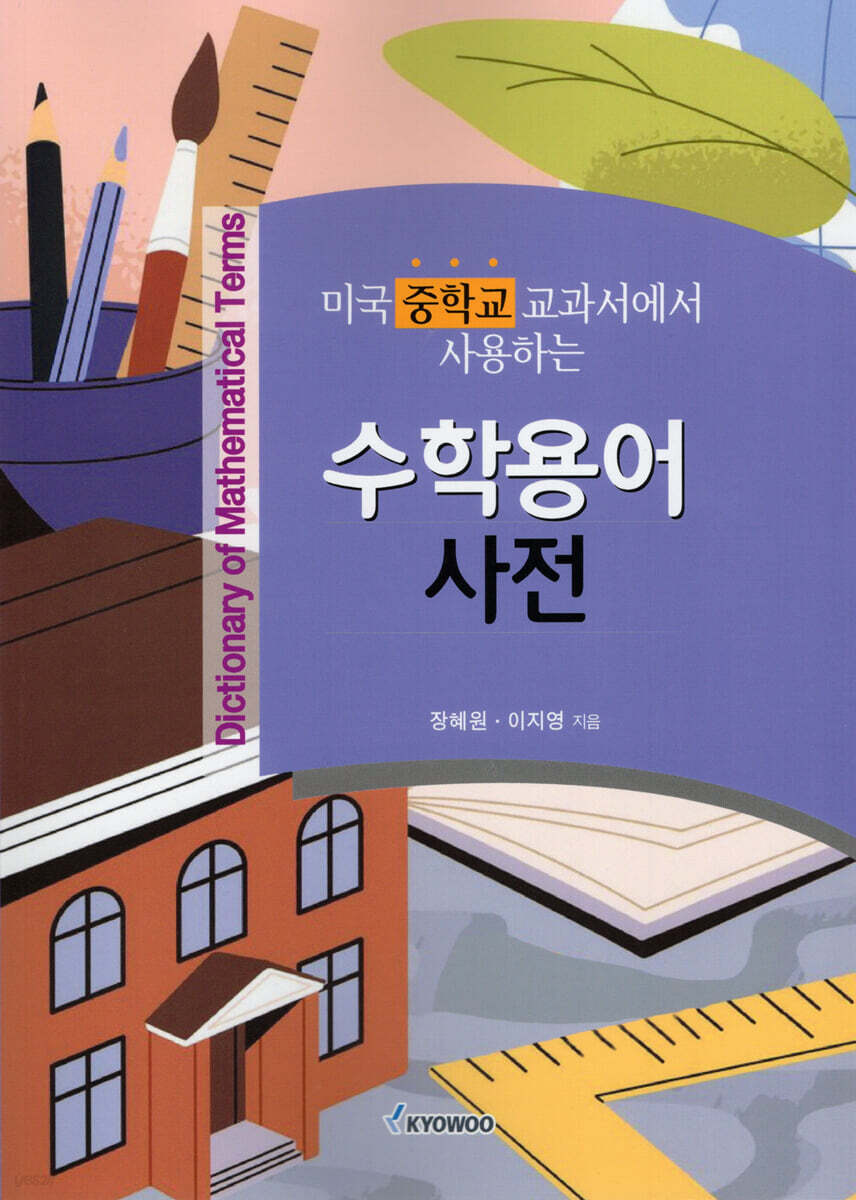
Dictionary of Math Terms Used in American Middle School Textbooks
 |
Description
Book Introduction
This book was created to help middle school or high school students studying mathematics, or anyone interested in mathematics, understand mathematical terms expressed in English more easily.
It was written to help people become familiar with the English expressions of mathematical terms and use them naturally by explaining the meanings of mathematical terms expressed in English and introducing the corresponding Korean terms.
It was written to help people become familiar with the English expressions of mathematical terms and use them naturally by explaining the meanings of mathematical terms expressed in English and introducing the corresponding Korean terms.
index
A
B
C
D
E
F
G
H
I
L
M
N
O
P
Q
R
S
T
U
V
INDEX
B
C
D
E
F
G
H
I
L
M
N
O
P
Q
R
S
T
U
V
INDEX
Publisher's Review
preface
Mathematics is said to be the language of nature.
It is said that 17th century Italian scientist Galileo said, “Mathematics is the language in which God has written the universe,” indicating that mathematics is an essential tool for explaining the world.
In the same context, mathematics is also called the language of science.
Sometimes we borrow the language of mathematics to describe scientific phenomena, and sometimes mathematical inquiry leads to scientific discoveries.
Representative examples include Newton and Einstein expressing their intended scientific principles by expressing the relationship between force and acceleration or the special theory of relativity in a single equation without having to explain them in detail, and the fact that Neptune, the eighth planet from the sun, was discovered through mathematical calculations rather than observations also shows this.
Some mathematicians generally consider mathematics to be a kind of language.
Language is a symbol system based on meaning, grammar, etc., and its basic function is communication, and mathematics satisfies all of these conditions.
In fact, when we study mathematics, we can understand many aspects and solve problems just by knowing the exact meaning of mathematical terms.
Terminology plays an important role in mathematics, and clearly understanding its meaning is the core of studying mathematics.
Meanwhile, mathematics is also called a universal language.
If we don't know the Hindi language, we can't read Indian novels and can't understand their content at all, but if we read Indian math textbooks, we can get a general idea of the content (compared to novels).
Because a special language of mathematical symbols is used.
If you open an Indian mathematics textbook and see equations with similar forms, you can probably guess that it is a section related to polynomial expansion.
In this way, it is said to be universal in that mathematical symbols and meanings are used in the same way in the past and present, and in any part of the world, without much difference.
Although the language of mathematics can be said to be more universal than everyday language, there are many cases where mathematical terms that express the same meaning do not fully convey the meaning of the term or are relatively different depending on the language.
Let's take a minority as an example.
The term prime in Korean has two mathematical meanings.
In English, these meanings are distinguished by the terms decimal (a number expressed using a decimal point) and prime number (a number whose only divisors are 1 and itself).
Additionally, in American school mathematics, the term whole number is commonly used, which is the set of numbers that includes 0 and the natural numbers.
On the other hand, there is no term that corresponds exactly to this in Korean mathematics.
There are also differences between mathematical terminology and everyday language.
For example, the English word function means function in mathematics, but in everyday life it means function.
American math education differs from Korea in many ways, not just in terminology.
First, there are no national standards in the United States.
Public education is administered by each state, resulting in different curricula across the 50 states.
On the other hand, Korea has a national curriculum where students across the country learn mathematics to the same standards, so the two countries' educational methods contrast greatly.
In particular, before many states adopted CCSSM in 2013, there were significant differences in curricula across states.
Another problem arose when textbooks became increasingly thicker and more expensive to reflect the curricula of each state.
Additionally, in the United States, multiple definitions for a single mathematical term are often used.
For example, both definitions of a trapezoid are used: (1) a quadrilateral with only one pair of parallel sides, and (2) a quadrilateral with at least one pair of parallel sides.
To bridge this curriculum gap, the National Council of Teachers of Mathematics (NCTM) has published comprehensive mathematics curricula for use by all states twice since 1989.
Although several European countries have adopted the NCTM curriculum, no state in the United States has adopted it.
However, CCSSM, which was created based on the NCTM curriculum, has been adopted and is being utilized in various ways in more than 40 states, excluding Alaska and Texas.
Therefore, CCSSM can be seen as the most useful standard for understanding the current American mathematics curriculum.
To help users understand, the authors of CCSSM have created a manual called CCSSM Progression Drafts, which guides users on how to understand and teach the mathematics concepts included in the curriculum.
The mathematical terms included in this book are defined and provided with examples based on the CCSSM and CCSSM Progression Drafts.
This dictionary was created to help middle school or high school students studying mathematics, or anyone interested in mathematics, more easily understand mathematical terms expressed in English.
This book was written to help readers become familiar with the English expressions of mathematical terms and use them naturally by explaining the meaning of mathematical terms expressed in English and introducing corresponding Korean terms.
To maximize this intention, we have devised several measures.
First, it contains how mathematical terminology is treated in mathematics textbooks used in the United States.
From the perspective of pragmatics, a branch of linguistics, words and sentences do not have fixed meanings, but their meanings can change depending on the situation or context in which they are used.
Therefore, having a thorough understanding of the meaning of a language means being able to interpret the meaning of words or sentences according to the context in which they are used, and language learning is achieved by using terms appropriately in appropriate situations where their meaning is common.
Therefore, this book utilizes the textbook Illustrative Mathematics as a context for using the terms, along with the meaning of the mathematical terms themselves.
Here are some examples of usage presented with IM written at the end of each term.
This is perhaps the most distinctive feature that distinguishes this book from others of its kind.
Second, we actively utilized visual expression.
You may have had the experience of being frustrated with a math book full of complicated formulas, but then being happy and understanding when you see a picture explaining or illustrating them.
Indeed, mathematicians have often elaborated their ideas by drawing before making great mathematical discoveries, and using visual representations to explain difficult mathematical concepts and theories is a common strategy used by mathematicians and educators.
In this book, we also intend to make explanations easier by visually representing the meaning of terms.
Third, in addition to the context in which the terms are used as explained above, examples of the terms are also presented.
Mathematics itself is characterized by abstractness.
This is because mathematical concepts are abstract objects that generalize and extract properties from specific individual cases.
The abstract nature has the advantage of making it easier to process ideas in your head, but it is also true that it can feel too difficult for mathematical learners.
Even the definition of mathematical terms is often difficult to overcome the limitations of abstraction through explanation alone.
So, we've provided examples for each term to make it easier to understand the meaning of the term.
We hope and encourage that your mathematical studies will become more vibrant and broad through your knowledge of the Korean and English expressions for the mathematical terms in this book.
I would also like to express my gratitude to the editorial staff of Kyowoo Publishing for their hard work in bringing this book to publication.
Mathematics is said to be the language of nature.
It is said that 17th century Italian scientist Galileo said, “Mathematics is the language in which God has written the universe,” indicating that mathematics is an essential tool for explaining the world.
In the same context, mathematics is also called the language of science.
Sometimes we borrow the language of mathematics to describe scientific phenomena, and sometimes mathematical inquiry leads to scientific discoveries.
Representative examples include Newton and Einstein expressing their intended scientific principles by expressing the relationship between force and acceleration or the special theory of relativity in a single equation without having to explain them in detail, and the fact that Neptune, the eighth planet from the sun, was discovered through mathematical calculations rather than observations also shows this.
Some mathematicians generally consider mathematics to be a kind of language.
Language is a symbol system based on meaning, grammar, etc., and its basic function is communication, and mathematics satisfies all of these conditions.
In fact, when we study mathematics, we can understand many aspects and solve problems just by knowing the exact meaning of mathematical terms.
Terminology plays an important role in mathematics, and clearly understanding its meaning is the core of studying mathematics.
Meanwhile, mathematics is also called a universal language.
If we don't know the Hindi language, we can't read Indian novels and can't understand their content at all, but if we read Indian math textbooks, we can get a general idea of the content (compared to novels).
Because a special language of mathematical symbols is used.
If you open an Indian mathematics textbook and see equations with similar forms, you can probably guess that it is a section related to polynomial expansion.
In this way, it is said to be universal in that mathematical symbols and meanings are used in the same way in the past and present, and in any part of the world, without much difference.
Although the language of mathematics can be said to be more universal than everyday language, there are many cases where mathematical terms that express the same meaning do not fully convey the meaning of the term or are relatively different depending on the language.
Let's take a minority as an example.
The term prime in Korean has two mathematical meanings.
In English, these meanings are distinguished by the terms decimal (a number expressed using a decimal point) and prime number (a number whose only divisors are 1 and itself).
Additionally, in American school mathematics, the term whole number is commonly used, which is the set of numbers that includes 0 and the natural numbers.
On the other hand, there is no term that corresponds exactly to this in Korean mathematics.
There are also differences between mathematical terminology and everyday language.
For example, the English word function means function in mathematics, but in everyday life it means function.
American math education differs from Korea in many ways, not just in terminology.
First, there are no national standards in the United States.
Public education is administered by each state, resulting in different curricula across the 50 states.
On the other hand, Korea has a national curriculum where students across the country learn mathematics to the same standards, so the two countries' educational methods contrast greatly.
In particular, before many states adopted CCSSM in 2013, there were significant differences in curricula across states.
Another problem arose when textbooks became increasingly thicker and more expensive to reflect the curricula of each state.
Additionally, in the United States, multiple definitions for a single mathematical term are often used.
For example, both definitions of a trapezoid are used: (1) a quadrilateral with only one pair of parallel sides, and (2) a quadrilateral with at least one pair of parallel sides.
To bridge this curriculum gap, the National Council of Teachers of Mathematics (NCTM) has published comprehensive mathematics curricula for use by all states twice since 1989.
Although several European countries have adopted the NCTM curriculum, no state in the United States has adopted it.
However, CCSSM, which was created based on the NCTM curriculum, has been adopted and is being utilized in various ways in more than 40 states, excluding Alaska and Texas.
Therefore, CCSSM can be seen as the most useful standard for understanding the current American mathematics curriculum.
To help users understand, the authors of CCSSM have created a manual called CCSSM Progression Drafts, which guides users on how to understand and teach the mathematics concepts included in the curriculum.
The mathematical terms included in this book are defined and provided with examples based on the CCSSM and CCSSM Progression Drafts.
This dictionary was created to help middle school or high school students studying mathematics, or anyone interested in mathematics, more easily understand mathematical terms expressed in English.
This book was written to help readers become familiar with the English expressions of mathematical terms and use them naturally by explaining the meaning of mathematical terms expressed in English and introducing corresponding Korean terms.
To maximize this intention, we have devised several measures.
First, it contains how mathematical terminology is treated in mathematics textbooks used in the United States.
From the perspective of pragmatics, a branch of linguistics, words and sentences do not have fixed meanings, but their meanings can change depending on the situation or context in which they are used.
Therefore, having a thorough understanding of the meaning of a language means being able to interpret the meaning of words or sentences according to the context in which they are used, and language learning is achieved by using terms appropriately in appropriate situations where their meaning is common.
Therefore, this book utilizes the textbook Illustrative Mathematics as a context for using the terms, along with the meaning of the mathematical terms themselves.
Here are some examples of usage presented with IM written at the end of each term.
This is perhaps the most distinctive feature that distinguishes this book from others of its kind.
Second, we actively utilized visual expression.
You may have had the experience of being frustrated with a math book full of complicated formulas, but then being happy and understanding when you see a picture explaining or illustrating them.
Indeed, mathematicians have often elaborated their ideas by drawing before making great mathematical discoveries, and using visual representations to explain difficult mathematical concepts and theories is a common strategy used by mathematicians and educators.
In this book, we also intend to make explanations easier by visually representing the meaning of terms.
Third, in addition to the context in which the terms are used as explained above, examples of the terms are also presented.
Mathematics itself is characterized by abstractness.
This is because mathematical concepts are abstract objects that generalize and extract properties from specific individual cases.
The abstract nature has the advantage of making it easier to process ideas in your head, but it is also true that it can feel too difficult for mathematical learners.
Even the definition of mathematical terms is often difficult to overcome the limitations of abstraction through explanation alone.
So, we've provided examples for each term to make it easier to understand the meaning of the term.
We hope and encourage that your mathematical studies will become more vibrant and broad through your knowledge of the Korean and English expressions for the mathematical terms in this book.
I would also like to express my gratitude to the editorial staff of Kyowoo Publishing for their hard work in bringing this book to publication.
GOODS SPECIFICS
- Date of issue: May 20, 2025
- Page count, weight, size: 172 pages | 188*257*20mm
- ISBN13: 9791125104155
- ISBN10: 1125104155
You may also like
카테고리
korean


korean

![GQ KOREA Mark (Monthly): December [2025]](http://librairie.coreenne.fr/cdn/shop/files/8ef265dbbfbf186523ed75ba7319009d.jpg?v=1765340328&width=3840)


