

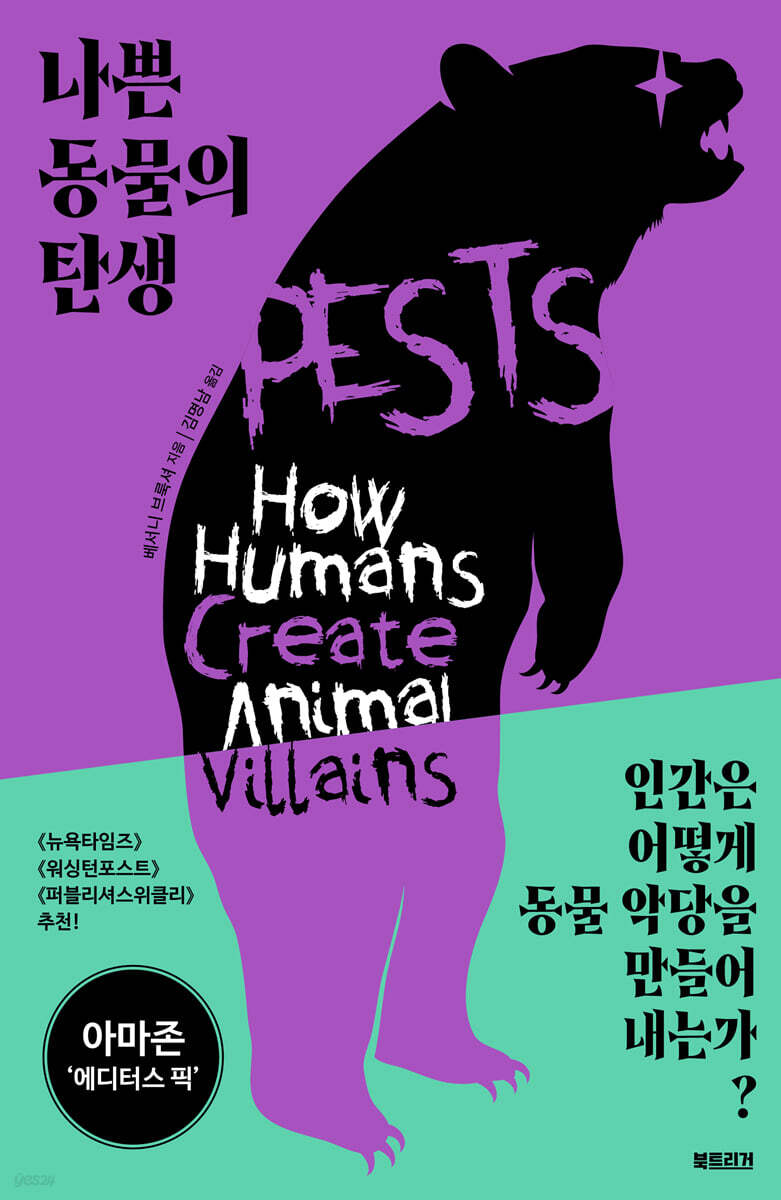
The Birth of a Bad Animal
 |
Description
Book Introduction
- A word from MD
- Modern cities are at war with animals.
Rats, pigeons, and cats are representative examples because they are considered 'bad animals'.
They say it's noisy, unclean, and unsightly.
Ultimately, when analyzing the hatred toward specific animals, the criteria for defining a bad animal are human-centered.
- Son Min-gyu, natural science producer
Animals that Cross the Line: Challenging Human Contradiction
Crossing the body of a 'harmful animal'
A Natural History of Desire and Culture, Myth and Science
All animals are equal.
But some animals are a little more equal.
Some animals are loved, some are hated.
Even within the same animal, people's reactions can vary 180 degrees depending on the situation they are in.
Cats, which are gentle at home, can become 'terrifying killers' that harm biodiversity outside, and pigeons, which were once 'symbols of peace', are now treated as 'winged rats' in the city.
Of course, animals have never changed.
What is always fickle is our gaze towards animals.
There is a mixture of human desires and needs, ideology and science.
Above all, we want to control nature.
Animals that stray from the places set by humans are mercilessly labeled as 'villains'.
The author vividly and humorously reveals this ambivalent perspective of humans, who easily care for and hate animals.
By listening to the stories of ordinary people who live alongside animals, field experts, and scholars, we provide a broad framework for understanding the interaction between humans and animals.
Through a narrative that leans neither toward naive compassion nor cold anthropocentrism, readers will be led to consider how to live 'well' with the animals around us.
Crossing the body of a 'harmful animal'
A Natural History of Desire and Culture, Myth and Science
All animals are equal.
But some animals are a little more equal.
Some animals are loved, some are hated.
Even within the same animal, people's reactions can vary 180 degrees depending on the situation they are in.
Cats, which are gentle at home, can become 'terrifying killers' that harm biodiversity outside, and pigeons, which were once 'symbols of peace', are now treated as 'winged rats' in the city.
Of course, animals have never changed.
What is always fickle is our gaze towards animals.
There is a mixture of human desires and needs, ideology and science.
Above all, we want to control nature.
Animals that stray from the places set by humans are mercilessly labeled as 'villains'.
The author vividly and humorously reveals this ambivalent perspective of humans, who easily care for and hate animals.
By listening to the stories of ordinary people who live alongside animals, field experts, and scholars, we provide a broad framework for understanding the interaction between humans and animals.
Through a narrative that leans neither toward naive compassion nor cold anthropocentrism, readers will be led to consider how to live 'well' with the animals around us.
- You can preview some of the book's contents.
Preview
index
Part 1: Fear and Loathing
Chapter 1: The Plague of Rats
Chapter 2 The Slithering Snake
Part 2: A Place to Call Home
Chapter 3: The Mouse's Nest
Chapter 4 Pigeon's Poop
Part 3: From the viewer's perspective
Chapter 5: The Elephant's Memory
Chapter 6: The Troublesome Cat
Part 4: The Power of Pests
Chapter 7: Coyote Pack
Chapter 8: The Flapping Sparrow
Part 5: Pests Past and Future
Chapter 9: A Herd of Deer
Chapter 10: The Lazy Bear
Chapter 11: Harmful Animals by Any Name
Further Reading
Translator's Note
Chapter 1: The Plague of Rats
Chapter 2 The Slithering Snake
Part 2: A Place to Call Home
Chapter 3: The Mouse's Nest
Chapter 4 Pigeon's Poop
Part 3: From the viewer's perspective
Chapter 5: The Elephant's Memory
Chapter 6: The Troublesome Cat
Part 4: The Power of Pests
Chapter 7: Coyote Pack
Chapter 8: The Flapping Sparrow
Part 5: Pests Past and Future
Chapter 9: A Herd of Deer
Chapter 10: The Lazy Bear
Chapter 11: Harmful Animals by Any Name
Further Reading
Translator's Note
Detailed image

Into the book
When they die, we sigh.
We mourn the loss of pumas, eagles, and pandas.
Develop a conservation plan and celebrate even small successes.
Even their sex lives are tracked.
(...) But when animals adapt too well, we don't seem to be very happy.
(...) In theory, we want those animals to live.
I just don't want them to live here.
To paraphrase Shakespeare, some animals are born pests, some animals become pests themselves, and some animals simply embrace the status of 'pests.'
But this is just a label we give to animals.
We know how to see them from more than one perspective.
While putting rat poison to kill rats, they protest against using rats as laboratory animals.
We shoot deer in the fall and show our children their adorable young ones in the spring.
Vermin with spines expose our inner hypocrisy.
It shows that the natural world evokes both admiration and bewilderment in those who live apart from it.
Maybe this is a good thing.
Maybe we need animals to humble us sometimes.
--- From "Introduction: What is a harmful organism ____?"
Corrigan says the key to the rat problem is waste management.
(...) Corrigan says things would be different if we used solid, lidded trash cans.
But perhaps the residents don't like the noise the garbage truck makes when it comes to collecting their garbage.
Corrigan says city officials could change their regulations to require trash to be put out in the morning instead of the night before.
But no one wants to wake up earlier than their normal wake-up time.
--- From "Chapter 1: The Plague-like Rats"
Scientists estimate that between 2000 and 2019, an average of 58,000 people died from snakebites each year in India.
In contrast, the United States had a total of 101 snakebite deaths between 1989 and 2018.
(...) What if India were like the United States? If so many people died from snakebites, wouldn't the entire population take to the forests with hoes and machetes? According to Sinu, in Kerala, the southwesternmost state of India where he lives and works, people don't do that.
--- From "Chapter 2: The Slithering Snake"
Human memory is short.
What have pigeons done for us recently? Pigeons once had a purpose, but now they've lost it.
The pigeons descended from their perches and began to loiter, becoming what Jerolmac calls walkers.
(...) we sent away the pigeon, declared it useless, decided that it was nothing more than a winged rat.
--- From "Chapter 4: Pigeon's Poop"
Our beliefs affect the lives of animals that live far beyond our own neighborhoods and countries, and the lives of the people who live with them.
In the case of elephants, how Kenyans deal with the harm they inflict is determined by the beliefs of people on the other side of the world—mediated by money, tourism, and politics.
People who live with elephants do not hate elephants.
They know that these animals play an important role in the ecosystem.
I know that beauty too.
Elephants are part of their culture, folklore and traditions.
But their view of elephants is not a dreamlike tale of peaceful wisdom or playful behavior, as Westerners often do.
It's hard to dream when death and destruction stare you in the face.
It's easy to see why people who live with elephants feel hostile.
In Kenya, it is difficult not to conclude that the lives of elephants are far more valuable than the lives of the Kenyans who live alongside them.
This is especially true when judged by the cold, hard yardstick of money.
An elephant's life is worth 20 million Kenyan shillings, and a human life is worth 5 million Kenyan shillings.
The reason the fines for killing elephants are so high is because elephants are so precious to Kenyans, both in terms of biodiversity, but also to people in developed countries who see elephants as lovable and peaceful creatures and want to go see them.
To them, elephants are never pests.
Elephants don't live in their backyards, and the damage they cause isn't at the tourists' expense.
--- From "Chapter 5: The Elephant's Memory"
We are responsible for the cats that come into our lives.
The same goes for wild cats.
We are responsible for both the lives of cats and the deaths they cause.
Whether we view cats as pets, essential rodent control, or a serious threat to biodiversity, they are there because we put them there.
Now, faced with the threat that cats could drive more species to extinction, we face a choice.
What will live and what will die? What will be honored and what will be vilified?
--- From "Chapter 6: The Troublesome Cat"
Nisner and I sat side by side in Griffith Park, basking in the late afternoon sun, thinking about this.
What if we acknowledged that our environment—both urban and suburban—is always fraught with danger? What if we embraced our lack of control and responded with proactive measures rather than preemptive strikes? What if we relaxed our grip on the environment, even just a little, out of fear? While there are risks, there are also rewards for both the people and animals who live there.
--- From "Chapter 7: The Coyote Pack"
The problem is that when we try to adapt the landscape to our 'desires', there is a lot of room for disagreement even among ourselves.
For example, one side might point out that the Blue Hills National Park is a natural ecosystem and say that we need to hunt deer to preserve that ecosystem in its evolved form.
On the other hand, the other side is right, saying that this is a natural ecosystem, so humans should not try to manage it.
“Even if we all agree that something is natural, that doesn’t mean we can or should do anything about it,” says Short Zanotti.
--- From "Chapter 9: The Deer Herd"
“Most Westerners would never say that Christianity has influenced their science, or their view of wildlife, or their view of the world,” Patterson says.
“Scientists would say that religion is completely separate from such things.
But I don't think that's true.
Their religion permeates everything.” It is difficult to be conscious of the water in which one swims and the air one breathes.
The same goes for the culture we grew up in.
If we assume that humans are responsible for everything, all sorts of conclusions naturally follow from that.
If we truly take responsibility for everything, we not only have the power to destroy everything, but we also have the responsibility and right to fix what we have changed in the way we want.
At this point, it seems natural to conclude that humans—especially cultures that colonize others through Western notions of conquering nature—are the true pests.
It is we who flock to cities, invade other people's habitats, and provide waste.
We were brought to a vulnerable island full of birds that didn't know how to fight back against greedy cats, rats, and other such things.
(...) But this answer seems too easy.
In the face of such declarations, we simply throw up our hands and say we have lost.
What can we do? We're a disaster for the Earth! Fortunately, humans are tenacious, resourceful, and capable of change.
We don't have to be trapped in a war of our own making.
We can learn from each other.
You can learn from other cultures, other people, and other ways of life.
When I hear the word 'coexistence,' I picture people picnicking in a park under a blue sky, with raccoons and deer frolicking peacefully beside them.
It would be nice if the lion and the lamb lay down together.
Anyway, the thing to note in this picture is that the people are acting as they please, and the animals are acting exactly as we want them to.
If that is what we think coexistence is, we will never reach that goal.
We mourn the loss of pumas, eagles, and pandas.
Develop a conservation plan and celebrate even small successes.
Even their sex lives are tracked.
(...) But when animals adapt too well, we don't seem to be very happy.
(...) In theory, we want those animals to live.
I just don't want them to live here.
To paraphrase Shakespeare, some animals are born pests, some animals become pests themselves, and some animals simply embrace the status of 'pests.'
But this is just a label we give to animals.
We know how to see them from more than one perspective.
While putting rat poison to kill rats, they protest against using rats as laboratory animals.
We shoot deer in the fall and show our children their adorable young ones in the spring.
Vermin with spines expose our inner hypocrisy.
It shows that the natural world evokes both admiration and bewilderment in those who live apart from it.
Maybe this is a good thing.
Maybe we need animals to humble us sometimes.
--- From "Introduction: What is a harmful organism ____?"
Corrigan says the key to the rat problem is waste management.
(...) Corrigan says things would be different if we used solid, lidded trash cans.
But perhaps the residents don't like the noise the garbage truck makes when it comes to collecting their garbage.
Corrigan says city officials could change their regulations to require trash to be put out in the morning instead of the night before.
But no one wants to wake up earlier than their normal wake-up time.
--- From "Chapter 1: The Plague-like Rats"
Scientists estimate that between 2000 and 2019, an average of 58,000 people died from snakebites each year in India.
In contrast, the United States had a total of 101 snakebite deaths between 1989 and 2018.
(...) What if India were like the United States? If so many people died from snakebites, wouldn't the entire population take to the forests with hoes and machetes? According to Sinu, in Kerala, the southwesternmost state of India where he lives and works, people don't do that.
--- From "Chapter 2: The Slithering Snake"
Human memory is short.
What have pigeons done for us recently? Pigeons once had a purpose, but now they've lost it.
The pigeons descended from their perches and began to loiter, becoming what Jerolmac calls walkers.
(...) we sent away the pigeon, declared it useless, decided that it was nothing more than a winged rat.
--- From "Chapter 4: Pigeon's Poop"
Our beliefs affect the lives of animals that live far beyond our own neighborhoods and countries, and the lives of the people who live with them.
In the case of elephants, how Kenyans deal with the harm they inflict is determined by the beliefs of people on the other side of the world—mediated by money, tourism, and politics.
People who live with elephants do not hate elephants.
They know that these animals play an important role in the ecosystem.
I know that beauty too.
Elephants are part of their culture, folklore and traditions.
But their view of elephants is not a dreamlike tale of peaceful wisdom or playful behavior, as Westerners often do.
It's hard to dream when death and destruction stare you in the face.
It's easy to see why people who live with elephants feel hostile.
In Kenya, it is difficult not to conclude that the lives of elephants are far more valuable than the lives of the Kenyans who live alongside them.
This is especially true when judged by the cold, hard yardstick of money.
An elephant's life is worth 20 million Kenyan shillings, and a human life is worth 5 million Kenyan shillings.
The reason the fines for killing elephants are so high is because elephants are so precious to Kenyans, both in terms of biodiversity, but also to people in developed countries who see elephants as lovable and peaceful creatures and want to go see them.
To them, elephants are never pests.
Elephants don't live in their backyards, and the damage they cause isn't at the tourists' expense.
--- From "Chapter 5: The Elephant's Memory"
We are responsible for the cats that come into our lives.
The same goes for wild cats.
We are responsible for both the lives of cats and the deaths they cause.
Whether we view cats as pets, essential rodent control, or a serious threat to biodiversity, they are there because we put them there.
Now, faced with the threat that cats could drive more species to extinction, we face a choice.
What will live and what will die? What will be honored and what will be vilified?
--- From "Chapter 6: The Troublesome Cat"
Nisner and I sat side by side in Griffith Park, basking in the late afternoon sun, thinking about this.
What if we acknowledged that our environment—both urban and suburban—is always fraught with danger? What if we embraced our lack of control and responded with proactive measures rather than preemptive strikes? What if we relaxed our grip on the environment, even just a little, out of fear? While there are risks, there are also rewards for both the people and animals who live there.
--- From "Chapter 7: The Coyote Pack"
The problem is that when we try to adapt the landscape to our 'desires', there is a lot of room for disagreement even among ourselves.
For example, one side might point out that the Blue Hills National Park is a natural ecosystem and say that we need to hunt deer to preserve that ecosystem in its evolved form.
On the other hand, the other side is right, saying that this is a natural ecosystem, so humans should not try to manage it.
“Even if we all agree that something is natural, that doesn’t mean we can or should do anything about it,” says Short Zanotti.
--- From "Chapter 9: The Deer Herd"
“Most Westerners would never say that Christianity has influenced their science, or their view of wildlife, or their view of the world,” Patterson says.
“Scientists would say that religion is completely separate from such things.
But I don't think that's true.
Their religion permeates everything.” It is difficult to be conscious of the water in which one swims and the air one breathes.
The same goes for the culture we grew up in.
If we assume that humans are responsible for everything, all sorts of conclusions naturally follow from that.
If we truly take responsibility for everything, we not only have the power to destroy everything, but we also have the responsibility and right to fix what we have changed in the way we want.
At this point, it seems natural to conclude that humans—especially cultures that colonize others through Western notions of conquering nature—are the true pests.
It is we who flock to cities, invade other people's habitats, and provide waste.
We were brought to a vulnerable island full of birds that didn't know how to fight back against greedy cats, rats, and other such things.
(...) But this answer seems too easy.
In the face of such declarations, we simply throw up our hands and say we have lost.
What can we do? We're a disaster for the Earth! Fortunately, humans are tenacious, resourceful, and capable of change.
We don't have to be trapped in a war of our own making.
We can learn from each other.
You can learn from other cultures, other people, and other ways of life.
When I hear the word 'coexistence,' I picture people picnicking in a park under a blue sky, with raccoons and deer frolicking peacefully beside them.
It would be nice if the lion and the lamb lay down together.
Anyway, the thing to note in this picture is that the people are acting as they please, and the animals are acting exactly as we want them to.
If that is what we think coexistence is, we will never reach that goal.
--- From "Chapter 11: Harmful Animals by Any Name"
Publisher's Review
When you told me to live well, now you want to kill me?
What have we 'done' to humans?
The year 2024 marked the 20th anniversary of the Jirisan Asiatic black bear restoration project.
The three pairs of Asiatic black bears that were released at that time have now grown to about 80 through generations.
Although the Jirisan Asiatic Black Bear Project is considered a successful example of biological restoration, some people are concerned that the bears, as top predators, could harm humans.
It is not an unfounded worry, as bears have been observed on the trail 140 times over the past 10 years.
Experts say that the Asiatic black bear can 'coexist' with humans because it is an animal that avoids people.
It is fortunate that there have been no casualties yet.
However, cases of economic damage are already being frequently reported in beekeeping farms and other places.
As the bear population grows and we become unable to effectively control it, the bear, the protagonist of the Dangun myth and a flagship species of the Jirisan ecosystem, could once again be relegated to the status of a 'harmful animal.'
Bethany Brookshire's The Birth of Bad Animals is full of examples like this.
An animal that was loved yesterday may be hated today, and an animal that was despised today may be admired tomorrow.
To the early settlers of the Americas, wolves were rivals for the meat of cattle, sheep, and deer.
The government offered a large reward, and people hunted the wolves indiscriminately.
Then, as wolves became rare, the population of prey animals exploded.
Only then did people reintroduce wolves to maintain the balance of the ecosystem.
Even to modern people, “the wolf has become a pure, admirable, and noble being.”
The animals were always the same...
Foolish people who create bad animals
People are vicious.
Treat animals as you please and use them as you please.
We move animals around according to our desires and needs, causing disaster to the ecosystem, and only then do we try to get rid of them.
But animals easily escape from human grasp.
This applies not only to beasts that appear threatening at first glance, but also to animals that appear harmless and cute at first glance.
From rats, snakes, cats, and elephants to deer, rabbits, sparrows, and squirrels, the countless animals that climb atop our heads and sit cross-legged are the main characters of this book.
In the 1930s, cane toads were introduced to Australia to protect agricultural crops by eating pests.
However, the native animals that ate the poisoned toads began to fall one after another.
It was the result of scientists succumbing to 'political pressure' and hastily intervening in the ecosystem.
A similar case is China's Elimination of the Four Harms Movement, which attempted to eradicate sparrow seeds but ended in a disaster that resulted in tens of millions of starvation deaths.
The Party sought to prove its authority by demonstrating control over nature, and scientists lacked the courage to go against the Party's will.
It was a question of “what China wants to become and what it wants to achieve.”
Moreover, humans constantly invent 'bad animals' based on arbitrary criteria such as economic utility, cultural learning, and even simple preference.
Pigeons, once a symbol of peace, a postal carrier, and an efficient source of food, were reduced to mere "winged rats" when their usefulness disappeared.
Elephants are sacred animals to Westerners, but to Kenyan locals, they are treated more favorably than people and are considered "government animals."
Cats capture people's hearts with their natural cuteness, but to small prey animals, they are 'terrifying killers.'
Animals are accepted or excluded by humans depending on the context in which they are placed.
Once an animal is deemed a 'pest', we readily cease to consider its morality, as if we had been issued a 'license to kill'.
The author makes no effort to hide the fact that one-sided love is as much a cause of this situation as animal abuse.
However, rather than arbitrarily taking sides or criticizing certain positions or animals, it points out the responsibilities that humans must bear and the work that they must do.
“We are responsible for both the lives of cats and the deaths they cause.”
Ecosystem neighbors just doing their best to survive
Beyond the illusion of controlling nature, seeking a path toward understanding and coexistence.
The stories of these animals, who are alternately looked upon with admiration and contempt, remind us of the fickleness and foolishness of human beings.
It makes me wonder if “humans are the true pests.”
But the author does not stop at such a simple conclusion.
“Fortunately, humans are tenacious, resourceful, and changeable creatures.”
What happened to the Australian sugar cane toads we mentioned earlier? They became integrated into the Australian ecosystem.
This was partly due to the remarkable adaptability of native animals, but also to the persistent efforts of scientists who strategically utilized the animals' habits and ecological web.
Australian scientists have persistently persuaded governments and conservation groups to release toad tadpoles into areas where toads have not yet invaded.
The idea was to get native animals to eat the mildly poisonous baby toads.
Rather than causing stomachaches in advance, the idea was to teach a lesson that eating toads incorrectly could lead to serious problems.
The 'Toad Teacher' program was a success.
Activists in Kenya are also constantly seeking measures to reduce the damage caused to local people by elephants and promote coexistence.
Efforts are underway to drive away elephants using methods such as beehive fences, odor-emitting repellents, and drones, while efforts are also underway to support people's livelihoods, such as changing crops in nearby areas and integrating them into the local economy.
The case of Cape Breton Island, the scene of a coyote killing spree, shows that we can only respect one another when we understand the ways of animals.
Scientists calmly educated residents about what coyotes are like and how to respond if they encounter one.
As a result, the fear of the residents was alleviated to an appropriate level.
As the saying goes, “knowledge is power.”
Instead of a simple answer, there is constant worry
A look of affection rather than hatred and contempt
Of course, there is no ‘one answer’.
The author does not appeal to naive paternalism or invoke the cold-blooded logic of survival of the fittest.
While we consider the balance of the ecosystem, we also avoid attitudes that arbitrarily disregard the welfare of individual animals.
It broadly covers the voices of experts and field activists with differing perspectives, emphasizing that the long-accumulated wisdom of indigenous peoples and the discoveries of modern science can be harmoniously utilized.
The author says:
“Coexistence cannot always be peaceful and sweet.”
Problems will arise again and again, and we can only derive rules of coexistence based on 'humble knowledge' each time.
Just as we create societies and set rules to live together with other people.
If food is scarce in their habitat but abundant in human territory, animals will come down to the houses.
If certain animals are slaughtered indiscriminately or introduced at will, the balance of the ecosystem will soon be destroyed.
This is why the author emphasizes ‘preparation in advance’ rather than ‘after-the-fact visits.’
As we follow the author as he busily traverses science and culture, between laboratories and fields, we are confronted with the simple truth: "There is no way to truly overcome nature."
Through the author's narrative, which simultaneously retains cheerfulness and warmth, curiosity and rigor, we will ponder together how to live with our "non-human neighbors" as members of the ecosystem.
What have we 'done' to humans?
The year 2024 marked the 20th anniversary of the Jirisan Asiatic black bear restoration project.
The three pairs of Asiatic black bears that were released at that time have now grown to about 80 through generations.
Although the Jirisan Asiatic Black Bear Project is considered a successful example of biological restoration, some people are concerned that the bears, as top predators, could harm humans.
It is not an unfounded worry, as bears have been observed on the trail 140 times over the past 10 years.
Experts say that the Asiatic black bear can 'coexist' with humans because it is an animal that avoids people.
It is fortunate that there have been no casualties yet.
However, cases of economic damage are already being frequently reported in beekeeping farms and other places.
As the bear population grows and we become unable to effectively control it, the bear, the protagonist of the Dangun myth and a flagship species of the Jirisan ecosystem, could once again be relegated to the status of a 'harmful animal.'
Bethany Brookshire's The Birth of Bad Animals is full of examples like this.
An animal that was loved yesterday may be hated today, and an animal that was despised today may be admired tomorrow.
To the early settlers of the Americas, wolves were rivals for the meat of cattle, sheep, and deer.
The government offered a large reward, and people hunted the wolves indiscriminately.
Then, as wolves became rare, the population of prey animals exploded.
Only then did people reintroduce wolves to maintain the balance of the ecosystem.
Even to modern people, “the wolf has become a pure, admirable, and noble being.”
The animals were always the same...
Foolish people who create bad animals
People are vicious.
Treat animals as you please and use them as you please.
We move animals around according to our desires and needs, causing disaster to the ecosystem, and only then do we try to get rid of them.
But animals easily escape from human grasp.
This applies not only to beasts that appear threatening at first glance, but also to animals that appear harmless and cute at first glance.
From rats, snakes, cats, and elephants to deer, rabbits, sparrows, and squirrels, the countless animals that climb atop our heads and sit cross-legged are the main characters of this book.
In the 1930s, cane toads were introduced to Australia to protect agricultural crops by eating pests.
However, the native animals that ate the poisoned toads began to fall one after another.
It was the result of scientists succumbing to 'political pressure' and hastily intervening in the ecosystem.
A similar case is China's Elimination of the Four Harms Movement, which attempted to eradicate sparrow seeds but ended in a disaster that resulted in tens of millions of starvation deaths.
The Party sought to prove its authority by demonstrating control over nature, and scientists lacked the courage to go against the Party's will.
It was a question of “what China wants to become and what it wants to achieve.”
Moreover, humans constantly invent 'bad animals' based on arbitrary criteria such as economic utility, cultural learning, and even simple preference.
Pigeons, once a symbol of peace, a postal carrier, and an efficient source of food, were reduced to mere "winged rats" when their usefulness disappeared.
Elephants are sacred animals to Westerners, but to Kenyan locals, they are treated more favorably than people and are considered "government animals."
Cats capture people's hearts with their natural cuteness, but to small prey animals, they are 'terrifying killers.'
Animals are accepted or excluded by humans depending on the context in which they are placed.
Once an animal is deemed a 'pest', we readily cease to consider its morality, as if we had been issued a 'license to kill'.
The author makes no effort to hide the fact that one-sided love is as much a cause of this situation as animal abuse.
However, rather than arbitrarily taking sides or criticizing certain positions or animals, it points out the responsibilities that humans must bear and the work that they must do.
“We are responsible for both the lives of cats and the deaths they cause.”
Ecosystem neighbors just doing their best to survive
Beyond the illusion of controlling nature, seeking a path toward understanding and coexistence.
The stories of these animals, who are alternately looked upon with admiration and contempt, remind us of the fickleness and foolishness of human beings.
It makes me wonder if “humans are the true pests.”
But the author does not stop at such a simple conclusion.
“Fortunately, humans are tenacious, resourceful, and changeable creatures.”
What happened to the Australian sugar cane toads we mentioned earlier? They became integrated into the Australian ecosystem.
This was partly due to the remarkable adaptability of native animals, but also to the persistent efforts of scientists who strategically utilized the animals' habits and ecological web.
Australian scientists have persistently persuaded governments and conservation groups to release toad tadpoles into areas where toads have not yet invaded.
The idea was to get native animals to eat the mildly poisonous baby toads.
Rather than causing stomachaches in advance, the idea was to teach a lesson that eating toads incorrectly could lead to serious problems.
The 'Toad Teacher' program was a success.
Activists in Kenya are also constantly seeking measures to reduce the damage caused to local people by elephants and promote coexistence.
Efforts are underway to drive away elephants using methods such as beehive fences, odor-emitting repellents, and drones, while efforts are also underway to support people's livelihoods, such as changing crops in nearby areas and integrating them into the local economy.
The case of Cape Breton Island, the scene of a coyote killing spree, shows that we can only respect one another when we understand the ways of animals.
Scientists calmly educated residents about what coyotes are like and how to respond if they encounter one.
As a result, the fear of the residents was alleviated to an appropriate level.
As the saying goes, “knowledge is power.”
Instead of a simple answer, there is constant worry
A look of affection rather than hatred and contempt
Of course, there is no ‘one answer’.
The author does not appeal to naive paternalism or invoke the cold-blooded logic of survival of the fittest.
While we consider the balance of the ecosystem, we also avoid attitudes that arbitrarily disregard the welfare of individual animals.
It broadly covers the voices of experts and field activists with differing perspectives, emphasizing that the long-accumulated wisdom of indigenous peoples and the discoveries of modern science can be harmoniously utilized.
The author says:
“Coexistence cannot always be peaceful and sweet.”
Problems will arise again and again, and we can only derive rules of coexistence based on 'humble knowledge' each time.
Just as we create societies and set rules to live together with other people.
If food is scarce in their habitat but abundant in human territory, animals will come down to the houses.
If certain animals are slaughtered indiscriminately or introduced at will, the balance of the ecosystem will soon be destroyed.
This is why the author emphasizes ‘preparation in advance’ rather than ‘after-the-fact visits.’
As we follow the author as he busily traverses science and culture, between laboratories and fields, we are confronted with the simple truth: "There is no way to truly overcome nature."
Through the author's narrative, which simultaneously retains cheerfulness and warmth, curiosity and rigor, we will ponder together how to live with our "non-human neighbors" as members of the ecosystem.
GOODS SPECIFICS
- Date of issue: February 15, 2025
- Page count, weight, size: 508 pages | 672g | 140*215*30mm
- ISBN13: 9791193378366
- ISBN10: 1193378362
You may also like
카테고리
korean


korean

![GQ KOREA Mark (Monthly): December [2025]](http://librairie.coreenne.fr/cdn/shop/files/8ef265dbbfbf186523ed75ba7319009d.jpg?v=1765340328&width=3840)


