

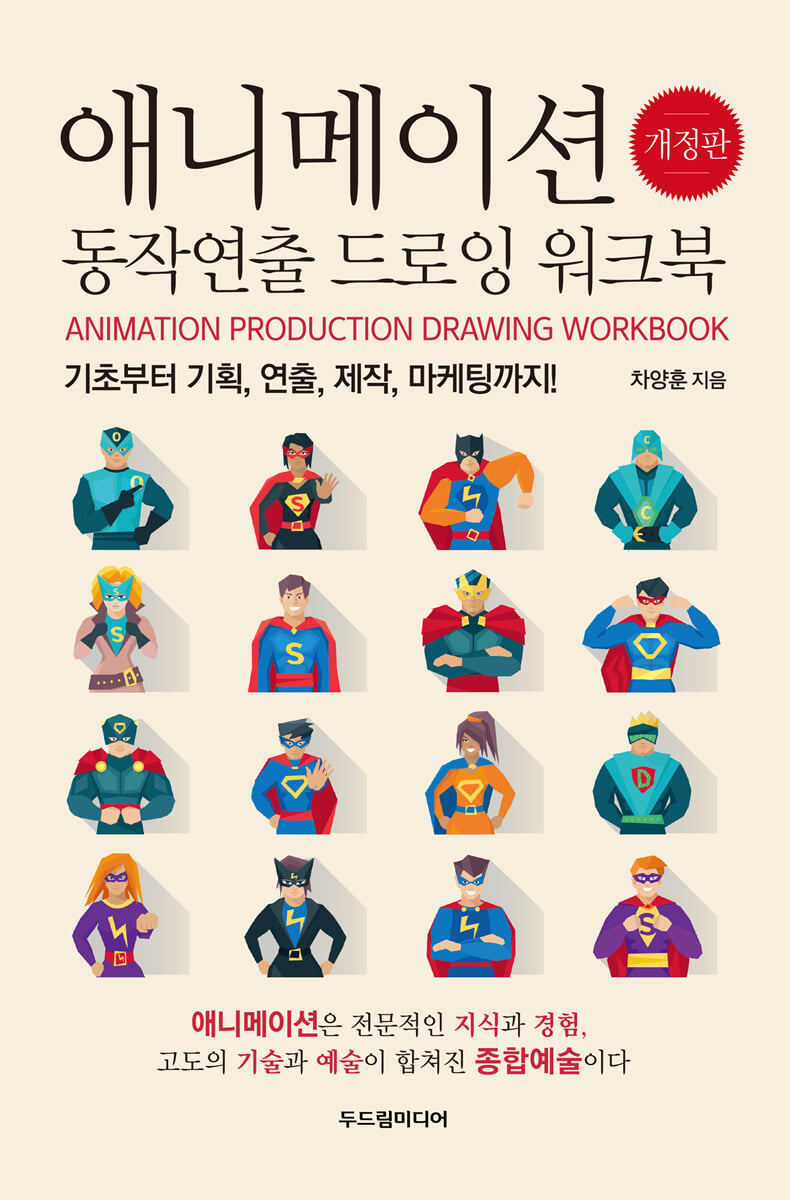
Animation Motion Direction Drawing Workbook
 |
Description
Book Introduction
From basic planning, directing, production, and completion
A to Z of Animation
Due to the rapid development of digital media, the traditional cell animation production method has been rapidly transformed into a new media animation industry, and students who want to study and acquire animation tend to rely on computer programs.
Of course, computers are very useful tools for implementing realistic motion.
However, we must not overlook the fact that the background to the splendid birth of Pixar's 3D animation today was possible not only because of the efforts of artists working with digital media, but also because of the efforts of artists working with traditional media such as drawing, painting, pastel, and sculpture.
Computer programs only serve to help you easily process, cut, and paste.
Ultimately, the key to creating animation lies not in technology but in the skills of the animator artist.
From this perspective, this book will focus on the directing of original animation, which is called the flower of animation, among the various processes of producing animation.
If we compare the directing of a film to that of a real actor, it can be seen as the performance of a great actor who gives a realistic performance.
Just as an actor who is new to acting learns to express movement, you will learn the core content of drawing movement expression corresponding to character movement expression acting.
By examining this through various examples and drawings, readers can easily learn how to plan and proceed with the timing of the basic movements of animation, and understand and utilize various expression methods necessary throughout the basic drawing process.
A to Z of Animation
Due to the rapid development of digital media, the traditional cell animation production method has been rapidly transformed into a new media animation industry, and students who want to study and acquire animation tend to rely on computer programs.
Of course, computers are very useful tools for implementing realistic motion.
However, we must not overlook the fact that the background to the splendid birth of Pixar's 3D animation today was possible not only because of the efforts of artists working with digital media, but also because of the efforts of artists working with traditional media such as drawing, painting, pastel, and sculpture.
Computer programs only serve to help you easily process, cut, and paste.
Ultimately, the key to creating animation lies not in technology but in the skills of the animator artist.
From this perspective, this book will focus on the directing of original animation, which is called the flower of animation, among the various processes of producing animation.
If we compare the directing of a film to that of a real actor, it can be seen as the performance of a great actor who gives a realistic performance.
Just as an actor who is new to acting learns to express movement, you will learn the core content of drawing movement expression corresponding to character movement expression acting.
By examining this through various examples and drawings, readers can easily learn how to plan and proceed with the timing of the basic movements of animation, and understand and utilize various expression methods necessary throughout the basic drawing process.
index
Preface 4
Chapter 1: Animation Basics 10
1.
Principles of Animation 13
2.
15 Types of Animation
3.
Understanding and Fundamentals of Video Output 19
Chapter 2 Animation Planning 22
1.
Basic Conditions of Planning 25
1) What (setting of material and genre)
2) How (determining the production method)
3) For whom (target setting)
4) How much (calculating production costs)
5) Until when (production period)
2.
Character Design 32
1) Character style
2) Character's age
3) Gender and main character settings
4) Product setup
5) Movement settings
6) Expression of personality
7) Design organization
3.
Coloring 44
4.
Screenwriting 56
1) Scene number and location
2) Fingerprint
3) Ambassador
4) Camera
Chapter 3: Animation Directing 66
1.
Screen composition 69
2.
Storyboarding Tips 80
1) Storyboard example
2) Maintain consistency in the direction of progress.
3) Clearly convey the character's facial expressions and movements.
4) Pay attention to the natural connection of the cuts.
5) Pay attention to the composition
6) Organize the timing of dialogue and sound.
7) Know the symbols of camera work.
3.
Layout Creation 110
1) Setting the light source and shadows
2) Pose details
3) Specifying the camera work area
4) Composition and three-dimensionality
5) Unification of props, etc.
Chapter 4 Animation Production 122
1.
Fundamentals of the Korean Won 125
2.
The Law of the Won 129
1) Squash & Stretch
2) Anticipation
3) Follow Through & Overlapping Action
4) Acceleration and Deceleration (Slow Out & Slow In)
3.
Wonhwa Technique 141
1) Cell separation
2) Shadow
3) Ambassador
4) Blink
5) Walking and running
6) Cell movement and matchline
7) Transmitted light
8) Brush effect
9) Original paintings of natural objects
4.
Fairy Tale 164
1) Turn your face
2) Walking
3) Running
5.
Chaehwa 184
1) Change color
2) Star cell processing
Chapter 5: Animation Completion 210
1.
Cut Shoot Edit 213
2.
Sound Editing 228
Chapter 6: Animation Marketing 242
Chapter 7: The Present and Future of Animation 250
References 256
Chapter 1: Animation Basics 10
1.
Principles of Animation 13
2.
15 Types of Animation
3.
Understanding and Fundamentals of Video Output 19
Chapter 2 Animation Planning 22
1.
Basic Conditions of Planning 25
1) What (setting of material and genre)
2) How (determining the production method)
3) For whom (target setting)
4) How much (calculating production costs)
5) Until when (production period)
2.
Character Design 32
1) Character style
2) Character's age
3) Gender and main character settings
4) Product setup
5) Movement settings
6) Expression of personality
7) Design organization
3.
Coloring 44
4.
Screenwriting 56
1) Scene number and location
2) Fingerprint
3) Ambassador
4) Camera
Chapter 3: Animation Directing 66
1.
Screen composition 69
2.
Storyboarding Tips 80
1) Storyboard example
2) Maintain consistency in the direction of progress.
3) Clearly convey the character's facial expressions and movements.
4) Pay attention to the natural connection of the cuts.
5) Pay attention to the composition
6) Organize the timing of dialogue and sound.
7) Know the symbols of camera work.
3.
Layout Creation 110
1) Setting the light source and shadows
2) Pose details
3) Specifying the camera work area
4) Composition and three-dimensionality
5) Unification of props, etc.
Chapter 4 Animation Production 122
1.
Fundamentals of the Korean Won 125
2.
The Law of the Won 129
1) Squash & Stretch
2) Anticipation
3) Follow Through & Overlapping Action
4) Acceleration and Deceleration (Slow Out & Slow In)
3.
Wonhwa Technique 141
1) Cell separation
2) Shadow
3) Ambassador
4) Blink
5) Walking and running
6) Cell movement and matchline
7) Transmitted light
8) Brush effect
9) Original paintings of natural objects
4.
Fairy Tale 164
1) Turn your face
2) Walking
3) Running
5.
Chaehwa 184
1) Change color
2) Star cell processing
Chapter 5: Animation Completion 210
1.
Cut Shoot Edit 213
2.
Sound Editing 228
Chapter 6: Animation Marketing 242
Chapter 7: The Present and Future of Animation 250
References 256
Into the book
The types of animation are classified by how and with what the listed images are created, that is, by the production method.
In fact, in the past, 2D animations were classified as either "full animation" (24 frames per second) or "limited animation" (12 frames per second or less) based on the number of pictures displayed, but now, due to circumstances, most are "limited animation" (in fact, Disney, which used to make full animations, no longer makes 2D animations after "The Princess and the Frog" in 2009), and it is meaningless because the number of pictures in a specific scene is increased or decreased depending on the situation.
So, if you create an animation in any way, you can name it that way.
Just as the first person to discover a star names it after himself.
The most popular types of animation are 2D digital animation and 3D digital animation.
The difference between the two is whether the picture is flat or three-dimensional depending on the production method.
It will be easy to understand if we take Dooly the Little Dinosaur and Pororo as examples.
--- p.15
Now that you know how to compose a screen, let's get started on creating a storyboard. Storyboards are created on storyboard paper.
The following image is a typical storyboard paper.
1.
Page: This is where you write the page number of the storyboard.
2.
Cut: This is where you write the cut number.
If the cut continues to the next page, rewrite the cut number at the top of the first page.
3.
Panel: A space where scenarios are expressed in pictures.
If it cannot be expressed in one picture, it is okay to use multiple panels, and since the cuts do not change, they are not numbered separately.
Also, there is no need to draw the same picture.
--- p.80
4) Blink
We blink when there is a change in facial expression or when the external environment triggers it.
Since blinking actions appear frequently in animation, let's learn how to do it.
In fact, the blinking action is the same as the mouth.
However, when you blink, you must work on the eyes as a separate cell (separate layer).
As shown in the picture, the character's eyes were worked on with C cells and the eyes were worked on with D cells, and the open and closed eyes had to be worked on.
The eyes in the middle are drawn by a fairy tale worker.
The timesheet for this example would look like this:
--- p.150
1) Change color
There are times when you need to change the colors of an image that has been completed like this due to unavoidable circumstances.
Especially in practice, there are colors that cannot be produced due to work schedules.
For example, in the picture above, the character had his eyes closed throughout the play, so there was no color designation for his pupils.
However, if a scene suddenly appears where the eyes open like in the picture above, and the color of the pupils needs to be specified, but the color has not been specified even after the animation is complete (the color setting manager must do the color setting), the work cannot be stopped vaguely while waiting for the color of the pupils to be set.
Because coloring, like fairy tales, is paid by the number of copies, if you don't work, you don't get any income.
In fact, in the past, 2D animations were classified as either "full animation" (24 frames per second) or "limited animation" (12 frames per second or less) based on the number of pictures displayed, but now, due to circumstances, most are "limited animation" (in fact, Disney, which used to make full animations, no longer makes 2D animations after "The Princess and the Frog" in 2009), and it is meaningless because the number of pictures in a specific scene is increased or decreased depending on the situation.
So, if you create an animation in any way, you can name it that way.
Just as the first person to discover a star names it after himself.
The most popular types of animation are 2D digital animation and 3D digital animation.
The difference between the two is whether the picture is flat or three-dimensional depending on the production method.
It will be easy to understand if we take Dooly the Little Dinosaur and Pororo as examples.
--- p.15
Now that you know how to compose a screen, let's get started on creating a storyboard. Storyboards are created on storyboard paper.
The following image is a typical storyboard paper.
1.
Page: This is where you write the page number of the storyboard.
2.
Cut: This is where you write the cut number.
If the cut continues to the next page, rewrite the cut number at the top of the first page.
3.
Panel: A space where scenarios are expressed in pictures.
If it cannot be expressed in one picture, it is okay to use multiple panels, and since the cuts do not change, they are not numbered separately.
Also, there is no need to draw the same picture.
--- p.80
4) Blink
We blink when there is a change in facial expression or when the external environment triggers it.
Since blinking actions appear frequently in animation, let's learn how to do it.
In fact, the blinking action is the same as the mouth.
However, when you blink, you must work on the eyes as a separate cell (separate layer).
As shown in the picture, the character's eyes were worked on with C cells and the eyes were worked on with D cells, and the open and closed eyes had to be worked on.
The eyes in the middle are drawn by a fairy tale worker.
The timesheet for this example would look like this:
--- p.150
1) Change color
There are times when you need to change the colors of an image that has been completed like this due to unavoidable circumstances.
Especially in practice, there are colors that cannot be produced due to work schedules.
For example, in the picture above, the character had his eyes closed throughout the play, so there was no color designation for his pupils.
However, if a scene suddenly appears where the eyes open like in the picture above, and the color of the pupils needs to be specified, but the color has not been specified even after the animation is complete (the color setting manager must do the color setting), the work cannot be stopped vaguely while waiting for the color of the pupils to be set.
Because coloring, like fairy tales, is paid by the number of copies, if you don't work, you don't get any income.
--- p.201
Publisher's Review
Requires professional knowledge and experience
A comprehensive art form that combines advanced technology and art
Animation production is not a field that can be easily entered without considerable dedication and will.
Because it is a field that requires more hands-on work than any other art form and requires wrestling with countless frames every day.
Animation can be said to be the result of countless repeated processes of drawing one part at a time in the correct order.
In addition, animation has its own unique production style and is a comprehensive art form that combines advanced technology and art, requiring highly specialized knowledge and experience.
The first chapter of this book covers the basics and principles of animation, the types of animation and how visual expression is done, and the understanding and basics of animation visual output.
In the second chapter, we learned character acting, motion drawing, and color expression in the process of planning, directing, and producing animation, so that we could apply and implement animation movements. In the last chapter, we explored the direction that the Korean animation industry should take in the future through mentions of animation marketing and the present and future of the animation industry.
This book will be of great help to readers and animation majors who want to know how to express the imaginary images they draw through movement.
A comprehensive art form that combines advanced technology and art
Animation production is not a field that can be easily entered without considerable dedication and will.
Because it is a field that requires more hands-on work than any other art form and requires wrestling with countless frames every day.
Animation can be said to be the result of countless repeated processes of drawing one part at a time in the correct order.
In addition, animation has its own unique production style and is a comprehensive art form that combines advanced technology and art, requiring highly specialized knowledge and experience.
The first chapter of this book covers the basics and principles of animation, the types of animation and how visual expression is done, and the understanding and basics of animation visual output.
In the second chapter, we learned character acting, motion drawing, and color expression in the process of planning, directing, and producing animation, so that we could apply and implement animation movements. In the last chapter, we explored the direction that the Korean animation industry should take in the future through mentions of animation marketing and the present and future of the animation industry.
This book will be of great help to readers and animation majors who want to know how to express the imaginary images they draw through movement.
GOODS SPECIFICS
- Date of issue: February 8, 2024
- Page count, weight, size: 264 pages | 152*225*20mm
- ISBN13: 9791193210567
- ISBN10: 1193210569
You may also like
카테고리
korean


korean

![GQ KOREA Mark (Monthly): December [2025]](http://librairie.coreenne.fr/cdn/shop/files/8ef265dbbfbf186523ed75ba7319009d.jpg?v=1765340328&width=3840)


