

Maria Callas
 |
Description
Book Introduction
A book commemorating the centennial of the birth of opera diva Maria Callas is published.
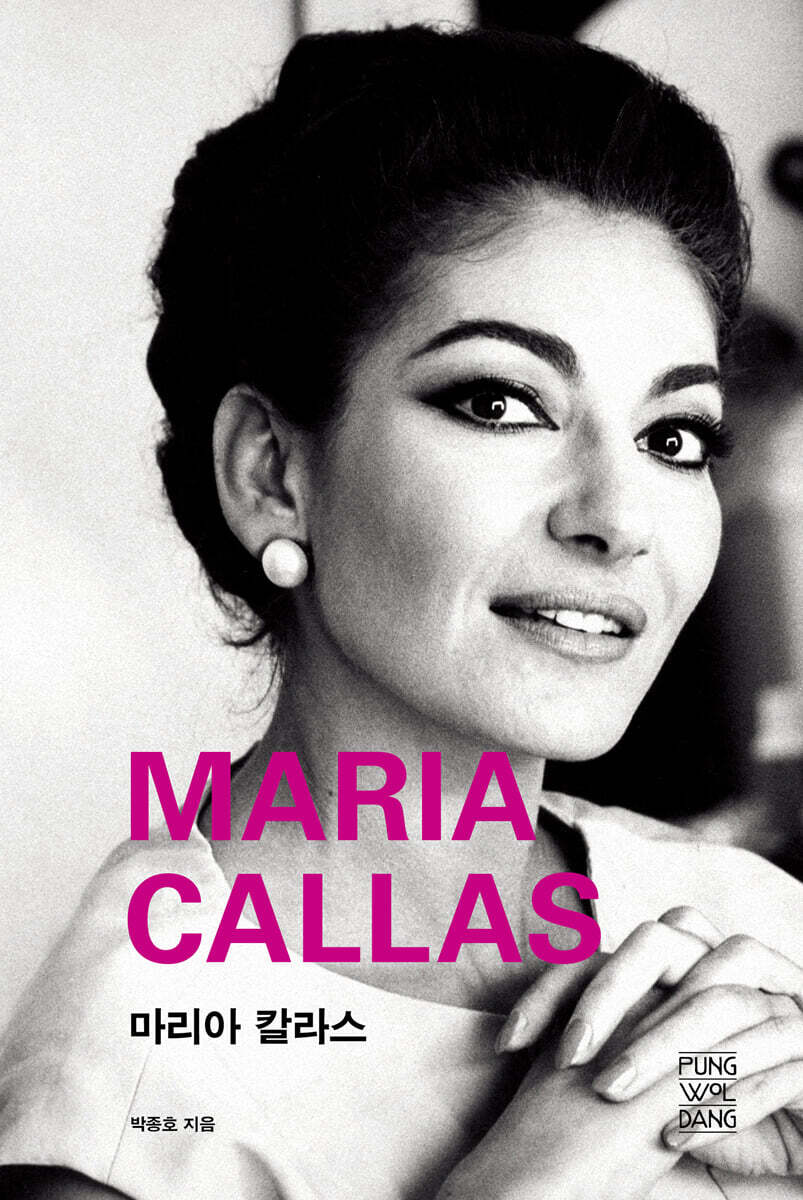
This year marks the 100th anniversary of the birth of Maria Callas (1923-1977), and Park Jong-ho, the CEO of Pungwoldang, a classical music company, has published “Maria Callas.”
This book is a 'Guide to Callas' and a confession of long-term love, written by an author who knows Callas' true value better than anyone else.
The author said that he felt it was necessary to talk about Callas in order to properly understand her and, furthermore, to understand opera more deeply.
Numerous books about Callas are filled with rumors and gossip, often of dubious authenticity, or are filled with lists of concert schedules and recordings, making them difficult to read for anyone but a dedicated fan.
This book goes beyond simply collecting and listing information about the person Callas, but approaches it from a psychological perspective to bring Callas to life as a human being.
This year marks the 100th anniversary of the birth of Maria Callas (1923-1977), and Park Jong-ho, the CEO of Pungwoldang, a classical music company, has published “Maria Callas.”
This book is a 'Guide to Callas' and a confession of long-term love, written by an author who knows Callas' true value better than anyone else.
The author said that he felt it was necessary to talk about Callas in order to properly understand her and, furthermore, to understand opera more deeply.
Numerous books about Callas are filled with rumors and gossip, often of dubious authenticity, or are filled with lists of concert schedules and recordings, making them difficult to read for anyone but a dedicated fan.
This book goes beyond simply collecting and listing information about the person Callas, but approaches it from a psychological perspective to bring Callas to life as a human being.
- You can preview some of the book's contents.
Preview
index
Prologue: Beginning the story of Callas
Act 1: The Ugly Duckling in the Broken Nest
A New Yorker born with the American dream / A mother who supported her daughter but then turned her back / Starting to sing to be loved / Music becoming the goal of her life / Meeting Hidalgo, a teacher from heaven / Fierce vocal studies in Athens / A dark life behind her studies / An early debut, but leaving Greece behind / Rejecting the opportunity that came to her / An opportunity that flew in from Verona / Heading to Verona with a dream / Meeting her benefactor Seraphine / The journey with Meneghini begins
Act 2: Spread your wings and fly
Starting her early career with Seraphine / The unexpected obstacle of Meneghini's mother / Finally singing "Norma" / The miracle of the Teatro La Fenice / Early success as a Wagnerian singer, but only so far / Becoming Madame Meneghini / The success of "Turandot", but putting it down / La Scala, the ancestral home of opera / Mexico City, which brought joy to her mother / Starting in Florence, "Vespers in Sicily" / Tebaldi, the irreconcilable rival / Finally conquering Scala / Standing as the great Norma of Scala / Callas and Mozart's operas / EMI, the eternal companion / The precious value of recording complete operas / Revitalizing London as the center of opera
Act 3: Becoming a Legend in Opera History
The most unique voice of Callas / The influence of Callas's perfectionism / Miraculous weight loss / The golden age of opera recording begins / The legendary recording of "Tosca" / Another myth of resurrection, "Medea" / Visconti makes Callas the best actress / Callas's peak, "The Vestal Maiden" / The conflict that followed "Andrea Chénier" / Her difficult interpersonal relationships / "The Sleepwalker" with Visconti and Bernstein / The unforgettable performance of "La Traviata" / Chicago's high popularity, but the butterfly turned into a leopard / Conquering Vienna with "Lucia" / Finally, a triumphant return to New York / Another triumph of Scala, "Anna Bolena" / A premonition of the waning moon, "Iphigenia in Tauris" / Another climax, a masterpiece, "A Masked Ball"
Act 4: Falling into an Endless Abyss
The beginning of a wrong encounter / The Roman scandal that became a fatal wound / Six hours in Paris that determined the rest of her life / Paris debut, the greatest show on earth / Onassis appears in her life / Christina Ho, a trap in life / Callas's hobbies and personality problems / Is Onassis the modern-day Ulysses? / One day that changed fate / An unbalanced relationship eventually leads to catastrophe / The beginning of a long and tedious separation / Activities after meeting Onassis / The tragic outcome with Onassis / The nightmare of Dallas, the beginning of decline / Historical evaluation and a regrettable calling / Relationships with people around her
Act 5: Days of Sorrow and Loneliness
Renunciation of American citizenship / Callas, who longed for children / The house built for happiness but became a dwelling place of unhappiness / The last friends who protected Callas / The only film she left behind, "Medea" / Onassis's next story, the days of curses / Becoming a teacher for a semester / The shameful failed director / The comeback concert that became a farewell concert / The last tour / The last days / Leaving this world / Her legacy
Epilogue Me and Callas
References│Source of illustrations
Act 1: The Ugly Duckling in the Broken Nest
A New Yorker born with the American dream / A mother who supported her daughter but then turned her back / Starting to sing to be loved / Music becoming the goal of her life / Meeting Hidalgo, a teacher from heaven / Fierce vocal studies in Athens / A dark life behind her studies / An early debut, but leaving Greece behind / Rejecting the opportunity that came to her / An opportunity that flew in from Verona / Heading to Verona with a dream / Meeting her benefactor Seraphine / The journey with Meneghini begins
Act 2: Spread your wings and fly
Starting her early career with Seraphine / The unexpected obstacle of Meneghini's mother / Finally singing "Norma" / The miracle of the Teatro La Fenice / Early success as a Wagnerian singer, but only so far / Becoming Madame Meneghini / The success of "Turandot", but putting it down / La Scala, the ancestral home of opera / Mexico City, which brought joy to her mother / Starting in Florence, "Vespers in Sicily" / Tebaldi, the irreconcilable rival / Finally conquering Scala / Standing as the great Norma of Scala / Callas and Mozart's operas / EMI, the eternal companion / The precious value of recording complete operas / Revitalizing London as the center of opera
Act 3: Becoming a Legend in Opera History
The most unique voice of Callas / The influence of Callas's perfectionism / Miraculous weight loss / The golden age of opera recording begins / The legendary recording of "Tosca" / Another myth of resurrection, "Medea" / Visconti makes Callas the best actress / Callas's peak, "The Vestal Maiden" / The conflict that followed "Andrea Chénier" / Her difficult interpersonal relationships / "The Sleepwalker" with Visconti and Bernstein / The unforgettable performance of "La Traviata" / Chicago's high popularity, but the butterfly turned into a leopard / Conquering Vienna with "Lucia" / Finally, a triumphant return to New York / Another triumph of Scala, "Anna Bolena" / A premonition of the waning moon, "Iphigenia in Tauris" / Another climax, a masterpiece, "A Masked Ball"
Act 4: Falling into an Endless Abyss
The beginning of a wrong encounter / The Roman scandal that became a fatal wound / Six hours in Paris that determined the rest of her life / Paris debut, the greatest show on earth / Onassis appears in her life / Christina Ho, a trap in life / Callas's hobbies and personality problems / Is Onassis the modern-day Ulysses? / One day that changed fate / An unbalanced relationship eventually leads to catastrophe / The beginning of a long and tedious separation / Activities after meeting Onassis / The tragic outcome with Onassis / The nightmare of Dallas, the beginning of decline / Historical evaluation and a regrettable calling / Relationships with people around her
Act 5: Days of Sorrow and Loneliness
Renunciation of American citizenship / Callas, who longed for children / The house built for happiness but became a dwelling place of unhappiness / The last friends who protected Callas / The only film she left behind, "Medea" / Onassis's next story, the days of curses / Becoming a teacher for a semester / The shameful failed director / The comeback concert that became a farewell concert / The last tour / The last days / Leaving this world / Her legacy
Epilogue Me and Callas
References│Source of illustrations
Detailed image

Into the book
While attending the National Conservatory of Music, Maria was fortunate enough to audition in front of Hidalgo thanks to her mother's enthusiasm.
Hidalgo recalled the first time he met Maria.
“It was absurd to ask such an ugly and country girl to become an opera singer.” But after hearing Maria sing, Hidalgo soon realized that he had found a student with the greatest talent.
--- p.25
Because Callas could not memorize all the lyrics to "The Puritans," a prompter sang them from below the stage.
Even though he occasionally got the lyrics wrong, it didn't stop him from moving the audience.
Vocal-wise, it was perfect.
Both operas ended beautifully.
After hearing this legendary story, Zephyrelli explained:
“So to speak, Callas is Birgit Nilsson today and Beverly Sills tomorrow.
“It was a miracle,” one said. “It was like a player playing football in the National Football League one day and baseball in the Major League the next.”
--- p.55
On days when Callas was on stage, the tenor sang better than usual.
There are legends that say the conductor and orchestra were better, the ushers were better at guiding people to their seats, and the ticket booth staff were more friendly in selling tickets.
Even the audience was better dressed and more quietly focused on the performance.
So on days like that, everything in the theater was perfect.
If a restaurant has a chef who is confident in his food or whose staff is proud of him, the waiters who serve the food will also have a more confident expression and be more friendly.
So, it is the same reason why the dining atmosphere is good and the food tastes even better.
--- p.101
Scala's 1955 production of La Traviata remains legendary.
Since then, La Traviata has not been performed at Scala.
As long as anyone living in Milan remembered Callas's performances, no soprano dared to sing Violetta.
After that, it was 30 years before La Traviata was staged at La Scala.
--- p.132
Upon arriving at Orly Airport, unexpectedly, many reporters and cameramen were waiting for her on the runway.
It's just a transfer, though.
Besides, until then Maria had never sung a single song in Paris.
However, the reporters who had gathered were very friendly to Callas, and Callas liked Paris from the first impression.
Thanks to the many cameras from that time, we can still see Callas's appearance and interviews from that time.
Callas answers reporters' questions with a big smile on her face, wearing a stylish coat and holding a toy in one hand.
--- p.162
The performances traveled across Germany from Hamburg to Berlin, Düsseldorf, Munich, Frankfurt, and Mannheim, before moving on to Madrid, Paris, Amsterdam, Milan, and Stuttgart.
So European fans were able to witness the ultimate tragedy right before their eyes.
A washed-up soprano, accompanied by a washed-up tenor, sang a tragic aria in a high note that was too high to even reach, squeezing her completely broken voice as she accompanied a pianist on the verge of death.
It was a funeral where the myth of Callas, which should have been preserved in a museum, was brought to the stage and torn apart before the audience's eyes.
--- p.224
Callas died in her apartment at 1:30 p.m. on September 16, 1977.
Bruna had her long, well-combed hair elegantly draped over her head.
The cause of death was announced as cardiac arrest.
The funeral was held on the afternoon of September 20th at the Greek Orthodox Cathedral of Georges Bizet.
The funeral was simple, but the numerous wreaths were different from other funerals.
The wreath featured the names of the French and Greek presidents and the world's leading theaters.
But the biggest difference was the sheer number of reporters and cameramen.
The priest's voice couldn't even be heard because of the sound of the camera shutter.
--- p.230
Callas still lives on, until the countless recordings she left behind are lost.
Just as the mother who passed away lives in everyone's heart.
Even at this very moment, somewhere on Earth, Callas's song is probably playing.
As long as the word art, the word opera, exists, its name will never be forgotten.
She came to this land a hundred years ago.
It is something to be thankful for.
Hidalgo recalled the first time he met Maria.
“It was absurd to ask such an ugly and country girl to become an opera singer.” But after hearing Maria sing, Hidalgo soon realized that he had found a student with the greatest talent.
--- p.25
Because Callas could not memorize all the lyrics to "The Puritans," a prompter sang them from below the stage.
Even though he occasionally got the lyrics wrong, it didn't stop him from moving the audience.
Vocal-wise, it was perfect.
Both operas ended beautifully.
After hearing this legendary story, Zephyrelli explained:
“So to speak, Callas is Birgit Nilsson today and Beverly Sills tomorrow.
“It was a miracle,” one said. “It was like a player playing football in the National Football League one day and baseball in the Major League the next.”
--- p.55
On days when Callas was on stage, the tenor sang better than usual.
There are legends that say the conductor and orchestra were better, the ushers were better at guiding people to their seats, and the ticket booth staff were more friendly in selling tickets.
Even the audience was better dressed and more quietly focused on the performance.
So on days like that, everything in the theater was perfect.
If a restaurant has a chef who is confident in his food or whose staff is proud of him, the waiters who serve the food will also have a more confident expression and be more friendly.
So, it is the same reason why the dining atmosphere is good and the food tastes even better.
--- p.101
Scala's 1955 production of La Traviata remains legendary.
Since then, La Traviata has not been performed at Scala.
As long as anyone living in Milan remembered Callas's performances, no soprano dared to sing Violetta.
After that, it was 30 years before La Traviata was staged at La Scala.
--- p.132
Upon arriving at Orly Airport, unexpectedly, many reporters and cameramen were waiting for her on the runway.
It's just a transfer, though.
Besides, until then Maria had never sung a single song in Paris.
However, the reporters who had gathered were very friendly to Callas, and Callas liked Paris from the first impression.
Thanks to the many cameras from that time, we can still see Callas's appearance and interviews from that time.
Callas answers reporters' questions with a big smile on her face, wearing a stylish coat and holding a toy in one hand.
--- p.162
The performances traveled across Germany from Hamburg to Berlin, Düsseldorf, Munich, Frankfurt, and Mannheim, before moving on to Madrid, Paris, Amsterdam, Milan, and Stuttgart.
So European fans were able to witness the ultimate tragedy right before their eyes.
A washed-up soprano, accompanied by a washed-up tenor, sang a tragic aria in a high note that was too high to even reach, squeezing her completely broken voice as she accompanied a pianist on the verge of death.
It was a funeral where the myth of Callas, which should have been preserved in a museum, was brought to the stage and torn apart before the audience's eyes.
--- p.224
Callas died in her apartment at 1:30 p.m. on September 16, 1977.
Bruna had her long, well-combed hair elegantly draped over her head.
The cause of death was announced as cardiac arrest.
The funeral was held on the afternoon of September 20th at the Greek Orthodox Cathedral of Georges Bizet.
The funeral was simple, but the numerous wreaths were different from other funerals.
The wreath featured the names of the French and Greek presidents and the world's leading theaters.
But the biggest difference was the sheer number of reporters and cameramen.
The priest's voice couldn't even be heard because of the sound of the camera shutter.
--- p.230
Callas still lives on, until the countless recordings she left behind are lost.
Just as the mother who passed away lives in everyone's heart.
Even at this very moment, somewhere on Earth, Callas's song is probably playing.
As long as the word art, the word opera, exists, its name will never be forgotten.
She came to this land a hundred years ago.
It is something to be thankful for.
--- p.235
Publisher's Review
“There is no one in her league.
That's all."
-Linda Ronstadt
“Calla? She was pure electricity.”
-Leonard Bernstein
“Whatever genius she is, Callas seems to have a strong element of genius.”
-Frederica von Stade
“She is a miracle.”
-Elisabeth Schwarzkopf
“If the public could understand, as we do, just how deep and complete a musician Callas was, they would be amazed.”
-Victor de Sabata
From the daughter of poor American immigrants to opera diva
Callas's life and music are like watching a movie.
Forty-six years after her death, Callas's appeal as an artist and a woman shows no signs of diminishing.
Callas has been the subject of numerous biographies, films, and documentaries, and her many official and bootleg recordings have sold in huge quantities.
Currently in production is a biographical film about Maria Callas, starring Angelina Jolie, titled "Maria."
Even after her death, Callas continues to create dramas worthy of the opera stage.
Callas, who was obese, ugly, and overly tall due to severe myopia, had an unfortunate childhood that did not even receive her mother's love. However, through record-breaking weight loss and constant training, she became a saint of opera that dominated the world for a century.
But on the other hand, Callas was helpless in the face of love, to the point of throwing away her fiercely built career.
He met the greatest Greek shipping magnate and became the subject of a scandal when he formed a love triangle with Jacqueline Kennedy.
At one time, he seemed to have achieved everything: work, success, and love, but in his later years, he became a recluse, dependent on antidepressants.
Although Callas displayed natural charisma on stage, off stage she was awkward with people and had no eye for people.
This is because, after being dragged by his ambitious mother to enroll in the Greek National Conservatory at the age of thirteen, he knew nothing but music.
This book unfolds, like a movie, the trials and tribulations, dreams, successes and downfalls of the individual Callas, born the second daughter of poor American immigrants and known as the greatest diva of opera.
With the best song and the best acting
Rewriting opera history
Opera director Franco Zeffirelli said, “The history of opera is divided into before and after Callas.”
Callas transformed opera from a "ridiculous spectacle of fat people squeezing their throats" into a natural and moving genre.
Callas achieved both the best singing and the best acting, and combined them to maximize the perfection of the opera.
In short, she acted with her voice and sang with her eyes.
Callas is also known as the singer who introduced acting to opera.
Until then, opera singers had only sung beautifully like a nightingale, but Callas immersed the audience in the drama on stage with her unique, heavy tone.
Callas is also famous for being the first singer to simultaneously sing the powerful and dramatic female warrior Brünnhilde in Die Walküre and the fragile and delicate country girl Elvira driven mad by love in I Puritani.
In the history of opera, Callas left a great mark by reviving bel canto opera.
Bel canto operas, such as those by Rossini, Donizetti, and Bellini, which were popular until the early 19th century, disappeared from theaters around 1840.
What took its place were later Verdi, Wagner, Puccini and verismo operas.
Callas revived music that had not been properly sung for a long time, using the repertoire sung by Giuditta Pasta, a legendary soprano of the bel canto era.
In addition, Callas had an advantage in learning and expressing music based on her outstanding piano skills, and she also had excellent memorization skills.
Just as he trained by memorizing the sheet music that his teacher, Hidalgo, lent him during his school days, he was famous for memorizing songs accurately in a short period of time.
The genius opera singer Callas, who came a hundred years ago, left us with many stories.
This book immerses you in the life of Callas, who lived a life more dramatic than a single opera.
Through the greatest prima donna in opera history
A book that will help you understand the essence of opera art.
The strength of this book is that it clearly and concisely organizes the history of the legendary singer Callas.
It vividly describes her journey from her studies with Hidalgo in Greece, to her debut in Verona, her success in Florence, and her reign as the queen of opera with La Scala at her feet.
In the process, readers will learn about the masterpieces of bel canto opera and who the famous Italian opera houses and masters are.
You will also encounter various stories, including the practices of old opera, the culture of Italian theater, the rivalries between contemporary singers, and various rumors that have now become legends.
Meanwhile, this book also introduces legendary albums produced by the world-renowned record company EMI (now Warner Music).
But the most important narrative regarding the career of the opera singer Callas is the influence she had on the world of opera.
The author points out that at first glance, he was a singer with a "bad voice" and a different sound in each register, but through rigorous training, he turned that weakness into a strength.
He points out that he has succeeded in perfectly reproducing various roles with a "charismatic personality and charisma that you can't forget once you hear it" and a tone with a very wide range of expression.
It revealed the depth of operatic art not only through singing but also through extreme immersion and acting.
Continuing her success in opera houses around the world, including Milan, London, Vienna, and New York, Callas collaborated with great artists such as Tullio Seraphine, Erich Kleiber, Leonard Bernstein, and Visconti.
The meeting of these people who influenced an era and the stories behind them are also exciting.
The life story of Callas, a person as dramatic as an opera
Live in song and fall in love
The author divides Callas's life into five 'acts', as if it were an opera.
Her story is one of success built on unwavering will, but it is also a tragic tale of a steep fall from grace, born of human flaws.
Her life is an opera in itself.
Callas had to spend her adolescence without a father due to her parents' divorce.
Callas, who was even blocked from receiving her father's letters by her mother, never overcame this deficiency.
Despite her teacher Hidalgo's advice to leave Greece and go to Italy, the home of opera, Callas headed to the United States where her father was.
The lack of fatherhood also changed her view of men.
Her ideal man was someone who was older, stylish, and stable.
Callas was drawn to older conductors and directors throughout her life who treated her like a daughter.
At the age of twenty-six, Callas married Meneghini, who was fifty-two and twice her age, and who was almost the same age as her father when she left him and went to Greece.
With this marriage, Callas gained a husband, a patron, a manager, and psychological stability.
But she lived an unfortunate life because of the men she considered her a haven.
Her husband was against having the child she so desperately wanted.
Because it was said to be interfering with her career.
Onassis, who chose to abandon her husband, also did not want children because she already had two children.
To him, she was merely a flashy trophy to match his success; he did not understand the musician Callas.
Callas dreamed of being a happy mother in an ordinary family, but reality did not allow for that.
Moreover, Onassis ended up marrying another woman, which drove Callas to despair.
She loses her love and is unable to escape the swamp of loss, and her life as a singer also comes to an end.
Callas died of a heart attack in her Paris apartment in 1977 at the young age of 54, but like so many operatic heroines she played on stage, she died because of love.
The final tour of the Korean Peninsula and the Japanese archipelago
The Legacy of Callas We Loved
Callas reached the top of the world opera scene in about three years.
During her short singing career of about 10 years, she sang about 50 operas and was said to have best conveyed the composer's intentions.
Her last performance was on a Far East tour in 1974.
On October 5th and 8th, Callas appeared before the Asian audience at the Ewha Womans University auditorium.
Even now, quite a few people remember this performance.
It became such a hot topic that the Korea Railroad Corporation adjusted the train schedule on the Gyeongui Line to block the train's whistle sound during the performance.
After two performances in Seoul, Callas and her ensemble moved on to Japan, performing the same program twice in Tokyo, then in Osaka and Hiroshima.
And on November 11, 1974, Callas appeared in public for the last time in Sapporo.
Many people regret not having seen Callas perform at the time, but in that performance, Callas sang with a forced voice that was not there.
Callas ended up in a small corner of the world music world that no one remembered.
Callas wandered the Korean Peninsula and the Japanese archipelago with a retired tenor and a dying pianist, and sang her last song in a small town in the northernmost part of Japan.
This tour gave Callas hopes of a comeback, but ultimately failed.
When we play Callas's 130+ albums, we hear her voice at its finest.
She is gone, but her music lives on.
Callas is still very much alive.
She doesn't disappear.
“A person dies twice.
You die once physically, and then you die again when those who remember you on earth completely disappear.
That is real death.
In that sense, Callas is not dead.”
That's all."
-Linda Ronstadt
“Calla? She was pure electricity.”
-Leonard Bernstein
“Whatever genius she is, Callas seems to have a strong element of genius.”
-Frederica von Stade
“She is a miracle.”
-Elisabeth Schwarzkopf
“If the public could understand, as we do, just how deep and complete a musician Callas was, they would be amazed.”
-Victor de Sabata
From the daughter of poor American immigrants to opera diva
Callas's life and music are like watching a movie.
Forty-six years after her death, Callas's appeal as an artist and a woman shows no signs of diminishing.
Callas has been the subject of numerous biographies, films, and documentaries, and her many official and bootleg recordings have sold in huge quantities.
Currently in production is a biographical film about Maria Callas, starring Angelina Jolie, titled "Maria."
Even after her death, Callas continues to create dramas worthy of the opera stage.
Callas, who was obese, ugly, and overly tall due to severe myopia, had an unfortunate childhood that did not even receive her mother's love. However, through record-breaking weight loss and constant training, she became a saint of opera that dominated the world for a century.
But on the other hand, Callas was helpless in the face of love, to the point of throwing away her fiercely built career.
He met the greatest Greek shipping magnate and became the subject of a scandal when he formed a love triangle with Jacqueline Kennedy.
At one time, he seemed to have achieved everything: work, success, and love, but in his later years, he became a recluse, dependent on antidepressants.
Although Callas displayed natural charisma on stage, off stage she was awkward with people and had no eye for people.
This is because, after being dragged by his ambitious mother to enroll in the Greek National Conservatory at the age of thirteen, he knew nothing but music.
This book unfolds, like a movie, the trials and tribulations, dreams, successes and downfalls of the individual Callas, born the second daughter of poor American immigrants and known as the greatest diva of opera.
With the best song and the best acting
Rewriting opera history
Opera director Franco Zeffirelli said, “The history of opera is divided into before and after Callas.”
Callas transformed opera from a "ridiculous spectacle of fat people squeezing their throats" into a natural and moving genre.
Callas achieved both the best singing and the best acting, and combined them to maximize the perfection of the opera.
In short, she acted with her voice and sang with her eyes.
Callas is also known as the singer who introduced acting to opera.
Until then, opera singers had only sung beautifully like a nightingale, but Callas immersed the audience in the drama on stage with her unique, heavy tone.
Callas is also famous for being the first singer to simultaneously sing the powerful and dramatic female warrior Brünnhilde in Die Walküre and the fragile and delicate country girl Elvira driven mad by love in I Puritani.
In the history of opera, Callas left a great mark by reviving bel canto opera.
Bel canto operas, such as those by Rossini, Donizetti, and Bellini, which were popular until the early 19th century, disappeared from theaters around 1840.
What took its place were later Verdi, Wagner, Puccini and verismo operas.
Callas revived music that had not been properly sung for a long time, using the repertoire sung by Giuditta Pasta, a legendary soprano of the bel canto era.
In addition, Callas had an advantage in learning and expressing music based on her outstanding piano skills, and she also had excellent memorization skills.
Just as he trained by memorizing the sheet music that his teacher, Hidalgo, lent him during his school days, he was famous for memorizing songs accurately in a short period of time.
The genius opera singer Callas, who came a hundred years ago, left us with many stories.
This book immerses you in the life of Callas, who lived a life more dramatic than a single opera.
Through the greatest prima donna in opera history
A book that will help you understand the essence of opera art.
The strength of this book is that it clearly and concisely organizes the history of the legendary singer Callas.
It vividly describes her journey from her studies with Hidalgo in Greece, to her debut in Verona, her success in Florence, and her reign as the queen of opera with La Scala at her feet.
In the process, readers will learn about the masterpieces of bel canto opera and who the famous Italian opera houses and masters are.
You will also encounter various stories, including the practices of old opera, the culture of Italian theater, the rivalries between contemporary singers, and various rumors that have now become legends.
Meanwhile, this book also introduces legendary albums produced by the world-renowned record company EMI (now Warner Music).
But the most important narrative regarding the career of the opera singer Callas is the influence she had on the world of opera.
The author points out that at first glance, he was a singer with a "bad voice" and a different sound in each register, but through rigorous training, he turned that weakness into a strength.
He points out that he has succeeded in perfectly reproducing various roles with a "charismatic personality and charisma that you can't forget once you hear it" and a tone with a very wide range of expression.
It revealed the depth of operatic art not only through singing but also through extreme immersion and acting.
Continuing her success in opera houses around the world, including Milan, London, Vienna, and New York, Callas collaborated with great artists such as Tullio Seraphine, Erich Kleiber, Leonard Bernstein, and Visconti.
The meeting of these people who influenced an era and the stories behind them are also exciting.
The life story of Callas, a person as dramatic as an opera
Live in song and fall in love
The author divides Callas's life into five 'acts', as if it were an opera.
Her story is one of success built on unwavering will, but it is also a tragic tale of a steep fall from grace, born of human flaws.
Her life is an opera in itself.
Callas had to spend her adolescence without a father due to her parents' divorce.
Callas, who was even blocked from receiving her father's letters by her mother, never overcame this deficiency.
Despite her teacher Hidalgo's advice to leave Greece and go to Italy, the home of opera, Callas headed to the United States where her father was.
The lack of fatherhood also changed her view of men.
Her ideal man was someone who was older, stylish, and stable.
Callas was drawn to older conductors and directors throughout her life who treated her like a daughter.
At the age of twenty-six, Callas married Meneghini, who was fifty-two and twice her age, and who was almost the same age as her father when she left him and went to Greece.
With this marriage, Callas gained a husband, a patron, a manager, and psychological stability.
But she lived an unfortunate life because of the men she considered her a haven.
Her husband was against having the child she so desperately wanted.
Because it was said to be interfering with her career.
Onassis, who chose to abandon her husband, also did not want children because she already had two children.
To him, she was merely a flashy trophy to match his success; he did not understand the musician Callas.
Callas dreamed of being a happy mother in an ordinary family, but reality did not allow for that.
Moreover, Onassis ended up marrying another woman, which drove Callas to despair.
She loses her love and is unable to escape the swamp of loss, and her life as a singer also comes to an end.
Callas died of a heart attack in her Paris apartment in 1977 at the young age of 54, but like so many operatic heroines she played on stage, she died because of love.
The final tour of the Korean Peninsula and the Japanese archipelago
The Legacy of Callas We Loved
Callas reached the top of the world opera scene in about three years.
During her short singing career of about 10 years, she sang about 50 operas and was said to have best conveyed the composer's intentions.
Her last performance was on a Far East tour in 1974.
On October 5th and 8th, Callas appeared before the Asian audience at the Ewha Womans University auditorium.
Even now, quite a few people remember this performance.
It became such a hot topic that the Korea Railroad Corporation adjusted the train schedule on the Gyeongui Line to block the train's whistle sound during the performance.
After two performances in Seoul, Callas and her ensemble moved on to Japan, performing the same program twice in Tokyo, then in Osaka and Hiroshima.
And on November 11, 1974, Callas appeared in public for the last time in Sapporo.
Many people regret not having seen Callas perform at the time, but in that performance, Callas sang with a forced voice that was not there.
Callas ended up in a small corner of the world music world that no one remembered.
Callas wandered the Korean Peninsula and the Japanese archipelago with a retired tenor and a dying pianist, and sang her last song in a small town in the northernmost part of Japan.
This tour gave Callas hopes of a comeback, but ultimately failed.
When we play Callas's 130+ albums, we hear her voice at its finest.
She is gone, but her music lives on.
Callas is still very much alive.
She doesn't disappear.
“A person dies twice.
You die once physically, and then you die again when those who remember you on earth completely disappear.
That is real death.
In that sense, Callas is not dead.”
GOODS SPECIFICS
- Date of issue: December 2, 2023
- Format: Hardcover book binding method guide
- Page count, weight, size: 240 pages | 434g | 132*202*19mm
- ISBN13: 9791189346485
- ISBN10: 1189346486
You may also like
카테고리
korean


korean

![GQ KOREA Mark (Monthly): December [2025]](http://librairie.coreenne.fr/cdn/shop/files/8ef265dbbfbf186523ed75ba7319009d.jpg?v=1765340328&width=3840)


