

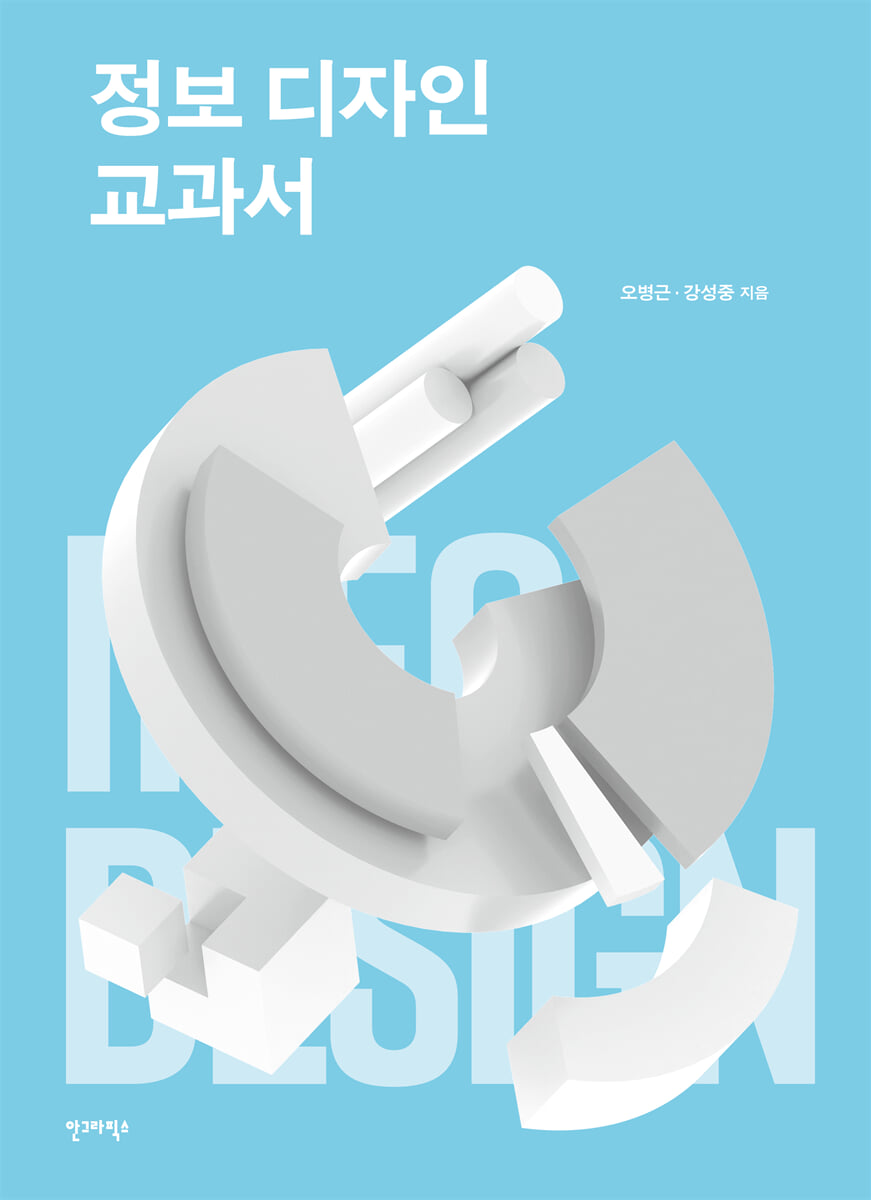
Information Design Textbook
 |
Description
Book Introduction
Presented from a design perspective and explained with a user-centered approach
The latest revised edition of the Information Design Textbook
This is a revised edition of the 『Information Design Textbook』, which covers the general content needed for information design, and presents a systematic learning method necessary for information designers.
Information design emphasizes not only visual elements but also a structural approach to information, organizing the core of information, and designing for user-centered information delivery.
In a flood of information that far exceeds the scope of what an individual can accept and manage, the purpose of information design is to discover the user's intentions and goals and to edit and process information accordingly.
Although this book is already well-known as a textbook in the field of information design, the revised edition, which replaces outdated materials and adds the latest examples, is even more substantial.
It is structured to help readers understand the concepts and history of information itself and information design through case studies, and then to understand the principles, methods, and design elements for designing information step by step.
Additionally, we approached information with a focus on the virtues that information designers should understand and know from a 'design perspective.'
It will also be helpful to working designers, students, academics in fields such as humanities and engineering that deal with information, and information managers in public administration and corporations.
The latest revised edition of the Information Design Textbook
This is a revised edition of the 『Information Design Textbook』, which covers the general content needed for information design, and presents a systematic learning method necessary for information designers.
Information design emphasizes not only visual elements but also a structural approach to information, organizing the core of information, and designing for user-centered information delivery.
In a flood of information that far exceeds the scope of what an individual can accept and manage, the purpose of information design is to discover the user's intentions and goals and to edit and process information accordingly.
Although this book is already well-known as a textbook in the field of information design, the revised edition, which replaces outdated materials and adds the latest examples, is even more substantial.
It is structured to help readers understand the concepts and history of information itself and information design through case studies, and then to understand the principles, methods, and design elements for designing information step by step.
Additionally, we approached information with a focus on the virtues that information designers should understand and know from a 'design perspective.'
It will also be helpful to working designers, students, academics in fields such as humanities and engineering that deal with information, and information managers in public administration and corporations.
- You can preview some of the book's contents.
Preview
index
preface
Recommendation
1 Overview of Information Design
What is information?
What is Information Design
History of Information Design
| The History of Information Design |
2 Principles of Information Design
Organization of information
Visualization of information
User Experience and Interaction
Case Study 1: Bus Routes Created with Big Data: Seoul's Owl Bus
3 Elements of Information Design
Graphics and information
Color and Information
User Experience
Dynamic Information Design
Case Study 2 | PHR Information Design
4 Application of Information Design
Principles and Methods
Knowledge and Research
Directions and Guidance
Systems and digital spaces
Case Study 3: A User-Created Map of Mobility Abbreviations: Everyone's Dribble
5 The Future of Information Design
Information and paradigm shifts
References
List of illustrations
Recommendation
1 Overview of Information Design
What is information?
What is Information Design
History of Information Design
| The History of Information Design |
2 Principles of Information Design
Organization of information
Visualization of information
User Experience and Interaction
Case Study 1: Bus Routes Created with Big Data: Seoul's Owl Bus
3 Elements of Information Design
Graphics and information
Color and Information
User Experience
Dynamic Information Design
Case Study 2 | PHR Information Design
4 Application of Information Design
Principles and Methods
Knowledge and Research
Directions and Guidance
Systems and digital spaces
Case Study 3: A User-Created Map of Mobility Abbreviations: Everyone's Dribble
5 The Future of Information Design
Information and paradigm shifts
References
List of illustrations
Into the book
Most of what we encounter in our daily lives is data, and it is virtually impossible to distinguish it from information.
Effective information delivery does not involve directly displaying data.
This is because it is incomplete, discontinuous, and not a complete message, and therefore has no value in terms of information transmission.
Only when data is properly arranged and organized, giving it the form and content of information, can it be given meaning and become useful to users.
---From "What is Information, p. 21"
One of the most effective ways to convey knowledge is through stories.
A good story is narrative, rich in detail and experience, delicately depicted, and allows for multiple interpretations.
Additionally, the story told while looking at the other person changes according to the listener's interests and experiences, and serves to make the information more personal.
---From "What is Information, p. 25"
In an information-rich environment like modern society, there must be an easy way to find the information you need.
The structure, form, and delivery method of information vary depending on the needs and circumstances of the information user, such as drivers asking for directions, shoppers reading labels on packaging, and comparing products when purchasing.
Good information design primarily aims to convey information accurately and efficiently to users.
---From "Information Organization, p. 79"
With the development of digital technology and the emergence of new information spaces such as the metaverse, interaction with information is expected to expand, and experience design is also expected to evolve accordingly.
Even though technologies and methods may change, people (users) are fundamentally at the center of interaction and experience design, and sufficient research on users' cognition, behavior, and cultural attributes must be conducted in advance.
---From "Information and Users, p. 134"
There are very few products that can be used by anyone, regardless of gender, age, or height.
In interface design, people are not vaguely referred to as users.
An app for a teenage student and an app for a 40-something businessperson should have different purposes and approaches.
Designing an interface that is suitable for users with different knowledge, experiences, and mental models about the system requires sufficient research and analysis of the users.
---From "User Experience, p. 203"
While information designers currently prioritize the ability to express information, in the future, information literacy—the ability to reconstruct information to suit a specific purpose and apply it to appropriate media—will become even more important.
Designers must be able to deconstruct and reconstruct presented data and create effective visualizations suitable for the media.
Designers in the digital information age must become creators of information who, in addition to providing aesthetic solutions, organize information to reveal meaning and utilize media technology.
Effective information delivery does not involve directly displaying data.
This is because it is incomplete, discontinuous, and not a complete message, and therefore has no value in terms of information transmission.
Only when data is properly arranged and organized, giving it the form and content of information, can it be given meaning and become useful to users.
---From "What is Information, p. 21"
One of the most effective ways to convey knowledge is through stories.
A good story is narrative, rich in detail and experience, delicately depicted, and allows for multiple interpretations.
Additionally, the story told while looking at the other person changes according to the listener's interests and experiences, and serves to make the information more personal.
---From "What is Information, p. 25"
In an information-rich environment like modern society, there must be an easy way to find the information you need.
The structure, form, and delivery method of information vary depending on the needs and circumstances of the information user, such as drivers asking for directions, shoppers reading labels on packaging, and comparing products when purchasing.
Good information design primarily aims to convey information accurately and efficiently to users.
---From "Information Organization, p. 79"
With the development of digital technology and the emergence of new information spaces such as the metaverse, interaction with information is expected to expand, and experience design is also expected to evolve accordingly.
Even though technologies and methods may change, people (users) are fundamentally at the center of interaction and experience design, and sufficient research on users' cognition, behavior, and cultural attributes must be conducted in advance.
---From "Information and Users, p. 134"
There are very few products that can be used by anyone, regardless of gender, age, or height.
In interface design, people are not vaguely referred to as users.
An app for a teenage student and an app for a 40-something businessperson should have different purposes and approaches.
Designing an interface that is suitable for users with different knowledge, experiences, and mental models about the system requires sufficient research and analysis of the users.
---From "User Experience, p. 203"
While information designers currently prioritize the ability to express information, in the future, information literacy—the ability to reconstruct information to suit a specific purpose and apply it to appropriate media—will become even more important.
Designers must be able to deconstruct and reconstruct presented data and create effective visualizations suitable for the media.
Designers in the digital information age must become creators of information who, in addition to providing aesthetic solutions, organize information to reveal meaning and utilize media technology.
---From "Information and Paradigm Change, p. 323"
Publisher's Review
Presenting an information design system
I need an easy-to-understand guide
Information has long been a key term driving society, economy, and technology.
The growing interest in and role of information is closely related to the development of digital technology, but in fact, information has been with humans since before the computer age.
Since the use of symbols and letters, activities dealing with information have continuously increased.
Furthermore, technological advancements have led to a rapid increase in the amount of information we produce, distribute, and consume, and the emergence of computers and networks has led to the popularization and decentralization of previously limited and centralized information production and access.
There are various approaches and interpretations of information in different fields.
The humanities and social sciences will be interested in the changes in humans and society, as well as in systems, caused by information, while the engineering field will focus on finding optimized systems for efficiently retrieving, storing, and managing information.
And the design field focuses on how to improve the efficiency of information delivery for communication, focusing on the information user.
Information design aims to efficiently express and use information, focusing on the environment and users in which information is delivered and used.
There are a variety of books covering information in each field, but this is not the case in the field of design.
Although the modern era is called the knowledge-based information society of the digital age, there are not many systematic and easy-to-understand guidelines on the design of knowledge and information.
Most books partially cover information design within the existing visual information and graphic design categories, or are portfolio-style books centered on design cases.
Accordingly, it is necessary to present an information design system through theory and application cases to understand the definition of information, the principles and methods of designing information, consideration of users, and the media and environment that contain information.
A revised edition reflecting social changes and technological advancements
Added richer data and up-to-date cases
This book is like a guide to systematically learning the theory and practice of handling information.
The first half of the book provides an overview of information and theories on the principles and elements of information design, along with case studies. The theory section visualizes related keywords in diagrams to help readers understand basic concepts.
Additionally, to help readers grasp the context of each topic, we included aphorisms for each chapter and used various illustrations to highlight important phrases in the content.
If we look at the structure divided into five areas in detail, first, Chapter 1, Overview of Information Design, covers the difference between data and information and the characteristics of information.
Explaining the concept of information design explains what information is and what information design is.
And we explore the changes and developments in how we access information through key examples from history.
Chapter 2, Principles of Information Design, presents a systematic method for each area based on the organization of information, visualization of information, and information and users, and explains information visualization based on the premise that the expertise and differentiation of design is the 'visualization of concepts and thoughts.'
Chapter 3, Elements of Information Design, explains the design elements such as information, graphics, colors, and information required in the actual design process, and also explains detailed fields such as dynamics, interface, and interaction related to media in line with technological developments.
Chapter 4, Application of Information Design, categorizes the concepts into 'Principles and Methods', 'Knowledge and Research', 'Pathfinding and Guidance', and 'Systems and Digital Space' according to the purpose of information, and collects excellent examples of application targets, processes, and backgrounds for each field.
Chapter 5, The Future of Information Design, presents the evolution of the intelligent information society, the development of information technology, and the role of designers in response.
Among the materials covered in information design, we have systematically organized the principles, methods, and applications that can be taken to universally understand data and turn it into information.
In particular, this revised edition reflects the latest data on social changes and technological advancements, including universal design, motion infographics, and digital spaces including social media. It also adds case studies of excellent implementations of information design to aid readers' understanding.
Developing through connection and communication with various fields
A book that will remain a foundational book in the field of information design for a long time.
Information design has many aspects that must be accomplished through connections with engineering, humanities, and social sciences.
This book presents key design project examples and detailed information.
Above all, we value creative information design and engage readers through fun and unique examples.
Due to the integration of information networks and the diversification of media, the role and importance of information design are expected to expand in the future.
Information transmission is not just a communication process, but it is also the core of sharing and communicating culture and emotions.
It can serve as a reference for those in academic fields such as humanities and social sciences or engineering, as well as for those in charge of information in public administration and businesses. Furthermore, designers working on actual projects will be able to acquire a system of theories and methods of information design and improve their expertise.
Beginning students can now learn a fundamental understanding of information and information design and methods for solving design problems.
In a situation where there are still not many domestic publications on information design, this book will serve as a foundation for the development of information design for a long time.
I need an easy-to-understand guide
Information has long been a key term driving society, economy, and technology.
The growing interest in and role of information is closely related to the development of digital technology, but in fact, information has been with humans since before the computer age.
Since the use of symbols and letters, activities dealing with information have continuously increased.
Furthermore, technological advancements have led to a rapid increase in the amount of information we produce, distribute, and consume, and the emergence of computers and networks has led to the popularization and decentralization of previously limited and centralized information production and access.
There are various approaches and interpretations of information in different fields.
The humanities and social sciences will be interested in the changes in humans and society, as well as in systems, caused by information, while the engineering field will focus on finding optimized systems for efficiently retrieving, storing, and managing information.
And the design field focuses on how to improve the efficiency of information delivery for communication, focusing on the information user.
Information design aims to efficiently express and use information, focusing on the environment and users in which information is delivered and used.
There are a variety of books covering information in each field, but this is not the case in the field of design.
Although the modern era is called the knowledge-based information society of the digital age, there are not many systematic and easy-to-understand guidelines on the design of knowledge and information.
Most books partially cover information design within the existing visual information and graphic design categories, or are portfolio-style books centered on design cases.
Accordingly, it is necessary to present an information design system through theory and application cases to understand the definition of information, the principles and methods of designing information, consideration of users, and the media and environment that contain information.
A revised edition reflecting social changes and technological advancements
Added richer data and up-to-date cases
This book is like a guide to systematically learning the theory and practice of handling information.
The first half of the book provides an overview of information and theories on the principles and elements of information design, along with case studies. The theory section visualizes related keywords in diagrams to help readers understand basic concepts.
Additionally, to help readers grasp the context of each topic, we included aphorisms for each chapter and used various illustrations to highlight important phrases in the content.
If we look at the structure divided into five areas in detail, first, Chapter 1, Overview of Information Design, covers the difference between data and information and the characteristics of information.
Explaining the concept of information design explains what information is and what information design is.
And we explore the changes and developments in how we access information through key examples from history.
Chapter 2, Principles of Information Design, presents a systematic method for each area based on the organization of information, visualization of information, and information and users, and explains information visualization based on the premise that the expertise and differentiation of design is the 'visualization of concepts and thoughts.'
Chapter 3, Elements of Information Design, explains the design elements such as information, graphics, colors, and information required in the actual design process, and also explains detailed fields such as dynamics, interface, and interaction related to media in line with technological developments.
Chapter 4, Application of Information Design, categorizes the concepts into 'Principles and Methods', 'Knowledge and Research', 'Pathfinding and Guidance', and 'Systems and Digital Space' according to the purpose of information, and collects excellent examples of application targets, processes, and backgrounds for each field.
Chapter 5, The Future of Information Design, presents the evolution of the intelligent information society, the development of information technology, and the role of designers in response.
Among the materials covered in information design, we have systematically organized the principles, methods, and applications that can be taken to universally understand data and turn it into information.
In particular, this revised edition reflects the latest data on social changes and technological advancements, including universal design, motion infographics, and digital spaces including social media. It also adds case studies of excellent implementations of information design to aid readers' understanding.
Developing through connection and communication with various fields
A book that will remain a foundational book in the field of information design for a long time.
Information design has many aspects that must be accomplished through connections with engineering, humanities, and social sciences.
This book presents key design project examples and detailed information.
Above all, we value creative information design and engage readers through fun and unique examples.
Due to the integration of information networks and the diversification of media, the role and importance of information design are expected to expand in the future.
Information transmission is not just a communication process, but it is also the core of sharing and communicating culture and emotions.
It can serve as a reference for those in academic fields such as humanities and social sciences or engineering, as well as for those in charge of information in public administration and businesses. Furthermore, designers working on actual projects will be able to acquire a system of theories and methods of information design and improve their expertise.
Beginning students can now learn a fundamental understanding of information and information design and methods for solving design problems.
In a situation where there are still not many domestic publications on information design, this book will serve as a foundation for the development of information design for a long time.
GOODS SPECIFICS
- Date of issue: August 31, 2023
- Page count, weight, size: 328 pages | 188*254*30mm
- ISBN13: 9791168230385
You may also like
카테고리
korean


korean

![GQ KOREA Mark (Monthly): December [2025]](http://librairie.coreenne.fr/cdn/shop/files/8ef265dbbfbf186523ed75ba7319009d.jpg?v=1765340328&width=3840)


