

British History Through Famous Paintings
 |
Description
Book Introduction
*The third story in the series of museums where history flows*
Henry VIII, the representative of the cruel absolute monarch, and Elizabeth I, the experienced virgin queen.
James I, the demonologist, George III, the farmer and madman,
Queen Victoria, who symbolizes a two-faced society like Dr. Jekyll and Mr. Hyde… … .
“Reign, but do not rule.”
Tudor, Stuart, Hanover, Saxe-Coburg and Gotha, Windsor
A glimpse into the present-day history of the British royal family through famous paintings!
The third book in the 'History Flowing Art Museum Series', which introduces the history of European dynasties through famous paintings, 'A History of England through Famous Paintings', has been published.
England was not ruled for a long time under the name of a single family, like the Habsburgs of Austria in the previous work, “A History of the Habsburgs Through Paintings,” or the Bourbons of France in “A History of the Bourbons Through Paintings.”
As one royal line dies, a new one is born, and with each change in royal lineage, absurd characters are born, creating new dramas that continue to this day.
Tudor, Stuart, Hanover, Saxe-Coburg and Gotha, and Windsor ruled England.
These five families may be thought of as separate families because their surnames are different, but whenever the family was cut off, the lineage was continued by a collateral line with a slight blood connection to the throne.
At least from the House of Hanover to the present (Windsor), it is a complete direct lineage, only the family name has changed.
The Habsburgs and Bourbons, who had a strong sense of tradition, would never have changed their family names, but they overcame the times by changing them casually or after going through many hardships through agreement between the monarch and parliament at the time.
It may be precisely this flexibility, or rather, this generosity, that allowed the British monarchy to survive and triumph over the demise of other great dynasties, such as the Habsburgs, Bourbons, and Romanovs.
From the reign of Henry VII of the Tudors to modern-day England under Charles III of the Windsor.
What kind of people were there that helped this island nation, once a mere second-rate state on the periphery, become known as the "land where the sun never sets"?
Henry VIII, who changed his religion for a divorce; Jane Grey, who reigned for only nine days; Elizabeth I, the pirate queen; Charles I, who went from being a tyrant to a martyr; Edward VIII, who gave up the throne for love…
As befitting the land of stories, Britain, each of its monarchs boasts a diverse range of personalities.
Kyoko Nakano presents the history of the British royal family, the most symbolic and influential of any living nation, in an easy and entertaining way, using familiar figures and famous paintings.
From the 15th century to the present day, the author's storytelling, accompanied by captivating illustrations depicting key figures and historical events from five dynasties, will make Western history, once perceived as difficult, much more approachable.
In addition, a family tree of the five dynasties and a chronological table by era were included to help readers understand, even if the text may seem complicated.
Henry VIII, the representative of the cruel absolute monarch, and Elizabeth I, the experienced virgin queen.
James I, the demonologist, George III, the farmer and madman,
Queen Victoria, who symbolizes a two-faced society like Dr. Jekyll and Mr. Hyde… … .
“Reign, but do not rule.”
Tudor, Stuart, Hanover, Saxe-Coburg and Gotha, Windsor
A glimpse into the present-day history of the British royal family through famous paintings!
The third book in the 'History Flowing Art Museum Series', which introduces the history of European dynasties through famous paintings, 'A History of England through Famous Paintings', has been published.
England was not ruled for a long time under the name of a single family, like the Habsburgs of Austria in the previous work, “A History of the Habsburgs Through Paintings,” or the Bourbons of France in “A History of the Bourbons Through Paintings.”
As one royal line dies, a new one is born, and with each change in royal lineage, absurd characters are born, creating new dramas that continue to this day.
Tudor, Stuart, Hanover, Saxe-Coburg and Gotha, and Windsor ruled England.
These five families may be thought of as separate families because their surnames are different, but whenever the family was cut off, the lineage was continued by a collateral line with a slight blood connection to the throne.
At least from the House of Hanover to the present (Windsor), it is a complete direct lineage, only the family name has changed.
The Habsburgs and Bourbons, who had a strong sense of tradition, would never have changed their family names, but they overcame the times by changing them casually or after going through many hardships through agreement between the monarch and parliament at the time.
It may be precisely this flexibility, or rather, this generosity, that allowed the British monarchy to survive and triumph over the demise of other great dynasties, such as the Habsburgs, Bourbons, and Romanovs.
From the reign of Henry VII of the Tudors to modern-day England under Charles III of the Windsor.
What kind of people were there that helped this island nation, once a mere second-rate state on the periphery, become known as the "land where the sun never sets"?
Henry VIII, who changed his religion for a divorce; Jane Grey, who reigned for only nine days; Elizabeth I, the pirate queen; Charles I, who went from being a tyrant to a martyr; Edward VIII, who gave up the throne for love…
As befitting the land of stories, Britain, each of its monarchs boasts a diverse range of personalities.
Kyoko Nakano presents the history of the British royal family, the most symbolic and influential of any living nation, in an easy and entertaining way, using familiar figures and famous paintings.
From the 15th century to the present day, the author's storytelling, accompanied by captivating illustrations depicting key figures and historical events from five dynasties, will make Western history, once perceived as difficult, much more approachable.
In addition, a family tree of the five dynasties and a chronological table by era were included to help readers understand, even if the text may seem complicated.
- You can preview some of the book's contents.
Preview
index
Current History, the British Royal Family
Part 1 Tudor
Tudor family tree
Chapter 1: Hans Holbein, The Ambassadors
Chapter 2: Antonis Mor, Mary Tudor
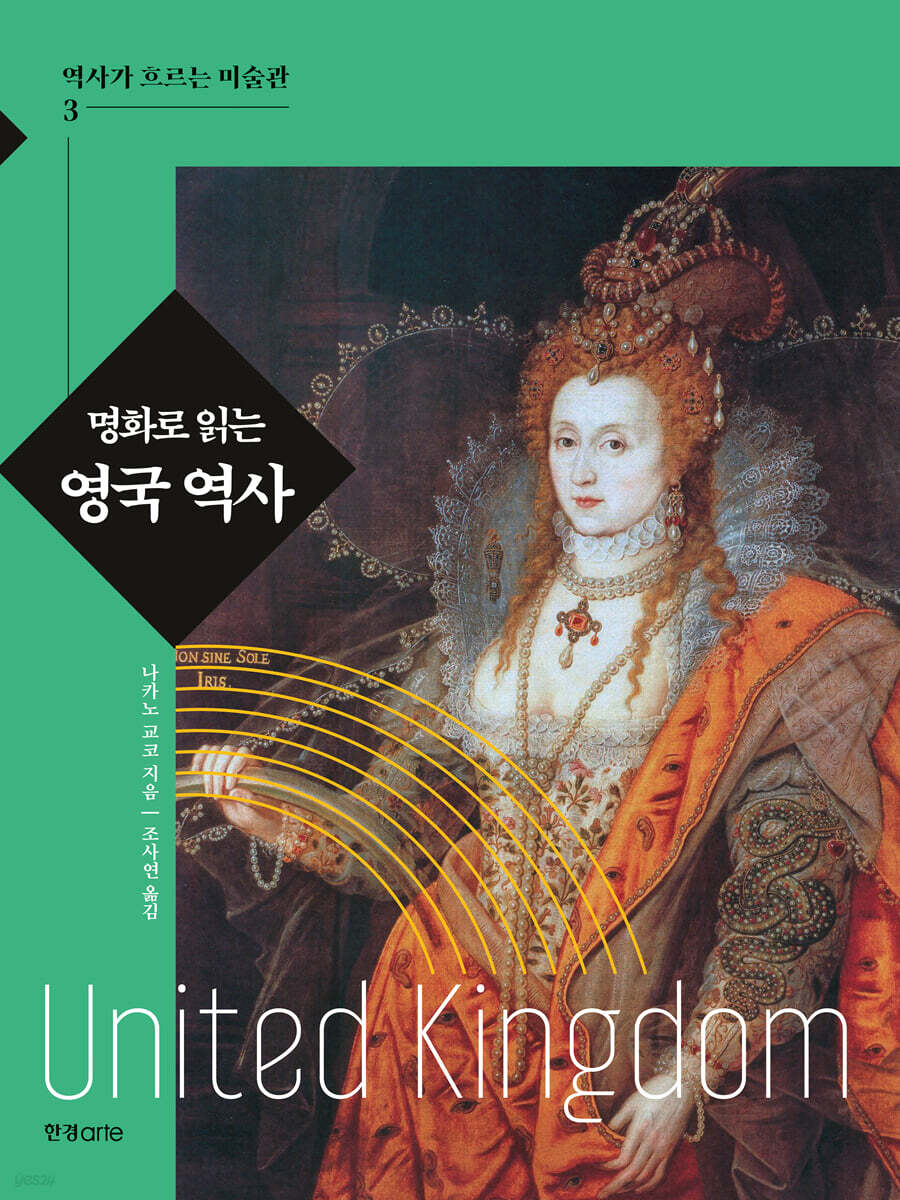
Chapter 3: Isaac Oliver, "Rainbow Portrait of Elizabeth I"
Part 2 Stewart
Stewart Family Tree
Chapter 4 John Gilbert, Guy Fawkes Before King James
Chapter 5: Paul Delaroche, Cromwell Viewing the Body of Charles I
Chapter 6: John Michael Wright, Charles II
Part 3 Hanover
Hanover family tree
Chapter 7 William Hogarth, The South Sea Bubble
Chapter 8 William Beach, George III
Chapter 9 William Turner, "Slave Ship"
Chapter 10: Franz Winterhalter, The Family of Queen Victoria
Chapter 11: Franz Winterhalter, Prince Edward
Chapter 12: The Royal Family at Buckingham Palace, by John Lavery
In conclusion
Key References
Chronology
Painters covered in this book
Part 1 Tudor
Tudor family tree
Chapter 1: Hans Holbein, The Ambassadors
Chapter 2: Antonis Mor, Mary Tudor
Chapter 3: Isaac Oliver, "Rainbow Portrait of Elizabeth I"
Part 2 Stewart
Stewart Family Tree
Chapter 4 John Gilbert, Guy Fawkes Before King James
Chapter 5: Paul Delaroche, Cromwell Viewing the Body of Charles I
Chapter 6: John Michael Wright, Charles II
Part 3 Hanover
Hanover family tree
Chapter 7 William Hogarth, The South Sea Bubble
Chapter 8 William Beach, George III
Chapter 9 William Turner, "Slave Ship"
Chapter 10: Franz Winterhalter, The Family of Queen Victoria
Chapter 11: Franz Winterhalter, Prince Edward
Chapter 12: The Royal Family at Buckingham Palace, by John Lavery
In conclusion
Key References
Chronology
Painters covered in this book
Detailed image

Into the book
Holbein's portrait of Henry VIII in his forties is a masterpiece.
The portrait, which fully captures the individuality and power of Henry VIII, is indistinguishable from his past and future actions.
The wide face that makes you see high levels of male hormones at first glance is further emphasized by the costume that makes his already muscular body look unnecessarily bulky, giving him a cruel and violent impression. The sharp eyes that are the very embodiment of coldness add to the fear.
He is the epitome of an absolute monarch who reigned during the barbaric age.
It is so physically and physiologically terrifying that it has a strong charm and attraction.
The first thing Henry VIII did after being crowned at the age of eighteen was to marry Catherine of Aragon, and then to execute his father's close associates.
Get what you want and eliminate those who stand in your way.
This pattern ran through his life.
---From "Chapter 1, Hans Holbein, The Ambassadors"
If we were to describe Elizabeth I in one word, it would be 'a lucky woman'.
This is not to say that everything went smoothly.
At every stage of her life, crises and disasters followed, but each time, 'fate used all means at its disposal' to bring good fortune to Elizabeth.
It was thanks to her great luck and wisdom that England was able to experience the Renaissance and join the ranks of European powers, although it was about a century later than Italy.
Afterwards, the idea that Britain prospered during the reign of a queen took hold (Britain also enjoyed its heyday during the reign of Queen Victoria).
---From Chapter 3, Isaac Oliver, “Rainbow Portrait of Elizabeth I”
Armed conflict continued intermittently for five years.
At first, the royalists had the advantage, but Oliver Cromwell, who was elected as the leader of the revolutionaries, led the 'Iron Horse', a group of ardent Puritans, and advanced as if possessed by a god, and the situation gradually turned around, and the civil war ended in 1648 with the arrest of the king.
Parliament then brought Charles I to trial and sentenced him to death for "despotism, treason, murder, and treason."
The beheading was carried out on the scaffold set up in front of the Banqueting House, so there is a legend that the last thing the king saw was the ceiling painting by Rubens described above.
The people, who were struggling under harsh taxes, had vaguely agreed with the king's evil deeds (this was a time when the percentage of literate people was very low), but when they actually witnessed the king being brought to trial and beheaded, they were terrified and gripped by fear.
Killing a king who was equal to God! At that moment, Charles I became a martyr.
People flocked to the execution ground, soaked the flowing blood of the king on cloths, and kept it as a sacred relic.
---From Chapter 5, Paul Delaroche, Cromwell Seeing the Body of Charles I
This is the very duality of the Victorian era itself.
An ugly truth hidden behind a noble appearance.
Even saying the 'leg' of a chair was considered vulgar and shameful, and the number of prostitutes in London alone was 80,000, with one in six houses being a brothel (according to 1857 statistics).
Even married couples slept in their underwear, academy paintings were filled with nudity, and the poor starved to death alongside the wealthy.
As discussed in the previous chapter, Clarence, Victoria's grandson and Edward's eldest son, was also a suspect in the murder of Jack the Ripper.
In "Queen Victoria and the Royal Family," Victoria is in the center, the person standing right behind her is Edward, and the boy standing to her right is Duke of Clarence.
The people outwardly paid homage to the royal family, but behind their backs they mocked them to their heart's content.
---From Chapter 11, Franz Winterhalter, Prince Edward
George V abandoned his two cousins, but no matter how much he was criticized, it was probably the right choice.
It was not a situation where one could save the king of a foreign country.
The British constitutional monarchy was in danger of extinction.
This is because the people's hatred for Germany began to turn towards the foreign dynasty of Saxe-Coburg and Gotha.
Not only the name Hanover, but Saxe-Coburg and Gotha were also German, and the fact that Queen Victoria and her husband usually spoke German was vivid in everyone's memory.
Everyone knew that past kings had brought queens from Germany, and of course, the current queen, Mary, was no exception.
From here on out, George V's agonizing decision begins.
Now is not the time for the royal family to survive while ignoring public opinion.
Shortly after the war began, the king announced that he would renounce the Saxe-Coburg and Gotha titles he had inherited from his parents and would henceforth use the pseudonym 'Windsor'.
The portrait, which fully captures the individuality and power of Henry VIII, is indistinguishable from his past and future actions.
The wide face that makes you see high levels of male hormones at first glance is further emphasized by the costume that makes his already muscular body look unnecessarily bulky, giving him a cruel and violent impression. The sharp eyes that are the very embodiment of coldness add to the fear.
He is the epitome of an absolute monarch who reigned during the barbaric age.
It is so physically and physiologically terrifying that it has a strong charm and attraction.
The first thing Henry VIII did after being crowned at the age of eighteen was to marry Catherine of Aragon, and then to execute his father's close associates.
Get what you want and eliminate those who stand in your way.
This pattern ran through his life.
---From "Chapter 1, Hans Holbein, The Ambassadors"
If we were to describe Elizabeth I in one word, it would be 'a lucky woman'.
This is not to say that everything went smoothly.
At every stage of her life, crises and disasters followed, but each time, 'fate used all means at its disposal' to bring good fortune to Elizabeth.
It was thanks to her great luck and wisdom that England was able to experience the Renaissance and join the ranks of European powers, although it was about a century later than Italy.
Afterwards, the idea that Britain prospered during the reign of a queen took hold (Britain also enjoyed its heyday during the reign of Queen Victoria).
---From Chapter 3, Isaac Oliver, “Rainbow Portrait of Elizabeth I”
Armed conflict continued intermittently for five years.
At first, the royalists had the advantage, but Oliver Cromwell, who was elected as the leader of the revolutionaries, led the 'Iron Horse', a group of ardent Puritans, and advanced as if possessed by a god, and the situation gradually turned around, and the civil war ended in 1648 with the arrest of the king.
Parliament then brought Charles I to trial and sentenced him to death for "despotism, treason, murder, and treason."
The beheading was carried out on the scaffold set up in front of the Banqueting House, so there is a legend that the last thing the king saw was the ceiling painting by Rubens described above.
The people, who were struggling under harsh taxes, had vaguely agreed with the king's evil deeds (this was a time when the percentage of literate people was very low), but when they actually witnessed the king being brought to trial and beheaded, they were terrified and gripped by fear.
Killing a king who was equal to God! At that moment, Charles I became a martyr.
People flocked to the execution ground, soaked the flowing blood of the king on cloths, and kept it as a sacred relic.
---From Chapter 5, Paul Delaroche, Cromwell Seeing the Body of Charles I
This is the very duality of the Victorian era itself.
An ugly truth hidden behind a noble appearance.
Even saying the 'leg' of a chair was considered vulgar and shameful, and the number of prostitutes in London alone was 80,000, with one in six houses being a brothel (according to 1857 statistics).
Even married couples slept in their underwear, academy paintings were filled with nudity, and the poor starved to death alongside the wealthy.
As discussed in the previous chapter, Clarence, Victoria's grandson and Edward's eldest son, was also a suspect in the murder of Jack the Ripper.
In "Queen Victoria and the Royal Family," Victoria is in the center, the person standing right behind her is Edward, and the boy standing to her right is Duke of Clarence.
The people outwardly paid homage to the royal family, but behind their backs they mocked them to their heart's content.
---From Chapter 11, Franz Winterhalter, Prince Edward
George V abandoned his two cousins, but no matter how much he was criticized, it was probably the right choice.
It was not a situation where one could save the king of a foreign country.
The British constitutional monarchy was in danger of extinction.
This is because the people's hatred for Germany began to turn towards the foreign dynasty of Saxe-Coburg and Gotha.
Not only the name Hanover, but Saxe-Coburg and Gotha were also German, and the fact that Queen Victoria and her husband usually spoke German was vivid in everyone's memory.
Everyone knew that past kings had brought queens from Germany, and of course, the current queen, Mary, was no exception.
From here on out, George V's agonizing decision begins.
Now is not the time for the royal family to survive while ignoring public opinion.
Shortly after the war began, the king announced that he would renounce the Saxe-Coburg and Gotha titles he had inherited from his parents and would henceforth use the pseudonym 'Windsor'.
---From Chapter 12, John Lavery, The Royal Family at Buckingham Palace
Publisher's Review
From 15th-century absolute monarchy to 21st-century constitutional monarchy in Britain
When you look at a famous painting, you can read history!
A storytelling masterpiece class that draws you in without you realizing it as you read.
In some countries, including Korea, it is called 'England', but in fact, there is no country called England.
The official name of the country is the United Kingdom of Great Britain and Northern Ireland (abbreviated as UK), and it is a union country consisting of England, Scotland, Wales, and Northern Ireland.
However, it took centuries of war after war for this UK national system to be completed.
Within the small island nation, the English, Scots, Welsh, and Northern Irish fought for dominance, with England at the center, and foreign invasions and religious wars were constant.
The United Kingdom (UK) in the 21st century is a constitutional monarchy, with Charles III of the House of Windsor ruling the UK after the death of Queen Elizabeth II in 2022.
While powerful European royal families like Austria's Habsburgs and France's Bourbons have faded into the dustbin of history, how has the British royal family managed to write a history that continues to unfold?
From the powerful absolute monarchy represented by Henry VIII in the 16th century to the establishment of the English constitutional monarchy, which 'sovereigns but does not rule.'
Kyoko Nakano presents a captivating account of the evolution of the British royal family and pivotal moments in British history through her fluid storytelling and illustrations.
John Gilbert's "Guy Fawkes Before King James" depicts the attempted bombing of Parliament in 1605 during the reign of James I of the Stuarts.
James, his right hand resting on the back of the chair, his usually large, bright eyes widening even further, glares at the kneeling man.
Even though he roughly pulled both of her hands, which were tied with rope, from behind her back, the man's attitude was extremely arrogant.
If there had been no pushback, the Capitol might have been completely blown away.
After severe torture, he confesses his real name, 'Guy Fawkes', and the names of his companions, who were plotting an unprecedented conspiracy to depose James I and install a Catholic king.
Long-standing religious conflicts and the royal family's incompetence and extravagance brought about a backlash.
During the reign of his son, Charles I, the king continued to abuse his power, such as forcing the Church of England on his homeland of Scotland without holding parliament and trying to increase his revenue through church taxes, which led to the 'Philadelphia Revolution'.
As a result, Charles I was executed for 'despotism, treason, murder, and treason', and England abolished the monarchy and declared a republic.
Based on this series of events, the 19th-century French painter Delaroche captured the relationship between the king and the revolutionaries on canvas.
It is “Cromwell Viewing the Body of Charles I.”
Charles's distinctive beard lying in the coffin, the vivid traces of blood remaining on his cut neck, Cromwell's complex and intricate expression wrapped in simple clothes...
Is it because it was drawn by someone who knows what happens next?
After the Restoration, Cromwell's entire family was murdered, and his own body was exhumed, beheaded, and left on the rack for a long time.
The monarchy was restored in 1660, but the era of absolute power of the king came to an end, and Parliament gained greater power than before, and a constitutional monarchy in England was established.
If you look at a painting knowing the changing times and the story behind it, even the same painting will come across differently.
Author Kyoko Nakano introduces twelve famous paintings related to figures representing the five royal families of England, along with numerous other famous paintings related to them. Through the historical background and anecdotes, she vividly conveys what kind of lives the figures in the paintings lived and what influence they had on history.
The famous paintings introduced in this book are also beneficial in that they range from oil paintings depicting solemn and splendid royal scenes to works satirizing the absurdity of reality and the royal family, such as William Hogarth's "The South Sea Foam" and James Gillray's "Caricature of George III."
As you follow the author's clear and exciting story, your understanding of history and the work will naturally deepen.
Elizabeth I, Queen Anne, Victoria I, Elizabeth II…
Jinx flourishing in the age of queens?
The Queens Who Created the 'Land Where the Sun Never Sets'
Because Britain was a country that did not apply 'Salic law', which only allowed males to inherit the throne, it produced many queens compared to neighboring European countries.
Perhaps because of this, England has produced so many outstanding queens that there is a jinx that says, "Britain prospers during the reign of a queen." The most representative figure is Elizabeth I.
The era of Elizabeth I, represented by the saying, “I married England,” is evaluated as having ushered in a golden age for England with her transcendent presence and charisma as a virgin queen.
The painting representing Elizabeth I, “Portrait of Elizabeth I in the Armada,” was painted after the defeat of the Spanish Armada.
At the time, no one thought that Britain could defeat the world-famous Invincible Armada.
But even though she was outnumbered, Elizabeth said, “I am only a very weak woman, but I have the heart of an English king in my heart.
He raised the morale of the British Navy by sending out a proclamation saying, “I will share life and death with everyone!” and at the same time, he showed his charisma as a monarch and led the war to victory.
The two paintings hanging behind Elizabeth, located in the center of the painting, depict the English and Spanish armies facing each other inside the bay on the left, while the one on the right depicts the enemy forces sinking in a storm.
Elizabeth, at the center, places her hand on the globe as if all the world's oceans are hers, naturally overwhelming her opponents with her innate dignity and confident aura.
In this way, paintings were used not only as portraits but also as political tools.
In fact, Elizabeth I had an image strategy of deifying herself as the Virgin Queen from early on, and had many artists paint her portrait, and she also appeared in prints, book illustrations, maps, and playing cards.
In another portrait, Isaac Oliver's "Portrait of Elizabeth I with a Rainbow," Elizabeth is shown wearing her usual abundance of pearls, a symbol of her virginity, and holding a rainbow in her right hand, just above which is inscribed the Latin phrase "Non sine Sole Iris" (No sun, no rainbow).
In the Old Testament, the rainbow signifies the 'promise between God and man' and is a symbol of peace.
The middle part has large eyes and ears scattered all around, representing great wisdom, and on the left sleeve is a snake symbolizing eternity, as if it were shedding its skin, and a red heart symbolizing love.
The gauntlets (armor that protects the forearms) that symbolize loyalty are also drawn on the pleated collar that covers the face.
In short, this painting is more of a propaganda icon than a portrait.
Another queen who led England to its golden age, Victoria I, was the first queen of the House of Hanover. During the Victorian era, Britain gained wealth through colonies that expanded around the world, earning it the nickname "the empire on which the sun never sets."
Unlike Elizabeth I, who reigned over the people with a kind of transcendent presence and charisma as the virgin queen, Queen Victoria was loved by the people for her image as a 'beloved wife' and 'caring mother'.
In Franz Winterhalter's painting "The Family of Queen Victoria," Victoria is surrounded by five children after only six years of marriage, and she later gives birth to a total of nine children, forming a happy family.
Victoria also decorated the living room with a tree and distributed photographs and prints of the royal family celebrating happily, showing the romance of her love marriage with her husband, Prince Albert, and the resulting ideal family to the public as a real family rather than a fairy tale, creating an ideal era of 'the union of the throne and virtue.'
In European history, England, in particular, prospered and enjoyed a golden age during the reign of her queen, boasting charisma and presence on par with the kings who led Europe's golden age, such as Frederick the Great of the Habsburgs and Louis XIV of Bourbon.
Perhaps the reason Britain is called 'the empire on which the sun never sets' and has been able to maintain its monarchy to this day is because of the prosperity brought about by the reigns of successive queens and the success of 'reigning but not ruling.'
When you look at a famous painting, you can read history!
A storytelling masterpiece class that draws you in without you realizing it as you read.
In some countries, including Korea, it is called 'England', but in fact, there is no country called England.
The official name of the country is the United Kingdom of Great Britain and Northern Ireland (abbreviated as UK), and it is a union country consisting of England, Scotland, Wales, and Northern Ireland.
However, it took centuries of war after war for this UK national system to be completed.
Within the small island nation, the English, Scots, Welsh, and Northern Irish fought for dominance, with England at the center, and foreign invasions and religious wars were constant.
The United Kingdom (UK) in the 21st century is a constitutional monarchy, with Charles III of the House of Windsor ruling the UK after the death of Queen Elizabeth II in 2022.
While powerful European royal families like Austria's Habsburgs and France's Bourbons have faded into the dustbin of history, how has the British royal family managed to write a history that continues to unfold?
From the powerful absolute monarchy represented by Henry VIII in the 16th century to the establishment of the English constitutional monarchy, which 'sovereigns but does not rule.'
Kyoko Nakano presents a captivating account of the evolution of the British royal family and pivotal moments in British history through her fluid storytelling and illustrations.
John Gilbert's "Guy Fawkes Before King James" depicts the attempted bombing of Parliament in 1605 during the reign of James I of the Stuarts.
James, his right hand resting on the back of the chair, his usually large, bright eyes widening even further, glares at the kneeling man.
Even though he roughly pulled both of her hands, which were tied with rope, from behind her back, the man's attitude was extremely arrogant.
If there had been no pushback, the Capitol might have been completely blown away.
After severe torture, he confesses his real name, 'Guy Fawkes', and the names of his companions, who were plotting an unprecedented conspiracy to depose James I and install a Catholic king.
Long-standing religious conflicts and the royal family's incompetence and extravagance brought about a backlash.
During the reign of his son, Charles I, the king continued to abuse his power, such as forcing the Church of England on his homeland of Scotland without holding parliament and trying to increase his revenue through church taxes, which led to the 'Philadelphia Revolution'.
As a result, Charles I was executed for 'despotism, treason, murder, and treason', and England abolished the monarchy and declared a republic.
Based on this series of events, the 19th-century French painter Delaroche captured the relationship between the king and the revolutionaries on canvas.
It is “Cromwell Viewing the Body of Charles I.”
Charles's distinctive beard lying in the coffin, the vivid traces of blood remaining on his cut neck, Cromwell's complex and intricate expression wrapped in simple clothes...
Is it because it was drawn by someone who knows what happens next?
After the Restoration, Cromwell's entire family was murdered, and his own body was exhumed, beheaded, and left on the rack for a long time.
The monarchy was restored in 1660, but the era of absolute power of the king came to an end, and Parliament gained greater power than before, and a constitutional monarchy in England was established.
If you look at a painting knowing the changing times and the story behind it, even the same painting will come across differently.
Author Kyoko Nakano introduces twelve famous paintings related to figures representing the five royal families of England, along with numerous other famous paintings related to them. Through the historical background and anecdotes, she vividly conveys what kind of lives the figures in the paintings lived and what influence they had on history.
The famous paintings introduced in this book are also beneficial in that they range from oil paintings depicting solemn and splendid royal scenes to works satirizing the absurdity of reality and the royal family, such as William Hogarth's "The South Sea Foam" and James Gillray's "Caricature of George III."
As you follow the author's clear and exciting story, your understanding of history and the work will naturally deepen.
Elizabeth I, Queen Anne, Victoria I, Elizabeth II…
Jinx flourishing in the age of queens?
The Queens Who Created the 'Land Where the Sun Never Sets'
Because Britain was a country that did not apply 'Salic law', which only allowed males to inherit the throne, it produced many queens compared to neighboring European countries.
Perhaps because of this, England has produced so many outstanding queens that there is a jinx that says, "Britain prospers during the reign of a queen." The most representative figure is Elizabeth I.
The era of Elizabeth I, represented by the saying, “I married England,” is evaluated as having ushered in a golden age for England with her transcendent presence and charisma as a virgin queen.
The painting representing Elizabeth I, “Portrait of Elizabeth I in the Armada,” was painted after the defeat of the Spanish Armada.
At the time, no one thought that Britain could defeat the world-famous Invincible Armada.
But even though she was outnumbered, Elizabeth said, “I am only a very weak woman, but I have the heart of an English king in my heart.
He raised the morale of the British Navy by sending out a proclamation saying, “I will share life and death with everyone!” and at the same time, he showed his charisma as a monarch and led the war to victory.
The two paintings hanging behind Elizabeth, located in the center of the painting, depict the English and Spanish armies facing each other inside the bay on the left, while the one on the right depicts the enemy forces sinking in a storm.
Elizabeth, at the center, places her hand on the globe as if all the world's oceans are hers, naturally overwhelming her opponents with her innate dignity and confident aura.
In this way, paintings were used not only as portraits but also as political tools.
In fact, Elizabeth I had an image strategy of deifying herself as the Virgin Queen from early on, and had many artists paint her portrait, and she also appeared in prints, book illustrations, maps, and playing cards.
In another portrait, Isaac Oliver's "Portrait of Elizabeth I with a Rainbow," Elizabeth is shown wearing her usual abundance of pearls, a symbol of her virginity, and holding a rainbow in her right hand, just above which is inscribed the Latin phrase "Non sine Sole Iris" (No sun, no rainbow).
In the Old Testament, the rainbow signifies the 'promise between God and man' and is a symbol of peace.
The middle part has large eyes and ears scattered all around, representing great wisdom, and on the left sleeve is a snake symbolizing eternity, as if it were shedding its skin, and a red heart symbolizing love.
The gauntlets (armor that protects the forearms) that symbolize loyalty are also drawn on the pleated collar that covers the face.
In short, this painting is more of a propaganda icon than a portrait.
Another queen who led England to its golden age, Victoria I, was the first queen of the House of Hanover. During the Victorian era, Britain gained wealth through colonies that expanded around the world, earning it the nickname "the empire on which the sun never sets."
Unlike Elizabeth I, who reigned over the people with a kind of transcendent presence and charisma as the virgin queen, Queen Victoria was loved by the people for her image as a 'beloved wife' and 'caring mother'.
In Franz Winterhalter's painting "The Family of Queen Victoria," Victoria is surrounded by five children after only six years of marriage, and she later gives birth to a total of nine children, forming a happy family.
Victoria also decorated the living room with a tree and distributed photographs and prints of the royal family celebrating happily, showing the romance of her love marriage with her husband, Prince Albert, and the resulting ideal family to the public as a real family rather than a fairy tale, creating an ideal era of 'the union of the throne and virtue.'
In European history, England, in particular, prospered and enjoyed a golden age during the reign of her queen, boasting charisma and presence on par with the kings who led Europe's golden age, such as Frederick the Great of the Habsburgs and Louis XIV of Bourbon.
Perhaps the reason Britain is called 'the empire on which the sun never sets' and has been able to maintain its monarchy to this day is because of the prosperity brought about by the reigns of successive queens and the success of 'reigning but not ruling.'
GOODS SPECIFICS
- Date of issue: March 15, 2023
- Page count, weight, size: 248 pages | 484g | 150*200*18mm
- ISBN13: 9788947548816
- ISBN10: 8947548812
You may also like
카테고리
korean


korean

![GQ KOREA Mark (Monthly): December [2025]](http://librairie.coreenne.fr/cdn/shop/files/8ef265dbbfbf186523ed75ba7319009d.jpg?v=1765340328&width=3840)


