

Edward Hopper
 |
Description
Book Introduction
From the Renaissance to the present day,
A basic art series where you can meet the masters of art history!
Returning with larger format and illustrations
The Basic Art Series began in 1985 with a collection of Picasso works and has since grown into a best-selling art book collection.
Since then, over 200 concise and thin books by each author have been produced and published in over 20 languages.
The series has excellent production values, excellent artwork, and intelligent content.
The thematic awareness of each book is vibrant yet accessible, making it easy to approach.
It has been republished 15 years after the first Korean edition was published in 2005.
This [Basic Art 2.0] series delivers more vivid images of the artwork to readers with larger formats and illustrations than before.
A basic art series where you can meet the masters of art history!
Returning with larger format and illustrations
The Basic Art Series began in 1985 with a collection of Picasso works and has since grown into a best-selling art book collection.
Since then, over 200 concise and thin books by each author have been produced and published in over 20 languages.
The series has excellent production values, excellent artwork, and intelligent content.
The thematic awareness of each book is vibrant yet accessible, making it easy to approach.
It has been republished 15 years after the first Korean edition was published in 2005.
This [Basic Art 2.0] series delivers more vivid images of the artwork to readers with larger formats and illustrations than before.
index
Page 6
Debut in Europe
Page 20
Image of the New World
Page 30
The limits of civilization
Page 46
Human dimension and symbolism of nature
Page 66
Individuals and Others
Page 84
The Transformation of Reality: Hopper, the Modern Painter
Page 94
Edward Hopper (1882-1967)
Life and Works
Debut in Europe
Page 20
Image of the New World
Page 30
The limits of civilization
Page 46
Human dimension and symbolism of nature
Page 66
Individuals and Others
Page 84
The Transformation of Reality: Hopper, the Modern Painter
Page 94
Edward Hopper (1882-1967)
Life and Works
Detailed image
.jpg)
Into the book
To most Europeans, Edward Hopper is known as the painter who represents the image of America.
Large-scale Hopper exhibitions in Germany and Europe in the late 1970s established the perception that he was not a representative of a painting technique belonging to a specific American artistic sect.
For Hopper, what is important is rather the subject of the painting itself, and the 'scenes' reproduced in his paintings have a double meaning.
Because while his paintings have a typical American feel, they also have a strong sense of alienation that comes with modern life and the disconnect it brings.
---From "Debut in Europe"
In Hopper's early works we can discern motifs and themes that the artist would later pursue.
It is for this very reason that the transition between Hopper's French and American paintings is very gradual.
Even though the initial motif changes and the drawing style changes drastically, there is in fact no fundamental break in his world of work.
---From "Images of the New World"
Overall, Hopper's later works demonstrate that his paintings make no fundamental distinction between natural and civilized spaces.
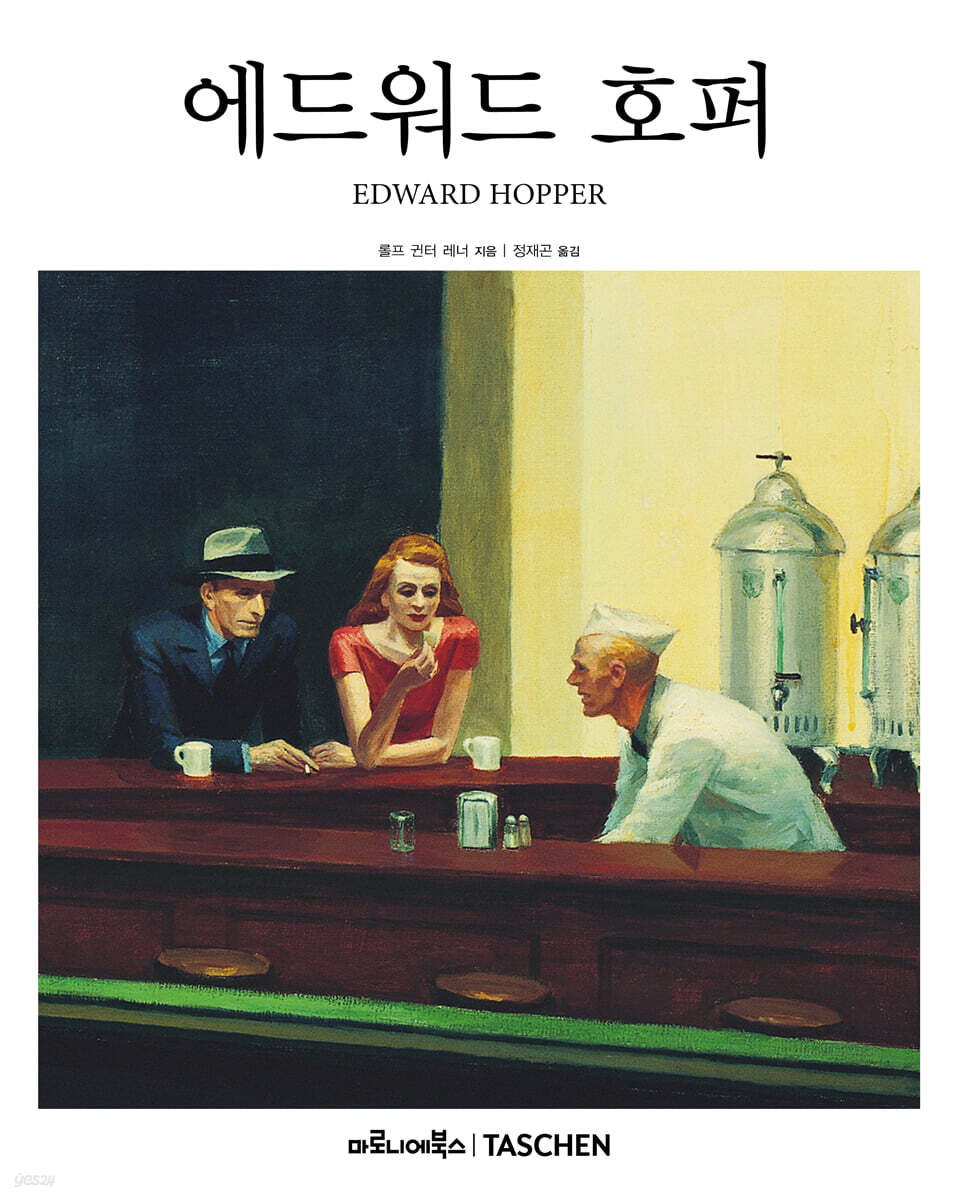
A good example is the cityscape painting "Night Watchers" from 1942, which largely follows his earlier works.
This painting is the only Hopper work in which the window is curved and the glass is visible through the window.
The space of the bar surrounds people like a sealed container.
Of course, in this work too, a clear boundary is drawn between the urban environment and natural space.
The city, shrouded in darkness, is illuminated only by the light coming from the bar.
---From "Individuals and Others"
Hopper's paintings, which at first glance appear to be faithful to realism, do not simply reproduce a reality that can be replicated, but always aim for a reconstruction that transcends the world of pure experience.
As can be seen in the picture-within-a-picture situations that Hopper often recreates, his overall pictorial practice creates empty space rather than replicating visible reality.
In doing so, his work highlights the disconnection that exists in our perception of reality or in our ability to perceive it.
Large-scale Hopper exhibitions in Germany and Europe in the late 1970s established the perception that he was not a representative of a painting technique belonging to a specific American artistic sect.
For Hopper, what is important is rather the subject of the painting itself, and the 'scenes' reproduced in his paintings have a double meaning.
Because while his paintings have a typical American feel, they also have a strong sense of alienation that comes with modern life and the disconnect it brings.
---From "Debut in Europe"
In Hopper's early works we can discern motifs and themes that the artist would later pursue.
It is for this very reason that the transition between Hopper's French and American paintings is very gradual.
Even though the initial motif changes and the drawing style changes drastically, there is in fact no fundamental break in his world of work.
---From "Images of the New World"
Overall, Hopper's later works demonstrate that his paintings make no fundamental distinction between natural and civilized spaces.
A good example is the cityscape painting "Night Watchers" from 1942, which largely follows his earlier works.
This painting is the only Hopper work in which the window is curved and the glass is visible through the window.
The space of the bar surrounds people like a sealed container.
Of course, in this work too, a clear boundary is drawn between the urban environment and natural space.
The city, shrouded in darkness, is illuminated only by the light coming from the bar.
---From "Individuals and Others"
Hopper's paintings, which at first glance appear to be faithful to realism, do not simply reproduce a reality that can be replicated, but always aim for a reconstruction that transcends the world of pure experience.
As can be seen in the picture-within-a-picture situations that Hopper often recreates, his overall pictorial practice creates empty space rather than replicating visible reality.
In doing so, his work highlights the disconnection that exists in our perception of reality or in our ability to perceive it.
---From "The Transformation of Reality: Hopper, the Modern Painter"
Publisher's Review
Solitary Art
A clear perspective on alienation
If Edward Hopper (1882-1967) had succeeded earlier, he might have become an American success story.
He was an artist struggling to sell even one more painting at the age of 40.
It wasn't until I was in my 80s that I was finally able to grace the cover of a magazine.
Today, half a century after his death, Hopper is recognized as a master of modern expression, displaying a strange and haunting, entirely different sense of mood and place.
Many of Hopper's works recreate the modern urban experience.
As each canvas is completed, it depicts a restaurant, cafe, shop, streetlight, gas station, train station, hotel room, and more.
Each scene is characterized by vivid colors, a theatrical lighting atmosphere, and characters depicted with rough outlines, giving them the feeling of being aliens appearing in the surroundings.
A look at his repertoire reveals a sense of eerie loneliness, alienation, solitude, and psychological tension throughout.
Yet, works depicting rural or coastal landscapes exhibit a comfortable and optimistic atmosphere.
This book presents key works from across Hopper's oeuvre that not only illustrate the context of American art history but also the essence of the American spirit.
A clear perspective on alienation
If Edward Hopper (1882-1967) had succeeded earlier, he might have become an American success story.
He was an artist struggling to sell even one more painting at the age of 40.
It wasn't until I was in my 80s that I was finally able to grace the cover of a magazine.
Today, half a century after his death, Hopper is recognized as a master of modern expression, displaying a strange and haunting, entirely different sense of mood and place.
Many of Hopper's works recreate the modern urban experience.
As each canvas is completed, it depicts a restaurant, cafe, shop, streetlight, gas station, train station, hotel room, and more.
Each scene is characterized by vivid colors, a theatrical lighting atmosphere, and characters depicted with rough outlines, giving them the feeling of being aliens appearing in the surroundings.
A look at his repertoire reveals a sense of eerie loneliness, alienation, solitude, and psychological tension throughout.
Yet, works depicting rural or coastal landscapes exhibit a comfortable and optimistic atmosphere.
This book presents key works from across Hopper's oeuvre that not only illustrate the context of American art history but also the essence of the American spirit.
GOODS SPECIFICS
- Publication date: September 30, 2022
- Format: Hardcover book binding method guide
- Page count, weight, size: 96 pages | 616g | 217*267*12mm
- ISBN13: 9788960536258
- ISBN10: 8960536253
You may also like
카테고리
korean


korean

![GQ KOREA Mark (Monthly): December [2025]](http://librairie.coreenne.fr/cdn/shop/files/8ef265dbbfbf186523ed75ba7319009d.jpg?v=1765340328&width=3840)


